
Chapter 4 – Linear Programming Models
1. An advertising model in which we try to determine how many excess exposures we can get at different given budget
levels is an example of a:
a.
static optimization model
b.
dynamic optimization model
c.
dual objective model
d.
multiple constraint model
c
1
2. The results of a sensitivity analysis with a dual objective model can be shown graphically using a:
a.
scatterplot
b.
tradeoff curve
c.
trend diagram
d.
bar chart
b
1
3. Problems in which we must determine how to schedule employees to provide adequate service under the same situation
each planning period are referred to as:
a.
static scheduling problem
b.
dynamic scheduling problem
c.
transportation scheduling problem
d.
All of these options
a
1
4. When a workforce scheduling problems is formulated as an integer programming model, it has:
a.
an integer objective function
b.
integer decision variables
c.
integer constraints
d.
all of these options
c
1
5. Workforce scheduling problems in which the worker schedules continue week to week are:
a.
continuous problems
b.
transition problems
c.
integrated problems
d.
wraparound problems
d
1
6. If Xij refers to the number of hours employee i works in week j , then to indicate that the number of working hours of 4
employees in week 3 should not exceed 160 hours, we must have a constraint of the form
a.
X11 + X12 + X13 + X14 ≤ 160
Chapter 4 – Linear Programming Models
b.
X13 + X23 + X33 + X43 ≤ 160
c.
X31 + X32 + X33 + X34 ≤ 160
d.
X43 ≤ 160
b
1
7. In aggregate planning models, which of the following statements are correct?
a.
The number of workers available influences the possible production levels
b.
We allow the workforce level to be modified each month through the hiring and firing of workers
c.
We eventually allow demand to be backlogged; that is, demand need not be met on time
d.
All of these options
d
1
8. Which of the following statements is a type of constraint that is often required in blending problems?
a.
Integer constraint
b.
Binary constraint
c.
Quality constraint
d.
None of these options
c
1
9. The constraints in a blending problem can be specified in a valid way and still lead to which of the following problems?
a.
Unboundedness
b.
Infeasibility
c.
Nonlinearity
d.
None of these options
c
1
10. To specify that X1 must be at most 75% of the blend of X1, X2, and X3, we must have a constraint of the form
a.
X1 ≥ 0.75(X2 + X3)
b.
X1 ≤ 0.25(X1 + X2 + X3)
c.
X1 ≤ 0.75(X1 + X2 + X3)
d.
0.75X1 ≥ X1 + X2 + X3
c
1
11. One way to solve a dual-objective problem is to use one objective as the target cell and constrain the other.
a.
True
b.
False
True
1
12. Multiple optimal solutions are quite common in linear programming models.
a.
True
b.
False
True
1
13. Integer programming (IP) models are optimization models in which all of the variables must be integers.
a.
True
b.
False
False
1
14. If we round the optimal values in the changing cells of a linear programming model, this is a good approximation of
the integer programming solution.
a.
True
b.
False
False
1
15. If integer constraints are used in a model, Solver uses an algorithm called branch and round to obtain the solution.
a.
True
b.
False
False
1
16. Solver does not offer a sensitivity report for models with integer constraints.
a.
True
b.
False
True
1
17. In aggregate planning models, the number of workers available influences the possible production levels.
a.
True
b.
False
True
1
18. Aggregate planning models usually relate a beginning value in one period to an ending value from the previous period.
a.
True
b.
False
True
1
19. In aggregate planning models, we can model backlogging of demand by allowing a month’s inventory to be negative.
a.
True
Chapter 4 – Linear Programming Models
b.
False
True
1
20. In blending problems, if a quality constraint involves a quotient, then the problem will be nonlinear.
a.
True
b.
False
True
1
Exhibit 4-1
A hospital emergency room requires different numbers of nurses on different days of the week. The number of full-time
employees required to be working (i.e. not on call) each day is given in the table below.
Mon
Tue
Wed
Thu
Fri
Sat
Sun
18
15
12
13
20
28
22
Hospital rules require that nurses work four consecutive days, are on call for one day, and then receive two days off. The
hospital wants to meet its daily requirements, while minimizing the number of nurses that must be on staff.
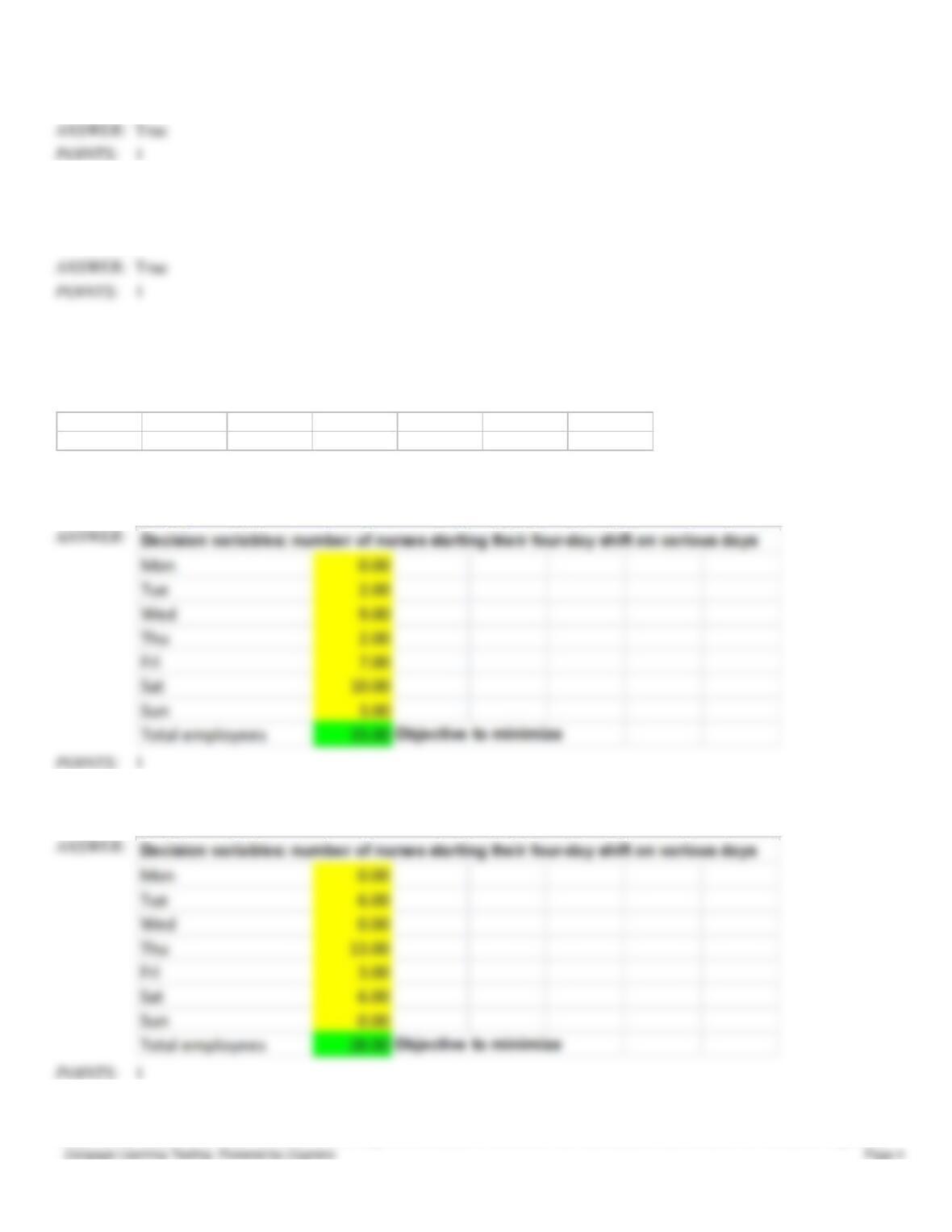
21. Refer to Exhibit 4-1. Use Solver to formulate and solve the hospital’s problem.
1
22. Refer to Exhibit 4-1. Suppose the hospital is experiencing a budget crunch and needs to use the nurses’ on call day to
temporarily staff the emergency room. Use Solver to formulate and solve the hospital’s problem.
1
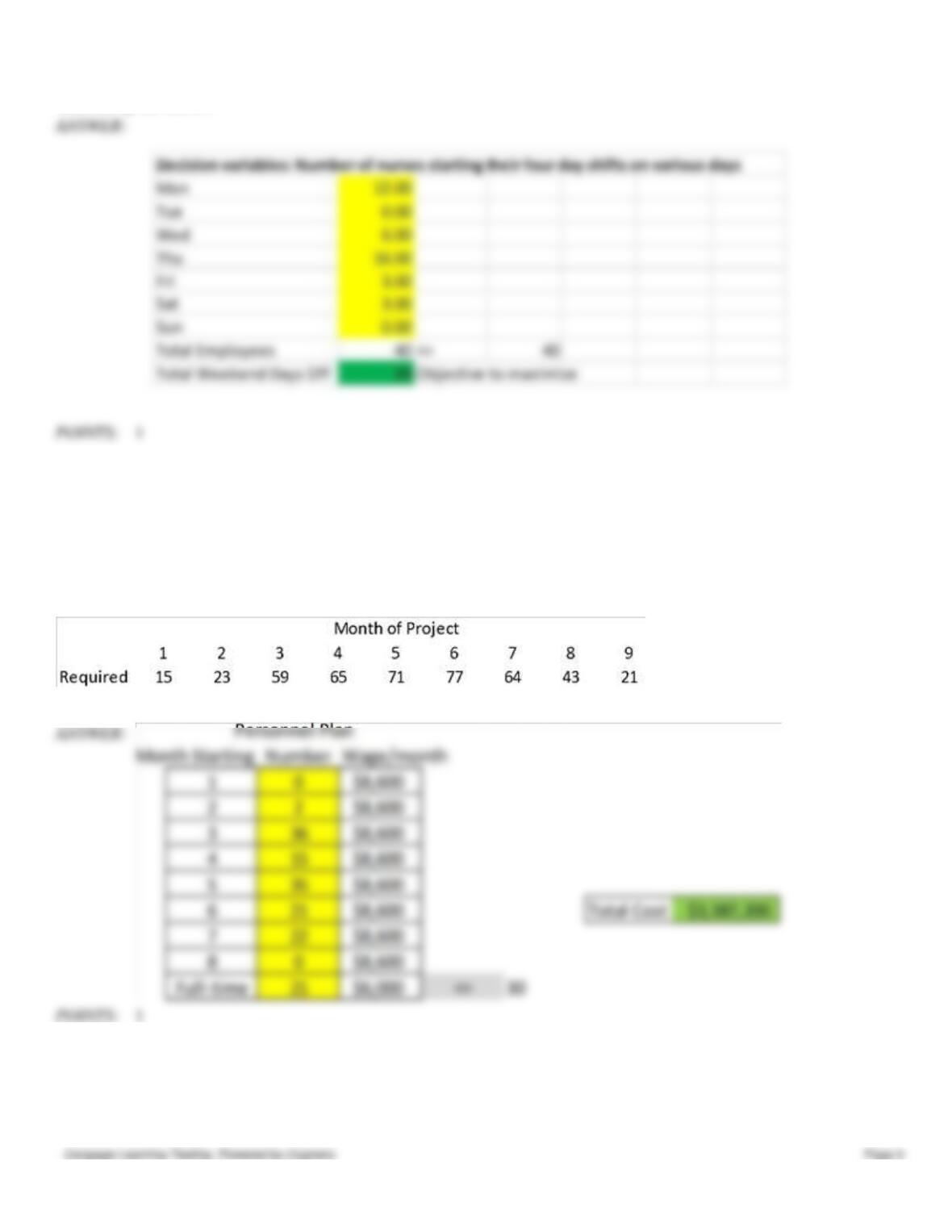
23. Refer to Exhibit 4-1. Suppose the hospital has 40 nurses and is not allowed to hire or fire any employees, and cannot
temporarily schedule nurses on their on call days. Determine a schedule that maximizes the number of weekend days off
Chapter 4 – Linear Programming Models
received by the nurses.
Exhibit 4-2
A construction company is preparing for a nine-month project, and will need to develop a staffing plan. The company can
assign up to 30 of its own full-time employees to the project, and will hire short-term contract employees to make up any
shortage in meeting the personnel requirements. Company employees earn $6,000 per month, while short-term contract
employees make $8,600/month. Contract employees can be assigned to the project beginning in any month, and their
contract period is two months. The number of workers required for the project by month is shown below:
24. Refer to Exhibit 4-2. Determine the optimal staffing plan for the project.
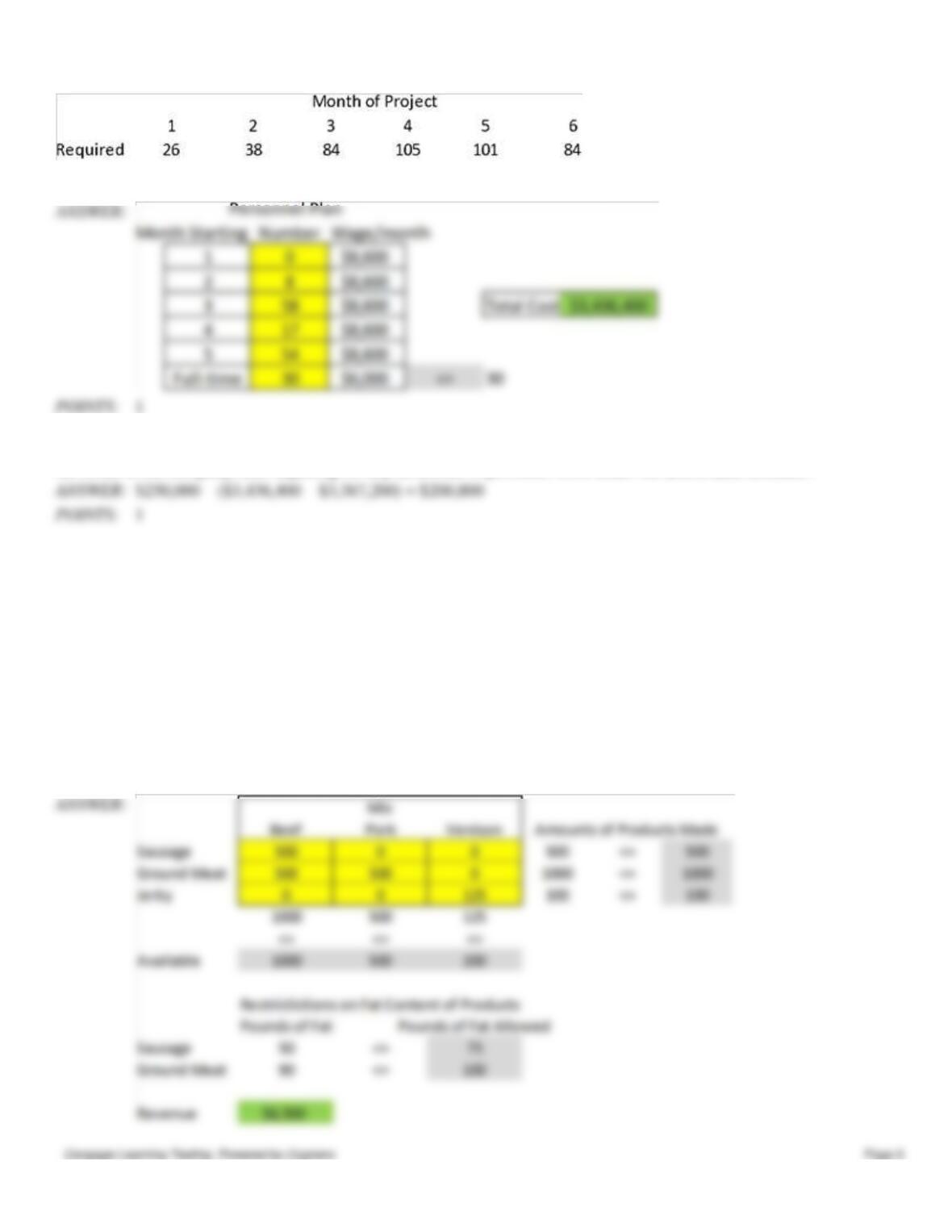
25. Refer to Exhibit 4-2. The project manager is evaluating options to complete the project early so that the company can
earn a bonus. He has determined that the project schedule can be compressed into a six-month schedule, with the same
total number of worker-months. In that case, the staffing requirements are as shown below.
Chapter 4 – Linear Programming Models
Develop an optimal staffing plan for the project under the accelerated schedule.
26. Refer to Exhibit 4-2. Suppose the bonus for completing the project three months early is $250,000. What would be the
net bonus to the company, after adjusting for any difference in personnel costs under the accelerated schedule?
$250,000 − ($3,436,400 − $3,387,200) = $200,800
Exhibit 4-3
A meat market manager for a large grocery store is preparing a processing plan to stock the shelves with sausage, ground
meat, and jerky, which he can prepare from beef, pork and venison. Sausage and ground meat can be made of any mix of
the beef, pork and venison, as long at the fat contents are below 15% for sausage and 10% for ground meat. Sausage sells
for $5/pound and ground meat sells for $3/pound. Jerky, which sells or $10/pound, is made in a drying process from beef
or venison. In the drying process, there is a 50% loss in weight for jerky made from beef (e.g., one pound of beef yields
0.5 pounds of beef jerky) and a 20% loss in weight for jerky made from venison. The market can sell at most 500 pounds
of sausage, 1000 pounds of ground meat, and 100 pounds of jerky before their expiration dates. There are currently 1,000
pounds of beef (10% fat content), 500 pounds of pork (8% fat content), and 200 pounds of venison (2% fat content)
available for processing.
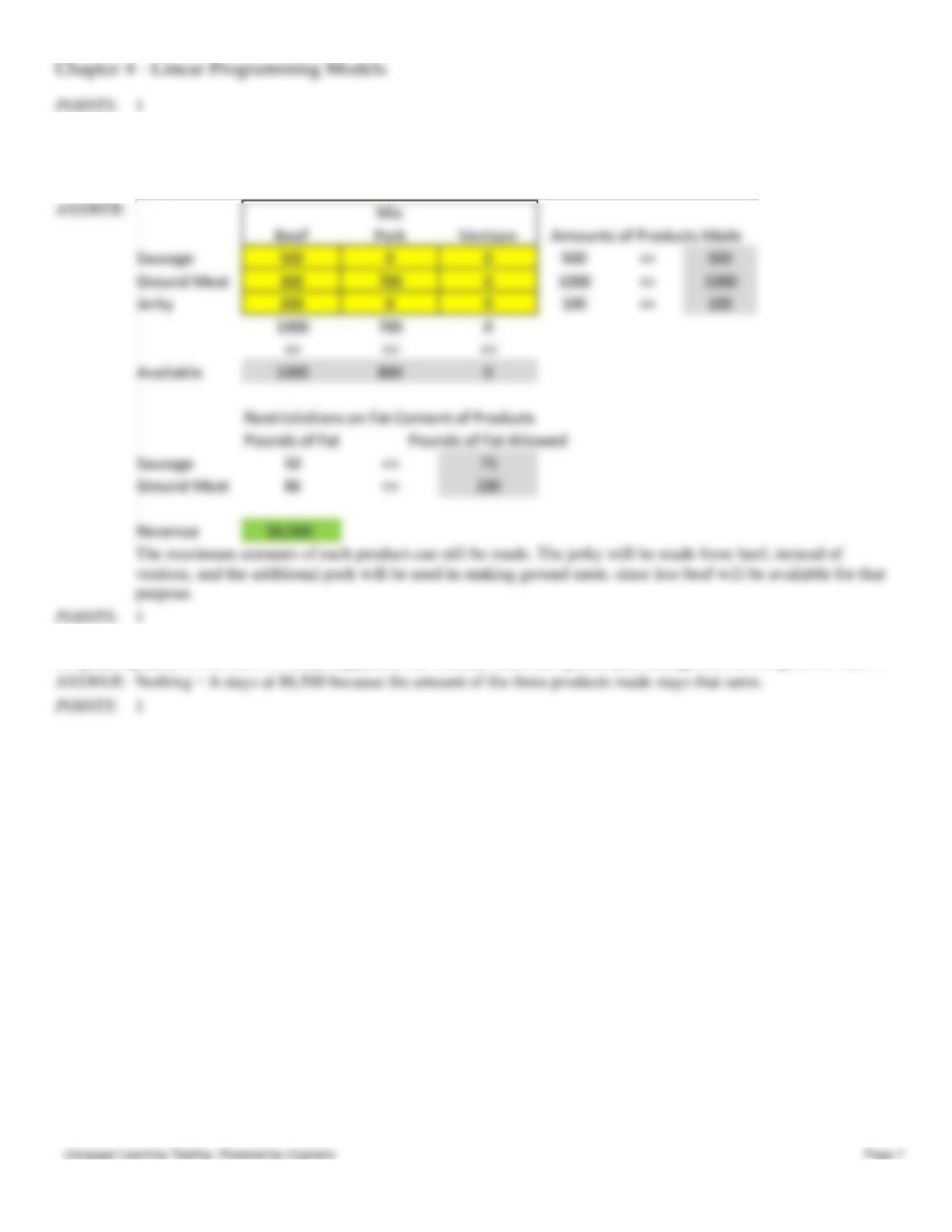
27. Refer to Exhibit 4-3. Determine the optimal processing plan for the meat market.
28. [Part 1] Refer to Exhibit 4-3. Suppose that later in the year, venison will be out of season, but the market will be able
to obtain an additional 300 pounds of pork for the same costs. Develop a processing plan in that case. How does the
solution change?
29. [Part 2] Refer to Exhibit 4-3. What happens to the revenue when the optimal plan changes to the one given in Part 1?
Nothing − it stays at $6,500 because the amount of the three products made stays that same.
Exhibit 4-4
A company blends nitrogen and phosphorous to produce two types of fertilizers. Fertilizer 1 must be at least 50% nitrogen
and sells for $55 per pound. Fertilizer 2 must be at least 55% phosphorous and sells for $45 per pound. The company can
purchase up to 9000 pounds of nitrogen at $20 per pound and up to 12,000 pounds of phosphorous at $12 per pound.
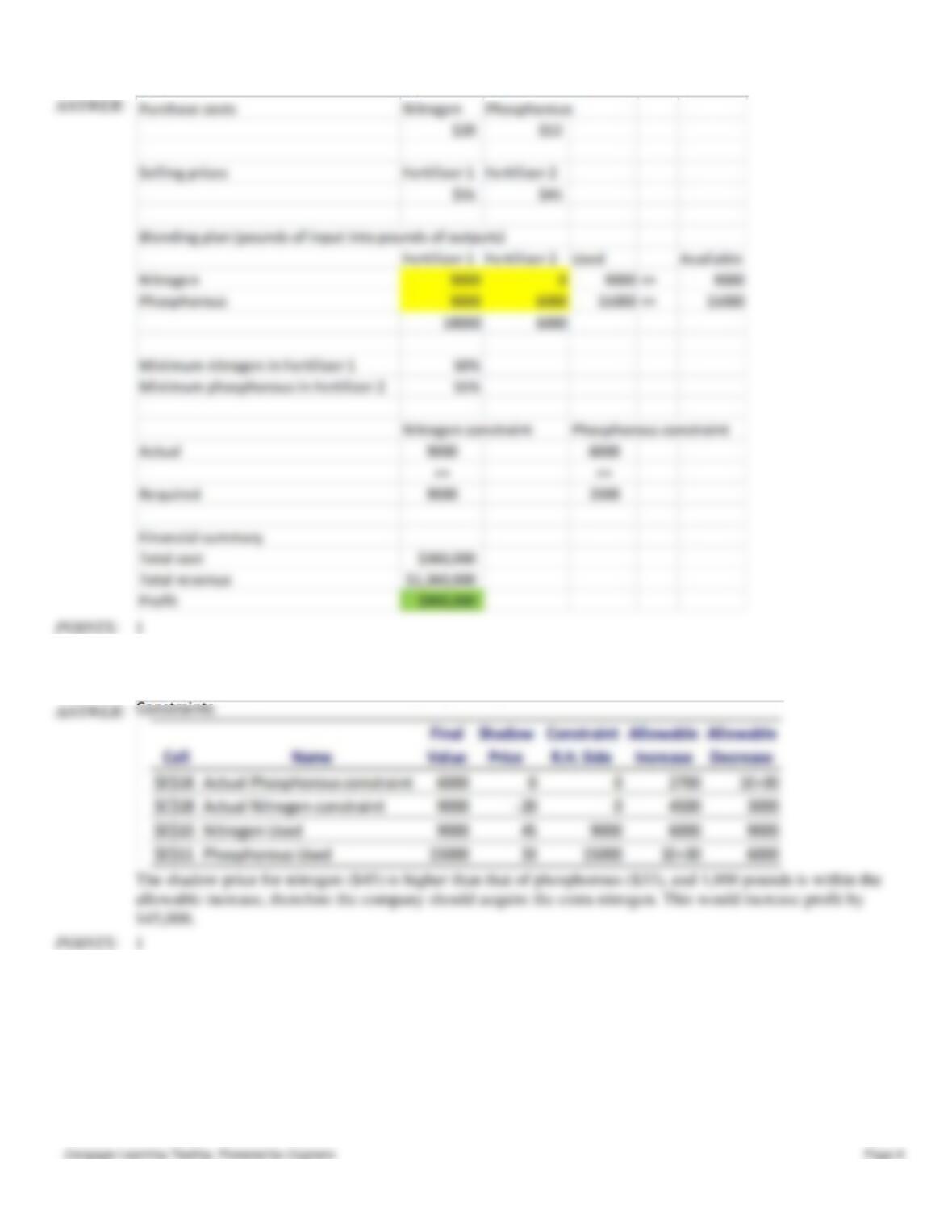
30. Refer to Exhibit 4-4. Assuming that all fertilizer produced can be sold, determine the optimal blending plan for the
company. What is the maximum profit?
Chapter 4 – Linear Programming Models
31. Refer to Exhibit 4-4. Suppose the company could acquire 1,000 pounds more of either nitrogen or phosphorous.
Which should it choose? What would be the resulting impact on profit?