1. A statistical experiment is a process that, when performed:
A) results in one and only one of two observations
B) results in at least two of many observations
C) may not lead to the occurrence of any outcome
D) results in one and only one of many observations
2. A sample point is
A) a collection of many sample spaces
B) a point that represents a population in a sample
C) an element of a sample space
D) a collection of observations
3. An event
A) is the same as a sample space C) includes one or more outcomes
B) includes exactly one outcome D) includes all possible outcomes
4. A simple event
A) is a collection of exactly two outcomes
B) includes one and only one outcome
C) does not include any outcome
D) includes all possible outcomes
5. A compound event includes
A) at least three outcomes C) one and only one outcome
B) at least two outcomes D) all outcomes of an experiment
6. The experiment of tossing a coin 3 times has
A) 2 outcomes B) 8 outcomes C) 6 outcomes D) 5 outcomes
Chapter 4
7. A box contains a few red, a few black, and a few white marbles. Two marbles are
randomly drawn from this box and the color of these marbles is observed. The total
number of outcomes for this experiment is
A) 3
B) 6
C) 9
D) you can’t tell until you know exactly how many marbles are in the box
8. You randomly select two households and observe whether or not they own a telephone
answering machine. Which of the following is a simple event?
A) Exactly one of them owns a telephone answering machine.
B) At least one of them owns a telephone answering machine.
C) At most one of them owns a telephone answering machine.
D) Neither of the two owns a telephone answering machine.
9. You toss a coin nine times and observe 3 heads and 6 tails. This event is a:
A) compound event C) multiple outcome
B) simple event D) multinomial sample point
10. The probability of an event is always
A) greater than zero C) between 0 and 1, inclusive
B) less than 1 D) greater than 1
11. According to the relative frequency concept of probability, the probability of an event is
A) 1 divided by the total number of outcomes for the experiment
B) the number of times the given event is observed divided by the total number of
repetitions of the experiment
C) the number of outcomes favorable to the given event divided by the sample space
D) the sample space divided by the number of outcomes favorable to the given event
12. You select one person from a group of eight males and two females. The two events “a
male is selected” and “a female is selected” are
A) independent C) not equally likely
B) equally likely D) collectively exhaustive
Chapter 4
13. Which of the following values cannot be the probability of an event?
A) 0.33 B) 2.47 C) 0.25 D) 1.00
14. A conditional probability is a probability
A) of a sample space based on a certain condition
B) that an event will occur given that another event has already occurred
C) that an event will occur based on the condition that no other event is being
considered
D) that an event will occur based on the condition that no other event has already
occurred
15. A marginal probability is a probability of
A) a sample space
B) an outcome when another outcome has already occurred
C) an event without considering any other event
D) an experiment calculated at the margin
16. Two mutually exclusive events
A) always occur together
B) can sometimes occur together
C) cannot occur together
D) can occur together, provided one has already occurred
17. Two events are independent if the occurrence of one event
A) affects the probability of the occurrence of the other event
B) does not affect the probability of the occurrence of the other event
C) means that the second event cannot occur
D) means that the second event is certain to occur
Chapter 4
18. Two complementary events
A) taken together do not include all outcomes for an experiment
B) taken together include all outcomes for an experiment
C) can occur together
D) are always independent
19. Two events A and B are independent if
A) P(A) is equal to P(B) C) P(A|B) is equal to P(A)
B) P(B|A) is equal to P(A) D) P(A|B) is equal to P(B)
20. If
( ) ( ) ( )P A B P A P B=
, then events A and B are
A) complementary B) mutually exclusive C) independent D) subjective
Use the following to answer questions 21-26:
The following table gives the two-way classification of 500 students based on sex and whether or
not they suffer from math anxiety.
Suffer From Math Anxiety
Sex
Yes
No
Male
167
73
Female
168
92
21. If you randomly select one student from these 500 students, the probability that this
selected student is a female is: (round your answer to three decimal places, so 0.0857
would be 0.086)
22. If you randomly select one student from these 500 students, the probability that this
selected student suffers from math anxiety is: (round your answer to three decimal places,
so 0.0857 would be 0.086)
Chapter 4
23. If you randomly select one student from these 500 students, the probability that this
selected student suffers from math anxiety, given that he is a male is: (round your answer
to three decimal places, so 0.0857 would be 0.086)
24. If you randomly select one student from these 500 students, the probability that this
selected student is a female, given that she does not suffer from math anxiety is: (round
your answer to three decimal places, so 0.0857 would be 0.086)
25. Which of the following pairs of events are mutually exclusive?
A) Female and male D) Male and no
B) Female and no E) Male and yes
C) Female and yes F) No and yes
26. Are the events “Has math anxiety” and “Person is female” independent or dependent?
Detail the calculations you performed to determine this.
27. In a group of 88 students, 16 are seniors. If you select one student randomly from this
group, the probability (rounded to three decimal places) that this student is a senior is:
28. In a group of 436 families, 259 own homes. If you select one family randomly from this
group, the probability (rounded to three decimal places) that this family owns a house is:
Chapter 4
29. You roll an unbalanced die 850 times, and a 3-spot is obtained 148 times. The probability
(rounded to three decimal places) of not obtaining a 3-spot for this die is approximately:
30. A quality control staff selects 192 items from the production line of a company and finds
21 defective items. The probability (rounded to three decimal places) that an item
manufactured by this company is not defective is:
Use the following to answer questions 31-44:
A pollster asked 1000 adults whether Republicans or Democrats have better domestic economic
policies. The following table gives the two-way classification of there opinions.
Sex
Republicans
Democrats
No Opinion
Male
205
350
39
Female
185
190
31
The pollster then randomly selected one adult from these 1,000 adults.
31. The probability that the selected adult is a male is: (round your answer to three decimal
places)
32. The probability that the selected adult says Democrats have better domestic economic
policies is: (round your answer to three decimal places)
33. The probability that the selected adult is a female given that she thinks that Republicans
have better domestic economic policies is approximately (round your answer to three
decimal places):
Chapter 4
34. The probability that the selected adult has no opinion given that he is a male is
approximately (round your answer to three decimal places):
35. Which of the following pairs of events are mutually exclusive?
A) Female and democrat D) Democrat and no opinion
B) Female and male E) Male and republican
C) Female and republican F) Male and no opinion
36. Are the events “Democrat” and “Female” independent or dependent? Detail the
calculations you performed to determine this.
37. The joint probability (rounded to three decimal places) of events “Republicans” and
“Male” is:
38. The probability (rounded to three decimal places) that a randomly selected adult from
these 1,000 adults is a female and holds the opinion that Democrats have better domestic
policies is:
39. The joint probability (rounded to three decimal places) of events “Male” and “No
Opinion” is:
Chapter 4
40. The joint probability (rounded to three decimal places) of events “Republicans” and
“Democrats” is:
41. The probability that the selected adult has no opinion is: (Round your answer to 2
decimal places.)
42. The probability (rounded to three decimal places) that the selected adult is a female or
thinks that Democrats have better domestic economic policies is:
43. The probability (rounded to three decimal places) that the selected adult has no opinion or
is a male is:
44. The probability that this adult is a male or doesn’t think that Democrats have better
domestic economic policies is: (Round your answer to 3 decimal places.)
45. The intersection of two events A and B is made up of the outcomes that are:
A) either in A or in B or in both A and B C) either in A or in B, but not both
B) common to both A and B D) not common to both A and B
46. The probability of the intersection of two events A and B is given by:
A)
( ) ( )P A P B+
C)
( ) ( | )P A P A B
B)
( ) ( ) ( and )P A P B P A B+−
D)
( ) ( | )P A P B A
Chapter 4
47. The joint probability of two independent events A and B is:
A)
( ) ( )P A P B+
C)
()()P A P B
B)
( ) ( ) ( or )P A P B P A B++
D)
( ) ( | )P A P A B
48. The joint probability of two mutually exclusive events is always equal to (rounded to one
decimal place)
49. In a class of 49 students, 11 are math majors. The teacher selects two students at random
from this class. The probability (to three decimal places) that both of them are math
majors is:
50. The athletic department of a school has 12 full-time coaches, and 4 of them are female.
The director selects two coaches at random from this group. The probability (to three
decimal places) that neither of them is a female is:
51. The probability that a physician is a pediatrician is 0.16. The administration selects two
physicians at random. The probability (rounded to three decimal places) that none of
them is a pediatrician is:
52. The probability that an adult possesses a credit card is 0.71. A researcher selects two
adults at random. The probability (rounded to three decimal places) that the first adult
possesses a credit card and the second adult does not possess a credit card is:
Chapter 4
53. The probability that a physician is a pediatrician is 0.24. The administration selects three
physicians at random. The probability (rounded to three decimal places) that exactly two
of them are pediatricians is:
54. The probability that an adult possesses a credit card is 0.77. A researcher selects four
adults at random. The probability (rounded to three decimal places) that three of the four
adults possess a credit card is:
55. The probability that a person is a college graduate is 0.34 and that he/she has high blood
pressure is 0.13. Assuming that these two events are independent, the probability (to four
decimal places) that a person selected at random is a college graduate and has high blood
pressure is
56. The probability that a person is a college graduate is 0.40 and that he/she has high blood
pressure is 0.18. Assuming that these two events are independent, the probability (to four
decimal places) that a person selected at random is a college graduate or has high blood
pressure is
57. The probability that a corporation made profits in 2005 is 0.80 and the probability that a
corporation made charitable contributions in 2005 is 0.25. Assuming that these two
events are independent, the probability (rounded to 4 decimal places) that a corporation
made profits in 2005 and made charitable contributions in 2005 is:
58. The probability that a corporation made profits in 2005 is 0.78 and the probability that a
corporation made charitable contributions in 2005 is 0.23. Assuming that these two
events are independent, the probability (rounded to 4 decimal places) that a corporation
made profits in 2005 or made charitable contributions in 2005, but not both is:
Chapter 4
59. The probability that an employee of a company is a male is 0.65 and the joint probability
that an employee of this company is a male and single is 0.23. The probability (rounded
to three decimal places) that a randomly selected employee of this company is single
given he is a male is:
60. The probability that a farmer is in debt is 0.76. The joint probability that a farmer is in
debt and lives in the Midwest is 0.21. The probability (rounded to three decimal places)
that a randomly selected farmer lives in the Midwest, given that he is in debt is:
61. The total number of outcomes for 3 rolls of a 9-sided die is:
62. A woman owns 15 blouses, 10 skirts, and 4 pairs of shoes. She will randomly select one
blouse, one skirt, and one pair of shoes to wear on a certain day. The total number of
possible outcomes is:
63. The union of two events A and B represents the outcomes that are:
A) either in A or in B or in both A and B C) neither in A nor in B
B) common to both A and B D) not common to both A and B
64. The probability of the union of two events A and B is the probability that:
A) neither event A happens nor event B happens
B) both events do not happen together
C) both events A and B happen together
D) either event A or event B or both A and B happen
Chapter 4
65. The probability of the union of two events A and B is:
A)
( ) ( ) ( or )P A P B P A B++
C)
( ) ( | )P A P B A
B)
( ) ( ) ( or )P A P B P A B+−
D)
( ) ( | )P A P A B
66. The probability of the union of two events A and B, that are mutually exclusive, is:
A)
( ) ( )P A P B+
C)
( ) ( | )P A P A B
B)
( ) ( ) ( and )P A P B P A B−+
D)
( ) ( | )P A P B A
67. The probability that a student at a university is a male is 0.52, that a student is a business
major is 0.17, and that a student is a male and a business major is 0.08. The probability
that a randomly selected student from this university is a male or a business major is:
68. The probability that a family has at least one child is 0.79, that a family owns a
camcorder is 0.19, and that a family has at least one child and owns a camcorder is 0.07.
The probability that a randomly selected family has at least one child or owns a
camcorder is:
69. 44% of the voters are in favor of limiting the number of terms for senators and
congressmen, 36% are against it, and 20% have no opinion. If a pollster selects one voter
at random, the probability (to two decimal places) that this voter is either in favor of
limiting the number of terms for senators and congressmen or has no opinion is:
70. A company has a total of 575 male employees. Of them, 134 are single, 276 are
married, 122 are either divorced or separated, and 43 are widowers. If management
selects one male employee at random from the company, the probability (rounded to
three decimal places) that this employee is married or a widower is:
Chapter 4
Use the following to answer questions 71-73:
A consume researcher inspects 300 batteries manufactured by two companies for being good or
defective. The following table gives the two-way classification of these 300 batteries.
Good
Defective
Company A
148
2
Company B
122
28
71. If the researcher selects one battery at random from these 300 batteries, the probability
(rounded to three decimal places) that this battery is good or made by company B is
72. If the researcher selects one battery at random from these 300 batteries, the probability
(rounded to three decimal places) that this battery is defective or made by company A is
73. If the researcher selects one battery at random from these 300 batteries, the probability
(rounded to three decimal places) that this battery is good or made by company A is
74. The probability that a person drinks at least five cups of coffee per day is 0.31, and the
probability that a person has high blood pressure is 0.09. Assuming that these two events
are independent, find the probability (to four decimal places) that a person selected at
random drinks less than five cups of coffee per day and has high blood pressure.
75. The probability that a person drinks at least five cups of coffee per day is 0.30, and the
probability that a person has high blood pressure is 0.09. Assuming that these two events
are independent, find the probability (to four decimal places) that a person selected at
random drinks less than five cups of coffee per day or has high blood pressure.
Chapter 4
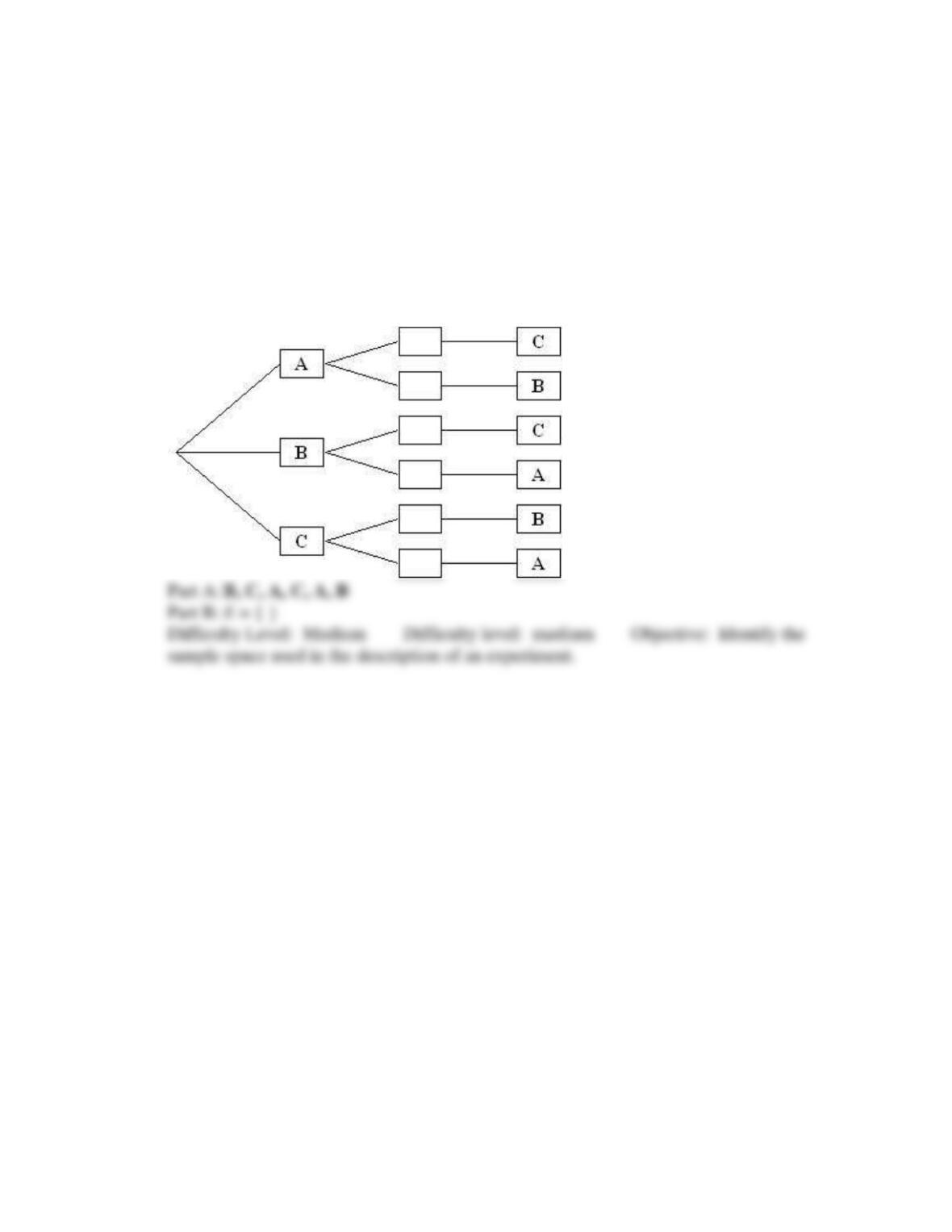
76. Friends will be called, one after another, and asked to go on a weekend trip with you.
You will call until one agrees to go (A) or four friends are asked. What is the tree
diagram for the sample space for this experiment?
A)
B)
C)
D)
Chapter 4
Page 15
77. Pioneer Of The Nile (A), I Want Revenge (B), and Hold Me Back (C), were the three
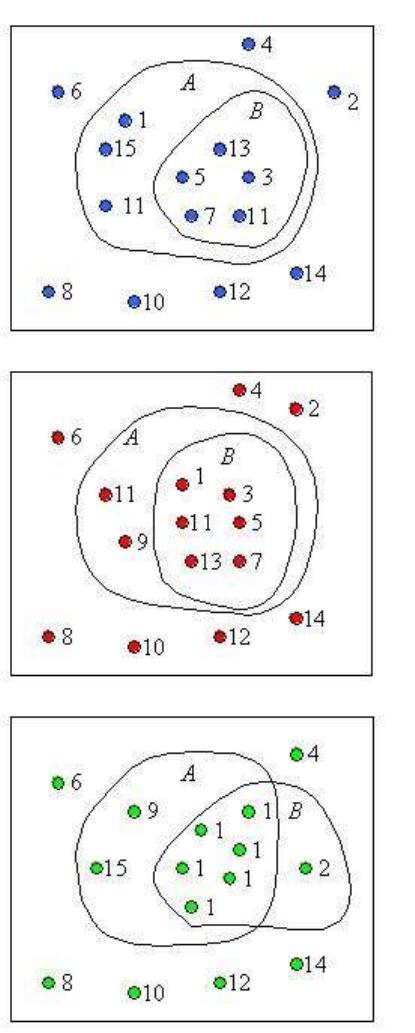
favorites to win the Kentucky Derby. According to an expert, they should arrive first,
second and third, respectively.
The tree diagram for the sample space is given below.
A) Complete the tree diagram from top to bottom
B) State the composition of the event E = [exactly two horses arrived in the predicted
place]
Chapter 4
Page 16
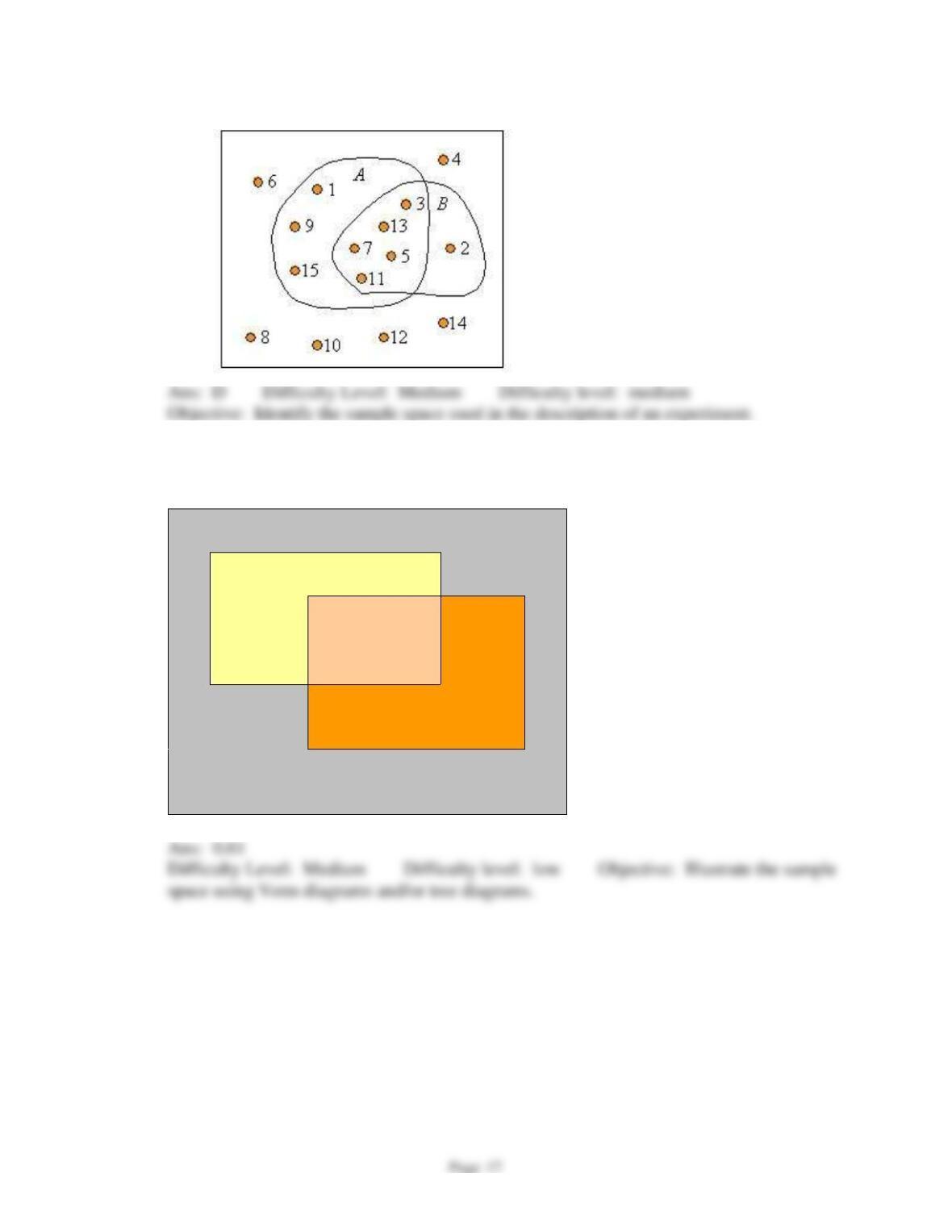
78. The sample space is given by the first 15 positive integers.
Consider the events:
A = [odd integers] B = [prime integers]
Make a Venn diagram showing these events.
A)
B)
C)
Chapter 4
D)
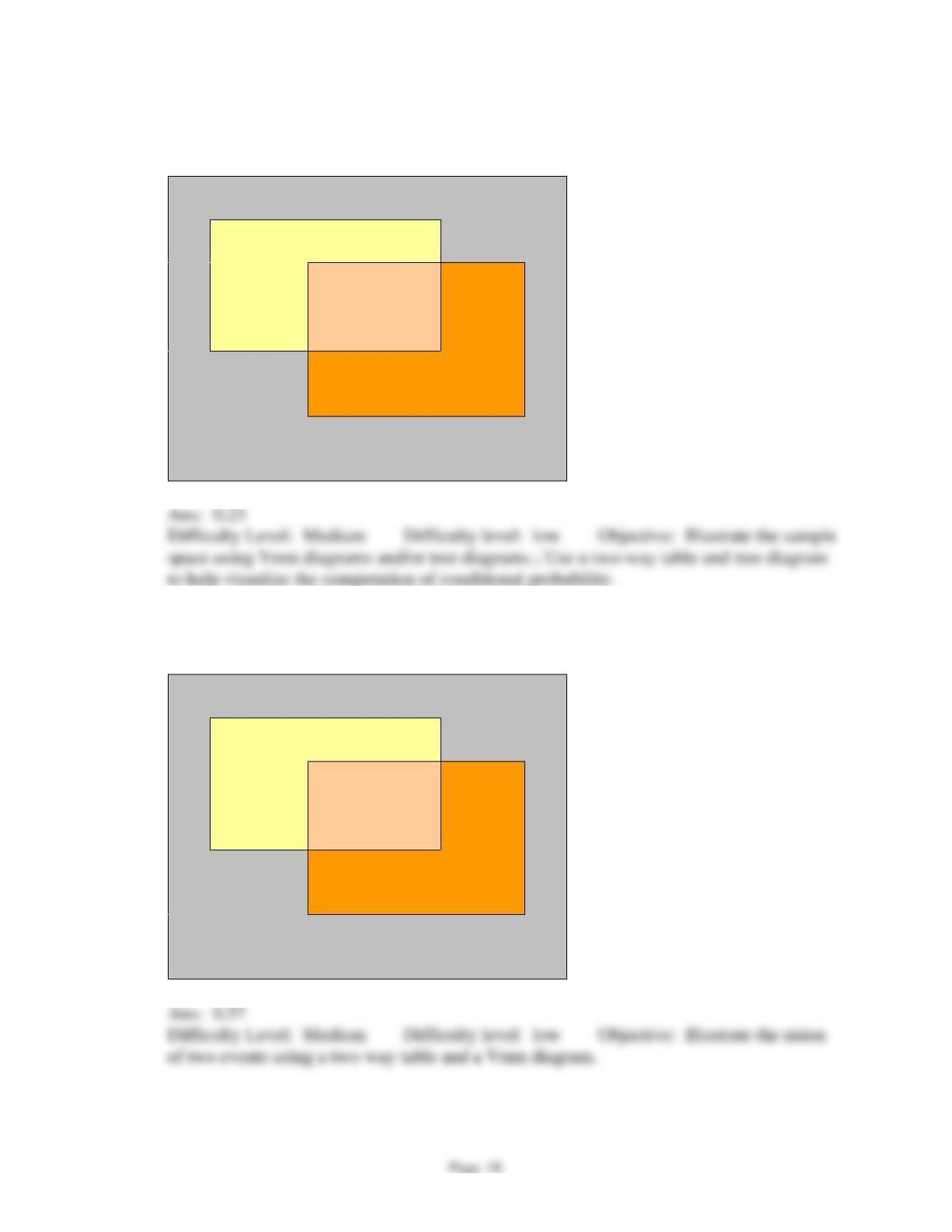
79. From the probabilities shown in this Venn diagram, determine the probability A does not
occur.
A
B
0.16
0.23
0.44
0.17
Chapter 4
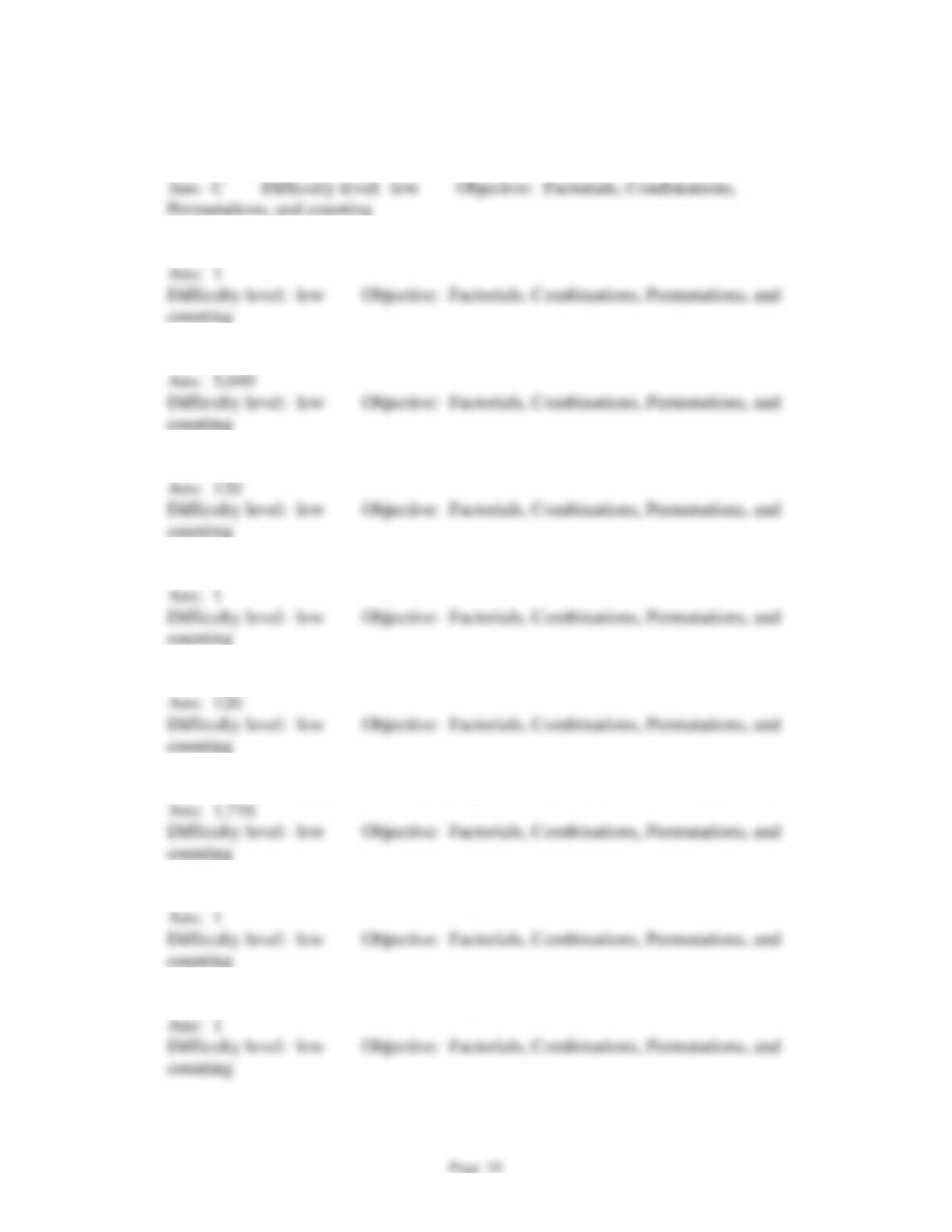
80. From the probabilities shown in this Venn diagram, determine the probability that A
occurs and B does not occur.
A
B
0.23
0.18
0.42
0.17
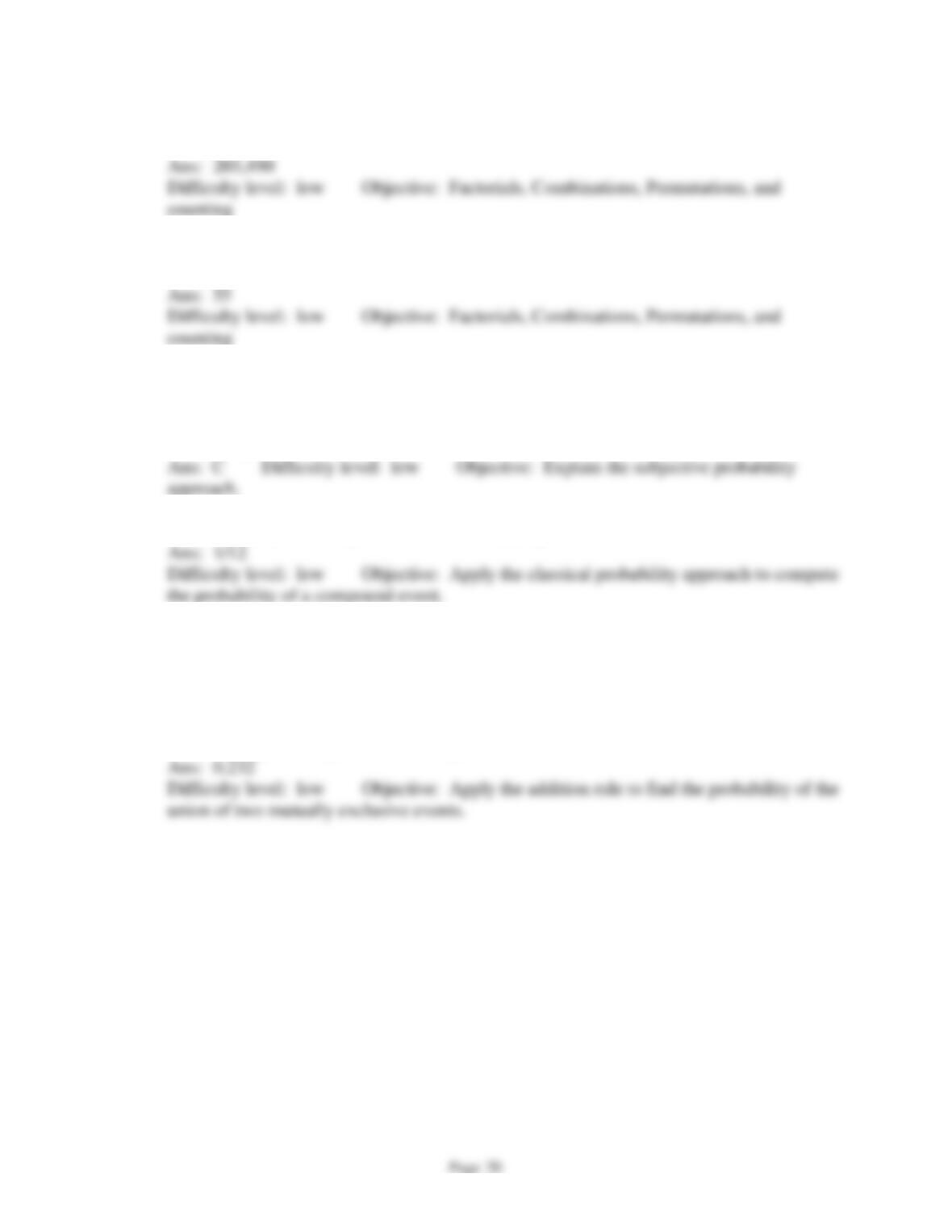
81. From the probabilities shown in this Venn diagram, determine the probability that exactly
one of the events A and B occurs.
A
B
0.02
0.21
0.55
0.22
Chapter 4
82. In general, “n factorial” represents:
A) the product of any n numbers C) the product of all integers from n to 1
B) the sum of all integers from n to 1 D) n-1
83. The factorial of zero is:
84. The factorial of 7 is:
85. The factorial of (13 – 8) is:
86. The factorial of (14 – 14) is:
87. The factorial of (5 – 0) is:
88. The number of combinations for selecting 6 elements from 13 distinct elements is:
89. The number of combinations for selecting zero elements from 9 distinct elements is:
90. The number of combinations for selecting 7 elements from 7 distinct elements is:
Chapter 4
91. A court randomly selects a jury of 8 persons from a group of 21 persons. The total
number of combinations is:
92. An investor randomly selects 9 stocks from 11 stocks for an investment portfolio. The
total number of combinations is:
93. When a person makes an educated guess about the likelihood that an event will occur, it
is an example of
A) conditional probability. C) subjective probability.
B) marginal probability. D) classical probability.
94. The probability of rolling a 1 on a die and flipping heads on a coin at the same time is:
95. Given the table.
Yes
No
Maybe
Male
0.097
0.135
0.293
Female
0.165
0.159
0.151
What is the probability that a randomly selected Male will answer “Yes” or “No”?