Introduction to General, Organic & Biological Chemistry, 12e (Timberlake)
Chapter 4 Atoms and Elements
4.1 Multiple-Choice Questions
1) The primary substances of which all other things are composed are ________.
A) molecules
B) compounds
C) elements
D) electrons
E) protons
2) Au is the symbol for ________.
A) gold
B) silver
C) argon
D) aluminum
E) sodium
3) aluminum
A) Al
B) Am
C) Au
D) Sn
E) Ag
4) iron
A) Ir
B) Fs
C) Fe
D) In
E) FE
5) sodium
A) So
B) Na
C) No
D) Sm
E) Au
6) mercury
A) Mr
B) Na
C) Au
D) Hg
E) Ag
7) potassium
A) P
B) Po
C) Pt
D) K
E) Ko
8) silver
A) S
B) Si
C) Ag
D) Au
E) AG
9) gold
A) Go
B) Hg
C) Ag
D) Au
E) AU
10) Ca is the symbol for
A) calcium.
B) carbon.
C) cobalt.
D) copper.
E) cadmium.
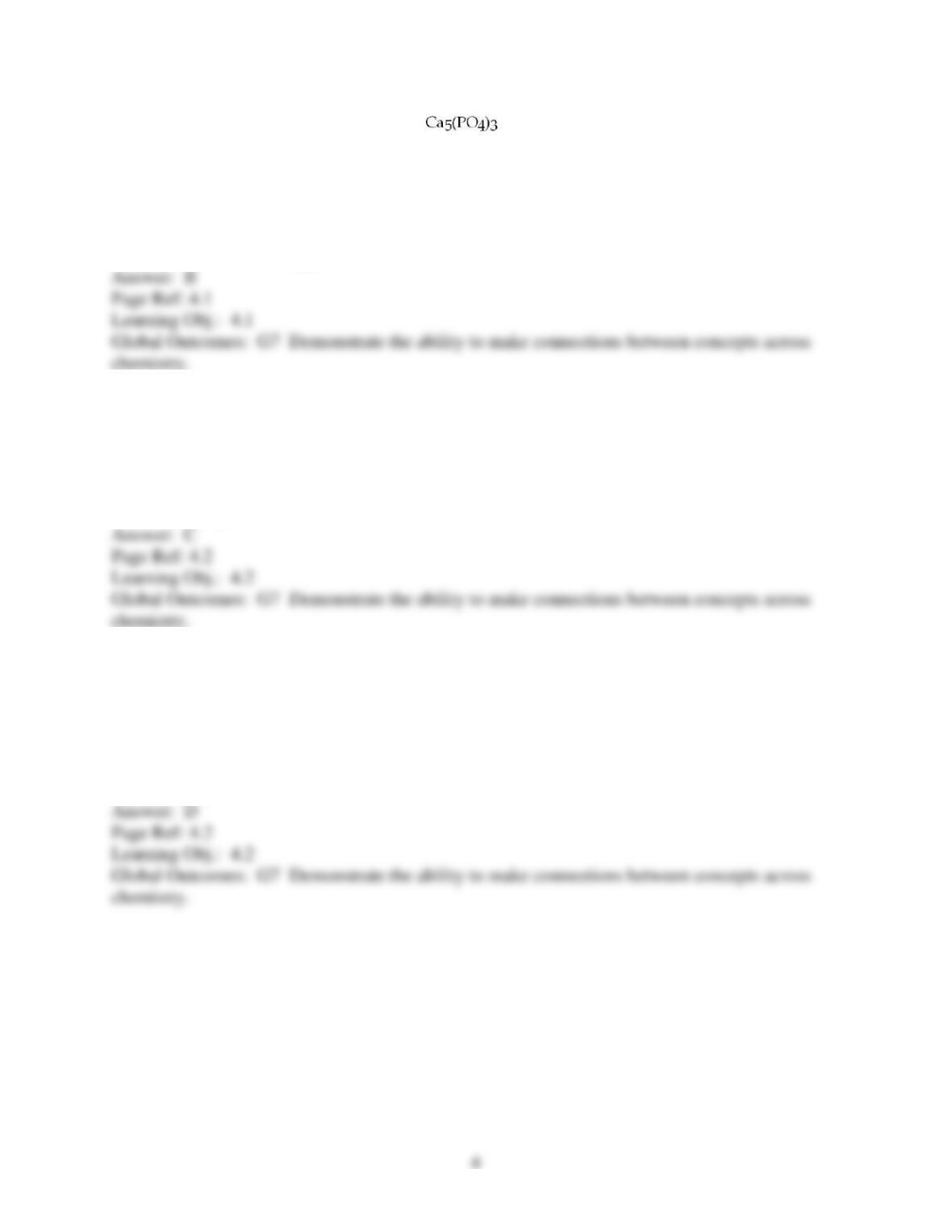
11) What elements are in hydroxyapatite, OH, a major compound in human bones and
teeth?
A) carbon, potassium, oxygen, hydrogen
B) calcium, phosphorous, oxygen, hydrogen
C) carbon, phosphorous, oxygen, helium
D) calcium, phosphorous, oxygen, helium
E) carbon, potassium, oxygen, helium
12) Which of the following is a characteristic of the modern periodic table?
A) A group is a horizontal row on the periodic table.
B) A period is a column on the periodic table.
C) The elements in each group have similar chemical properties.
D) The B groups contain the representative elements.
E) The A groups contain the transition elements.
13) Which of the following properties is not a characteristic of the Group 1A (1) elements (alkali
metals)?
A) They are shiny.
B) They are good conductors of heat.
C) They react vigorously with water.
D) Most of them are liquids at room temperature.
E) They are good conductors of electricity.
14) The Group 8A (18) elements ________.
A) are unreactive and are rarely found in combination with other elements
B) are good conductors of electricity
C) melt at high temperatures
D) are liquids at room temperature
E) react vigorously with water
15) Which of the following elements is a metal?
A) nitrogen
B) fluorine
C) argon
D) strontium
E) phosphorus
16) Which of the following elements is a nonmetal?
A) nitrogen
B) sodium
C) iron
D) silver
E) calcium
17) Which of the following elements is a metalloid?
A) nitrogen
B) lithium
C) iron
D) gold
E) silicon
18) Which of the following is a characteristic of nonmetals?
A) shiny
B) malleable
C) good conductors of heat
D) low melting points
E) good conductors of electricity
19) Which of the following elements is a noble gas?
A) oxygen
B) chlorine
C) bromine
D) argon
E) nitrogen
20) The elements lithium, sodium, and potassium ________.
A) are isotopes of each other
B) are in the same period of elements
C) have the same number of neutrons
D) are in the same group
E) have the same mass number
21) The elements sodium, magnesium, and silicon ________.
A) are isotopes of each other
B) are in the same period of elements
C) have the same number of neutrons
D) are in the same group
E) have the same mass number
22) Which element would have physical and chemical properties similar to chlorine?
A) Ar
B) Br
C) S
D) O
E) P
23) What is the symbol of the element in Group 4A (14) and Period 2?
A) Be
B) Mg
C) Ca
D) C
E) Si
24) The element in this list with chemical properties similar to magnesium is ________.
A) sodium
B) boron
C) carbon
D) strontium
E) chlorine
25) Identify the noble gas in the following list.
A) helium
B) nitrogen
C) oxygen
D) gold
E) chlorine
26) Semiconductors are located in the periodic table on (or in) the ________.
A) left side of the table
B) right side of the table
C) line dividing metals from nonmetals in the table
D) first period of the table
E) last period of the table
27) Identify the metalloid in the following list.
A) sulfur
B) fluorine
C) silver
D) copper
E) germanium
28) The smallest particle of an element that retains the characteristics of the element is a(n)
________.
A) electron
B) neutron
C) proton
D) atom
E) nucleus
29) According to the atomic theory, ________.
A) all atoms are different
B) atoms are neither created nor destroyed during a chemical reaction
C) atoms of the same element combine to form compounds
D) all matter is made up of tiny particles called electrons
E) a compound can contain different numbers of atoms as long as it has the same kinds of atoms
30) Which of the following descriptions of a subatomic particle is correct?
A) A proton has a positive charge and a mass of approximately 1 amu.
B) An electron has a negative charge and a mass of approximately 1 amu.
C) A neutron has no charge and its mass is negligible.
D) A proton has a positive charge and a negligible mass.
E) A neutron has a positive charge and a mass of approximately 1 amu.
31) In an atom, the nucleus contains ________.
A) an equal number of protons and electrons
B) all the protons and neutrons
C) all the protons and electrons
D) only neutrons
E) only protons
32) The atomic number of an atom is equal to the number of ________.
A) nuclei
B) neutrons
C) neutrons plus protons
D) electrons plus protons
E) protons
33) The number of neutrons in an atom is equal to ________.
A) the atomic number
B) the mass number
C) the mass number + the atomic number
D) the mass number – the atomic number
E) the number of protons
34) The mass number of an atom can be calculated from ________.
A) the number of electrons
B) the number of protons plus neutrons
C) the number of protons
D) the number of electrons plus protons
E) the number of neutrons
35) What is the mass number of an atom of potassium that has 20 neutrons?
A) 15
B) 19
C) 35
D) 39
E) 59
11
36) Consider a neutral atom with 30 protons and 34 neutrons. The atomic number of the element
is ________.
A) 30
B) 32
C) 34
D) 64
E) 94
37) Consider a neutral atom with 30 protons and 34 neutrons. The mass number for this atom is
________.
A) 30
B) 32
C) 34
D) 64
E) 94
38) Consider a neutral atom with 30 protons and 34 neutrons. The number of electrons in this
atom is ________.
A) 30
B) 32
C) 34
D) 64
E) 94
39) How many protons are in an isotope of sodium with a mass number of 25?
A) 11
B) 14
C) 15
D) 25
E) 32
40) Consider an isotope of sodium with a mass number of 25. The number of neutrons in this
isotope of sodium is ________.
A) 11
B) 14
C) 16
D) 25
E) 32
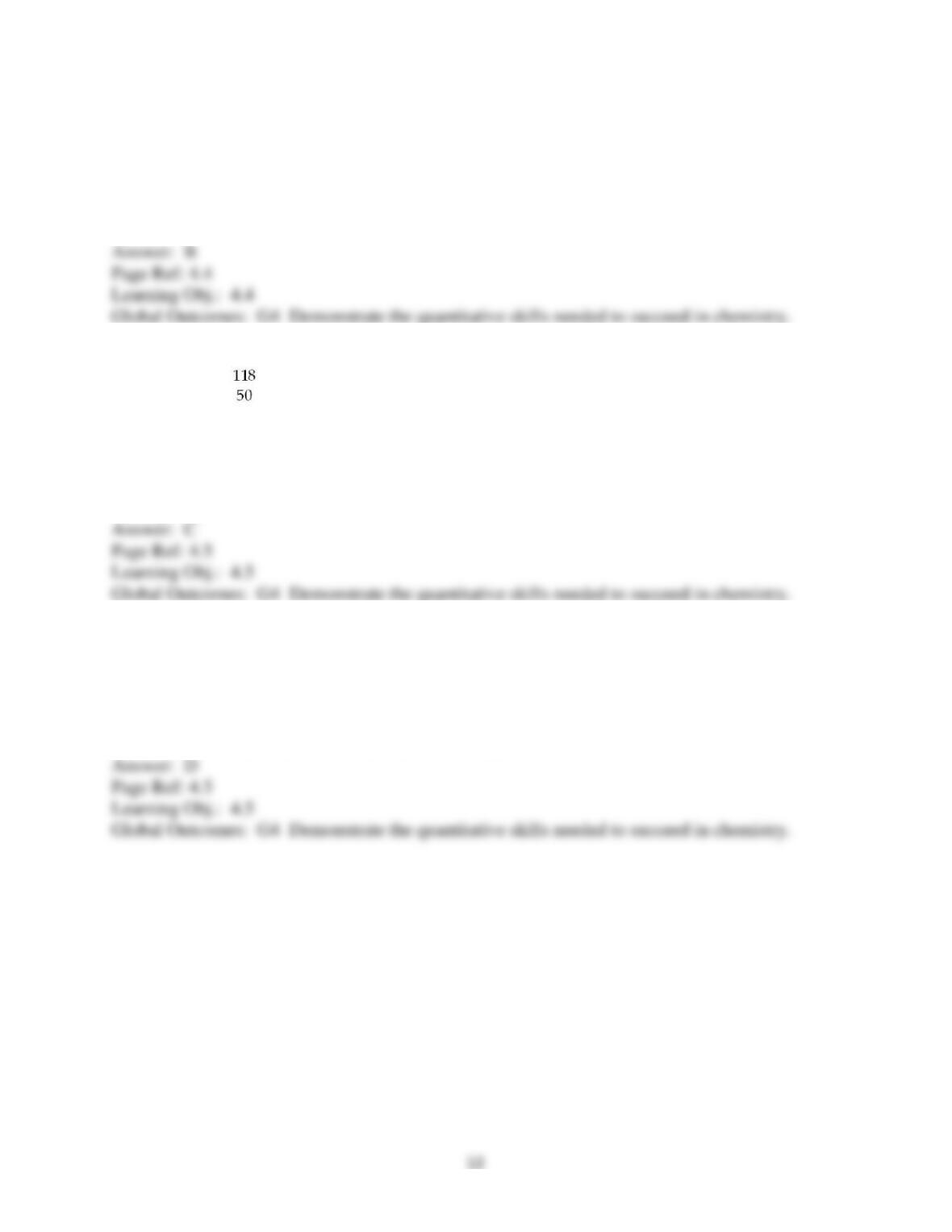
41) Which of the following gives the correct numbers of protons, neutrons, and electrons in a
neutral atom of Sn?
A) 118 protons, 50 neutrons, 118 electrons
B) 118 protons, 118 neutrons, 50 electrons
C) 50 protons, 68 neutrons, 50 electrons
D) 68 protons, 68 neutrons, 50 electrons
E) 50 protons, 50 neutrons, 50 electrons
42) Isotopes are atoms of the same element that have ________.
A) different atomic numbers
B) the same atomic numbers but different numbers of protons
C) the same atomic numbers but different numbers of electrons
D) the same atomic number but different numbers of neutrons
E) the same atomic mass but different numbers of protons
43) The correct symbol for the isotope of potassium with 22 neutrons is ________.
A) K
B) K
C) P
D) P
E) K
44) The atomic mass of an element is equal to ________.
A) its mass number
B) its atomic number
C) one-twelfth of the mass of a carbon-12 atom
D) the mass of an “average atom”
E) the mass of the heaviest isotope
45) A sample of chlorine has two naturally occurring isotopes. The isotope Cl-35 makes up
75.8% of the sample, and the isotope Cl-37 makes up 24.3% of the sample. Which of the
following statements is true?
A) The atomic mass of chlorine will be less than 35.
B) The atomic mass of chlorine will be more than 37.
C) You cannot tell what the atomic mass will be.
D) The atomic mass will be between 35 and 37.
E) The atomic mass will be 24.3.
46) Which of the following is not true for the atoms 13N, 14N, and 15N?
A) They all have the same mass number.
B) They are isotopes.
C) They all have the same atomic number.
D) They all have 7 protons.
E) They all have 7 electrons.
47) The electron arrangement of any particular atom shows ________.
A) the number of isotopes possible
B) a description of the shape of each electron energy level
C) the number of electrons in each energy level
D) a diagram of an atomic nucleus
E) the maximum number of electrons each energy level can hold
48) The maximum number of electrons that may occupy the third electron energy level is
________.
A) 2
B) 8
C) 10
D) 18
E) 32
49) What is the element with the electron arrangement 2,8,7?
A) Be
B) Cl
C) F
D) S
E) Ar
50) What is the electron arrangement for aluminum?
A) 2,8,3
B) 2,8,5
C) 2,8,7
D) 2,8,8
E) 2,8,10
51) What is the electron arrangement for potassium (atomic number 19)?
A) 2,8,9
B) 2,8,7,2
C) 2,10,7
D) 2,8,8,1
E) 2,8,6,3
52) What element has the electron arrangement 2,8,4?
A) carbon
B) oxygen
C) sulfur
D) iron
E) silicon
53) The number of electrons in the outer energy level of a neutral atom of boron (atomic number
5) is ________.
A) 2
B) 3
C) 5
D) 8
E) 10
54) What is the correct electron arrangement for the lithium atom?
A) 3
B) 3,1
C) 1,2
D) 2,1
E) 2,5
55) The number of electron energy levels in a magnesium atom is ________.
A) 1
B) 2
C) 3
D) 4
E) 5
56) The number of valence electrons found in an atom of a Group A element is equal to
________.
A) its atomic number
B) its mass number
C) its group number
D) eight
E) eight minus the group number
57) Valence electrons are electrons located ________.
A) in the outermost energy level of an atom
B) in the nucleus of an atom
C) in the innermost energy level of an atom
D) throughout the atom
E) in the first three shells of an atom
58) In an electron-dot symbol of an element, the dots are used to represent ________.
A) all of the electrons in the atom
B) the valence electrons
C) the electron arrangement
D) only the electrons that will participate in bond formation
E) the electrons that the element will gain when it forms a compound
59) How many valence electrons are in the electron-dot symbols for the elements in group 3A
(13)?
A) 1
B) 2
C) 3
D) 4
E) 6
60) The number of dots in the electron dot symbol of nitrogen is ________.
A) one
B) two
C) three
D) four
E) five
61) The number of dots in the electron dot symbol of carbon is ________.
A) one
B) two
C) three
D) four
E) five
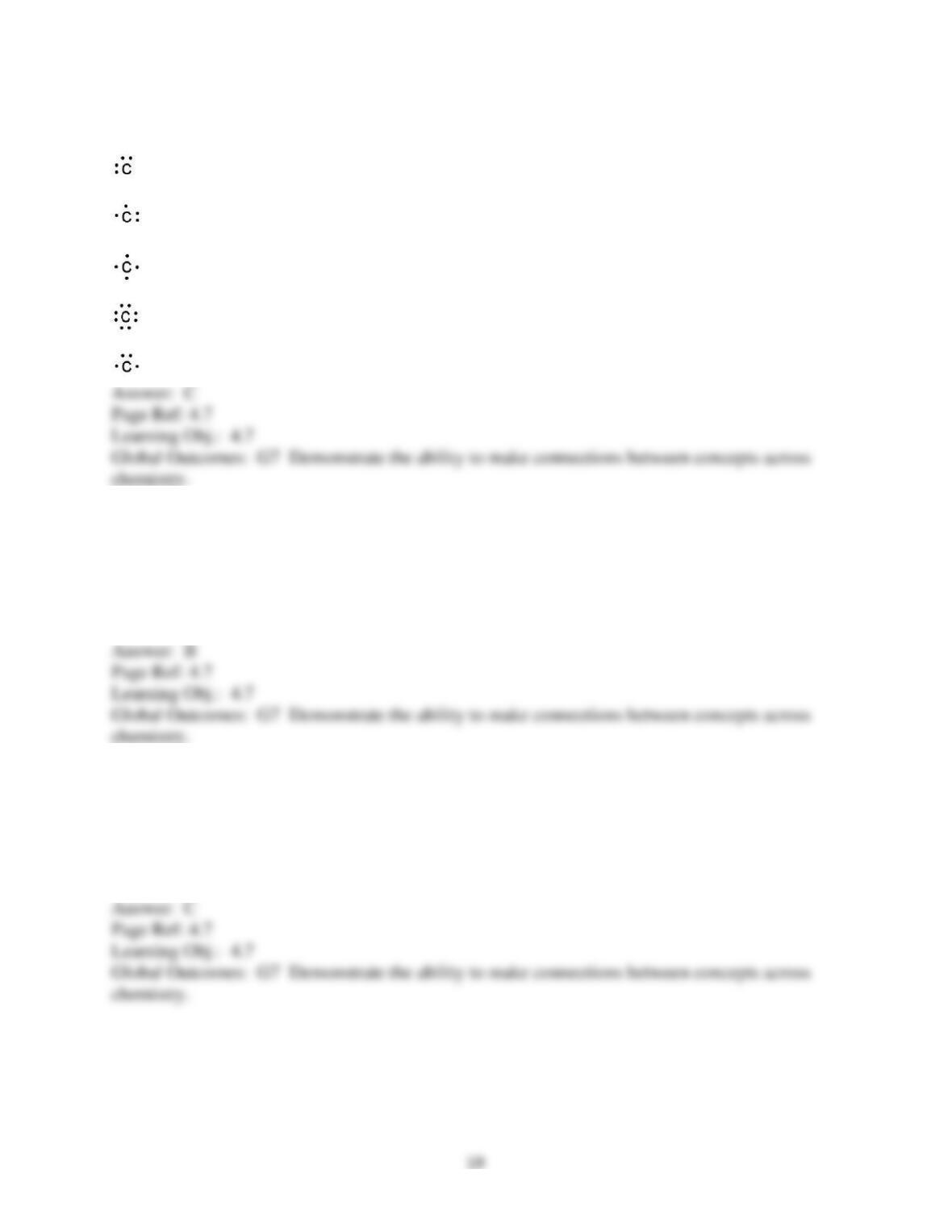
62) Which of the following is the correct electron-dot symbol for carbon?
A)
B)
C)
D)
E)
63) The atomic size of atoms ________.
A) increases going across a period
B) decreases going across a period
C) decreases going down within a group
D) does not change going across a period
E) none of the above
64) The atomic size of atoms ________.
A) increases going across a period
B) decreases going down within a group
C) increases going down within a group
D) does not change going down within a group
E) none of the above
65) The ionization energy of atoms ________.
A) decreases going across a period
B) decreases going down within a group
C) increases going down within a group
D) does not change going down within a group
E) none of the above
66) Ionization energy is ________.
A) the energy an ion acquires from an electron
B) the energy needed to remove the least tightly bound electron
C) highest for metals in Group 1A (1)
D) higher for potassium than for lithium
E) none of the above
67) The metallic character of elements ________.
A) increases going across a period
B) decreases going down within a group
C) increases going down within a group
D) does not change going down within a group
E) none of the above
68) The metallic character of elements ________.
A) decreases going across a period
B) decreases going down within a group
C) increases going across a period
D) does not change going down within a group
E) none of the above
4.2 Short Answer Questions
Write the symbol from the element name.
1) The symbol for sodium is ________.
2) The symbol for lead is ________.
3) The symbol for mercury is ________.
4) The symbol for copper is ________.
5) The symbol for sulfur is ________.
6) The symbol for silver is ________.
Write the electron arrangement for the atom shown.
7) Sodium
8) Chlorine
9) Argon
10) Sulfur
11) Magnesium
12) Phosphorus
4.3 True/False Questions
1) The symbol for gold is Au.
2) The symbol for potassium is P.
3) The symbol for mercury is Mg.
4) Chromium is a metal.
5) Radon is a metal.
6) Mercury is a metal.
7) Sulfur is a nonmetal.
8) Iodine is a metal.
9) The proton has a positive charge.
10) The proton is 2000 times the mass of the neutron.
11) The atomic number is equal to the number of protons.
12) The mass number is equal to the number of electrons.
13) The atomic number of sodium is 23.
14) A sodium atom with a mass number of 23 has 23 neutrons.
15) A lead atom with a mass number of 208 has 126 neutrons.
16) A calcium atom two electrons in the fourth energy level.
17) An argon atom 18 electrons in the third energy level.
18) Ionization energy increases going down a group.
19) Metallic character increases going down a group.
20) Atomic size decreases going from left to right within a period.
21) Sulfur has 16 valence electrons.
22) Potassium has one valence electron.

4.4 Matching Questions
Match the correct symbols with the names of elements.
A) Ca
B) Co
C) Cu
D) Cl
E) C
1) calcium
Page Ref: 4.1
Learning Obj.: 4.1
Global Outcomes: G7 Demonstrate the ability to make connections between concepts across
chemistry.
2) copper
Page Ref: 4.1
Learning Obj.: 4.1
Global Outcomes: G7 Demonstrate the ability to make connections between concepts across
chemistry.
3) carbon
Page Ref: 4.1
Learning Obj.: 4.1
Global Outcomes: G7 Demonstrate the ability to make connections between concepts across
chemistry.
4) chlorine
Page Ref: 4.1
Learning Obj.: 4.1
Global Outcomes: G7 Demonstrate the ability to make connections between concepts across
chemistry.
5) cobalt
Page Ref: 4.1
Learning Obj.: 4.1
Global Outcomes: G7 Demonstrate the ability to make connections between concepts across
chemistry.

Do the following represent elements in a group, a period, or neither?
A) period
B) neither
C) group
6) Li, Na, K
Page Ref: 4.2
Learning Obj.: 4.2
Global Outcomes: G7 Demonstrate the ability to make connections between concepts across
chemistry.
7) Li, C, F
Page Ref: 4.2
Learning Obj.: 4.2
Global Outcomes: G7 Demonstrate the ability to make connections between concepts across
chemistry.
8) F, S, P
Page Ref: 4.2
Learning Obj.: 4.2
Global Outcomes: G7 Demonstrate the ability to make connections between concepts across
chemistry.
9) O, S, Se
Page Ref: 4.2
Learning Obj.: 4.2
Global Outcomes: G7 Demonstrate the ability to make connections between concepts across
chemistry.
10) He, H, I
Page Ref: 4.2
Learning Obj.: 4.2
Global Outcomes: G7 Demonstrate the ability to make connections between concepts across
chemistry.

Classify the following elements.
A) alkaline earth metal
B) halogen
C) noble gas
D) transition element
E) alkali metal
11) sodium
Page Ref: 4.2
Learning Obj.: 4.2
Global Outcomes: G7 Demonstrate the ability to make connections between concepts across
chemistry.
12) argon
Page Ref: 4.2
Learning Obj.: 4.2
Global Outcomes: G7 Demonstrate the ability to make connections between concepts across
chemistry.
13) bromine
Page Ref: 4.2
Learning Obj.: 4.2
Global Outcomes: G7 Demonstrate the ability to make connections between concepts across
chemistry.
14) copper
Page Ref: 4.2
Learning Obj.: 4.2
Global Outcomes: G7 Demonstrate the ability to make connections between concepts across
chemistry.
15) magnesium
Page Ref: 4.2
Learning Obj.: 4.2
Global Outcomes: G7 Demonstrate the ability to make connections between concepts across
chemistry.
30
Classify the following elements as metals, metalloids, or nonmetals.
A) metal
B) nonmetal
C) metalloid
16) phosphorus
Page Ref: 4.2
Learning Obj.: 4.2
Global Outcomes: G7 Demonstrate the ability to make connections between concepts across
chemistry.
17) chlorine
Page Ref: 4.2
Learning Obj.: 4.2
Global Outcomes: G7 Demonstrate the ability to make connections between concepts across
chemistry.
18) germanium
Page Ref: 4.2
Learning Obj.: 4.2
Global Outcomes: G7 Demonstrate the ability to make connections between concepts across
chemistry.
19) cobalt
Page Ref: 4.2
Learning Obj.: 4.2
Global Outcomes: G7 Demonstrate the ability to make connections between concepts across
chemistry.
20) sulfur
Page Ref: 4.2
Learning Obj.: 4.2
Global Outcomes: G7 Demonstrate the ability to make connections between concepts across
chemistry.
21) nickel
Page Ref: 4.2
Learning Obj.: 4.2
Global Outcomes: G7 Demonstrate the ability to make connections between concepts across
chemistry.
22) potassium
Page Ref: 4.2
Learning Obj.: 4.2
Global Outcomes: G7 Demonstrate the ability to make connections between concepts across
chemistry.

Give the correct number of electrons.
A) eight
B) one
C) two
D) five
E) seven
23) in the outer energy level of nitrogen
Page Ref: 4.6
Learning Obj.: 4.6
Global Outcomes: G7 Demonstrate the ability to make connections between concepts across
chemistry.
24) in the second energy level of magnesium
Page Ref: 4.6
Learning Obj.: 4.6
Global Outcomes: G7 Demonstrate the ability to make connections between concepts across
chemistry.
25) in the highest occupied electron energy level of chlorine
Page Ref: 4.6
Learning Obj.: 4.6
Global Outcomes: G7 Demonstrate the ability to make connections between concepts across
chemistry.
26) in the first electron energy level of chlorine
Page Ref: 4.6
Learning Obj.: 4.6
Global Outcomes: G7 Demonstrate the ability to make connections between concepts across
chemistry.
27) in the third energy level of sodium
Page Ref: 4.6
Learning Obj.: 4.6
Global Outcomes: G7 Demonstrate the ability to make connections between concepts across
chemistry.