4
Personal and Dependency Exemptions; Filing Status; Determination of Tax for an
Individual; Filing Requirements
Solutions to Tax Return Problems
The solution to problem 4-53 is on page 4-2; the solution to problem 4-54 is on pages 4-3
through 4-6; the solution to problem 4-55 is on pages 4-7 through 4-10; the solution for
tax research problems 4-60 and 4-61 are on page 4-9 through 4-10.
Tax Return Problem 4-53
[Insert UNF here]
Tax Return Problem 4-54
[Insert UNF here]
[Insert UNF here]
[Insert UNF here]
[Insert UNF here]
Tax Return Problem 4-55
[Insert UNF here]
[Insert UNF here]
[Insert UNF here]
[Insert UNF here]
Solutions to Tax Research Problems
4-60 The election for husband and wife to file jointly is allowed by Code § 6013. Two
exceptions are provided. A joint return is not allowed if (1) either spouse is a
nonresident alien at any time during the tax year, or (2) the spouses use different
taxable years.
If one spouse is a citizen or resident of the United States and both spouses
elect, under § 6013(g), the nonresident alien spouse may be treated as a resident
and file a joint return. The election makes Chapters 1-5 and 24 of the Internal
Revenue Code applicable to both spouses. Accordingly, both spouses’ incomes
must be included in the joint return and both spouses will be subject to
withholding.

This election is for the year made and all subsequent years until terminated. It
may be terminated voluntarily, by death, by legal separation, by the Secretary of
Treasury [in certain instances per § 6013 (g)(5)]. Once an election is terminated, it
may never be made by the same two spouses again.
In this problem, C and N may elect to file jointly; however, they must then
include N’s worldwide income on that return. If N has little or no income, this will
be beneficial.
The risks are related to the fact that this is a one-time election which continues
until terminated. Should C and N terminate the election, they lose the ability to re–
elect, so it is not wise to elect without careful consideration.
4-61 Ted qualifies for the maximum earned income exclusion of $95,100 for 2012.
Thus, his taxable income for 2012 is $25,150, computed as follows (computations for
2011 and 2012 are shown for convenience):
2012 2011
Foreign earned income $110,000 $110,000
Interest income 20,000 20,000
Total income $130,000 $130,000
Foreign earned income exclusion (95,100) (92,900)
Standard deduction (5,950) (5,800)
Personal exemption (3,800) (3,700)
Taxable income $ 25,150 $ 27,600
According to the prescribed method of computing the tax under § 901, for 2011 the first
$92,900 is excluded and the balance is taxed as if the exclusion did not exist. Thus the
$25,150 of taxable income is taxed at the rates that apply to income from $95,101
exclusion amount to $120,250 ($95,100 exclusion amount + taxable income $25,150).
The actual tax is determined by taking the difference between the tax on taxable income
without the exclusion and the tax on the excluded amount. For 2011 and 2012, the tax is
as computed below.
Tax calculation for 2012
Taxable income $25,150
Foreign earned income exclusion 95,100
Taxable income without the exclusion $120,250

2012 tax on taxable income without the exclusion $27,131
2012 tax on excluded income (20,089)
Tax on taxable income $7,042
Taxable income $27,600
Foreign earned income exclusion 92,900
Taxable income without the exclusion $120,500
2012 tax on taxable income without the exclusion $27,357
2012 tax on excluded income (19,629)
Tax on taxable income $7,746
Note that for reporting purposes all of the foreign earned income is reported (the gross
amount) and the exclusion is claimed as a negative item on line 21 Other Income. Form
2555 is used to determine the amount of the foreign earned income exclusion.
4
Personal and Dependency Exemptions; Filing Status; Determination of Tax for an
Individual; Filing Requirements
Test Bank
True or False
________ 1. A person who is claimed as a dependent on another person’s return
claims a personal exemption of zero on his or her own return.
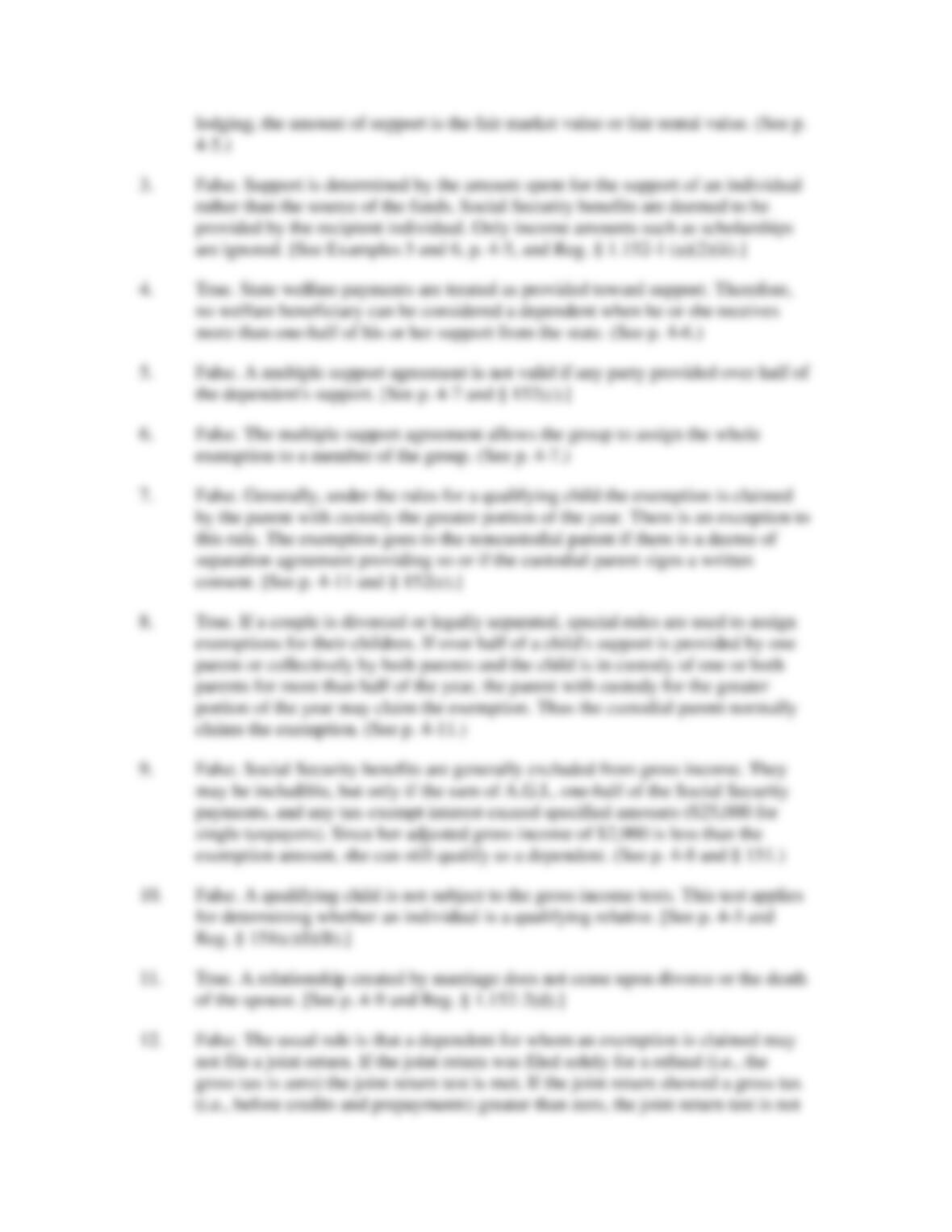
________ 2. When support is provided in a form other than a current cash expenditure
(e.g., a home in which the dependent is living), it is the cost of the
support item that is considered in determining whether the support test is
met.
________ 3. Social Security benefits spent on food and lodging are not included in
support for an individual.
________ 4. A person who receives more than one-half of his or her support in
welfare payments from the state cannot qualify as a dependent of another
individual.
________ 5. Under a multiple support agreement, A, who provided 55 percent of the
support of his mother, may assign the exemption to his sister, L, who
provided 25 percent of the support.

________ 6. A multiple support agreement allows a group of individuals to divide the
exemption amount so that each member of the group has a proportional
share of the total exemption deduction for the common dependent.
________ 7. The general rule for children of divorced or separated parents who
together provide over one-half the support and together have custody
more than one-half the year is that the exemption goes to the parent
providing the greater amount of support.
________ 8. The general rule for children of divorced or separated parents who
together provide over one-half the support and together have custody
more than one-half the year is that the exemption goes to the custodial
parent.
________ 9. A single woman whose only income is taxable interest of $2,900 and
Social Security benefits of $7,300 for 2012 cannot qualify as a
dependent of her son because she fails to meet the gross income test.
________ 10. A 16-year-old child with earned income of $8,000 cannot be claimed as
a dependent on his or her parents’ tax return.
________ 11. Individual F lives with his daughter W and her husband H, and is their
dependent. If W dies, H may continue to support F and claim him as a
dependent.
________ 12. A taxpayer may not claim an exemption for any child who filed a joint
return with her spouse.
________ 13. A U.S. citizen’s family member who is a French citizen and Mexican
resident could meet the citizenship test for purposes of the dependency
exemption.
________ 14. A taxpayer with adjusted gross income in excess of a certain amount can
lose the entire exemption deduction.
________ 15. A single taxpayer with one dependent receives a total exemption
deduction that is less than that of a head of household with one
dependent.
________ 16. Once a married couple files a joint return for a year, they may not file
amended separate returns for that year after the due date.
________ 17. A person whose spouse died in 20X1 may qualify as a surviving spouse
only in 20X1 and 20X2, if all other requirements are met.
________ 18. A person who qualifies as an abandoned spouse can file as a head of
household.

________ 19. To qualify as an abandoned spouse, a taxpayer must claim at least one
dependency exemption.
________ 20. In determining the amount spent for support of a potential dependent,
amounts spent on entertainment and vacations are included.
________ 21. V is 11 years of age, her only income is interest from savings of $3,200,
and she has no itemized deductions. V is claimed as a dependent by her
parents. V’s taxable income is $2,250 for 2012, $1,300 of which is taxed
at her parents’ marginal tax rate.
________ 22. A parent whose 12-year-old child’s only income is interest of $4,100
may elect to report the income on his own return and pay the tax with
that return.
________ 23. A taxpayer filing as a head of household whose taxable income in 2012
is $60,000 owes Federal income tax of $15,000 (25% × $60,000).
________ 24. An extension of time to file a return for an individual taxpayer for up to
six months is automatic (i.e., no explanation is required so long as the
proper form is filed before the due date).
________ 25. A single taxpayer whose only income is from a sole proprietorship with
gross income of $8,700 and net income of $3,800 is not required to file a
tax return for 2012.
________ 26. A taxpayer generally may amend his or her tax return for any missed
deductions within three years of the original due date.
________ 27. A taxpayer whose estimated tax due after withholding is less than $1,000
need not make estimated payments even if the other requirements are
met.
________ 28. A taxpayer who does not file a tax return is protected by a seven-year
statute of limitations (i.e., the IRS cannot assess a deficiency after seven
years).
________ 29. A taxpayer who files late and fails to get the proper extension must pay a
penalty of 0.5 percent per month (up to a maximum of 25%), beginning
with the due date of the tax return (usually April 15 for calendar year
individuals) and ending with the date the return is filed.
Multiple Choice
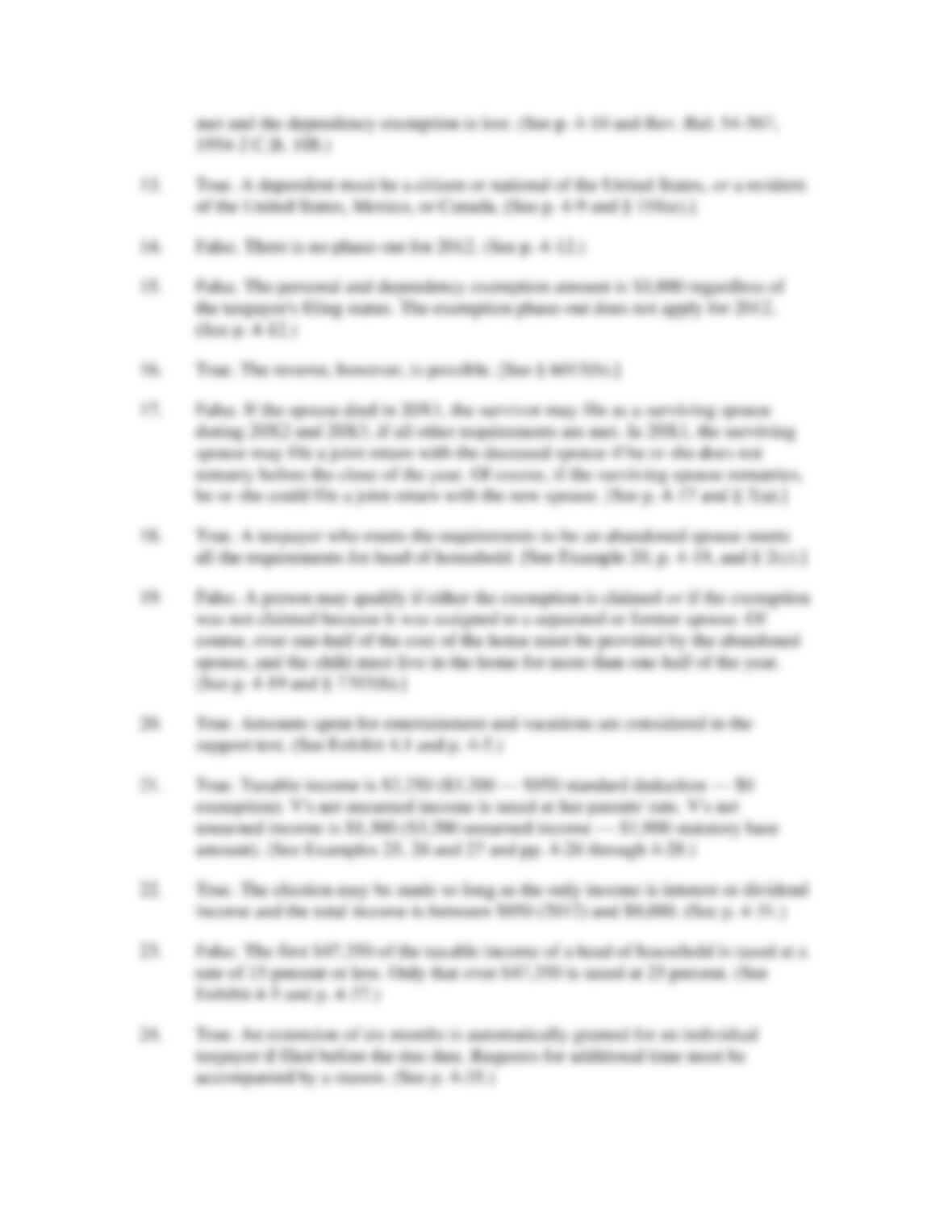
________ 30. G and J are married and have three children: R, S, and C. R, age 19, was
the star of the men’s volleyball team at State University, where he was a
full-time student in the current year. He received a scholarship valued at
$8,000. G and J provide his other support of $5,000. S, who was a full-

time high school student all year, worked part-time, earning $3,700. G
and J spent $4,000 toward S’s support. C was a high school freshman and
had no income during the year. How many exemptions may G and J
claim on their joint tax return?
a. Two
b. Three
c. Four
d. Five
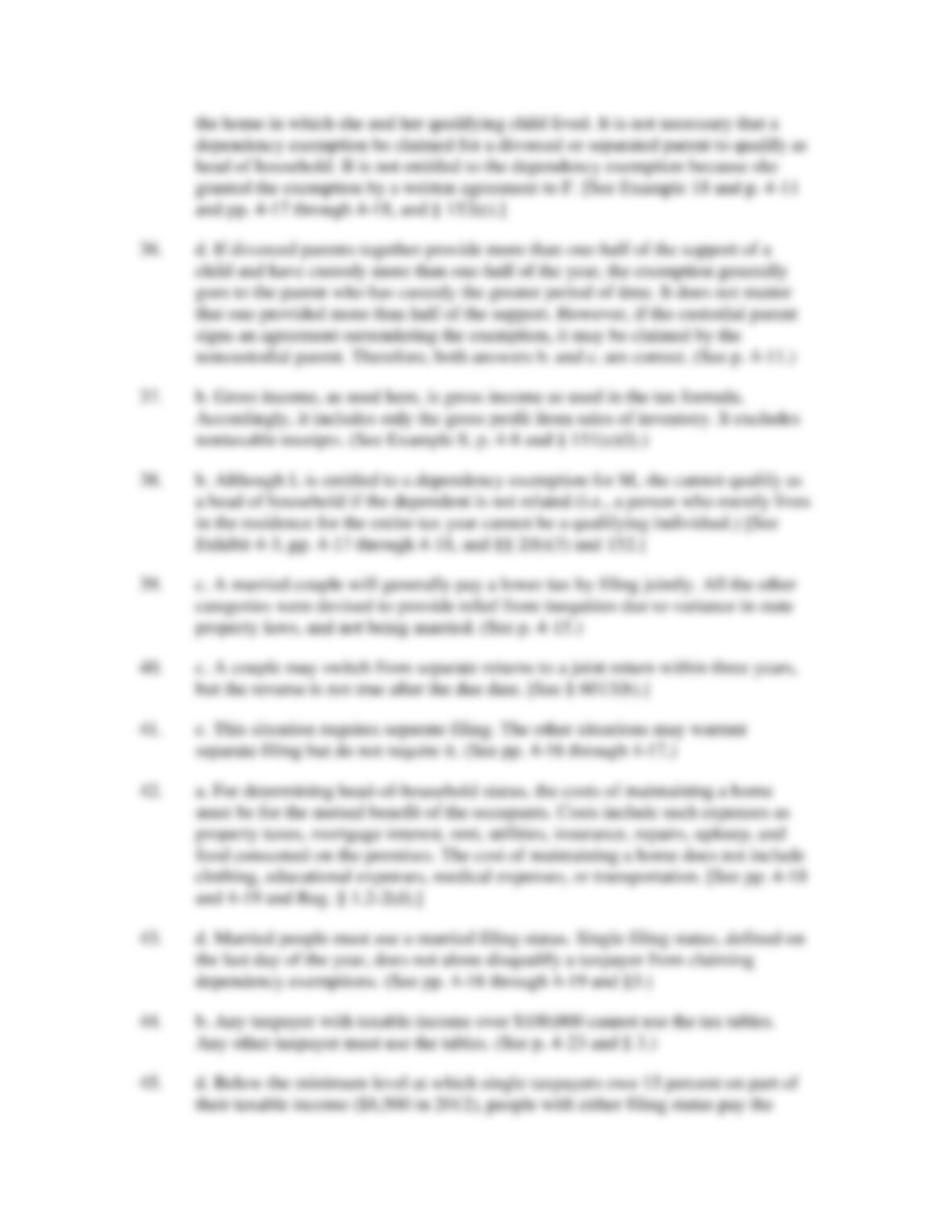
________ 31. V is 66 years of age and has good sight. V provided $8,000 of the
support of his elderly mother, who lives in a rest home and whose only
income is Social Security benefits of $6,200. What is V’s filing status
and how many exemptions may he claim?
a. Head of household and two
b. Head of household and one
c. Single and two
d. Single and one
________ 32. Which one of the following is not included in determining the amount of
support given to a dependent?
a. Services performed by the parent for the dependent
b. Gifts of toys
c. Expenditures for recreation
d. Expenses for education
________ 33. Which one of the following items when spent is not included in support?
a. Social security old age benefits spent on food
b. State aid to dependent children spent on rent
c. University scholarships for academic excellence
d. Charitable contributions paid on one’s behalf by a parent
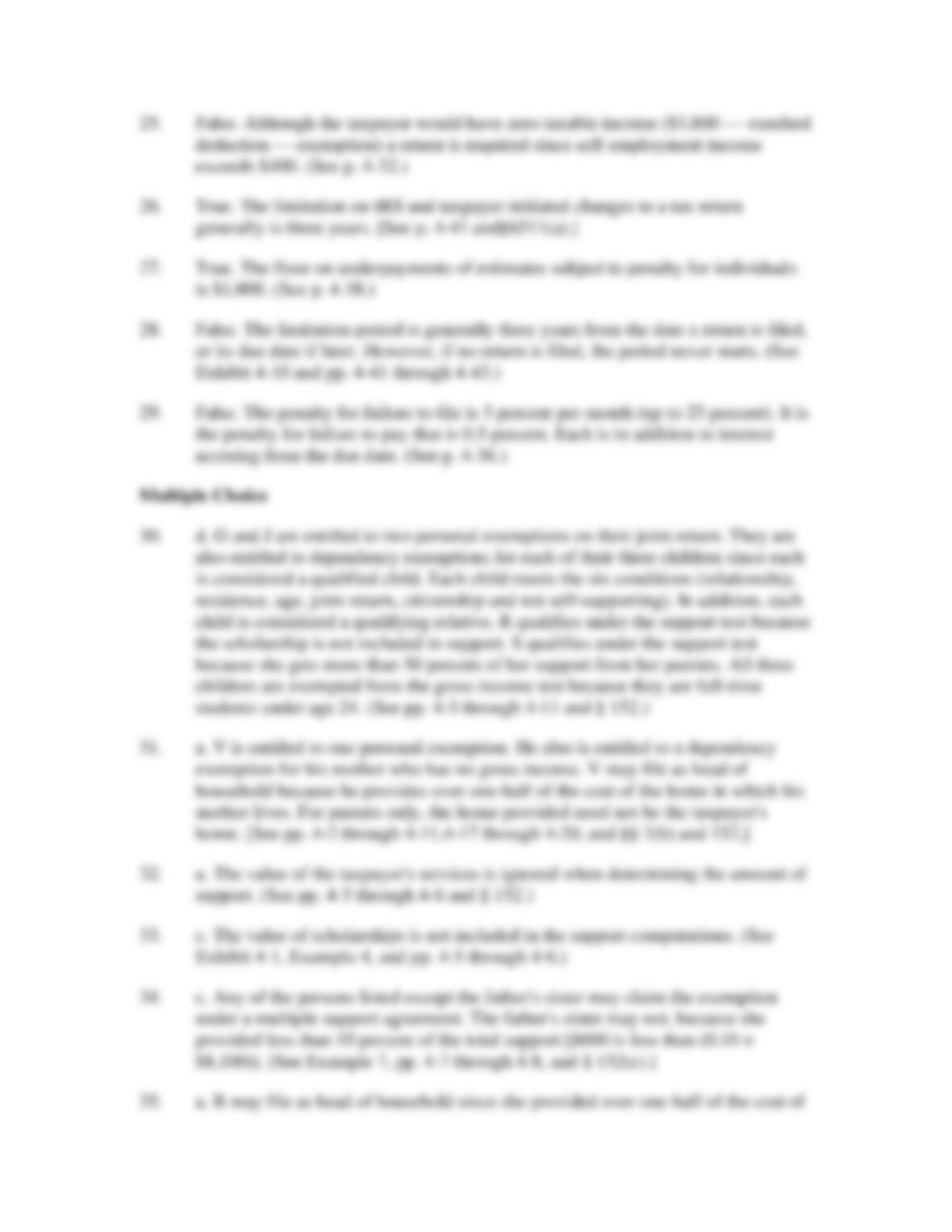
________ 34. D, whose parents are deceased, is supported by her grandparents and
other relatives. Her support this year was provided as follows:

Interest income $1,500
Social security survivor’s benefits 2,000
Contributions by maternal grandparents 1,500
Contributions by paternal grandparents 1,500
Contributions by mother’s brother 1,000
Contributions by father’s sister 600
Under a multiple support agreement, who may claim a dependency
exemption for D?
a. Any of those listed
b. Either set of grandparents
c. Either set of grandparents or the mother’s brother
d. None of those listed because the Social Security benefits and interest
income exceed the exemption amount
________ 35. F and B were divorced in 1996, their divorce decree gave custody of
their child to B, and under a separate written agreement, B surrendered
the dependency exemption to F for the current year. F paid child support
of $800 in the current year. B provided the other support of $2,000 for
their only child. What is B’s filing status and her number of exemptions?
a. Head of household and one
b. Head of household and two
c. Single and one
d. Single and two
________ 36. Z and X are the divorced parents of JR. The divorce was granted in June
of 1996 and Z was given custody, except for specific visits to X. Z
provided $4,500 and X provided $5,000 toward JR’s total support of
$9,900. Which one of the following is true for the current year?
a. If no agreement is executed, X is entitled to the dependency
exemption, because X provided more than 50 percent of JR’s
support.
b. If Z signs an agreement waiving the dependency exemption and it is
attached to X’s return, X may take the dependency exemption.

c. If no agreement is signed, Z is entitled to the dependency exemption.
d. Both b. and c.
________ 37. Which of the following is not true of the gross income test for the
dependency exemption (i.e., in testing to determine if the individual is a
qualifying relative)?
a. Generally, a dependent’s gross income may not exceed the
exemption amount.
b. Gross income is interpreted to mean “gross cash receipts.”
c. A child of the taxpayer, under age 24, who is a full-time student at
any time during five calendar months of the tax year is exempted
from the test.
d. A child of the taxpayer under age 19 is exempted from the test.
________ 38. L is single, 35 years of age, and owns her own home. She provides more
than one-half the support for M, who is unrelated to L and lives legally
in L’s home for the entire year. M also is single, is a citizen of the United
States, and has gross income of $2,800. What is L’s filing status and her
proper number of exemptions for the current calendar year?
a. Single and one
b. Single and two
c. Head of household and two
d. Married filing separately and one
________ 39. Which of the following generally has the least favorable tax rates?
a. Head of household
b. Married, filing jointly
c. Married, filing separately
d. Single
________ 40. Which one of the following statements is true of returns filed by married
persons filing jointly?
a. Each spouse is liable for one-half the tax due if there are any
deficiencies.

b. Each spouse is liable for his or her proportional share due, based on
percentage of total income, if there are any deficiencies.
c. Once a married couple files a joint return for a year, they may not
switch to separate returns after the due date for that return.
d. The joint return is available more for convenience than for tax
savings.
________ 41. In what situation is a married person generally required to file
separately?
a. They are separated and planning a divorce.
b. Another taxpayer could claim one spouse as a dependent.
c. Either spouse is a nonresident alien.
d. Use of the separate return tables yields a lower tax than use of the
joint return tables.
________ 42. A taxpayer filing as a head of household or as a surviving spouse must
determine the costs of maintaining the home. What item below may not
be included in these costs?
a. Clothing
b. Food consumed on the premises
c. Insurance
d. Repairs
________ 43. Which statement below is not true of single filing status?
a. A single taxpayer may claim dependency exemptions.
b. Single filing status applies to anyone who does not qualify as
married, surviving spouse, or head of household.
c. A person whose divorce becomes final on December 30, and does
not re-marry the next day, will use single filing status for the
calendar year if he/she is not head of household.
d. A married person may elect to use single filing status if filing
separately.
________ 44. Which of the following taxpayers is not required to use the tax tables?

a. A single taxpayer with taxable income of $88,000.
b. A married couple with taxable income of $110,000.
c. A head of household with taxable income of $65,000.
d. No taxpayer is required to use the tax tables.
________ 45. Compared with a single taxpayer who has the same taxable income, a
taxpayer filing as head of household owes
a. A smaller amount of tax
b. The same amount of tax
c. A larger amount of tax
d. Either the same or a smaller amount of tax, depending on the amount
of taxable income
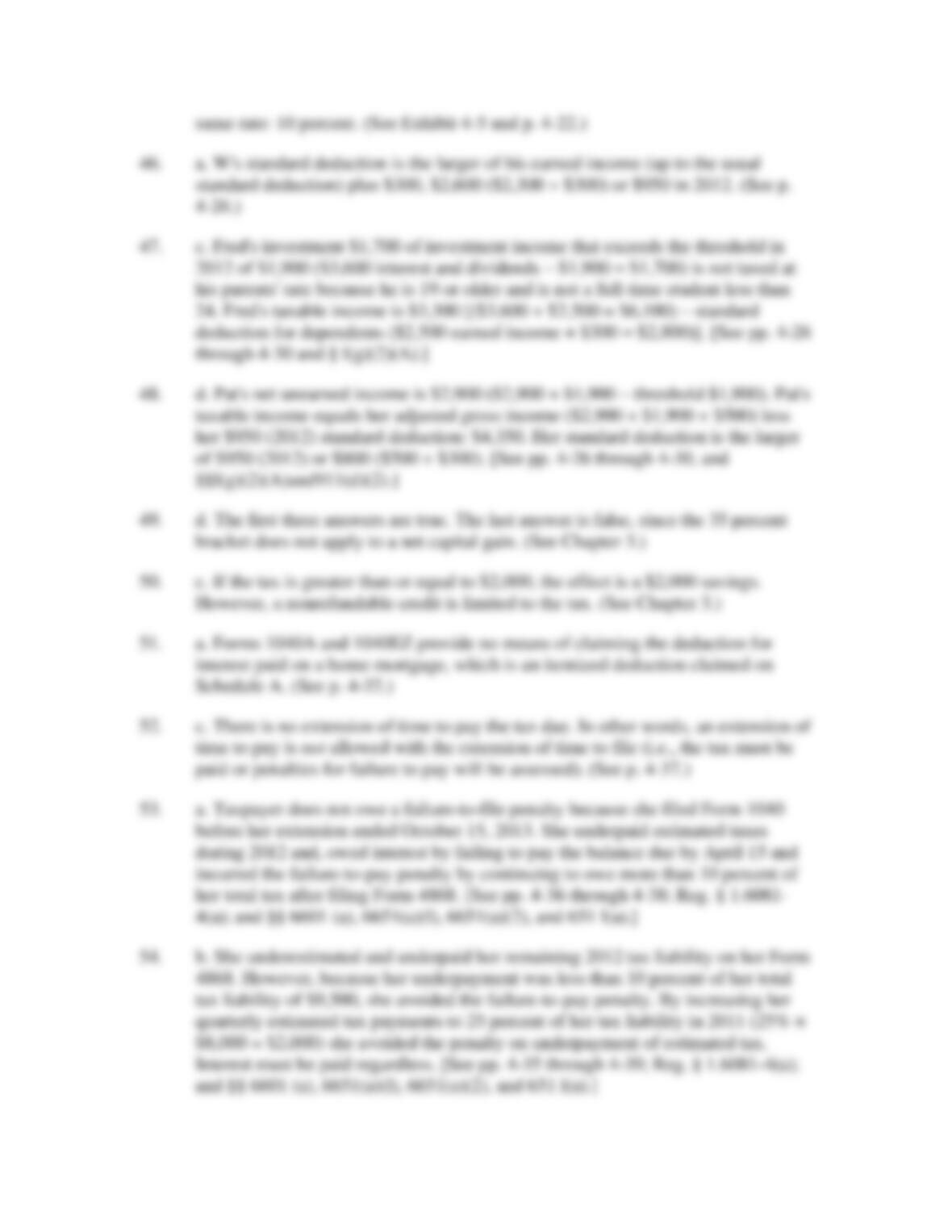
________ 46. W is a full-time student and is claimed as a dependent by his parents.
During 2012, he had tax-exempt interest income of $1,500 and wages of
$2,300. He also had records supporting itemized deductions of $75. How
much is W’s standard deduction?
a. $2,600
b. $950
c. $2,300
d. $5,700
________ 47. Fred, 19 years of age and single, is claimed as a dependent on his
parents’ return. He has decided not to go to college. The following
information is derived from his tax return for 2012:
Taxable interest and dividends $3,600
Salary from part-time job 2,500
Itemized deductions 1,270
Which of the following is false?
a. Fred’s taxable income is $3,300.
b. Fred will not itemize his deductions for the year.

c. $1,700 of the interest and dividends will be taxed at Fred’s parents’
marginal tax rate if it is higher than Fred’s rate.
d. Fred’s standard deduction is $2,800.
________ 48. Pat, age 12, received the following income in 2012:
Dividends $2,900
Interest 1,900
Wages 500
She deposited all her income in a savings account. Pat is a U.S. citizen
and lives with her parents, who provide the full $13,000 annual cost of
her support. Which statement is false?
a. Pat’s parents may claim her as a dependent.
b. Pat has net unearned income of $2,900.
c. Pat has taxable income of $4,350.
d. Pat’s standard deduction is $800.
________ 49. A 35 percent tax is assessed on income in excess of specified levels.
Which of the following is not true of the 35 percent bracket?
a. The 35 percent bracket applies to unlimited amounts of income over
the specified levels.
b. The level at which a head of household encounters the 35 percent
bracket is the same as that for a single individual.
c. The fact that a taxpayer reaches the 35 percent bracket does not
affect the amount of tax paid on the income in lower tax brackets.
d. The 35 percent bracket applies to all types or characters of income.
________ 50. A $2,000 non-refundable tax credit for two taxpayers with the same
filing status results in
a. A $2,000 tax reduction
b. A tax reduction equal to $2,000 times the marginal tax bracket
c. A tax reduction equal to the lesser of $2,000 or the gross tax
d. No tax savings

________ 51. A taxpayer whose income consists of wages plus interest income under
$400, is single with no dependents, and plans to claim the deduction for
interest paid on his home mortgage may file
a. Form 1040 only.
b. Form 1040 or Form 1040A only.
c. Form 1040A or Form 1040EZ only.
d. Form 1040, Form 1040A, or Form 1040EZ.
________ 52. Which of the following is not true of the due date for the individual tax
return?
a. The due date is the fifteenth day of the fourth month following the
taxable year.
b. An automatic extension of time to file the individual return will be
granted upon request.
c. An extension of time to file also allows the taxpayer to pay his or her
tax late with no penalty. Interest will be charged, however.
d. An extension beyond four months from the original due date will be
granted if an adequate reason is given.
________ 53. J paid her 2012 taxes by filing quarterly estimated tax payments of
$2,000 each. She requested an automatic extension of the filing due date
in March, 2013, and in July filed her completed return showing total
2012 tax liability of $9,500. If she paid $8,400 in 2012 taxes, enclosed
no money with Form 4868 in March, and enclosed $1,500 with Form
1040 in July, what interest or penalty does she not owe?
a. Failure-to-file penalty
b. Failure-to-pay penalty
c. Interest on balance due
d. Penalty on underpayment of estimated tax
________ 54. K owed $9,500 in taxes for 2012, paid as follows: estimated tax
payments of $2,100 each quarter, $1,000 with her Form 4868 (request
for automatic extension) in March, and the remaining $100 with her
Form 1040 in July. K’s 2011 total tax was $8,000. What interest or
penalty does she owe?
a. Failure-to-pay penalty

b. Interest on balance due
c. Penalty on underpayment of estimated tax
d. None of the above
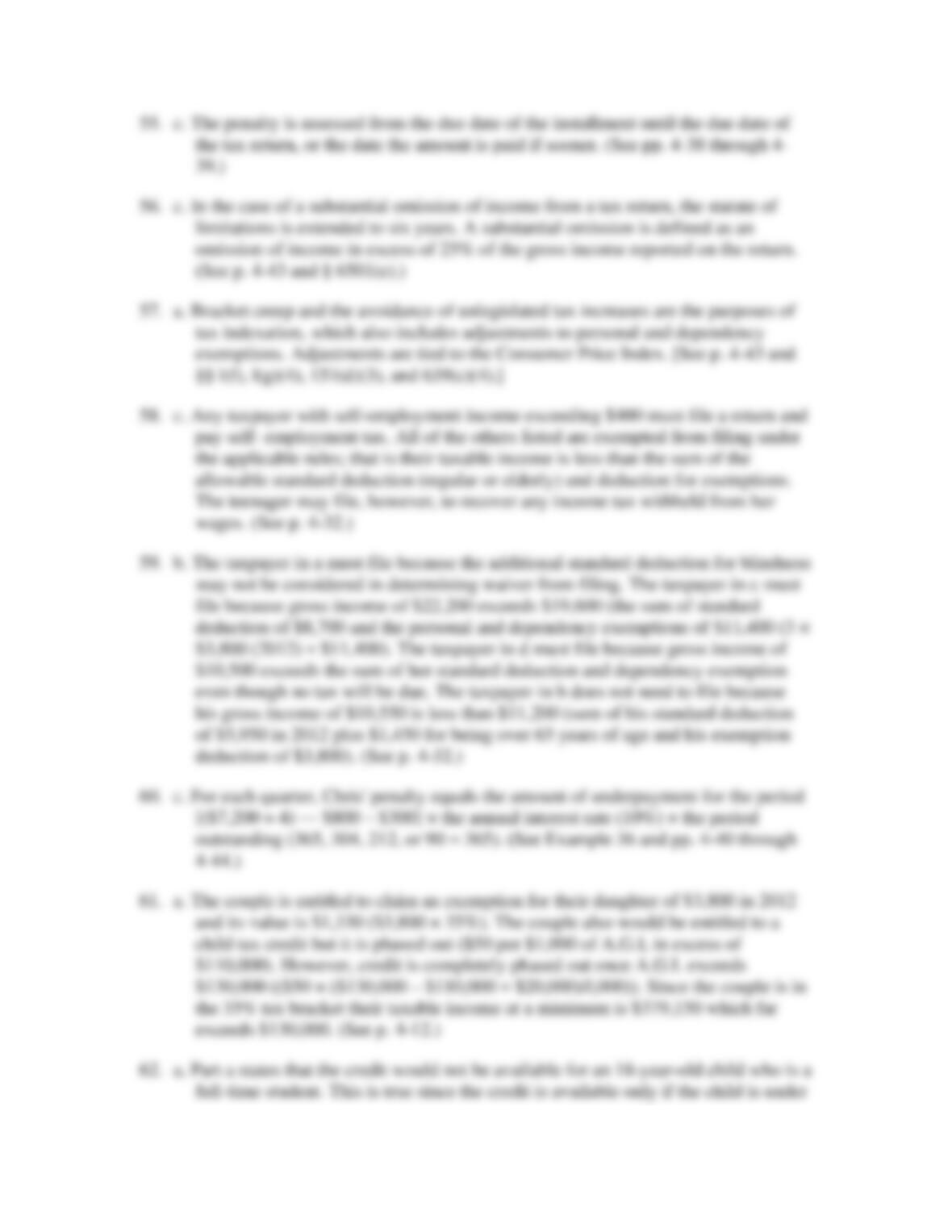
________ 55. A penalty is assessed against individuals for failure to make adequate
estimated tax payments. Which of the following is not true of that
penalty?
a. The penalty is not assessed if the tax due is less than $1,000.
b. The penalty is not assessed if the total prepayments—withholding,
estimated tax payments, and others—are at least 90 percent of the
total tax due for the year.
c. The penalty is assessed from the due date of the installment until the
tax is actually paid (if later).
d. The penalty is not assessed if the total prepayments—withholding,
estimated tax payments, and others—equal or exceed the prior year’s
tax (unless taxable income exceeded $150,000).
________ 56. Which statement concerning the statute of limitations is not true?
a. The statute of limitations never ends if the return is fraudulent.
b. If an individual (calendar year) taxpayer files a return for calendar
year 2011 on March 15, 2012, the IRS normally may not assess an
additional tax liability against the taxpayer after April 15, 2015 for
reasons other than a false or fraudulent return, no return, or a
substantial omission of income.
c. The statute of limitations period does not change regardless of the
amount of income that is omitted or deduction improperly claimed.
d. The statute of limitations begins to run only if a return is filed.
________ 57. Tax indexation
a. Decreases (or eliminates) bracket creep
b. Results in unlegislated tax increases
c. Provides adjustments in standard deductions and tax brackets only
d. Provides adjustments tied to changes in the Index of Leading
Economic Indicators

________ 58. Information from the following table will be useful for answering this
question. All figures are for 2012.
Personal, dependency exemption: $3,800 (2012)
Filing Status Basic Standard Deduction Additional Standard Deduction*
Married, filing jointly $11,900 $1,150
Married, filing separately 5,900 1,150
Head of household 8,700 1,450
Single 5,950 1,450
*Blind taxpayer, taxpayer 65 or older
Which of the following taxpayers must file a return for 2012?
a. A single taxpayer, age 67, has Social Security benefits of $9,000 and
interest income of $10,950
b. A married couple, both under 65 years, have interest income of
$18,200
c. A single taxpayer, age 65, has self-employment earnings of $2,700
d. A single teenager, claimed as a dependent by her parents, has part-
time wages of $5,100
________ 59. Information from the following table will be useful for answering this
question. All figures are for 2012.
Personal, dependency exemption: $3,700
Filing Status Basic Standard Deduction Additional Standard Deduction*
Married, filing jointly $11,900 $1,150
Married, filing separately 5,900 1,150
Head of household 8,700 1,450
Single 5,950 1,450
*Blind taxpayer, taxpayer 65 or older
Which one of the following taxpayers is not required to file a tax return
for 2012?

a. A blind 47-year-old single person whose only gross income is
interest income of $9,350
b. A 66-year-old single taxpayer who is not claimed as a dependent and
whose only gross income is interest of $10,550
c. A 26-year-old head of household with two children whose only gross
income is wages of $22,400
d. A 35-year-old single taxpayer whose only income is gross rents of
$10,500 and who has expenses directly attributable to the rents of
$4,900
________ 60. Chris, a single taxpayer, has investment income in addition to his salary.
Use the information below to answer the following question concerning
Chris’ estimated tax payments during 20X1. Assume that all forms of
income, withholding, and deductions occur at a constant rate throughout
the year.
Salary $39,000
Federal income tax withheld $3,200
Interest income 14,150
If Chris pays quarterly installments of $300 on or before the due dates
(his 20X0 tax liability was $7,200), and he pays the remaining tax
liability on April 15, 20X2, calculate the penalty for underestimation of
tax that Chris will owe to the nearest dollar. Assume a penalty interest
rate of 10 percent, and installment due dates 365, 304,212, and 90 days
prior to April 15.
a. $70
b. $175
c. $186
d. $280
________ 61. H and W are married and have a 15-year-old daughter who lives with
them the entire taxable year. The couple’s marginal tax rate for federal
tax purposes is 35 percent. What amount will their daughter save them in
taxes?
a. $1,330
b. $3,800

c. $0
d. $950
e. None of the above
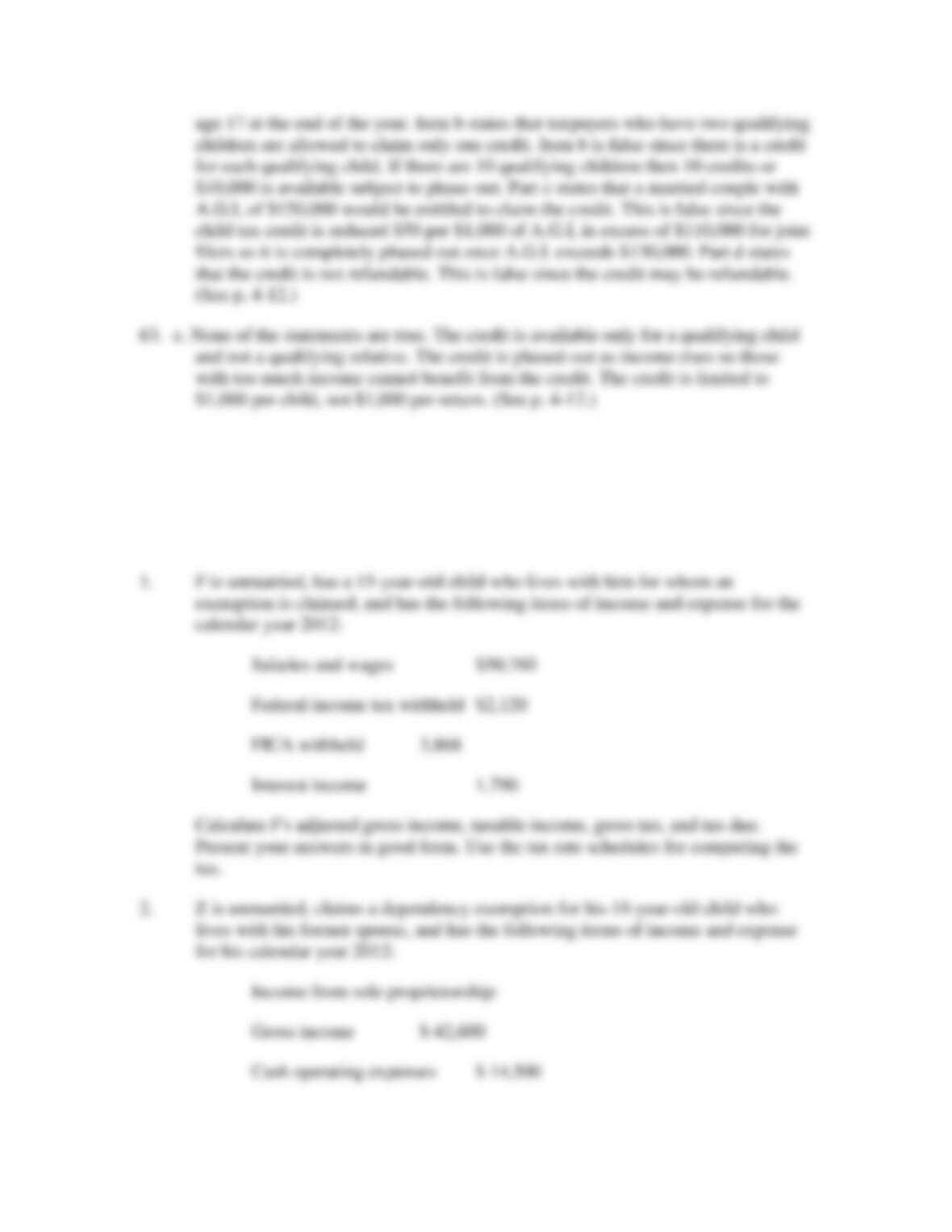
________ 61. Which of the following statements about the child tax credit is true?
a. The credit would not be available for an 18-year-old child who is a
full-time student.
b. Taxpayers who have two qualifying children are allowed to claim
only one credit.
c. A married couple with A.G.I, of $150,000 would be entitled to claim
a credit for their only child who is 2 years old.
d. The credit is not refundable
e. More than one of the above is true
________ 63. Which of the following statement about the child tax credit is true?
a. The credit is available for a qualifying child or a qualifying relative.
b. The credit is available regardless of how much income the taxpayer
has.
c. The amount of the credit is limited to $1,000 per return.
d. More than one of the above is true.
e. None of the above is true.
4
Personal and Dependency Exemptions; Filing Status; Determination of Tax for an
Individual; Filing Requirements
Solutions to Test Bank
True or False
4
Personal and Dependency Exemptions; Filing Status; Determination of Tax for an
Individual; Filing Requirements
Comprehensive Problems
Solutions to Comprehensive Problems