
Name:
Class:
Date:
chapter 4
Indicate whether the statement is true or false.
1. Two or more events are said to be exhaustive if at most one of them can occur.
a.
True
b.
False
2. Two events A and B are said to be independent if P(A and B) = P(A) + P(B)
a.
True
b.
False
3. You think you have a 90% chance of passing your statistics class. This is an example of subjective
probability.
a.
True
b.
False
4. If P(A and B) = 0, then A and B must be collectively exhaustive.
a.
True
b.
False
5. The probability that event A will not occur is denoted as .
a.
True
b.
False
6. The number of car insurance policy holders is an example of a discrete random variable.
a.
True
b.
False
7. Suppose A and B are mutually exclusive events where P(A) = 0.3 and P(B) = 0.4, then P(A and B) = 0.12.
a.
True
b.
False
8. The time students spend in a computer lab during one day is an example of a continuous random variable.
a.
True
b.
False
9. Probability is a number between 0 and 1, inclusive, which measures the likelihood that some event will
occur.
a.
True
b.
False
10. If A and B are two independent events with P(A) = 0.20 and P(B) = 0.60, then P(A and B) = 0.80
a.
True
b.
False
11. The law of large numbers states that subjective probabilities can be estimated based on the long run
relative frequencies of events

Name:
Class:
Date:
chapter 4
a.
True
b.
False
12. When we wish to determine the probability that at least one of several events will occur, we would use the
addition rule.
a.
True
b.
False
13. The number of cars produced by GM during a given quarter is a continuous random variable.
a.
True
b.
False
14. If A and B are independent events with P(A) = 0.40 and P(B) = 0.50, then P(A/B) is 0.50.
a.
True
b.
False
15. If P(A and B) = 1, then A and B must be collectively exhaustive.
a.
True
b.
False
16. Given that events A and B are independent and that P(A) = 0.8 and P(B/A) = 0.4, then P(A and B) = 0.32.
a.
True
b.
False
17. Two or more events are said to be mutually exclusive if at most one of them can occur.
a.
True
b.
False
18. Two events are said to be independent when knowledge of one event is of no value when assessing the
probability of the other.
a.
True
b.
False
19. The temperature of the room in which you are writing this test is a continuous random variable.
a.
True
b.
False
20. Suppose A and B are two events where P(A) = 0.5, P(B) = 0.4, and P(A and B) = 0.2, then P(B/A) = 0.5.
a.
True
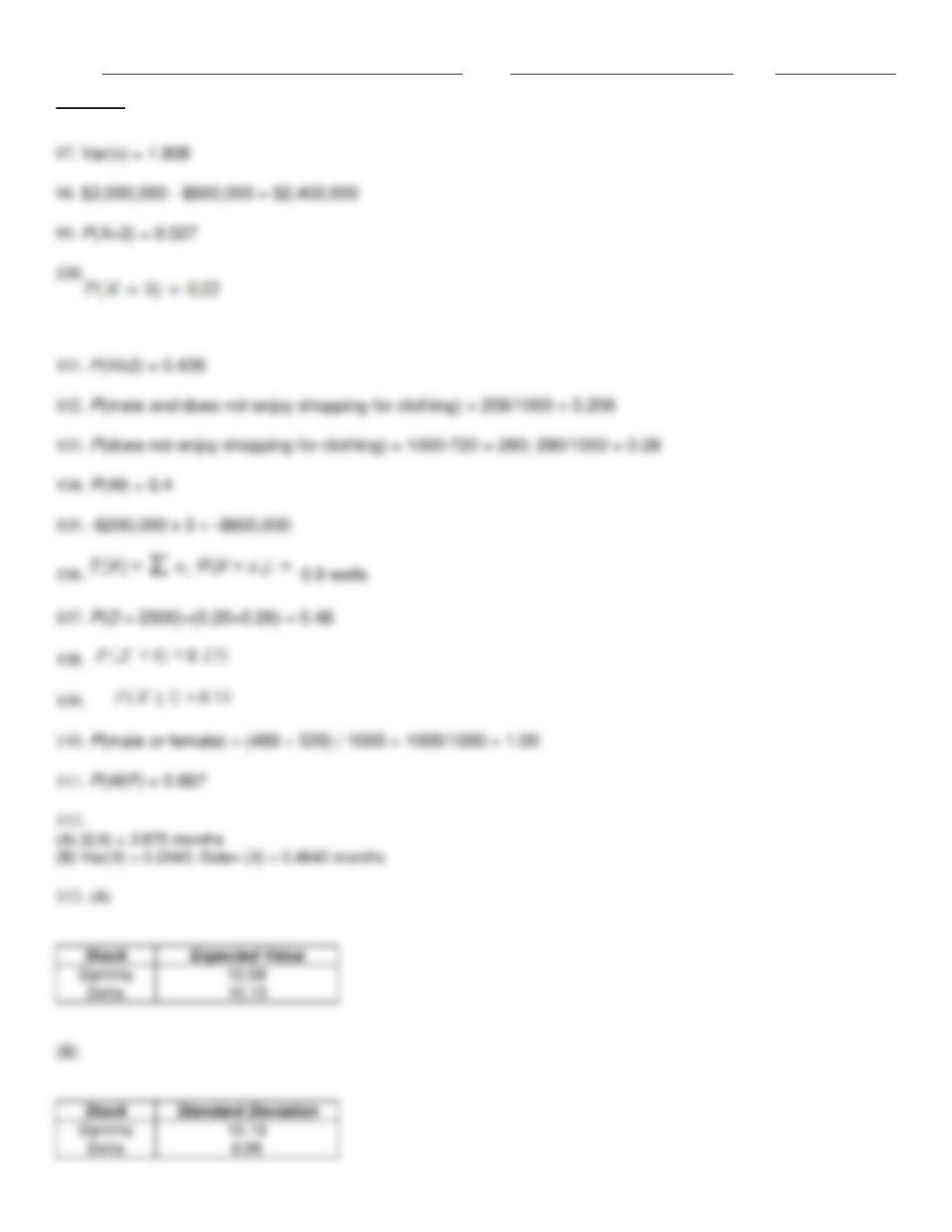
b.
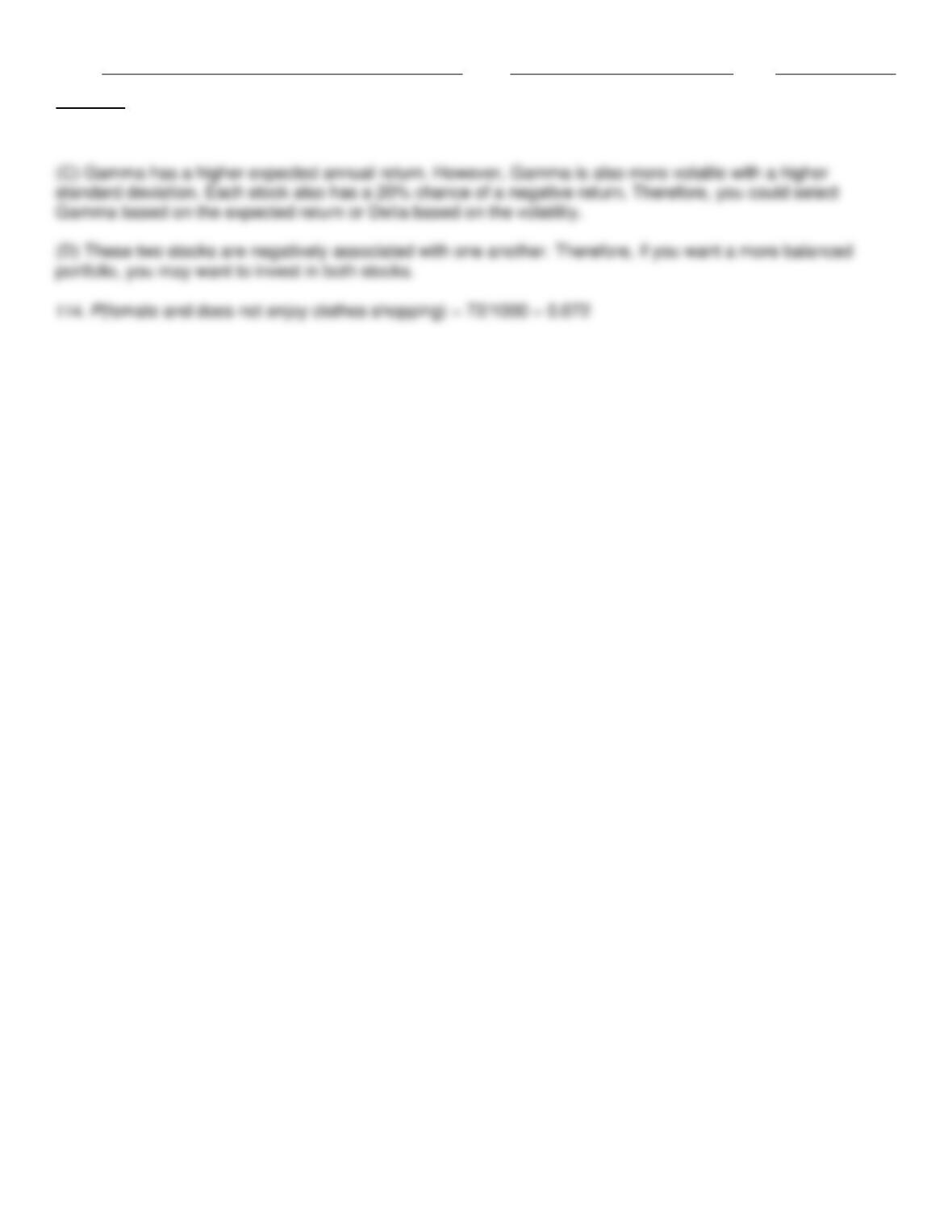
False
21. Two or more events are said to be exhaustive if one of them must occur.
a.
True
b.
False
22. Suppose that after graduation you will either buy a new car (event A) or take a trip to Europe (event B).
Events A and B are mutually exclusive.

Name:
Class:
Date:
chapter 4
a.
True
b.
False
23. Suppose A and B are mutually exclusive events where P(A) = 0.2 and P(B) = 0.5, then P(A or B) = 0.70.
a.
True
b.
False
24. Two events A and B are said to mutually be exclusive if P(A and B) = 0.
a.
True
b.
False
25. The relative frequency of an event is the number of times the event occurs out of the total number of times
the random experiment is run.
a.
True
b.
False
26. The multiplication rule for two events A and B is: P(A and B) = P(A|B)P(A).
a.
True
b.
False
27. If events A and B have nonzero probabilities, then they can be both independent and mutually exclusive.
a.
True
b.
False
28. When two events are independent, they are also mutually exclusive.
a.
True
b.
False
29. Football teams toss a coin to see who will get their choice of kicking or receiving to begin a game. The
probability that given team will win the toss three games in a row is 0.125.
a.
True
b.
False
30. The number of people entering a shopping mall on a given day is an example of a discrete random
variable.
a.
True
b.
False
31. Conditional probability is the probability that an event will occur, with no other events taken into
consideration.
a.
True
b.
False
32. A random variable is a function that associates a numerical value with each possible outcome of a random
phenomenon.
a.
True
b.
False
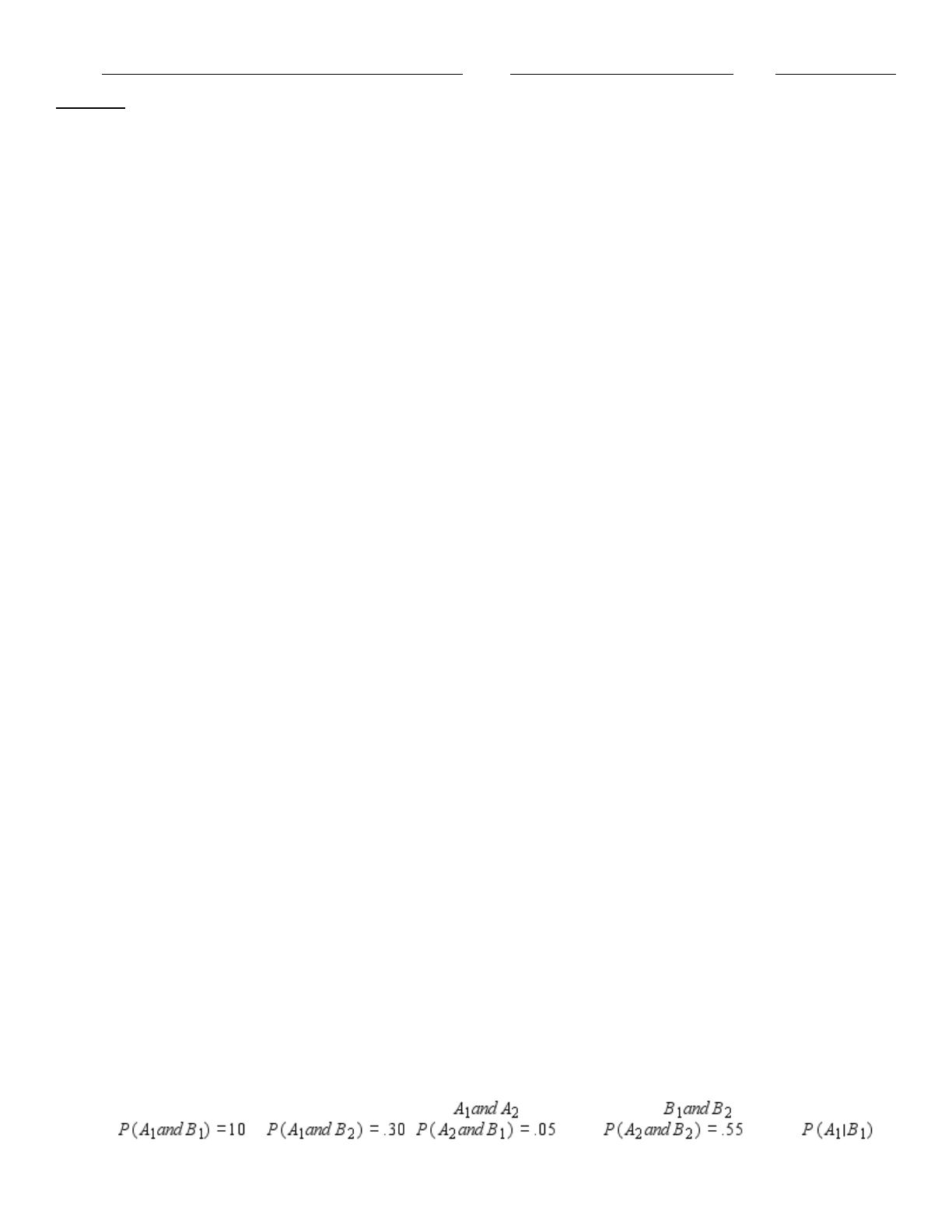
Name:
Class:
Date:
chapter 4
33. Subjective probability is the probability that a given event will occur, given that another event has already
occurred.
a.
True
b.
False
Indicate the answer choice that best completes the statement or answers the question.
34. Which of the following statements are true?
a.
Probabilities must be negative
b.
Probabilities must be greater than 1
c.
The sum of all probabilities for a random variable must be equal to 1
d.
All of these options are true.
35. If A and B are mutually exclusive events with P(A) = 0.30 and P(B) = 0.40, then the probability that either A
or B occur is:
a.
0.10
b.
0.12
c.
0.70
d.
None of these options.
36. If two events are independent, what is the probability that they both occur?
a.
0
b.
0.50
c.
1.00
d.
Cannot be determined from the information given
37. If two events are mutually exclusive and collectively exhaustive, what is the probability that both occur?
a.
0.00
b.
0.50
c.
1.00
d.
Cannot be determined from the information given.
38. If P(A) = P(A|B), then events A and B are said to be
a.
mutually exclusive
b.
independent
c.
exhaustive
d.
complementary
39. There are two types of random variables, they are
a.
discrete and continuous
b.
exhaustive and mutually exclusive
c.
complementary and cumulative
d.
real and unreal
40. If events A and B are mutually exclusive, then the probability of both events occurring simultaneously is
equal to
a.
0.0
b.
0.5
c.
1.0
d.
any value between 0.5 and 1.0
41. The probabilities shown in a table with two rows, and two columns, , are as
follows: , , , and . Then ,

Name:
Class:
Date:
chapter 4
calculated up to two decimals, is
a.
.33
b.
.35
c.
.65
d.
.67
42. If P(A) = 0.25 and P(B) = 0.65, then P(A and B) is:
a.
0.25
b.
0.40
c.
0.90
d.
Cannot be determined from the information given
43. A function that associates a numerical value with each possible outcome of an uncertain event is called a
a.
conditional variable
b.
random variable
c.
population variable
d.
sample variable
44. The law of large numbers is relevant to the estimation of
a.
objective probabilities
b.
subjective probabilities
c.
both objective and subjective probabilities
d.
neither objective nor subjective probabilities
45. The probability of an event and the probability of its complement always sum to
a.
1
b.
0
c.
any value between 0 and 1
d.
any positive value
46. If two events are collectively exhaustive, what is the probability that both occur at the same time?
a.
0.00
b.
0.50
c.
1.00
d.
Cannot be determined from the information given.
47. If A and B are any two events with P(A) = .8 and P(B|A) = .4, then the joint probability of A and B is
a.
.80
b.
.40
c.
.32
d.
1.20
48. If two events are collectively exhaustive, what is the probability that one or the other occurs?
a.
0.25
b.
0.50
c.
1.00
d.
Cannot be determined from the information given.
49. If two events are mutually exclusive, what is the probability that both occur at the same time?
a.
0.00
b.
0.50
c.
1.00
d.
Cannot be determined from the information given.
50. The formal way to revise probabilities based on new information is to use:
a.
complementary probabilities
b.
conditional probabilities
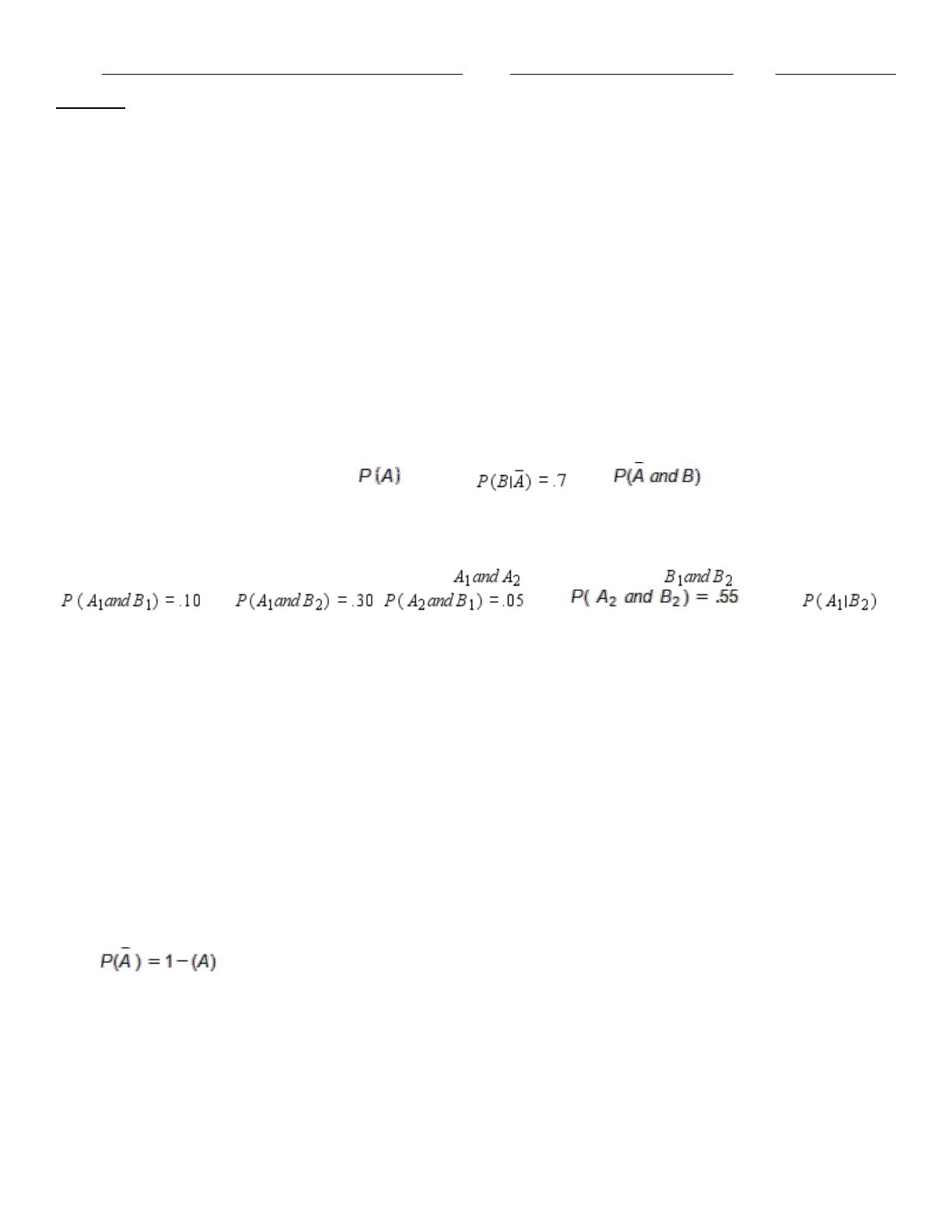
Name:
Class:
Date:
chapter 4
c.
unilateral probabilities
d.
common sense probabilities
51. Which of the following best describes the concept of probability?
a.
It is a measure of the likelihood that a particular event will occur.
b.
It is a measure of the likelihood that a particular event will occur, given that another event has
already occurred.
c.
It is a measure of the likelihood of the simultaneous occurrence of two or more events.
d.
None of these options.
52. If A and B are mutually exclusive events with P(A) = 0.70, then P(B):
a.
can be any value between 0 and 1
b.
can be any value between 0 and 0.70
c.
cannot be larger than 0.30
d.
Cannot be determined with the information given
53. If A and B are any two events with = .8 and , then is
a.
.56
b.
.14
c.
.24
d.
None of these options.
54. The probabilities shown in a table with two rows, and two columns, , are as follows:
, , , and . Then ,
calculated up to two decimals, is
a.
.33
b.
.35
c.
.65
d.
.67
55. If two events are mutually exclusive, what is the probability that one or the other occurs?
a.
0.25
b.
0.50
c.
1.00
d.
Cannot be determined from the information given.
56. Let A and B be the events of the FDA approving and rejecting a new drug to treat hypertension,
respectively. The events A and B are
a.
independent
b.
conditional
c.
unilateral
d.
mutually exclusive
57. is the:
a.
addition rule
b.
commutative rule
c.
rule of complements
d.
rule of opposites
58. Probabilities that cannot be estimated from long-run relative frequencies of events are
a.
objective probabilities
b.
subjective probabilities
c.
complementary probabilities
d.
joint probabilities
Name:
Class:
Date:
chapter 4
59. Probabilities that can be estimated from long-run relative frequencies of events are
a.
objective probabilities
b.
subjective probabilities
c.
complementary probabilities
d.
joint probabilities
60. A discrete probability distribution:
a.
lists all of the possible values of the random variable and their corresponding probabilities
b.
is a tool that can be used to incorporate uncertainty into models
c.
can be estimated from long-run proportions
d.
is the distribution of a single random variable
Suppose that patrons of a restaurant were asked whether they preferred beer or whether they preferred wine. 60% said
that they preferred beer. 70% of the patrons were male. 80% of the males preferred beer.
61. Are gender of patrons and drinking preference independent? Explain.
An oil company is planning to drill three exploratory wells in different areas of West Texas. The company estimates that
each of these wells, independent of the others, has about a 30% chance of being successful.
62. What is the probability that any well will not be successful?
A small grocery store is considering installing an express checkout line. Let X be the number of customers in the regular
checkout line. Note that these numbers include the customers being served, if any. The probability distribution of X is
given in the table below.
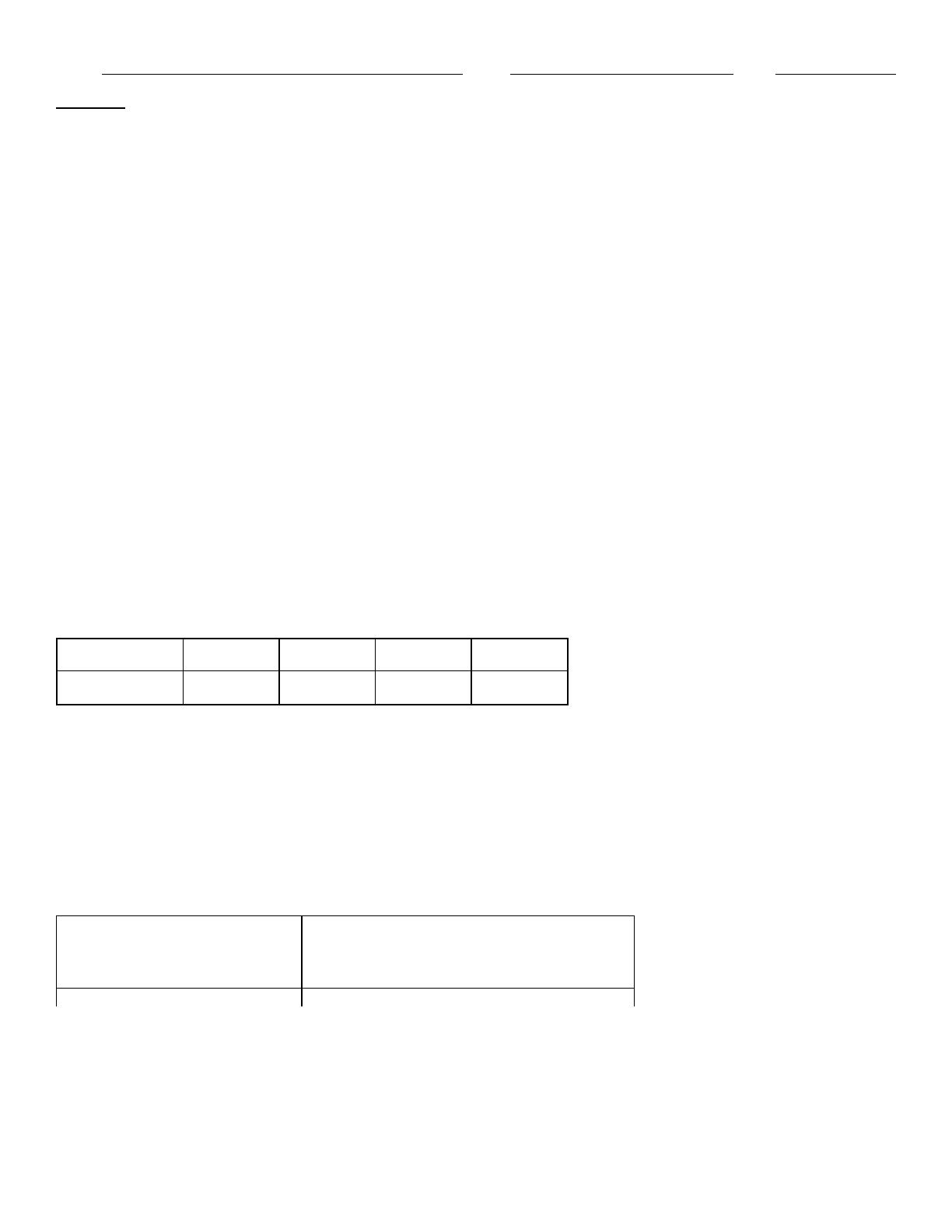
x
0
1
2
3
P(X=x)
0.28
0.22
0.26
0.24
63. What is the probability that at most one person is waiting or being served in the express checkout line?
A sporting goods store sells softball bats. Let X be the numbers of bats sold on a typical day at the store. Based on the
store historical data, the probability distribution of X is provided in the table below.
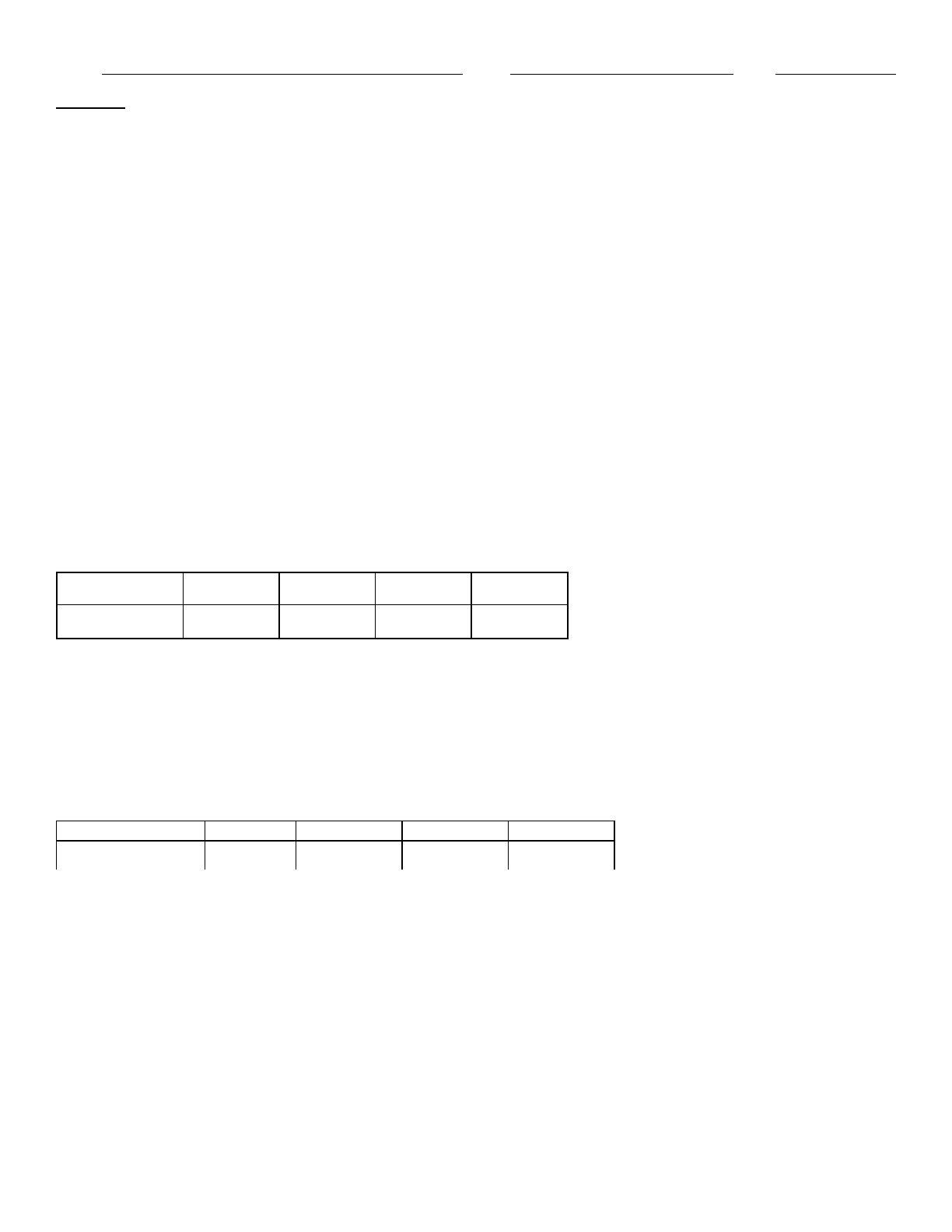
Sales (in units)
x
0
1
2
3
P(X=x)
0.19
0.374
0.335
0.101
Name:
Class:
Date:
chapter 4
64. What is the probability of observing the sale of at least one bat on a given day at this sporting goods store?
A sample of 1000 households was selected in Los Angeles to determine information concerning consumer behavior.
Among the questions asked was “Do you enjoy shopping for clothing?” Overall, 720 answered yes. 480 males were
interviewed, and 272 males answered yes.
65. Does consumer behavior depend on the gender of consumer? Explain using probabilities.
66. What is the probability that a respondent chosen at random enjoys or does not enjoy shopping for clothing?
67. What is the probability that a respondent chosen at random is a male who enjoys shopping for clothing or a
female who enjoys shopping for clothing?
68. What is the probability that a respondent was female?
69. What is the probability that a household answered no?
A small grocery store is considering installing an express checkout line. Let X be the number of customers in the regular
checkout line. Note that these numbers include the customers being served, if any. The probability distribution of X is
given in the table below.
x
0
1
2
3
P(X=x)
0.28
0.22
0.26
0.24
70. On average, how many customers would you expect to see in line?
Suppose that the manufacturer of a particular product assesses the distribution of the demand for its product in the
upcoming quarter as presented below. Use this information to answer the following questions.
Demand (in units)
x
2000
2500
3000
3500
P(X=x)
0.28
0.26
0.20
0.26
71. What is the probability that the demand for this product will be less than 3500 units in the upcoming
quarter?
72. Find the expected demand (in units) for the upcoming quarter.
Suppose that patrons of a restaurant were asked whether they preferred beer or whether they preferred wine. 60% said
that they preferred beer. 70% of the patrons were male. 80% of the males preferred beer.
73. Suppose a randomly selected patron is a female. What is the probability the patron prefers beer?
A sporting goods store sells softball bats. Let X be the numbers of bats sold on a typical day at the store. Based on the
store historical data, the probability distribution of X is provided in the table below.
Name:
Class:
Date:
chapter 4
Sales (in units)
x
0
1
2
3
P(X=x)
0.19
0.374
0.335
0.101
74. What is probability of observing the sale of no more than 1 bat at this sporting goods store?
A small grocery store is considering installing an express checkout line. Let X be the number of customers in the regular
checkout line. Note that these numbers include the customers being served, if any. The probability distribution of X is
given in the table below.
x
0
1
2
3
P(X=x)
0.28
0.22
0.26
0.24
75. What is the probability that no one is waiting or being served in the regular checkout line?
Suppose that patrons of a restaurant were asked whether they preferred beer or whether they preferred wine. 60% said
that they preferred beer. 70% of the patrons were male. 80% of the males preferred beer.
76. What is the probability that a randomly selected patron is not male?
A manufacturing facility needs to open a new assembly line in four months or there will be significant cost overruns. The
manager of this project believes that there are four possible values for the random variable X (the number of months from
now it will take to complete this project): 3, 3.5, 4, and 4.5. It is currently believed that the probabilities of these four
possibilities are in the ratio 1 to 2 to 3 to 2. That is, X = 3.5 is twice as likely as X = 3 and X = 4 is 1.5 times as likely as X
= 3.5.
77. Find the probability distribution of X.
Suppose that patrons of a restaurant were asked whether they preferred beer or whether they preferred wine. 60% said
that they preferred beer. 70% of the patrons were male. 80% of the males preferred beer.
78. Suppose a randomly selected patron prefers wine. What is the probability the patron is a male?
An oil company is planning to drill three exploratory wells in different areas of West Texas. The company estimates that
each of these wells, independent of the others, has about a 30% chance of being successful.
79. What is the probability that none of the oil wells will be successful?
Name:
Class:
Date:
chapter 4
A manufacturing facility needs to open a new assembly line in four months or there will be significant cost overruns. The
manager of this project believes that there are four possible values for the random variable X (the number of months from
now it will take to complete this project): 3, 3.5, 4, and 4.5. It is currently believed that the probabilities of these four
possibilities are in the ratio 1 to 2 to 3 to 2. That is, X = 3.5 is twice as likely as X = 3 and X = 4 is 1.5 times as likely as X
= 3.5.
80. What is the probability that this project will not be completed on time?
Suppose that patrons of a restaurant were asked whether they preferred beer or whether they preferred wine. 60% said
that they preferred beer. 70% of the patrons were male. 80% of the males preferred beer.
81. What is the probability a randomly selected patron is a female who prefers wine?
A small grocery store is considering installing an express checkout line. Let X be the number of customers in the regular
checkout line. Note that these numbers include the customers being served, if any. The probability distribution of X is
given in the table below.
x
0
1
2
3
P(X=x)
0.28
0.22
0.26
0.24
82. Find the probability that three or fewer customers are in line.
Suppose that patrons of a restaurant were asked whether they preferred beer or whether they preferred wine. 60% said
that they preferred beer. 70% of the patrons were male. 80% of the males preferred beer.
83. What is the probability a randomly selected patron is a female who prefers beer?
84. What is the probability a randomly selected patron is a female?
Suppose that the manufacturer of a particular product assesses the distribution of the demand for its product in the
upcoming quarter as presented below. Use this information to answer the following questions.
Demand (in units)
x
2000
2500
3000
3500
P(X=x)
0.28
0.26
0.20
0.26
85. What is the probability that the demand for this product will be above its mean in the upcoming quarter?
Suppose that patrons of a restaurant were asked whether they preferred beer or whether they preferred wine. 60% said
that they preferred beer. 70% of the patrons were male. 80% of the males preferred beer.
86. Suppose a randomly selected patron prefers beer. What is the probability the patron is a male?
Suppose that the manufacturer of a particular product assesses the distribution of the demand for its product in the
upcoming quarter as presented below. Use this information to answer the following questions.
Demand (in units)
x
2000
2500
3000
3500
Name:
Class:
Date:
chapter 4
P(X=x)
0.28
0.26
0.20
0.26
87. What is the probability that the demand of this product will be below its mean in the upcoming quarter?
A small grocery store is considering installing an express checkout line. Let X be the number of customers in the regular
checkout line. Note that these numbers include the customers being served, if any. The probability distribution of X is
given in the table below.
x
0
1
2
3
P(X=x)
0.28
0.22
0.26
0.24
88. Find the probability that at least two people are in line.
A sample of 1000 households was selected in Los Angeles to determine information concerning consumer behavior.
Among the questions asked was “Do you enjoy shopping for clothing?” Overall, 720 answered yes. 480 males were
interviewed, and 272 males answered yes.
89. How many females were interviewed?
90. What is the probability that a respondent chosen at random enjoys shopping for clothing?
A sporting goods store sells softball bats. Let X be the numbers of bats sold on a typical day at the store. Based on the
store historical data, the probability distribution of X is provided in the table below.
Sales (in units)
x
0
1
2
3
P(X=x)
0.19
0.374
0.335
0.101
91. What is the probability of observing the sale of no more than two bats on a given day at this sporting goods
store?
92. What is the standard deviation of the probability distribution?
93. What is the expected number of bats sold on a typical day?

Name:
Class:
Date:
chapter 4
A sample of 1000 households was selected in Los Angeles to determine information concerning consumer behavior.
Among the questions asked was “Do you enjoy shopping for clothing?” Overall, 720 answered yes. 480 males were
interviewed, and 272 males answered yes.
94. What is the probability that a respondent chosen at random is a male?
95. What is the probability that a respondent chosen at random is a female and enjoys shopping for clothing?
A small grocery store is considering installing an express checkout line. Let X be the number of customers in the regular
checkout line. Note that these numbers include the customers being served, if any. The probability distribution of X is
given in the table below.
x
0
1
2
3
P(X=x)
0.28
0.22
0.26
0.24
96. What is the probability that three customers are waiting in line?
A sporting goods store sells softball bats. Let X be the numbers of bats sold on a typical day at the store. Based on the
store historical data, the probability distribution of X is provided in the table below.
Sales (in units)
x
0
1
2
3
P(X=x)
0.19
0.374
0.335
0.101
97. Calculate the variance of the probability distribution.
An oil company is planning to drill three exploratory wells in different areas of West Texas. The company estimates that
each of these wells, independent of the others, has about a 30% chance of being successful.
98. If it costs $200,000 to drill each well and a successful well will produce $1,000,000 worth of oil over its
lifetime, what is the expected net value of this three-well program if all three wells are successful?
99. If a new pipeline will be constructed in the event that all three wells are successful, what is the probability
that the pipeline will be constructed?
A small grocery store is considering installing an express checkout line. Let X be the number of customers in the regular
checkout line. Note that these numbers include the customers being served, if any. The probability distribution of X is
given in the table below.

Name:
Class:
Date:
chapter 4
x
0
1
2
3
P(X=x)
0.28
0.22
0.26
0.24
100. Find the probability that one customer is in the regular checkout line.
A sporting goods store sells softball bats. Let X be the numbers of bats sold on a typical day at the store. Based on the
store historical data, the probability distribution of X is provided in the table below.
Sales (in units)
x
0
1
2
3
P(X=x)
0.19
0.374
0.335
0.101
101. What is the probability of observing the sale of at least two bats on a given day at this sporting goods
store?
A sample of 1000 households was selected in Los Angeles to determine information concerning consumer behavior.
Among the questions asked was “Do you enjoy shopping for clothing?” Overall, 720 answered yes. 480 males were
interviewed, and 272 males answered yes.
102. What is the probability that a respondent chosen at random is a male and does not enjoy shopping for
clothing?
103. What is the probability that a respondent chosen at random does not enjoy shopping for clothing?
Suppose that patrons of a restaurant were asked whether they preferred beer or whether they preferred wine. 60% said
that they preferred beer. 70% of the patrons were male. 80% of the males preferred beer.
104. What is the probability a randomly selected patron prefers wine?
An oil company is planning to drill three exploratory wells in different areas of West Texas. The company estimates that
each of these wells, independent of the others, has about a 30% chance of being successful.
105. If it costs $200,000 to drill each well and a successful well will produce $1,000,000 worth of oil over its
lifetime, what is the expected net value of this three-well program if no wells are successful?
106. How many of the wells can the company expect to be successful?

Name:
Class:
Date:
chapter 4
Suppose that the manufacturer of a particular product assesses the distribution of the demand for its product in the
upcoming quarter as presented below. Use this information to answer the following questions.
Demand (in units)
x
2000
2500
3000
3500
P(X=x)
0.28
0.26
0.20
0.26
107. What is the probability that the demand for this product exceeds 2500 units in the upcoming quarter?
A manufacturing facility needs to open a new assembly line in four months or there will be significant cost overruns. The
manager of this project believes that there are four possible values for the random variable X (the number of months from
now it will take to complete this project): 3, 3.5, 4, and 4.5. It is currently believed that the probabilities of these four
possibilities are in the ratio 1 to 2 to 3 to 2. That is, X = 3.5 is twice as likely as X = 3 and X = 4 is 1.5 times as likely as X
= 3.5.
108. What is the probability that this project will be completed in less than 4 months from now?
A small grocery store is considering installing an express checkout line. Let X be the number of customers in the regular
checkout line. Note that these numbers include the customers being served, if any. The probability distribution of X is
given in the table below.
x
0
1
2
3
P(X=x)
0.28
0.22
0.26
0.24
109. Find the probability that no more than one customer is in line.
A sample of 1000 households was selected in Los Angeles to determine information concerning consumer behavior.
Among the questions asked was “Do you enjoy shopping for clothing?” Overall, 720 answered yes. 480 males were
interviewed, and 272 males answered yes.
110. What is the probability that a respondent chosen at random is a male or a female?
Suppose that patrons of a restaurant were asked whether they preferred beer or whether they preferred wine. 60% said
that they preferred beer. 70% of the patrons were male. 80% of the males preferred beer.
111. Suppose a randomly selected patron is a female. What is the probability that the patron prefers wine?
A manufacturing facility needs to open a new assembly line in four months or there will be significant cost overruns. The
manager of this project believes that there are four possible values for the random variable X (the number of months from
now it will take to complete this project): 3, 3.5, 4, and 4.5. It is currently believed that the probabilities of these four
possibilities are in the ratio 1 to 2 to 3 to 2. That is, X = 3.5 is twice as likely as X = 3 and X = 4 is 1.5 times as likely as X
= 3.5.
112. (A) What is the expected completion time (in months) from now for this project?
(B) How much variability (in months) exists around the expected value found in (A)?
The possible annual percentage return of the stocks of Gamma, Inc. and Delta, Inc. share a common probability
distribution, given below.
Name:
Class:
Date:
chapter 4
Probability
Return of Gamma, Inc.
Return of Delta, Inc.
0.05
36.2
–6.4
0.15
23.4
–1.8
0.30
15.18
6.9
0.20
6.2
12.4
0.15
–2.0
16.8
0.05
–4.2
30.2
113. (A) What is the expected annual return of each stock?
(B) What is the standard deviation of the annual return of each stock?
(C) On the basis of your answers to (A) and (B), which of these stocks would you prefer to buy? Defend your
choice.
(D) Are the annual returns of these two stocks positively or negatively associated with each other? How might
the answer to this question influence your decision to purchase shares?
A sample of 1000 households was selected in Los Angeles to determine information concerning consumer behavior.
Among the questions asked was “Do you enjoy shopping for clothing?” Overall, 720 answered yes. 480 males were
interviewed, and 272 males answered yes.
114. What is the probability that a respondent chosen at random is a female and does not enjoy shopping for
clothing?
Name:
Class:
Date:
chapter 4
Answer Key
Name:
Class:
Date:
chapter 4
Name:
Class:
Date:
chapter 4
Since 0.272 0.3456, we conclude that consumer behavior and gender are dependent of each other.
Name:
Class:
Date:
chapter 4
Name:
Class:
Date:
chapter 4
Name:
Class:
Date:
chapter 4