Corporate Finance, 3e (Berk/DeMarzo)
Chapter 4 The Time Value of Money
4.1 The Timeline
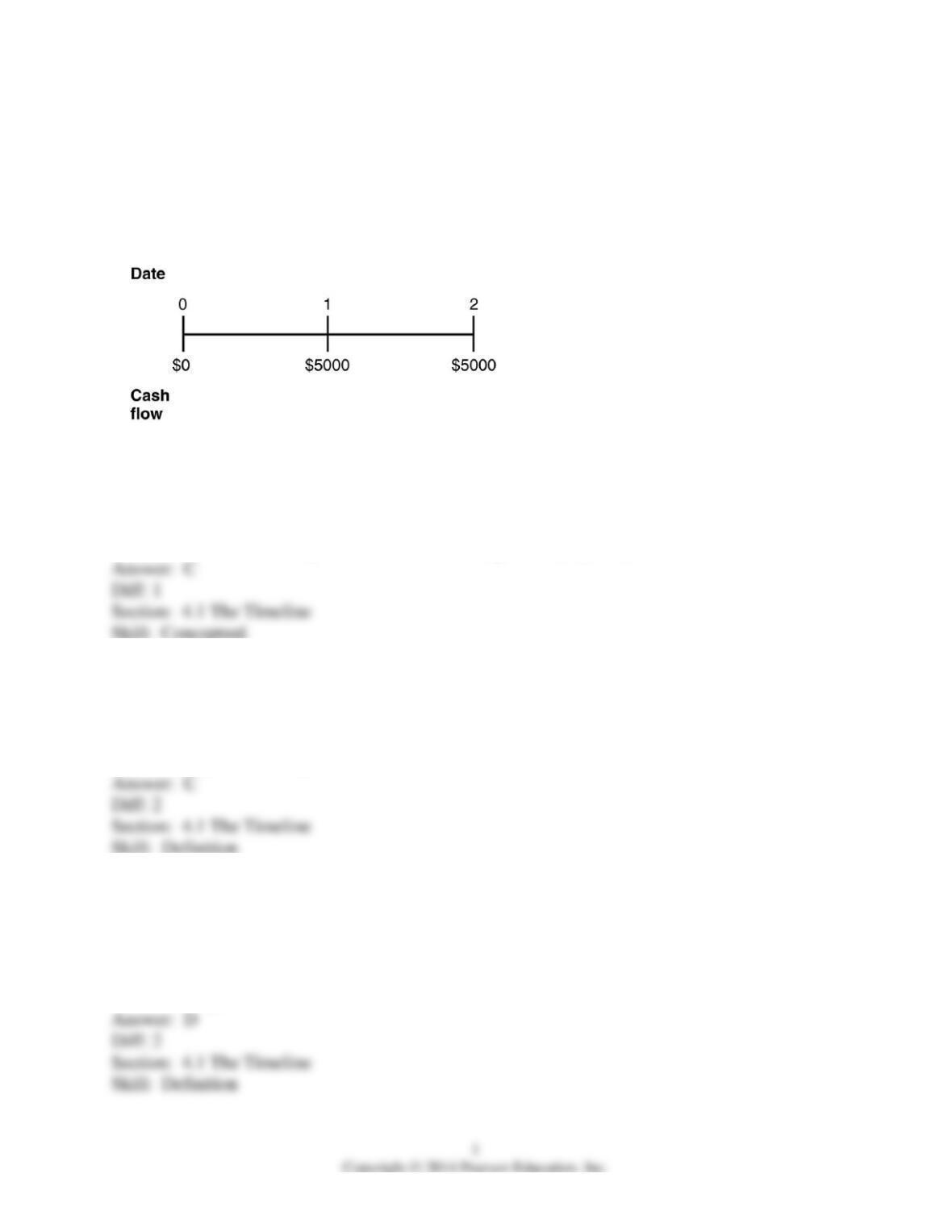
Use the figure for the question(s) below.
1) Which of the following statements regarding timelines is FALSE?
A) Timelines are an important first step in organizing and then solving a financial problem.
B) We refer to a series of cash flows lasting several periods as a stream of cash flows.
C) Not every stream of cash flows can be represented on a timeline.
D) A timeline is a linear representation of the timing of the (expected) cash flows.
2) Which of the following statements regarding the timeline is FALSE?
A) Date 1 is one year from now.
B) The $5000 below date 1 is the payment you will receive at the end of the first year.
C) The $5000 below date 2 is the payment you will receive at the beginning of the second year.
D) Date 0 represents today.
3) Which of the following statements regarding the timeline is FALSE?
A) Date 1 is the end of the first year.
B) Date 0 is the beginning of the first year.
C) The space between date 0 and date 1 represents the time period between two specific dates.
D) You will find the timeline most useful in tracking cash flows if you interpret each point on the
timeline as a period or interval of time.
Use the information for the question(s) below.
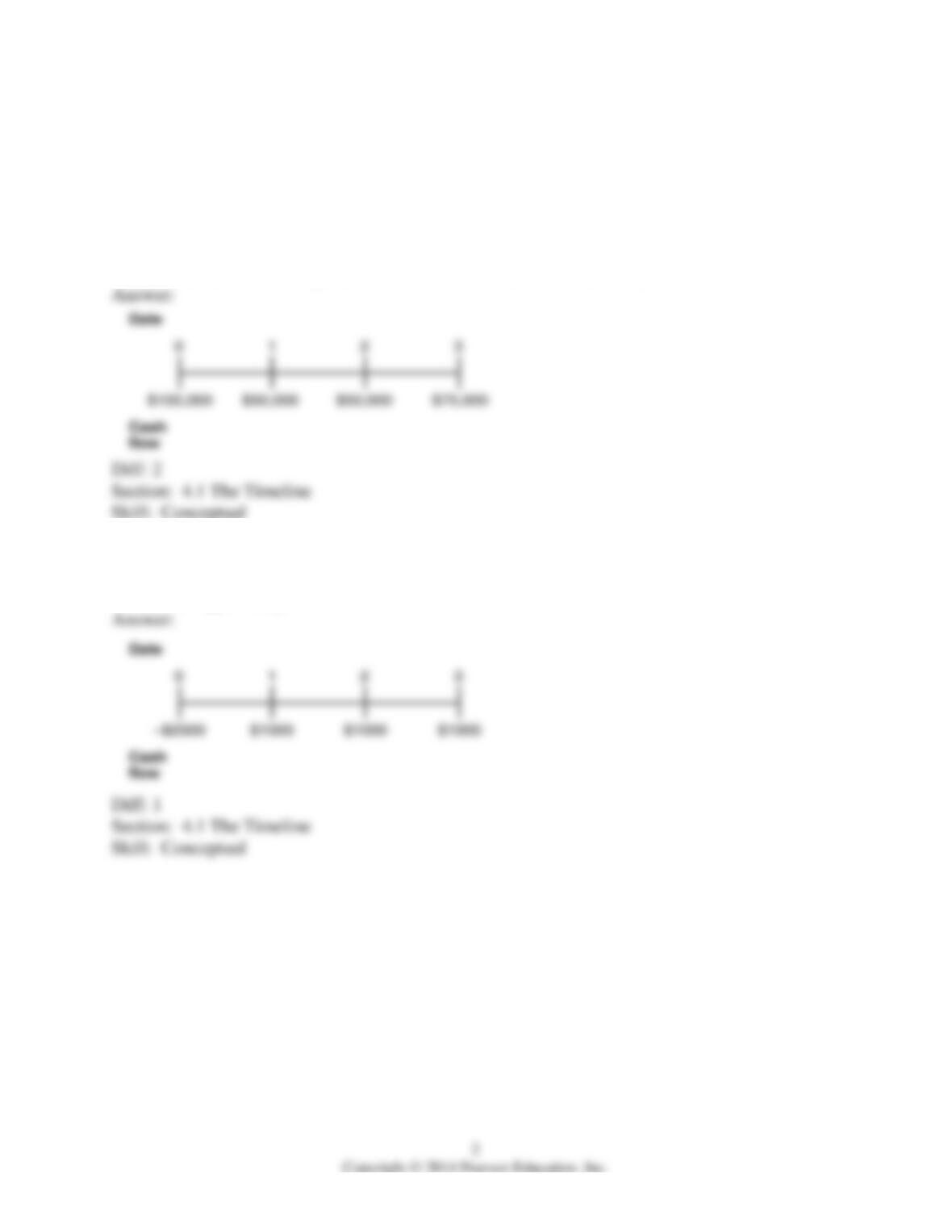
Joe just inherited the family business, and having no desire to run the family business, he has
decided to sell it to an entrepreneur. In exchange for the family business, Joe has been offered an
immediate payment of $100,000. Joe will also receive payments of $50,000 in one year, $50,000
in two years, and $75,000 in three years. The current market rate of interest for Joe is 6%.
4) Draw a timeline detailing Joe’s cash flows from the sale of the family business.
5) You have been offered the following investment opportunity, if you pay $2500 today, you will
receive $1000 at the end of each of the next three years. Draw a timeline detailing this
investment opportunity.
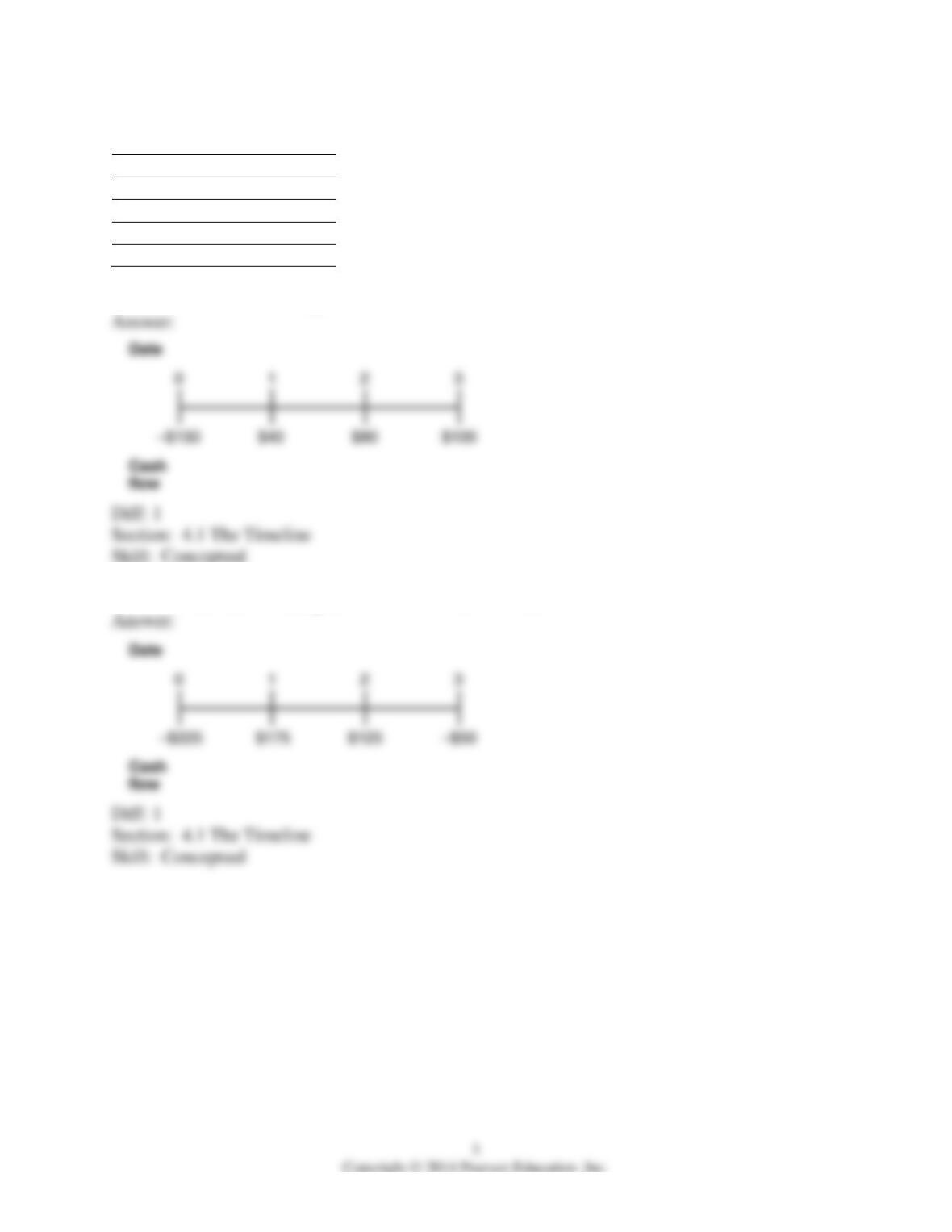
Use the table for the question(s) below.
Year
A
B
0
-$150
-$225
1
40
175
2
80
125
3
100
-50
6) Draw a timeline detailing the cash flows from investment “A.”
7) Draw a timeline detailing the cash flows from investment “B.”
Use the information for the question(s) below.
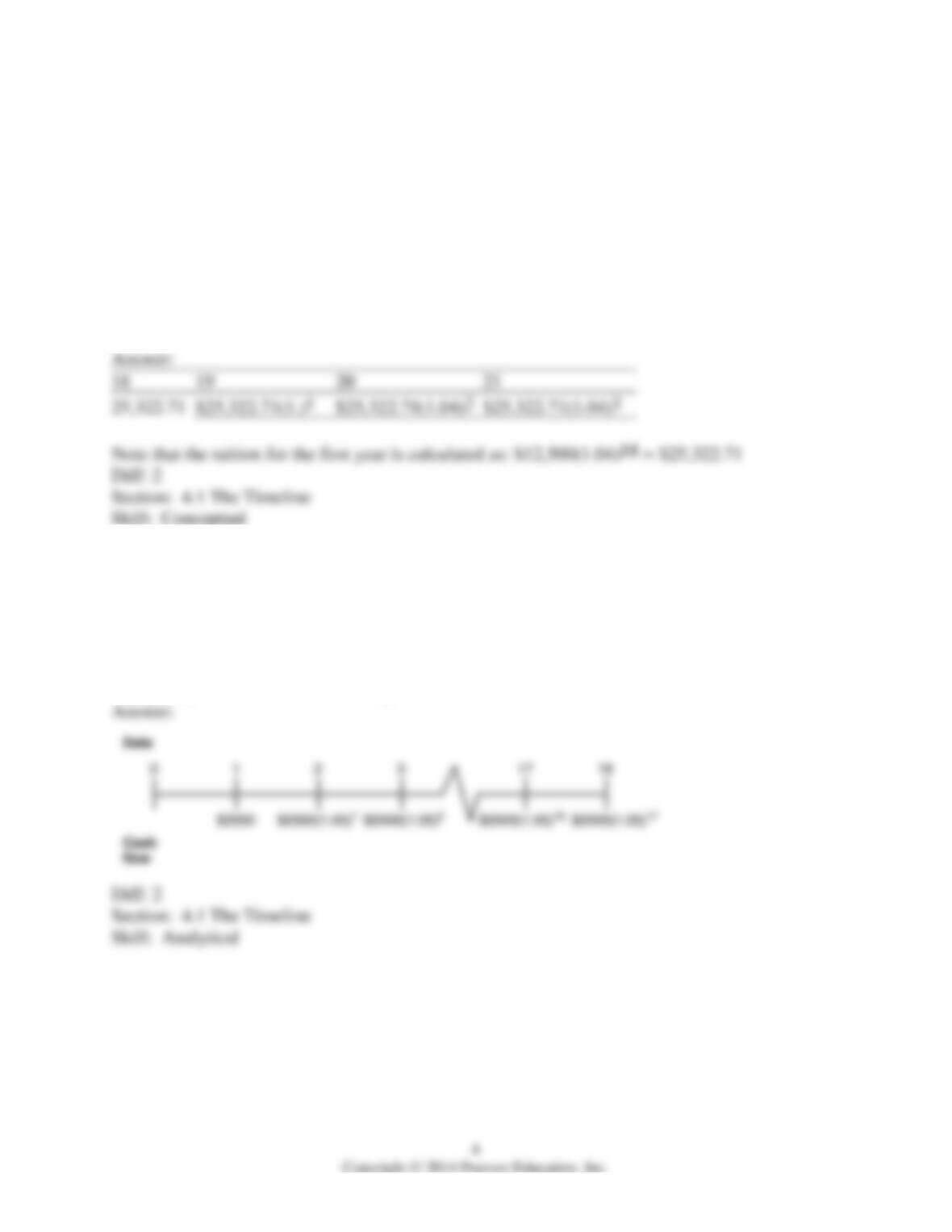
Suppose that a young couple has just had their first baby and they wish to ensure that enough
money will be available to pay for their child’s college education. Currently, college tuition,
books, fees, and other costs, average $12,500 per year. On average, tuition and other costs have
historically increased at a rate of 4% per year.
8) Assume that college costs continue to increase an average of 4% per year and that all her
college savings are invested in an account paying 7% interest. Draw a timeline that details the
amount of money she will need to have in the future four each of her four years of her
undergraduate education.
9) Suppose that a young couple has just had their first baby and they wish to insure that enough
money will be available to pay for their child’s college education. They decide to make deposits
into an educational savings account on each of their daughter’s birthdays, starting with her first
birthday. Assume that the educational savings account will return a constant 7%. The parents
deposit $2000 on their daughter’s first birthday and plan to increase the size of their deposits by
5% each year. Draw a timeline that details the amount that would be available for the daughter’s
college expenses on her 18th birthday.
4.2 The Three Rules of Time Travel
1) Which of the following statements is FALSE?
A) The process of moving a value or cash flow forward in time is known as compounding.
B) The effect of earning interest on interest is known as compound interest.
C) It is only possible to compare or combine values at the same point in time.
D) A dollar in the future is worth more than a dollar today.
2) Which of the following statements is FALSE?
A) Finding the present value and compounding are the same.
B) A dollar today and a dollar in one year are not equivalent.
C) If you want to compare or combine cash flows that occur at different points in time, you first
need to convert the cash flows into the same units or move them to the same point in time.
D) The equivalent value of two cash flows at two different points in time is sometimes referred
to as the time value of money.
3) At an annual interest rate of 7%, the future value of $5,000 in five years is closest to:
A) $3,565
B) $6,750
C) $7,015
D) $7,035
4) At an annual interest rate of 7%, the present value of $5,000 received in five years is closest
to:
A) $3,565
B) $6,750
C) $7,015
D) $7,035
Use the following information to answer the question(s) below.
Consider the following four alternatives:
1. $132 received in two years.
2. $160 received in five years.
3. $200 received in eight years.
4. $220 received in ten years.
5) The ranking of the four alternatives from most valuable to least valuable if the interest rate is
7% per year would be:
A) 1, 2, 3, 4
B) 4, 3, 2, 1
C) 3, 4, 2, 1
D) 3, 1, 2, 4
6) The ranking of the four alternatives from most valuable to least valuable if the interest rate is
6% per year would be:
A) 1, 2, 3, 4
B) 1, 3, 2, 4
C) 4, 3, 1, 2
D) 3, 4, 2, 1
Use the following information to answer the question(s) below.
Your great aunt Matilda put some money in an account for you on the day you were born. This
account pays 8% interest per year. On your 21st birthday the account balance was $5,033.83.
7) The amount of money that your great aunt Matilda originally put in the account is closest to:
A) $600
B) $800
C) $1,000
D) $1,200
8) The amount of money that would be in the account if you left the money there until your 65th
birthday is closest to:
A) $29,556
B) $148,780
C) $168,824
D) $748,932
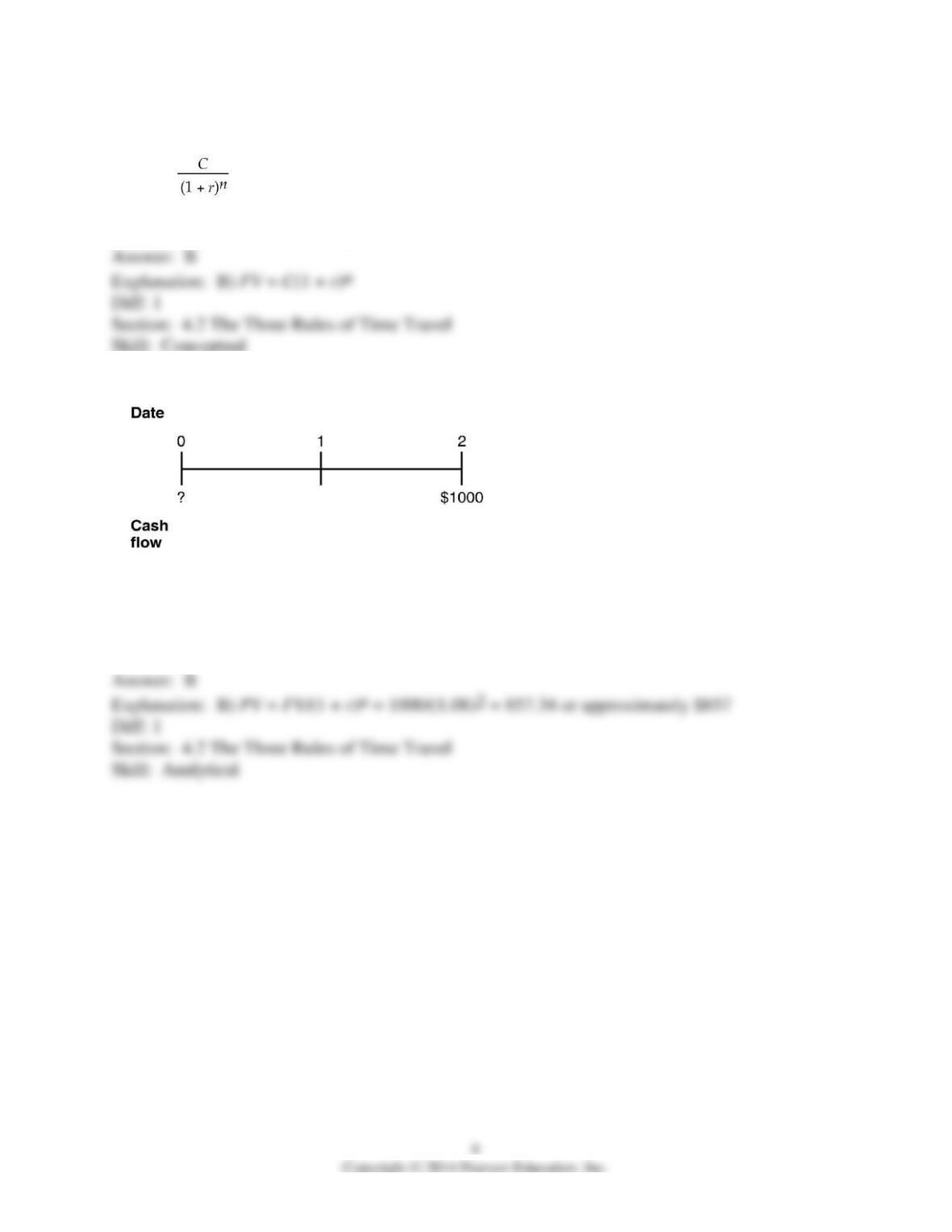
9) Which of the following statements is FALSE?
A) The process of moving a value or cash flow backward in time is known as discounting.
B) FV =
C) The process of moving a value or cash flow forward in time is known as compounding.
D) The value of a cash flow that is moved forward in time is known as its future value.
10) Consider the following time line:
If the current market rate of interest is 8%, then the present value of this timeline is closest to:
A) $1000
B) $857
C) $860
D) $926
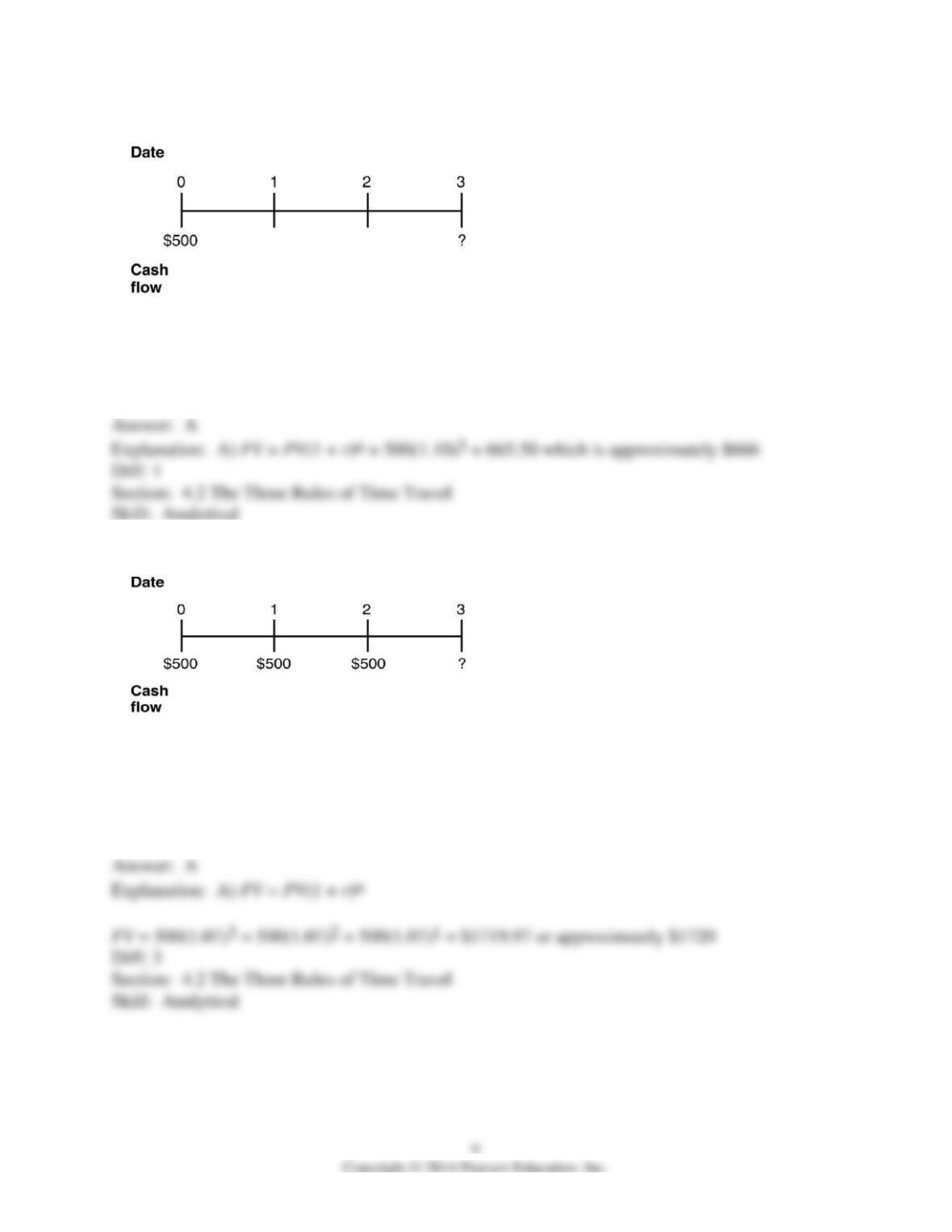
11) Consider the following timeline:
If the current market rate of interest is 10%, then the future value of this timeline is closest to:
A) $666
B) $500
C) $605
D) $650
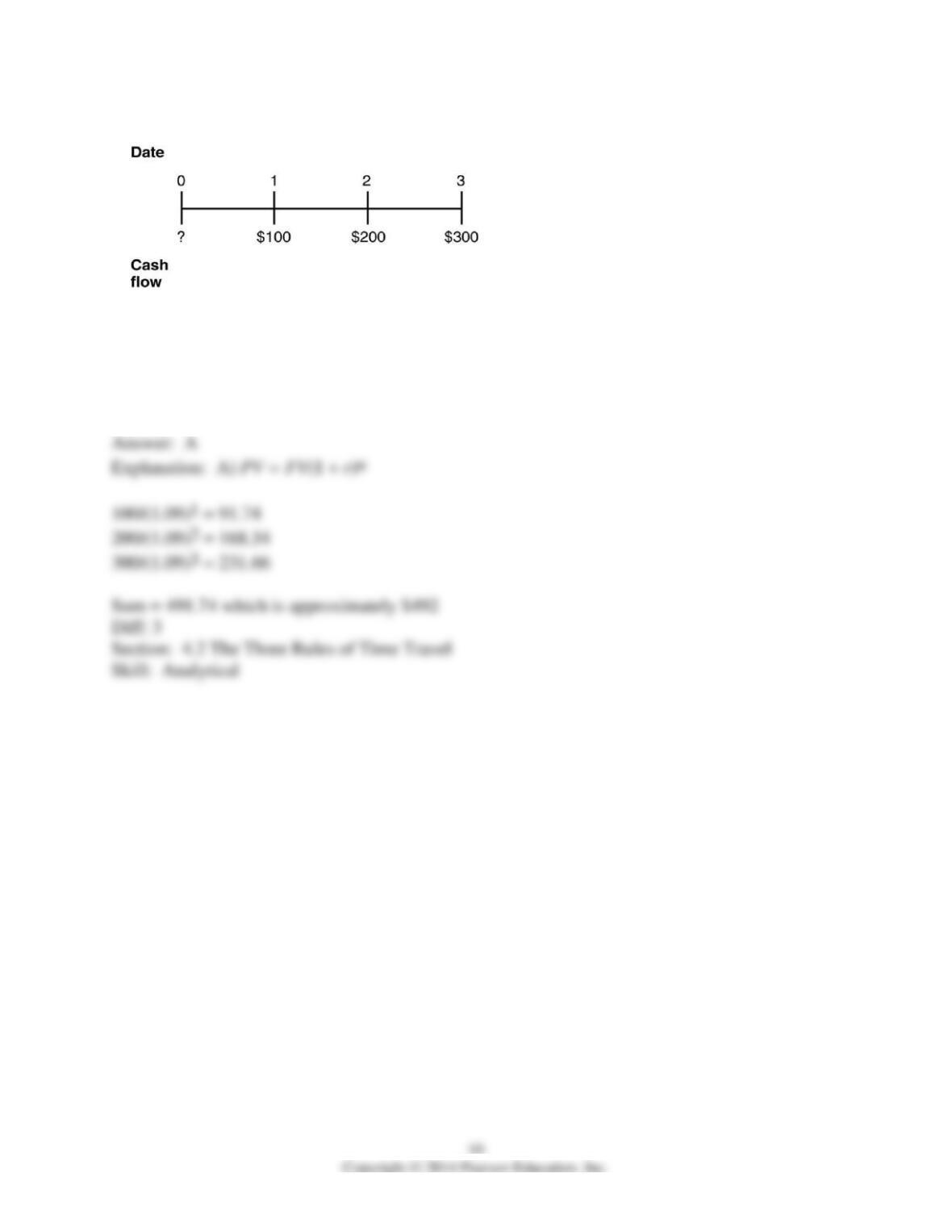
12) Consider the following timeline:
If the current market rate of interest is 7%, then the future value of this timeline as of year 3 is
closest to:
A) $1720
B) $1500
C) $1404
D) $1717
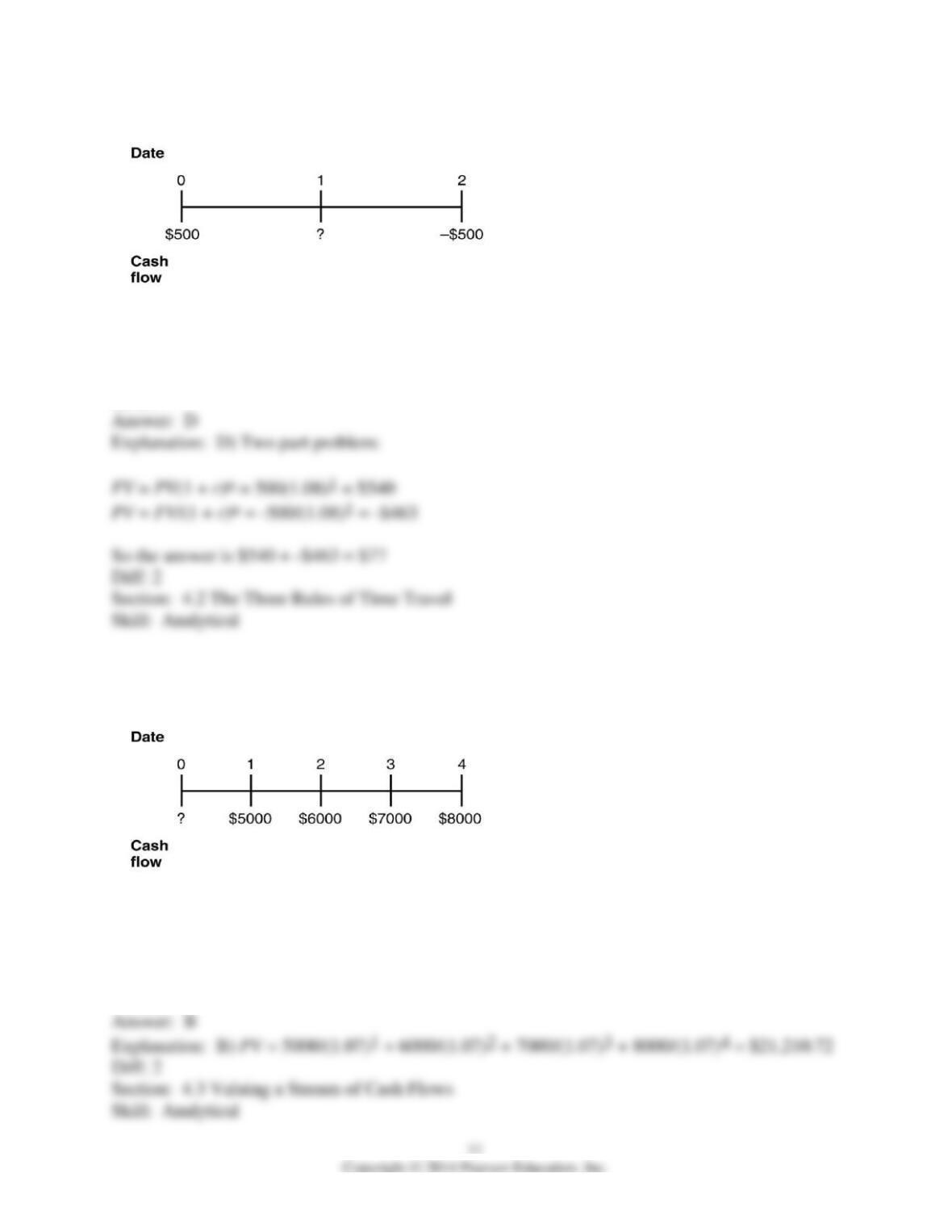
13) Consider the following timeline:
If the current market rate of interest is 9%, then the present value of this timeline as of year 0 is
closest to:
A) $492
B) $637
C) $600
D) $400
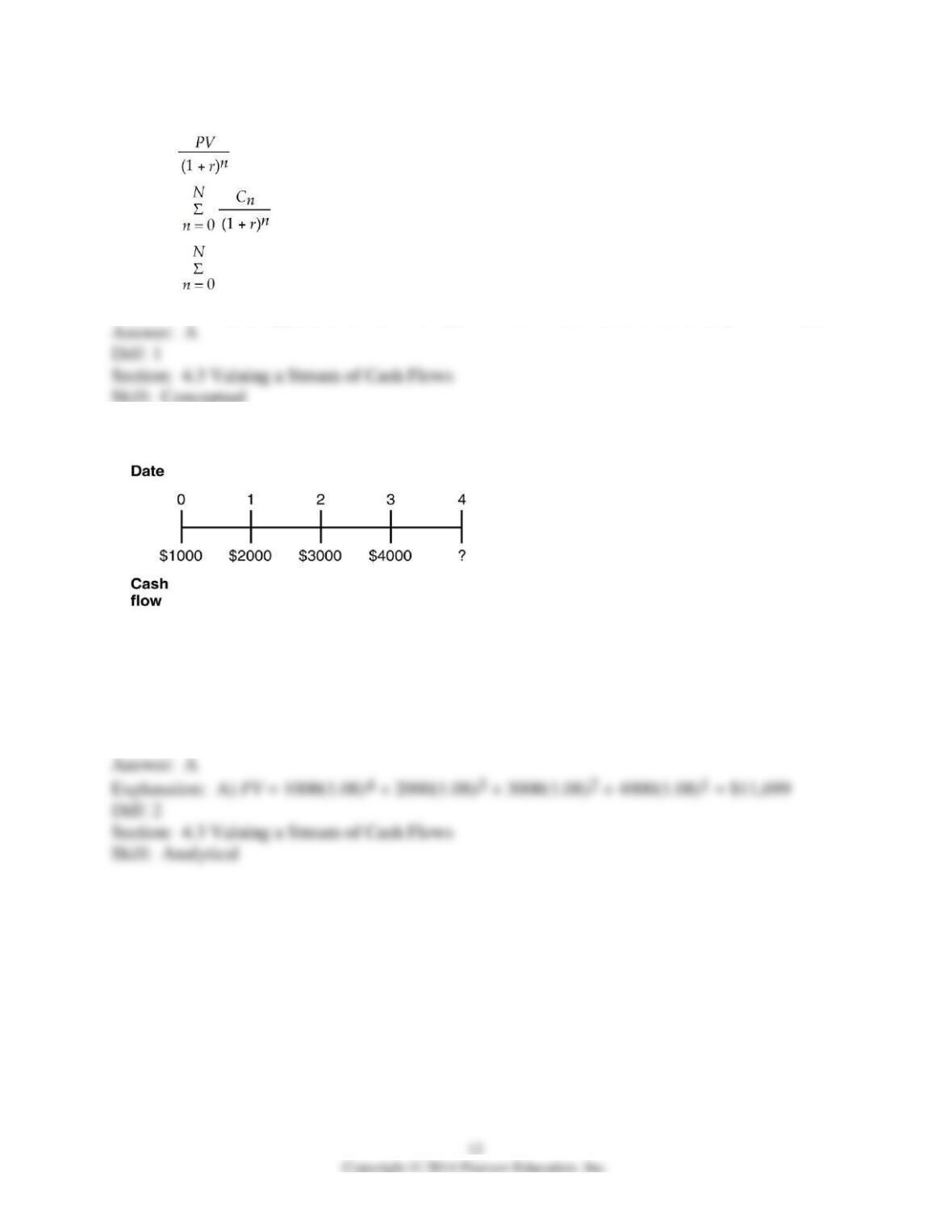
14) Consider the following timeline:
If the current market rate of interest is 8%, then the value as of year 1 is closest to:
A) $0
B) $1003
C) $540
D) $77
4.3 Valuing a Stream of Cash Flows
1) Consider the following timeline detailing a stream of cash flows:
If the current market rate of interest is 8%, then the present value of this stream of cash flows is
closest to:
A) $22,871
B) $21,211
C) $24,074
D) $26,000
2) Which of the following statements is FALSE?
A) FV =
B) PV =
C) FV = Cn × (1 + r)n
D) Most investment opportunities have multiple cash flows that occur at different points in time.
3) Consider the following timeline detailing a stream of cash flows:
If the current market rate of interest is 8%, then the future value of this stream of cash flows is
closest to:
A) $11,699
B) $10,832
C) $12,635
D) $10,339
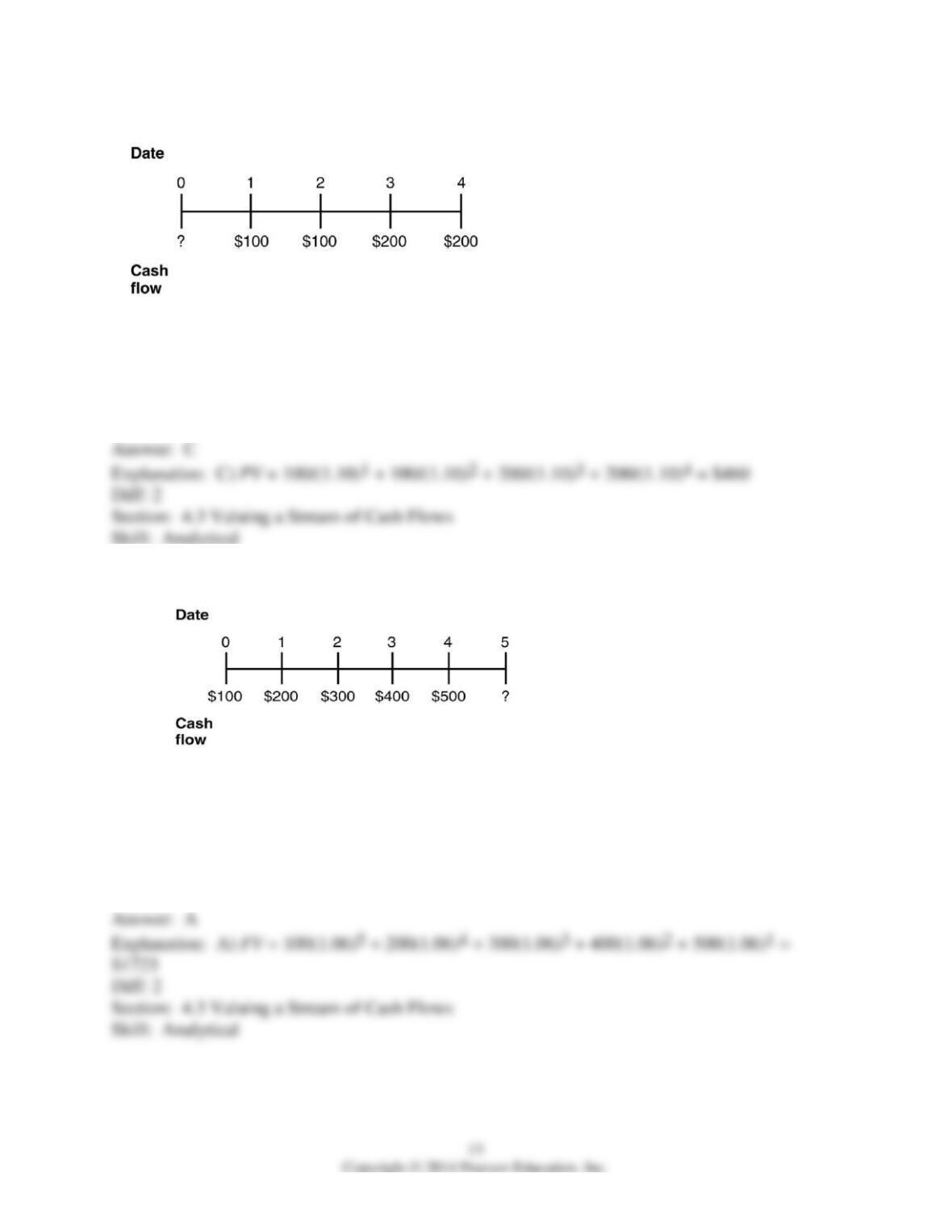
4) Consider the following timeline detailing a stream of cash flows:
If the current market rate of interest is 10%, then the present value of this stream of cash flows is
closest to:
A) $674
B) $600
C) $460
D) $287
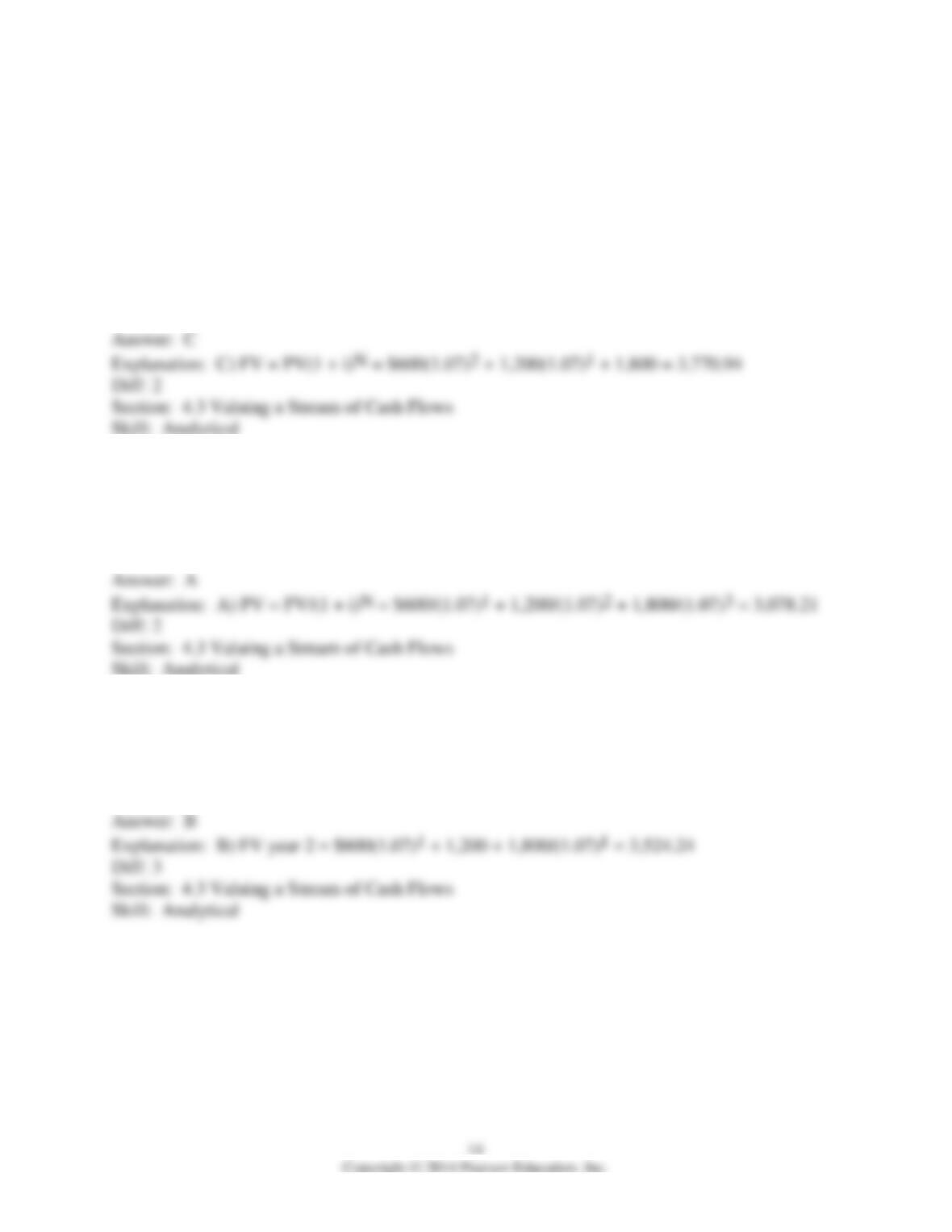
5) Consider the following timeline detailing a stream of cash
flows:
If the current market rate of interest is 6%, then the future value of this stream of cash flows is
closest to:
A) $1,723
B) $1,500
C) $1,626
D) $1,288
Use the following timeline to answer the question(s) below.
0 1 2 3
$600 $1,200 $1,800
6) At an annual interest rate of 7%, the future value of this timeline in year 3 is closest to:
A) $3,295
B) $3,600
C) $3,770
D) $4,035
7) At an annual interest rate of 7%, the present value of this timeline in year 0 is closest to:
A) $3,080
B) $3,600
C) $3,770
D) $4,035
8) At an annual interest rate of 7%, the future value of this timeline in year 2 is closest to:
A) $3,080
B) $3,525
C) $3,770
D) $4,035
9) Taggart Transcontinental currently has a bank loan outstanding that requires it to make three
annual payments at the end of the next three years of $1,000,000 each. The bank has offered to
allow Taggart Transcontinental to skip making the next two payments in lieu of making one
large payment at the end of the loan’s term in three years. If the interest rate on the loan is 6%,
then the final payment that the bank will require to make Taggart Transcontinental indifferent
between the two forms of payments is closest to:
A) $2,673,000
B) $3,000,000
C) $3,184,000
D) $3,375,000
Use the information for the question(s) below.
Joe just inherited the family business, and having no desire to run the family business, he has
decided to sell it to an entrepreneur. In exchange for the family business, Joe has been offered an
immediate payment of $100,000. Joe will also receive payments of $50,000 in one year, $50,000
in two years, and $75,000 in three years. The current market rate of interest for Joe is 6%.
10) In terms of present value, how much will Joe receive for selling the family business?
4.4 Calculating the Net Present Value
Use the following information to answer the question(s) below.
Nielson Motors is considering an opportunity that requires an investment of $1,000,000 today
and will provide $250,000 one year from now, $450,000 two years from now, and $650,000
three years from now.
1) If the appropriate interest rate is 10%, then the NPV of this opportunity is closest to:
A) ($88,000)
B) $88,000
C) $300,000
D) $1,300,000
2) If the appropriate interest rate is 10%, then Nielson Motors should:
A) invest in this opportunity since the NPV is positive.
B) not invest in this opportunity since the NPV is positive.
C) invest in this opportunity since the NPV is negative.
D) not invest in this opportunity since the NPV is negative.
3) If the appropriate interest rate is 15%, then Nielson Motors should:
A) invest in this opportunity since the NPV is positive.
B) not invest in this opportunity since the NPV is positive.
C) invest in this opportunity since the NPV is negative.
D) not invest in this opportunity since the NPV is negative.
4) Kampgrounds Inc. is considering purchasing a parcel of wilderness land near a popular
historic site. Although this land will cost Kampgrounds $400,000 today, by renting out
wilderness campsites on this land, Kampgrounds expects to make $35,000 at the end of every
year indefinitely. If the appropriate discount rate is 8%, then the NPV of this new wilderness
campsite is closest to:
A) -$50,000
B) -$37,500
C) $37,500
D) $50,000
5) Wyatt oil is considering drilling a new self sustaining oil well at a cost of $1,000,000. This
well will produce $100,000 worth of oil during the first year, but as oil is removed from the well
the amount of oil produced will decline by 2%, per year forever. If the Wyatt oil’s appropriate
interest rate is 8%, then the NPV of this oil well is closest to:
A) -$250,000
B) $0
C) $250,000
D) $1,000,000
1) Which of the following statements regarding perpetuities is FALSE?
A) To find the value of a perpetuity one cash flow at a time would take forever.
B) A perpetuity is a stream of equal cash flows that occurs at regular intervals and lasts forever.
C) PV of a perpetuity =
D) One example of a perpetuity is the British government bond called a consol.
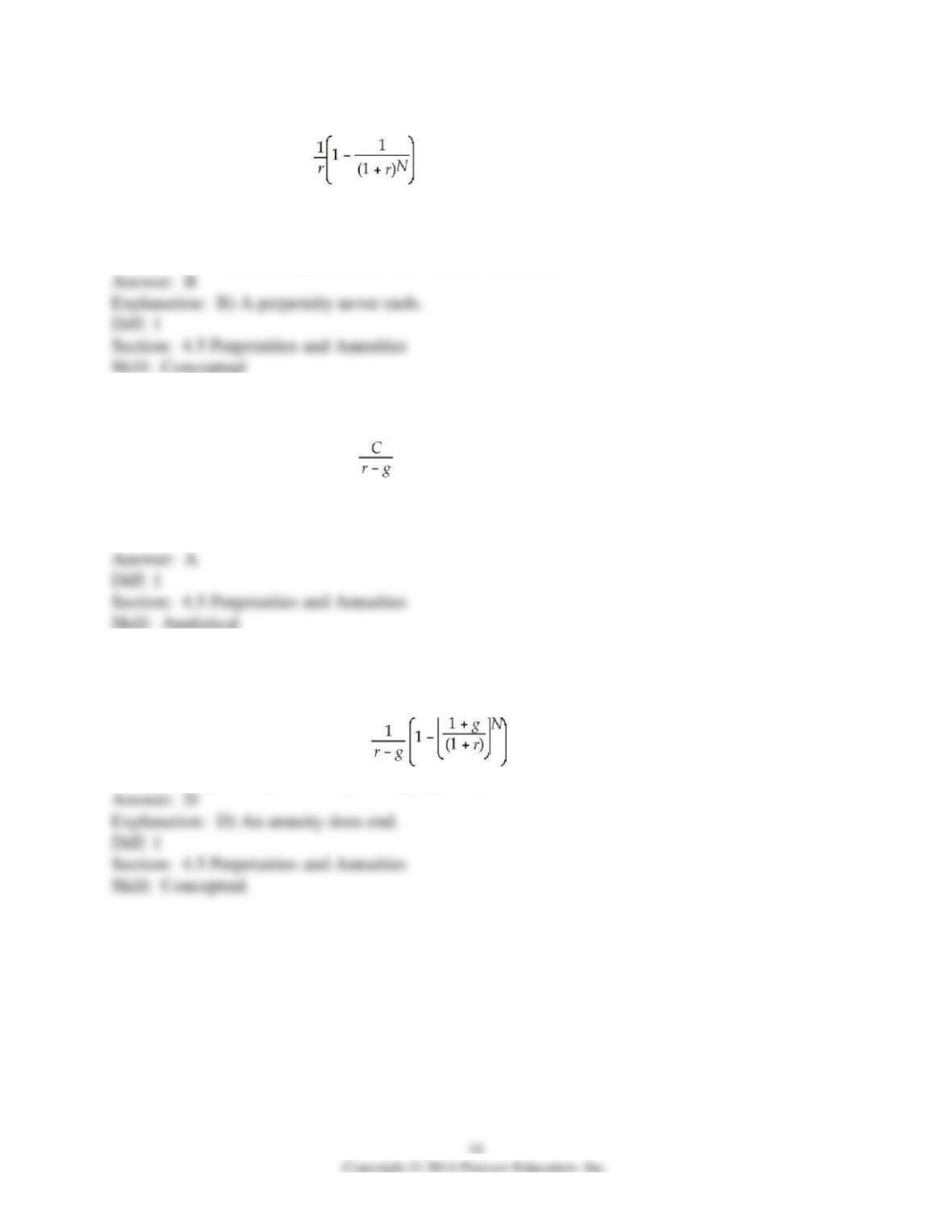
2) Which of the following statements regarding annuities is FALSE?
A) PV of an annuity = C ×
B) The difference between an annuity and a perpetuity is that a perpetuity ends after some fixed
number of payments.
C) An annuity is a stream of N equal cash flows paid at regular intervals.
D) Most car loans, mortgages, and some bonds are annuities.
3) Which of the following statements regarding growing perpetuities is FALSE?
A) We assume that r < g for a growing perpetuity.
B) PV of a growing perpetuity =
C) To find the value of a growing perpetuity one cash flow at a time would take forever.
D) A growing perpetuity is a cash flow stream that occurs at regular intervals and grows at a
constant rate forever.
4) Which of the following statements regarding growing annuities is FALSE?
A) A growing annuity is a stream of N growing cash flows, paid at regular intervals.
B) We assume that g < r when using the growing annuity formula.
C) PV of a growing annuity = C ×
D) A growing annuity is like a growing perpetuity that never comes to an end.
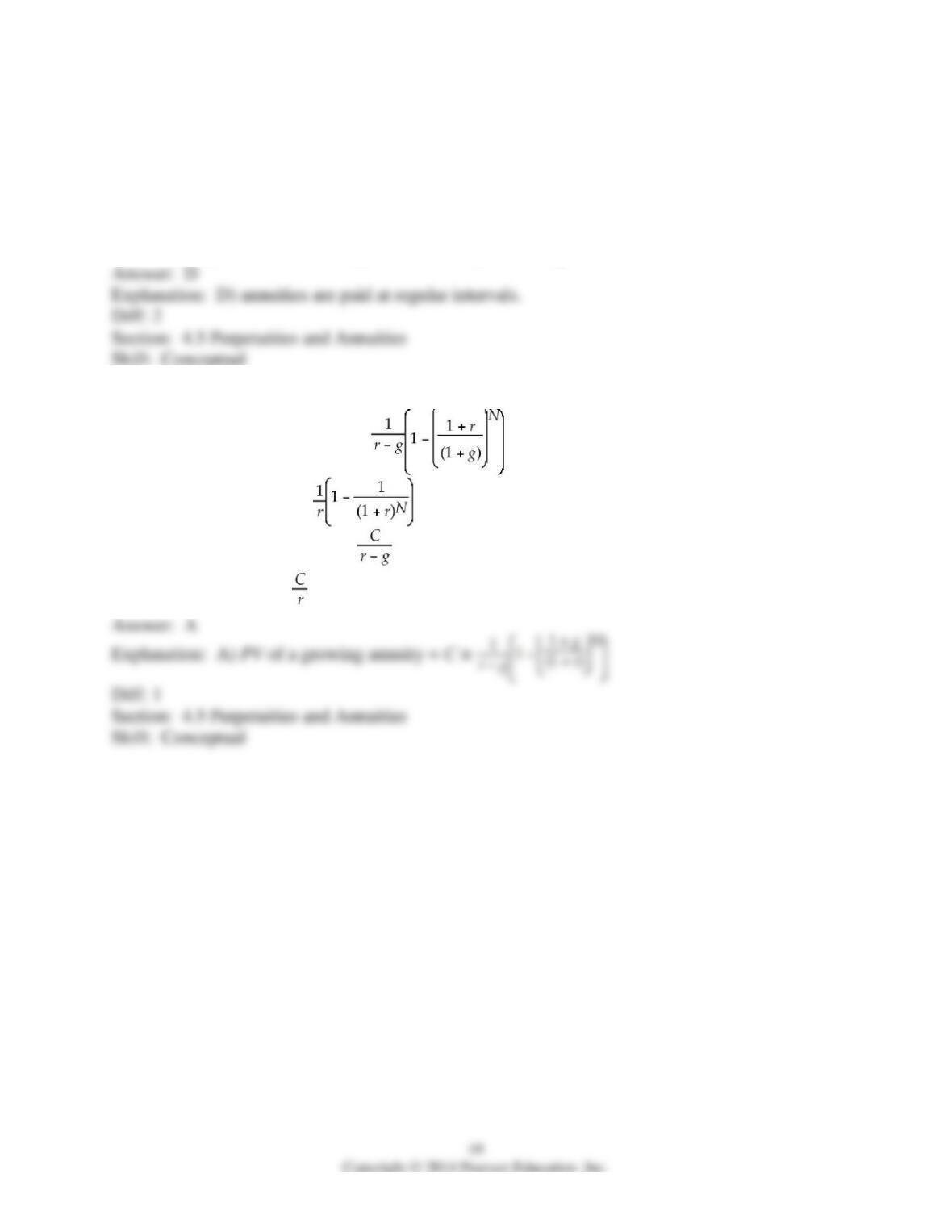
5) Which of the following statements is FALSE?
A) The difference between an annuity and a perpetuity is that an annuity ends after some fixed
number of payments.
B) Most car loans, mortgages, and some bonds are annuities.
C) A growing perpetuity is a cash flow stream that occurs at regular intervals and grows at a
constant rate forever.
D) An annuity is a stream of N equal cash flows paid at irregular intervals.
6) Which of the following formulas is INCORRECT?
A) PV of a growing annuity = C ×
B) PV of an annuity = C ×
C) PV of a growing perpetuity =
D) PV of a perpetuity =
Use the information for the question(s) below.
Suppose that a young couple has just had their first baby and they wish to ensure that enough
money will be available to pay for their child’s college education. Currently, college tuition,
books, fees, and other costs, average $12,500 per year. On average, tuition and other costs have
historically increased at a rate of 4% per year.
7) Assuming that costs continue to increase an average of 4% per year, tuition and other costs for
one year for this student in 18 years when she enters college will be closest to:
A) $12,500
B) $21,500
C) $320,568
D) $25,323
8) Assuming that college costs continue to increase an average of 4% per year and that all her
college savings are invested in an account paying 7% interest, then the amount of money she will
need to have available at age 18 to pay for all four years of her undergraduate education is
closest to:
A) $97,110
B) $107,532
C) $101,291
D) $50,000