Chapter 4: The Balance Sheet and the Statement of Shareholders’ Equity
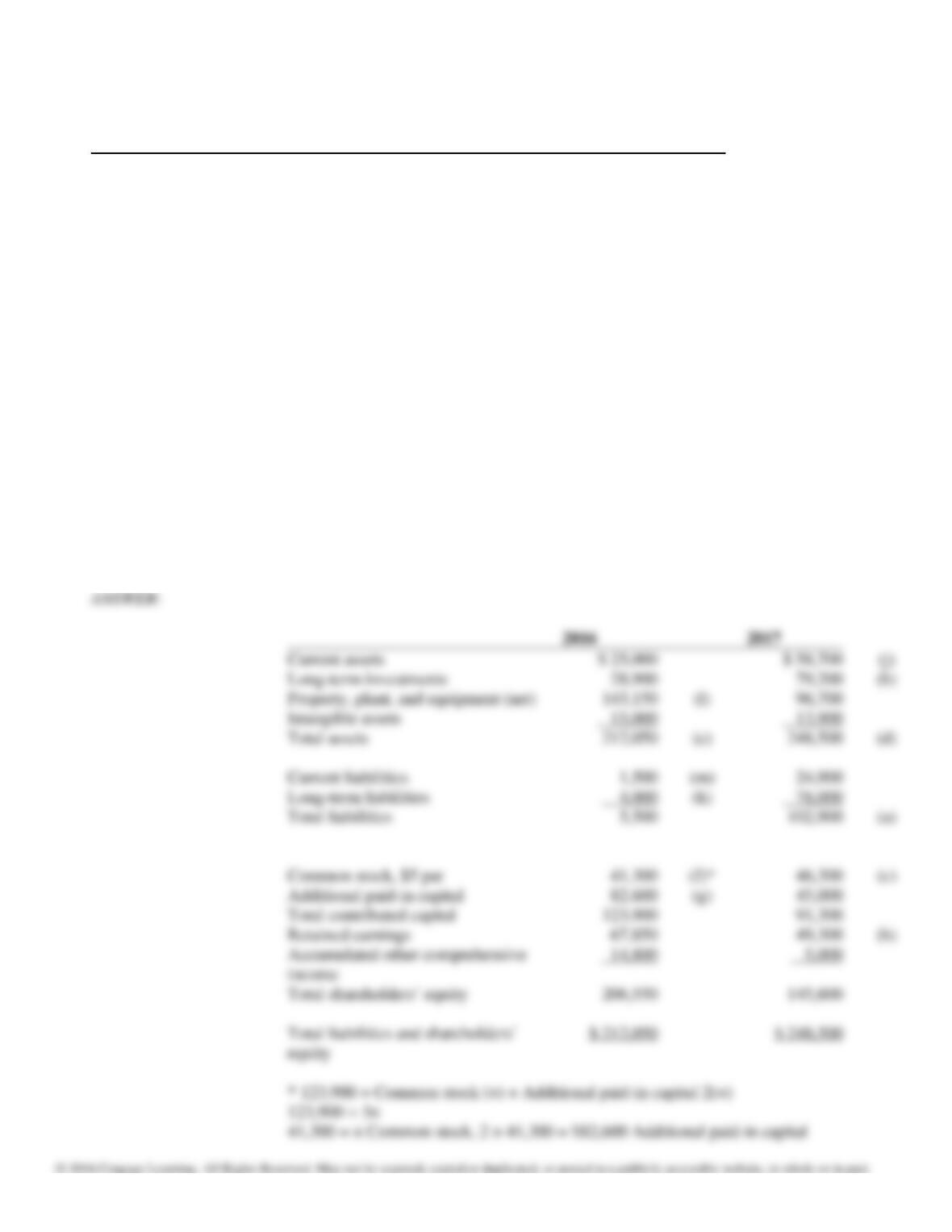
109. Gerald Company’s balance sheet information at the end of 2016 and 2017 is as follows:
2016
2017
Total shareholders’ equity
$ (n)
$ 145,600
Accumulated other comprehensive income
14,800
5,000
Current liabilities
(m)
24,900
Intangible assets
15,000
13,900
Property, plant, and equipment (net)
(l)
96,700
Current assets
25,000
(j)
Total contributed capital
123,900
(i)
Long-term liabilities
(k)
78,000
Retained earnings
67,850
(h)
Total assets
(e)
(d)
Common stock, $5 par
(f)
(c)
Working capital
23,500
33,800
Additional paid-in capital
(g)
45,000
Long-term investments
28,900
(b)
Total liabilities
5,500
(a)
At the end of 2016, additional paid-in capital was twice the amount of common stock. During 2017 the company
issued 1,000 shares of common stock.
Required:
Fill in the blanks lettered a through n. It is not necessary to calculate the information in alphabetical order.
Current assets
Long-term investments
Property, plant, and equipment (net)
96,700
Intangible assets
Total assets
Current liabilities
24,900
Long-term liabilities
Total liabilities
Common stock, $5 par
46,300
Additional paid-in capital
Total contributed capital
Retained earnings
49,300
income
Total shareholders’ equity
Chapter 4: The Balance Sheet and the Statement of Shareholders’ Equity
Current Assets:
Cash
Marketable securities,
Total current assets:
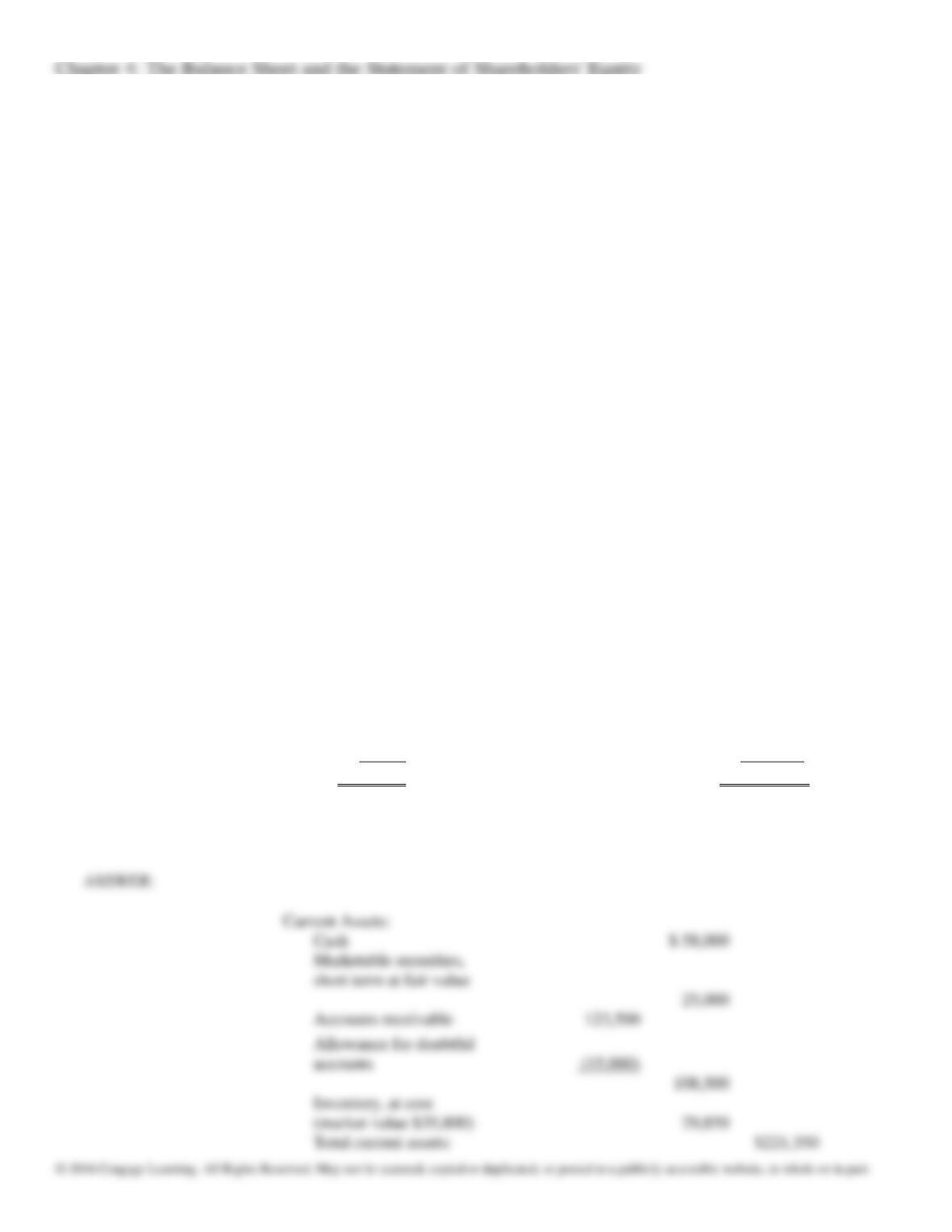
110. Hardy’s bookkeeper provided the following balance sheet.
HARDY COMPANY
Balance Report for the year ended December 31, 2016
Current Assets:
Current Liabilities:
Cash
$ 58,000
Accounts payable
$ 25,000
Accounts receivable
123,500
Accumulated depreciation:
buildings
20,000
Inventory, at higher of cost
or market (cost $29,850)
35,800
Wages payable
22,200
Sinking fund for bond
retirement
115,000
Additional paid-in capital
on common stock
100,000
Long-Term Investments:
Long-Term Liabilities:
Treasury stock (at cost)
55,500
Bonds payable
100,000
Investments in bonds
100,000
Preferred stock, $50 par
150,000
Marketable securities,
short term at fair value
25,000
Allowance for doubtful accounts
15,000
Trademark
25,000
Premium on preferred stock
45,000
Property, Plant, and Equipment:
Accumulated depreciation:
equipment
12,000
Land
75,000
Current taxes payable
10,000
Buildings
100,000
Shareholders’ Equity:
Equipment
45,000
Common Stock, $1 par
75,000
Intangibles:
Employees
Copyrights
150,000
15,000
Unrealized gain on write
up of inventory to market
value
5,950
Patents
20,000
Retained earnings
362,650
Total Assets
$ 942,800
Total Equities
$ 942,800
Required:
Prepare the corrected asset section of a classified balance sheet.
Chapter 4: The Balance Sheet and the Statement of Shareholders’ Equity
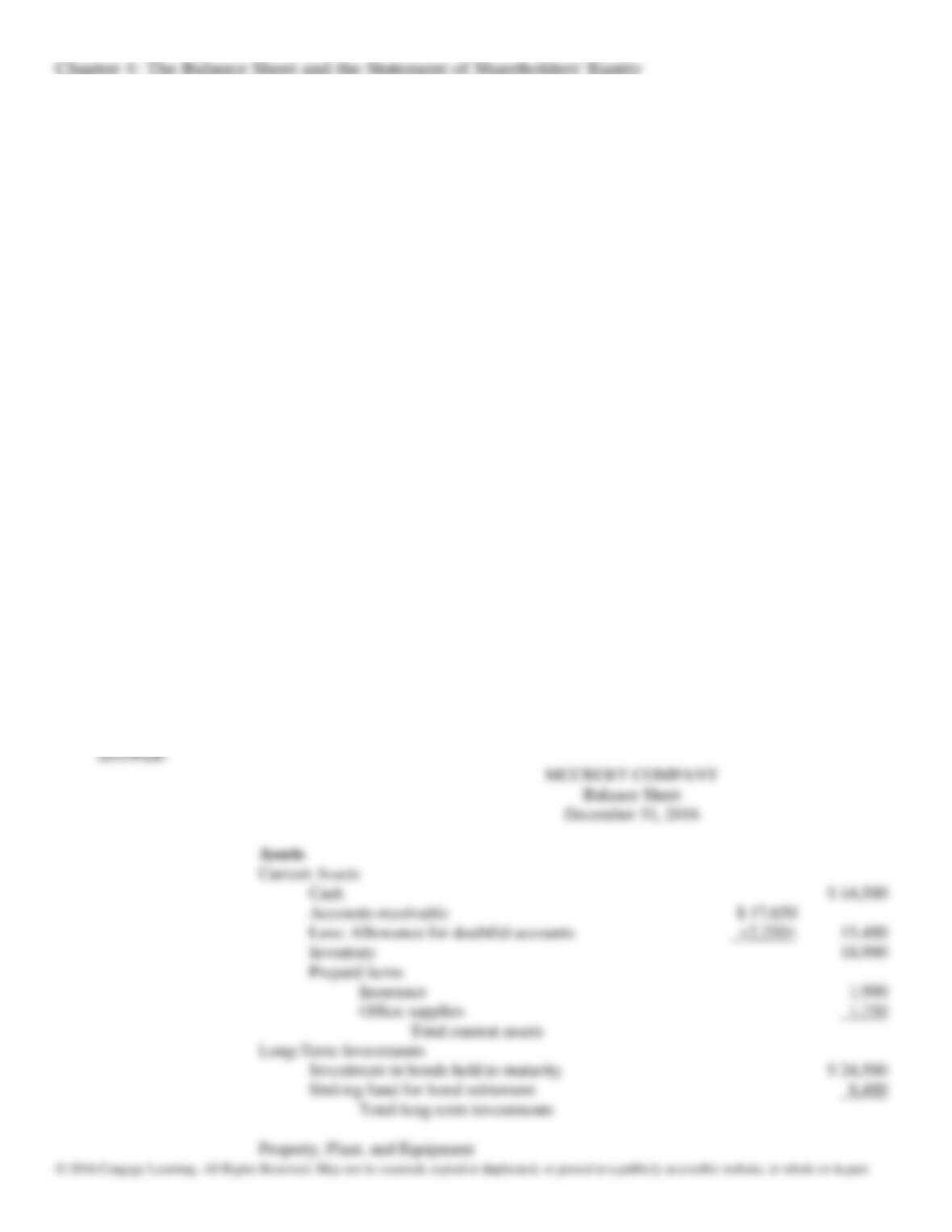
111. Listed below (in random order) are all of the December 31, 2016 balance sheet accounts of McCrery Company.
Land
$70,500
Sinking fund for bond retirement
8,400
Discount on bonds payable
8,900
Equipment
24,000
Preferred stock, $100 par
5,000
Accumulated depreciation, buildings
5,500
Investment in bonds held to maturity
24,500
Accrued wages
3,950
Additional paid-in capital on common stock
3,500
Buildings
117,500
Bonds payable (due 2019)
113,000
Office supplies
1,750
Retained earnings
17,400
Inventory
18,900
Accounts receivable
17,650
Accounts payable
15,650
Prepaid insurance
1,900
Common stock, $10 par
106,750
Allowance for doubtful accounts
2,250
Interest payable
1,500
Cash
14,500
Treasury stock (at cost)
1,150
Dividends payable
14,750
Additional paid-in capital on preferred stock
2,150
Notes payable (due 1/1/19)
8,000
Income taxes payable (current)
6,000
Accumulated depreciation, equipment
4,250
Required:
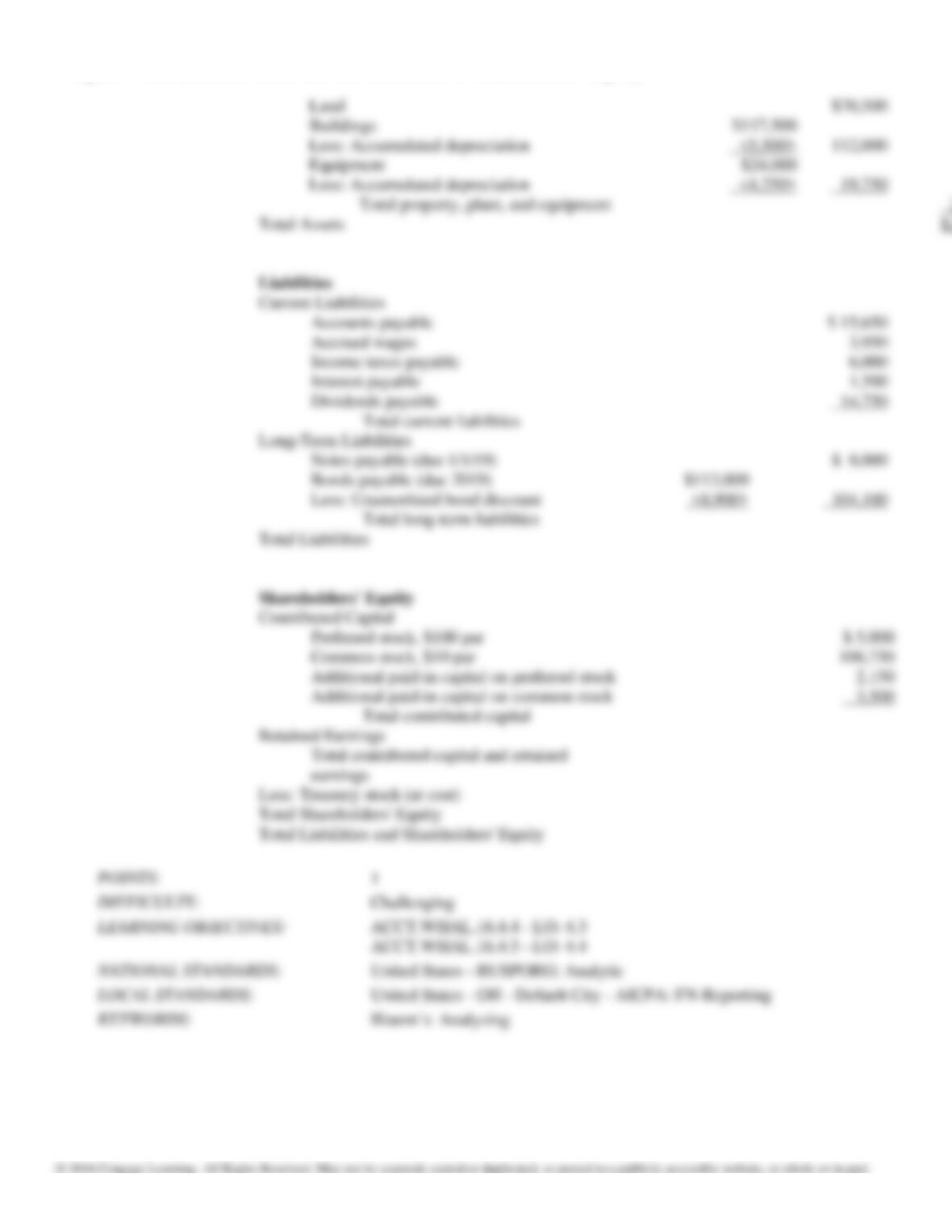
Prepare a properly classified balance sheet for McCrery Company on December 31, 2016.
Chapter 4: The Balance Sheet and the Statement of Shareholders’ Equity
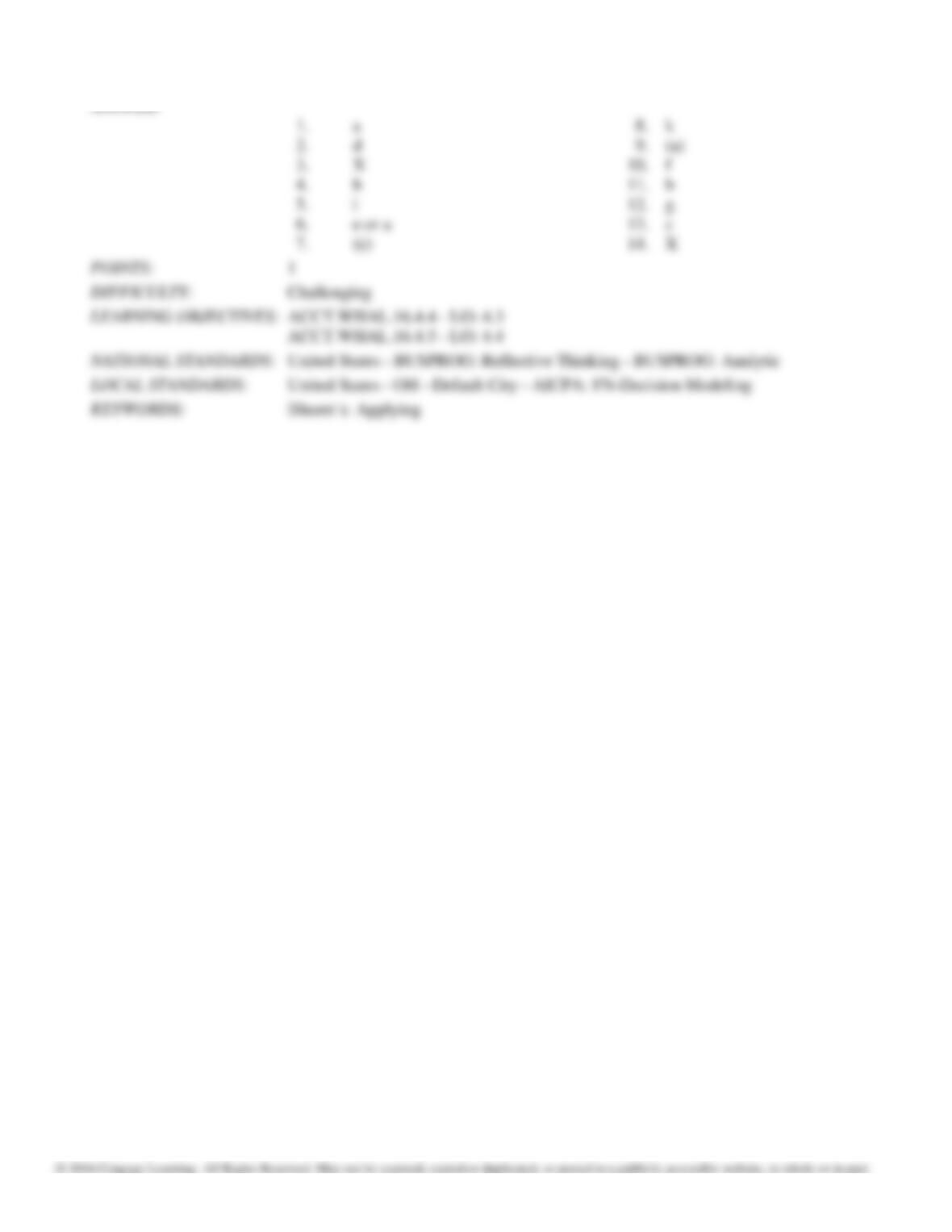
112. The balance sheet contains the major sections (a–k) listed below. A listing of account titles (1-12) follows.
a.
Current assets
g.
Long-term liabilities
b.
Long-term investments
h.
Other liabilities
c.
Property, plant, and equipment
i.
Contributed capital
d.
Intangible assets
j.
Retained earnings
e.
Other assets
k.
Accumulated other comprehensive
f.
Current liabilities
income
____
1.
Work in process inventory
____
2.
Trademarks
____
3.
Sales
____
4.
Cash surrender value of life insurance policy
____
5.
Additional paid-in capital on common stock
____
6.
Deferred tax assets
____
7.
Accumulated depreciation
____
8.
Unrealized decrease in value in available for sale securities
____
9.
Allowance for uncollectible accounts receivable
____
10.
Interest payable
____
11.
Sinking fund for preferred stock retirement
____
12.
Bonds Payable (due in 10 years)
____
13.
Leased machinery under a capital lease
____
14.
Cost of goods sold
Required:
Using the letters (a-k), indicate in which section of the balance sheet each of the accounts (1–14) would be classified.
Put parentheses around the letter used if it represents a contra account. If the account does not appear on the balance
sheet, place an “X” in the space provided.
Chapter 4: The Balance Sheet and the Statement of Shareholders’ Equity
Chapter 4: The Balance Sheet and the Statement of Shareholders’ Equity
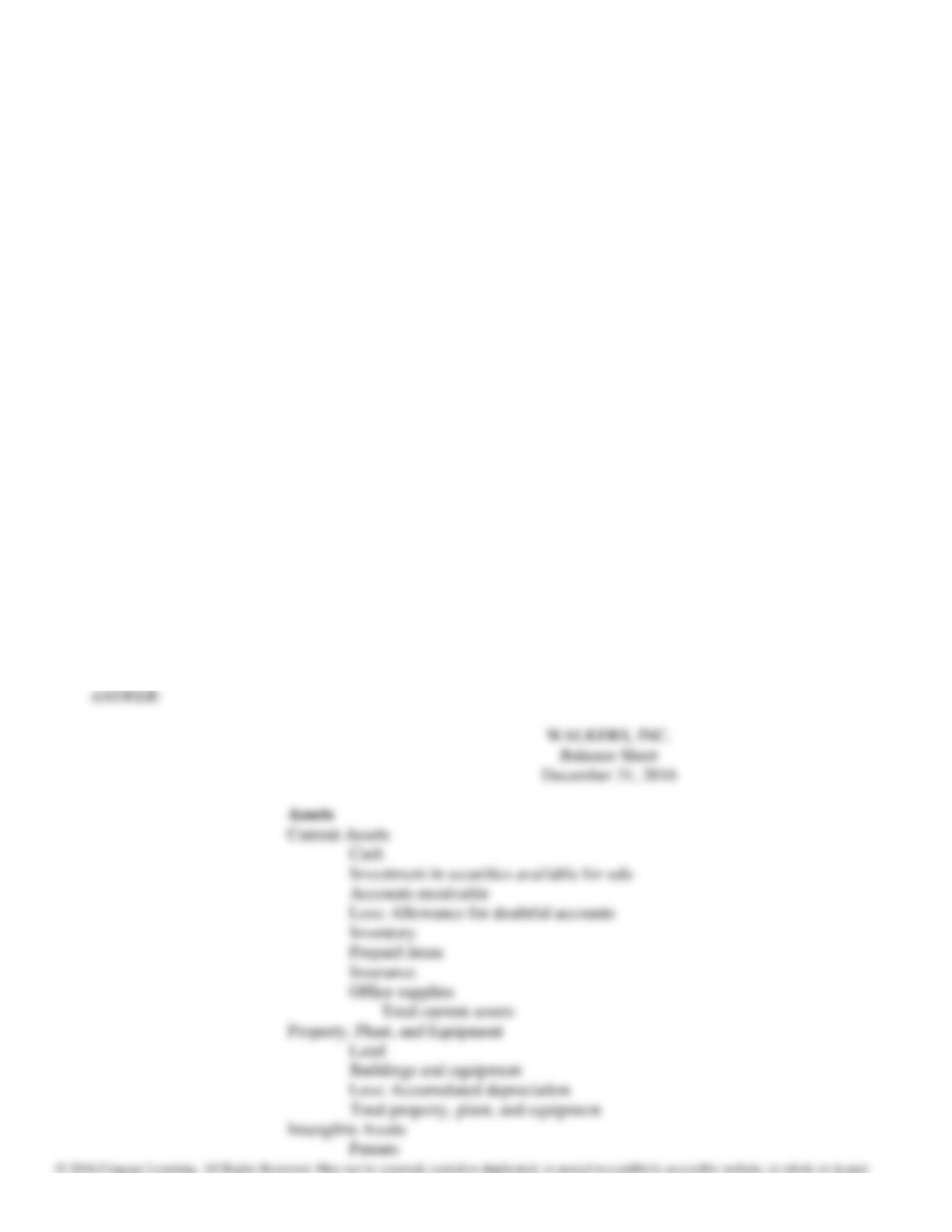
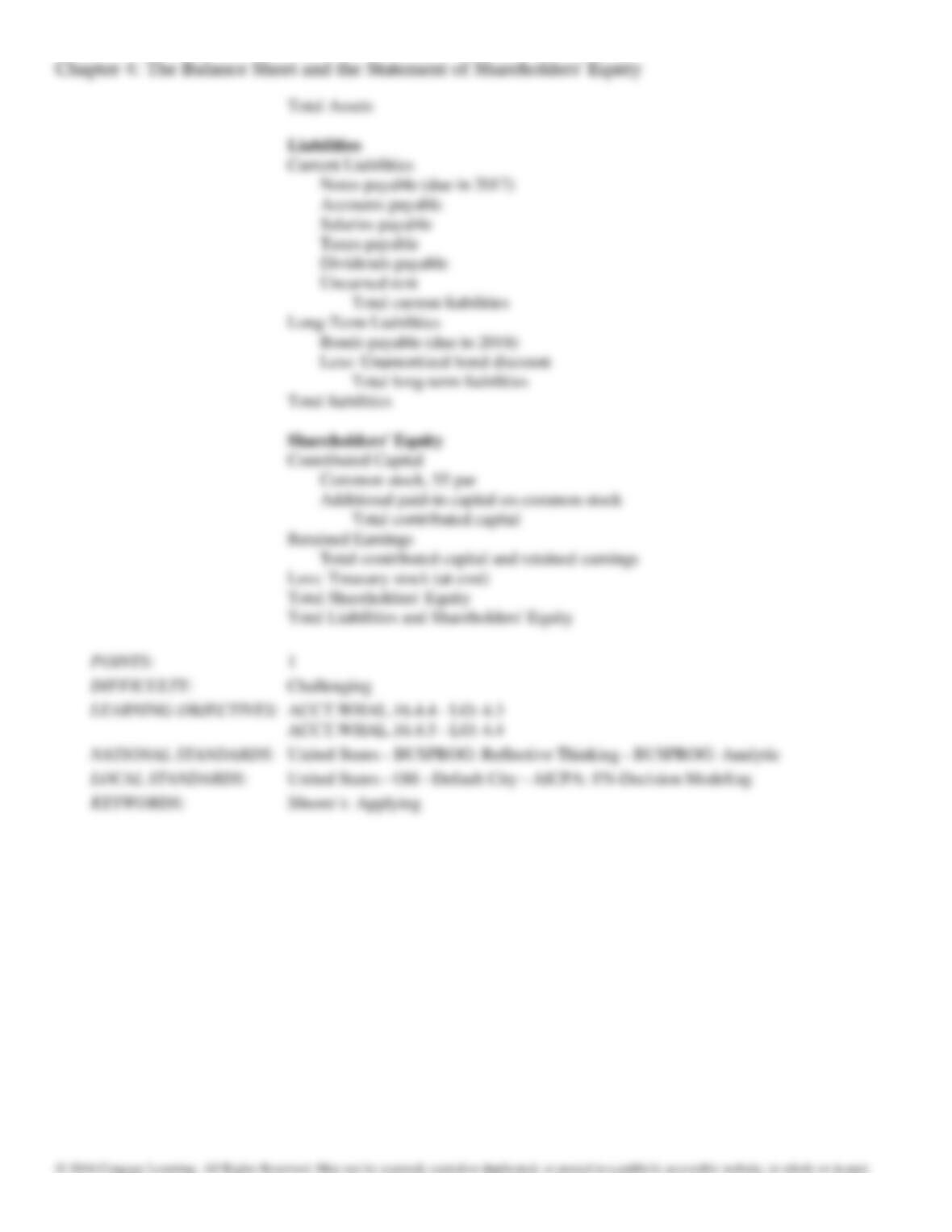
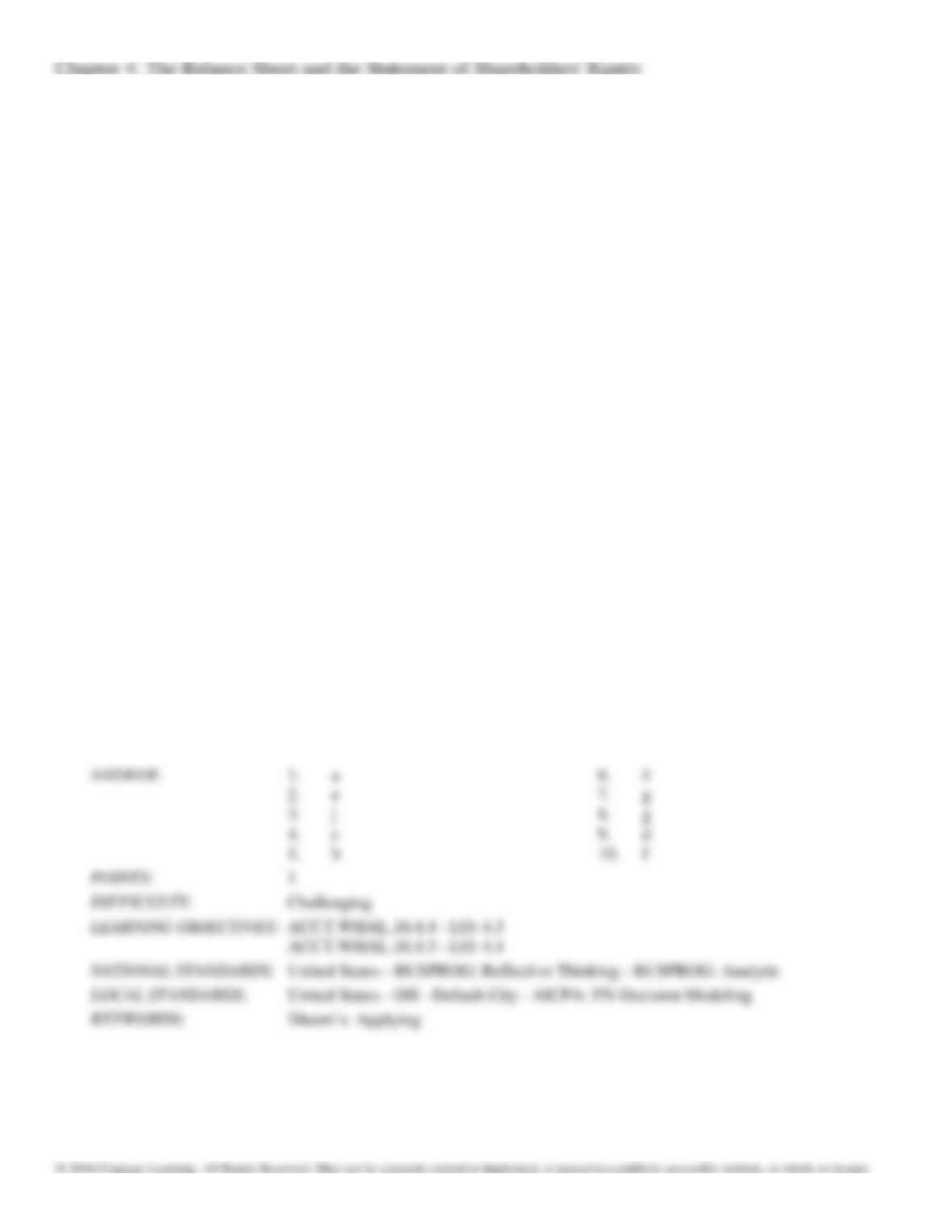
113. Below is an alphabetical listing of the accounts of Walkers, Inc. as of December 31, 2016.
Accounts payable
Accounts receivable
Accumulated depreciation: buildings and equipment
Additional paid-in capital on common stock
Allowance for doubtful accounts
Bonds payable (due 2018)
Buildings and equipment
Cash
Common stock, $5 par
Discount on bonds payable
Dividends payable
Inventory
Investment in securities available for sale
Land
Notes payable (due 2017)
Office supplies
Patents
Prepaid insurance
Retained earnings
Salaries payable
Taxes payable
Treasury stock
Unearned rent
Required:
Prepare a properly classified balance sheet (without amounts) for Walkers, Inc. on December 31, 2016.
114. The balance sheet contains the major sections (a–j) listed below. A listing of balance sheet accounts (1-10) follows.
a.
Current assets
f.
Current liabilities
b.
Long-term investments
g.
Long-term liabilities
c.
Property, plant, and equipment
h.
Contributed capital
d.
Intangible assets
i.
Retained earnings
e.
Other assets
j.
Accumulated other comprehensive
income
____
1.
Unexpired insurance
____
2.
Idle machinery
____
3.
Unrealized gain on available-for-sale securities
____
4.
Land
____
5.
Fund to retire preferred stock
____
6.
Additional paid-in capital on common stock
____
7.
Deferred income tax payable−noncurrent
____
8.
Obligation for future pension payments
____
9.
Trademark
____
10.
Unearned ticket sales
Required:
Using the letters (a-j), indicate in which section of the balance sheet the accounts (1-10) would most likely be
classified.
1.
a
6.
2.
e
7.
3.
j
8.
4.
c
9.
5.
b
10.
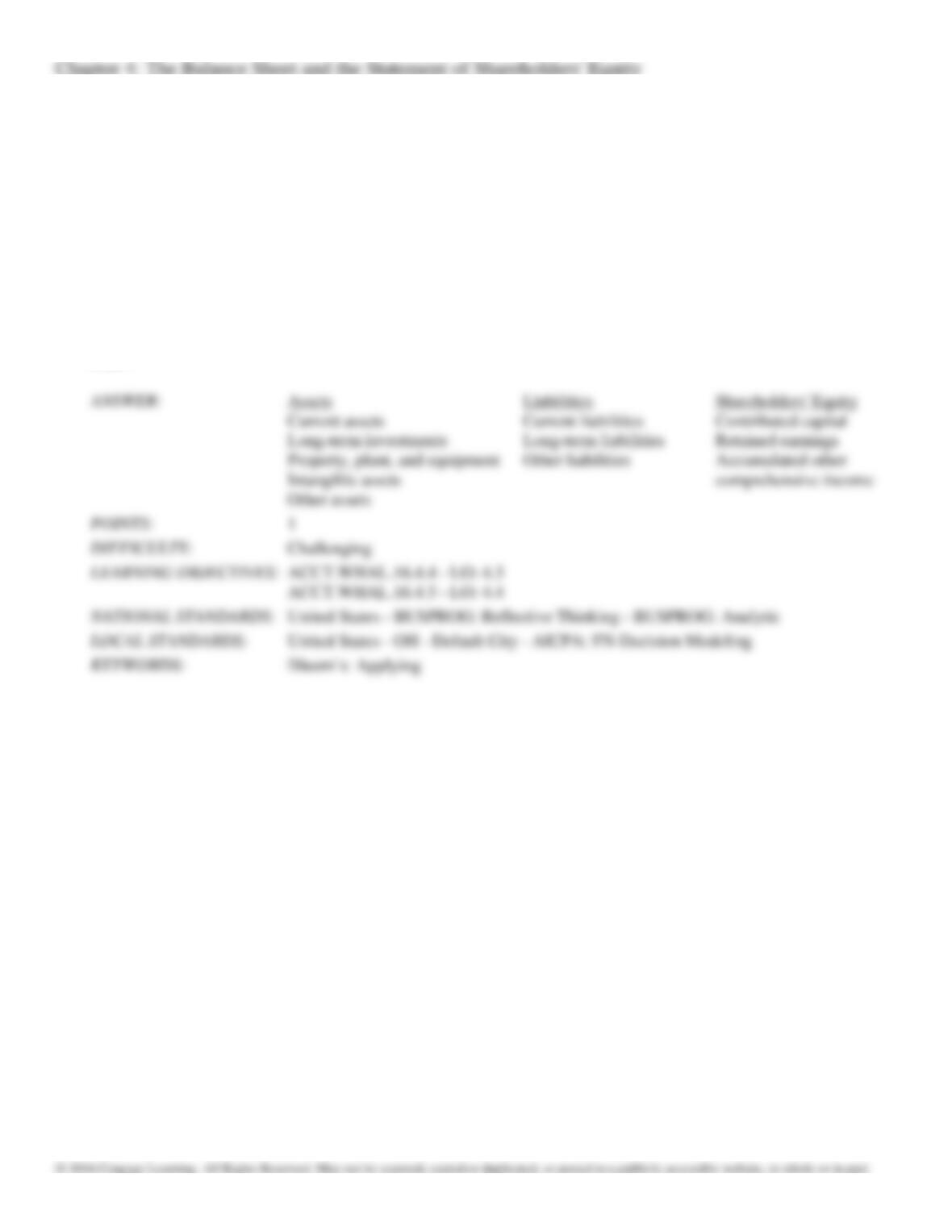
115. A corporation’s balance sheet is usually divided into three primary sections with various classifications reported
within each section group in an informative manner. Listed below are some typical classifications within a section.
Contributed capital
Other assets
Current assets
Other liabilities
Current liabilities
Property, plant, and equipment
Intangible assets
Retained earnings
Long-term investments
Accumulated other comprehensive income
Long-term liabilities
Assets
Liabilities
Current assets
Current liabilities
Long-term investments
Long-term liabilities
Property, plant, and equipment
Other liabilities
Intangible assets
Other assets
Required:
Identify each of the three balance sheet sections and list the classifications within each section in the appropriate
order.
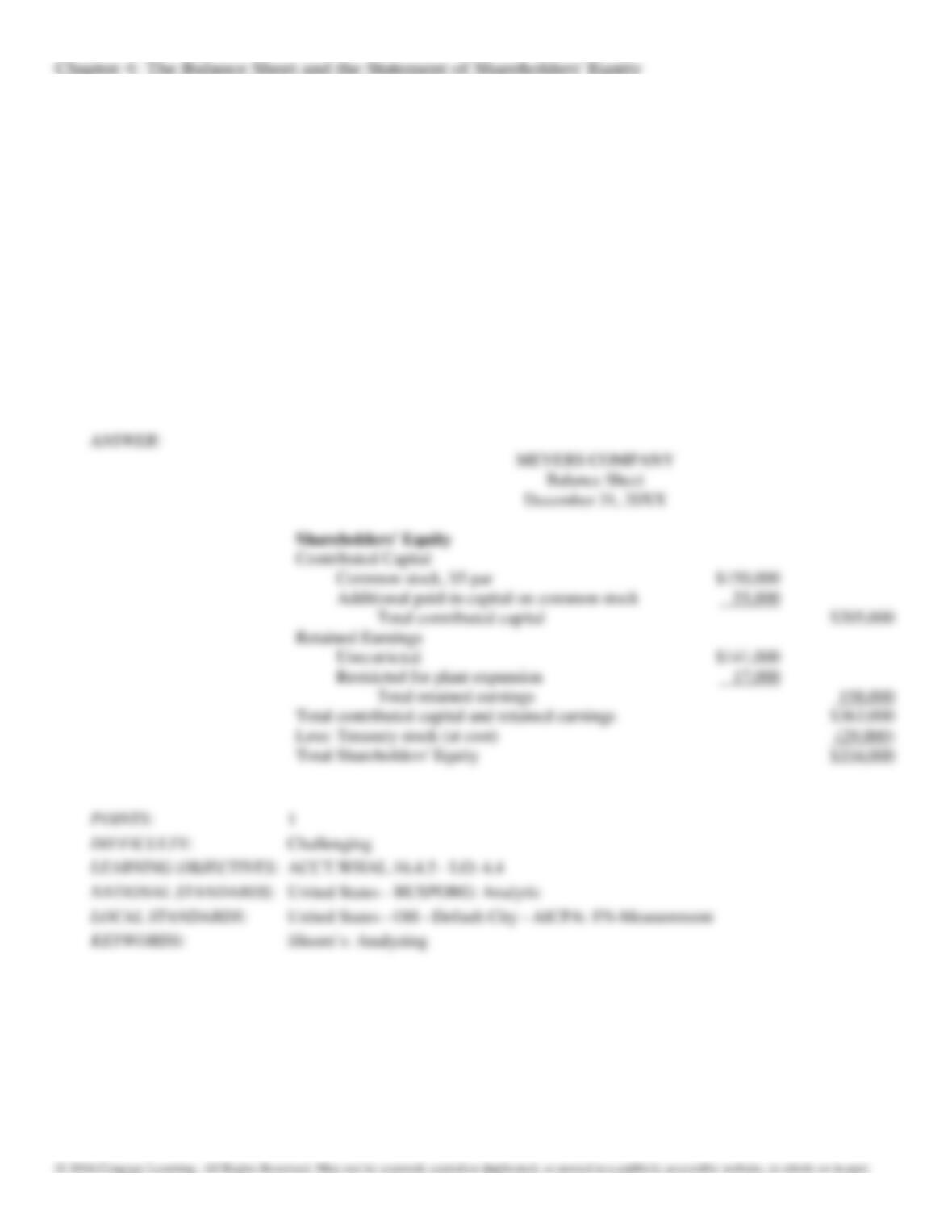
116. The following information has been provided by Meyers Company as of December 31, 20XX:
Unearned rent
$ 4,500
Retained earnings (unrestricted)
141,000
Common stock, $5 par
150,000
Premium on bonds payable
1,800
Bonds payable
28,000
Additional paid-in capital on common stock
55,000
Treasury stock, at cost
29,000
Retained earnings restricted for plant expansion
17,000
Sinking fund for bond retirement
31,250
Required:
Prepare the shareholders’ equity section of the balance sheet for Meyers.
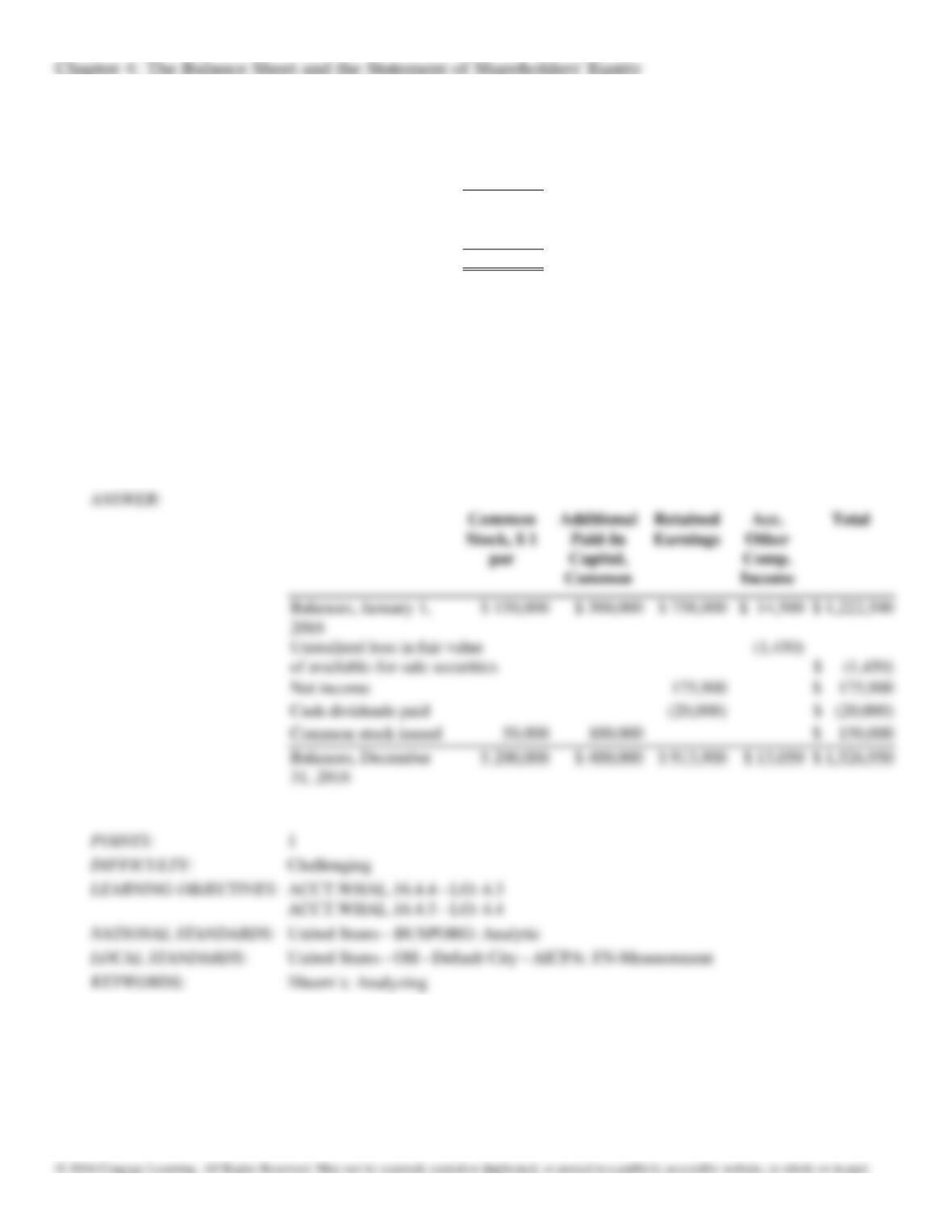
117. On January 1, 2016 Hammer Company listed the following shareholders’ equity section of its balance sheet:
Contributed Capital:
Common stock, $1 par
$ 150,000
Additional paid-in capital on common stock
$ 300,000
Total Contributed Capital
$ 450,000
Retained Earnings
$ 758,000
Accumulated other comprehensive income
$ 14,500
Total Shareholders’ Equity
$ 1,222,500
During 2016, the following transactions and events occurred and were recorded:
1.)
Hammer issued 50,000 shares of common stock at $3 per share.
2.)
Hammer earned net income of $175,900.
3.)
Hammer paid a cash dividend of $.10 per share of common stock
4.)
Hammer had an unrealized loss associated with some available-for-sale
securities in the amount of $1,450.
Required:
Prepare Hammer’s statement of shareholders’ equity for 2016.
1
Challenging
ACCT.WHAL.16.4.4 – LO: 4.3
ACCT.WHAL.16.4.5 – LO: 4.4
United States – BUSPORG: Analytic
United States – OH – Default City – AICPA: FN-Measurement
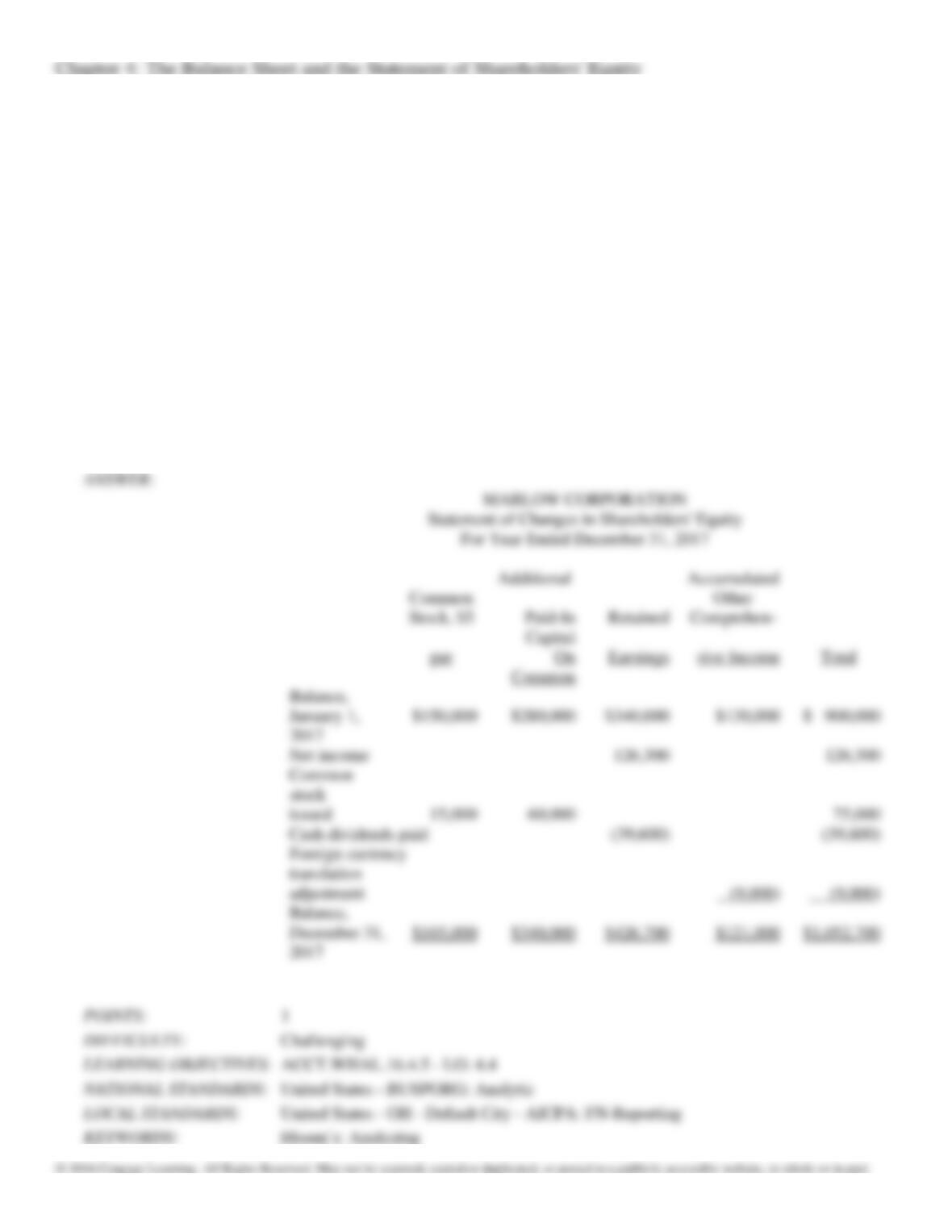
118. On January 1, 2015, Marlow Corporation had the following shareholders’ equity account balances:
Accumulated other comprehensive income
$ 130,000
Additional paid-in capital on common stock
280,000
Common stock, $5 par (30,000 shares authorized)
150,000
Retained earnings
340,000
During 2015, the following events occurred in the order listed and were properly recorded:
∙
The company issued 3,000 shares of common stock at $25 per share.
∙
The company earned net income of $126,300.
∙
The company paid a $1.20 per share dividend on its common stock.
∙
The company experienced an unrealized decrease in the value of its investment in
available-for-sale securities of $9,000.
Required:
Prepare a statement of changes in shareholders’ equity for 2015.
1
Challenging
ACCT.WHAL.16.4.5 – LO: 4.4
United States – BUSPORG: Analytic
United States – OH – Default City – AICPA: FN-Reporting