174.
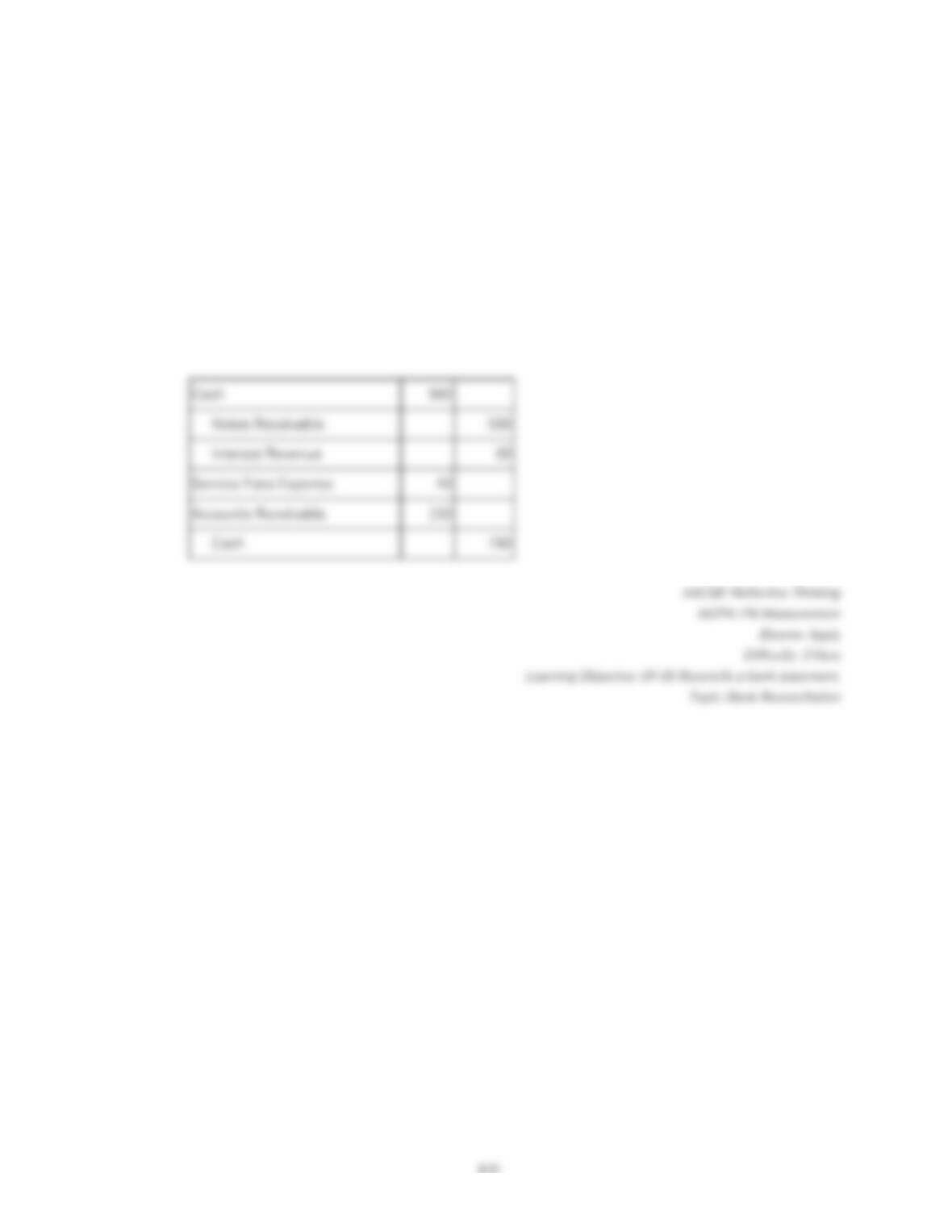
A company’s Cash account shows a balance of $5,680 at the end of the month. Comparing
the company’s Cash account with the monthly bank statement reveals several additional
cash transactions such as deposits outstanding ($1,250), checks outstanding ($2,380),
bank service fees ($40), an NSF check from a customer ($150), a customer’s note
receivable collected by the bank ($500), and interest earned ($60). Prepare the necessary
entries to adjust the balance of cash.
175.
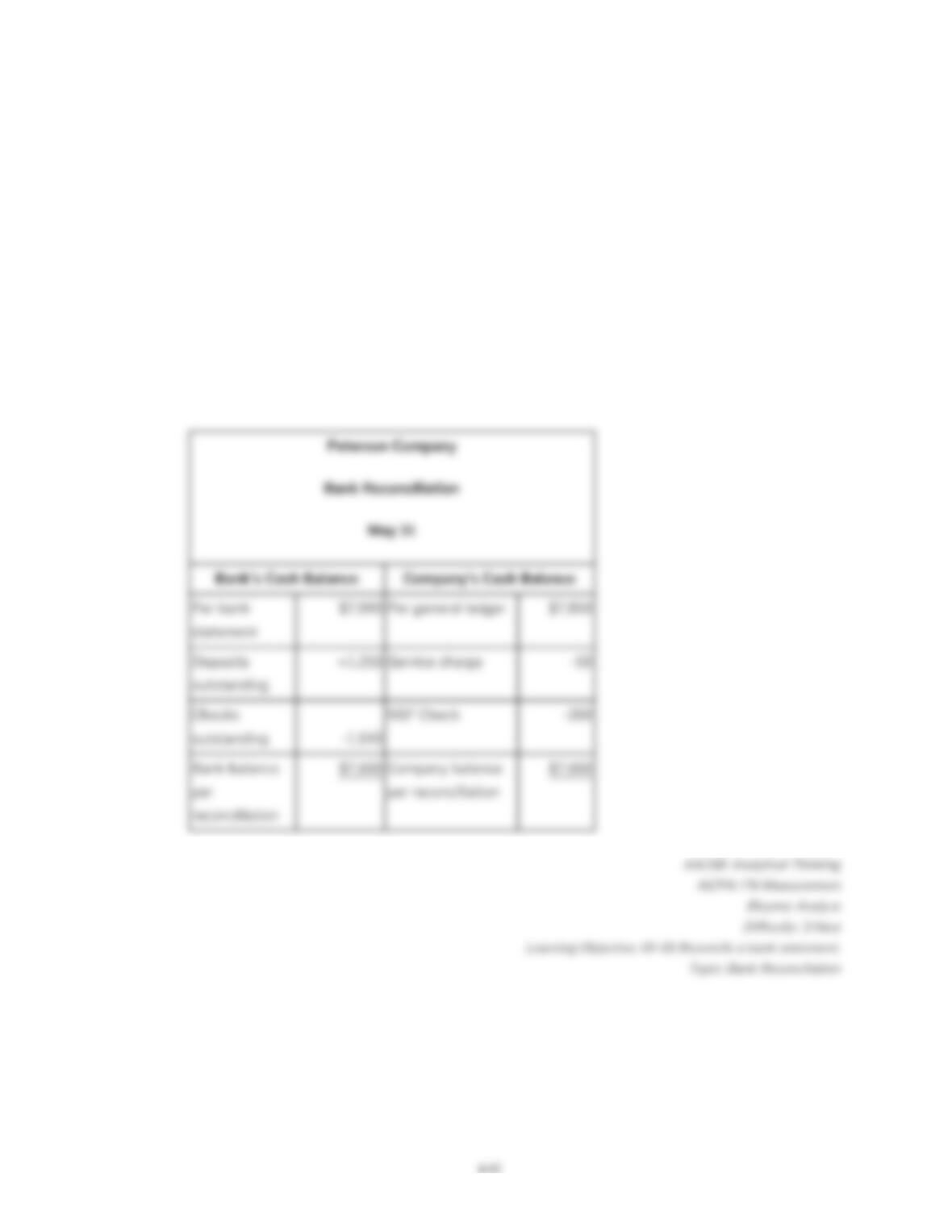
Peterson Company’s general ledger shows a cash balance of $7,850 on May 31. May cash
receipts of $1,250, included in the general ledger balance, are placed in the night
depository at the bank on May 31 and processed by the bank on June 1. The bank
statement dated May 31 shows an NSF check for $200 and a service fee of $50. The bank
processes all checks written by the company by May 31 and lists them on the bank
statement, except for one check totaling $1,640. The bank statement shows a balance of
$7,990 on May 31. Prepare a bank reconciliation to calculate the correct ending balance of
cash on May 31.
4-83
176.
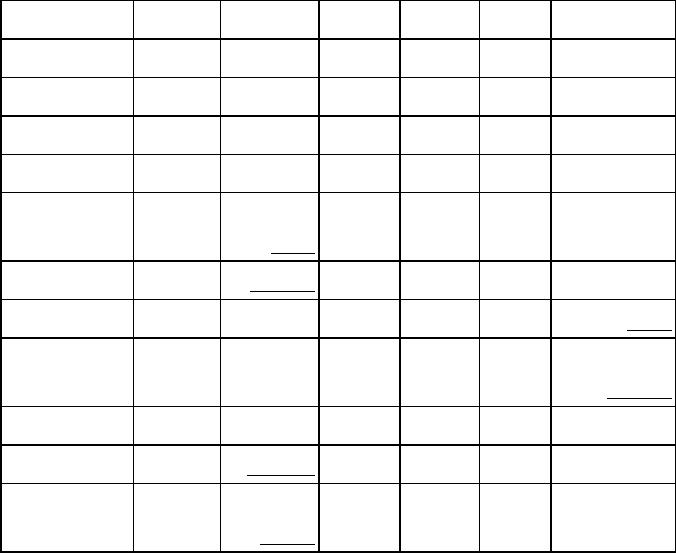
Madison Company’s cash ledger reports the following for the month ending March 31.
Date
Amount
No.
Date
Amount
Deposits:
3/4
$1,200
Checks:
541
3/2
$5,100
3/11
1,200
542
3/8
800
3/18
3,700
543
3/12
2,200
3/25
3,400
544
3/19
1,100
Cash receipts
3/26-
3/31
2,100
545
3/27
200
$11,600
546
3/28
600
547
3/30
1,300
Balance on
March 1
$5,400
$11,300
Receipts
11,600
Disbursements
(11,300)
Balance on
March 31
$5,700
Information from March’s bank statement and company records reveals the following
additional information:
a. The ending cash balance recorded in the bank statement is $6,790.
b. Cash receipts of $2,100 from 3/26 – 3/31 are outstanding.
c. Checks 545 and 547 are outstanding.
d. The deposit on 3/11 included a customer’s check for $400 that did not clear the bank
(NSF check).
e. Check 543 was written for $2,800 for office supplies in March. The bank properly
recorded the check for this amount.
f. An automatic withdrawal for March rent was made on March 4 for $1,500.
g. Madison’s checking account earns interest based on the average daily balance. The
amount of interest earned for March is $50.
h. Last year, one of Madison’s top executives borrowed $4,000 from Madison. On March
24, the executive paid $4,200 ($4,000 borrowed amount plus $200 interest) directly to the
bank in payment for the borrowing.
i. The bank charged the following service fees: $30 for NSF check, $10 for automatic
withdrawal for rent payment, and $20 for collection of the loan amount from the executive.
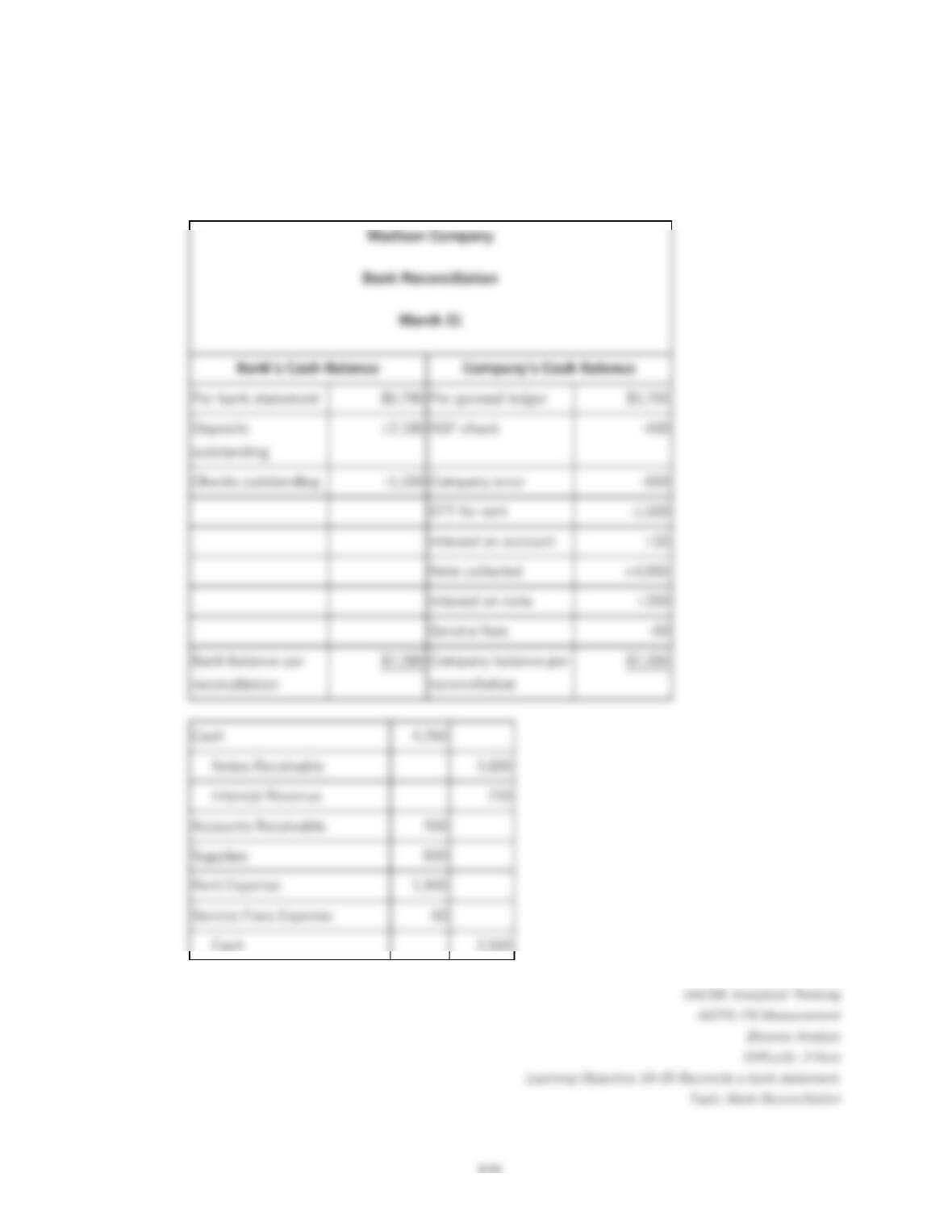
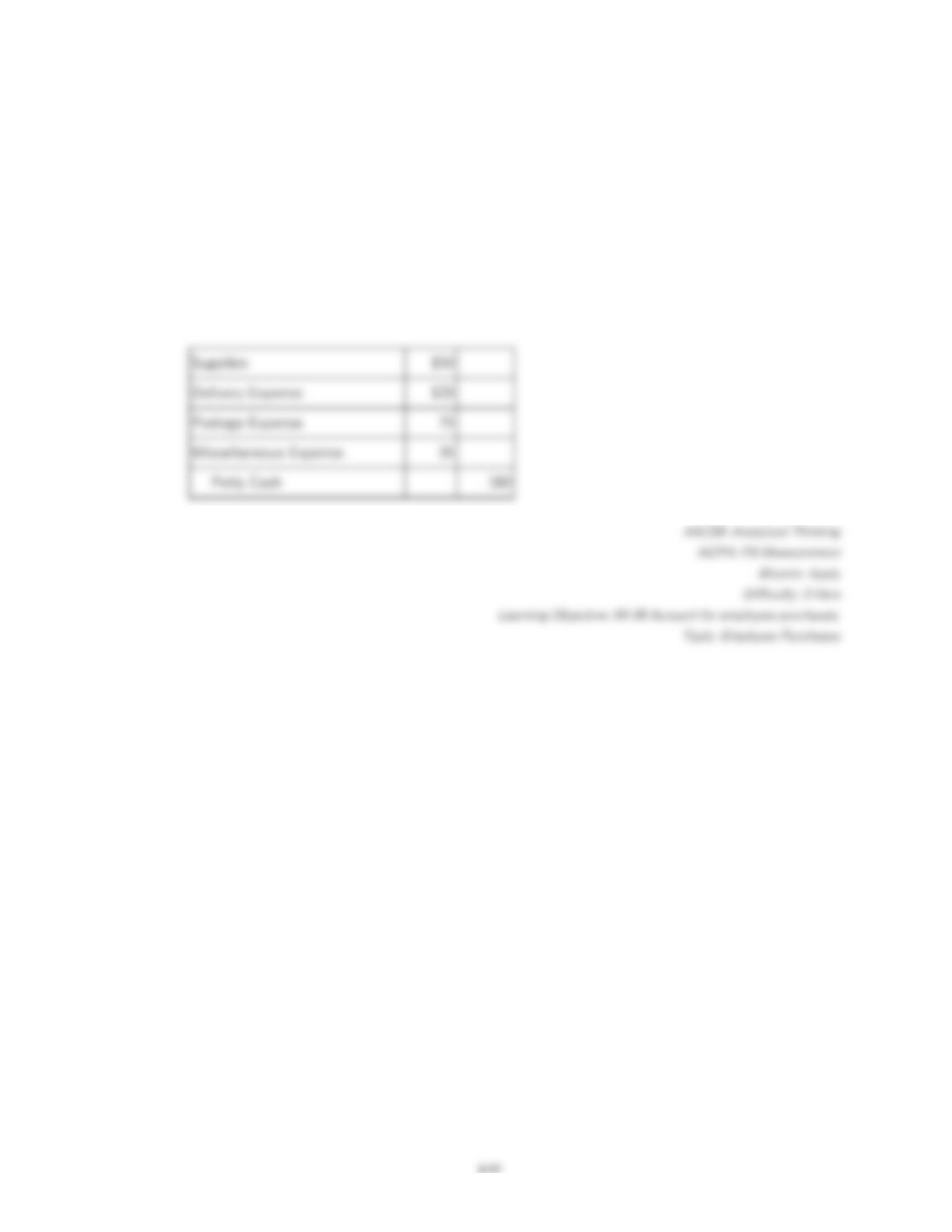
Prepare a bank reconciliation for March 31, and record the necessary cash adjustments.
177.
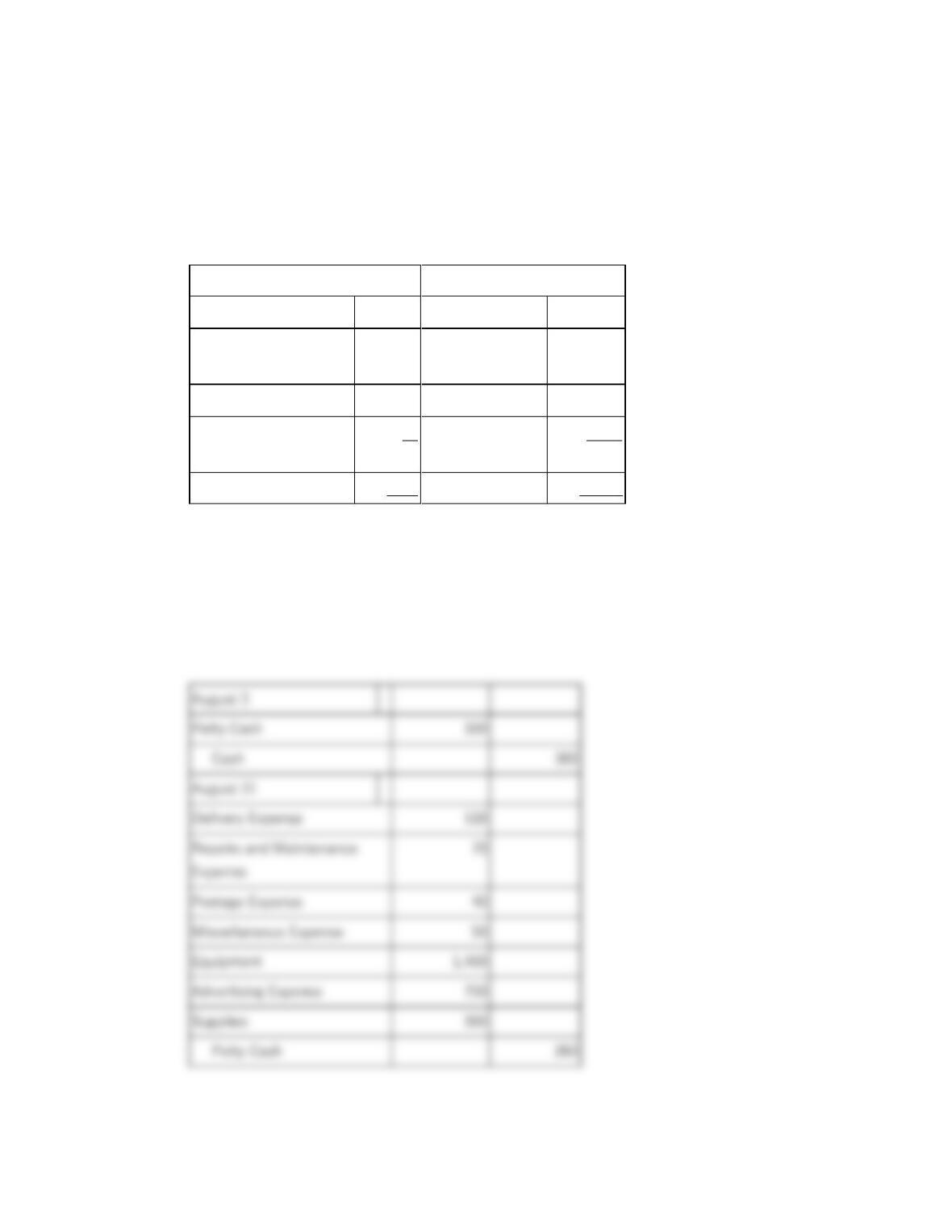
A company establishes a petty cash fund for $400. By the end of the month, employees
had made the following expenditures from the fund: supplies, $150; fuel for deliveries,
$120; postage, $75; miscellaneous, $35. Record the entry to recognize expenditures from
the petty cash fund.
4-86
178.
A company establishes a $300 petty cash fund on August 3 to pay for minor cash
expenditures. The fund is replenished at the end of each month. In addition, the company
has issued credit cards for more substantial employee purchases. These credit cards are
issued to authorized managers. At the end of August, the following employee purchases
have been made:
Petty Cash Fund
Credit Card
Delivery fees
$100
Equipment
$1,400
Plumbing maintenance
70
Advertising
750
Postage
40
Supplies
360
Flowers for the office
50
$260
$2,510
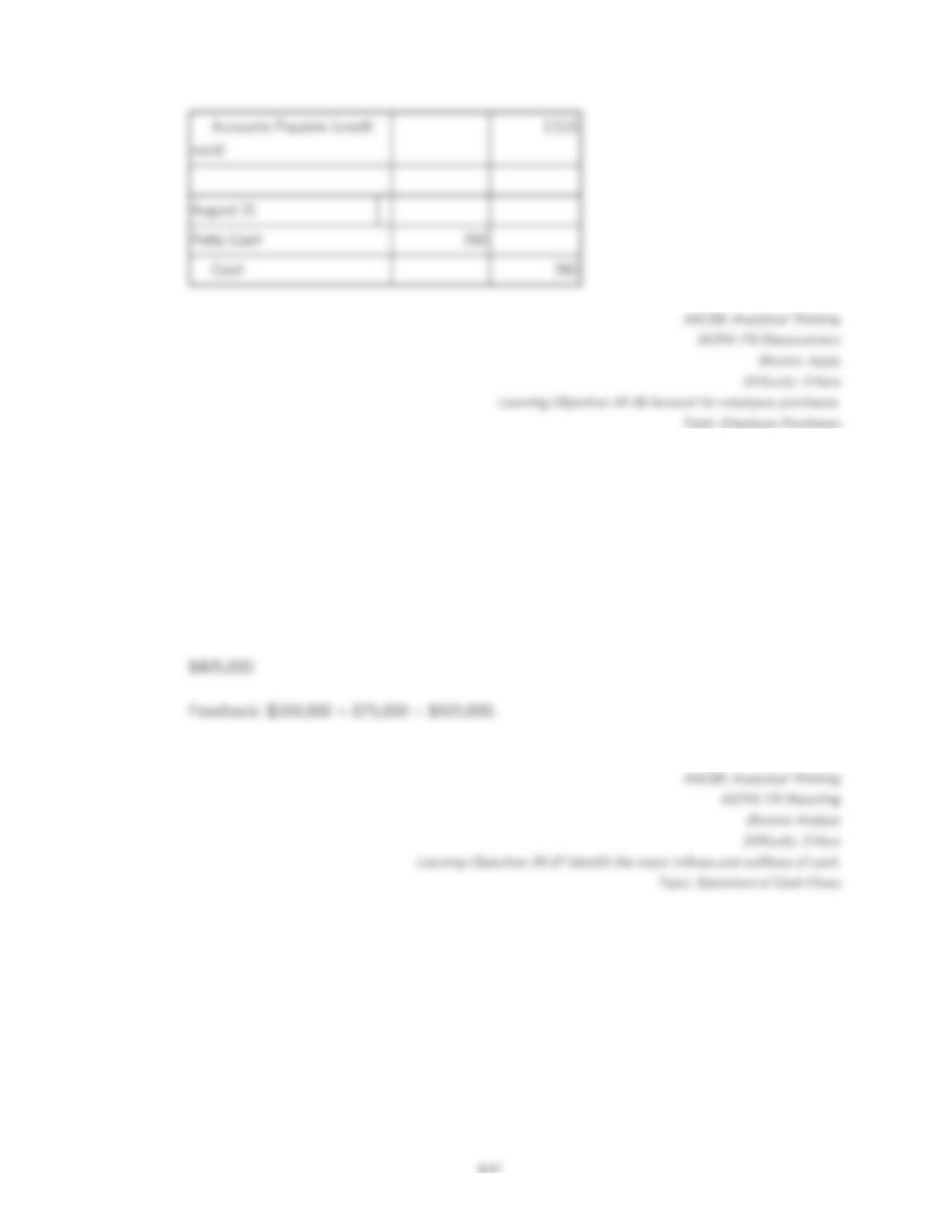
Record the establishment of the petty cash fund on August 3, all employee expenditures,
and replenishment of the fund on August 31.
179.
A company provides services on account during the current year totaling $400,000. By the
end of the year, $350,000 of this amount had been received. In addition, $75,000 was
received on account from customers for services provided in the prior year. Determine the
amount of operating cash flows the company will report as received from customers in the
current year.
180.
During the current year, a company provides services on account for $100,000. By the end
of the year, $60,000 of this amount had been received. In addition, cash payments for the
year were employees’ salaries, $50,000; office supplies, $10,000; and utilities $20,000.
Determine the amount of operating cash flows the company will report in the current year.
181.
During the current year, a company purchases equipment for $250,000, paying $50,000
immediately and promising to pay the remainder within 30 days after the end of the year.
Determine the amount of investing cash flows the company will report in the current year.
182.
At the beginning of the current year, a company issued stock for $100,000 and borrowed
$50,000 from the bank. By the end of the year, the company had provided services of
$80,000 for cash, paid employee salaries of $30,000, and paid utilities of $10,000.
Determine the amount of financing cash flows the company will report in the current year.
183.
During the year, a company issues common stock for $50,000 and repays previously
borrowed amounts of $75,000. In addition, the company pays dividends of $5,000 to
stockholders. Determine the amount of financing cash flows the company will report in the
current year.
184.
Consider the following transactions:
1. Pay employees’ salaries.
2. Repay borrowing to the bank.
3. Purchase equipment with note payable.
4. Provide services to customers on account.
5. Pay dividends to stockholders.
6. Collect cash from customers for services provided.
7. Purchase supplies on account.
8. Pay for supplies purchased in transaction 7 above.
For each transaction, indicate the type of cash flow involved based on the classifications
in the statement of cash flows. If a transaction does not involve cash, write ‘No Cash.’
185.
A company had the following transactions during the year:
1. Paid rent for the next two years, $8,000.
2. Purchased office supplies on account, $2,400.
3. Purchased equipment, paying $12,000 cash and issuing a note payable for $4,000.
4. Borrowed from the bank, $6,000.
5. Paid employee salaries, $7,200.
6. Paid $2,000 on account related to transaction 2 above.
7. Paid dividends to stockholders, $2,800.
8. Sold land for $10,000 that was purchased in a prior year for $7,500.
9. Collected cash from customers for services provided, $25,700.
Calculate cash flows from operating activities, investing activities, and financing activities.
4-92
186.
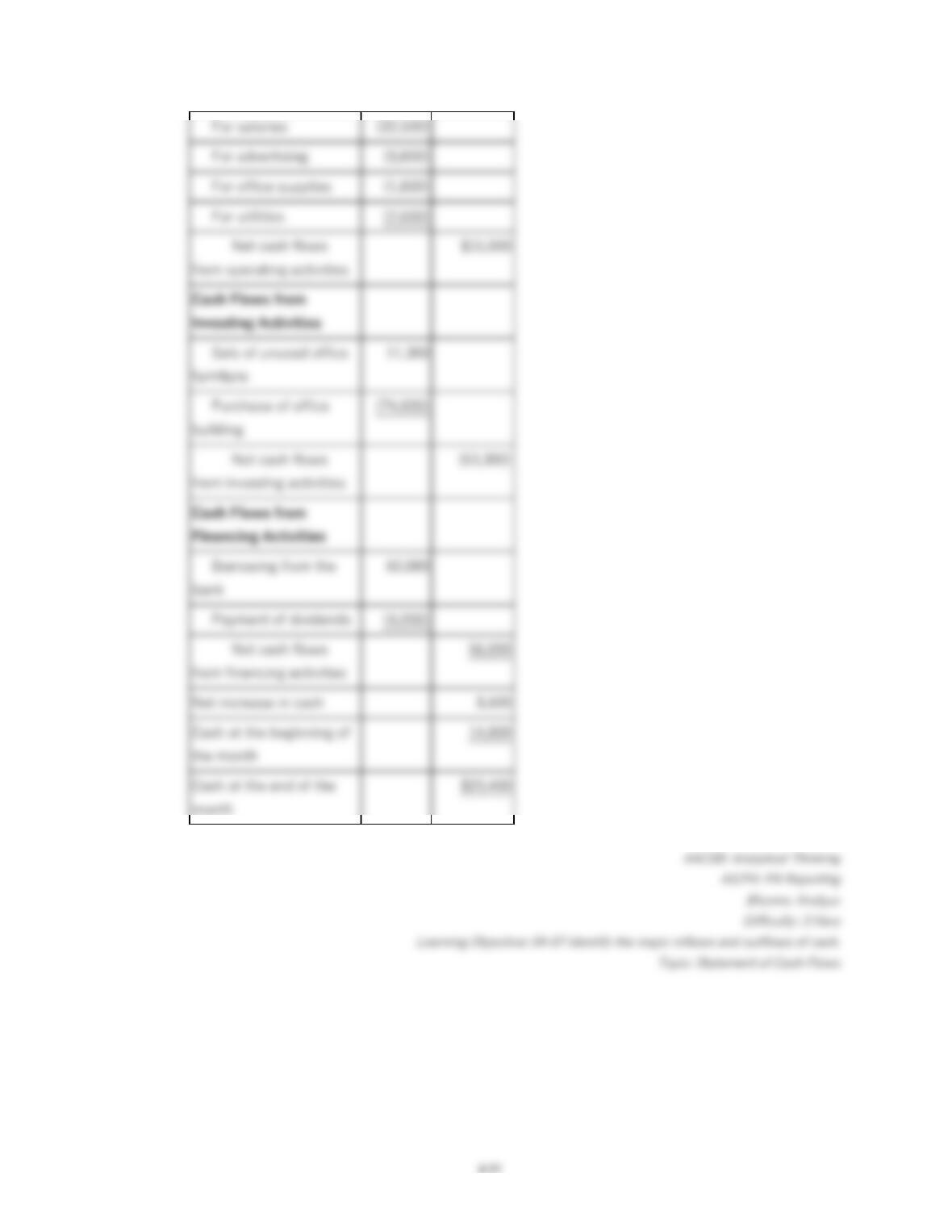
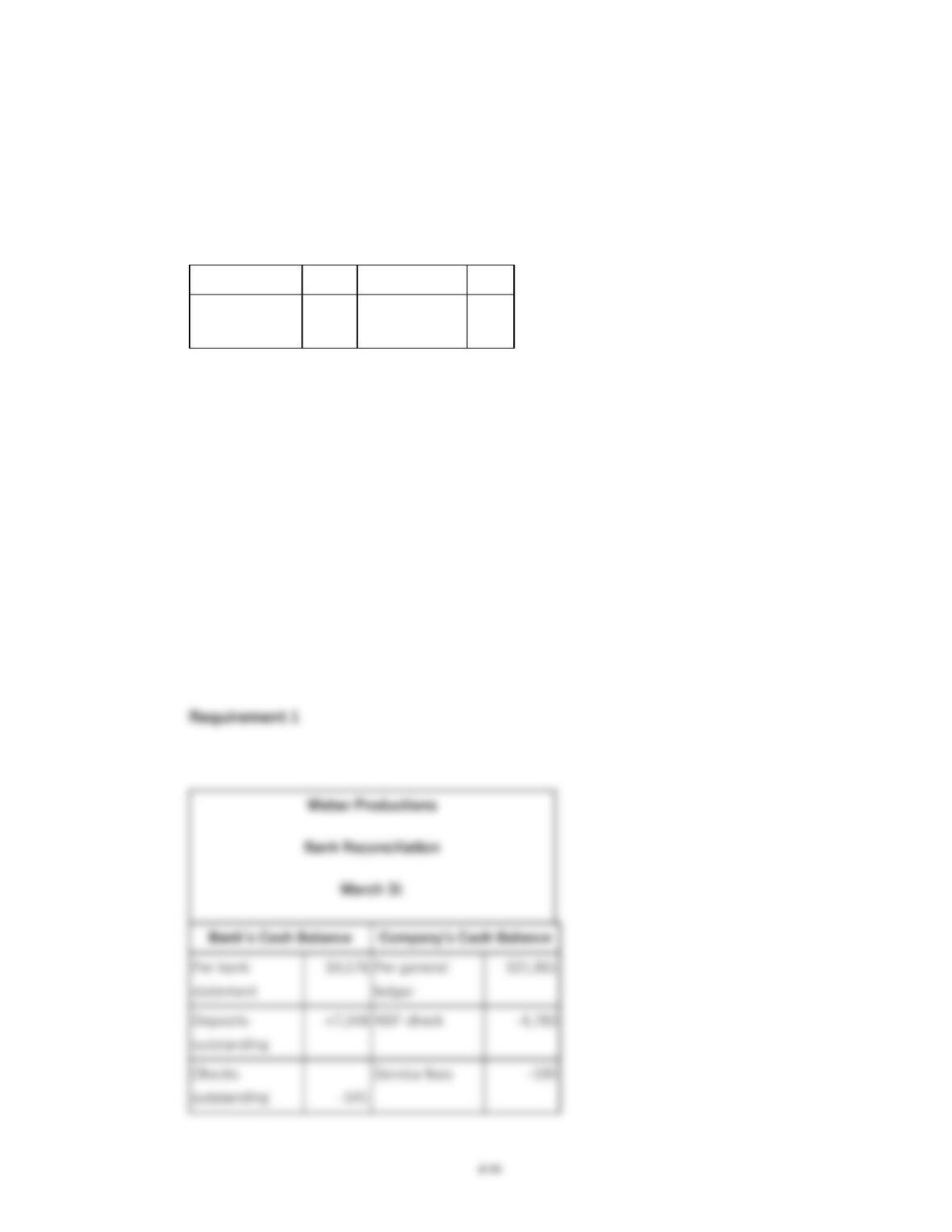
Below is a summary of all the transactions of Sampson Consulting for the month of April
2018.
Cash Transactions
Cash collections from:
Customers
$52,600
Sale of unused office furniture
11,300
Borrowing from the bank
60,000
Cash payments for:
Employee salaries
(22,500)
Office building
(74,600)
Utilities expense
(2,600)
Office supplies
(1,800)
Dividends to stockholders
(4,000)
Advertising expense
(9,800)
Noncash Transactions
Services to customers on account
11,800
Purchase supplies on account
5,800
Issue note payable for equipment
23,700
Prepare a statement of cash flows for the month of April, properly classifying each of the
transactions into operating, investing, and financing activities. The cash balance at the
beginning of April is $14,800.
Cash inflows:
From customers
187.
At the end of March, Weber Productions’ accounting records reveal a balance for cash
equal to $21,861. However, the balance of cash in the bank at the end of March is only
$4,576. Weber is concerned and asks the company’s accountant to reconcile the two
balances. Examination of the bank statement and company records at the end of March
reveals the following information:
NSF checks
$6,783
Service fees
$195
Deposits
outstanding
7,348
Checks
outstanding
541
In addition, Weber owes one of its suppliers $200. During March, the company’s
accountant mistakenly wrote the check for $1,200. The check was recorded in the
company’s records for $200 but processed by the bank for $1,200. Weber has contacted
the supplier who has agreed to send a $1,000 refund in April directly to the bank. Finally, a
petty cash fund of $2,500 was established during March. This amount was withdrawn from
the checking account but not recorded.
Required:
1. Calculate the correct ending balance of cash at the end of March.
2. Discuss any problems you see with the company’s cash procedures.