Chapter 4: The Balance Sheet and the Statement of Shareholders’ Equity
61. Current liabilities includes all of the following except
a.
income tax payable.
b.
mortgage due to be paid this year.
c.
notes receivable.
d.
advance payments from customers.
c
1
Easy
ACCT.WHAL.16.4.4 – LO: 4.3
United States – BUSPROG – BUSPROG: Analytic
United States – OH – Default City – AICPA – FN-Decision Modeling
Bloom’s: Understanding
62. Most long-term liabilities are reported on the balance sheet at their
a.
net realizable value.
b.
replacement value.
c.
historical cost.
d.
present value.
d
1
Easy
ACCT.WHAL.16.4.4 – LO: 4.3
United States – BUSPROG – BUSPROG: Analytic
United States – OH – Default City – AICPA – FN-Decision Modeling
Bloom’s: Understanding
63. Which of the following is not a component of shareholders’ equity?
a.
Noncontrolling interest
b.
Residual capital
c.
Earned capital
d.
Contributed capital
b
1
Easy
ACCT.WHAL.16.4.5 – LO: 4.4
United States – BUSPROG – BUSPROG: Analytic
United States – OH – Default City – AICPA – FN-Decision Modeling
Bloom’s: Understanding
Chapter 4: The Balance Sheet and the Statement of Shareholders’ Equity
64. Which of the following is included in shareholders’ equity?
a.
Sinking funds
b.
Deferred revenues
c.
Accumulated other comprehensive income
d.
Goodwill
c
1
Easy
ACCT.WHAL.16.4.5 – LO: 4.4
United States – BUSPROG – BUSPROG: Analytic
United States – OH – Default City – AICPA – FN-Decision Modeling
Bloom’s: Understanding
65. Which of the following is not a component of contributed capital?
a.
Preferred stock
b.
Treasury stock
c.
Earned capital
d.
Additional paid-in capital
c
1
Easy
ACCT.WHAL.16.4.5 – LO: 4.4
United States – BUSPROG – BUSPROG: Analytic
United States – OH – Default City – AICPA – FN-Decision Modeling
Bloom’s: Understanding
66. A negative balance for retained earnings due to cumulative net losses is called a(n)
a.
deficit.
b.
retained loss.
c.
retained debit.
d.
other comprehensive loss.
a
1
Easy
ACCT.WHAL.16.4.5 – LO: 4.4
United States – BUSPROG – BUSPROG: Analytic
United States – OH – Default City – AICPA – FN-Decision Modeling
Bloom’s: Understanding
67. On the balance sheet, treasury stock is presented as a
a.
long-term investment account.
b.
contra shareholders’ equity account.
c.
companion shareholders’ equity account.
d.
contra asset account.
b
1
Easy
ACCT.WHAL.16.4.5 – LO: 4.4
United States – BUSPROG – BUSPROG: Analytic
United States – OH – Default City – AICPA – FN-Decision Modeling
Bloom’s: Understanding
68. A deficit occurs when a company’s
a.
retained earnings are less than its common stock.
b.
dividends distributed are greater than comprehensive income.
c.
dividends and cumulative losses are greater than cumulative net income.
d.
retained earnings are less than assets minus liabilities.
c
1
Easy
ACCT.WHAL.16.4.5 – LO: 4.4
United States – BUSPROG – BUSPROG: Analytic
United States – OH – Default City – AICPA – FN-Decision Modeling
Bloom’s: Understanding
69. Other comprehensive income (loss) includes all of the following except
a.
Extraordinary gains/losses
b.
Certain pension plan gains/losses.
c.
Foreign currency translation gains/losses.
d.
Unrealized gains/losses on available-for-sale investments.
a
1
Easy
ACCT.WHAL.16.4.5 – LO: 4.4
United States – BUSPROG – BUSPROG: Analytic
United States – OH – Default City – AICPA – FN-Decision Modeling
Bloom’s: Understanding
Chapter 4: The Balance Sheet and the Statement of Shareholders’ Equity
70. Additional paid-in capital represents
a.
the value of earnings not paid out as dividends.
b.
the difference between contributed capital and earned capital.
c.
the value of repurchased treasury stock.
d.
the difference between par value and market value .
d
1
Easy
ACCT.WHAL.16.4.5 – LO: 4.4
United States – BUSPROG – BUSPROG: Analytic
United States – OH – Default City – AICPA – FN-Decision Modeling
Bloom’s: Understanding
71. A component of equity that arises when a parent company owns a majority of the common shares of a subsidiary
company is known as
a.
majority interest.
b.
noncontrolling interest.
c.
earned capital.
d.
unearned capital.
b
1
ACCT.WHAL.16.4.5 – LO: 4.4
United States – BUSPROG – BUSPROG: Analytic
United States – OH – Default City – AICPA – FN-Decision Modeling
Bloom’s: Understanding
72. Distributions to owners include all of the following except
a.
paying dividends.
b.
repurchasing treasury stock.
c.
giving away fixed assets.
d.
noncontrolling interests.
d
1
Moderate
ACCT.WHAL.16.4.5 – LO: 4.4
United States – BUSPROG – BUSPROG: Analytic
United States – OH – Default City – AICPA – FN-Decision Modeling
Bloom’s: Understanding
73. In preparing a statement of changes in shareholders‘ equity, the company includes land given to a shareholder as a
dividend. This transaction is included in the statement because it represents
a.
an investment by a shareholder that increases equity.
b.
an investment by a shareholder that decreases equity.
c.
a distribution to a shareholder that increases equity.
d.
a distribution to a shareholder that decreases equity.
d
1
Moderate
ACCT.WHAL.16.4.5 – LO: 4.4
United States – BUSPROG: Reflective Thinking – BUSPROG: Analytic
74. A reader of a set of financial statements would expect to be able to find in the statement of changes in shareholders’
equity
a.
increases in total assets.
b.
increases in total liabilities.
c.
increases to net income.
d.
increases from other comprehensive income.
d
1
Easy
ACCT.WHAL.16.4.5 – LO: 4.4
United States – BUSPROG: Reflective Thinking – BUSPROG: Analytic
United States – OH – Default City – AICPA: FN-Decision Modeling
75. GAAP requires that all derivative financial instruments be reported at their
a.
historical cost.
b.
fair value.
c.
present value.
d.
par value.
b
1
Moderate
ACCT.WHAL.16.4.6 – LO: 4.5
United States – BUSPROG – BUSPROG: Analytic
Chapter 4: The Balance Sheet and the Statement of Shareholders’ Equity
76. A reader might find information about gain contingencies in an annual report by examining
a.
a contingent account receivable.
b.
an accrued revenue.
c.
a deferred revenue.
d.
footnote disclosures.
d
1
Moderate
ACCT.WHAL.16.4.6 – LO: 4.5
United States – BUSPROG: Reflective Thinking – BUSPROG: Analytic
United States – OH – Default City – AICPA: FN-Decision Modeling
77. A subsequent event is an event that occurs
a.
after the annual report is issued.
b.
anytime after the end of the accounting period.
c.
between the end of the accounting period and the date the annual report is issued.
d.
anytime before the annual report is issued.
c
1
Moderate
ACCT.WHAL.16.4.6 – LO: 4.5
United States – BUSPROG: Reflective Thinking – BUSPROG: Analytic
United States – OH – Default City – AICPA: FN-Decision Modeling
78. All of the following are examples of subsequent events that would be disclosed in the footnotes to the financial
statements except
a.
fire or flood loss.
b.
a litigation settlement.
c.
a bond issuance after the balance sheet date.
d.
the write off of a significant uncollectible account.
d
1
Moderate
ACCT.WHAL.16.4.6 – LO: 4.5
United States – BUSPROG: Reflective Thinking – BUSPROG: Analytic
United States – OH – Default City – AICPA: FN-Decision Modeling
Chapter 4: The Balance Sheet and the Statement of Shareholders’ Equity
79. Activities between affiliated entities such as subsidiaries must be disclosed in the financial statements of a corporation
as
a.
segment analysis.
b.
significant events.
c.
related party transactions..
d.
contingent activities.
c
1
Moderate
ACCT.WHAL.16.4.7 – LO: 4.5
United States – BUSPROG: Reflective Thinking – BUSPROG: Analytic
80. The SEC requires disclosure of quarterly high and low market prices for
a.
two years.
b.
three years.
c.
four years.
d.
The SEC does not require disclosure of quarterly high and low market prices.
a
1
ACCT.WHAL.16.4.7 – LO: 4.5
United States – BUSPROG: Reflective Thinking – BUSPROG: Analytic
United States – OH – Default City – AICPA: FN-Decision Modeling
81. Time-series analysis is most closely associated with
a.
Common-size analysis
b.
Cross-sectional analysis
c.
Intracompany comparisons
d.
Intercompany comparisons
c
1
Easy
ACCT.WHAL.16.4.9 – LO: 4.7
United States – BUSPROG: Reflective Thinking – BUSPROG: Analytic
United States – OH – Default City – AICPA: FN-Decision Modeling
Chapter 4: The Balance Sheet and the Statement of Shareholders’ Equity
82. Cross-sectional analysis is most closely associated with
a.
Common-size analysis
b.
Time-series analysis
c.
Intracompany comparisons
d.
Intercompany comparisons
d
1
Easy
ACCT.WHAL.16.4.9 – LO: 4.7
United States – BUSPROG: Reflective Thinking – BUSPROG: Analytic
United States – OH – Default City – AICPA: FN-Decision Modeling
83. A comparison of a company’s performance with that of its own past results is known as
a.
common-size analysis.
b.
intercompany analysis.
c.
ratio analysis.
d.
intracompany analysis.
d
1
Easy
ACCT.WHAL.16.4.9 – LO: 4.7
United States – BUSPROG: Reflective Thinking – BUSPROG: Analytic
United States – OH – Default City – AICPA: FN-Decision Modeling
84. A comparison of a company’s performance with that of its competitors is known as
a.
common-size analysis.
b.
intercompany comparison.
c.
ratio analysis.
d.
intracompany comparison.
b
1
Easy
ACCT.WHAL.16.4.9 – LO: 4.7
United States – BUSPROG: Reflective Thinking – BUSPROG: Analytic
United States – OH – Default City – AICPA: FN-Decision Modeling
85. The ability of a company to adapt its resources to create change and react to change is called
a.
financial flexibility.
b.
return on investment .
c.
operating capability.
d.
risk .
a
1
Easy
ACCT.WHAL.16.4.9 – LO: 4.7
United States – BUSPROG: Reflective Thinking – BUSPROG: Analytic
United States – OH – Default City – AICPA: FN-Decision Modeling
86. The ease with which an asset can be converted into cash is termed
a.
financial flexibility.
b.
liquidity.
c.
operating capability.
d.
capital maintenance.
b
1
Easy
ACCT.WHAL.16.4.9 – LO: 4.7
United States – BUSPROG – BUSPROG: Analytic
United States – OH – Default City – AICPA – FN-Decision Modeling
Bloom’s: Understanding
87. Financial flexibility is assessed by evaluating
a.
profitability.
b.
leverage.
c.
liquidity.
d.
c
1
Easy
ACCT.WHAL.16.4.9 – LO: 4.7
United States – BUSPROG – BUSPROG: Analytic
United States – OH – Default City – AICPA – FN-Decision Modeling
Bloom’s: Understanding
Efficiency
Chapter 4: The Balance Sheet and the Statement of Shareholders’ Equity
88. Which of the following formulas represents working capital?
a.
Current assets – current liabilities
b.
Quick assets – current liabilities
c.
Current assets ¸ current liabilities
d.
Quick assets ¸ current liabilities
a
1
Easy
ACCT.WHAL.16.4.9 – LO: 4.7
United States – BUSPROG – BUSPROG: Analytic
United States – OH – Default City – AICPA – FN-Decision Modeling
Bloom’s: Understanding
89. Selected information from a company’s balance sheet follows:
Long-term debt
$ 140
Retained earnings
130
Current assets
275
Property, plant, and equipment
160
Common stock
530
Current liabilities
75
Working capital is
a.
$250
b.
$230
c.
$220
d.
$200
d
1
Moderate
ACCT.WHAL.16.4.9 – LO: 4.7
United States – BUSPORG: Analytic
United States – OH – Default City – AICPA: FN-Measurement
Chapter 4: The Balance Sheet and the Statement of Shareholders’ Equity
90. Efficiency ratios are measures of
a.
financial flexibility.
b.
liquidity.
c.
operating capability.
d.
leverage.
c
1
Moderate
ACCT.WHAL.16.4.9 – LO: 4.7
United States – BUSPROG: Reflective Thinking – BUSPROG: Analytic
United States – OH – Default City – AICPA: FN-Decision Modeling
91. Information about a company’s operating capability may be helpful to external users in
a.
assessing the uncertainty of its future cash flows.
b.
evaluating the timing of cash flows in the near future.
c.
evaluating the efficiency with which the company uses its resources to generate revenue.
d.
assessing a return of investment as well as a return on investment.
c
1
Easy
ACCT.WHAL.16.4.9 – LO: 4.7
United States – BUSPROG: Reflective Thinking – BUSPROG: Analytic
United States – OH – Default City – AICPA: FN-Decision Modeling
Chapter 4: The Balance Sheet and the Statement of Shareholders’ Equity
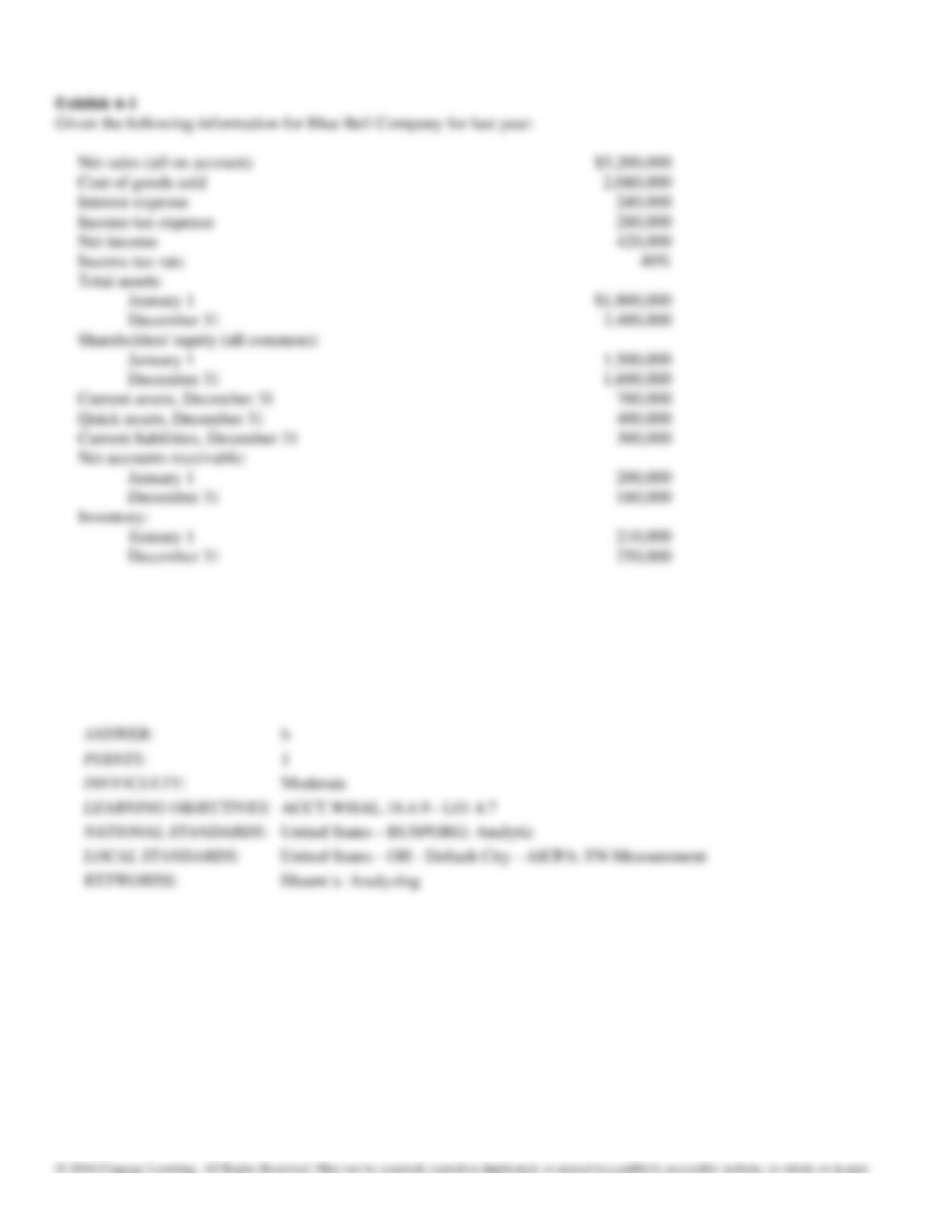
92. Refer to Exhibit 4-1. Blue Bell’s current ratio at December 31 was
a.
3.67 times
b.
2.33 times
c.
1.33 times
d.
b
Moderate
United States – OH – Default City – AICPA: FN-Measurement
0.43 times
Chapter 4: The Balance Sheet and the Statement of Shareholders’ Equity
93. Refer to Exhibit 4-1. Blue Bell’s accounts receivable turnover for the year was
a.
2.2 times
b.
26.0 times
c.
27.4 times
d.
28.9 times
c
1
Moderate
ACCT.WHAL.16.4.9 – LO: 4.7
United States – BUSPORG: Analytic
United States – OH – Default City – AICPA: FN-Measurement
94. Refer to Exhibit 4-1. Blue Bell’s return on assets for the year was
a.
17.5%
b.
20.0%
c.
26.9%
d.
31.4%
c
1
Moderate
ACCT.WHAL.16.4.9 – LO: 4.7
United States – BUSPORG: Analytic
United States – OH – Default City – AICPA: FN-Measurement
95. Refer to Exhibit 4-1. Blue Bell’s quick ratio at December 31was
a.
3.67 times
b.
2.33 times
c.
1.33 times
d.
0.43 times
c
1
Easy
ACCT.WHAL.16.4.9 – LO: 4.7
United States – BUSPROG – BUSPROG: Analytic
United States – OH – Default City – AICPA – FN-Decision Modeling
Bloom’s: Applying
Chapter 4: The Balance Sheet and the Statement of Shareholders’ Equity
96. Refer to Exhibit 4-1. Blue Bell’s return on common equity for the year was
a.
26.3%
b.
27.1%
c.
36.4%
d.
42.8%
b
1
Easy
ACCT.WHAL.16.4.9 – LO: 4.7
United States – BUSPROG – BUSPROG: Analytic
United States – OH – Default City – AICPA – FN-Decision Modeling
Bloom’s: Applying
97. Refer to Exhibit 4-1. Blue Bell’s debt to assets ratio December 31was
a.
16.7% 2.2 times
b.
33.3% 26.0 times
c.
26.2% 27.4 times
d.
42.8% 28.9 times
b
1
Easy
ACCT.WHAL.16.4.9 – LO: 4.7
United States – BUSPROG – BUSPROG: Analytic
United States – OH – Default City – AICPA – FN-Decision Modeling
Bloom’s: Applying
98. Refer to Exhibit 4-1. Blue Bell’s debt to equity ratio December 31 was
a.
1.33 2.2 times
b.
0.50 26.0 times
c.
0.35 27.4 times
d.
0.20 28.9 times
c
1
Moderate
ACCT.WHAL.16.4.9 – LO: 4.7
United States – BUSPROG – BUSPROG: Analytic
United States – OH – Default City – AICPA – FN-Decision Modeling
Bloom’s: Applying
Chapter 4: The Balance Sheet and the Statement of Shareholders’ Equity
99. Refer to Exhibit 4-1. Blue Bell’s inventory turnover for the year was
a.
9.0 times
b.
8.3 times
c.
12.0%
d.
11.1%
a
1
Moderate
ACCT.WHAL.16.4.9 – LO: 4.7
United States – BUSPROG – BUSPROG: Analytic
United States – OH – Default City – AICPA – FN-Decision Modeling
Bloom’s: Applying
100. A company’s operating cycle might be measured as
a.
Total asset turnover in days minus fixed asset turnover in days.
b.
Total asset turnover in days minus fixed asset turnover in days minus inventory turnover in days minus
accounts receivable turnover in days.
c.
Inventory turnover in days plus accounts receivable turnover in days plus accounts payable turnover in days.
d.
Inventory turnover in days plus accounts receivable turnover in days minus accounts payable turnover in days.
d
1
ACCT.WHAL.16.4.9 – LO: 4.7
United States – BUSPROG – BUSPROG: Analytic
United States – OH – Default City – AICPA – FN-Decision Modeling
Bloom’s: Remembering
101. Which of the following is a measure of operating efficiency?
a.
Debt to assets ratio
b.
Asset turnover ratio
c.
Return on assets
d.
Return on equity
b
1
Easy
ACCT.WHAL.16.4.9 – LO: 4.7
United States – BUSPROG – BUSPROG: Analytic
United States – OH – Default City – AICPA – FN-Decision Modeling
Bloom’s: Remembering
Chapter 4: The Balance Sheet and the Statement of Shareholders’ Equity
102. Under IFRS, liabilities and shareholders’ equity on the balance sheet usually appear in which order?
a.
Equity, noncurrent liabilities, and current liabilities
b.
Current liabilities, noncurrent liabilities, and equity
c.
Equity, current liabilities, and noncurrent liabilities
d.
Noncurrent liabilities, current liabilities, and equity
a
1
Moderate
ACCT.WHAL.16.4.9 – LO: 4.7
United States – BUSPROG – BUSPROG: Analytic
United States – OH – Default City – AICPA – FN-Decision Modeling
Bloom’s: Understanding
103. Which of the following is not included under the heading “Capital and reserves” for IFRS financial statements?
a.
Accumulated net profits or losses
b.
Cumulative currency translation adjustments
c.
Upward revaluations of land and buildings
d.
Allowance for uncollectible accounts
d
1
Moderate
ACCT.WHAL.16.4.9 – LO: 4.7
United States – BUSPROG – BUSPROG: Analytic
United States – OH – Default City – AICPA – FN-Decision Modeling
Bloom’s: Understanding
104. Certain differences exist between IFRS and U.S. GAAP financial statement reporting. Which of the following is
false?
a.
IFRS presents a different ordering of the liabilities and shareholders’ equity sections.
b.
IFRS allows the upward revaluation of property, plant, and equipment.
c.
IFRS does not require a statement of cash flows.
d.
IFRS financial statements are similar to U.S. GAAP.
c
1
Moderate
ACCT.WHAL.16.4.9 – LO: 4.7
United States – BUSPROG – BUSPROG: Analytic
United States – OH – Default City – AICPA – FN-Decision Modeling
Bloom’s: Understanding

Chapter 4: The Balance Sheet and the Statement of Shareholders’ Equity
105. Which of the following account titles are not allowed under GAAP?
a.
Revaluation reserves
b.
Provisions
c.
Capital
d.
Revaluation reserves and provisions
d
1
Moderate
ACCT.WHAL.16.4.9 – LO: 4.7
United States – BUSPROG – BUSPROG: Analytic
United States – OH – Default City – AICPA – FN-Decision Modeling
Bloom’s: Understanding

Chapter 4: The Balance Sheet and the Statement of Shareholders’ Equity
106. Listed below are ten terms followed by a list of descriptive phrases.
a.
financial position
f.
operating capability
b.
equity
g.
assets
c.
net income
h.
acquisition cost
d.
liquidity
i.
control
e.
financial flexibility
j.
recognition
____
1.
Process of recording and reporting an element in the financial statements
____
2.
Economic resource
____
3.
Ability of a company to use its financial resources to adapt to change
____
4.
Economic resources, economic obligations, and their relationships at a point in
time
____
5.
Amount of time until an asset is converted into cash or a liability is paid
____
6.
The ability to deny or regulate the use of an asset
____
7.
Residual interest of a company
____
8.
Ability of a company to maintain a given physical level of operations
____
9.
Is measured in terms of changes in assets and liabilities
____
10.
Historical cost of an asset
1.
j
6.
2.
g
7.
3.
e
8.
4.
a
9.
5.
d
10.
Required:
Match each descriptive phrase with the best-related term by placing the appropriate letter in the space provided.

107. Five methods of measuring values of individual assets are listed below, followed by a series of descriptive
statements.
a.
historical cost
b.
current replacement cost
c.
fair value
d.
net realizable value
e.
present value
____
1.
The amount of cash into which an asset is expected to be converted, less any
expected conversion costs.
____
2.
The amount of cash that would be required to obtain the same asset on the date of
the balance sheet.
____
3.
The net amount of discounted expected cash flows relating to the asset.
____
4.
The amount of cash that could be obtained on the balance sheet date if the asset
were sold in its present condition in an orderly liquidation.
____
5.
The amount of cash paid for the asset when it was originally acquired.
Required:
Match each measurement alternative with its descriptive statement by placing the appropriate letter in the space
provided.
1.
2.
3.
4.
5.
Chapter 4: The Balance Sheet and the Statement of Shareholders’ Equity
108. Five methods of measuring values of individual assets are listed below, followed by a series of balance sheet sheet
accounts.
a.
historical cost
b.
current replacement cost
c.
fair value
d.
net realizable value
e.
present value
____
1.
Receivables net of allowance for doubtful accounts
____
2.
Prepaid expenses
____
3.
Investment securities available for sale
____
4.
Patents
____
5.
Raw materials inventory adjusted downward to lower of cost or market
____
6.
Capital lease obligations
____
7.
Financial instruments
____
8.
Property, plant, and equipment
____
9.
Bonds payable
____
10.
Trading securities
1.
d
6.
2.
a
7.
3.
c
8.
4.
a
9.
5.
b
10.
Required:
Match each balance sheet account to appropriate method for measuring its value by placing the appropriate letter in
the space provided.