Chapter 4: Relevant Costs for Nonroutine Operating Decisions
Learning Questions
True /
False
Multiple Choice
Matching
Exercises
Short
Answer
Problems
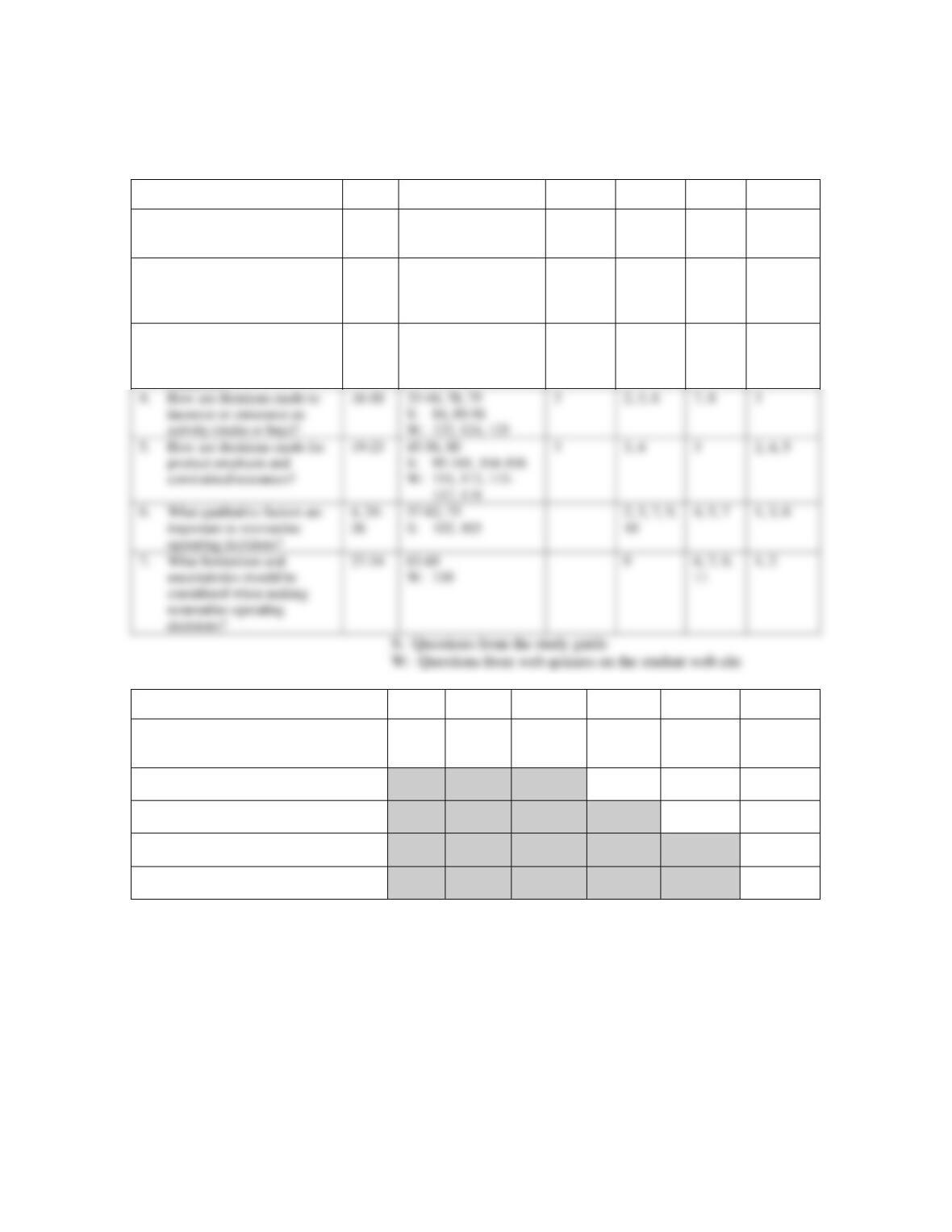
1. What is the process for
making non-routine
operating decisions?
1-7
1-10, 71-74, 81-83
W: 109, 110
1,2
2. How are decisions made to
accept, reject and price
special orders?
7-10
11-22, 76, 77
S: 85-87, 92-95
W: 113, 114, 118,
120, 126
3
1, 7, 9
4, 5, 6
3. How are decisions made to
keep or drop products,
segments, or whole
businesses?
11–15
23–32
S: 88, 96-98
W: 121, 123
3
8, 10
9, 10
1, 6
Level of Complexity*
True /
False
Multiple
Choice
Matching
Exercises
Short
Answer
Problems
Foundation: Repeat or paraphrase
information; Reason to single correct
solution; Perform computations; etc.
All
All
All
All
1, 2, 3, 8,
10
1, 2, 3, 4,
5, 6
Step 1: Identify the problem, relevant
information, and uncertainties
2, 5, 7, 9,
10
1, 3, 4, 5,
6, 7, 9, 11
1, 2, 3, 4,
6
Step 2: Explore interpretations and
connections
2
Step 3: Prioritize alternatives and
implement conclusions
Step 4: Envision and direct strategic
innovation
*Based on level in Steps for Better Thinking (Exhibit 1.10, textbook p. 16):
Note: Step 1, 2, 3, and 4 questions in this test bank are intentionally open-ended and subjective, giving students the
opportunity to demonstrate skills such as judgment, reasoning, identification of uncertainties, identification or analysis of
pros and cons, and so on. Therefore, student answers may not exactly match those shown in the solutions.
4. How are decisions made to
insource or outsource an
activity (make or buy)?
16–18
33-44, 78, 79
3
2, 5, 6
7, 8
3
5. How are decisions made for
product emphasis and
constrained resources?
19–23
45-56, 80
S: 99-101, 104-108
W: 111, 112, 115-
3
3, 4
3
2, 4, 5
6. What qualitative factors are
important to nonroutine
operating decisions?
4, 24-
26
57-62, 75
2, 5, 7, 9,
10
4, 5, 7
1, 3, 6
considered when making
decisions?
11

4-2 Cost Management
True / False
1. Because nonroutine operating decisions are so unique, managers cannot use a standard decision
process for addressing them.
2. Nonroutine operating decisions involve primarily decisions about long-term strategic plans.
3. Nonroutine operating decisions rarely require analysis of qualitative factors.
4. The effect of production practices on the environment is an example of a qualitative factor to be
considered in a nonroutine operating decision.
5. The process for making a nonroutine operating decision starts with identifying the decision type.
6. An order from a new customer always constitutes a special order.
7. Special order decisions are long-term decisions that may need to include the time value of money.
8. If a service organization is at capacity, it would only accept a special order for service if it was priced
at or above the price that regular customers pay for the service.
9. A key aspect of special order decisions is being at least as well off after the decision as before it.
10. If idle capacity exists, a special order must cover its full cost to be profitable.
11. In multi-product firms, managers need to consider the effect on demand for other products when they
make a keep or drop decision about one product.
12. Average costs are appropriate to use when deciding whether to keep a product or product line.
13. The general rule is to discontinue a service when its total fixed costs are less than its avoidable fixed
costs.
14. The general rule is to discontinue a product line when its total profit margin is greater than its
avoidable fixed cost.
15. The general rule is to discontinue a segment of the business when its total contribution margin does
not cover avoidable fixed costs.
16. The general rule for make or buy decisions is to choose the option with the lowest total cost.
17. Opportunity costs are often relevant in make or buy decisions.
18. Make or buy decisions are sometimes known as outsourcing decisions.
19. Managers should always emphasize products with the highest total contribution margin.
20. Emphasizing products with higher contribution margins assumes that fixed costs are unaffected by
product mix.
21. The number of lawnmowers available could be a constraint for a lawn care service.
22. One way to deal with constrained resources is to spend money to alleviate them.
23. When resources are constrained, managers should emphasize products and services that maximize the
contribution margin per unit of constrained resource.
24. Product quality is seldom a factor in make or buy decisions.
25. Managers may outsource a service because they do not consider it a core competency.
26. Rapid growth may require a company to outsource certain products or services.
27. Since nonroutine operating decisions do not typically involve large dollar amounts, managers do not
need to consider uncertainties when evaluating them.

Chapter 4: Relevant Costs for Nonroutine Operating Decisions 4-3
28. As long as managers can identify relevant information for making nonroutine operating decisions,
they will make the best decision.
29. Uncertainties about future revenues affect all nonroutine operating decisions.
30. The accessibility and timeliness of information can affect decision quality in nonroutine situations.
31. A factor in special order decisions is the effect that the decision will have on regular customers.
32. Managers may choose to keep an unprofitable product if dropping it would adversely affect the sales
of profitable products.
33. Strategic plans require managers to emphasize products that generate the highest short-term profit.
34. Relationships with resource suppliers are not a consideration in constrained resource decisions.
Multiple Choice
1. The process for making nonroutine operating decisions
a. Is the same as the process for making routine operating decisions
b. Involves qualitative techniques only
c. Begins with identifying the type of decision
d. Ignores qualitative factors
2. In applying a relevant quantitative analysis technique to a nonroutine operating decision, managers
must
a. Identify input variables
b. Identify a dependent variable
c. Not use estimates
d. Interpret results in the most favorable way possible
3. In nonroutine situations, managers must identify the type of decision to be made. Which of the
following is not an example of a nonroutine operating decision?
a. Make or buy
b. Special order pricing
c. Budgeting
d. Managing limited resources
4. Because many management decisions are unique, managers address them using a (an)
a. Cookbook
b. Process
c. Information system
d. Team
5. The process for addressing a nonroutine operating decision begins with
a. Applying relevant quantitative techniques
b. Applying relevant qualitative techniques
c. Questioning managers’ judgment
d. Identifying the type of decision involved
6. Nonroutine operating decisions differ from routine operating decisions in that nonroutine decisions
a. Ignore cash flows
b. Consider cash flows
c. Do not happen on a regular basis
d. Involve small dollar amounts
4-4 Cost Management
7. Sunk costs should be considered in
a. Both routine and nonroutine operating decisions
b. Neither routine or nonroutine operating decisions
c. Routine decisions only
d. Nonroutine operating decisions only
8. Which of the following is the best definition of a qualitative factor?
a. Factors related to product or service quality
b. Factors that cannot be identified in a decision-making process
c. Factors that are not valued in monetary terms
d. Factors that are superior to quantitative factors in decision making
9. A product emphasis decision may involve
a. Sunk costs and opportunity costs
b. Multiple resource constraints and sunk costs
c. Multiple products and qualitative factors
d. Sunk costs and qualitative factors
10. Qualitative factors can be difficult to identify because
a. They are not usually relevant in nonroutine operating decisions
b. They are usually unimportant
c. No set formula assures managers they have considered the important issues
d. They are typically the same as sunk costs
Use the following data for the next 2 questions.
Wolff Co. sells product P at a price of $38 a unit. The per-unit cost data are: direct materials $8, direct labor
$10, and overhead $12 (25% fixed and 75% variable). Wolff has sufficient capacity to accept a special order
for 40,000 units just received. Selling costs associated with this order would be $3 per unit.
11. The minimum selling price per unit should be
a. $24
b. $30
c. $32
d. $36
12. At a selling price of $33 per unit, the operating income will
a. Increase by $60,000
b. Increase by $80,000
c. Increase by $120,000
d. Increase by $160,000
Use the following data for the next 2 questions.
Wagner Corporation can manufacture 490,000 tennis rackets a year at a variable cost of $15 per racket and
fixed costs of $500,000. Wagner budgeted that it can sell 400,000 at $25 each. An additional order of
100,000 was received, but at a discount of 35% from the regular price.
13. The relevant cost to Wagner of the special order is
a. $1,500,000
b. $1,450,000
c. $1,625,000
d. Some other amount
Chapter 4: Relevant Costs for Nonroutine Operating Decisions 4-5
14. If Wagner accepts the special order, income before taxes will
a. Decrease by $100,000
b. Increase by $125,000
c. Increase by $25,000
d. Some other amount
15. Assume the following cost data:
Per-unit costs:
Direct material $6
Direct labor $4
Variable overhead $2
Variable selling $4
Fixed overhead $300
Fixed selling $400
A special order for 100 units is received. The buyer wants his name stamped on each unit. This will
increase labor costs by $0.25 per unit and cost $300 for the stamping machine. What price must be
charged to earn $300 on the special order?
a. $1,925
b. $1,775
c. $2,225
d. $2,075
16. PRO Shops has a capacity of 45,000 units, and is currently producing and selling 40,000 at $25 a unit.
The present cost structure, on a per unit basis, is:
Direct material $10
Direct labor 5
Variable overhead 3
Fixed overhead 4
An order for 7,000 units has been received from a Japanese company at a price of $20 per unit. If the
order is accepted, profit will
a. Decrease by $2,000
b. Increase by $14,000
c. Increase by $7,000
d. Increase by $4,000
17. The general rule for special orders is
a. Profit should be greater after the special order than before it
b. Only take special orders when excess capacity exists
c. The organization should be as well off after taking the order as it was before taking it
d. Ignore all fixed costs associated with the special order
18. To make a decision about a special order, managers need to know whether
a. The order replaces regular business
b. The customer will buy the same product in the future
c. The customer is a not-for-profit organization
d. The order has a long-term strategic effect
19. Sebastian is a manager at DLL Restaurant. He is considering accepting a special order from a
neighborhood homeless shelter for 150 Thanksgiving meals. Which of the following is a relevant
qualitative factor he should consider?
a. The number of homeless who will be served
b. His production capacity
c. The potential publicity for his restaurant
d. The price concerns of his competitors

4-6 Cost Management
20. In making a special order decision, which of the following is a relevant fixed cost?
a. Incremental fixed costs associated with current business
b. Contribution margin of any current business replaced
c. Depreciation on existing production equipment
d. Incremental fixed costs associated with the order
21. A company will only incur an opportunity cost for a special order when
a. Current capacity is constrained
b. The price of the order is less than its variable cost
c. The cost of the order is greater than the average cost for current business
d. Qualitative factors can be ignored
22. Managers should accept a special order if its price is greater than the sum of
a. All variable costs and all fixed costs
b. All variable costs and all opportunity costs
c. All fixed costs and all opportunity costs
d. Variable costs, relevant fixed costs and opportunity costs
Use the following data for the next 2 questions:
Redmond Corporation is closing one of its divisions. Operating data on this division follows:
Sales $80,000
Variable costs 40,000
Overhead 40,000
Overhead consists of $30,000 in salary and $10,000 for rent and insurance. The salary is for the chief
engineer, who will continue to work for Redmond even if the division is closed.
23. Rent and insurance that will cease if the division is closed is an
a. Unavoidable and irrelevant cost
b. Unavoidable and relevant cost
c. Avoidable and irrelevant cost
d. Avoidable and relevant cost
24. Assuming all overhead costs continue to be incurred even if the division closes, what will be the
effect on overall company profits of closing the division?
a. $10,000 decrease
b. $40,000 decrease
c. $40,000 increase
d. $30,000 decrease
25. The managers of Adamson Apple Co. are considering dropping one of their product lines. The
product line typically has the following revenue and costs:
Sales $100,000
Variable costs 80,000
Contribution margin 20,000
Fixed costs 25,000
Operating loss $ (5,000)
If the product line is discontinued, $4,000 of the fixed costs would be avoided. Also, the freed-up
capacity would generate $4,000 of additional contribution margin from the expansion of other
product lines. If Adamson discontinues the product line, the effect on overall income will be
a. $12,000 decrease
b. $8,000 decrease
c. $9,000 increase
d. $3,000 increase

Chapter 4: Relevant Costs for Nonroutine Operating Decisions 4-7
26. Which of the following is an opportunity cost associated with dropping a business segment?
a. The revenue given up
b. The avoidable fixed costs
c. The benefits from using excess capacity for something else
d. The increase in employee morale
27. Managers should discontinue a business if which of the following is less than the sum of relevant
fixed costs and opportunity costs?
a. Profit
b. Variable cost
c. Total cost
d. Contribution margin
28. Managers should discontinue a business if its contribution margin is less than the sum of
a. Relevant fixed costs and opportunity costs
b. Relevant fixed costs and sunk costs
c. Relevant opportunity costs and sunk costs
d. Relevant opportunity costs and profits
29. In making a decision to drop a product line, variable costs are
a. Always relevant
b. Never relevant
c. Usually relevant
d. Usually sunk
30. Yvonne and Ken own and operate Deluxe Housecleaning Service. Which of the following is a
qualitative factor associated with dropping carpet cleaning from their current line of services?
a. The timeliness with which they can provide other cleaning services
b. The quality of their current carpet cleaning equipment
c. The potential effect on demand for their other services
d. The lost revenue from current customers
31. If financial statement data are used to evaluate a decision to discontinue a business
a. Average costs are often mistakenly included as relevant information
b. Average costs are often correctly included as relevant information
c. Qualitative factors are irrelevant
d. Financial statement data is useless in this decision-making context
32. In the decision to drop a product line, fixed costs are often classified as
a. Avoidable or sunk
b. Sunk or opportunity
c. Product or period
d. Incremental or avoidable
33. A company manufactures chips used in the production of computers. The chips can be purchased for
$50 each from an outside vendor. It costs the manufacturer $60 a chip to produce them, of which 25%
is fixed overhead cost. What are the relevant costs for this decision? Based on these costs, which
option should the company choose?
Relevant Costs
(Manufacture and Purchase) Decision
a. $50 and $45 Manufacture
b. $50 and $45 Purchase
c. $45 and $40 Purchase
d. $45 and $40 Manufacture
4-8 Cost Management
34. N.G., Inc. currently buys 9,000 subcomponents from an outside supplier at $10 each. The company
has excess capacity, which it sublets to another company for $20,000 per year. If the company were
to use the idle capacity to produce the subcomponent internally, it would incur variable production
costs of $6 per unit, and it would hire a new supervisor for $15,000 per year. Other fixed overhead
costs would not change, but the average overhead cost per subcomponent unit would be $2. What is
the advantage or disadvantage (in dollars) if N.G. makes the subcomponent instead of continuing to
buy outside and subletting the excess capacity?
a. $6,000 disadvantage
b. $21,000 disadvantage
c. $1,000 advantage
d. $21,000 advantage
35. In deciding whether to manufacture a part or buy it from an outside supplier, which of the following
is an irrelevant cost?
a. Direct labor
b. Variable overhead
c. Fixed overhead that will be avoided if the part is purchased from an outside supplier
d. Fixed overhead that will continue even if the part is purchased from an outside supplier
36. Which of the following statements about outsourcing is true?
I. Outsourcing is the process of finding external suppliers
II. Outsourcing is not very common in today’s business world
III. Outsourcing is used for manufactured goods, but not for services
a. I only
b. I and III only
c. II and III only
d. I, II, and III
37. For manufacturers, outsourcing decisions are often known as
a. Make or buy
b. Routine
c. Constrained resource decisions
d. Special order decisions
38. In an outsourcing decision, the general rule managers should follow is to
a. Choose the option with the lowest relevant cost
b. Maximize the use of constrained resources
c. Outsource if the price is greater than the sum of variable costs and fixed costs
d. Do not outsource if the cost is less than the sum of relevant fixed costs and opportunity costs
39. In an outsourcing decision, fixed costs are
a. Never relevant
b. Relevant if they are greater than associated opportunity costs
c. Relevant if the company is operating outside the relevant range
d. Relevant if they can be avoided through outsourcing
40. PQK Corporation produces and sells bookends. Its managers are considering whether to outsource
the task of cutting the wood for the bookends to DLN Corporation. Which of the following is most
likely to be a qualitative factor that managers will consider in making the decision?
a. Cost of delivery
b. Timeliness of delivery
c. Whether DLN will outsource the delivery process
d. Depreciation on DLN’s fleet of delivery trucks

Chapter 4: Relevant Costs for Nonroutine Operating Decisions 4-9
41. Financial institutions often consider outsourcing their information technology functions
internationally. Which of the following are qualitative factors that should managers consider in the
decision?
I. Potential language barriers
II. Political stability
III. The tax cash flows
a. I only
b. II and III only
c. I, II, and III
d. I and II only
42. In general, a company should outsource if the cost to buy is
a. Less than the sum of variable costs and fixed costs
b. Less than the relevant variable costs.
c. Greater than or equal to (variable costs + relevant fixed costs – opportunity costs)
d. Less than or equal to (variable costs + relevant fixed costs – opportunity costs)
43. Which of the following is an opportunity cost that should be considered in an outsourcing decision?
a. Avoidable fixed costs
b. Benefits from alternate uses of released capacity
c. Unavoidable fixed costs
d. Employee morale
44. Managers should generally consider opportunity costs in both “keep or drop” and “make or buy”
decisions. Which of the following is an opportunity cost they should consider in both situations?
a. Avoidable fixed costs
b. Benefits from alternate uses of released capacity
c. Depreciation on new machinery
d. Market share
Use the following data for the next 2 questions:
Amsat Company has equipment that is in high demand, but has a limited amount of time available. The
equipment can be used to produce a number of different products. The following data are available:
Unit Variable Units
Product Unit Price Cost Per Hour
L $400 $200 8
M 300 150 22
N 600 250 8
O 200 100 20
45. Which product should be emphasized first?
a. L
b. M
c. N
d. O
46. Which product should be emphasized last?
a. L
b. M
c. N
d. O

4-10 Cost Management
Use the following data for next 2 questions:
Tieton Co. has two departments, Fabrication and Assembly. They produce 2 products. Product T needs 6
hours in fabrication and 6 hours in assembly. Product S needs 2 hours in fabrication and 4 hours in assembly.
Fabrication has 24 hours available and Assembly 18. Total variable costs are $ 20 and $15 for T and S
respectively. T sells for $22 and S for $16.
47. The objective function to maximize Tieton’s profits is
a. MAX$22T+ $16S
b. MAX$20T+ $15S
c. MAX$1T + $2S
d. MAX$2T + $1S
48. The constraints for Tieton’s 2 departments are
a. 6T + 2S <= 24 AND 6T + 4S <= 18
b. 6T + 2S <= 18 AND 6T + 4S <= 24
c. 6T + 6S <= 24 AND 2T + 4S <= 18
d. 6T + 6S <= 18 AND 2T + 4S <= 24
49. Flox Hill Consulting has its own printing department with the following annual costs:
Supplies $400,000
Labor 300,000
Overhead 200,000
Total $900,000
The managers would like to outsource the printing function because it is not considered a core
competency. The overhead is 60% fixed. Of the fixed overhead, $60,000 is the salary of the
printing department director. The remaining overhead is an allocation of overhead costs for the entire
consulting firm. The department director would still oversee the printing activities and coordinate all
of the printing activities for the organization with the outside printing vendor. The maximum amount
that Flox Hill is willing to pay an outside firm to replace the printing services is
a $820,000
b $900,000
c. $700,000
d. $840,000
50. A company should always promote the product
a. With the highest per unit contribution margin
b. That results in the highest total contribution margin
c. With the lowest variable cost per unit
d. With the least waste
51. The shadow price of a slack variable in a linear programming solution that maximizes the total
contribution margin reflects
a. The amount of excess capacity available for the associated constraint
b. The decrease in contribution margin that occurs if a unit of the associated product is produced
c. The contribution margin returned by the firm’s profitable product
d. The increase in contribution margin that would occur if another unit of the constrained resource
were available
52. When resources are constrained, managers should emphasize the product with the
a. Highest contribution margin per unit
b. Highest contribution margin per unit of constrained resource
c. Lowest average cost
d. Largest market share
Chapter 4: Relevant Costs for Nonroutine Operating Decisions 4-11
53. When resources are constrained, managers are most likely to use the following method to develop
decision making information
a. Simple or multiple regression
b. Analysis at the account level
c. Linear programming
d. High-low method
54. In a linear programming problem, slack resources are the same as
a. Idle capacity
b. Constraints
c. Limits on production
d. Mixed costs
55. Managers relax constraints by
I. Using constrained resources more effectively
II. Increasing available resources
III. Emphasizing the product with the highest contribution margin per unit
a. I only
b. II only
c. I and II only
d. I, II, and III
56. If an organization cannot deliver goods or services quickly because of a constraint, managers might
relax that constraint to
a. Protect customer loyalty
b. Ensure optimal profitability
c. Increase the selling price of the product
d. Find the next bottleneck
57. In a special order decision, which of the following is most likely a qualitative factor that managers
should consider?
a. Can we deliver without disrupting current schedules?
b. Will layoffs affect worker morale?
c. Does this order reflect our core competencies?
d. Will the decision affect future supply costs?
58. Effect on brand name recognition is a qualitative factor that managers should consider in
a. Product line keep and drop decisions
b. Special order decisions
c. Cost prediction decisions
d. Make or buy decisions
59. To ensure high quality in outsourcing decisions, organizations typically negotiate contracts with
a. A high margin for error
b. No uncertainties
c. Specific performance criteria
d. The lowest overall cost
60. Why are qualitative factors often difficult to identify?
a. They are unimportant in decision making
b. No set formula provides assurance that managers have considered the correct issues
c. They are only important when a company operates internationally
d. Qualitative factors are not difficult to identify
4-12 Cost Management
61. Which of the following is a relevant qualitative factor in a special order decision?
a. The cost of constrained resources
b. The effect of production processes on the political environment
c. The effect of production processes on the legal environment
d. How easily customers might share price information
62. “Whether delivery timeliness is an important factor” is an example of a
a. Quantitative factor
b. Qualitative factor
c. Constrained resource
d. Cost driver
63. Accuracy of cost estimates is one of the uncertainties in this type of decision.
I. Special order
II. Make or buy
III. Product emphasis
a. I and II only
b. I and III only
c. II and III only
d. I, II, and III
64. Factors that affect information quality in nonroutine operating decisions include:
I. Uncertainties
II. Timeliness
III. Analysis technique assumptions
IV. Overall cost structure
a. I, III, and IV only
b. II, III, and IV only
c. I, II, and III only
d. I and IV only
65. For which of the following decisions is vendor reliability a major uncertainty?
a. Constrained capacity
b. Special order
c. Outsourcing
d. International
66. Future revenues and costs are often a source of uncertainty for nonroutine operating decisions. Future
revenues and costs can be affected by
I. Economic environment changes
II. Customer demand
III. Government regulation
IV. Forecasting techniques
a. I and IV only
b. I and II only
c. I, II, and III only
d. I, II, III, and IV
67. General decision rules associated with outsourcing decisions assume the organization’s goal is to
a. Minimize constraints
b. Maximize short-term profits
c. Capture market share
d. Report financial information reliably
Chapter 4: Relevant Costs for Nonroutine Operating Decisions 4-13
68. The assumption that organizations seek to maximize short-term profits ignores
a. Qualitative factors
b. Fixed costs
c. Constrained resources
d. Managers’ desire for bonuses
69. Uncertainties affect
a. Special order decisions and outsourcing decisions, but not product emphasis decisions
b. Special order and product emphasis decisions, but not outsourcing decisions
c. Product emphasis and outsourcing decisions, but not special order decisions
d. Special order decisions, outsourcing decisions and product emphasis decisions
70. Depreciation is irrelevant in decision making
a. Under any circumstances
b. If it relates to equipment not yet purchased
c. If it relates to equipment already on hand
d. If it is different for each alternative
71. A cost that has been incurred in the past and cannot be changed is a (an)
a. Short-term cost
b. Opportunity cost
c. Sunk cost
d. Variable cost
72. Mr. Bigletter is employed at an annual salary of $25,000. He plans to start his own business and
estimates that he can gross $30,000 annually. If he chooses to open the new business, his foregone
salary is a (an)
a. Irrelevant cost
b. Sunk cost
c. Opportunity cost
d. Incremental cost
Use the following information for the next 3 questions.
Horton and Associates produces two products named BigBlast and LittleBlast. Last month 4,000 units of
BigBlast and 1,000 units of the LittleBlast were produced and sold. Following are average prices and costs
for last month:
BigBlast LittleBlast
Selling price $100 $200
Direct materials (25) (75)
Direct labor (15) (35)
Variable overhead (5) (30)
Product line fixed costs (10) (40)
Corporate fixed costs (25) (25)
Average margin per unit $ 20 $( 5)
The production lines for both products are highly automated, so large changes in production cause very little
change in total direct labor costs. Workers who are classified as direct labor monitor the production line and
are permanent employees who regularly work 40 hours per week. All costs other than “corporate fixed costs”
listed under each product line could be avoided if the product line were dropped.
73. Using only the information provided above, Horton could make several types of decisions. Possible
decisions include
I. Keep or drop
II. Product emphasis
III. Special order
IV. Constrained resources

4-14 Cost Management
a I and II only
b I and III only
c. I, II, and IV only
d. III and IV only
74. What is the breakeven sales volume (in units) for BigBlast? (In other words, what is the sales volume
at which Horton should be financially indifferent between dropping and keeping BigBlast?)
a 728 units
b 2,545 units
c. 1,084 units
d. 790 units
75. The following qualitative factors are relevant to Horton’s decision.
I. Would dropping one product affect the sales of the other product?
II. Are all product line fixed costs completely avoidable?
III. Would layoffs affect other workers’ morale?
a I only
b I and III only
c. I, II, and III
d. II and III only
Use the following data for the next 2 questions:
A manufacturer operating with excess capacity has been asked to fill a special order at $7.25 per unit. The
regular price is $10 per unit. No other use of the currently idle capacity can be found. The manufacturer’s
usual variable costs per unit are $3.50 for direct materials, $2.00 for direct labor, $1.00 for variable overhead,
and $0.50 for sales commission. No sales commission would be paid on this special order. The average fixed
overhead cost per unit is $0.25.
76. Under the general decision rule, the minimum price per unit for this special order is
a. $7.25
b. $6.50
c. $7.00
d. $7.50
77. Assume there is no excess capacity (i.e., the company can sell every unit that it produces to regular
customers). Under the general decision rule, the minimum price per unit for this special order would
be
a $10.00
b $7.25
c. $5.75
d. $6.50
More Difficult Multiple Choice
These multiple choice questions require more complex computations or present information differently than
in the textbook.
Use the following data for the next 2 questions:
Growe Company manufactures sewing machines and requires 30,000 units of a component that is used in the
manufacturing process. If Growe buys the part from Zigler Brothers, the plant will be idle. Of the fixed, 55%
overhead will continue regardless of the decision. The cost to buy the part from Zigler is $46. The unit cost to
make the part is:

Chapter 4: Relevant Costs for Nonroutine Operating Decisions 4-15
Direct materials $12
Direct labor 20
Variable overhead 12
Average fixed overhead 10
Total $54
78. Relevant costs to make the part are
a. $1,320,000
b. $1,380,000
c. $1,620,000
d. $1,455,000
79. Which alternative is more profitable and by what amount?
a. Buy, $150,000
b. Make,$150,000
c. Buy, $75,000
d. Make, $75,000
80. Tyke, Inc. produces 2 products A and B, each requiring direct material and labor. Total labor
available is 200 hours, and 300 pounds of material. Each unit of A sells for $10, and B sells for $15.
Given the following linear programming information:
Maximize: $4A + $5Y
Subject to: 3A + 1B ≤ 200
2A + 2B ≤ 300
What are the variable costs per unit for A and B?
a. $4 and $15
b. $14 and $19
c. $6 and $10
d. $7 and $14
81. The Wasson Widget Co. has 1,000 obsolete widgets on hand. These units were produced a year ago at
a cost of $10,000. The units could be scrapped for $1,000 or reworked for $2,000 and sold for $5,000.
Which alternative is desirable and why?
a. Scrap, income of $1,000 is higher than the other option
b. Rework, incremental loss $7,000
c. Rework, income of $3,000 is higher than the other option
d. Scrap, incremental loss $9,000
Use the following data for the next 2 questions:
Vicade has 1,000 commercial video game machines in inventory produced at a cost of $400 each (60%
variable and 40% fixed). The machines were to have been sold for $1,000 each. However, the machines
currently contain a minor malfunction, reducing their selling price to $150 each. The company could correct
the malfunction at a variable cost of $250 each, and then sell the machines for $550 each.
82. For purposes of determining whether the machines should be reworked, what is the opportunity cost
per unit?
a. $150
b. $200
c. $240
d. $400
83. If the games are reworked, what will be the contribution per unit from doing so?
a. $350
b. $300
c. $150
d. $100

4-16 Cost Management
Multiple Choice from Study Guide
s84. Each year Wright’s Widgets buys 10,000 subcomponents that it needs in the production of its widgets
from an outside supplier for $15 each. If Wright instead used its existing idle capacity to produce it
in-house, the variable production costs would be $8 per unit and $3 of fixed production overhead
would be allocated to each unit. Additionally, Wright would need to hire one quality control
technician for $28,000 per year. The excess capacity that would be required is currently leased to
another company for $25,000 per year. What is the advantage or disadvantage if Wright continues to
buy the subcomponent from the outside supplier?
a. $13,000 advantage
b. $17,000 disadvantage
c. $37,000 advantage
d. $3,000 disadvantage
Use the following information for the next 3 questions.
Taylor Enterprises sells its product for $40 per unit. Taylor recently received a special order from a customer
for 20,000 units. Production costs per unit for regular sales are:
Direct materials $ 6
Direct labor 14
Manufacturing overhead (2/3 variable) 12
s85. Suppose the special order price is $600,000 for all 20,000 units, and assume that Taylor has sufficient
capacity to fill the special order. Should it be accepted?
a. Yes, because profits will increase by $120,000
b. No, because profits will decrease by $200,000
c. No, because profits will decrease by $40,000
d. Yes, because profits will increase by $40,000
s86. Suppose that Taylor would like to earn $50,000 on this order and assume that there is sufficient
capacity to fill the special order. What price per unit should Taylor charge for the special order?
a. $34.50
b. $42.50
c. $30.50
d. $26.50
s87. Suppose that the special order price is $600,000 for all 20,000 units, but there is not sufficient
capacity to fill the order; 8,000 units of regular business will be replaced by the special order if it is
accepted. Should Taylor accept the special order and why?
a. No, because profits will decrease by $56,000
b. Yes, because profits will increase by $40,000
c. No, because profits will decrease by $24,000
d. No, because profits will decrease by $280,000
s88. Moore Manufacturing has two major product lines, Gidgets and Gadgets. Income statements for the
two product lines follow:
Gidgets Gadgets
Revenues $400,000 $400,000
Variable costs 225,000 150,000
Product line fixed costs 130,000 100,000
Allocated corporate fixed costs 120,000 90,000
Operating income (loss) $(75,000) $60,000
If the Gidget product line were dropped, all of its product line fixed costs could be avoided. Should
the Gidget product line be dropped, and why?
Chapter 4: Relevant Costs for Nonroutine Operating Decisions 4-17
a. Yes, profits increase $75,000
b. No, profits decrease $45,000
c. No, profits decrease $55,000
d. No, profits decrease $175,000
Use the following information for the next 4 questions.
Solo Co. made and sold 100,000 of its only product in 2004. Solo’s income statement for 2004 follows:
Sales $1,000,000
Direct materials 300,000
Direct labor 150,000
Variable manufacturing overhead 50,000
Fixed manufacturing overhead 100,000
Gross margin 400,000
Variable selling & administrative costs 75,000
Fixed selling & administrative costs 60,000
Operating income $265,000
In 2005, Solo expects to produce and sell 80,000 units, and the selling price and variable costs per unit will
remain unchanged. One third of the direct materials costs are for a subcomponent that Solo purchases from an
outside supplier. In 2005, Solo will be producing the component internally for $0.75 per unit.
s89. What is the contribution margin per unit in 2005?
a. $5.25
b. $4.50
c. $2.81
d. $0.81
s90. What is the expected operating income in 2005?
a. $232,000
b. $90,000
c. $200,000
d. $105,000
s91. What is the effect on 2005 profits of Solo’s decision to produce the component internally?
a. Increase by $25,000
b. Increase by $20,000
c. Decrease by $65,000
d. Decrease by $33,000
s92. Relevant costs in a special order decision include all of the following except
a. Direct materials costs of $3 per unit
b. Fixed cost of $1500 for rental of a machine needed to produce the order
c. Contribution margin per unit of regular sales when there is sufficient capacity to produce the
order
d. Unusual shipping charges paid by Solo of $4 per unit for the special order

4-18 Cost Management
Use the following information for the next 3 questions.
Loso Co. made and sold 100,000 of its only product in 2004 for $15 each. Loso’s costs per unit for 2004
follow:
Direct materials $ 5.00
Direct labor 2.00
Variable manufacturing overhead 1.00
Fixed manufacturing overhead 1.50
Variable selling & administrative costs 0.80
Fixed selling & administrative costs 0.50
Total $10.80
In 2005, Loso expects to produce and sell 80,000 units. The selling price and variable costs per unit will
remain unchanged, as will total fixed costs. Early in 2005, a new customer approaches Loso and requests a
one-time special order for 30,000 units.
s93. What are total budgeted fixed costs for 2005?
a. $160,000
b. $150,000
c. $120,000
d. $200,000
s94. Suppose the special order will incur only half the regular variable selling & administrative costs and
will require the rental of a special grinding machine for $15,000. Assume the capacity of Loso is
120,000 units per year. What is the minimum price per unit for the special order that Loso should
accept?
a. $9.00
b. $8.90
c. $11.00
d. $10.90
s95. Suppose the special order will incur only half the regular variable selling & administrative costs and
will require the rental of a special grinding machine for $15,000. Assume the capacity of Loso is
100,000 units per year. What is the minimum price per unit for the special order that Loso should
accept?
a. $10.97
b. $15.10
c. $11.10
d. $15.50
Use the following information for the next 3 questions.
Ricardo Company has three products, A, B, and C. The following information is available:
Product A Product B Product C
Sales $30,000 $70,000 $34,000
Variable costs 18,000 27,000 18,000
Contribution margin 12,000 43,000 16,000
Fixed costs:
Avoidable 4,500 12,000 12,000
Unavoidable 3,000 10,000 6,200
Operating income $ 4,500 $21,000 $ (2,200)
s96. If Ricardo drops Product C, then operating income will
a. Increase by $2,200
b. Decrease by $16,000
c. Decrease by $4,000
d. Decrease by $9,800

Chapter 4: Relevant Costs for Nonroutine Operating Decisions 4-19
s97. Suppose that eliminating Product C will free up warehouse space for Product A’s use, and will reduce
the avoidable fixed costs of Product A by $1,500. If Ricardo drops Product C, then operating income
will
a. Increase by $3,700
b. Decrease by $14,500
c. Decrease by $8,300
d. Decrease by $2,500
s98. Suppose that eliminating Product C will reduce sales of Product B by 10%. If Ricardo drops Product
C, then operating income will
a. Decrease by $11,000
b. Decrease by $6,100
c. Decrease by $4,300
d. Decrease by $8,300
Use the following information for the next 3 questions.
Clark, Inc. makes 3 products, B, C, and D. Clark only has 110 machine hours available each week.
Contribution margin, machine hour requirements, and weekly customer demand information is as follows:
B C D
Contribution margin per unit $8 $4 $7
Machine hours required per unit 0.6 0.4 0.2
Weekly customer demand 200 600 100
s99. In what order should the products be produced?
a. B, C, D
b. C, D, B
c. D, B, C
d. B, D, C
s100. How many units of each product should be produced?
a. 200 Bs, 0 Cs, and 100 Ds
b. 150 Bs, 0 Cs, and 100 Ds
c. 0 Bs, 600 Cs, and 0 Ds
d. 200 Bs, 100 Cs, and 100 Ds
s101. What is the maximum amount that Clark would be willing to pay, above the normal cost, for one
more machine hour per week?
a. $10.00
b. $13.33
c. $35.00
d. $0.00
s102. Quantitative factors in a nonroutine operating decision
a. Include nonfinancial information
b. Could never include product quality considerations
c. Are always relevant to a nonroutine operating decision
d. Are of a higher quality than qualitative factors
s103. Qualitative information used in a make or buy decision is least likely to include
a. Reliability of the supplier
b. Quality of the supplier’s product
c. Effect of purchasing a component on the company’s long-term strategic plan
d. None of the above (all are good examples of qualitative information)

4-20 Cost Management
Use the following information for the next 3 questions.
Karl, Inc. makes 2 products, W and X. Karl only has 100 machine hours and 400 labor hours available each
week. Customer demand for both products is unlimited. Contribution margin and machine and direct labor
hour requirements are as follows:
W X
Contribution margin per unit $12 $28
Machine hours required per unit 1.2 2.2
Labor hours required per unit 2.4 4.4
s104. Which of the following statements is true?
a. The machine hour constraint is slack
b. The labor hour constraint is binding
c. Karl should only produce one product
d. This problem cannot be solved without using software or tedious mathematical computations not
covered in this chapter
s105. What is the optimal production plan?
a. Produce 83 Ws and no units of X
b. Produce 45 Xs and no units of W
c. Produce 83 Ws and 45 Xs
d. This problem cannot be solved without using software or tedious mathematical computations not
covered in this chapter
s106. How much would Karl be willing to pay, above the normal cost, to obtain one more machine hour
and one more labor hour, respectively?
a. $12.73 and $6.36
b. $12.73 and $0
c. $10.00 and $0
d. This problem cannot be solved without using software or tedious mathematical computations not
covered in this chapter.
s107. Which of the following is considered a bottleneck in a product emphasis/constrained resource
decision?
a. Employees need to be paid extra when they work overtime
b. The company’s 12 machines can only operate 18 hours per day
c. Customer demand for product A is limited to 1,200 units per month
d. All of the above are considered bottlenecks
s108. Which of the following is true?
a. In a product emphasis/constrained resource decision with 2 products and 2 constraints, it will
always be optimal to make both products
b. In a product emphasis/constrained resource decision with 2 products and 1 constraint, it will
always be optimal to make only one product
c. Product emphasis/constrained resource decisions with more than 2 products and more than 2
constraints cannot be solved without software
d. All of the above are true
Multiple Choice from Web Quizzes (Available on Student Web Site)
w109. The following information is always relevant for short-term decisions:
a. Fixed costs
b. Unavoidable costs
c. Sunk costs
d. Incremental costs
Chapter 4: Relevant Costs for Nonroutine Operating Decisions 4-21
w110. Variable costs are important for which type of relevant cost decisions?
I Special order
II Outsourcing
III Keep or drop a product
a. I and II only
b. II and III only
c. I and III only
d. I, II, and III
w111. Under the general decision rule for relaxing a constraint, managers are willing to pay
a. Only what they pay now
b. Up to the entire contribution margin per unit of constrained resource
c. What they pay now plus some or all of the contribution margin per constrained resource
d. Less than what they pay now
w112. A bottleneck
a. Is not a capacity constraint
b. Has an opportunity cost of lost revenue from unmet demand
c. Is unrelated to capacity
d. Cannot be used efficiently
Use the following information for the next 2 questions.
A manufacturer operating with excess capacity has been asked to fill a special order at $7.25 per unit. No
other use of the currently idle capacity can be found. The manufacturer’s usual variable costs per unit are
$3.50 for direct materials, $1.50 for direct labor, $1.50 for variable overhead, and $0.50 for sales commission.
No sales commission would be paid on this special order. The average overhead per unit is $0.25.
w113. The expected contribution margin per unit for the special order is
a. $0.00
b. $0.25
c. $0.75
d. $1.00
w114. Under the general decision rule, the minimum price per unit for this special order is
a. $7.25
b. $6.50
c. $7.00
d. $7.50
w115. A constraint is
a. A limited resource that is not binding in that it does not slow down the manufacturing or service
delivery process
b. A limited resource that restricts an organization’s ability to provide enough products or services
to satisfy demand
c. A service that an organization has decided to discontinue
d. A product that an organization has decided to discontinue
w116. When an organization faces multiple constraints for multiple products, what kind of quantitative
analysis needs to be performed?
a. Use the same technique as for a special order
b. No quantitative analysis, because there is no way to use constrained resources optimally
c. A linear programming analysis that optimizes the contribution margin per constrained resource
d. Rank products on contribution margin and pick the product with the highest one
4-22 Cost Management
w117. How are constrained resources and relevant ranges related?
a. Resources are usually constrained within their relevant ranges
b. If production is beyond the capacity limit, resources are probably constrained, and production is
outside of the relevant range
c. When constrained resources are relaxed or elevated, the relevant range does not change
d. There is no relation between constrained resources and relevant ranges.
w118. Suppose a manager decides to sell a special order at the breakeven price. However, he is concerned
that the organization could lose money if there are any errors in the analysis. About which factor
should the manager be concerned?
a. The accuracy of the cost function
b. Current demand
c. Opportunity costs
d. Sunk costs
w119. The general decision rule for choosing products to emphasize, assuming no constraints and no
relevant qualitative factors, is to emphasize products
a. That people like
b. With the highest contribution margin per unit
c. With lowest average costs
d. That are easy to manufacture
w120. If a firm has no extra capacity and a customer asks for a special order, what price is acceptable
(assuming there are no relevant qualitative factors)?
a. The regular price because this order replaces regular business
b. Only variable cost
c. Variable cost plus average fixed cost
d. Only the average fixed cost
w121. The general rule is to keep any product or service in the short term
a. That can be sold
b. That covers variable costs
c. That covers variable costs plus any fixed costs that can be avoided if the product or service is
dropped
d. If it covers part of the avoidable costs
w122. When deciding whether to outsource or insource a product or service, managers consider
a. The reliability of the product or service supplier
b. All of the fixed costs
c. Only the variable costs
d. No qualitative factors
w123. A not-for-profit organization provides meals and medicine for homeless people. Because of funding
cutbacks, one of the two services must be curtailed. To make this choice, managers are likely to
consider all of the following except
a. The volume of each service that can be provided with existing funding
b. The number of other organizations providing each service
c. Future funding possibilities
d. The cost of the building housing the program
w124. (CMA) What is the opportunity cost of making a component part in a factory given no alternative use
of the capacity?
a. The variable manufacturing cost of the component.
b. The total manufacturing cost of the component.
c. The total variable cost of the component.
d. Zero

Chapter 4: Relevant Costs for Nonroutine Operating Decisions 4-23
w125. (CMA) Hillary Corporation has its own cafeteria with the following annual costs:
Food $200,000
Labor 150,000
Overhead 220,000
Total $575,000
The overhead is 40% fixed. Of the fixed overhead, $50,000 is the salary of the cafeteria supervisor.
The remainder of the fixed overhead has been allocated from total company overhead. Assuming the
cafeteria supervisor will remain and that Hillary will continue to pay her salary, the maximum cost
Hillary is willing to pay an outside firm to replace the cafeteria services is
a. $575,000
b. $350,000
c. $438,000
d. $482,000
w126. (CMA) Callow Company has considerable excess manufacturing capacity. A special job order’s cost
sheet includes the following allocated manufacturing overhead costs:
Fixed costs $42,000
Variable costs 66,000
The fixed costs include a normal $7,400 allocation for in-house design costs, although no in-house
design will be done. Instead, the job will require the use of external designers costing $15,500. What
is the total amount to be included in the calculation to determine the minimum acceptable price for
the job?
a. $73,000
b. $81,500
c. $108,000
d. $116,100
Matching
1. Nonroutine operating decisions can be made following a general process. Steps in the process are
shown in the right-hand column below. Various examples of the steps are shown on the left. Match
each example with the appropriate step. Each numbered item has only one correct answer. Each
lettered item may be used once, more than once, or not at all.
____ 1. Constrained resources
____ 2. Customer information
sharing
____ 3. Delivery timeliness
____ 4. Evaluate information
quality
____ 5. Linear programming
____ 6. Make or buy
____ 7. Product emphasis
____ 8. Product quality
____ 9. Regression
____ 10. Special order
A. Identify the type of decision
managers must make
B. Identify and apply relevant
quantitative analysis
techniques
C. Identify and analyze
qualitative factors
D. Consider quantitative and
qualitative information to
make a decision
4-24 Cost Management
2. Nonroutine operating decisions can be made following a general, 4-step process. The 4 steps are
listed below, in random order. Number the steps in the correct order (1 through 4).
____ Identify and analyze qualitative factors
____ Identify the type of decision managers must make
____ Consider quantitative and qualitative information to make a decision
____ Identify and apply relevant quantitative analysis techniques
3. Various general decision rules are used for different kinds of nonroutine operating decisions. The
types of nonroutine operating decisions are listed below on the right; decision rules are listed on the
left. Match each decision rule with the appropriate decision type. Each numbered item has only one
correct answer. Each lettered item may be used once, more than once, or not at all.
____ 1. Accept if price is greater than or equal to the sum
of variable costs, relevant fixed costs and
opportunity costs
____ 2. Drop if the contribution margin is less than the
sum of relevant fixed costs and opportunity costs
____ 3. Emphasize the product with the highest
contribution margin per unit if resources are not
constrained
____ 4. If resources are constrained, emphasize the
product with the highest contribution margin per
unit of the constrained resource
____ 5. If the price is greater than or equal to the sum of
variable costs and opportunity costs, accept the
order
____ 6. Keep work inside if the cost to buy is less than or
equal to the sum of variable costs and relevant
fixed costs
____ 7. Make the product if the cost to buy is greater
than or equal to the difference between variable
costs and opportunity costs
____ 8. Outsource if the cost to buy is greater than or
equal to the sum of variable costs and relevant
fixed costs, less opportunity costs
____ 9. When operating with resource constraints,
emphasize the product with the highest overall
profit margin
____ 10. When resources are constrained, sell as much as
possible of the product with the highest price
A. Special order
B. Product emphasis
C. Keep or drop
business segment
D. Insource or
outsource
E. None of the
above
Chapter 4: Relevant Costs for Nonroutine Operating Decisions 4-25
Exercises
1. Jones Corporation prepared the following budgeted income statement at the beginning of the current
year: Expected sales (80,000 units) $400,000
Operating costs:
Variable costs $220,000
Fixed costs 100,000 320,000
Operating income $ 80,000
During the middle of the year, the managers estimated that regular sales would amount to only 70,000
units. Recently, a foreign company requested a special order for 10,000 units at a price of $4. If the
order is accepted, each unit must be stamped with the customer’s name. This would require the
purchase of a stamping machine for $10,000 that could only be used for this order.
a. Determine the relevant costs for the special order decision.
b. What will be the effect on overall company profits if the order is accepted?
2. National Motors manufactures cars and currently uses only 50% of its manufacturing facility (20,000
cars). The company could utilize more of its facility by producing its own tires. It currently purchases
tires at $30 per set of four. National would incur $12 per set for direct materials, $10 for direct labor,
and $24 for overhead (which is 30% variable) if it produces the tires.
a. Should National Motors make or buy the tires? Provide calculations that support your answer.
b. Suppose National Motors could rent the unused portion of its plant and receive $1,500 a month.
Should the company make or buy the tires? Provide calculations that support your answer
c. List two qualitative factors that could affect this decision.
3. Speedy Sports manufactures three kinds of tennis rackets. However, Speedy has a limited number of
machine hours available to make these items. The following data pertain to each racket:
Wood Steel Graphite
Machine time per unit 48 min. 50 min. 75 min.
Unit sales price $25 $30 $50
Unit variable cost 15 19 34
Unit contribution margin $10 $11 $16
a. In what order should the rackets be produced?
b. Assume there are 1,200 machine hours available and that demand is 200, 600, and 500 units,
respectively, for wood, steel, and graphite. Determine how many units of each should be
produced.
c. What is the maximum amount that Speedy would be willing to pay per machine hour to relax the
constraint?
4. Skiing Accessories has 3,000 machine hours of plant capacity available for manufacturing sun
goggles. Following is information about these products.
Premium Regular
Selling price per unit $50 $30
Variable cost per unit $35 $10
Units that can be manufactured per machine
hour on the same production line 8 5
Estimated demand 12,000 goggles 21,000 goggles
4-26 Cost Management
a. How many machine hours should be devoted to the manufacture of each product?
b. What is the maximum amount that Skiing Accessories would be willing to spend to increase
capacity?
5. Kleindale Company currently manufactures a subassembly for its main product. The costs per unit
are as follows: Direct materials $ 1.50
Direct labor 15.00
Variable overhead 8.00
Average fixed overhead 32.00
Total $56.50
Merriman Corp has contacted Kleindale with an offer to outsource 5,000 subassemblies for $40.00
each. Kleindale would eliminate $100,000 of fixed overhead if it accepts the proposal.
a. Should Kleindale make or buy the subassemblies? Provide calculations to support your answer.
b. At what volume of subassembly production would Kleindale generally be indifferent to making
or buying the subassembly?
c. List two qualitative factors that might influence this make or buy decision.
6. Fast Bikes manufactures bicycles for mountain and road use. At its plant in Yuma, it assembles two
bikes: premier and regular mountain bikes. Here is information for these bikes.
Premier Regular
Selling price $1,600 $1,000
Variable costs per unit 1,200 500
Contribution margin per unit $400 $ 500
Contribution margin ratio 25% 50%
Variable costs include only direct materials and direct labor. There are only 600 machine hours
available each day for manufacturing the bikes. Additional capacity cannot be obtained in the short
run. Fast Bikes can sell as many of these mountain bikes as it produces. Premier bikes require 2
machine-hours each, and regular bikes require 5 machine-hours each.
a. Which product should Fast Bikes emphasize?
b. Currently there are no variable costs associated with machine operations; all costs are fixed. Up
to what maximum amount per machine-hour would Fast Bike be willing to pay to increase the
number of machine hours available?
7. Weisbach Wallets (WW) produces nylon waterproof wallets. WW’s plant capacity is 50,000 per
month. Unit costs for the current production volume of 48,000 wallets are:
Direct materials $6.00
Direct labor 4.00
Variable overhead 1.50
Fixed overhead 3.00
Marketing – fixed 1.00
Marketing – variable 2.80
Current monthly sales are 48,000 wallets at $18 each. Suppose REI Phoenix has contacted the
manufacturing plant at WW about purchasing 2,000 units at $13 each. Current sales would not be
affected by this order.
a. Should WW accept this special order? Provide computations to support your answer.
b. What is the minimum price that WW would generally accept for this order?
c. List two qualitative factors that should be considered for this decision.
Chapter 4: Relevant Costs for Nonroutine Operating Decisions 4-27
8. Cowboy Boots Company produces two products: Fun and Fancy Boots. Last month 2,000 units of
Fun Boots and 4,000 units of Fancy Boots were produced and sold. Average prices and costs for the
two products in that month are displayed below.
Fun Fancy
Selling price $95 $225
Direct materials 40 95
Direct labor 7 25
Variable overhead 3 15
Product line fixed costs 15 45
Headquarters fixed costs 20 20
Average margin per unit $10 $ 25
The production lines for both products are highly automated, so large changes in production entail
very little change in total direct labor costs. Workers who are classified as direct labor monitor the
production line and are permanent employees who regularly work 40 hours per week.
All product-line costs, other than “corporate fixed costs,” could be avoided if the product line were
dropped. Headquarters fixed costs totaled $120,000 and the total sales amounted to 6,000 units, so
the average corporate fixed cost per unit was $20. About $18,000 of the corporate fixed costs could
be avoided if Fun Boots were dropped, and about $12,000 of the corporate fixed costs could be
avoided if Fancy Boots were dropped. The remaining $90,000 could be avoided only by going out of
business entirely.
a. What is the overall corporate breakeven in total sales revenue, assuming the sales mix is the same
as last month’s?
b. What is the breakeven sales volume (in units produced and sold) for Fun Boots? (In other words,
what is the sales volume at which Cowboy should be financially indifferent between dropping
and retaining Fun Boots?)
9. Yogurt Supreme sells yogurt cones in a variety of natural flavors. Data for a recent month appear
below:
Revenue (10,000 cones @ $0.93 each) $9,300
Cost of ingredients $3,500
Rent 2,500
Store attendant 1,800 7,800
Income $1,500
a. The manager has received a call from a club requesting a bid on 100 cones to be picked up in 3
days. The cones could be made up well in advance by the store attendant during slack periods.
Each cone would require, however, a special plastic cover that costs $0.05. What is the minimum
acceptable price per cone for this special order?
b. If the club is able to pay no more than the minimum price, what other considerations may affect
the decision? List two.
10. Quick Clean sends workers to homes and offices to perform cleaning services for special occasions.
There are 4 different outlets and one headquarters for the company. Headquarters’ costs are allocated
to outlets using a rate of 30% of revenue. The income statement for one of the outlets for last year
was as follows:
4-28 Cost Management
Revenue (500 visits) $200,000
Costs:
Direct labor wages ($160 per visit) $80,000
Rent and insurance 20,000
Variable selling and administrative 10,000
Fixed selling and administrative 35,000
Allocated headquarters costs 60,000 205,000
Income $( 5,000)
a. Quick Clean wants to know whether this outlet should be dropped. Identify the relevant cash
flows and make a recommendation to management about this decision.
b. List one qualitative factor that might affect this type of decision.
Short Answer
1. List two different types of nonroutine operating decisions, and give an example of each one for a
retail hardware store.
2. When an organization faces constrained resources, there are several ways to either relax the constraint
or maximize the use of it. List two actions an organization could take to minimize the effects of a
constraint or to relax it.
3. Describe quantitative and qualitative information, and explain why both are important in nonroutine
operating decision making.
4. List two qualitative factors that need to be considered when making a decision about whether to
accept a special order.
5. Donald is the sales manager of DVL Corporation. He is considering accepting a special order with a
positive contribution margin. The order would require the company to purchase special equipment.
Nevertheless, Donald estimates that the special order would contribute $10,000 to DVL’s profits
during the current quarter. Discuss the factors that Donald should consider in deciding whether to
accept the special order.
6. Nancy is the sales manager of VLP Corporation, which manufactures and sells slipcovers for
household furniture. The current selling price of a slipcover is $150. Nancy has the opportunity to
fill a special order for slipcovers at a price of $140 each. Describe three uncertainties that Nancy
faces in making the special order decision.
7. NSL Corporation produces and sells bookcases and magazine racks. Its production operation is
organized into three parts: fabrication (where the wood and other raw materials are cut), assembly
(where the cut materials are assembled into finished products), and painting (where the final products
are painted and prepared for customers). NSL is considering outsourcing one of the three functions,
each of which would have an equal financial effect on the corporation overall. Discuss why each of
the following qualitative factors might be so important that it could override quantitative
considerations for this decision.
a. Ability to ensure high quality
b. Timeliness of delivery
c. Whether NSL’s managers consider the function to be a core competency
8. Describe the costs that are usually relevant to a make or buy decision.
9. Describe two assumptions that need to be met when considering whether to keep or drop a product.
10. What types of opportunity costs are considered in both keep or drop and make or buy decisions?

Chapter 4: Relevant Costs for Nonroutine Operating Decisions 4-29
11. Financial statement information uses average costs (variable plus average fixed overhead) to calculate
cost of goods sold and to value inventory. Are these average costs useful in making nonroutine
operating decisions? Explain.
Problems
1. State University is organized into four colleges with the following characteristics:
Business Engineering Science Humanities
Number of majors 5,000 4,500 4,800 1,200
Number of non-majors taking classes 1,000 500 2,400 3,600
Revenue from student fees $600,000 $500,000 $720,000 $480,000
Revenue from external grants $200,000 $1,500,000 $800,000 $120,000
Variable cost per student $35.00 $65.00 $80.00 $25.00
Fixed cost per student (based on total students) $35.00 $55.00 $25.00 $10.00
a. List three items that would likely be included in the category of variable costs per student from
the perspective of each college.
b. List two items that would likely be included as fixed costs per student from the perspective of
each college.
c. Calculate the contribution margin per student from the perspective of each college and then from
the perspective of the university as a whole.
d. Calculate the total profit from the perspective of each college and then for the university as a
whole.
e. Based on financial considerations alone, identify the college that would be most likely to be
dropped from the university during a budget crisis. Then identify the candidate that would least
likely be dropped.
f. List three uncertainties about the quantitative analyses you performed in part (e).
g. List three qualitative issues that should be considered in making a decision to drop one of the
colleges.
2. Spinning Wool currently produces and sells three different types of yarn. Total demand for the yarn
exceeds the firm’s capacity. The constraint on production is the time available on a special machine
that cleans the wool used for the yarn. Data on the products and time required on the special machine
are summarized in the following chart.
Type of Yarn
Fine Medium Coarse
Selling price $24 $30 $36
Variable manufacturing cost $12 $18 $11
Variable marketing cost $2 $2 $6
Fixed cost per lot $5 $8 $10
Machine hours needed per lot 0.2 0.25 0.5
Maximum demand (in lots) per period 4,000 3,750 5,000
The firm has only 2,500 hours of time available on the special machine per period. Fixed costs are
$100,000 per period, which will not change if the product mix changes or if any products are
dropped.
a. Which product should Spinning Wool emphasize? Show your calculations.
b. Up to how much per hour should Spinning Wool be willing to pay to increase capacity on the
special machine?
c. Describe two reasons why the managers cannot be certain that they have accurately estimated the
product selling prices.
(continued on next page)
4-30 Cost Management
d. Describe two reasons why the managers cannot be certain that they have accurately estimated the
product variable costs.
e. Discuss how the uncertainties in parts (c) and (d) are likely to affect the managers’ product
emphasis decisions at Spinning Wool.
3. Franklin Manufacturing has just received an offer from a supplier to buy 12,000 units of a
computerized component used in its main product. The component is currently produced internally.
The supplier has offered to sell the component for $75 per unit. The estimated costs of producing it
are given below.
Direct materials $30
Direct labor $15
Variable overhead $25
Fixed overhead $28
Prior to making a decision, the company’s CEO commissioned a special study to see whether there
would be any decrease in fixed overhead costs. The company would avoid two setups and that would
reduce total spending by $10,000 per setup. One inspector would be laid off at a savings of $20,000.
Janitorial services would be reduced by 200 hours at $15/hour. Although the work decreases by 200
hours, the janitor assigned to the computerized component line also spends time cleaning for other
product lines and is guaranteed a 40 hour work week. Further, another department could use the area
where this component is produced. That department is currently paying $90,000 to rent the same
amount of space.
a. Ignore the special study, and determine whether the gear should be produced internally or
purchased from the supplier.
b. Now repeat the analysis, using the special study data.
c. Briefly identify qualitative factors that might affect the decision, including strategic implications.
4. McVictor Industries solved the following linear programming problem as the basis for its budget for
the next operating period. Fixed costs are budgeted as $80 per unit.
Objective Function: Maximize $250×Regular + $130×Premium
Subject to:
Assembly hours constraint:
10 hours × Regular + 25 hours × Premium ≤ 10,000 hours
Testing hours constraint:
10 hours × Regular + 5 hours × Premium ≤ 5,000 hours
Excel’s Solver function produced the results shown below.
Regular
375
Premium
250
Target function:
$126,250
Constraints:
Assembly
10,000
Testing
5,000
Chapter 4: Relevant Costs for Nonroutine Operating Decisions 4-31
Answer Report:
Target Cell (Max)
Cell
Name
Original Value
Final Value
$A$7
Target function
0
126250
Adjustable Cells
Cell
Name
Original Value
Final Value
$A$5
Regular
0
375
$B$5
Premium
0
250
Constraints
Cell
Name
Cell Value
Formula
Status
Slack
$B$9
Assembly
10000
$B$9<=10000
Binding
0
$B$10
Testing
5000
$B$10<=5000
Binding
0
Sensitivity Report:
Adjustable Cells
Final
Reduced
Objective
Allowable
Allowable
Cell
Name
Value
Cost
Coefficient
Increase
Decrease
$A$5
Regular
375
0
250
10
198
$B$5
Premium
250
0
130
495
5
Constraints
Final
Shadow
Constraint
Allowable
Allowable
Cell
Name
Value
Price
R.H. Side
Increase
Decrease
$B$9
Assembly
10000
0.25
10000
15000
5000
$B$10
Testing
5000
24.75
5000
5000
3000
a. What quantity of each product should McVictor produce?
b. What is the contribution margin with this sales mix?
c. Suppose McVictor wants to relax the constraint in Testing. Up to what maximum amount per
hour would the company be willing to pay?
d. If McVictor relaxes the constraint in Testing, will the contribution margin increase? Explain.
e. What would happen if Assembly hours decrease by more than 5,000?
f. By how much could the contribution margin of regular increase before the sales mix would
change?
g. Identify reasons why the managers cannot be certain that they have accurately estimated the
resource constraints.
5. Water Away produces and sells types of plastic boats. All three boats are manufactured using a
single computer-controlled plastic injection molding machine.
Boat A Boat B Boat C
Selling price $79.00 $99.00 $149.00
Direct materials 34.00 34.00 43.00
Direct labor 0.40 0.60 1.00
Variable overhead 1.00 2.00 1.00
General overhead 24.00 36.00 60.00
Product Margin $19.60 $36.00 $44.00
4-32 Cost Management
Computer controlled injection molder:
Machine time required per unit 0.02 hr 0.03 hr 0.05 hr
Daily demand 200 units 120 units 60 units
Daily machine time requirements 4 hrs 3.6 hrs 3 hrs
To meet daily demand for all three products, 10.6 hours would be required on the injection molder.
However, the machine must be attended at all times by a skilled operator who works only a standard
8-hour workday. Therefore, insufficient capacity exists to meet demand for all three products.
The labor cost per unit is determined by multiplying the operator’s wage of $20 per hour by the
fraction of an hour required to produce a single boat. Direct labor employees are guaranteed a 40-
hour work week. General overhead is almost entirely fixed.
a. The production bottleneck is the machine, and this bottleneck can be relaxed by inducing the
skilled operator to work overtime. Up to how much should the firm be willing to pay per hour in
total for the first hour of overtime?
b. The supervisor at the boat company believes that the bottleneck should be relaxed, even if the
company only breaks even on the units sold after the capacity limit has been reached. Explain
this reasoning.
6. Midtown Clinic provides its own housekeeping services. The clinic director would like to outsource
this service, and has found a company that will provide the service for $24 per hour. The following
information has been collected about the cost per hour to the clinic for performing its own
housekeeping services:
Cost per hour of service:
Cleaning supplies $ 2
Direct labor $17
Variable overhead $1
Total hours of housekeeping services per year 2,600
Total fixed overhead $36,000
a. Should Midtown Clinic outsource housekeeping, assuming that $26,000 of fixed costs can be
eliminated if the service is outsourced? Provide calculations to support your answer.
b. At what level of service (in hours) would Midtown generally be indifferent between providing
housekeeping services or outsourcing them, assuming that $26,000 of fixed costs can be
eliminated?
c. Identify one potential opportunity cost that the clinic director might have overlooked.
d. Describe two qualitative factors that might affect this outsourcing decision.
Chapter 4: Relevant Costs for Nonroutine Operating Decisions 4-33
Answers
True / False
Multiple Choice
4-34 Cost Management
Matching
Chapter 4: Relevant Costs for Nonroutine Operating Decisions 4-35
Exercises
4-36 Cost Management
Short Answer
Chapter 4: Relevant Costs for Nonroutine Operating Decisions 4-37
Problems
4-38 Cost Management