
Chapter 4: Activity-Based Costing
129. Refer to Figure 4-14. If material moves are used to assign material handling costs, the amount of material handling
costs allocated to the proposed job would be
a. $ 60.
b. $147.
c. $170.
d. $180.
130. Refer to Figure 4-14. If the number of inspections is used to assign inspection costs, the amount of inspection costs
allocated to the proposed job would be
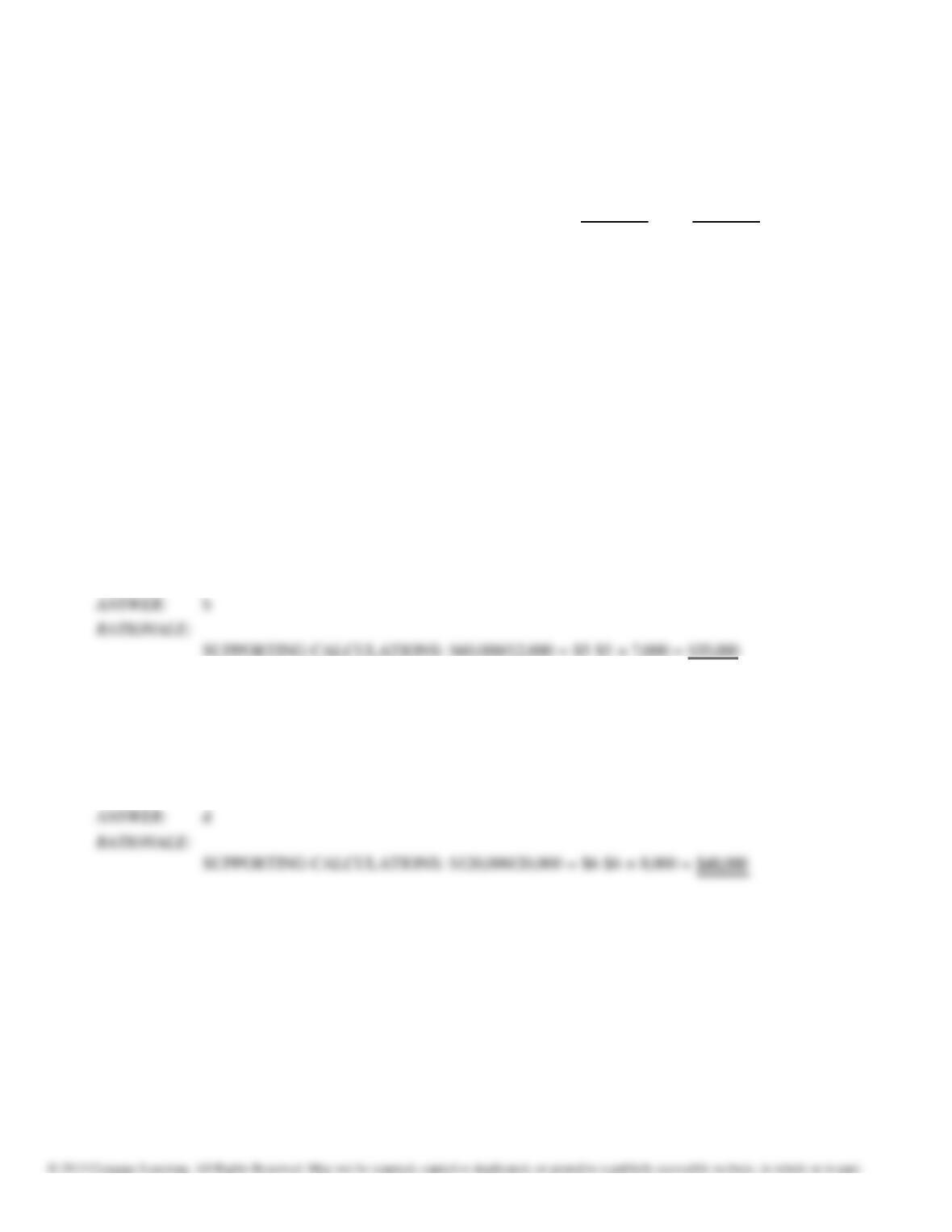
SUPPORTING CALCULATIONS: $90,000/1,000 = $90 $90 × 6 = $540
a. $2,700.
b. $ 990.
c. $ 900.
d. $ 540.
131. Bienvenue, Inc., has identified the following overhead costs and activity drivers for next year:
Expected
Expected
Overhead Item
Cost
Activity Driver
Quantity
Setup costs
$100,000
Number of setups
500
Ordering costs
40,000
Number of orders
3,200
Maintenance
200,000
Machine hours
4,000
Power
20,000
Kilowatt hours
80,000
The following are two of the jobs completed during the year:
Job CC
Job DD
Direct materials
$375
$1,000
Direct labor
$350
$1,200
Units completed
100
160
Direct labor hours
50
80
Number of setups
1
4
Number of orders
4
5
Machine hours
20
25
Kilowatt hours
30
50
Chapter 4: Activity-Based Costing
The company‘s normal activity is 4,000 direct labor hours.
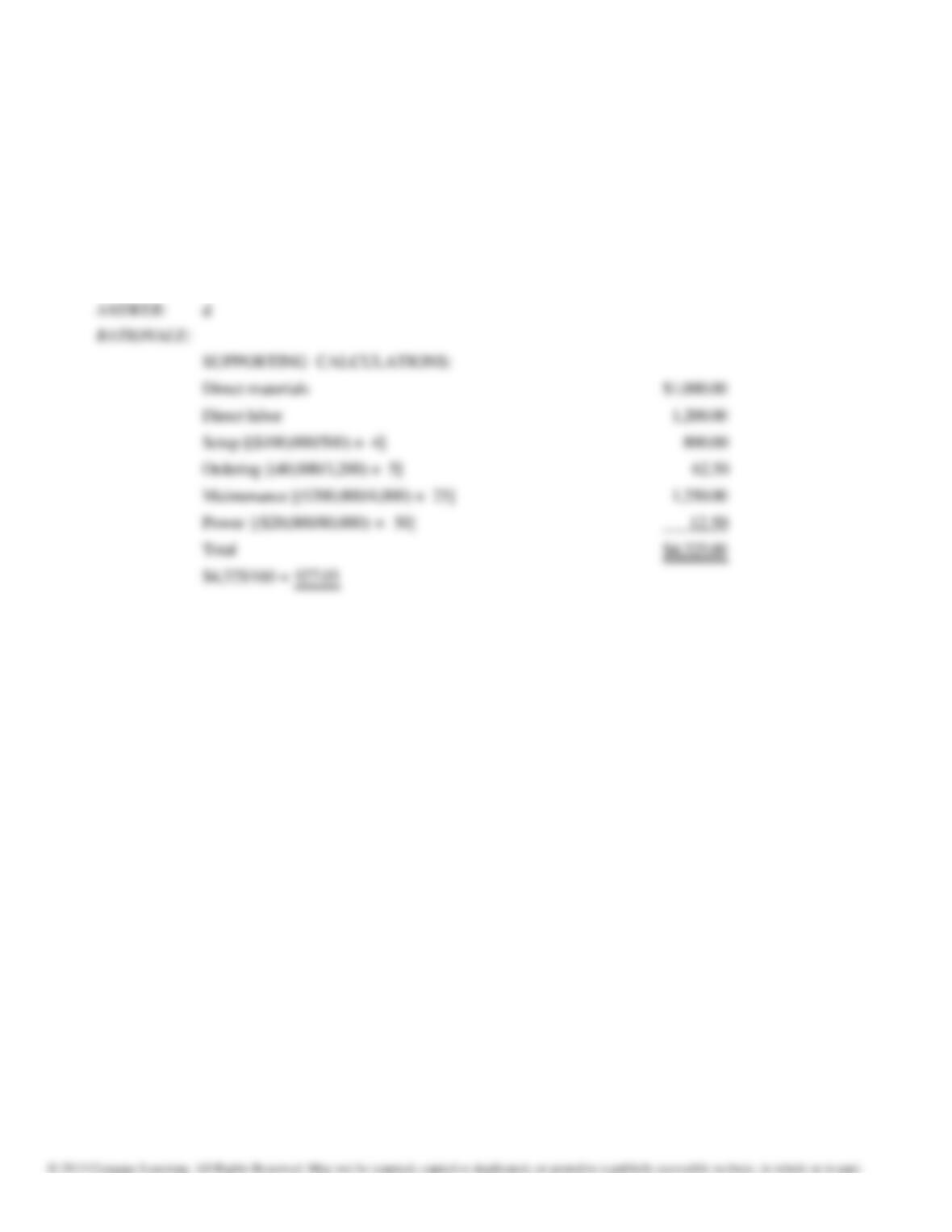
If the activity drivers are used to allocate overhead costs, the unit cost (rounded to two decimal places) for Job DD
would be
a. $21.40.
b. $26.56.
c. $26.95.
d. $27.03.
Chapter 4: Activity-Based Costing
Figure 4-15
Carriage Manufacturing uses an activity-based costing system. The company produces Model 21 and Model 22.
Information relating to the two products is as follows:
Model 21
Model 22
Units produced
24,000
30,000
Machine hours
7,500
8,500
Direct labor hours
8,000
12,000
Material handling (number of moves)
4,000
6,000
Setups
5,000
7,000
The following costs are reported:
Material handling
$ 40,000
Labor-related overhead
120,000
Setups
60,000
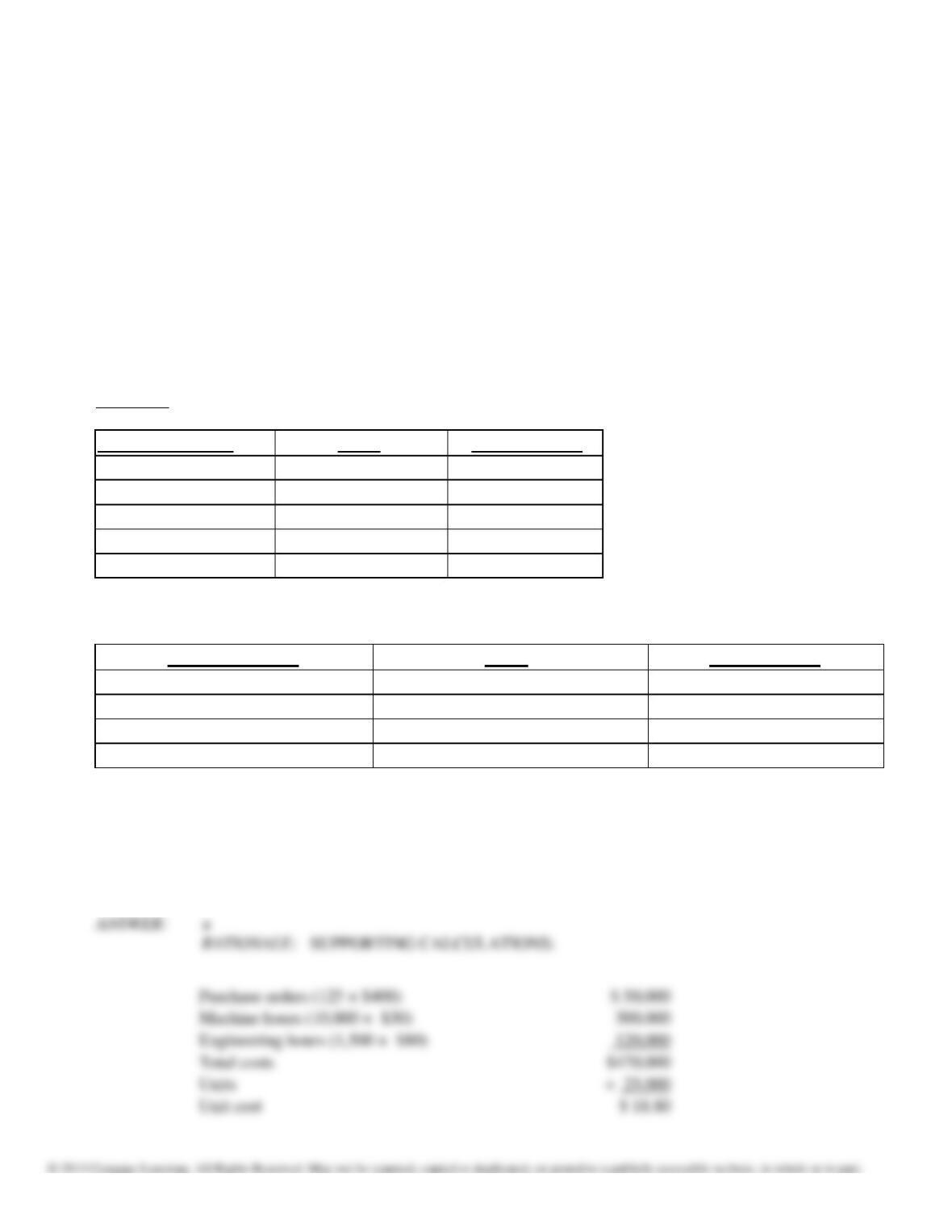
132. Refer to Figure 4-15. Setup costs assigned to Model 22 are
a. $36,000.
b. $35,000.
c. $28,000.
d. $25,000.
133. Refer to Figure 4-15. Labor-related overhead costs assigned to Model 21 are
a. $60,000.
b. $58,000.
c. $54,400.
d. $48,000.
Chapter 4: Activity-Based Costing
Figure 4-16
Samson Company recently installed an activity–based relational database. Using the information contained in the
activity relational table, the following pool rates were computed:
$400 per purchase order
$24 per machine hour, Process 1
$30 per machine hour, Process 2
$80 per engineering hour
Two products are produced by Special Products: L and M. The plant has two manufacturing processes, Process 1
and Process 2. Other processes include engineering, product handling, and procurement. Product L goes through
Process 1 while Product M goes through Process 2. The product relational table for Special Products is as follows:
Product L
Activity Driver #
Name
Activity Usage
1
Units
200,000
2
Purchase Orders
250
3
Machine Hours
80,000
4
Engineering Hours
1,250
Product M
Activity Driver #
Name
Activity Usage
1
Units
25,000
2
Purchase Orders
125
3
Machine Hours
10,000
4
Engineering Hours
1,500
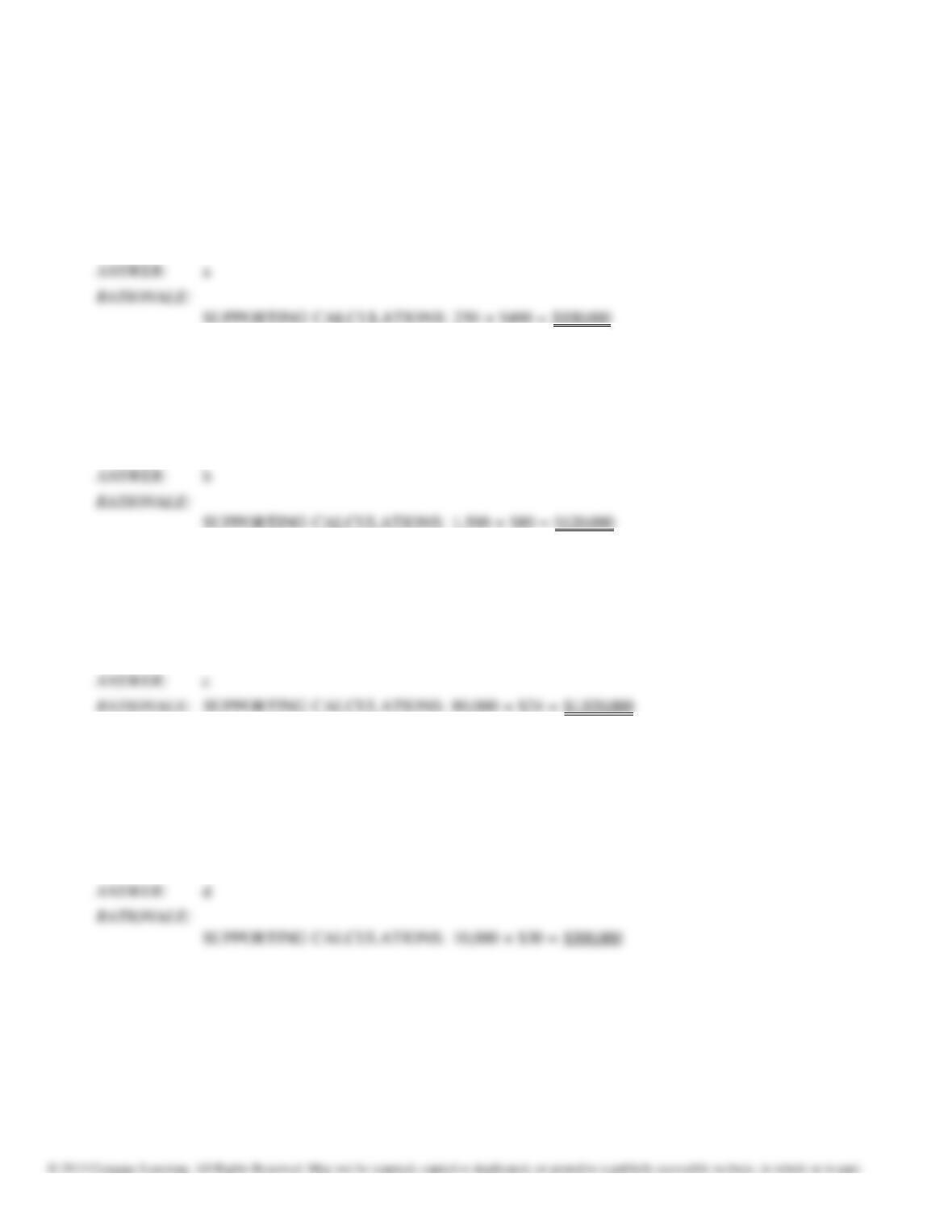
134. Refer to Figure 4–16. What is the unit cost of Product M?
a. $ 18.80
b. $504.00
c. $ 10.60
d. $ 12.00
Chapter 4: Activity-Based Costing
135. Refer to Figure 4-16. How much purchasing overhead cost will be assigned to Product L using the number of
purchase orders?
a. $ 100,000
b. $ 50,000
c. $80,000,000
d. $ 133,500
136. Refer to Figure 4-16. How much engineering overhead cost will be assigned to Product M using engineering hours?
a. $100,000
b. $120,000
c. $2,000,000
d. $801,000
137. Refer to Figure 4-16. How much machine overhead cost will be assigned to Product L using Process 1?
a. $2,400,000
b. $4,800,000
c. $1,920,000
d. $240,000
138. Refer to Figure 4-16. How much machine overhead cost will be assigned to Product M using Process 2?
a. $2,400,000
b. $1,920,000
c. $240,000
d. $300,000
Chapter 4: Activity-Based Costing
139. Refer to Figure 4-16. What is the unit cost of Product L?
a. $9.42
b. $504.00
c. $10.60
d. $7.52
RATIONALE SUPPORTING CALCULATIONS:
Purchase orders (250 × $400)
$ 100,000
Machine hours (80,000 × $24)
1,920,000
Engineering hours (1,250 × $80)
100,000
Total costs
$2,120,000
Units
÷ 200,000
Unit costs
$ 10.60
Figure 4-17
X-TREME Corporation has the following activities: creating bills of materials (BOM), studying manufacturing
capabilities, improving manufacturing processes, training employees, and designing tooling. The general ledger
accounts reveal the following expenditures for manufacturing engineering:
Salaries
$ 75,000
Equipment
40,000
Supplies
10,000
Total
$125,000
The equipment is used for two activities: improving processes and designing tooling. Thirty-five percent of the
equipment’s time is used for improving processes and 65 percent is used for designing tools. The salaries are
for two engineers. One is paid $50,000, while the other earns $25,000. The $50,000 engineer spends 40
percent of his time training employees in new processes and 60 percent of his time on improving processes.
The remaining engineer spends equal time on all activities. Supplies are consumed in the following proportions:
Creating BOMs
25
Studying capabilities
10
Improving processes
20
Training employees
25
Designing tooling
20
140. Refer to Figure 4-17. What is the cost assigned to the creating BOMs activity?
a. $31,250
b. $43,750
c. $7,500
d. $125,000
Chapter 4: Activity-Based Costing
141. Refer to Figure 4-17. What is the cost assigned to the improving processes activity?
a. $250,000
b. $25,000
c. $43,750
d. $51,000
142. Refer to 4–17. What is the cost assigned to the training employees activity?
a. $125,000
b. $81,250
c. $31,250
d. $27,500
143. Refer to 4-17. What is the cost assigned to the designing tooling activity?
a. $81,250
b. $33,000
c. $25,000
d. $125,000
144. Which of the following quantities is an example of an activity driver in activity–based costing?
a. number of direct labor hours
b. number of labor transactions
c. number of machine hours
d. all of these
145. If activity–based costing is used, materials handling would be classified as a
a. unit–level activity.
b. batch–level activity.
c. product–level activity.
d. facility–level activity.

Chapter 4: Activity-Based Costing
146. If activity-based costing is used, security is an example of a
a. unit–level activity.
b. batch–level activity.
c. product–level activity.
d. facility–level activity.
147. If activity–based costing is used, modifications made by engineering to the product design of several products
would be classified as a
a. product–level activity.
b. batch–level activity.
c. unit–level activity.
d. facility–level activity.
148. If activity-based costing is used, insurance on the plant would be classified as a
a. unit–level activity.
b. batch–level activity.
c. product–level activity.
d. facility–level activity.
149. If activity-based costing is used, set–ups would be classified as a
a. unit–level activity.
b. batch–level activity.
c. product–level activity.
d. facility–level activity.
150. If activity-based costing is used, set–ups would be classified as a
a. unit–level activity.
b. product–level activity.
c. batch–level activity.
d. facility–level activity.

Chapter 4: Activity-Based Costing
151. Maintenance of the production equipment would be classified as a
a. unit–level activity.
b. product–level activity.
c. cell–level activity.
d. facility–level activity.
Figure 4-18
Marion Manufacturing uses an activity-based costing system. The company produces Model X and Model Y.
Information relating to the two products is as follows:
Model X
Model Y
Units produced
20,000
40,000
Machine hours
8,000
10,000
Direct labor hours
14,000
16,000
Engineering labor (hours)
1,000
1,400
Setups
40
60
The following costs are reported:
Engineering
$ 48,000
Setups
100,000
Machine-related overhead
144,000
152. Refer to Figure 4–18. Machine-related overhead would be classified as a
a. unit–level activity.
b. batch–level activity.
c. product–level activity.
d. facility–level activity.
153. Refer to Figure 4-18. Setups would be classified as a
a. unit–level activity.
b. batch–level activity.
c. product–level activity.
d. facility–level activity.

Chapter 4: Activity-Based Costing
Figure 4-19
Attraction Corporation produces specially machined parts. The parts are produced in batches in one continuous
manufacturing process. Each part is custom produced and requires special engineering design activity (based on
customer specifications). Once the design is completed, the equipment can be set up for batch production. Once the
batch is completed, a sample is taken and inspected to see if the parts are within the tolerances allowed. Thus, the
manufacturing process has four activities: engineering, setups, machining, and inspecting. In addition, there is a
sustaining process with two activities: providing utilities (plant wide) and providing space. Costs have been assigned
to each activity using direct tracing and resource drivers:
Engineering
$1,000,00
Setups
900,000
Machining
2,000,00
Inspection
800,000
Providing space
250,000
Providing utilities
180,000
Activity drivers for each activity have been identified and their practical capacities listed:
Machine hours
25,000
Setups
200
Engineering hours
5,000
Inspection hours
2,500
The costs of facility-level activities are assigned using machine hours.
154. Refer to 4–19. What is (are) the facility-level activity(ies)?
a. set–ups
b. inspecting
c. providing space
d. both a and b
155. Refer to Figure 4-19. What is (are) the product-level activity(ies)?
a. engineering
b. setups
c. inspecting
d. all of the above

Chapter 4: Activity-Based Costing
156. Refer to Figure 4-19. What is (are) the unit-level activity(ies)?
a. engineering
b. setups
c. providing space
d. machining
157. Batch-level costs are assigned using
a. non–unit–based activity drivers.
b. unit–based activity drivers.
c. cost pools.
d. departmental rates.
158. If activity-based costing is used, electricity usage would be an example of a
a. batch–level activity.
b. unit–level activity.
c. product–level activity.
d. facility–level activity.
Chapter 4: Activity-Based Costing
Figure 4-20
Quasi-Tech Corporation produces specially machined parts. The parts are produced in batches in one continuous
manufacturing process. Each part is custom produced and requires special engineering design activity (based on
customer specifications). Once the design is completed, the equipment can be set up for batch production. Once the
batch is completed, a sample is taken and inspected to see if the parts are within the tolerances allowed. Thus, the
manufacturing process has four activities: engineering, setups, machining, and inspecting. Costs have been assigned
to each activity using direct tracing and resource drivers:
Activity
Expected Cost
Activity Driver
Activity Capacity
Engineering
$1,000,000
engineering hours
5,000 hours
Setups
$ 900,000
setups
200 setups
Machining
$2,000,000
machine hours
25,000 machine hours
Inspection
$ 800,000
inspection hours
2,500 inspection hours
Owens produces two models: Model X and Model Y. The following table shows how the two products consume
activity.
Model C
Model D
Units completed
300,000
200,000
Engineering hours
1,000
4,000
Setups
80
120
Machine hours
20,000
5,000
Inspection hours
1,500
1,000
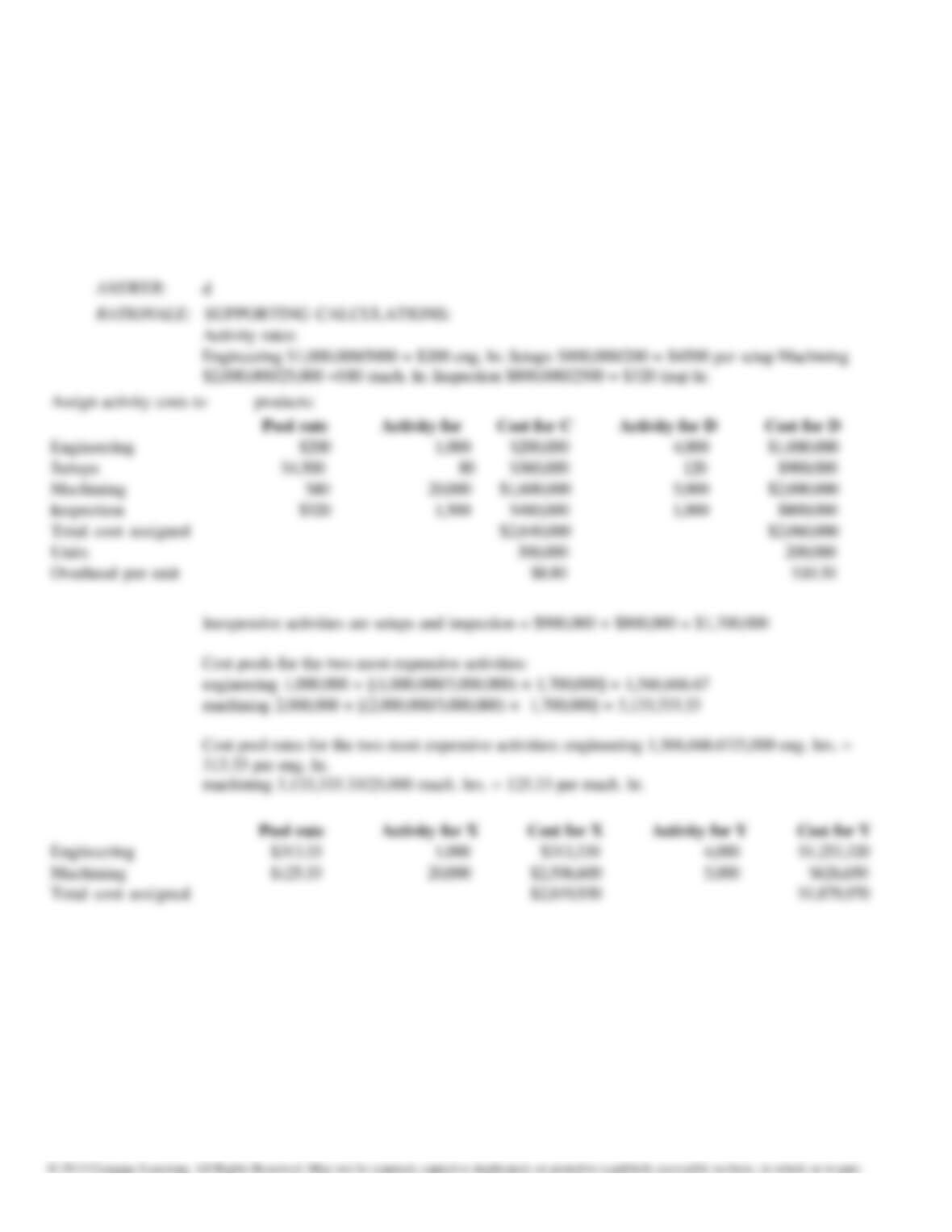
159. Refer to Figure 4-20. How much overhead is assigned to Model C using the 4 activity drivers?
a. $2,820,000
b. $2,640,000
c. $2,060,000
d. $560,000
Chapter 4: Activity-Based Costing
160. Refer to Figure 4-20. How much overhead is assigned to Model D using the 4 activity drivers?
a. $560,000
b.$2,060,000
c $2,640,000
d.$2,820,000
Chapter 4: Activity-Based Costing
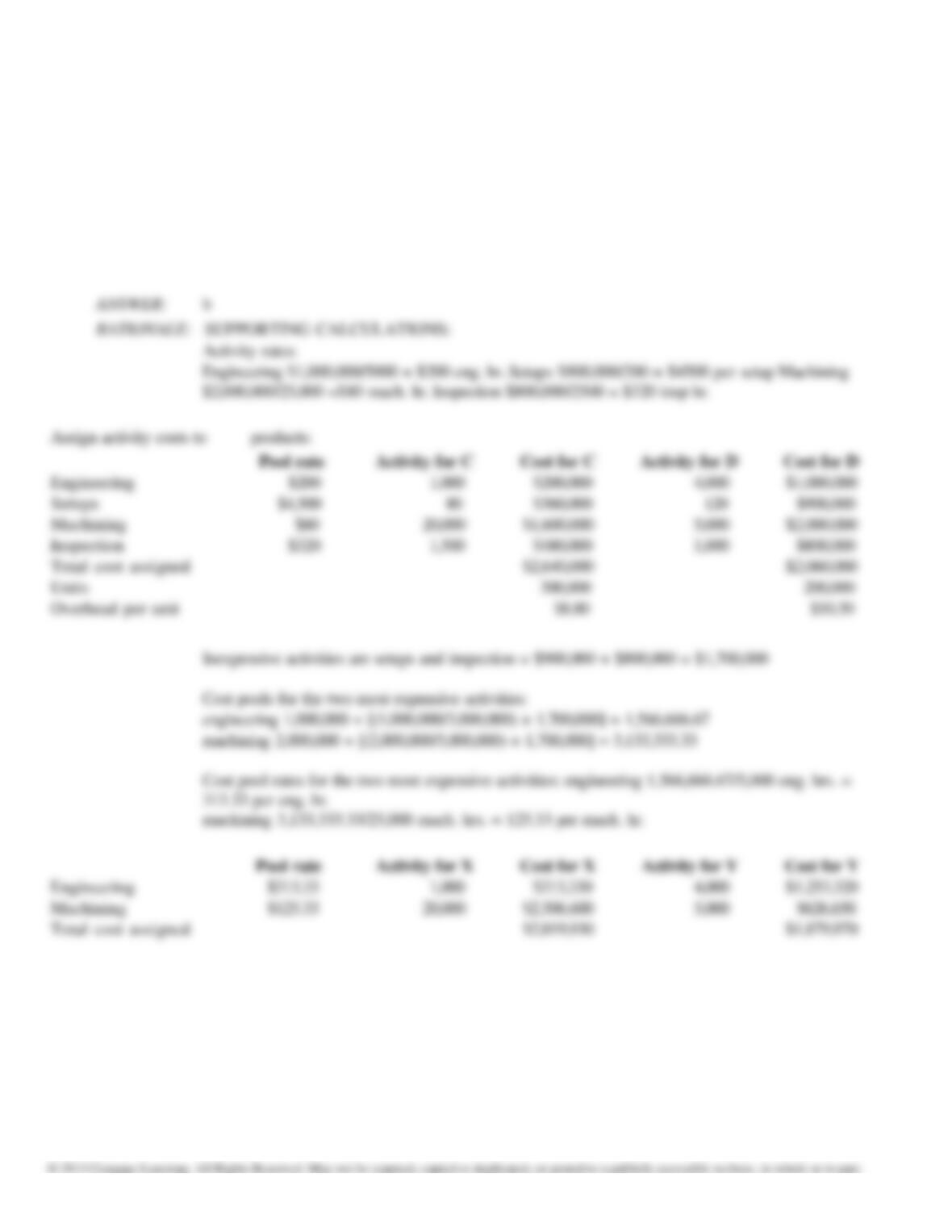
161. Refer to Figure 4-20. Determine the engineering costs assigned to model C using the two most expensive activities
for cost pools. The costs of the two relatively inexpensive activities are allocated to the two most expensive
activities in proportion to their costs. (Round to two decimal places.) The engineering cost assigned to model C
would be
a. $2,819,930
b. $1,566,666.67
c. $566,666.67
d. $313,330
Chapter 4: Activity-Based Costing
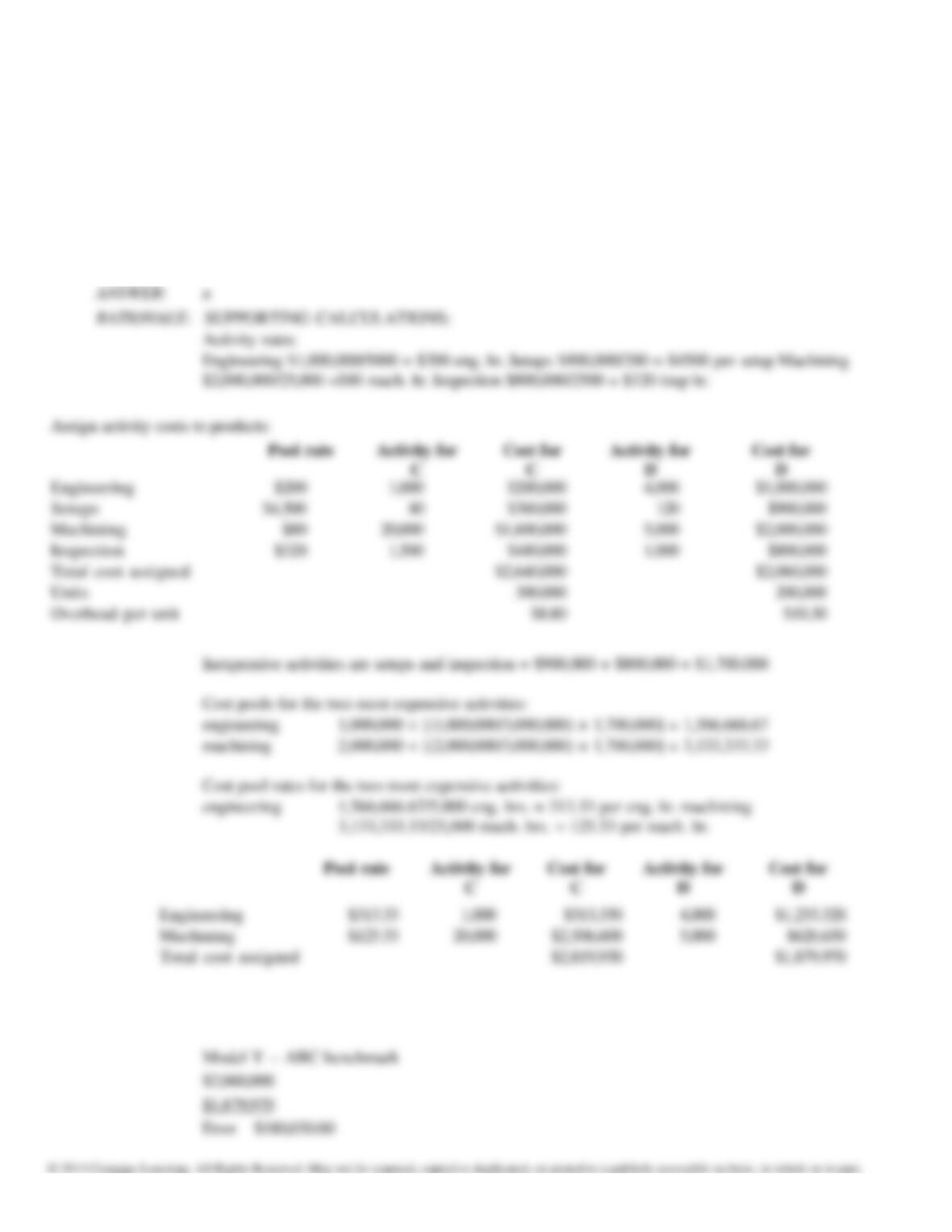
162. Refer to Figure 4-20. First determine the overhead costs assigned to model D using the two most expensive
activities for cost pools. The costs of the two relatively inexpensive activities are allocated to the two most
expensive activities in proportion to their costs. (Round to two decimal places.)The engineering cost assigned to
model D would be
a. $626,650.
b. $1,253,320.
c. $1,879,970.
d. $3,133,333.33.
Chapter 4: Activity-Based Costing
163. Refer to Figure 4-20. First, determine the overhead costs assigned to model D using the two most expensive
activities for cost pools. The costs of the two relatively inexpensive activities are allocated to the two most
expensive activities in proportion to their costs. (Round to two decimal places.)What is the error in the overhead
cost assigned to model D using ABC (4 driver model) as the benchmark?
a. $180,030
b. $240,700
c. $313,330
d. $626,650
Chapter 4: Activity-Based Costing
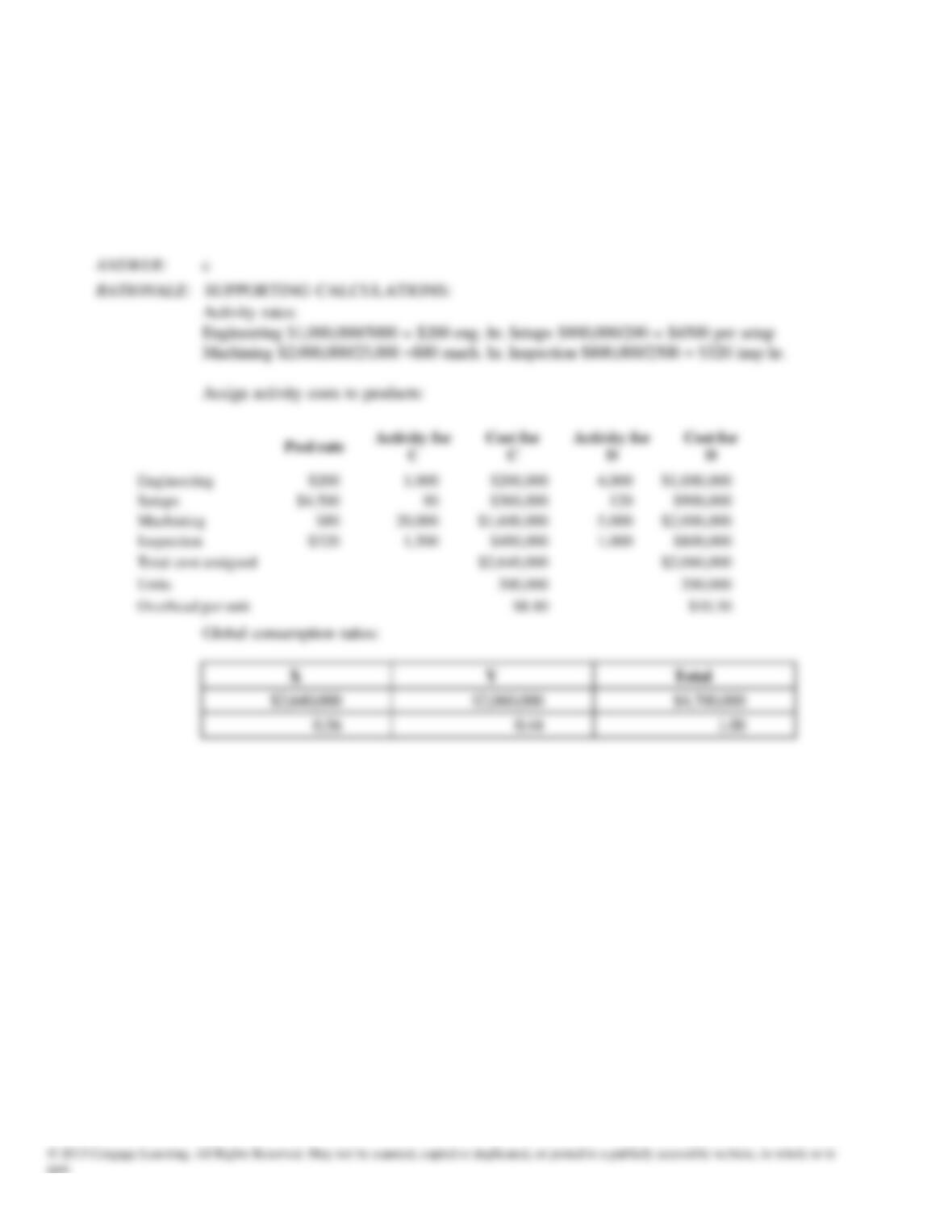
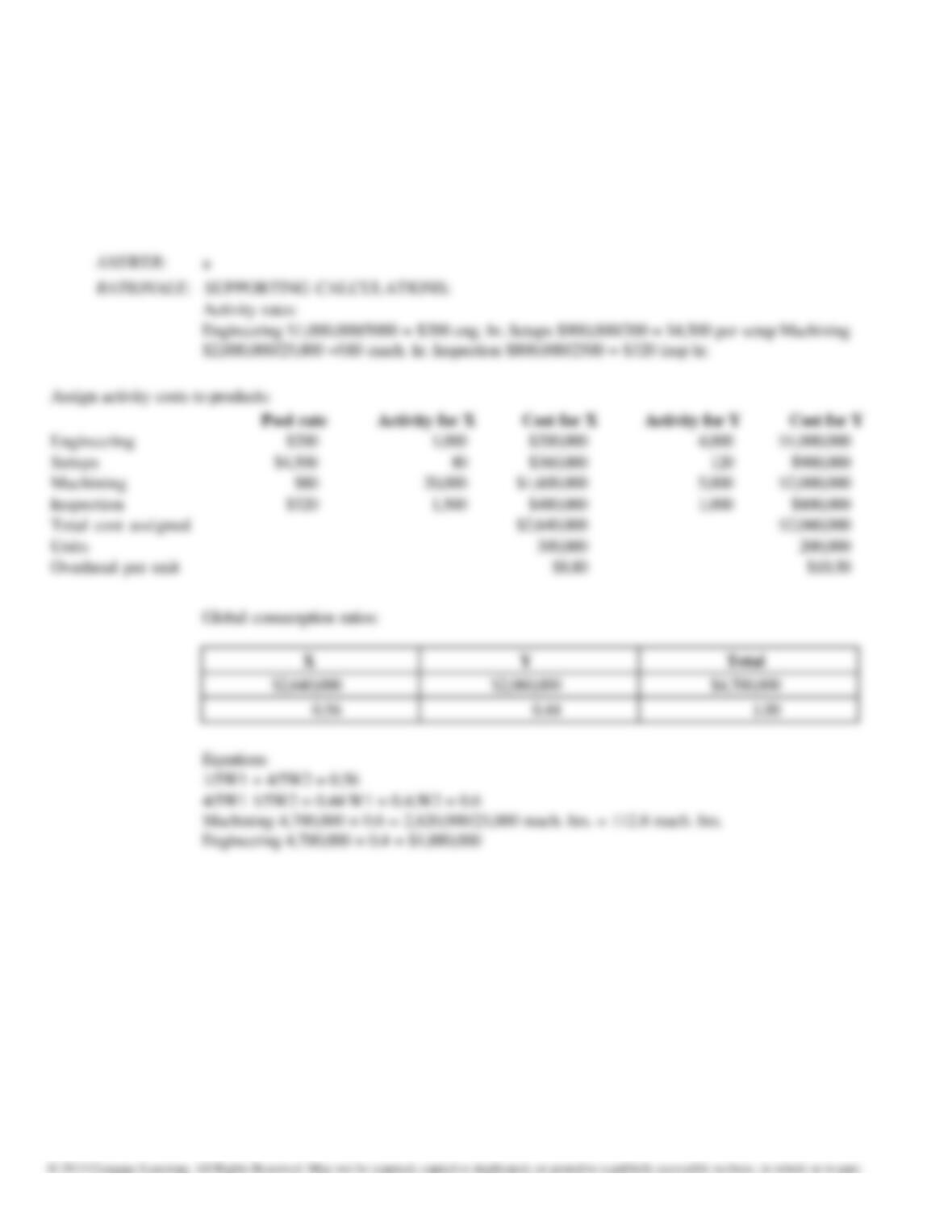
164. Refer to Figure 4–20. What are the global consumption ratios of Model C and D respectively? (round to two
decimal places)
a. 0.20; 0.80
b. 0.42; 0.58
c. 0.56; 0.44
d. 0.84; 0.16
Chapter 4: Activity-Based Costing
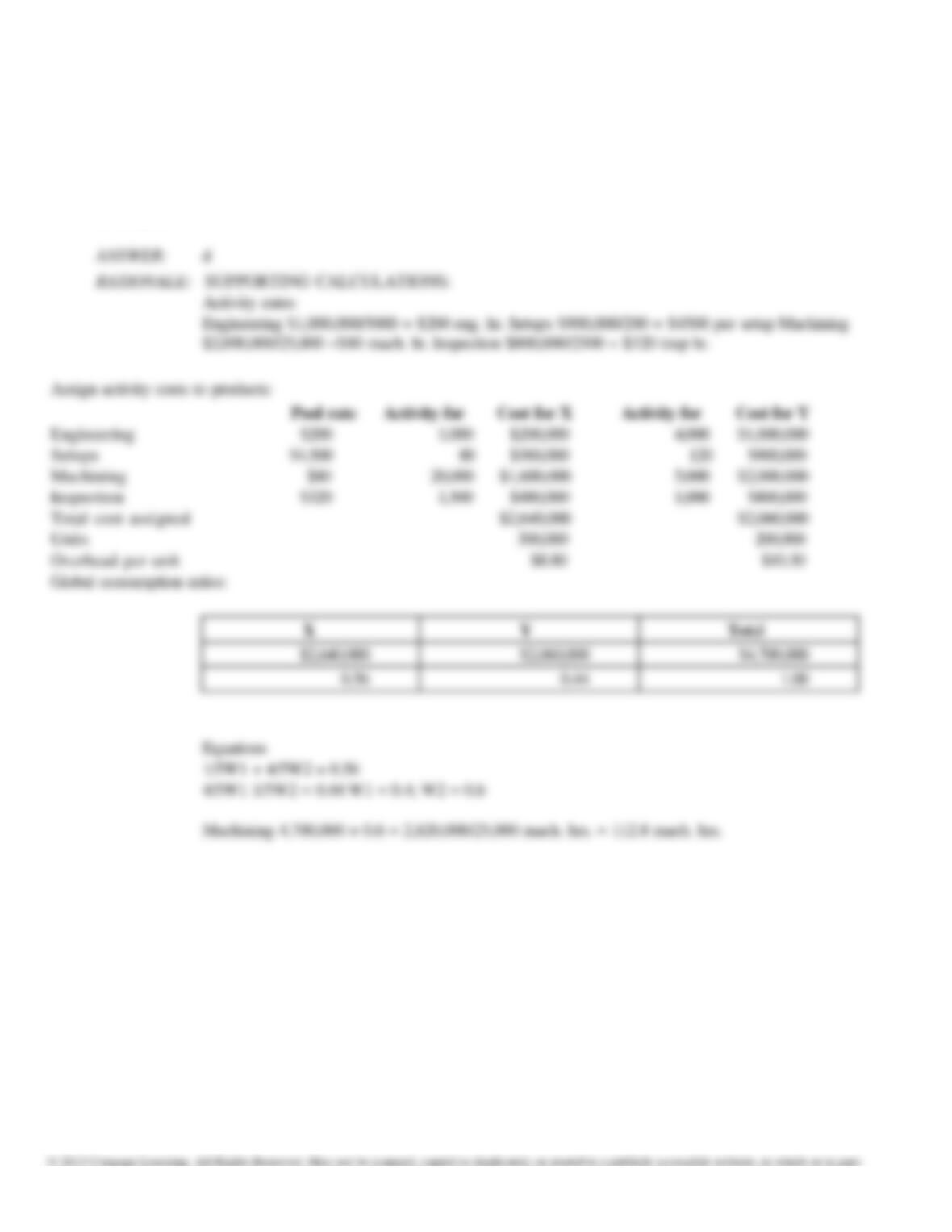
165. Refer to Figure 4-20. Using the activity ratios for engineering and machining, what is the overhead cost assigned to
the engineering pool? (round to two decimal places)
a. $1,880,000
b. $2,620,000
c. $2,740,000
d. $2,870,000
Chapter 4: Activity-Based Costing
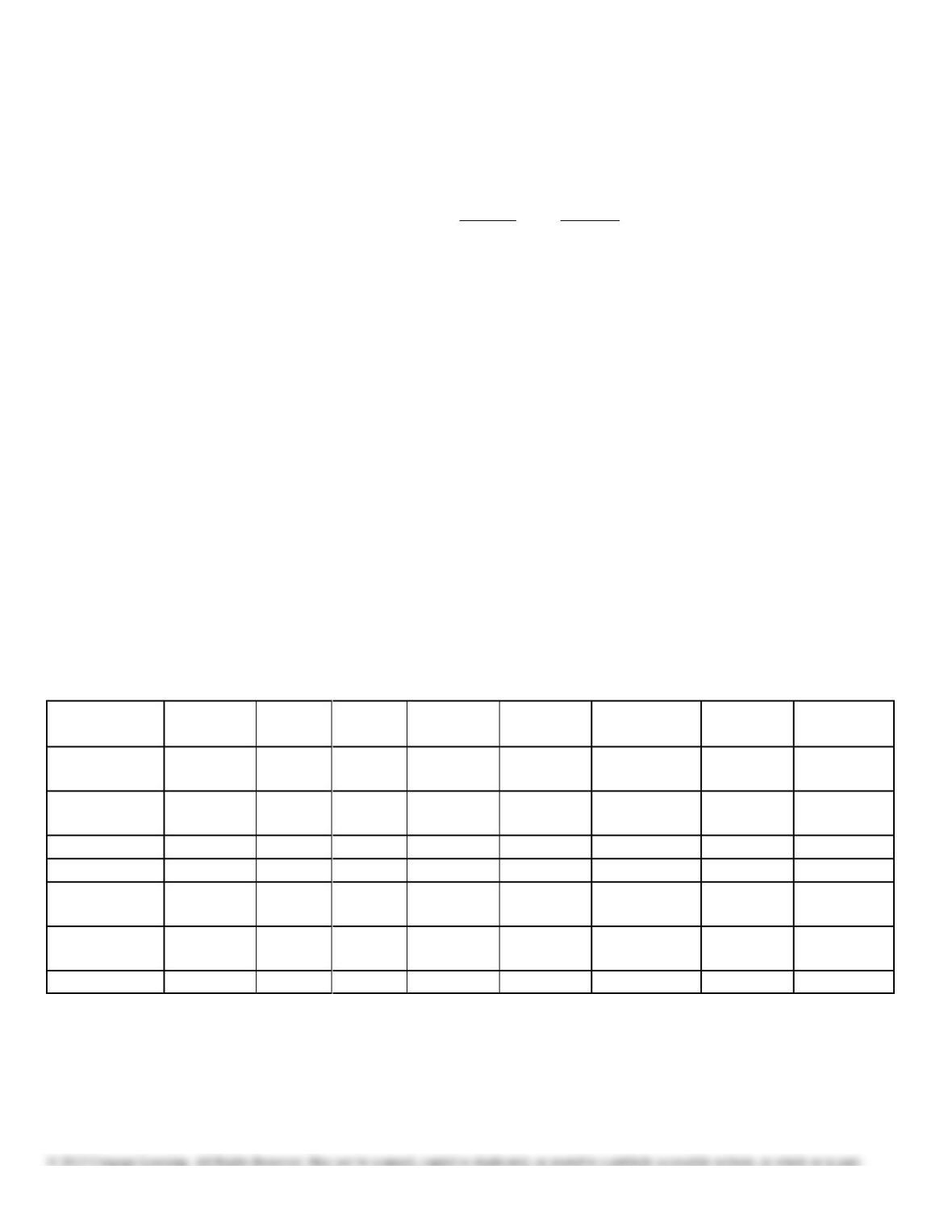
166. Refer to Figure 4-20. Using the activity ratios for engineering and machining, what is the overhead rate for
machining? (round to two decimal places)
a. $376
b. $541.50
c. $872.60
d. $112.80
Chapter 4: Activity-Based Costing
Figure 4-21
Appleby Manufacturing uses an activity-based costing system. The company produces Model F and Model G.
Information relating to the two products is as follows:
Model F
Model G
Units produced
24,000
30,000
Machine hours
7,500
8,500
Direct labor hours
8,000
12,000
Material handling (number of moves)
4,000
6,000
Setups
5,000
7,000
Purchase orders
30
40
Inspections
10,000
14,000
Product line variations
8
12
The following overhead costs are reported for the following activities of the production process:
Material handling
$ 40,000
Labor-related overhead
120,000
Setups
60,000
Product design
100,000
Batch inspections
120,000
Central purchasing
70,000
Jones manufacturing has used activity based costing to assign costs to Models F and G as given in the table below:
Activity
Cost Pool
Driver
Pool
Rate
Model F
Activity
Model F
Cost
Model G
Activity
Model G
Cost
Total
Material
handling
$40,000
10,000
$4
4,000
$16,000
6,000
$24,000
$40,000
Labor related
overhead
$120,000
20,000
$6
8,000
$48,000
12,000
$72,000
$120,000
Setups
$60,000
12,000
$5
5,000
$25,000
7,000
$35,000
$60,000
Product design
$100,000
20
$5,000
8
$40,000
12
$60,000
$100,000
Batch
inspections
$120,000
24,000
$5
10,000
$50,000
14,000
$70,000
$120,000
Central
purchasing
$70,000
70
$1,000
30
$30,000
40
$40,000
$70,000
total
$209,000
$301,000
$510,000
Appleby Manufacturing wants to implement an approximately relevant ABC system by using the two most
expensive activities for cost assignment.