Chapter 4: Activity-Based Costing
197. Maroone, Inc., has identified the following overhead costs and activity drivers for next year:
Overhead Item
Expected Cost
Activity Driver
Expected
Setup costs
$150,000
Number of setups
1,200
Ordering costs
40,000
Number of orders
10,000
Maintenance
200,000
Machine hours
16,000
Power
20,000
Kilowatt hours
100,000
The following are the two product models completed during the year:
Model SS
Model TT
Direct materials
$2,250
$2,50
Direct labor
3,000
1,87
Units completed
375
300
Direct labor hours
90
110
Number of setups
6
8
Number of orders
8
15
Machine hours
180
150
Kilowatt hours
90
120
The company’s normal activity is 20,000 direct labor hours.
Required:
a. Determine the unit cost for each job using direct labor hours to apply overhead.
b. Determine the unit cost for each job using the four activity drivers. (Round amounts to 2 decimal
places.)
c. Which method produces the more accurate cost assignment? Why?
Chapter 4: Activity-Based Costing

Chapter 4: Activity-Based Costing
198. Forest Queen Manufacturing has four categories of overhead. The four categories and expected
overhead costs for each category for next year are as follows:
Maintenance
$70,000
Materials handling
30,000
Setups
25,000
Inspection
50,000
Currently, overhead is applied using a predetermined overhead rate based upon budgeted direct labor
hours. 50,000 direct labor hours are budgeted for next year.
The company has been asked to submit a bid for a proposed job. The plant manager feels that
obtaining this job would result in new business in future years. Usually, bids are based upon full
manufacturing cost plus 30 percent.
Estimates for the proposed job are as follows:
Direct materials
$2,500
Direct labor (750 hours)
$3,750
Number of machine hours
300
Number of material moves
8
Number of setups
3
Number of inspections
5
In the past, full manufacturing cost has been calculated by allocating overhead using a volume-based
activity driver, direct labor hours. The plant manager has heard of a new way of applying overhead
that uses cost pools and activity drivers.
Expected activity for the four activity drivers that would be used are:
Machine hours
16,000
Material moves
4,000
Setups
2,000
Quality inspections
8,000
Required:
a. Determine the amount of overhead that would be allocated to the proposed job if direct labor
hours are used as the volume-based activity driver.
Determine the total cost of the proposed job.
Determine the company’s bid if the bid is based upon full manufacturing cost plus 30 percent.
b. Determine the amount of overhead that would be applied to the proposed project if activity– based
costing is used.
Determine the total cost of the proposed job if activity-based costing is used.
Determine the company’s bid if activity-based costing is used and the bid is based upon full
manufacturing cost plus 30 percent.
Chapter 4: Activity-Based Costing
c. Which product costing method produces the more competitive bid?
Chapter 4: Activity-Based Costing
199. The Data Retrieving Corporation provided the following data about its resources and activities.
Resources
Activities
clerical hours
Supervision
$140,000
processing accounts
10,000
phone and supplies
80,000
issuing statements
2,000
salaries
250,000
processing data
10,000
computer
20,000
answering customer inquiries
3,000
total
$490,000
total
25,000
In addition, computers are used for issuing statements (30 percent) and processing data (70 percent).
Phones, supplies, and answering customer inquiries are 60 percent, with the other 40 percent divided
equally among the remaining activities, including supervision. The supervisor spends 100 percent of
his/her time on supervision. In addition to the 25,000 clerical hours, there are 2,000 hours of
supervision used (the hours used by the supervising clerks activity which is not listed above)
Required:
Prepare a work distribution matrix for the primary activities.

Chapter 4: Activity-Based Costing
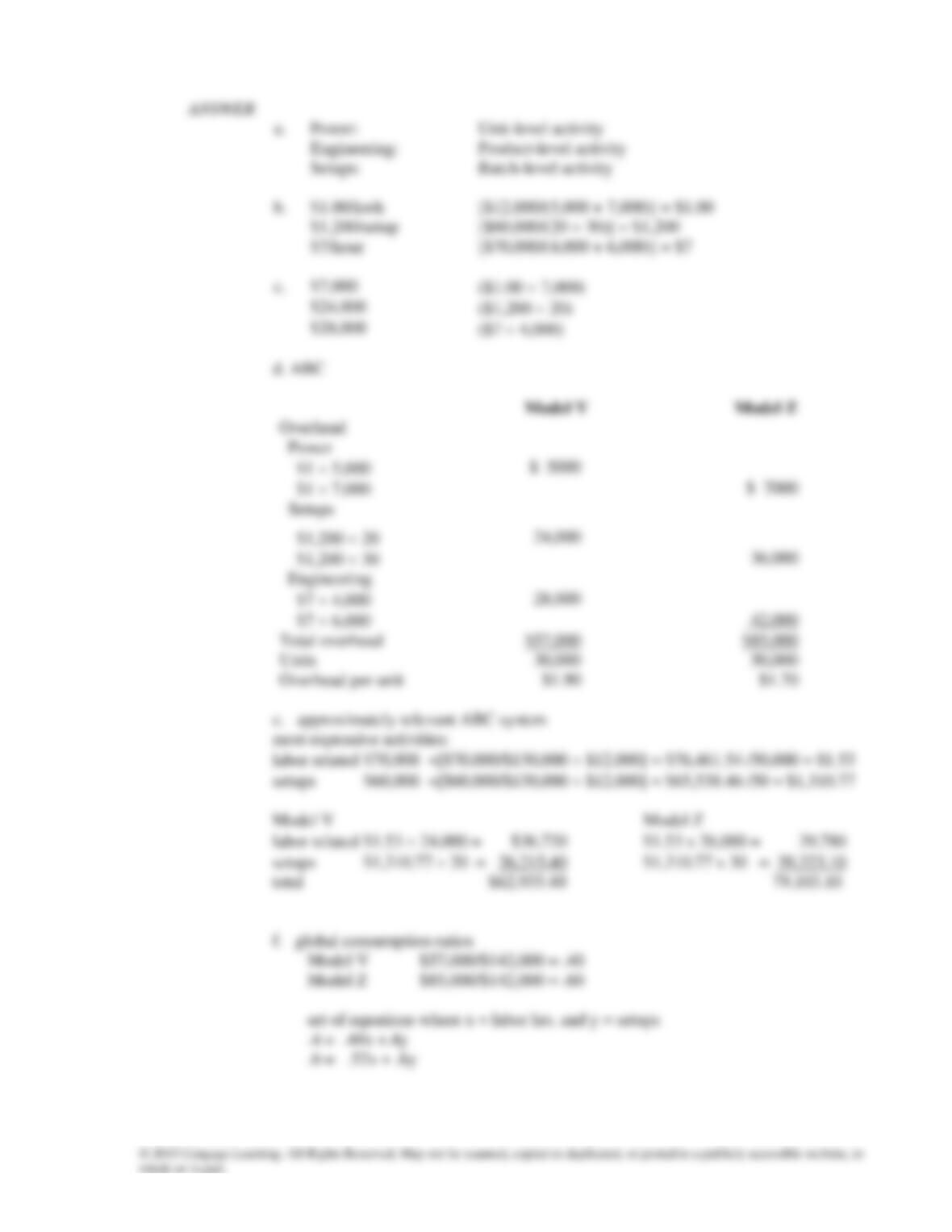
200. Elantra Manufacturing uses an activity-based costing system. The company produces Model V and
Model Z. Information concerning the two products is as follows:
Model V
Model Z
Units produced
30,000
50,000
Direct labor hours
24,000
26,000
Engineering labor (hours)
4,000
6,000
Setups
20
30
Kilowatt hours
The following overhead activities and
costs are reported:
5,000
7,000
Power
$12,000
Labor-related overhead
70,000
Setups
60,000
Required:
a. Classify the following overhead activities as unit-level activities, batch-level activities, or product-
level activities:
Power
Engineering
Setups
b. Calculate the following:
Activity rate for power
Activity rate for setups
Activity rate for engineering
c. Calculate the following:
Power costs assigned to Model Z
Setups costs assigned to Model V
Engineering costs assigned to Model V
d. Calculate the total overhead cost per unit for Model V and Z using ABC.
e. Calculate the total overhead cost assigned to Model V and Z using the approximately relevant
ABC system based on only the two most expensive activities. Round to 2 decimal places)
f. State the set of equations using the equally accurate reduced ABC system based on the
consumption ratios for labor related costs and setups (round to 2 decimal places).
Chapter 4: Activity-Based Costing
Chapter 4: Activity-Based Costing
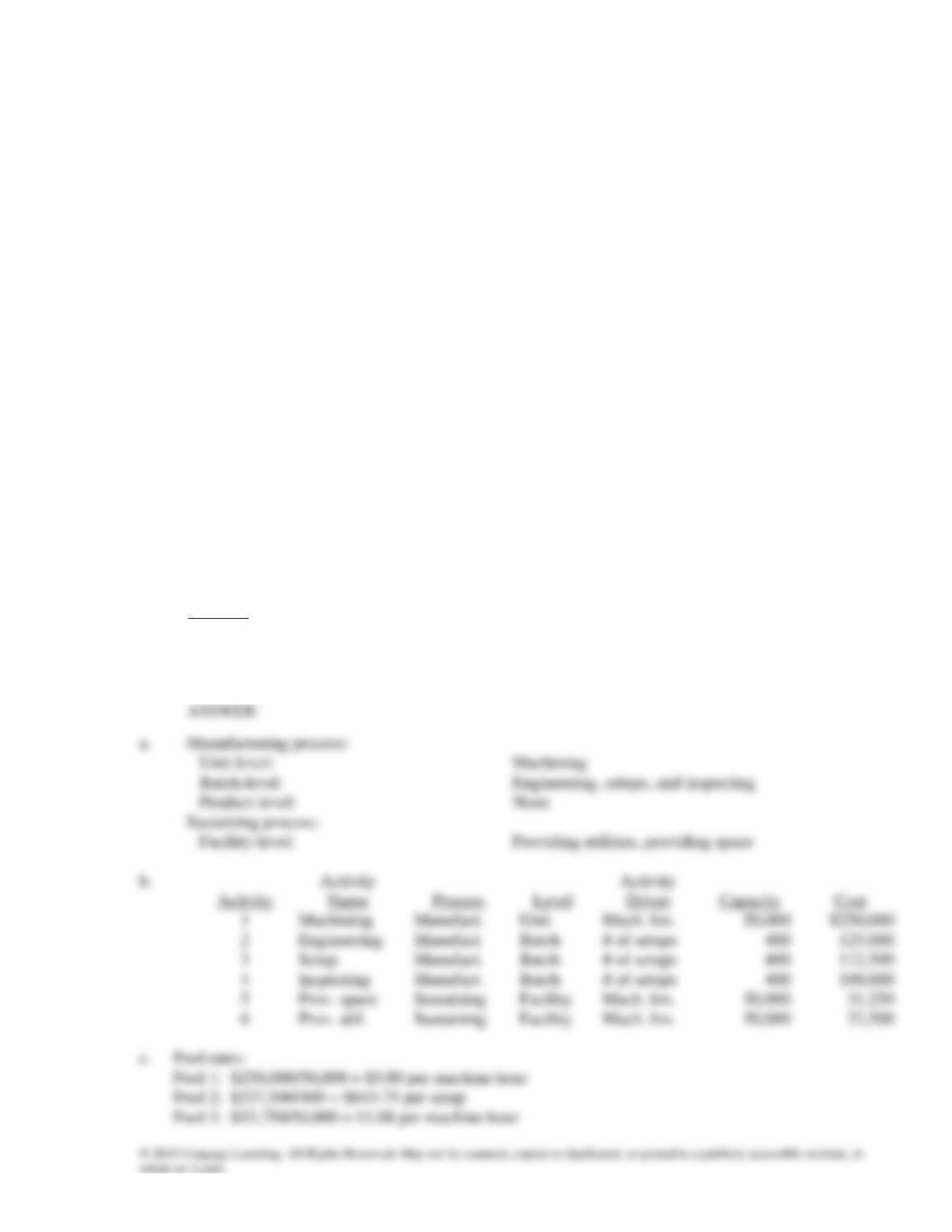
201. Funland Manufacturing Company produces specially machined parts. The parts are produced in
batches in one continuous manufacturing process. Each part is custom produced and requires special
engineering design activity (based on customer specifications). Once the design is completed, the
equipment can be set up for batch production. Once the batch is completed, a sample is taken and
inspected to see if the parts are within the tolerances allowed. Thus, the manufacturing process has
four activities: engineering, setups, machining, and inspecting. In addition, there is a sustaining process
with two activities: providing utilities (plantwide) and providing space. Costs have been assigned to
each activity using direct tracing and resource drivers:
Engineering
$125,000
Setups
112,500
Machining
250,000
Inspection
100,000
Providing space
31,250
Providing utilities
22,500
Activity drivers for each activity have been identified and their practical capacities listed:
Machine hours
50,000
Setups
400
Engineering hours
10,000
Inspection hours
5,000
The cost of unit-level activities are assigned using machine hours
The costs of batch-level activities are assigned using number of setups. The costs of facility-level
activities are assigned using machine hours.
Required:
a. Identify the activities within each process as unit-level, batch-level, product-level, or facility- level.
b. Build an activity relational table.
c. Compute the pool rates (round to two decimal places).
b.
Machining
Manufact.
Unit
Mach. hrs.
Engineering
Manufact.
Batch
# of setups
Setup
Manufact.
Batch
# of setups
112,500
Inspecting
Manufact.
Batch
# of setups
Prov. space
Sustaining
Facility
Mach. hrs.
31,250
Prov. util.
Sustaining
Facility
Mach. hrs.
22,500
Manufacturing process:
Unit-level:
Machining
Batch-level:
Engineering, setups, and inspecting
Product-level:
None
Sustaining process:
Facility-level:
Providing utilities, providing space
Chapter 4: Activity-Based Costing
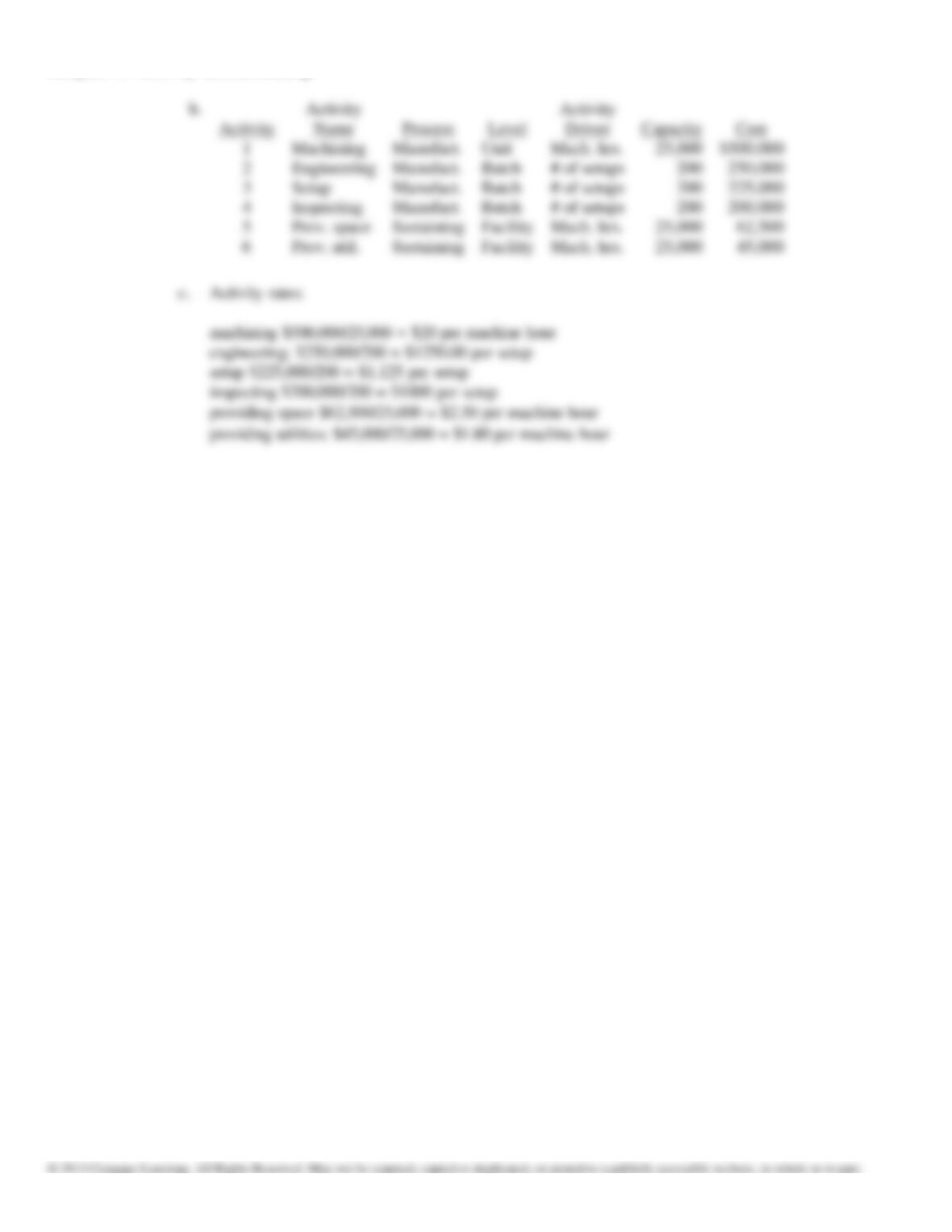
202. Harrison Corporation produces specially machined parts. The parts are produced in batches in one
continuous manufacturing process. Each part is custom produced and requires special engineering
design activity (based on customer specifications). Once the design is completed, the equipment can be
set up for batch production. Once the batch is completed, a sample is taken and inspected to see if the
parts are within the tolerances allowed. Thus, the manufacturing process has four activities:
engineering, setups, machining, and inspecting. In addition, there is a sustaining process with two
activities: providing utilities (plantwide) and providing space. Costs have been assigned to each activity
using direct tracing and resource drivers:
Engineering
$250,000
Setups
225,000
Machining
500,000
Inspection
200,000
Providing space
62,500
Providing utilities
45,000
Activity drivers for each activity have been identified and their practical capacities listed:
Machine hours
25,000
Setups
200
Engineering hours
5,000
Inspection hours
2,500
The cost of unit-level activities are assigned using machine hours
The costs of batch-level activities are assigned using number of setups. The costs of facility-level
activities are assigned using machine hours.
Required:
a. Identify the activities within each process as unit-level, batch-level, product-level, or facility- level.
b. Build an activity relational table.
c. Compute the rates for each activity (round to 2 decimal places).
Chapter 4: Activity-Based Costing
Chapter 4: Activity-Based Costing
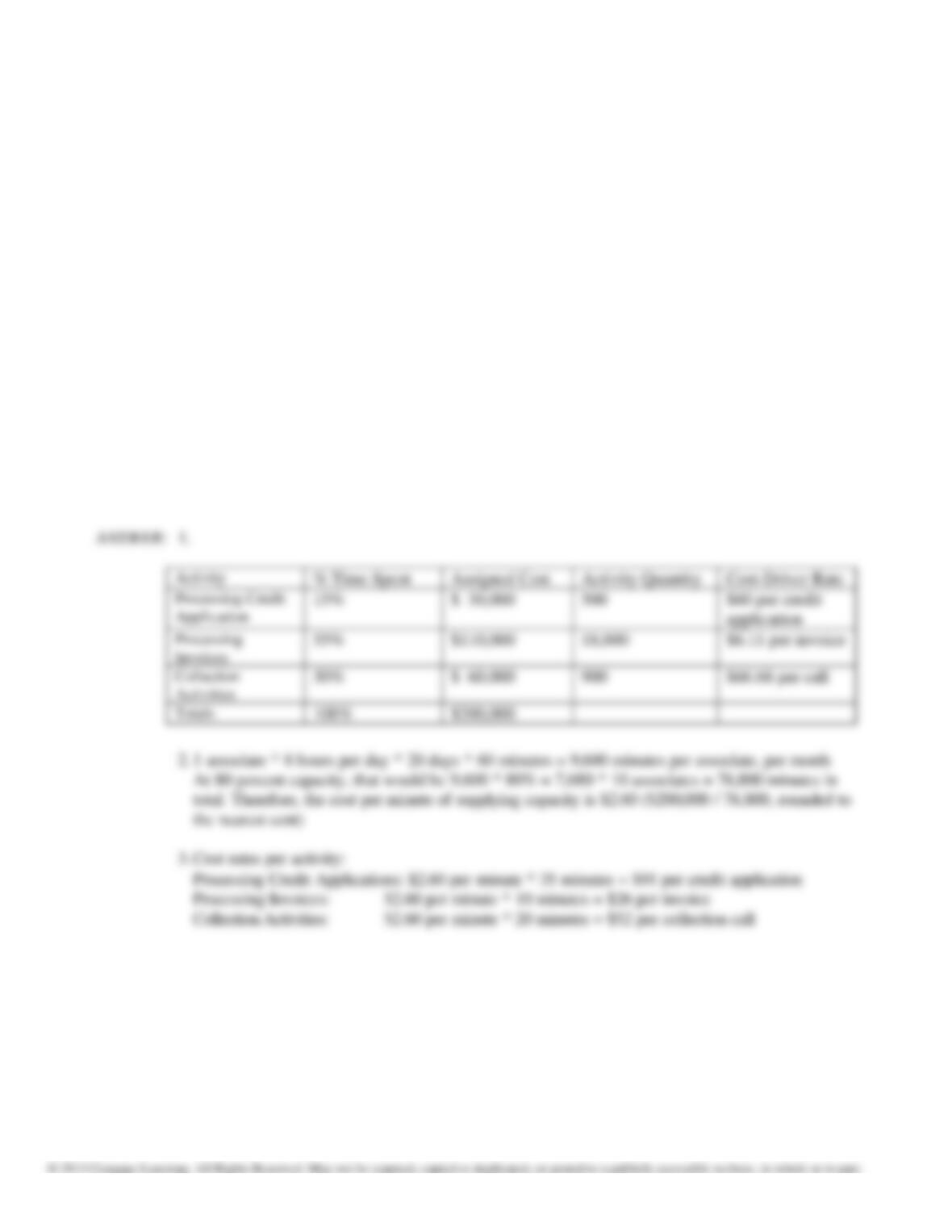
203. Inventive Manufacturing Company has the following activities: creating bills of materials (BOM), studying
manufacturing capabilities, improving manufacturing processes, training employees, and designing tooling. The
general ledger accounts reveal the following expenditures for manufacturing engineering:
Salaries
$500,000
Equipment
100,000
Supplies
30,000
Total
$630,000
The equipment is used for two activities: improving processes and designing tooling. Forty percent of the
equipment‘s time is used for improving processes and 60 percent is used for designing tools. The salaries are for
five engineers, one who earns $160,000 and four who earn $85,000 each. The $160,000 engineer spends 30 percent
of his time training employees in new processes and 70 percent of his time on improving processes. One engineer
spends 100 percent of her time on designing tooling and another engineer spends 100 percent of his time on
improving processes. The remaining two engineers spend equal time on all activities. Supplies are consumed in the
following proportions:
Creating BOMs
15%
Studying capabilities
5%
Improving processes
30%
Training employees
30%
Designing tooling
Required:
20%
Using the resource drivers and direct tracing, calculate the cost of each manufacturing engineering activity. What
are the resource drivers?
Activity
Creating BOMS
*
Studying capabilities
**
Improving processes
***
Training employees
****
Designing tooling
*****
(0.20 $170,000 + 0.15 $30,000)
(0.20 $170,000 + 0.05 $30,000)
(0.40 $100,000 + 0.70 $160,000 + $85,000 + 0.20 $170,000 + 0.30 $30,000)
(0.30 $160,000 + 0.20 $170,000 + 0.30 $30,000)
(0.60 $100,000 + $85,000 + 0.20 $170,000 + 0.20 $30,000)
Chapter 4: Activity-Based Costing
204. Bayview Manufacturing Company has an accounts receivable department that performs three activities within
the department: processing customer credit applications, invoicing customers, and performing collection
activities. During interviews, the employee survey reports that they spend 15 percent of their time processing
credit applications, 55 percent of their time invoicing customers, and 30 percent of their time on collection
activities. The accounts receivable department employs 10 associates for a total cost of $200,000. Assume each
associate works 8 hours per day, 20 days per month, but an estimate of practical capacity is 80 percent. After
close observation of the employee’s daily work, managers conclude the following:
Processing a credit application:
35 minutes
Invoicing a Customer:
10 minutes
Collection activities:
20 minutes
The estimated monthly quantities of work in the three activities are 500 credit applications, 18,000 invoices, and
900 collection calls.
Required:
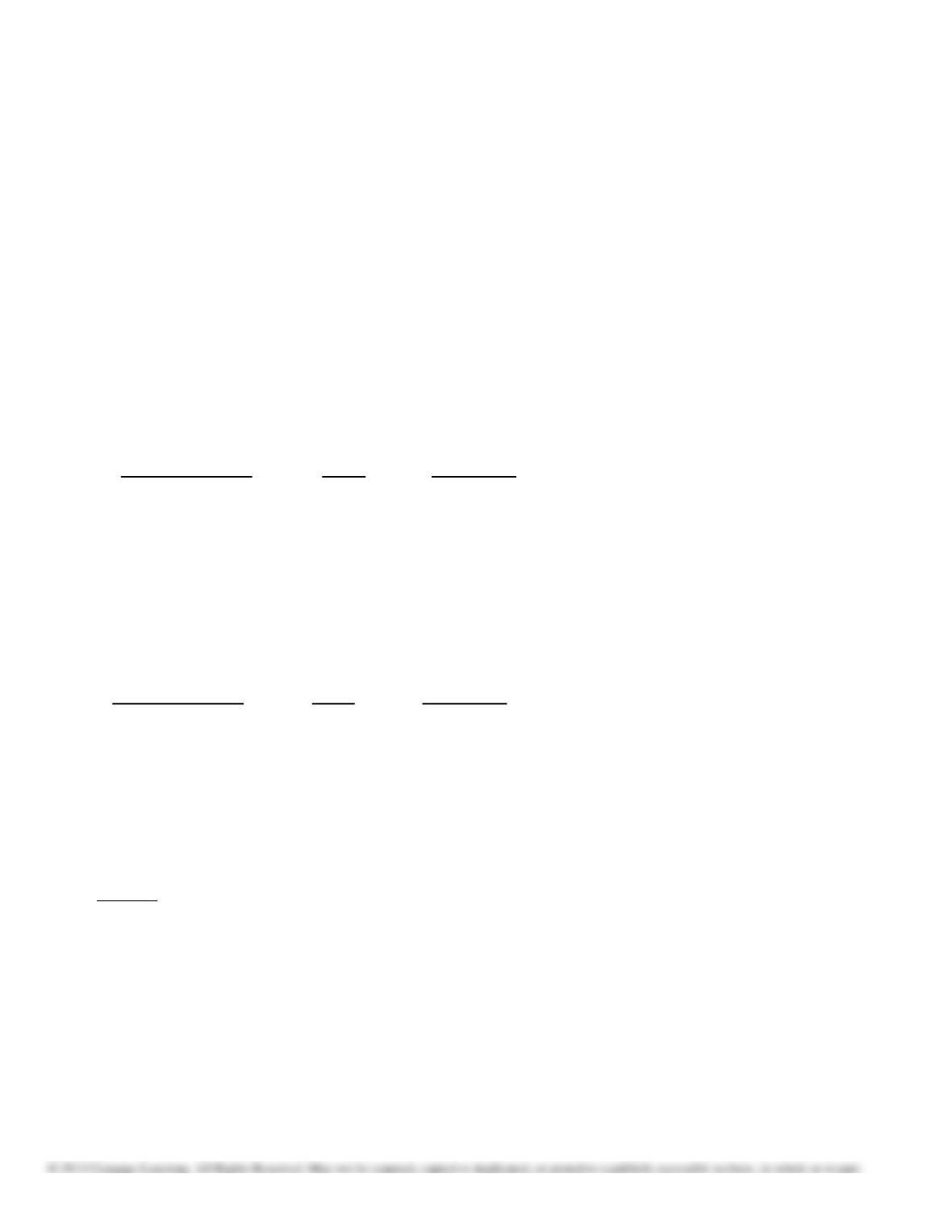
1. Under a traditional ABC system, what is the cost of one unit of activity?
2. Assuming the practical capacity information, what is the cost per minute of supplying capacity?
3. Under time-driven ABC, what are the cost driver rates for each activity?
Chapter 4: Activity-Based Costing
205. Green Mountain Manufacturing has recently installed an activity-based relational data base. Using the
information contained in the activity relational table, the following pool rates were computed:
$400 per purchase order
$24 per machine hour, Process R
$30 per machine hour, Process S
$80 per engineering hour
$4 per packing order
$200 per square foot
Two products are produced by Green Mountain: Normal and Excellent. Each product has an area in the plant
that is dedicated to its production. The plant has two manufacturing processes, the Normal process (Process R)
and the Excellent process (Process S). Other processes include engineering, product handling, and procurement.
The product relational table for Green Mountain is as follows:
Normal Product:
Activity Driver #
Name
Activity
1
Units
800,000
2
Purchase orders
1,000
3
Machine hours
320,000
4
Engineering hours
5,000
5
Packing orders
400,000
6
Square footage
6,000
Excellent Product:
Activity Driver #
Name
Activity
1
Units
100,000
2
Purchase orders
500
3
Machine hours
40,000
4
Engineering hours
6,000
5
Packing orders
100,000
6
Square footage
4,000
Required:
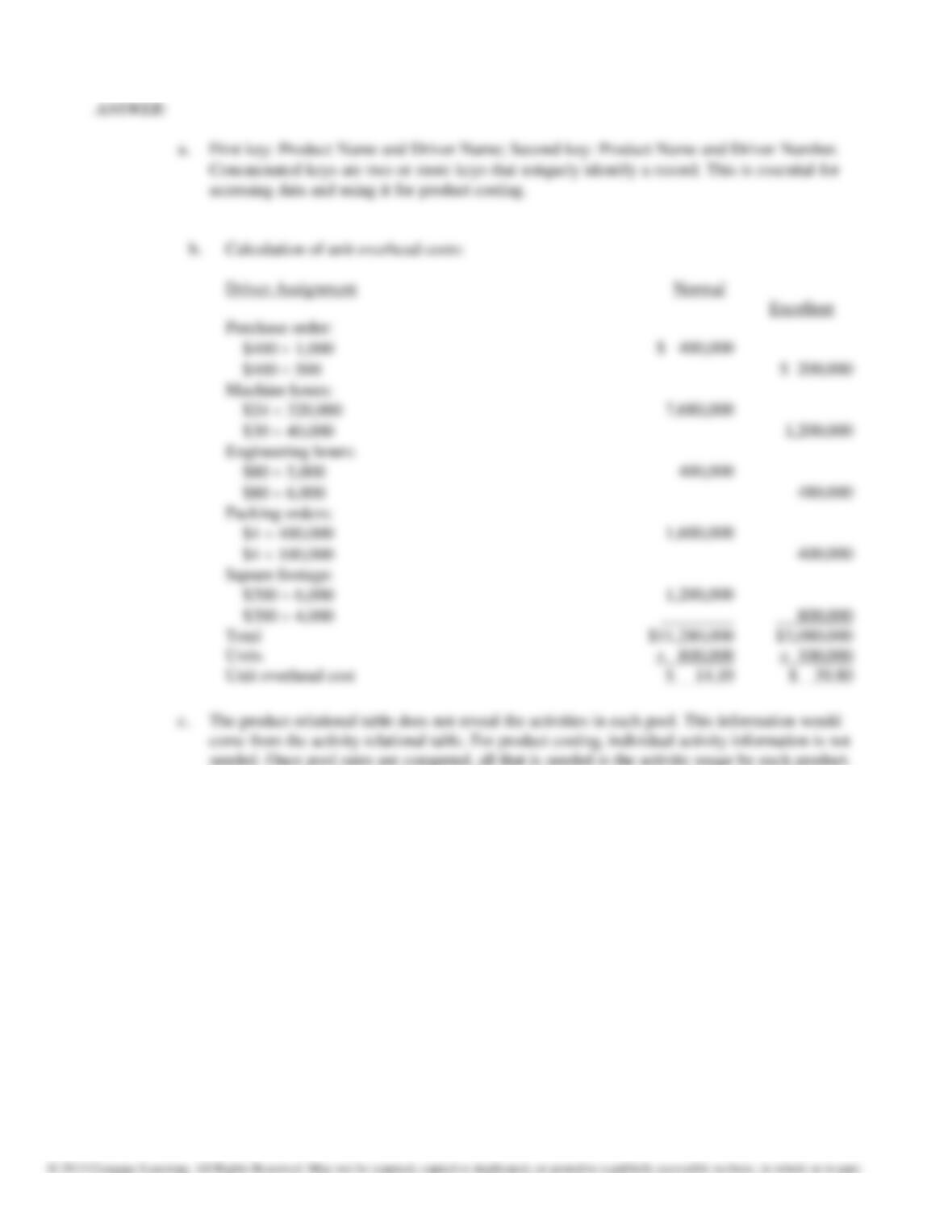
a. Identify two different concatenated keys. What is the purpose of concatenated keys?
b. Using the pool rates and the information from the product relational table, calculate the unit overhead cost
for each product.
c. Does the product relational table indicate how many activities are in each pool? Is this necessary for
product costing? Explain.
Chapter 4: Activity-Based Costing