70 Chapter 4 The Time Value of Money
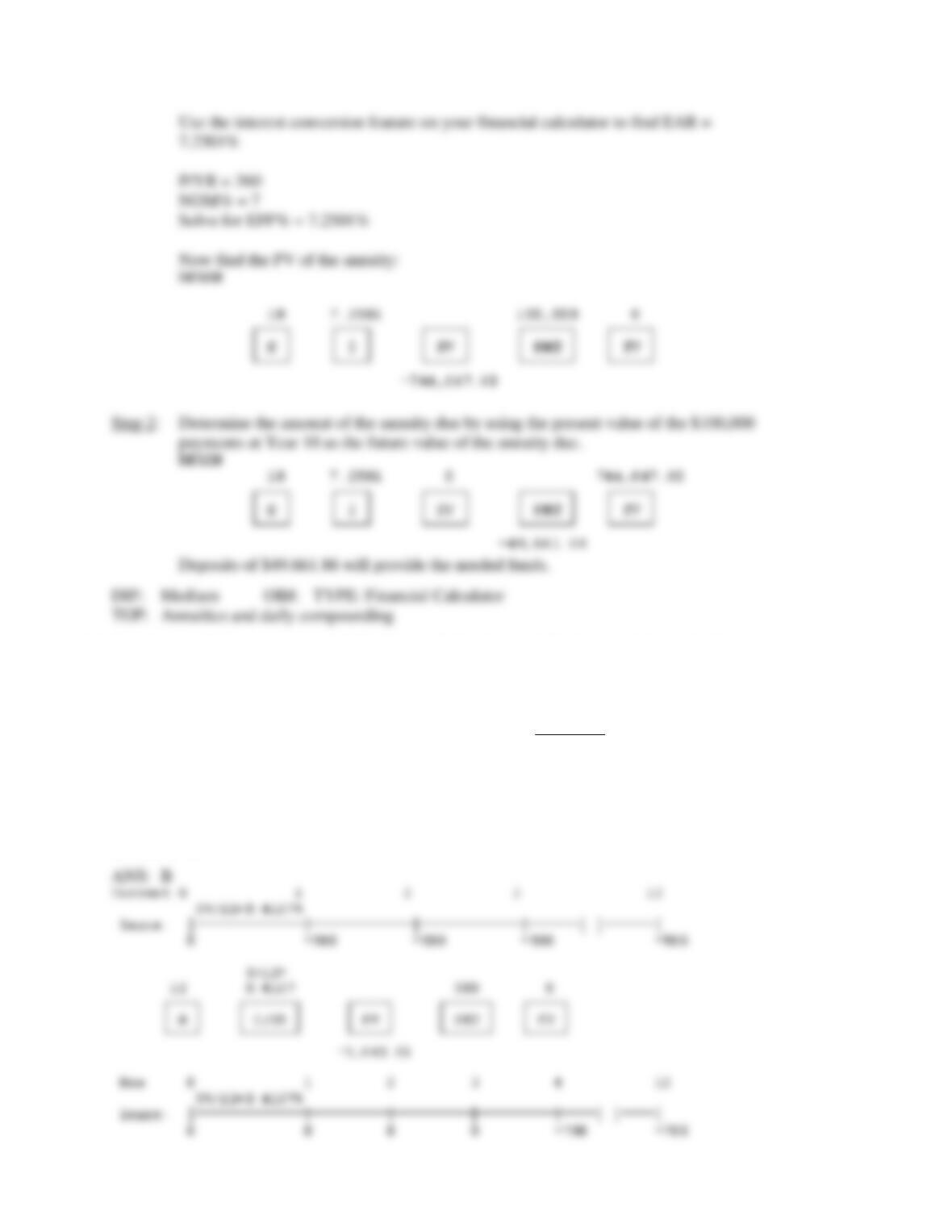
65. Your lease calls for payments of $500 at the end of each month for the next 12 months. Now your
landlord offers you a new 1-year lease which calls for zero rent for 3 months, then rental
payments of $700 at the end of each month for the next 9 months. You keep your money in a
bank time deposit that pays a simple annual rate of 5 percent. By what amount would your net
worth change if you accept the new lease? (Hint: Your return per month is 5%/12 =
0.4166667%.)
a.
-$509.81
b.
-$253.62
c.
+$125.30
d.
+$253.62
e.
+$509.81
Chapter 4 The Time Value of Money 71
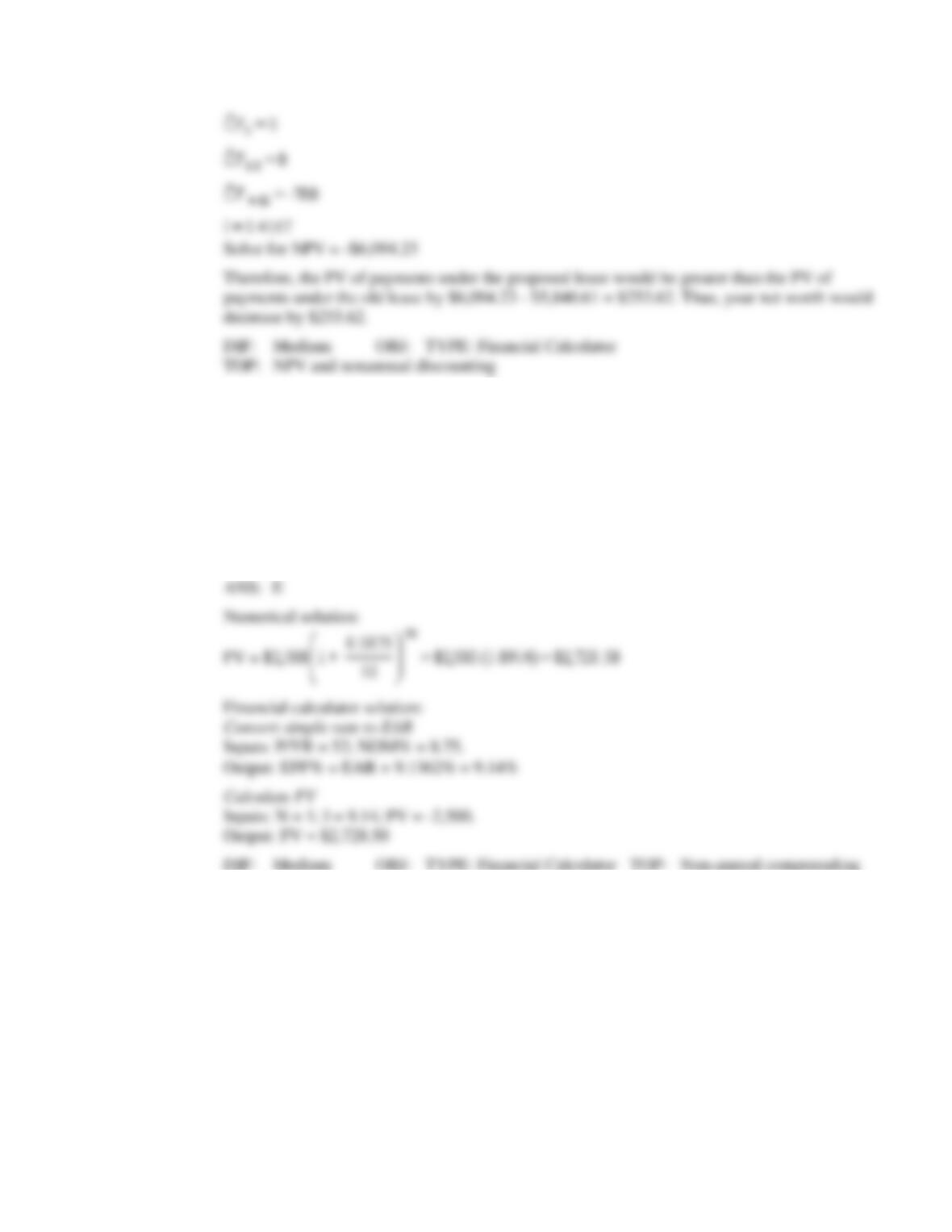
66. You plan to invest $2,500 in a money market account which will pay an annual stated (simple)
interest rate of 8.75 percent, but which compounds interest on a weekly basis. If you leave this
money on deposit for one year (52 weeks), what will be your ending balance when you close the
account?
a.
$2,583.28
b.
$2,611.72
c.
$2,681.00
d.
$2,703.46
e.
$2,728.50
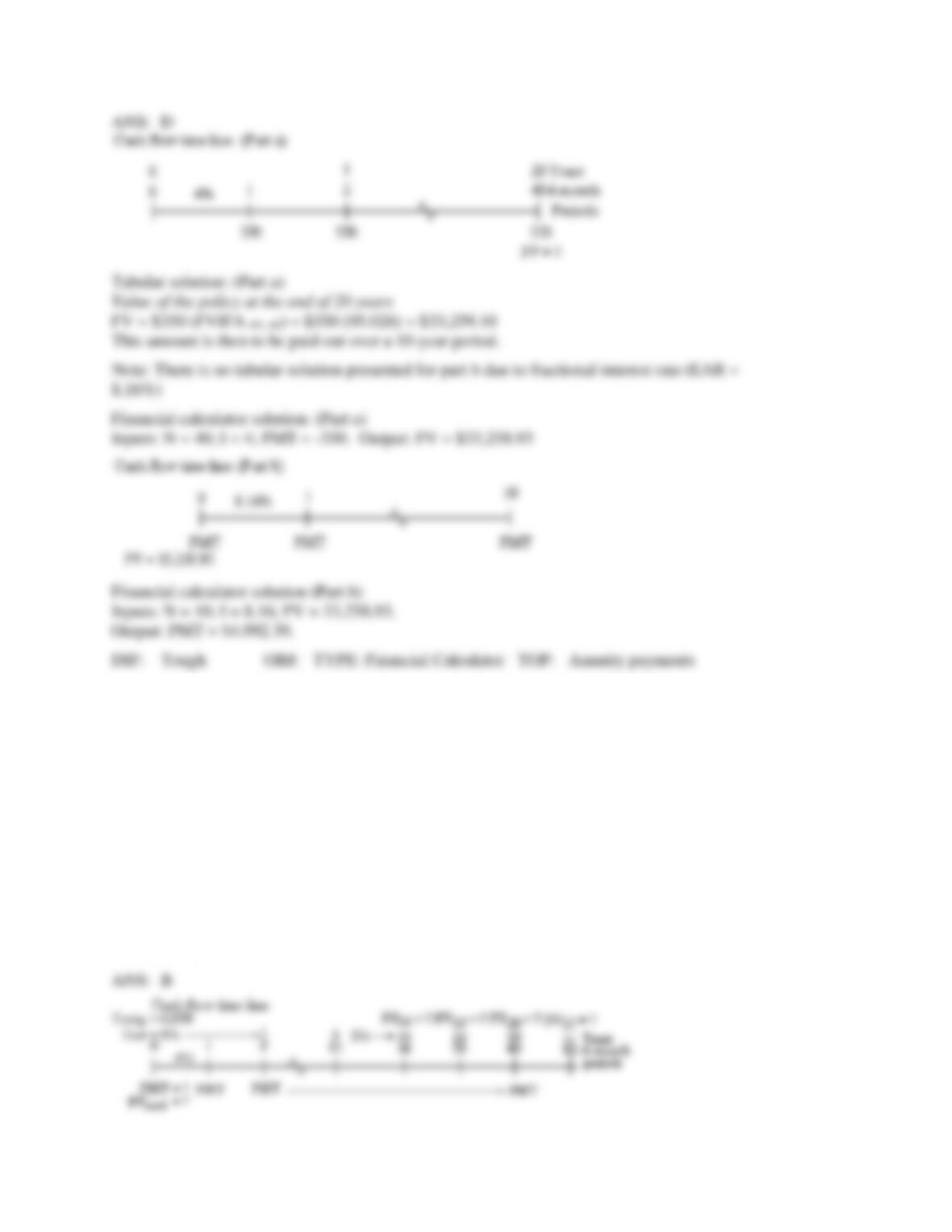
67. You have just purchased a life insurance policy that requires you to make 40 semiannual
payments of $350 each, where the first payment is due in 6 months. The insurance company has
guaranteed that these payments will be invested to earn you an effective annual rate of 8.16
percent, although interest is to be compounded semiannually. At the end of 20 years (40
payments), the policy will mature. The insurance company will pay out the proceeds of this
policy to you in 10 equal annual payments, with the first payment to be made one year after the
policy matures. If the effective interest rate remains at 8.16 percent, how much will you receive
during each of the 10 years?
a.
$6,113.20
b.
$5,244.62
c.
$5,792.21
d.
$4,992.39
e.
$4,723.81
72 Chapter 4 The Time Value of Money
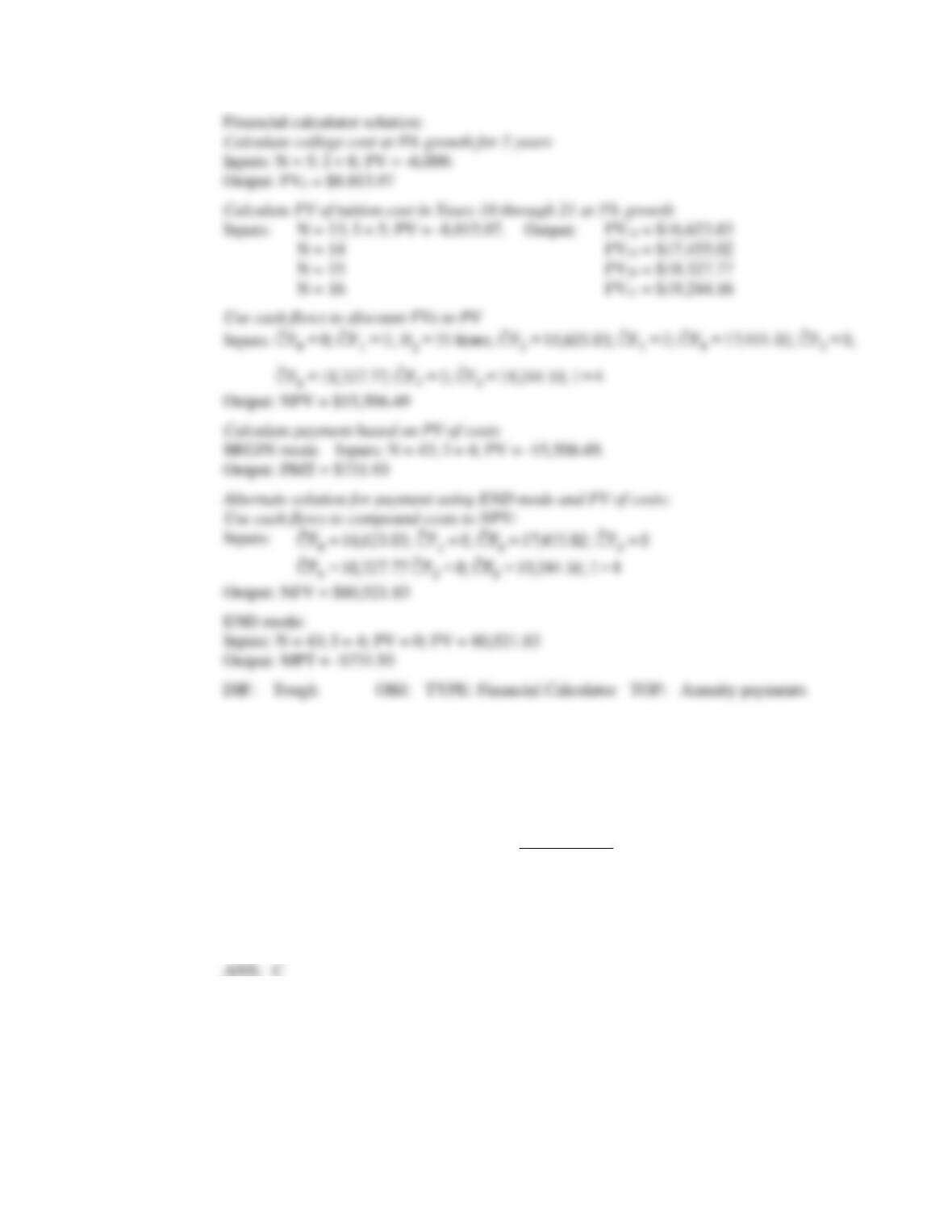
68. Assume that you just had a child, and you are now planning for her college education. You would
like to make 43 equal payments over the next 21 years (the first payment to be made immediately,
all other payments to be made at 6-month intervals, with the final payment to be made at her 21st
birthday) so that you will be able to cover her expected expenses while in school. You expect to
pay expenses on her 18th, 19th, 20th, and 21st birthdays. Assume that the current (time period 0)
annual cost of college is $6,000, that you expect annual inflation to be 8 percent for the next 5
years, and then 5 percent thereafter. If you expect to be able to earn a return of 4 percent every 6
months on your investments (a simple rate of 8 percent with semiannual compounding), what will
be the amount of each of the 43 payments?
a.
$705.86
b.
$731.93
c.
$692.15
d.
$650.46
e.
$785.72
Chapter 4 The Time Value of Money 73
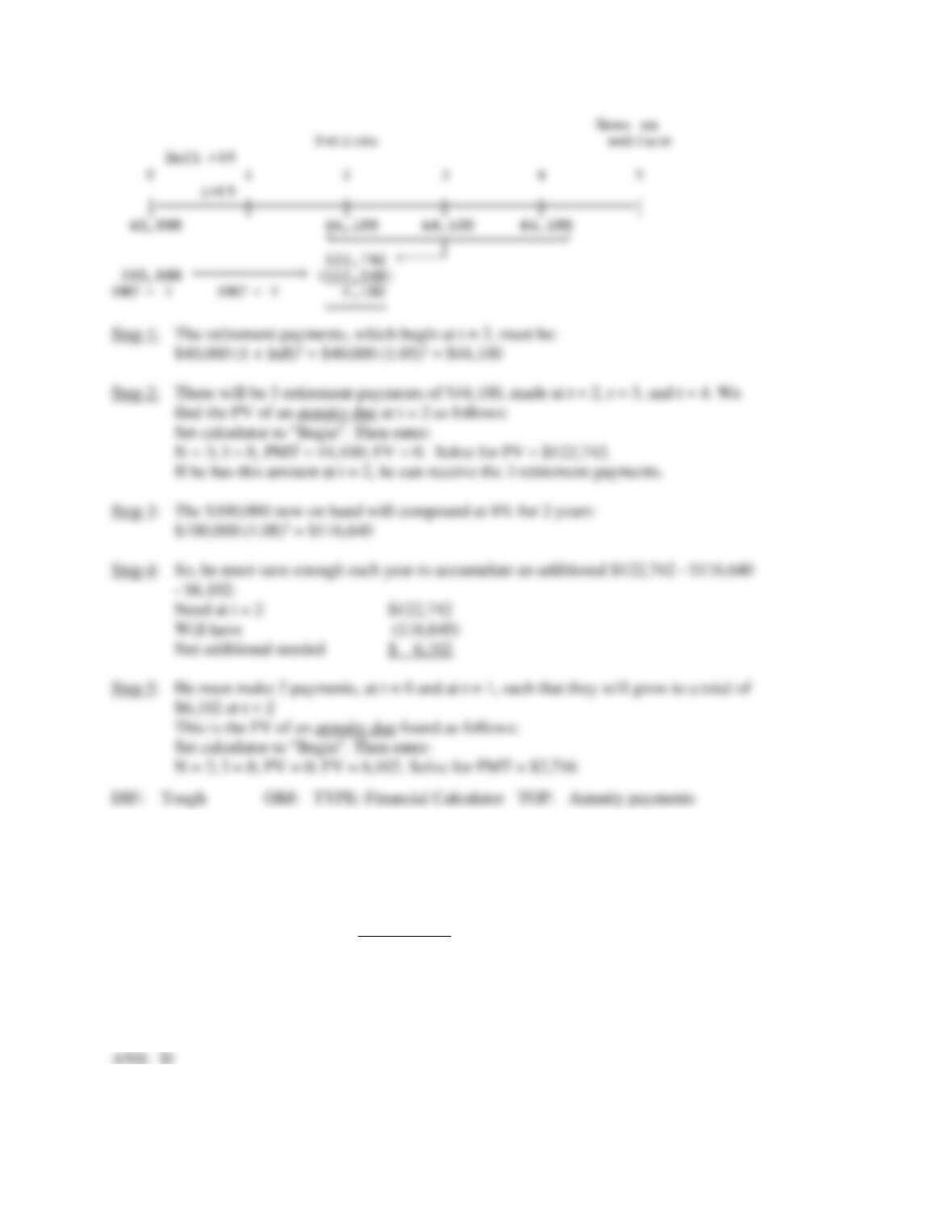
69. Your father, who is 60, plans to retire in 2 years, and he expects to live independently for 3 years.
He wants a retirement income which has, in the first year, the same purchasing power as $40,000
has today. However, his retirement income will be of a fixed amount, so his real income will
decline over time. His retirement income will start the day he retires, 2 years from today, and he
will receive a total of 3 retirement payments. Inflation is expected to be constant at 5 percent.
Your father has $100,000 in savings now, and he can earn 8 percent on savings now and in the
future. How much must he save each year, starting today, to meet his retirement goals?
a.
$1,863
b.
$2,034
c.
$2,716
d.
$5,350
e.
$6,102
74 Chapter 4 The Time Value of Money
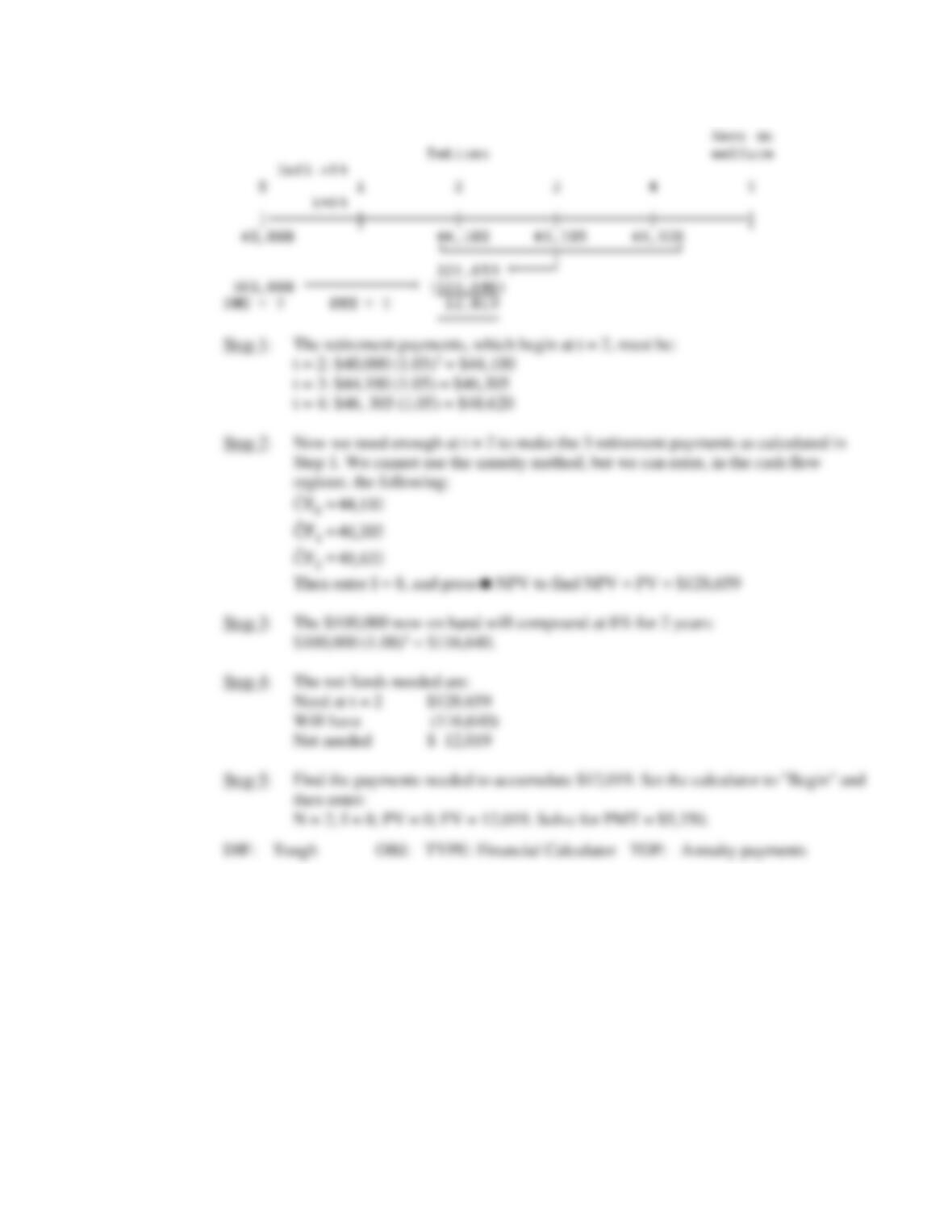
70. Your father, who is 60, plans to retire in 2 years, and he expects to live independently for 3 years.
Suppose your father wants to have a real income of $40,000 in today’s dollars in each year after
he retires. His retirement income will start the day he retires, 2 years from today, and he will
receive a total of 3 retirement payments. Inflation is expected to be constant at 5 percent. Your
father has $100,000 in savings now, and he can earn 8 percent on savings now and in the future.
How much must he save each year, starting today, to meet his retirement goals?
a.
$1,863
b.
$2,034
c.
$2,716
d.
$5,350
e.
$6,102
Chapter 4 The Time Value of Money 75
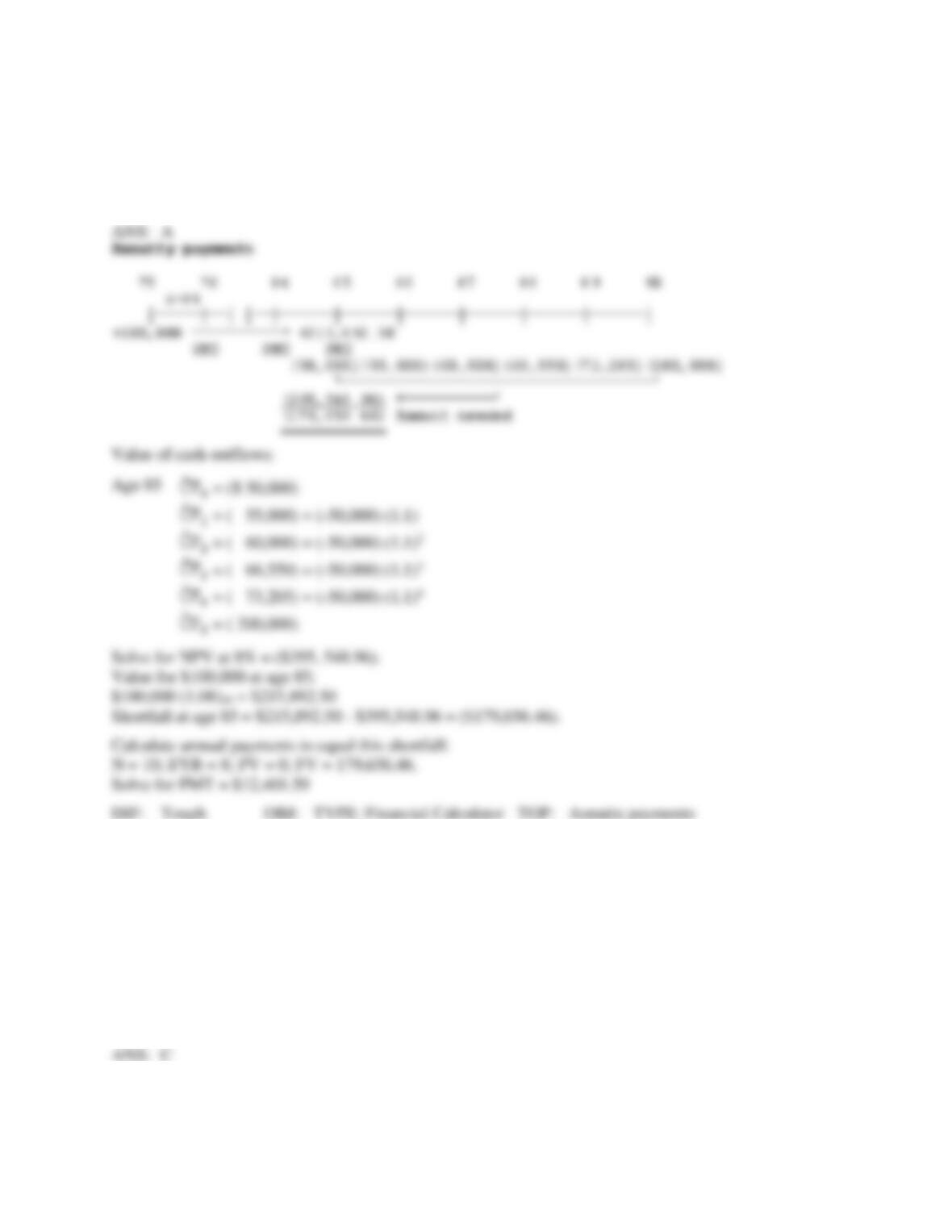
71. Your client just turned 75 years old and plans on retiring in 10 years on her 85th birthday. She is
saving money today for her retirement and is establishing a retirement account with your office.
She would like to withdraw money from her retirement account on her birthday each year until
she dies. She would ideally like to withdraw $50,000 on her 85th birthday, and increase her
withdrawals 10 percent a year through her 89th birthday (i.e., she would like to withdraw $73,205
on her 89th birthday). She plans to die on her 90th birthday, at which time she would like to leave
$200,000 to her descendants. Your client currently has $100,000. You estimate that the money in
the retirement account will earn 8 percent a year over the next 15 years. Your client plans to
contribute an equal amount of money each year until her retirement. Her first contribution will
come in one year; her tenth and final contribution will come in ten years (on her 85th birthday).
How much should she contribute each year in order to meet her objectives?
76 Chapter 4 The Time Value of Money
a.
$12,401.59
b.
$12,998.63
c.
$13,243.18
d.
$13,759.44
e.
$14,021.53
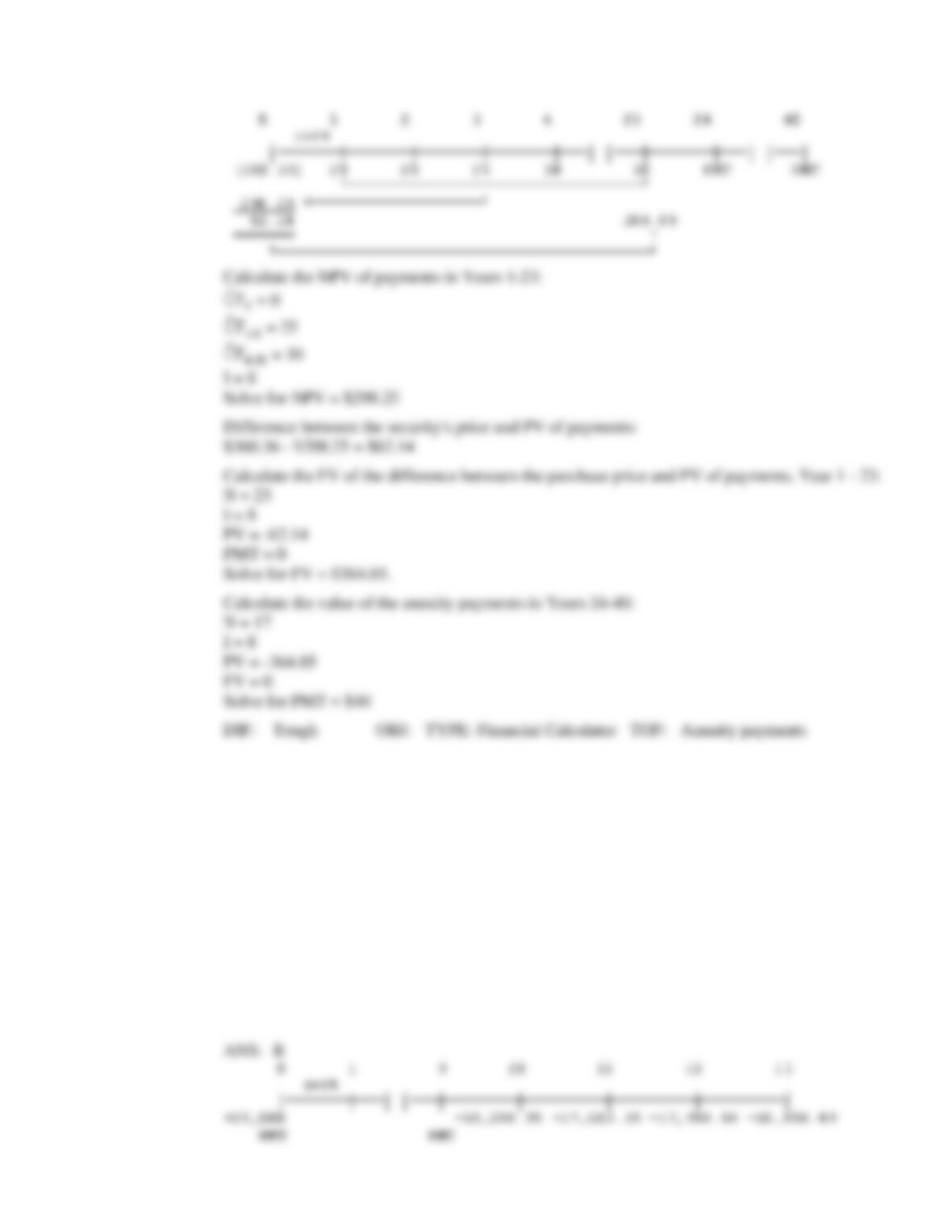
72. You are considering an investment in a 40-year security. The security will pay $25 a year at the
end of each of the first three years. The security will then pay $30 a year at the end of each of the
next 20 years. The simple interest rate is assumed to be 8 percent, and the current price (present
value) of the security is $360.39. Given this information, what is the equal annual payment to be
received from Year 24 through Year 40 (i.e., for 17 years)?
a.
$35
b.
$38
c.
$40
d.
$45
e.
$50
Chapter 4 The Time Value of Money 77
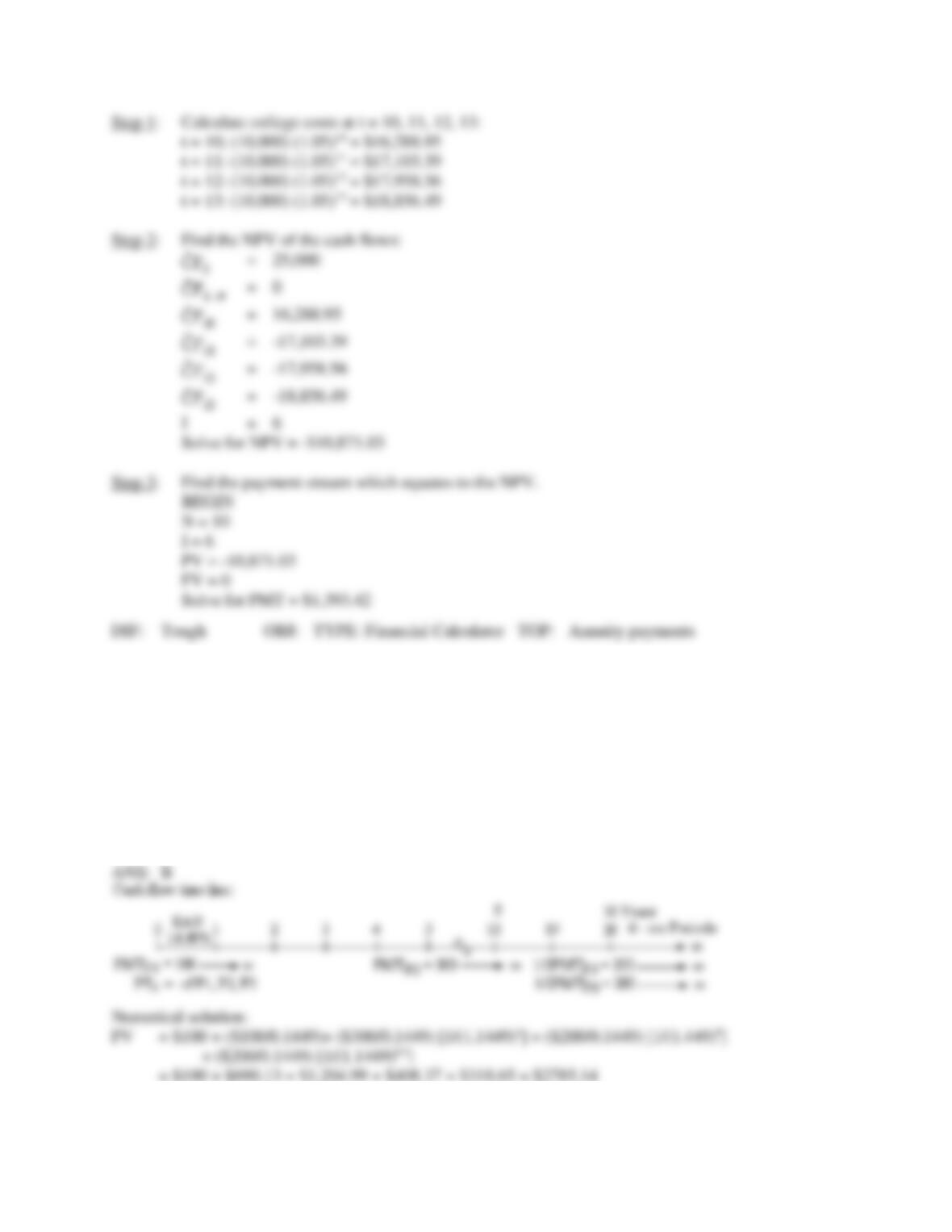
73. You are currently saving for your child’s college education. The current cost of college is $10,000
a year. You expect that college costs will continue to increase at a rate of 5 percent a year. Your
child is scheduled to begin attending a four-year college 10 years from now (i.e., college
payments will be made at t=10, t=11, t=12, and t=13). You currently have $25,000 in an account
which earns 6 percent after taxes. You would like to have all of the necessary savings by the time
your child enters college, and you would like to contribute a constant amount at the beginning of
each of the next 10 years in order to provide the necessary amount. (You want to make 10 equal
contributions starting in Year 0 and ending at Year 9.) How much should you contribute to the
account each year in order to fully provide for your child’s education?
a.
$1,133.16
b.
$1,393.42
c.
$1,477.02
d.
$1,507.81
e.
$1,622.33
78 Chapter 4 The Time Value of Money
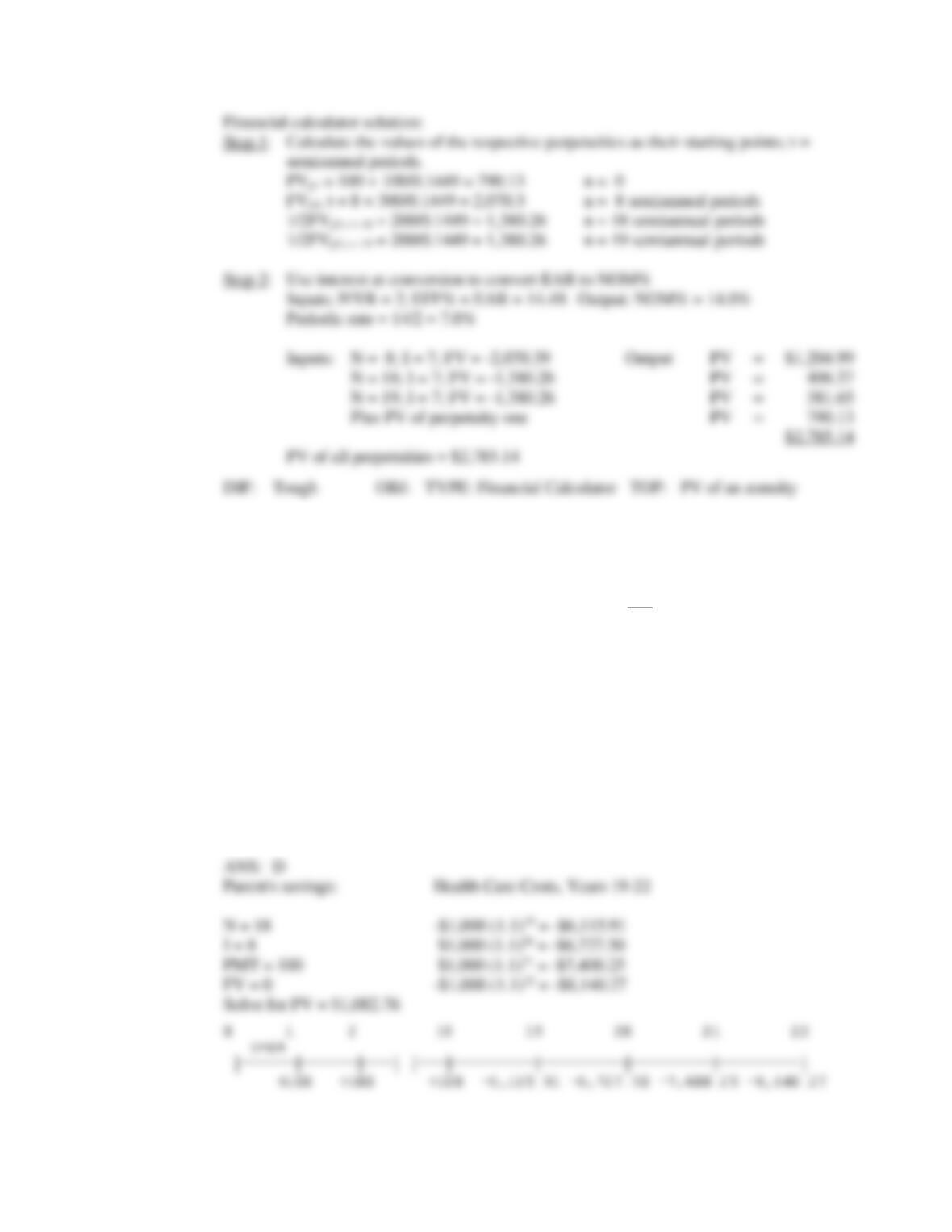
74. You will receive a $100 annual perpetuity, the first payment to be received now, at Year 0, a
$300 annual perpetuity payable starting at the end of Year 5, and a $200 semiannual (2 payments
per year) perpetuity payable starting midway through Year 10. If you require an effective annual
interest rate of 14.49 percent, what is the present value of all three perpetuities together at Year 0?
(Hint: The semiannual annuity can be thought of as two annual annuities.)
a.
$2,091.86
b.
$2,785.14
c.
$4,213.51
d.
Infinite; the present value of any perpetuity is infinite.
e.
Cannot determine the value since some payments are annually and some semiannually.
Chapter 4 The Time Value of Money 79
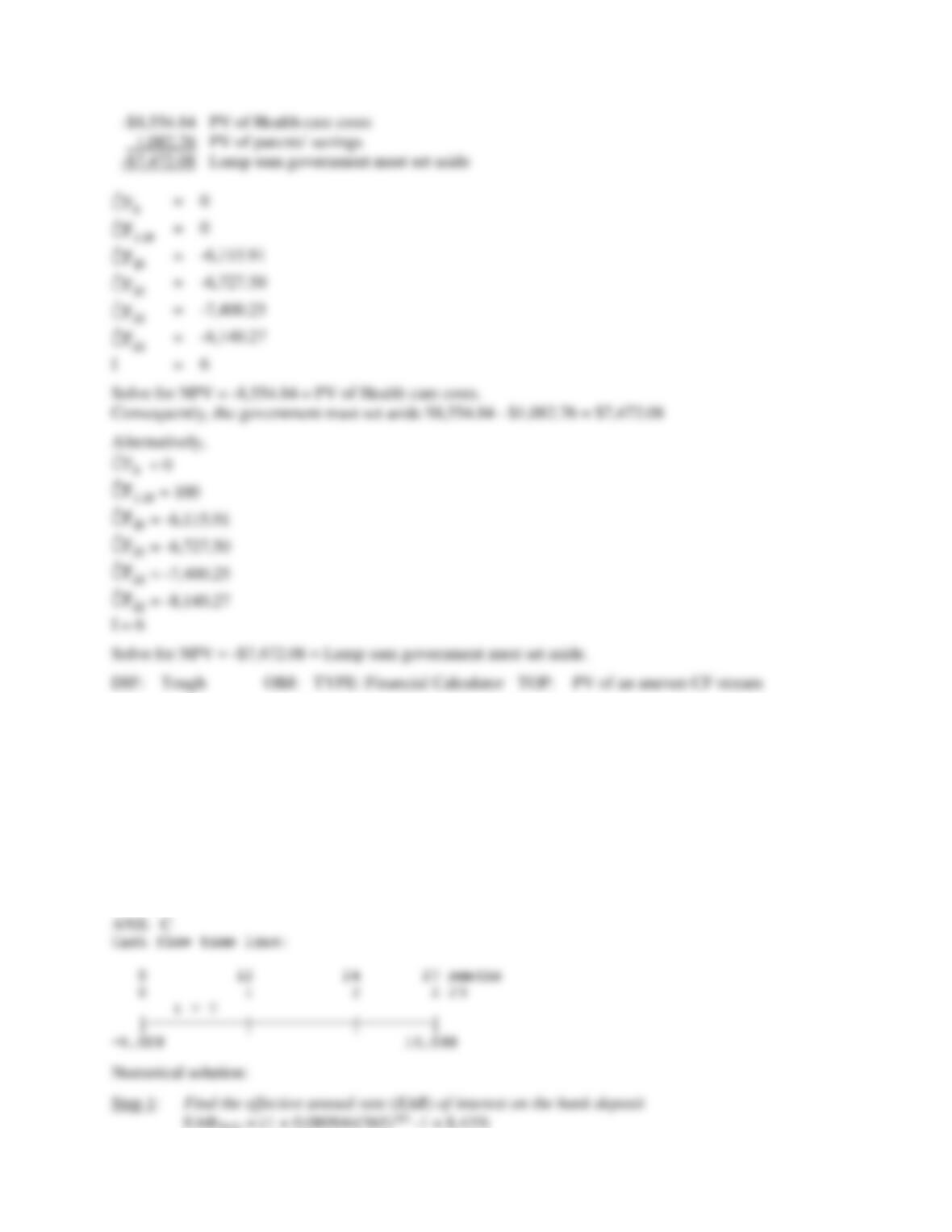
75. Hillary is trying to determine the cost of health care to college students, and parents’ ability to
cover those costs. She assumes that the cost of one year of health care for a college student is
$1,000 today, that the average student is 18 when he or she enters college, that inflation in health
care cost is rising at the rate of 10 percent per year, and that parents can save $100 per year to
help cover their children’s costs. All payments occur at the end of the relevant period, and the
$100/year savings will stop the day the child enters college (hence 18 payments will be made).
Savings can be invested at a simple rate of 6 percent, annual compounding. Hillary wants a health
care plan which covers the fully inflated cost of health care for a student for 4 years, during years
19 through 22 (with payments made at the end of years 19 through 22). How much would the
government have to set aside now (when a child is born), to supplement the average parent’s share
of a child’s college health care cost? The lump sum the government sets aside will also be
invested at 6 percent, annual compounding.
a.
$1,082.76
b.
$3,997.81
c.
$5,674.23
d.
$7,472.08
e.
$8,554.84
80 Chapter 4 The Time Value of Money
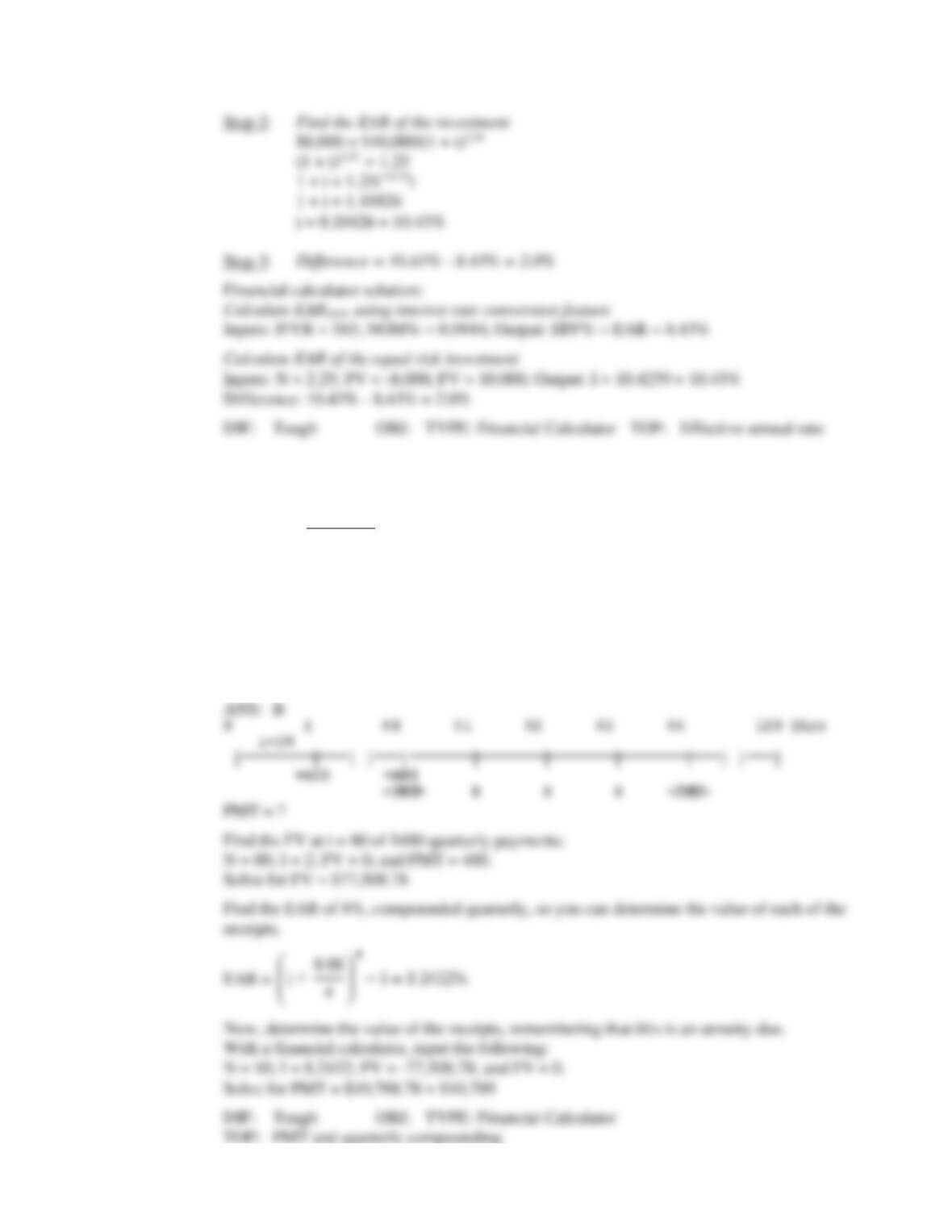
76. You have some money on deposit in a bank account which pays a simple (or quoted) rate of
8.0944 percent, but with interest compounded daily (using a 365-day year). Your friend owns a
security which calls for the payment of $10,000 after 27 months. The security is just as safe as
your bank deposit, and your friend offers to sell it to you for $8,000. If you buy the security, by
how much will the effective annual rate of return on your investment change?
a.
1.87%
b.
1.53%
c.
2.00%
d.
0.96%
e.
0.44%
Chapter 4 The Time Value of Money 81
77. Your employer has agreed to make 80 quarterly payments of $400 each into a trust account to
fund your early retirement. The first payment will be made 3 months from now. At the end of 20
years (80 payments), you will be paid 10 equal annual payments, with the first payment to be
made at the beginning of Year 21 (or the end of Year 20). The funds will be invested at a simple
rate of 8.0 percent, quarterly compounding, during both the accumulation and the distribution
periods. How large will each of your 10 receipts be? (Hint: You must find the EAR and use it in
one of your calculations.)
a.
$7,561
b.
$10,789
c.
$11,678
d.
$12,342
e.
$13,119