Chapter 04 Test Bank KEY
1. Human capital investment consists of
2. “Expenditures on education and training can be treated as investment in human capital.” This statement
is
3. Approximately what percentage of the U.S. population had completed four or more years of college by
the year 2014?
4. Age-earnings data show that
4-2
5. Available evidence indicates that
6. The total economic cost of formal education typically does not include
7. The primary indirect cost of going to college is
4-3
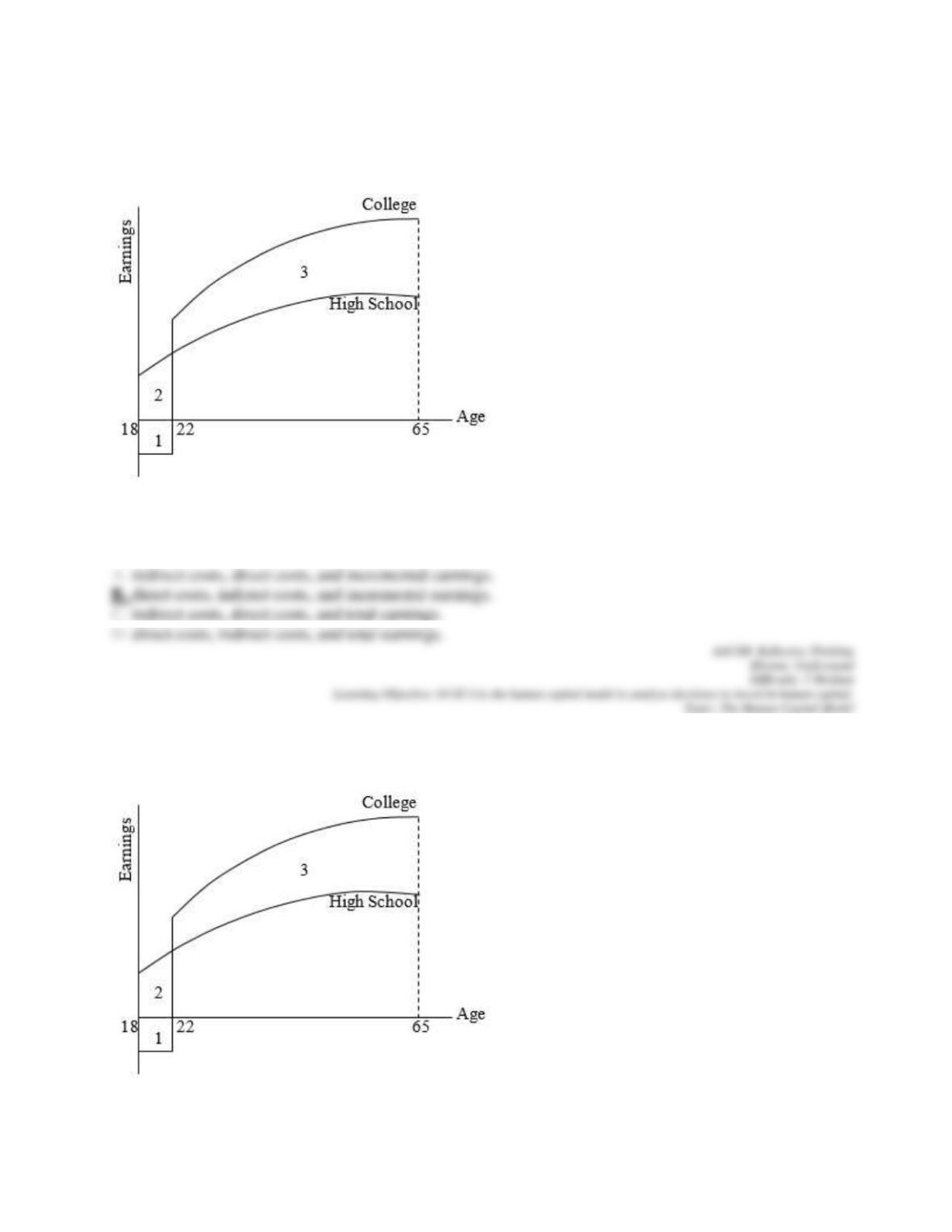
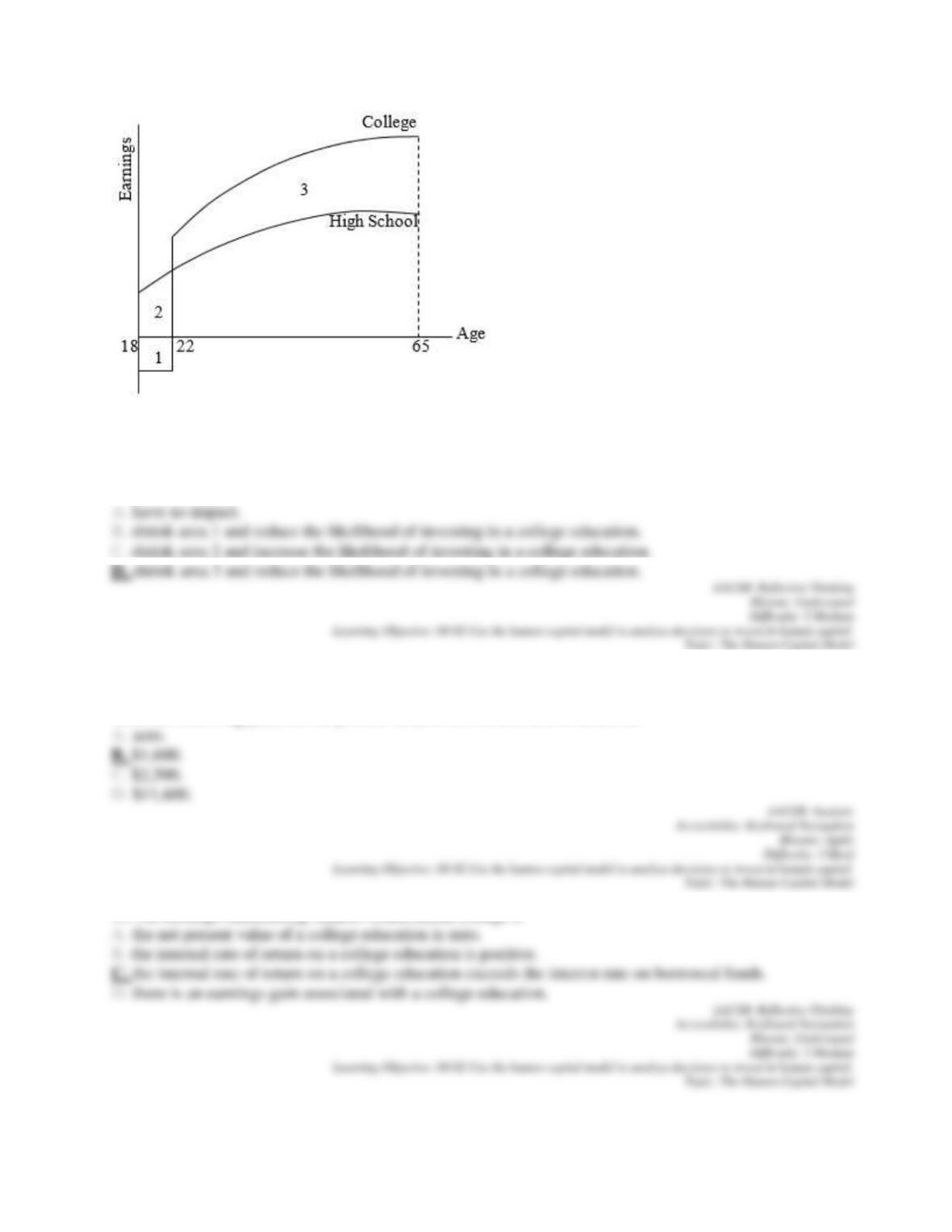
8. Refer to the following diagram.
According to human capital theory, areas 1, 2, and 3 represent, respectively,
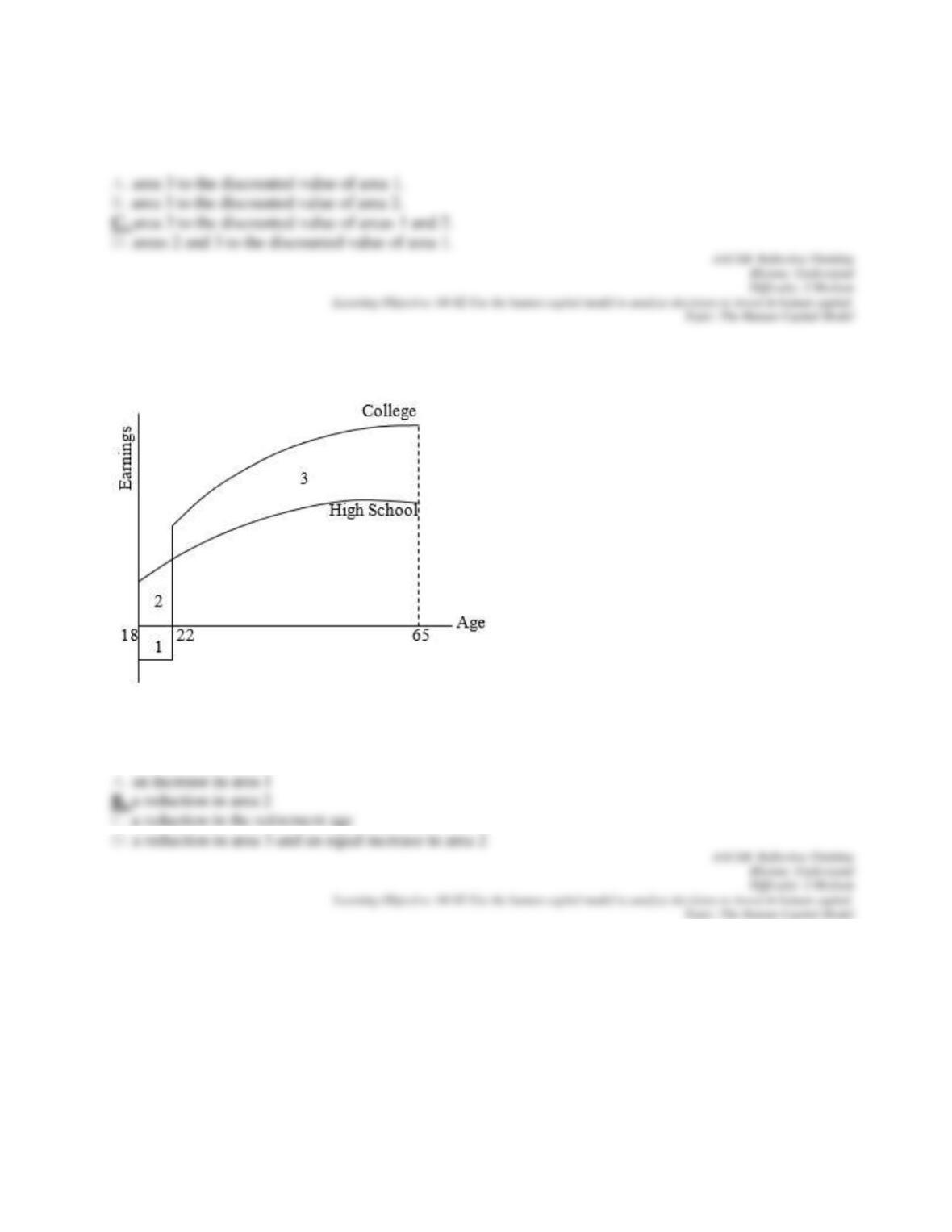
9. Refer to the following diagram.
4-4
In deciding whether or not to go to college, one would compare the discounted value of
10. Refer to the following diagram.
Which one of the following would increase the likelihood of investing in a college education?
11. Refer to the following diagram.
4-5
Suppose there is now a 25% likelihood that a person’s work career may be interrupted for ten years after
schooling has been completed. In the diagram above, this development would
12. Consider an individual who will invest a total of $10,000 in direct and indirect costs for training in order
to increase earnings by $12,500 for the next year. Suppose the interest rate is 8%. If this person plans to
retire the following year, the net present value of this investment is closest to
13. An earnings-maximizing student would attend college if
14. Which one of the following would indicate a profitable human capital investment?
15. At the optimal amount of education, the internal rate of return on education is
16. Which one of the following circumstances would most likely lead to increased investment in education
by women?
17. All else equal, investment in education will be greater,
18. Other things equal, the lower the cost of a human capital investment,
Topic: The Human Capital Model
19. Human capital theory predicts that the proportion of people attending college will decrease if
20. Most rate-of-return studies of education indicate that
21. From 1980 to the present, the college wage premium
22. The college wage premium
23. The increase in the college wage premium during the 1980s was most likely caused by
24. The declining college wage premium in the 1970s is generally attributed to the
25. Studies of the rate of return on human capital must be interpreted with care because
26. The private rate of return on human capital may _____ the social rate because _____.
27. All else equal, the social rate of return to education will be lower than the private return if
28. In calculating the social rate of return on a human capital investment, one would
4-9
29. Based on standardized test scores for students in the following countries, which has the highest
measured schooling quality?
30. The demand for human capital curves slope downward and to the right because
31. Typically, as the level of education increases,
32. Refer to the following diagram.
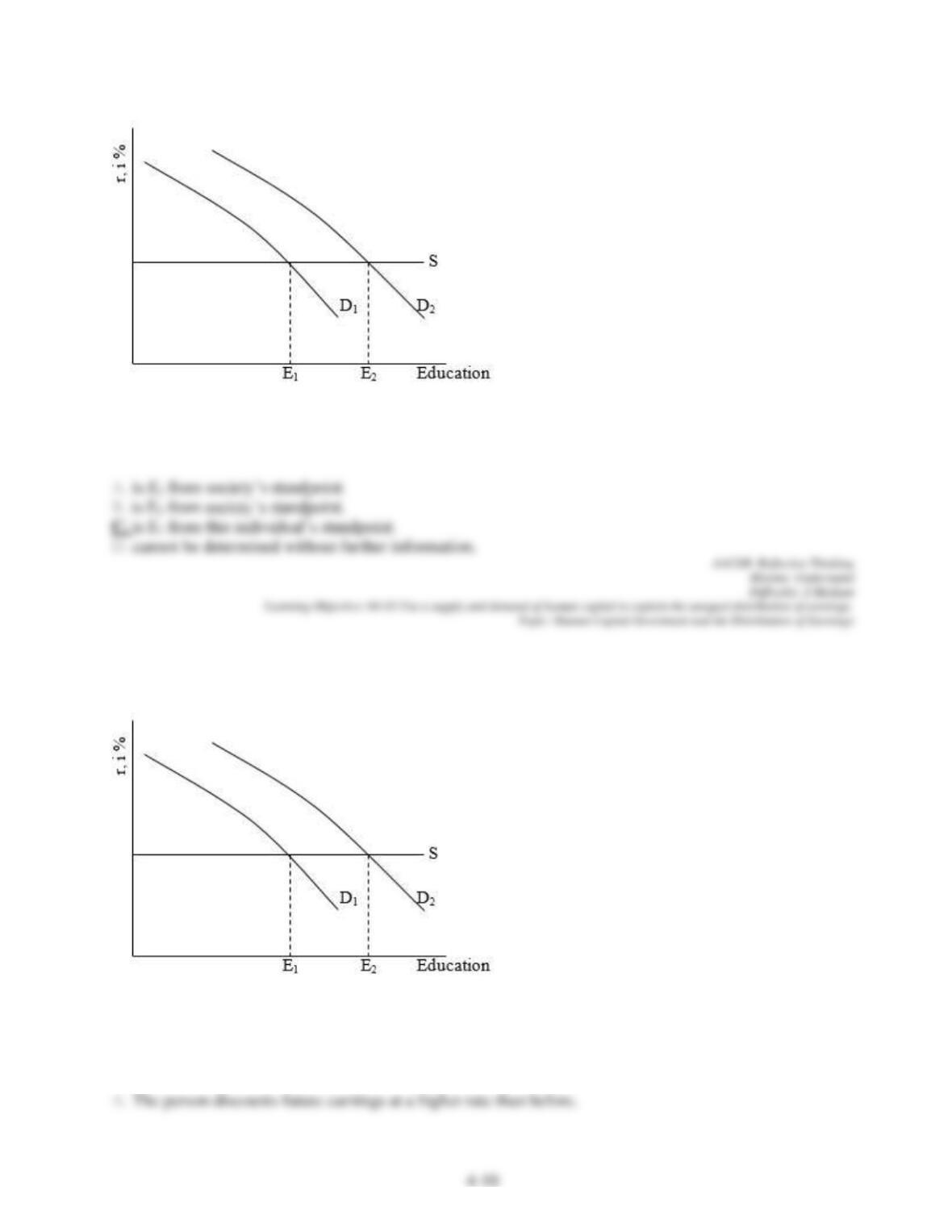
If D1 is this individual’s investment demand curve, then the optimal amount of education
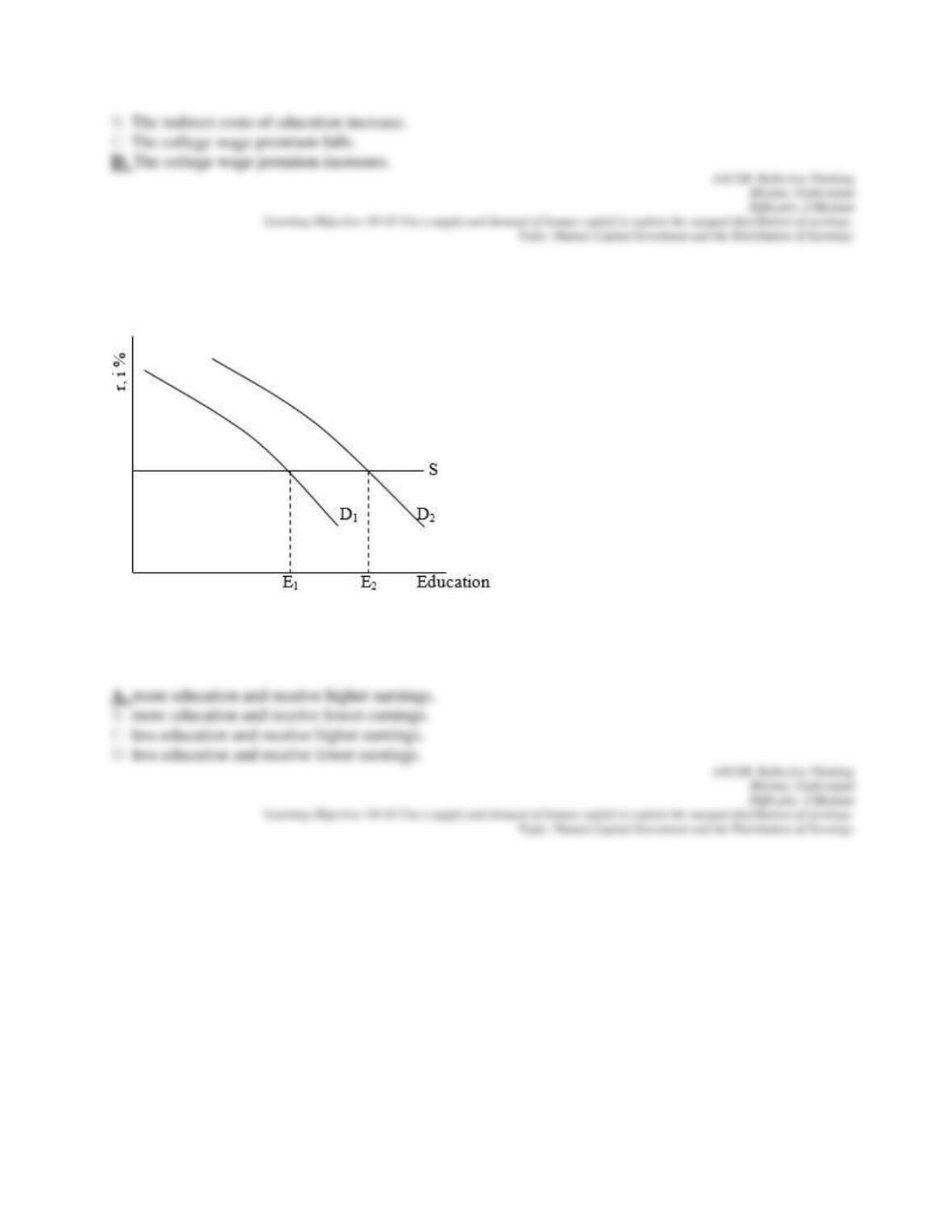
33. Refer to the following diagram.
Which one of the following might cause a person’s human capital investment demand curve to shift from
D1 to D2?
4-11
34. Refer to the following diagram.
Compared to D1, a person whose demand curve is given by D2 will likely obtain
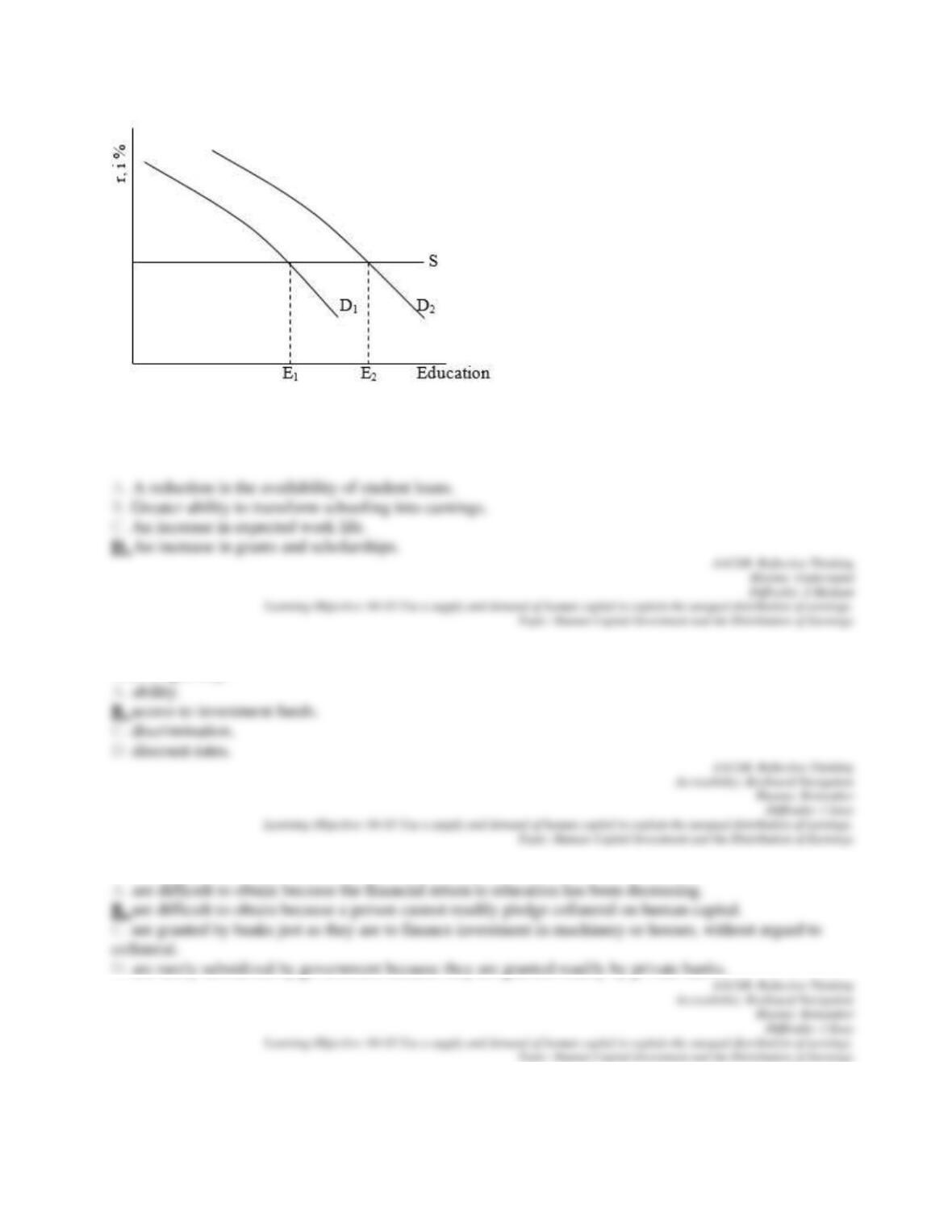
35. Refer to the following diagram.
4-12
Which one of the following will shift the supply of investment funds curve downward?
36. Personal differences in demand for human capital curves can be explained by differences in all of the
following, except
37. Private loans to finance investments in human capital
38. Which one of the following observations would tend to widen the dispersion of earnings?
4-13
39. Which one of the following most closely approximates pure specific training?
40. General training
41. Specific training
42. A worker who has obtained specific training is more likely to establish a long-term association with an
employer because
4-14
43. Charley’s employer is considering him for a general training program that will cost $3 per hour. His
current marginal revenue product is $15 per hour and will rise to $20 upon completion of the program. Of
the following, Charley’s training and posttraining wage, respectively, will most likely be
44. Mary’s employer is considering her for a firm-specific training program that will cost $3 per hour. Her
current marginal revenue product is $15 per hour and will rise to $20 upon completion of the program. Of
the following, Mary’s training and posttraining wage, respectively, will most likely be
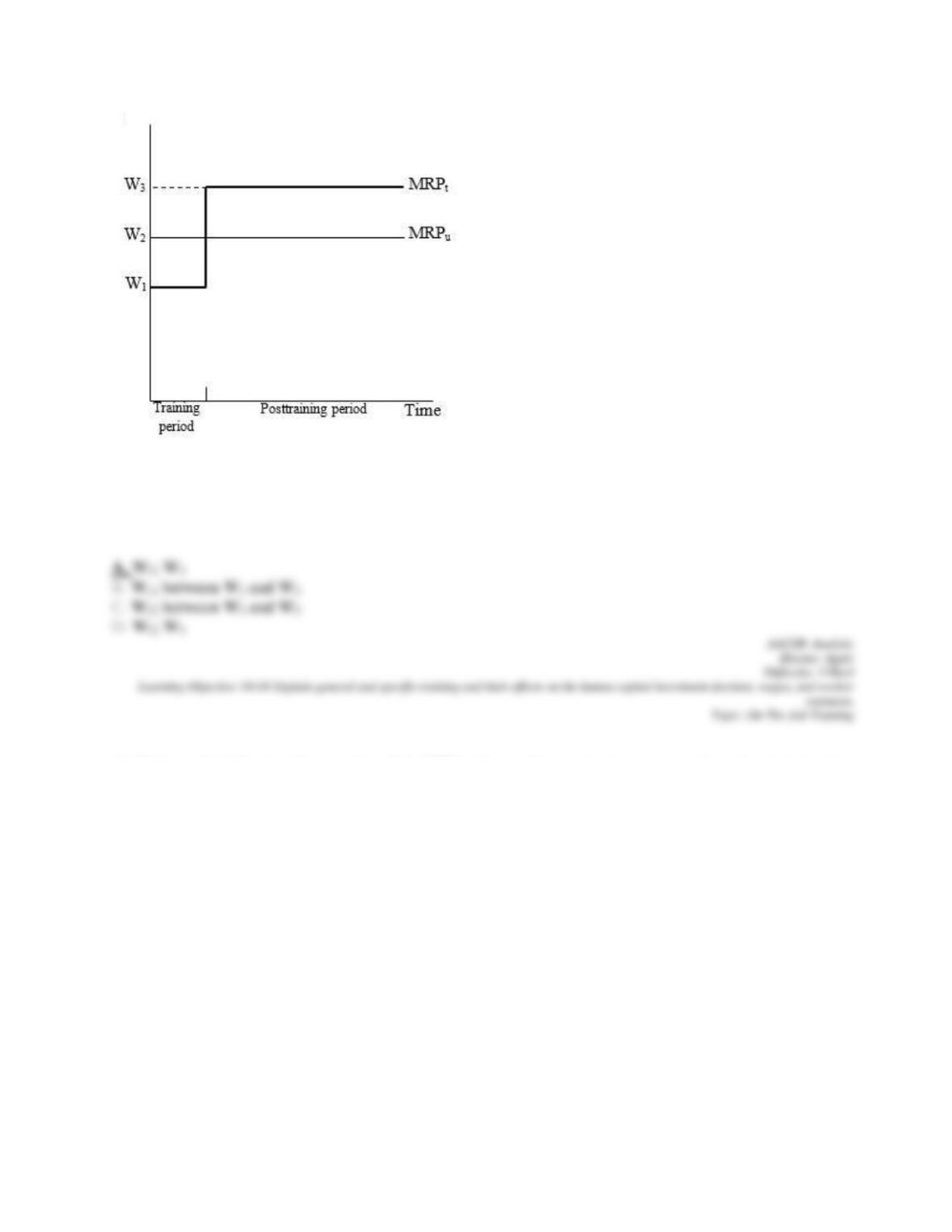
45. Refer to the following diagram, in which MRPu refers to the marginal revenue product of an untrained
worker, while MRPt refers to this worker’s marginal revenue product as a result of a program of on-the-job
training.
4-15
In the case of general training, the wage rate during the training period will be _____, while the posttraining
wage will be _____.
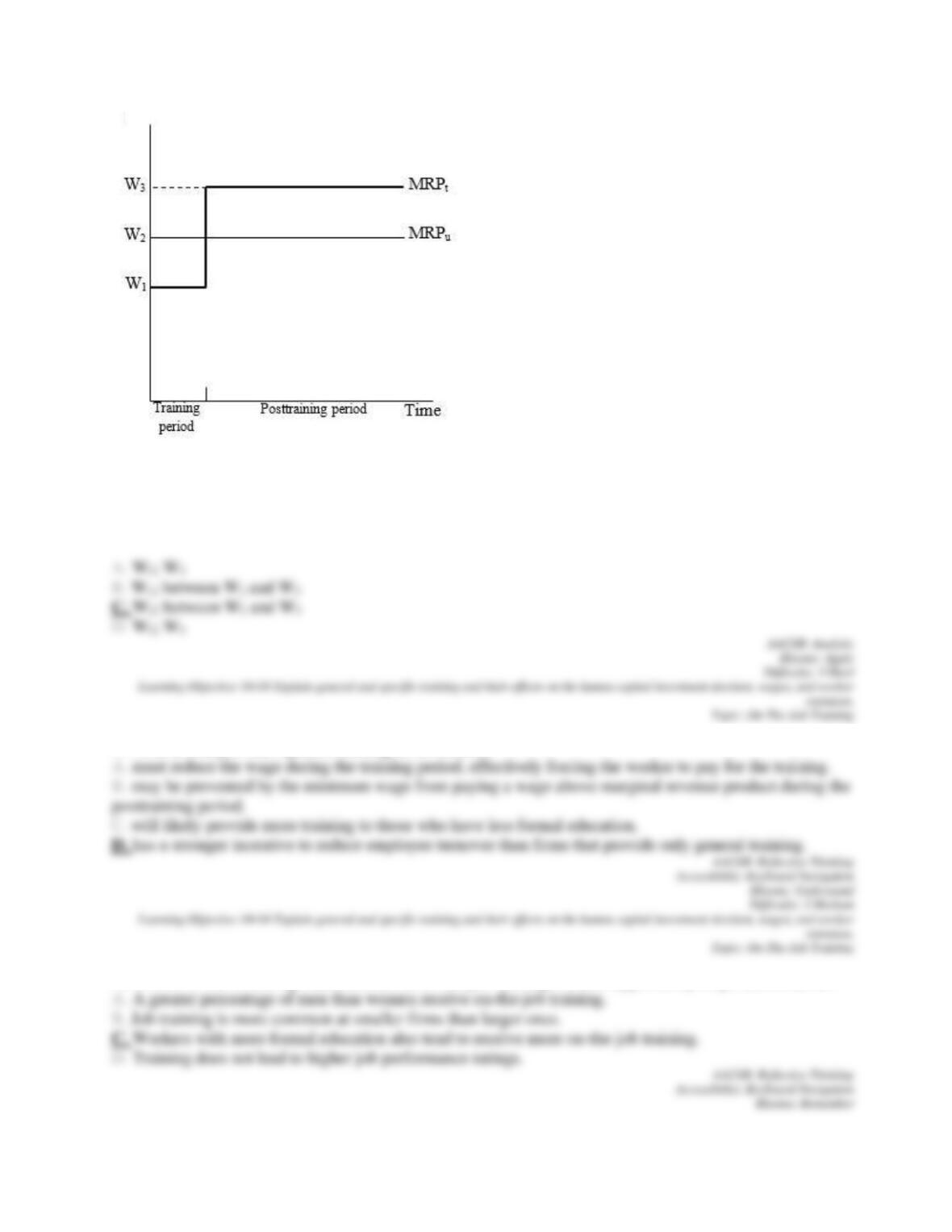
46. Refer to the following diagram, in which MRPu refers to the marginal revenue product of an untrained
worker, while MRPt refers to this worker’s marginal revenue product as a result of a program of on-the-job
training.
4-16
In the case of specific training, the wage rate during the training period will be _____, while the posttraining
wage will be _____.
47. A firm that provides specific training to its workers
48. Which of the following statements about on-the-job training is most supported by empirical evidence?
Difficulty: 1 Easy
Learning Objective: 04-04 Explain general and specific training and their effects on the human capital investment decision, wages, and worker
retention.
Topic: On-The-Job Training
49. Empirical evidence suggests that
50. If education is undertaken as consumption as well as investment,
51. If part of the typical college graduate’s additional earnings is attributable to ability and not to
education,
52. If the screening hypothesis is true,
53. Evidence suggests that, during recessions, the college enrollment rate
4-18
54. Research by Dale and Krueger shows that, all else equal,
55. Which of the following is a true statement?
Chapter 04 Test Bank Summary
Category
# of Ques
tions
AACSB: Analytic
5
AACSB: Reflective Thinking
50
Accessibility: Keyboard Navigation
45
Blooms: Apply
5
Blooms: Remember
33
Blooms: Understand
17
Difficulty: 1 Easy
33
Difficulty: 2 Medium
17
Difficulty: 3 Hard
5
Learning Objective: 04-01 Explain the meaning of investment in human capital.
5
Learning Objective: 04-
27
4-19
02 Use the human capital model to analyze decisions to invest in human capital.
Learning Objective: 04-
03 Use a supply and demand of human capital to explain the unequal distribution of earnin
gs.
9
Learning Objective: 04-
04 Explain general and specific training and their effects on the human capital investment
decision, wages, and worker retention.
12
Learning Objective: 04-05 Critically evaluate the human capital model.
2
Topic: Criticisms of Human Capital Theory
2
Topic: Human Capital Investment and the Distribution of Earnings
9
Topic: Investment in Human Capital: Concept and Data
5
Topic: On-The-Job Training
12
Topic: The Human Capital Model
27