8) Ecological imperialism is well-suited for study by political ecologists.
9) The second phase of European expansion was external and also known as colonialism.
10) The dip in Europe’s population from 1300 to 1500 was due in part to food shortages.
11) Though it began hundreds of years ago, the Columbian Exchange continues.
12) Before the arrival of the Spaniards and Portuguese, horses were not known in the Americas.
13) None of the beneficial impacts of the Columbian Exchange went to the peoples of the New
World.
14) The majority of the energy consumed in the world today comes from nonrenewable sources.
15) Land use change occurs through conversion from one use to another or by modifications of
existing cover.
16) With global warming, the rising sea level could realistically flood over half of Bangladesh.
17) Long before the Columbian exchange, Italy was known for its tomatoes, Ireland for its
potatoes, and Thailand for its peppers.
18) The Kyoto Protocol is credited with closing the hole in the ozone layer.
19) Knox and Marston argue that the changes in the Earth’s atmosphere associated with global
climate change are anthropogenic.
20) Australia once had 20,000 square km of wetlands. Now they have none.
21) According to your text, the pair of processes with the greatest impact on humans and their
environment are industrialization and urbanization.
22) Solar power and fuelwood for heating and cooking are being encouraged in the periphery as
sustainable and renewable forms of energy.
23) The environmental determinism model holds that nature is molded and controlled by human
societies.
24) Nature is in part a social creation.
25) Prevailing views and concepts of nature have remained fairly constant since the Columbian
Exchange.
26) In general, peripheral countries do a better job protecting the environment than core
countries do.
27) Members of the Sierra Club and Greenpeace are more likely to hold the preservationist view
than the conservationist view.
28) As water becomes scarcer, it becomes increasingly attractive as an investment opportunity.
29) Walden Pond continues to be the classic example of the benefits of environmental
preservation.
30) Population growth in Europe is expected to drop between now and 2050.
31) The European human population has grown more in the last 2,000 years than in the previous
400,000 years.
32) During the period of European external expansion, the introduction of plants and animals
flowed from the Europe to the Americas, but not in the reverse direction.
33) The United States is both the largest producer and consumer of energy in the world.
34) Over the last four decades, global energy consumption has decreased.
35) The world’s largest accidental oil spill ever was in the Persian Gulf.
36) The majority of countries in the core are not expanding their nuclear power capabilities.
37) The increased incidence of acid rain is primarily due to the burning of fossil fuels.
38) Thinning of some trees from a forest is conversion of the land, not modification.
39) There are fewer acres of rainforest now than fifty years ago.
40) San Francisco Bay has been little modified by humans, and thus has a thriving ecosystem
very similar to the one that existed 200 years ago.
41) Virtual water is consumed in cyberspace.
42) Deep ecology includes the concept of biospherical egalitarianism.
43) The world’s primary generators and exporters of hazardous wastes such as electronic waste
are in the core.
44) The main culprits behind biopiracy are from the periphery.
45) As some core countries move away from nuclear energy because of its risk, many more non-
core countries are increasing their nuclear energy programs.
46) Few peripheral regions continue to use wood as a significant source of energy.
47) Desertification is most common in tropical and subtropical areas.
48) A beef steak has a bigger water footprint than a liter of beer.
49) The biggest environmental problem associated with hydropower projects like the Three
Gorges Dam are to the atmosphere—acid rain and global warming.
50) As explained in our text, biomass and hydroelectricity are the ideal forms of renewable
energy in the world’s periphery.
51) Bread requires more virtual water than a load of laundry.
52) Emissions trading is a way of reducing emissions of GHGs by actually allowing some.
53) Average household energy use in the United States has dropped over the last 3 decades.
4.3 Questions with Images
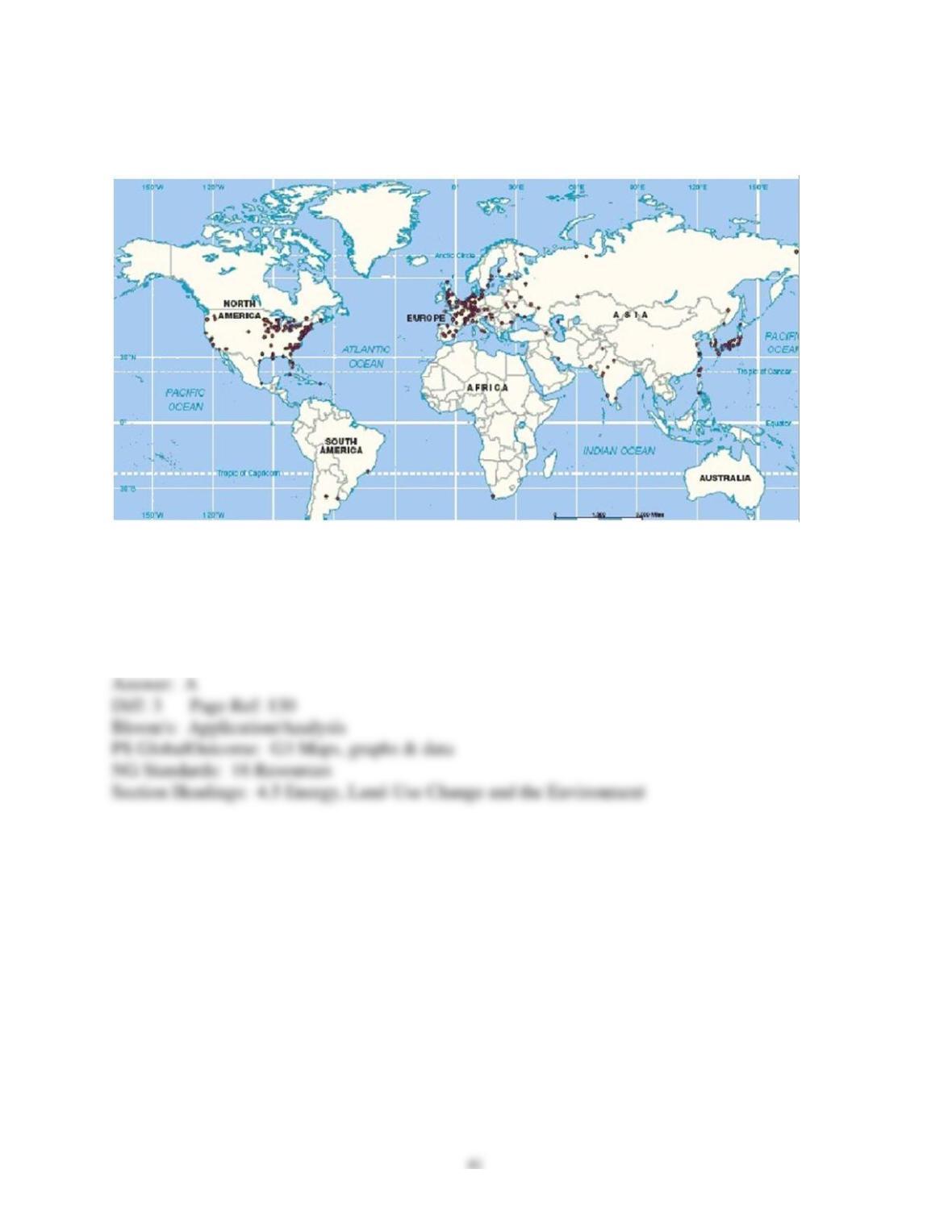
1) The above map shows the world distribution of
A) nuclear reactors.
B) hydropower facilities.
C) wood-fired power plants.
D) natural gas fields.
E) oil refineries.