Chapter 04 – Pedigree Analysis in Human Genetics
True / False
1. Human traits are controlled only by the genetic material found in the 46 chromosomes.
a.
True
b.
False
False
genes.
2. Phenotypic variation can occur in traits controlled by the same allele.
a.
True
b.
False
True
analysis.
3. A pedigree is always able to provide enough information to rule out all but one possible pattern of inheritance.
a.
True
b.
False
False
4. The frequency of heterozygotes for cystic fibrosis shows ethnic variations.
a.
True
b.
False
True
symptoms.
5. Duchenne muscular dystrophy and Becker’s muscular dystrophy are caused by different mutations in the same X-linked
gene.
a.
True
b.
False
True
6. Abraham Lincoln’s son, Robert, showed no signs of Marfan syndrome.
a.
True
b.
False
True
7. Most of those affected with an autosomal dominant genetic disorder are homozygous for that trait.
a.
True
b.
False
False
8. A blood test cannot determine if a person is a carrier of Tay-Sachs disease because the mutant allele is undetectable.
a.
True
b.
False
False
analysis.
9. Males never give an X chromosome to any of their sons.
a.
True
b.
False
True
10. If a pedigree analysis suggests that an autosomal or X-linked inheritance pattern is equally likely, then additional
genetic testing is needed to identify the pattern of inheritance.
a.
True
b.
False
True
Chapter 04 – Pedigree Analysis in Human Genetics
Multiple Choice
11. The chance of a child having albinism when both of his parents are heterozygous for the disorder is ____ percent.
a.
0
b.
25
c.
33
d.
50
e.
75
b
Bloom’s: Understand
4-3 Autosomal Recessive Traits
inheritance.
12. Almost all cases of cystic fibrosis, a(n) ____ genetic disorder, are the result of mating between two unaffected parents.
a.
mitochondrial
b.
autosomal dominant
c.
autosomal recessive
d.
X-linked dominant
e.
X-linked recessive
c
Bloom’s: Understand
4-3 Autosomal Recessive Traits
symptoms.
13. In autosomal dominant inheritance, ____.
a.
the trait often skips generations
b.
about one-fourth of the progeny in a pedigree will show the trait
c.
two affected individuals may have unaffected children
d.
males are more affected than females
e.
the aa phenotype will be affected
c
Bloom’s: Understand
4-4 Autosomal Dominant Traits
similar conditions.
14. If a man expresses an X-linked recessive trait, ____.
a.
all of his brothers will also express it
b.
his father transmitted the trait to him
4-2 Pedigree Analysis Is a Basic Method in Human Genetics
objectives and limitations of pedigree analysis.
Chapter 04 – Pedigree Analysis in Human Genetics
c.
his father carried the trait
d.
all of his sisters will also express it
e.
his mother was heterozygous or homozygous for the trait
e
Bloom’s: Understand
4-5 Sex-Linked Inheritance Involves Genes on the X and Y Chromosomes
dominant and X-linked recessive inheritance.
15. Y-linked traits are ____.
a.
known as homozygous traits
b.
known to skip generations in males
c.
carried only by males and transmitted only to males
d.
carried only by females, but are never expressed
e.
passed on to only 50% of female progeny
c
Bloom’s: Understand
4-6 Paternal Inheritance: Genes on the Y Chromosome
chromosome.
16. If two phenotypically normal parents have six children, and two daughters and two sons have the same genetic
disorder, that disorder is most likely to be ____.
a.
hemophilia
b.
cystic fibrosis
c.
Marfan syndrome
d.
muscular dystrophy
e.
color blindness
b
Bloom’s: Understand
4-3 Autosomal Recessive Traits
symptoms.
17. Camptodactyly causes ____.
a.
bent, immobile little fingers
b.
breathing difficulties
c.
loose joints
d.
muscle deterioration
e.
near-sightedness
a
Bloom’s: Remember
4-9 Many Factors Can Affect the Outcome of Pedigree Analysis
analyses of inheritance patterns in autosomal dominant traits.
Chapter 04 – Pedigree Analysis in Human Genetics
18. Approximately ____ Y-linked genes have been discovered.
a.
10
b.
20
c.
60
d.
80
e.
120
c
Bloom’s: Remember
4-6 Paternal Inheritance: Genes on the Y Chromosome
chromosome.
19. The gene responsible for Marfan syndrome encodes a protein associated with ____.
a.
heart muscle
b.
connective tissue
c.
fat tissue
d.
red blood cells
e.
nervous tissue
b
Bloom’s: Remember
4-4 Autosomal Dominant Traits
symptoms.
20. One goal of pedigree analysis is to determine ____.
a.
what diseases a family will display
b.
if two people are related
c.
gene loci
d.
whether a gene has a dominant or recessive pattern of inheritance
e.
what treatment a person should undergo
d
Bloom’s: Understand
4-2 Pedigree Analysis Is a Basic Method in Human Genetics
objectives and limitations of pedigree analysis.
21. If a pedigree of several generations shows only females affected by a particular trait, it cannot be a(n) ____ trait.
a.
autosomal recessive
b.
autosomal dominant
c.
Y-linked
d.
X-linked recessive
e.
X-linked dominant
c
Bloom’s: Understand
22. One characteristic of an autosomal dominant trait is that ____.
a.
50% of individuals with two affected parents will be affected
b.
if two affected individuals are homozygous, the risk of having an affected child is 1:4
c.
heterozygous fathers will always have affected daughters
d.
every affected individual has at least one affected parent
e.
mothers always pass the trait on to their sons
d
Bloom’s: Understand
4-4 Autosomal Dominant Traits
similar conditions.
23. The X and Y chromosomes ____.
a.
are responsible for autosomal recessive inheritance
b.
will lead to color-blindness in all carriers
c.
are found paired with all 22 autosomal chromosomes
d.
are responsible for albinism
e.
play major roles in determining the sex of an individual
e
Bloom’s: Understand
4-5 Sex-Linked Inheritance Involves Genes on the X and Y Chromosomes
HUHE.CUMM.16.4-5-1 – Compare and contrast sex–linked and autosomal inheritance.
24. Common recessive alleles present in a family can result in a pedigree that looks like ____ inheritance.
a.
X-linked recessive
b.
X-linked dominant
c.
autosomal dominant
d.
autosomal recessive
e.
Y-linked
c
Bloom’s: Understand
4-9 Many Factors Can Affect the Outcome of Pedigree Analysis
trait.
25. The phenotype of ____ does not develop until adulthood.
a.
muscular dystrophy
b.
Marfan syndrome
c.
cystic fibrosis
4-6 Paternal Inheritance: Genes on the Y Chromosome
chromosome.
Chapter 04 – Pedigree Analysis in Human Genetics
d.
hemophilia
e.
Huntington’s disease
e
Bloom’s: Remember
4-9 Many Factors Can Affect the Outcome of Pedigree Analysis
analysis.
26. Mitochondria are transmitted from mothers to ____.
a.
all of their daughters through the cytoplasm of the egg
b.
all of their sons through the cytoplasm of the egg
c.
all of their children through the cytoplasm of the egg
d.
50% of their children through the X chromosome
e.
50% of daughters through the X chromosome
c
Bloom’s: Understand
4-7 Non-Mendelian Inheritance: Maternal Mitochondrial Genes
HUHE.CUMM.16.4-7-1 – Describe the evolution and cellular functions of mitochondria.
27. The initial circumstance that led some to believe that Abraham Lincoln had Marfan syndrome was that ____ had the
disease.
a.
one of Lincoln’s descendants
b.
Lincoln’s sister
c.
a descendent of Lincoln’s great-great-grandfather
d.
DNA analysis on Lincoln’s skull determined that he
e.
Photographs of Lincoln provided physical evidence that he
c
Bloom’s: Remember
4-1 Pedigrees and Dead Presidents
similar conditions.
28. There are ____ basic patterns of Mendelian inheritance.
a.
three
b.
four
c.
five
d.
six
e.
seven
c
Bloom’s: Remember
4-2 Pedigree Analysis Is a Basic Method in Human Genetics
HUHE.CUMM.16.4-2-1 – Recognize the five basic patterns of Mendelian inheritance.
29. Hemophilia is characterized by ____.
Chapter 04 – Pedigree Analysis in Human Genetics
a.
defects in the mechanism of blood clotting
b.
an extremely low blood iron level
c.
jaundice of the eyes and skin
d.
muscular weakness and atrophy
e.
breathing difficulties
Bloom’s: Remember
4-5 Sex-Linked Inheritance Involves Genes on the X and Y Chromosomes
symptoms of each.
30. A trait shows ____ if the phenotype of that trait is present in less than 100% of those with the related genotype.
a.
autosomal recessive inheritance
b.
autosomal dominant inheritance
c.
incomplete dominance
d.
incomplete penetrance
e.
incomplete expressivity
d
Bloom’s: Understand
4-9 Many Factors Can Affect the Outcome of Pedigree Analysis
analyses of inheritance patterns in autosomal dominant traits.
31. The basic method of genetic analysis in humans requires a(n) ____________________ of several generations.
Bloom’s: Understand
4-2 Pedigree Analysis Is a Basic Method in Human Genetics
objectives and limitations of pedigree analysis.
32. Color blindness is an inherited disorder passed from ____________________ to child.
Bloom’s: Understand
4-5 Sex-Linked Inheritance Involves Genes on the X and Y Chromosomes
symptoms of each.
33. If both parents are homozygous for a disease-causing recessive gene, ____________________ of their children will be
affected.
Bloom’s: Understand
4-3 Autosomal Recessive Traits
34. The probability that a disease phenotype will appear when a disease-related genotype is present is called
____________________.
35. Mucus production that blocks ducts of certain glands and lung passages is a symptom of ____________________.
36. A mutation in the gene that codes for a connective tissue protein called fibrillin causes ____________________.
37. Genetic diseases transmitted only by a mother to both sons and daughters result from ____________________ genes.
38. When affected males produce all affected daughters and no affected sons, the pattern of inheritance is likely to be
____________________.
39. The most common forms of color blindness result in the inability to properly perceive the colors
____________________ and ____________________.
40. Mitochondrial gene defects most often affect the ____________________ and the ____________________.
41. Individuals with Marfan syndrome experience an eyesight problem called ____________________.
42. OMIM is an acronym that stands for ____________.
43. The variable phenotypic expression shown in camptodactyly results from the interaction of ____________________
and ________________factors.
44. If an autosomal ____________________ allele is very common in a population, there is a chance that it will enter the
pedigree from outside the family.
45. If a man expresses an X-linked recessive trait, his ____________________ was either homozygous or heterozygous
for the trait.
46. A marriage between two related individuals, such as first cousins, is called ____________________.
47. Czar Nicholas II of Russia and Queen Victoria’s granddaughter, Alix, were the parents of a son with the genetic
disorder affecting the mechanism of blood clotting called ____________________.
48. One goal of pedigree analysis is to discover whether the gene in question is located on an X or a Y chromosome or on
a(n) ____________________.
49. The phenotype in homozygous dominant individuals affected with an autosomal genetic disorder is often more severe
than the ____________________ phenotype.
50. Cytoplasmic organelles that convert energy from food molecules in ATP and are transmitted from mothers to all their
children through the cytoplasm of the egg are called ____________________.
51. Define the terms penetrance and expressivity and explain how they affect the expression of single gene traits.
52. Lisa has a rare genetic defect that causes acute sun-sensitivity. Her mother has the defect, but her father does not. All
of Lisa’s siblings, two brothers and a sister, are also affected. All four siblings are married, but none of their spouses has
the mutant gene. Draw a pedigree for this family. Identify and explain the most likely mode of transmission for this
disorder.
53. List and explain at least three patterns of inheritance of an autosomal dominant trait.
54. Summarize the arguments, both for and against, for the hypothesis that Abraham Lincoln had Marfan syndrome.
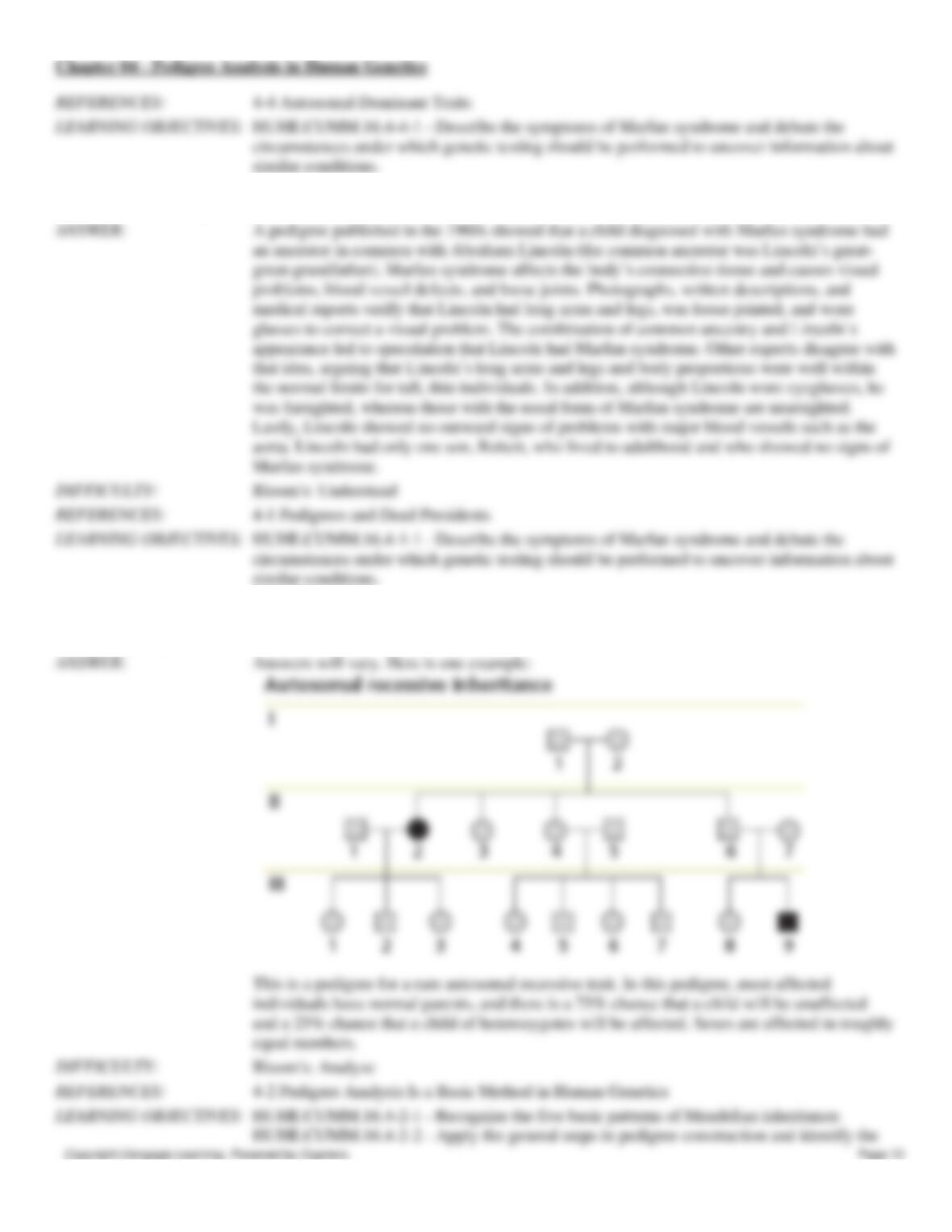
55. Choose one of the basic patterns of Mendelian inheritance and draw and explain a three-generation family pedigree
illustrating that pattern.
56. Summarize the usefulness of the online catalog of human genetic traits developed and maintained by researchers at
Johns Hopkins University.
57. Draw and label a pedigree of Noah and his parents based on the theory that he was affected with an autosomal
recessive genetic disorder. Explain your drawing and briefly describe the disorder that Noah might have had.
58. Define the term hemizygous and explain how the hemizygous condition relates to sex-linked inheritance.
59. Explain why color-blindness is much more common in males than in females.
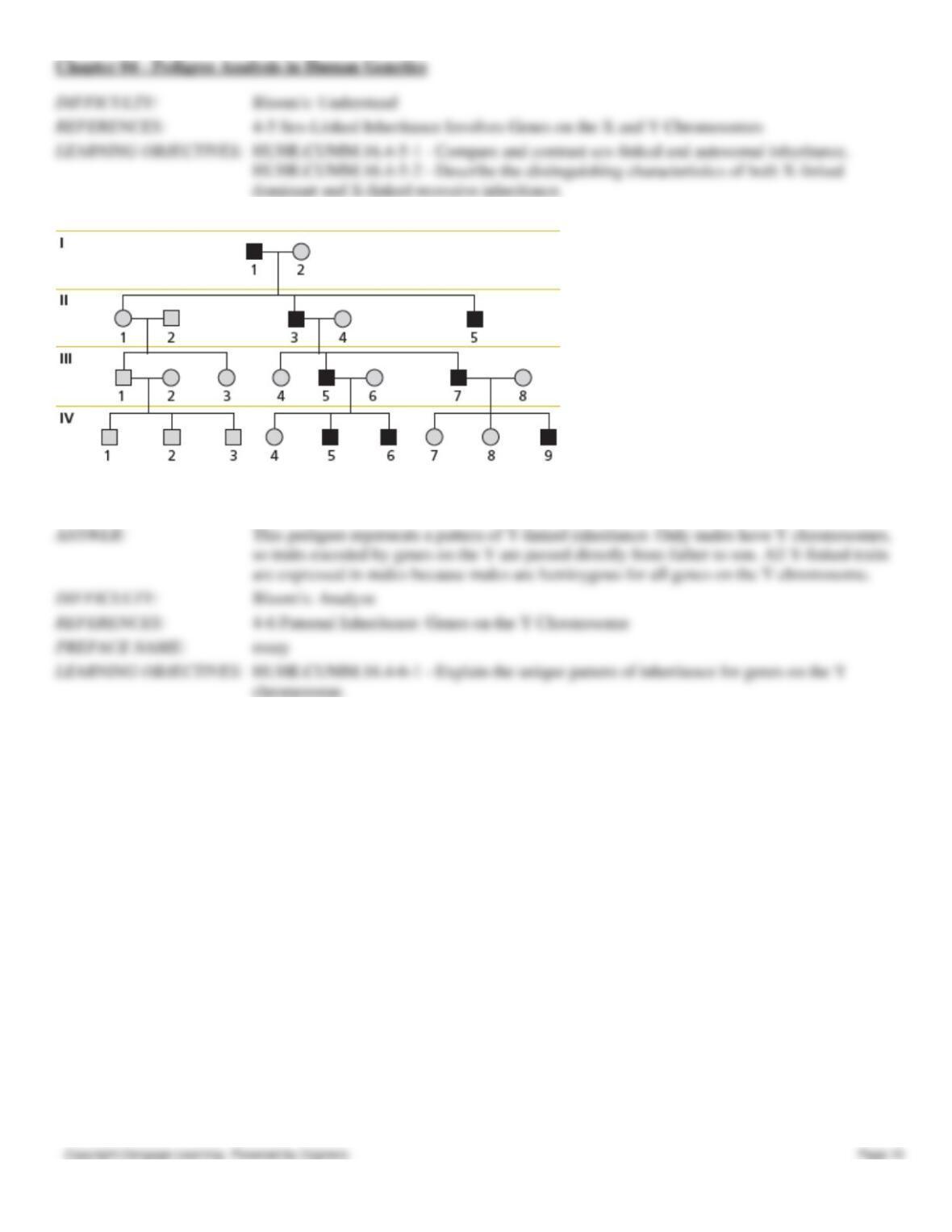
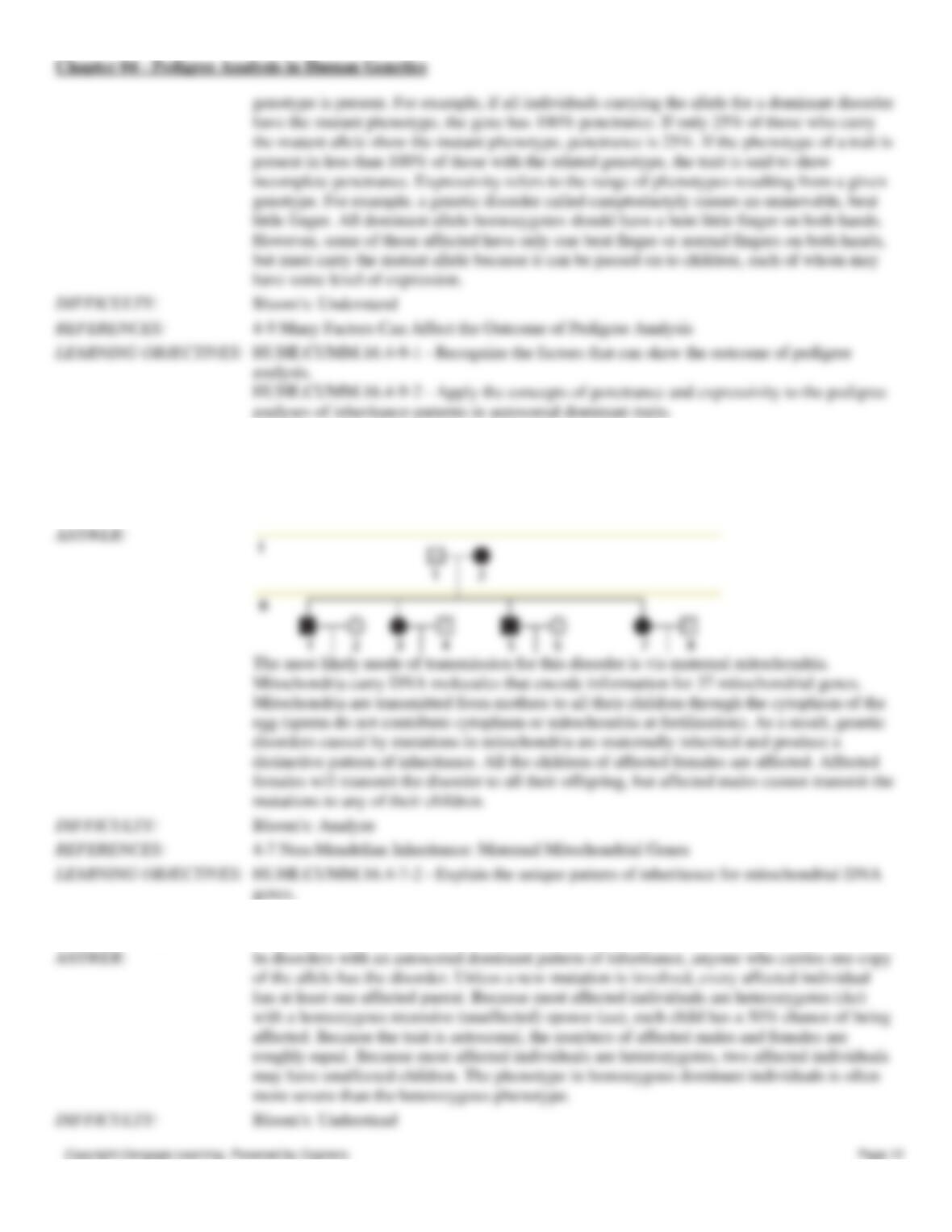
60. Identify the pattern of Mendelian inheritance represented in the pedigree above and explain how you made this
determination.