Cost Accounting: A Managerial Emphasis, 6e
Chapter 4 – Job Costing
Chapter 4 Job Costing
4.1 Identify and explain the elements of an effective job-costing system.
1) Cost assignment includes cost allocation for indirect costs and direct costs.
2) Cost pools are defined as groupings of individual cost items which can range from broad, company–
wide categories to very narrow categories.
3) A cost allocation base is only financial in nature, and is usually the cost driver of the particular costs
being measured.
4) A job costing system assigns costs to a distinct unit or set of units of a product or service.
5) A process costing system assigns costs to groups of similar units during a specified time period and
then computes the average unit cost.
6) Direct costs are allocated to the cost object using a cost-allocation method.
Cost Accounting: A Managerial Emphasis, 6e
Chapter 4 – Job Costing
7) The objective of allocating indirect costs is to measure the underlying usage of indirect resources by
jobs.
8) For each cost pool, the indirect cost rate equals the indirect cost pool divided by the cost allocation
base.
9) Raw materials that can be traced to a cost object are an example of an indirect cost.
10) Managers and accountants gather the information that goes into their cost systems through source
documents, which are the original records that support journal entries in an accounting system.
11) It is not a requirement to identify the indirect costs associated with each job when assigning costs to
individual jobs.
12) Process costing is a useful system for tracking the costs of building a house.
13) A job cost record (or job cost sheet) is a document where the costs are recorded and accumulated.
Cost Accounting: A Managerial Emphasis, 6e
Chapter 4 – Job Costing
14) Fixed and variable costs may be allocated to a cost object.
15) The cost driver of an indirect cost is often used as the cost allocation base.
16) In each period, job costing divides the total cost of producing an identical or similar product by the
total number of units produced to obtain a per-unit cost.
17) To smooth seasonal fluctuating levels of output, separate indirect-cost rates should be calculated for
each month.
18) Transferring costs from pools to jobs is called
A) cost allocation.
B) cost control.
C) cost pool.
D) cost factoring.
E) cost processing.
Cost Accounting: A Managerial Emphasis, 6e
Chapter 4 – Job Costing
19) A factor used to systematically link an indirect cost to a cost object is called
A) a cost allocation base.
B) a cost pool.
C) cost assignment.
D) a traceable cost.
E) a non-traceable cost.
20) Which of the following includes both traced direct costs and allocated indirect costs?
A) cost tracing
B) cost pools
C) assigned costs
D) cost allocation
E) cost recording
21) The process of assigning costs to a particular product or service is called
A) a cost allocation system.
B) a cost assigning system.
C) a job costing system.
D) a process costing system.
E) a cost recording system.
22) Which of the following would most likely be a direct cost in a manufacturing company?
A) supervision and engineering
B) utilities
C) repairs
D) utilities and repairs
E) raw materials
Cost Accounting: A Managerial Emphasis, 6e
Chapter 4 – Job Costing
23) A grouping of individual cost items is called a
A) cost objective.
B) costing group.
C) cost department.
D) cost pool.
E) cost base.
24) A materials requisition record and a labour time record are examples of which of the following?
A) normal cost schedule
B) job cost sheets
C) job cost records
D) cost object statements
E) source documents
25) Which of the following would be appropriately costed using a process costing system?
A) oil refining
B) a law firm managing individual legal cases
C) assembly of individual aircraft by Bombardier
D) movies produced by Lions Gate Entertainment
E) audit engagements performed by KPMG
26) The first step in job costing is to
A) identify the cost object.
B) identify the direct costs.
C) select the cost allocation base.
D) identify the indirect costs.
E) compute the rate per unit.
Cost Accounting: A Managerial Emphasis, 6e
Chapter 4 – Job Costing
27) Which of the following is one of the steps used in assigning manufacturing overhead costs to
individual jobs?
A) combine different cost objects into pools
B) assign direct costs to the cost object
C) identify the direct cost pools associated with the job
D) calculate the direct cost allocation rate for each direct cost pool
E) select the cost-allocation base to use in allocating indirect costs to the cost object
28) Managers and accountants collect most of the cost information that goes into their information
systems through
A) an information databank.
B) computer programs.
C) source documents.
D) time surveys.
E) interviewing workers.
29) Assigning direct costs to a cost object is called
A) cost allocation.
B) job costing.
C) cost pooling.
D) process costing.
E) cost tracing.
30) In a costing system
A) cost tracing allocates indirect costs.
B) cost allocation assigns direct costs.
C) there may never be more than one indirect cost pool.
D) a cost object should be a product and not a department or a geographic territory.
E) a cost allocation base can be either financial or nonfinancial.
Cost Accounting: A Managerial Emphasis, 6e
Chapter 4 – Job Costing
31) Many large companies which have multiple production methods and processes have hybrid costing
systems that are
A) mostly job-costing.
B) combined using actual and normal costing.
C) mostly process costing.
D) a mix of job-costing and process costing.
E) combined using joint allocation costing.
32) Place the following steps in the order suggested by the seven steps used to assign costs to individual
jobs:
A. Select the cost allocation base
B. Compute the indirect cost allocation rate
C. Compute the total cost of the job
D. Identify the direct costs of the job
E. Compute the indirect cost assigned to the job
F. Identify and add the indirect costs into one cost pool
G. Identify the distinct job that is the cost object
A) G, F, A, B, E, D, C
B) G, D, A, B, F, E, C
C) G, A, F, B, E, D, C
D) G, A, D, F, B, E, C
E) G, D, A, F, B, E, C
33) Which of the following is not possible to use as a cost allocation base for manufacturing overhead?
A) direct labour dollars
B) direct labour hours
C) direct material dollars
D) direct labour hours or dollars
E) indirect labour hours
Cost Accounting: A Managerial Emphasis, 6e
Chapter 4 – Job Costing
34) The General Ledger account that combines the separate job cost records is called the ________
account.
A) Cost of Goods Sold
B) Finished Goods Control
C) Manufacturing Overhead Allocated
D) Manufacturing Overhead Control
E) Work-in-Process Control
35) The new manager of the insurance division does not understand how the company can have so many
overhead rates for assigning costs to the activities of the company’s life insurance underwriters. There is
one rate schedule for average assignable costs when agents write standard policies. There is another rate
schedule which the agents must complete when they write special policies, and these policies are costed
out differently from those that are categorized as standard policies.
Required:
Why might the company have different costing systems with different overhead rates for the standard
and specialized policies?
Cost Accounting: A Managerial Emphasis, 6e
Chapter 4 – Job Costing
36) For each item below indicate the source documents that would most likely authorize the journal entry
in a job-costing system.
Required:
a. direct materials purchased
b. direct materials used
c. direct manufacturing labour
d. indirect manufacturing labour
e. finished goods control
f. cost of goods sold
37) Describe job-costing and process-costing systems. Explain when it would be appropriate to use each.
38) In a job-costing system, explain why it is necessary to apply indirect costs to production through the
use of a manufacturing overhead cost allocation rate.
Cost Accounting: A Managerial Emphasis, 6e
Chapter 4 – Job Costing
4.2 Apply the decision framework in a seven-step method to assign total actual costs to
a distinct service.
1) Based on the following data, calculate the actual indirect cost rate, using direct labour hours as the
allocation base.
Actual total indirect costs
$1,152,000
Budgeted total indirect costs
1,216,000
Actual direct labour costs
3,200,000
Actual direct labour rate
$50 per hour
Actual machine hours
3,000 hours
A) $384.00
B) $7.68
C) $18.00
D) $19.00
E) $138.89
2) A law office employs full-time attorneys and five paraprofessionals. For 2012 indirect costs were
budgeted at $225,000, but actually amounted to $350,000.
Direct and indirect costs are applied on a professional labour–hour basis which includes both attorney
and paraprofessional hours. Total budgeted labour-hours were 25,000; however, actual labour-hours
were 30,000.
What is the actual indirect-cost rate, if a client used 5,000 professional labour-hours?
A) $5.00
B) $9.00
C) $7.50
D) $14.00
E) $11.67
Cost Accounting: A Managerial Emphasis, 6e
Chapter 4 – Job Costing
3) Professional labour costs in a CGA firm are traced directly to the cost object of a given job. Generally,
other indirect operating costs are
A) first traced to a cost pool and then allocated to the final cost object, the given job.
B) allocated directly to the final cost object, the given job.
C) allocated to an intermediate cost object, assigned to a given auditor, and then traced to a cost pool
which is then allocated to the final cost object, the given job.
D) costs which are assigned to a given job using indirect cost tracing.
E) treated the same as direct costs in a service firm.
4) Fixed costs remain constant at $200,000 per month. During high-output months variable costs are
$160,000, and during low-output months variable costs are $40,000. What are the respective high and low
indirect cost allocation rates if professional labour-hours are 8,000 for high-output months and 2,000 for
low-output months?
A) $45.00 per hour; $120.00 per hour
B) $45.00 per hour; $45.00 per hour
C) $25.00 per hour; $20.00 per hour
D) $56.20 per hour; $120.00 per hour
E) $25.00 per hour; $100.00 per hour
5) Normandeau Company’s actual indirect cost pool amounted to $1,400,000 and the direct labour pool
was $5,400,000. Overhead is allocated on the basis of direct labour hours. Actual and budgeted direct
labour hours were 25,000 and 30,000 for the period. What is the manufacturing overhead cost allocation
rate using actual direct labour hours as the cost allocation base?
A) $46.67
B) $272.00
C) $75.00
D) $226.67
E) $56.00
Cost Accounting: A Managerial Emphasis, 6e
Chapter 4 – Job Costing
6) A company currently has 30 full-time employees. Actual time for each employee was as follows:
billable time for clients
2,000 hours
vacation time
200 hours
professional development
175 hours
nonbillable time
0 hours
sick leave
125 hours
Consumer demand for the company’s services is at 100 percent of time available. Each employee receives
a salary of $75,000 per year.
What is the total actual indirect cost allocation rate if management believes that clients should be charged
for the employees’ benefits?
A) $10.00
B) $6.67
C) $30.00
D) $6.00
E) $37.50
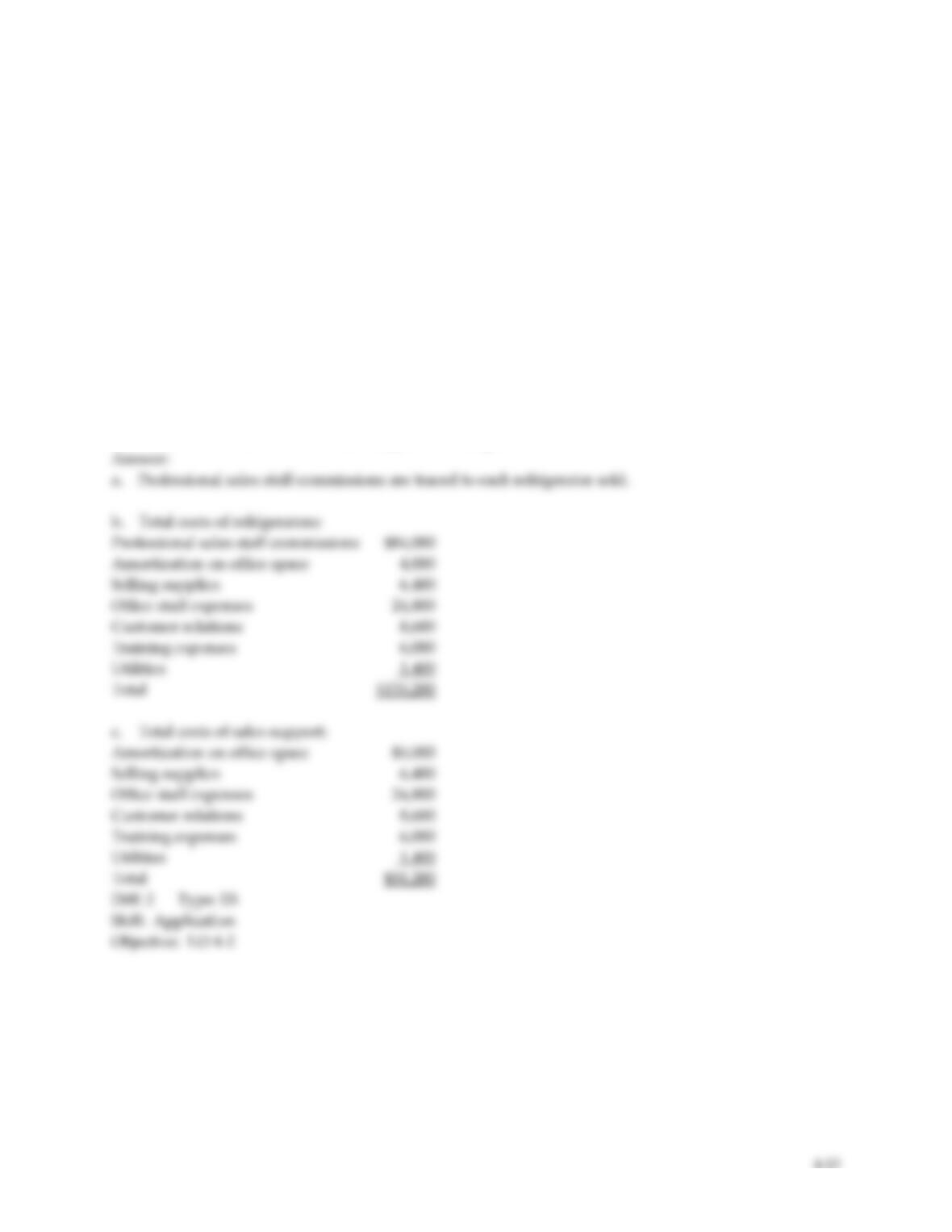
7) John wants to identify the total cost for computing the corporate tax return he prepared for his client.
Labour is the only direct cost at $50 per hour. Indirect costs are $60 per labour hour. What is the total
direct cost, indirect cost, and job cost, respectively, if 15 hours are spent preparing the tax return?
A) $700, $850, $1,550
B) $750, $800, $1,550
C) $750, $900, $1,650
D) $800, $640, $1,440
E) $800, $900, $1,440
Cost Accounting: A Managerial Emphasis, 6e
Chapter 4 – Job Costing
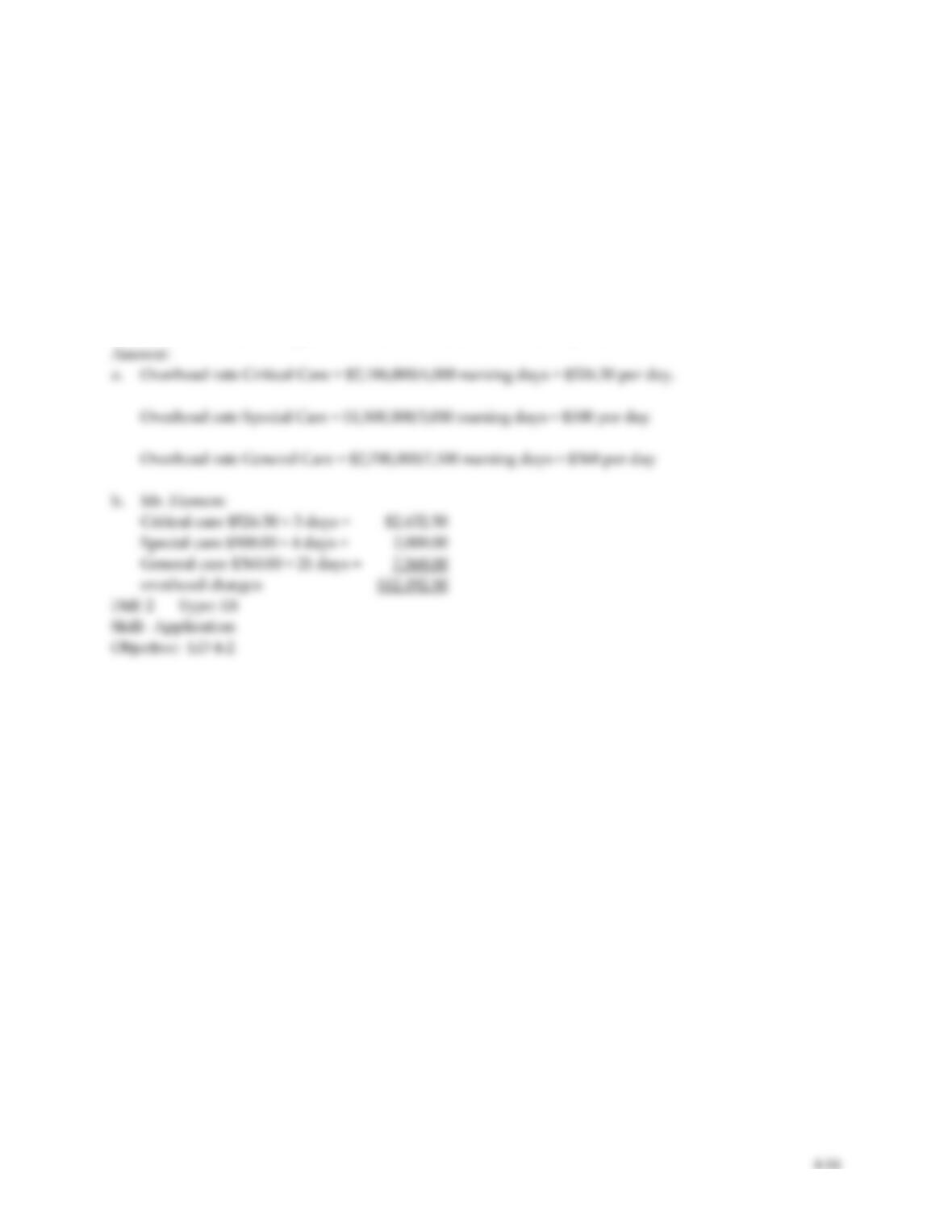
8) Larry’s Appliance Shop operates retail stores that sell appliances. The cost objects are the individual
sales of a given type of appliance and sales support. For refrigerators in July, the following costs were
recorded:
Professional sales staff commissions $84,000
Amortization on office space 4,000
Selling supplies 6,400
Office staff expenses 24,800
Customer relations 8,600
Training expenses 6,000
Utilities 1,400
Required:
a. Which of the costs will be subject to direct cost tracing?
b. What is the total cost for refrigerators?
c. What is the total cost of the Sales Support for refrigerators?
Cost Accounting: A Managerial Emphasis, 6e
Chapter 4 – Job Costing
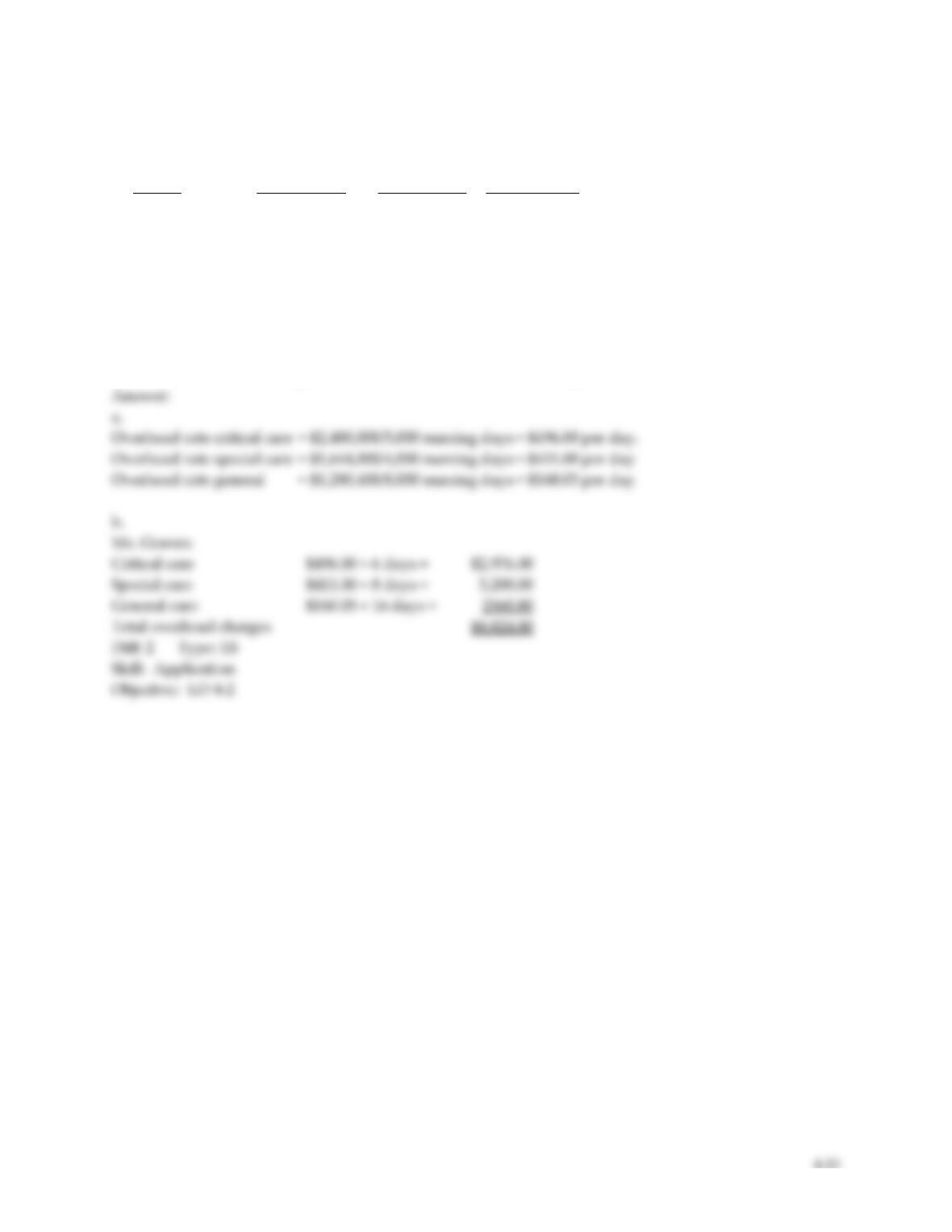
9) General Hospital uses a job-costing system for all patients. In March the Critical Care and Special Care
facilities had cost allocation bases of 4,000 nursing days and 3,000 nursing days, respectively. The nursing
care charges for each department for the month were $2,106,000 and $1,500,000, respectively. The General
Care area had costs of $2,700,000 and 7,500 nursing days for the month.
Patient Jim Hansen spent 5 days in Critical Care, 4 days in Special Care and 21 days in General Care
during March.
Required:
a. Determine the cost allocation rate for each department.
b. What are the total charges to Mr. Hansen if he was in the facility the entire month of March?
Cost Accounting: A Managerial Emphasis, 6e
Chapter 4 – Job Costing
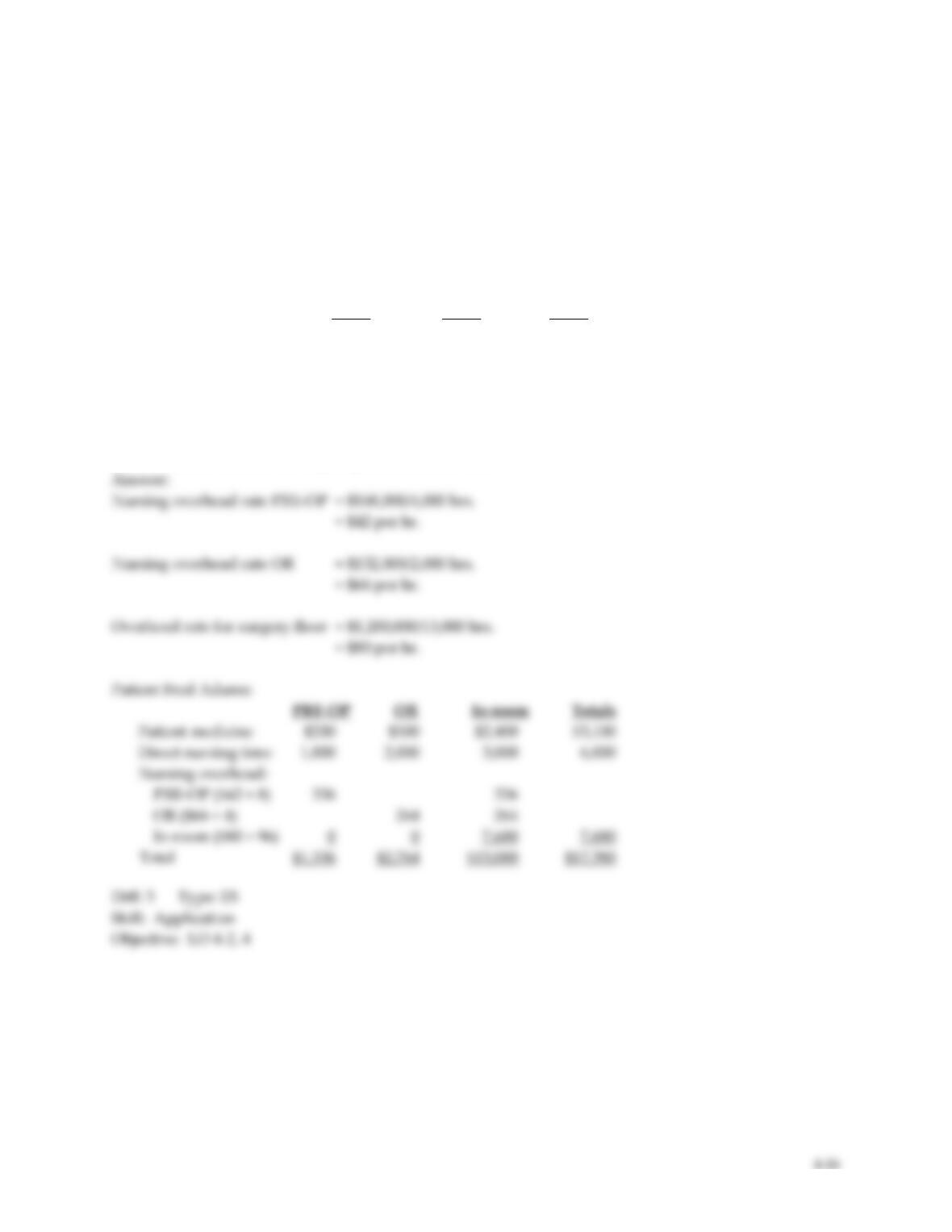
10) Sedgewick County Hospital uses a job-costing system for all patients. In June, the nursing care
charges for each department and the cost allocation bases of nursing days are as follows:
June Critical Care Special Care General Care
Nursing costs $2,480,000 $1,644,000 $1,280,400
Nursing days 5,000 4,000 8,000
Patient Ms. Graves spent six days in Critical Care and eight days in Special Care during June. The
remainder of the 30-day month was spent in the General Care area.
Required:
a. Determine the budgeted overhead rate for each department.
b. What are the total charges to Ms. Graves if she was in the facility the entire month?
Cost Accounting: A Managerial Emphasis, 6e
Chapter 4 – Job Costing
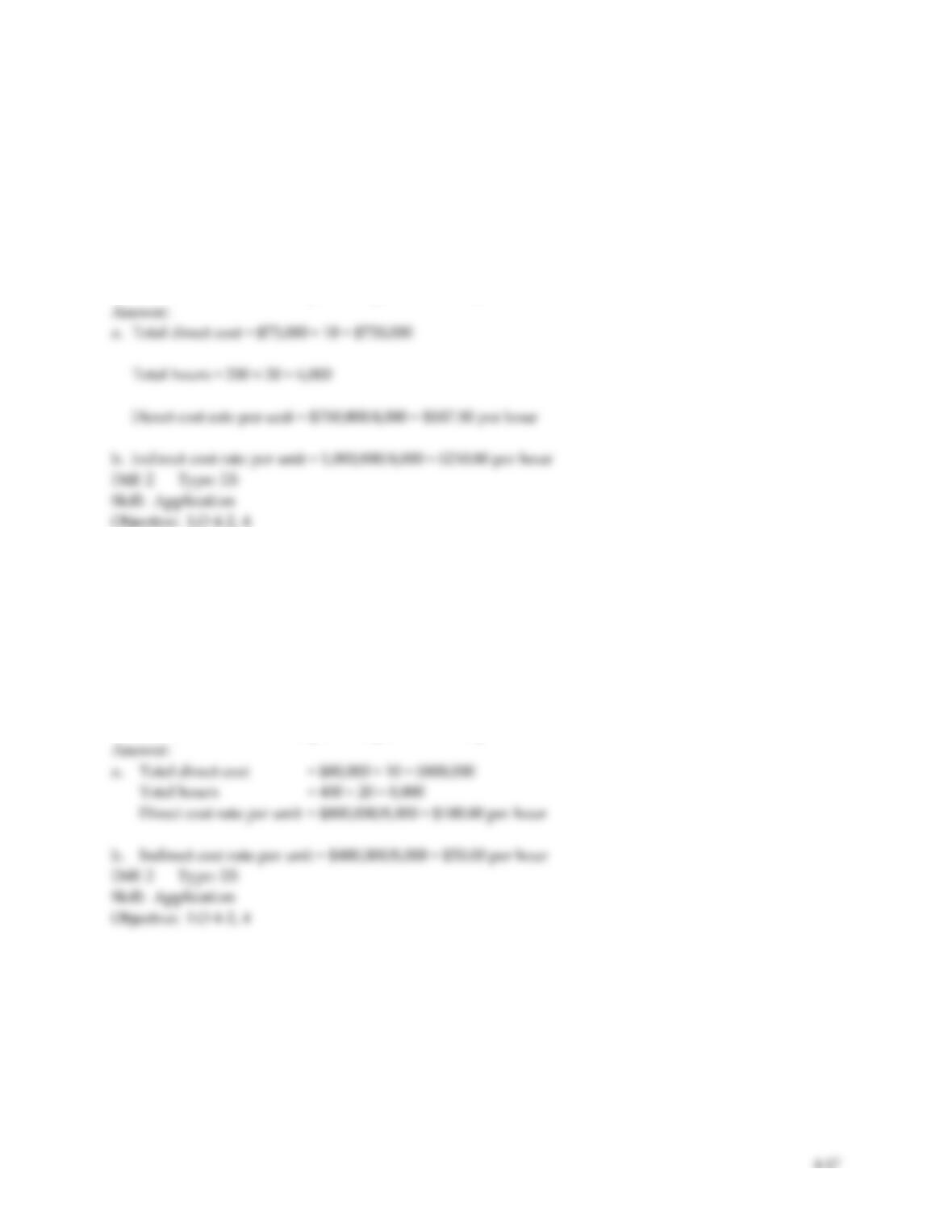
11) Cowley County Hospital uses a job-costing system for all patients who have surgery. In March, the
Pre-Operating Room (PRE-OP) and Operating Room (OR) had budgeted allocation bases of 4,000 nursing
hours and 2,000 nursing hours, respectively. The budgeted nursing overhead costs for each department
for the month were $168,000 and $132,000, respectively. The hospital floor for surgery patients had
budgeted overhead costs of $1,200,000 and 15,000 nursing hours for the month. For patient Fred Adams,
actual hours incurred were eight and four hours, respectively, in the PRE–OP and OR rooms. He was in
the hospital for 4 days (96 hours). Other costs related to Adams were:
PRE-OP OR In-room
Costs Costs Costs
Patient medicine $200 $500 $2,400
Direct nursing time $1,000 $2,000 $3,000
The hospital uses a budgeted overhead rate for applying overhead to patient stays.
Required:
What is the total cost of the stay of patient Fred Adams?
Cost Accounting: A Managerial Emphasis, 6e
Chapter 4 – Job Costing
12) A local attorney employs ten full-time professionals. The budgeted compensation per employee is
$75,000. The maximum billable hours for each client are 200. Clients always receive their full amount of
time. All professional labour costs are included in a single direct cost category and are traced to jobs on a
per-hour basis. Any other costs are included in a single indirect cost pool, allocated according to
professional labour-hours. Budgeted indirect costs for the year are $1,000,000 and the firm had 20 clients.
Required:
a. What is the direct labour budgeted cost rate per hour?
b. What is the indirect cost pool budgeted cost rate per hour?
13) A local attorney employs ten full-time professionals. The budgeted compensation per employee is
$80,000. The maximum billable hours for each client are 400. Clients always receive their full amount of
time. All professional labour costs are included in a single direct cost category and are traced to jobs on a
per-hour basis. Any other costs are included in a single indirect cost pool, allocated according to
professional labour-hours. Budgeted indirect costs for the year are $400,000 and the firm had 20 clients.
Required:
a. What is the direct labour budgeted cost rate per hour?
b. What is the indirect cost pool budgeted cost rate per hour?
Cost Accounting: A Managerial Emphasis, 6e
Chapter 4 – Job Costing
14) A local engineering firm is bidding on a design project for a new client. The total budgeted direct
labour costs for the firm are $800,000. The total budgeted indirect costs are $1,200,000. It is estimated that
there are 16,000 billable hours in total.
Required:
a. What is the budgeted direct labour cost rate?
b. What is the budgeted indirect cost allocation rate assuming direct labour cost is the cost allocation
base?
c. What should be the engineering firm bid on the project if the direct labour hours are estimated at 500
hours?
4.3 Apply the decision framework in a seven-step method to assign total actual costs to
a distinct product.
1) The following data were taken from the records of a manufacturing company. The company has been
calculating the actual indirect cost allocation rate using direct labour hours as the allocation base.
Calculate the rate using machine hours as the allocation base.
Actual total indirect costs
$1,152,000
Budgeted total indirect costs
$1,216,000
Actual direct labour costs
$3,200,000
Actual direct labour rate
$50 per hour
Actual machine hours
300,000 hours
# of employees
32
A) $60.67
B) $10.67
C) $7.89
D) $4.05
E) $3.84
Cost Accounting: A Managerial Emphasis, 6e
Chapter 4 – Job Costing
2) Last week Job # WPP 298 was charged: DM of $4,606; DL of $1,579; and, MOH of $3,960 based on
machine hours. The materials requisition record for this week showed an additional purchase of 10
brackets at a unit cost of $16; the direct labour costs were the same as the first week; and, the total
machine hours for both weeks are now 140 hours at $45 per machine hour. Calculate the revised total job
cost. (direct materials + direct labour + manufacturing overhead).
A) $10,145
B) $11,884
C) $12,645
D) $18,184
E) $14,224
3) Camden Company gathered the following information for the year ended December 31:
Direct labour cost incurred for the year
$240,000
Manufacturing overhead costs
$180,000
Beginning finished goods inventory
$200,000
Work-in-process inventory, Dec. 31
$55,000
Finished goods inventory, Dec. 31
$67,500
Cost of goods sold
$141,000
Estimated direct labour hours
300,000
Clyde Company uses a job costing system.
What is the indirect cost allocation rate for the year be using direct labour hours as the allocation base?
A) $1.11 per direct labour hour
B) $0.90 per direct labour hour
C) $1.20 per direct labour hour
D) $0.60 per direct labour hour
E) $0.47 per direct labour hour
Cost Accounting: A Managerial Emphasis, 6e
Chapter 4 – Job Costing
4) ZamTech Moldings allocates manufacturing overhead to jobs based on machine hours. The company
has the following estimated costs for the upcoming year:
Direct materials used
$25,000
Direct labour costs
$62,000
Salary of factory supervisor
$41,000
Advertising expense
$33,000
Heating and lighting costs for factory
$21,000
Depreciation on factory equipment
$9,000
Sales commissions
$8,000
The company estimates that 1,800 direct labour hours will be worked in the upcoming year, while 2,000
machine hours will be used during the year. The predetermined indirect allocation rate per machine hour
is closest to
A) $56.
B) $36.
C) $100.
D) $15.
E) $40
5) Copley Enterprises manufactures digital video equipment. For each unit $1,475 of direct material is
used and there is $1,500 of direct manufacturing labour at $30 per hour. Manufacturing overhead is
applied at $35 per direct manufacturing labour hour. Calculate the cost of each unit.
A) $2,975
B) $4,025
C) $1,750
D) $3,150
E) $4,725