Chapter 4
DESIGNING INSTRUCTIONAL PROGRAMS
OUTLINE
I. Curriculum
A. Definition
B. Choosing a Curriculum
C. Considering Children with Special Needs
D. Philosophy of This Text
II. General Instructional Strategies
A. Motivation
B. Applied Behavior Analysis
III. Play as an Important Teaching Context
IV. Arranging the Physical Environment to Maximize Learning
A. The Physical Environment
B. Grouping Children
C. Sound and Lighting
D. Visual Materials
E. Special Considerations for Infants and Toddlers
V. Creating a Positive Social-Emotional Environment
A. Anticipate Children’s Questions
VI. Designing the Teaching-Learning Environment: Universal Design for Learning
VII. Embedded Teaching and Learning Opportunities
VIII. Providing a Variety of Activities to Accomplish Any One Outcome or Objective
A. Terminal Objective
B. Individualized (En Route) Objectives

C. The Activity: Bathing a Doll
D. Evaluating the Effectiveness of Each Activity
E. Using an Activity to Achieve More Than One Objective
IX. Summary
X. Discussion Topics and Activities
ESSENTIAL CONCEPTS AND VOCABULARY
Antecedents
Applied Behavior analysis
Behavior modification
Consequences
Contingencies
Curriculum
Ecologically relevant
Effectance motivation
Positive reinforcement
Progressive matching
Reinforcers
Scaffolding
Social-transactional approach
Successive approximations
Universal design for learning
Zone of proximal development (ZPD)
Course Assignment
Generic Teaching Strategy Rubric Grading Sheet
Generic Teaching Strategies Chart (three pages)
Generic Teaching Strategies Rubric Grading Sheet
Assignment directions:
Students will need to observe generic teaching strategies in a preschool special day class. Expect to observe for at
least 2 hours and arrange interview time with the teacher after the observation for clarification, if necessary. Before
the observation, write the definition of each teaching strategy on your generic teaching strategies chart based on
your textbook. During the observation, use your chart to record examples of each teaching strategy. Write a 2–3
page reflection and turn in your completed generic teaching strategies chart.
Reflective essay will consist of:
1. An introduction paragraph with a short description of the type of classroom, number of students, types of
disabilities, and number of adults. ______
2. Answers to the following questions:
a. Compare and discuss the strategies that were used. Which strategies were used the most? The
least? Or, not at all? Critique why you think the teacher used these specific strategies. ______
3. Reflect by drawing conclusions and bringing it all together: How is my thinking reinforced, altered or
transformed as a result of this assignment? What new perspective or ideas have I gained? What questions
are raised for me? How might I apply generic teaching strategies in my future as a teacher? ______
Rubric:
Exceeds Standards
Meet Standards
Below Standard
___Essay shows a deep level of
thinking and reflection
___Essay is sometimes thoughtful
___ Essay is mostly “surface level”
and lacks thoughtfulness
___Based on class content and
readings
___ Some evidence tied to class
content and readings.
___ Poorly tied to class content and
readings.
___ Thorough introduction is
present
___ Most of the introduction
components are present
___ A few of the introduction
components are present
___ Thoroughly discussed all 4
questions about strategies
___ Discussed most of the
questions about strategies
___ Addresses some of the
questions about strategies.
___ Most definitions of strategies
are correct and based on readings
___ Some definitions of strategies
are correct and based on readings
___Definitions of strategies are
incorrect and not based on readings
___ Provided specific examples
most of the time
___ Provided specific examples
some of the time
___ Majority of examples are vague
___ Thorough conclusion by
discussing all the questions above
___ Adequate conclusion and
discusses most questions above
___ Conclusion discusses only a
few of the questions above
development as a teacher
evident in the conclusion
conclusion
A
Exceeds standards
B
Meet standards
C
Majority meet standards some below standard
D
A few meet standards some below standards
F
Below standard
Scaffolding
Planned
Transitions
Consistent
Routine
Repetition
Teaching
Strategy
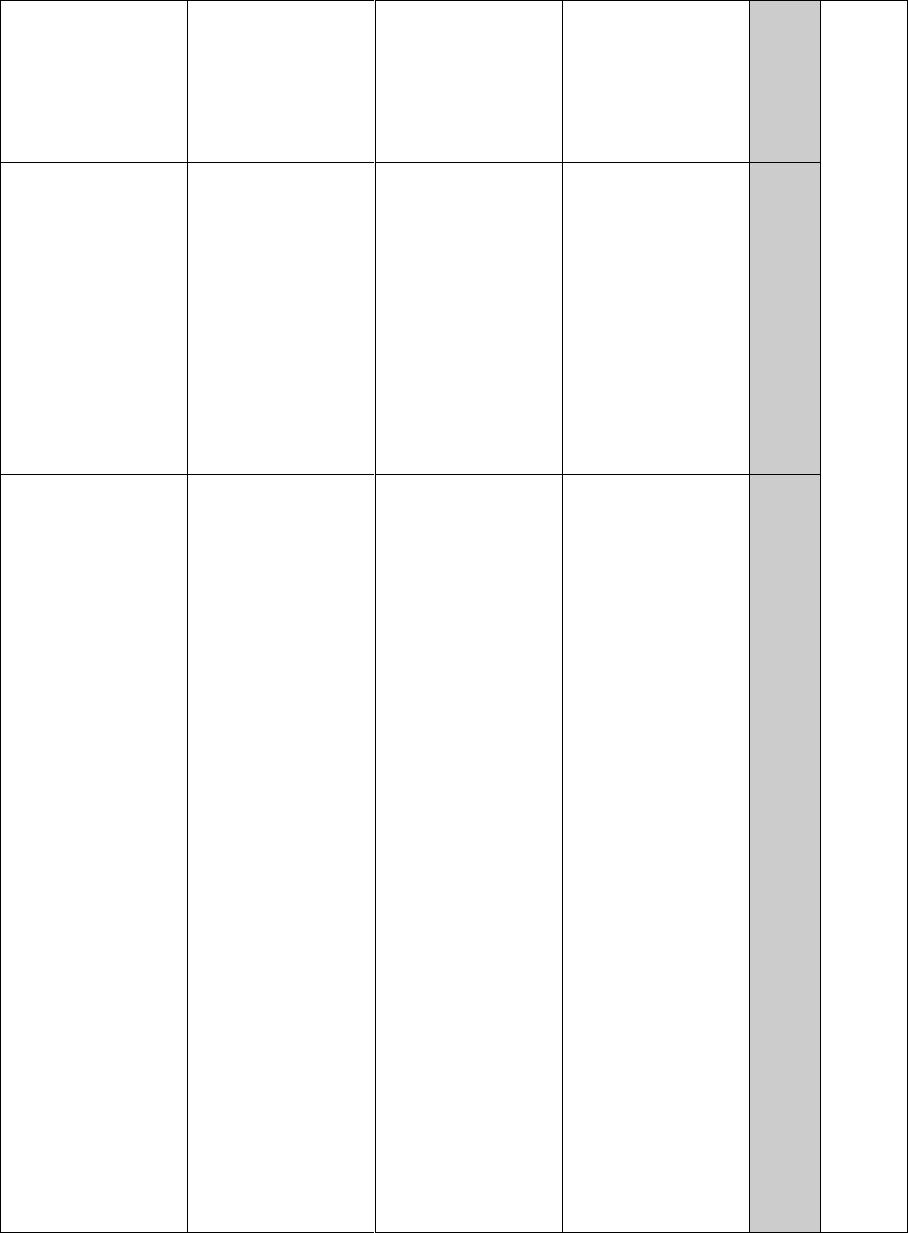
GENERIC TEACHING STRATEGIES CHART
NAME:______________________________________________
Definition
Examples

Applied
Behavior
Analysis
(positive
reinforcement
and successful
approximations)
Motivation:
External
Internal
Use of High
Preference
Items
Getting
Children’s
Attention
Teaching
Strategy
Definition
Examples

Establish Turn
Taking
Progressive
Matching
Repeat Keywords
and Phrases
Use Labels and
Specific
Descriptors
Follow the Child’s
Lead
Adult-Child
Communication
Strategy

CHAPTER 4
Multiple Choice
1. Early childhood educators need to _________________ to motivate children with disabilities
a. Follow the curriculum guide
b. Identify high-preference people, objects, and activities
c. Establish turn taking
d. Put materials at eye level
2. The classic theory of effectance motivation is that
a. Motivators are externally provided
b. Positive reinforcers increase the strength of certain behaviors
c. The child is reinforced by contingencies
d. All children have an internal drive toward achievement
3. Providing graduated cues to assist a child through problem solving was described by Bruner
as
a. Zone of proximal development
b. Reinforcement
c. Scaffolding
d. Successive approximations
4. Which adult-child communication strategy may need to be taught first before the other
strategies can be used effectively?
a. Mapping
b. Turn-taking
c. Progressive matching
d. Redundancy
5. “When the teacher points to any of the eight primary colors, and says, ‘What is this color?’
Audrey will name the color correctly 80% of the time. “All 8 colors must be checked” is a (n)
a. En-route behavior
b. Individual objective
c. Positive reinforcer
d. Terminal objective
6. Anything that happens before a behavior is called
a. Consequences
b. Contingencies
c. Antecedents
d. Reinforcers

7. Anything that happens after a behavior is called
a. Consequences
b. Contingencies
c. Antecedents
d. Reinforcers
8. Standing next to a child and reminding him that he is waiting very patiently for his turn in
order to avoid his typical behavior of a tantrum is an example of
a. Consequences
b. Contingencies
c. Antecedents
d. Reinforcers
9. Which of the following is probably not helpful when communicating with young children who
have disabilities?
a. Use progressive matching
b. Talk about what the child is interested in
c. Be specific and label words
d. Continually introduce many new words throughout the day
10. __________ is starting with whatever the child can do and gradually encouraging him/her
that move closer and closer to the correct behavior
a. Equivalent practice
b. Embedded learning opportunities
c. Progressive matching
d. Successful approximations
True-False
1. The content of curriculum must be ecologically relevant.
2. The best intervention strategies evolve around activities within the context of daily living.
3. Good behavior modification relies primarily on punishers.
4. Another word for a positive reinforcer is antecedent.
5. Play is different from other activities in the classroom because it has no intended outcome or
goal.
6. Play is probably the single most important concept in early childhood special education.
7. Another expression for terminal objective is “en–route behavior.”

8. Constantly repeating key phrases is a great way to help children with special needs learn
language.
9. Vygotsky described zone of proximal development as providing just the right amount of help
and support that a child needs to finish the task independently.
10. The main focus of positive behavioral support is on prevention of undesirable behaviors.
Short Answer
1. Why is the primary method of instruction rooted in the quality of the social interaction and
responsive communication between children and teachers?
2. Describe how you would go about conducting a high-preference inventory.
3. Explain what is meant by mediated learning events.
4. What is “equivalent practice” in a teacher’s scheduled plan for the day?
5. What types of skills do children with special needs learns when there is a consistent daily
schedule in their inclusive classroom?
6. Daily living routines such as dressing, bath time and eating can be stressful for families of
children with disabilities. Briefly give some advice on how parents can provide a consistent
routine for one of the activities mentioned.
7. Explain the statement, “one of the most powerful keys to learning his motivation,” as it
relates to children with disabilities and special needs.
8. Explain what a teacher can do to avoid prompt dependence in young children with
disabilities.
9. Given example of successive approximations.
10. What is the difference between antecedents, consequences, and contingencies?
Comprehensive Essay
1. Imagine that you are speaking to a group of parents about adult-child communication
strategies. What advice would you give them to assist their children’s language learning?
2. Play routines can be designed to teach language concepts and social skills. Give an example
of a play routine in a classroom.

3. Draw a picture your own inclusive classroom for children ages 3–5 of varying abilities and
explain your rationale for placement of learning areas.
4. Write a terminal objective and at least three individual objectives for “to learn to sort by
sizes.”
5. You will be setting up an inclusion classroom for infants and toddlers. What special
considerations do you need to keep in mind while designing your learning environment?
6. Give examples of how you would use the 3 key Universal Design for Learning principles
when designing an inclusive program.
7. Discuss at least 3 different opportunities of where and when in the daily schedule you would
embed the goal of “will independently write first name.”
8. Transitions (lining up, waiting for snack, etc.) and cleanup times are rich opportunities for
learning but are frequently underutilized as opportunities to embed learning objectives.
Describe 3 behavioral objectives that can be embedded during transitions and 3 others for
cleanup times.
9. The way that a teacher talks to young children with disabilities can impact their cognitive and
language development. Give some examples of what strategies you would use to
communicate with a three-year-old child who is using one word sentences.
10. How would you use the zone of proximal development (ZPD) and scaffolding to teach a
child to string small beads?
Chapter 4 :