
114
CHAPTER 4, FORM F
COLLEGE ALGEBRA
NAME
DATE
1. Consider the function defined by
( )
23; 0f x x x= – ³
. Which of the 1. ____________
following represents the domain and the range of
( )
fx
?
a.
( ) ( )
, ; ,– ¥ ¥ – ¥ ¥
b.
( ]( )
, 3 ; ,– ¥ – – ¥ ¥
c.
[ ) [ )
3, ; 0,– ¥ ¥
d.
( ]( ]
, 3 ; 3,0– ¥ – –
2. If
( )
4f x x=-
, find
( )
1.fx
–
2. ____________
a.
24x+
b.
24x+
c.
24x–
d.
2
4x–
3. Solve
53 1
2.
16
x–=
3. ____________
a.
{ }
3–
b.
{ }
3
c.
1
3
ìü
ïï
ïï
íý
ïï
ïï
îþ
d.
1
–3
ìü
ïï
ïï
íý
ïï
ïï
îþ
Write in logarithmic form.
4.
2/5
32 4=
4. ____________
a.
32
2
log 4 5
=
b.
25
log 32 4=
c.
32
2
log 4
5=
d.
4
2
log 32 5
=
Write in exponential form.
5.
logxyz=
5. ____________
a.
y
xz=
b.
z
xy=
c.
x
zy=
d.
z
yx=
115
CHAPTER 4, FORM F
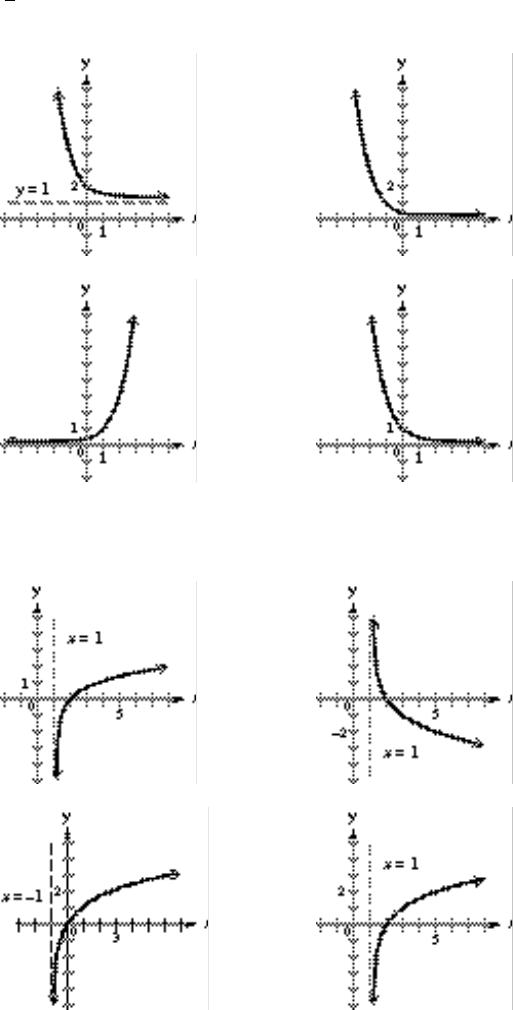
6.
1
1
3
x
y
+
æö
÷
ç
=÷
ç÷
ç
èø
6. ____________
a.
b.
c.
d.
7.
2
log ( –1)yx=
7. ____________
a.
b.
c.
d.

116
CHAPTER 4, FORM F
8. Use properties of logarithms to write the following as a sum, 8. ____________
difference, or product of logarithms.
3
7
log xz
y
a.
77
17
2
(3log )(log )
log
xz
y
b.
7 7 7
1
(3log )(log ) – log
2
x z y
c.
7 7 7
1
3log log – log
2
x z y+
d.
7 7 7
1
(3log )(log ) log
2
x z y
æö
÷
ç÷
ç÷
ç
èø
Use a calculator to find approximations for each of the following logarithms. Express answers to three decimal places.
9.
3
log 40
9. ____________
a. .298 b. 3.358 c. 1.602 d. 2.139
10.
ln14
10. ____________
a. 2.639 b. 2.894 c. 4.321 d. 5.135
11.
If ( ) and (4) 625, find (–3).
x
f x a f f==
11. ____________
a. –125 b.
1
25
c.
1
–125
d.
1
125
12. What values of x cannot possibly be solutions of the following equation? 12. ____________
log (4 – 2) 5
ax=
a.
1,
2
éö
÷
ê¥÷
÷
êø
ë
b.
1,
2
æö
÷
ç¥÷
ç÷
ç
èø
c.
1
–,
2
æù
çú
¥
ç
çú
èû
d.
1
–,
2
æö
÷
ç¥÷
ç÷
ç
èø
13. Between what two consecutive integers must x be if 13. ____________
5 620?
x=
a. 2 and 3 b. 3 and 4
c. 5 and 6 d. 7 and 8
Use properties of logarithms to solve each equation. Express answers to three decimal places.
14.
log(2 ) log( 2) log5xx+ – – =
14. ____________
a.
{ }
3–
b.
{ }
0
c.
{ }
3
d.
5
2
ìü
ïï
ïï
íý
ïï
ïï
îþ
15.
21
5 36
w+=
15. ____________
a.
{ }
.478
b.
{ }
.613
c.
{ }
1.026
d.
{ }
1.531

117
CHAPTER 4, FORM F
16.
33
log (13 2) – log ( 2) 2xx+ + =
16. ____________
a.
{ }
5
b.
{ }
4
c.
{ }
7
d.
2
11
ìü
ïï
ïï
íý
ïï
ïï
îþ
17. The number of bacteria in a culture t hours after the beginning 17. ____________
of the experiment is given by the function
0.2 .
( ) 8,000 t
B t e=
How long, to the nearest tenth of an hour, would it take the
bacteria in the experiment to double?
a. 4.3 hr b. 0.35 hr
c. 0.43 hr d. 3.5 hr
18. The temperature of a liquid t minutes after being placed into an 18. ____________
environment having constant temperature
0
T
is given by
–.21
0
( ) 100 t
T t T e=+
How long, to the nearest minute, will it take a bowl of hot soup
to cool to a temperature of 25°C in a room at 15°C?
a. 11 min b. 7 min
c. 9 min d. 4 min
19. Find the number of years for $2,800 to grow to $4,100 at 19. ____________
4.2% compounded semiannually.
a. 7.8 yr b. 9.2 yr
c. 11.1 yr d. 13.5 yr
20. The population of a town is 1825 and increasing at a rate of 20. ____________
1.4% per year, while the number of dogs in the town is currently
820 and increasing at a rate of 8% per year. Assuming this trend
continues, estimate graphically when the dog population will
exceed the human population in this town.
a. 66.3 yr b. 12.7 yr
c. 80.4 yr d. 14.1 yr

118
CHAPTER 4, FORM F