Chapter 4
True-False
1. It is possible for a company to post a healthy net income but still not have the
cash needed to pay its employees, suppliers, and creditors.
2. The statement of cash flows shows the changes in the income statement
accounts between periods.
3. The four parts of a cash flow statement are cash, operating activities, profit
activities, and financing activities.
4. Payments for purchases of inventory, operating expenses, and interest are all
classified as operating activities on the statement of cash flows.
5. Proceeds from borrowing and issuing the firm’s own equity securities are
examples of financing cash inflows.
6. Cash from sales of property, plant and equipment and cash collections from
loans to others are examples of investing cash flows.
7. A decrease in an asset account constitutes a cash outflow on the cash flow
statement.
8. The change in retained earnings is often the product of both an operating and a
financing activity.
9. Cash flows from operating activities represent cash generated internally, while
Cash flows from investing and financing activities provide cash from external
sources.
10. Using the indirect method to prepare a statement of cash flows requires
converting net income to cash flow from operating activities.
11. An increase in an asset account or decrease in a liability or equity account is a
cash outflow.
12. Gains and losses from asset sales are considered an operating activity.
13. Depreciation and amortization expense are added back to net income because
they represent the recognition of a cash expense.
14. An increase in cash is equal to net cash provided by operating activities plus
net cash provided by financing activities minus net cash provided by investing
activities.
15. An increase in accounts receivable means the firm has collected cash from
customers.
16. An increase in accounts payable means the firm has not yet paid their suppliers.
17. The statement of cash flows is helpful in determining the capacity of a firm to
meet obligations for cash.
18. While creditors rely heavily on cash flow information, investors do not need to
be concerned with cash flows and can rely exclusively on earnings.
19. Temporary shortfalls of cash can be satisfied by borrowing or other means,
such as selling long-lived assets, but ultimately a company must generate cash
from operations.
20. Cash flow from operations is especially important for those firms that are
heavily invested in inventories and use accounts receivables and accounts payables
as a major part of business operations.
21. Generating cash from investing activities is the preferred method for obtaining
excess cash.
22. The summary analysis of the statement of cash flows categorizes yearly cash
flows as inflows or outflows.
23. The preferred method to support expansion is to use external sources of cash.
24. It is best to use long-term debt to support increases in inventories and accounts
receivable.
25. In theory, firms should only pay dividends if the company has excess cash not
needed for expansion, capital expenditures, or repayment of debt.
Multiple Choice
1. Why is the statement of cash flows useful to the analyst?
a. It is the only source in financial statements for learning about cash
generation.
b. Focusing on net income can be misleading if a company has a healthy
profit, but cannot translate the profit into cash.
c. The statement of cash flows reveals why a company was able to generate
a profit.
d. Both (a) and (b).
2. Which of the following is not true with regard to the preparation of a cash flow
statement?
a. Cash flows are categorized by operating, investing, and financing
activities.
b. The changes in all income statement accounts are calculated and then
listed as cash inflows or outflows.
c. The direct method or the indirect method may be used to prepare the
statement of cash flows.
d. The changes in all of the balance sheet accounts are calculated and then
listed as inflows or outflows, except for cash.
3. The following items would be classified as operating activities on the statement
of cash flows:
a. Payments for inventory, payments for salaries, cash received from sale of
goods.
b. Acquisitions of equipment, payment of dividends, revenue.
c. Proceeds from borrowing, payments of dividends, purchases of supplies.
d. Payments on loans, payments for taxes, payments for rent.
4. The following items would be classified as investing activities on the statement
of cash flows:
a. Proceeds from borrowing, payment of dividends, receipt of dividends.
b. Sale of goods, receipt of dividends, repurchase of firm’s own stock.
c. Sale of property, purchase of equity securities, loans to others.
d. Payment to lenders, proceeds from issuing common stock, revenue.
5. The following items would be classified as financing activities on the statement
of cash flows:
a. Payments for inventory, payments to lenders, payments for taxes.
b. Proceeds from borrowing, payment of dividends, repayment of debt.
c. Loans to others, returns from loans to others, acquisition of land.
d. Sales of goods, repayment of debt, loans to others.
For questions 6-12 identify how the item would be classified on the statement of
cash flows:
a. Cash accounts.
b. Operating accounts.
c. Financing accounts.
d. Investing accounts.
6. Accounts receivable.
7. Long-term debt.
8. Property, plant and equipment.
9. Cash equivalents.
10. Accounts payable.
11. Certificates of deposit.
12. Inventory.
Questions 13-21 are based on the indirect method of presenting cash flow from
operating activities. Indicate whether the following items will be added (A) or
subtracted (S) from net income to obtain cash flow from operating activities.
13. An increase in accounts payable.
14. A decrease in inventory.
15. A gain from an asset sale.
16. A decrease in an accrued liability.
17. An increase in accounts receivable.
18. Depreciation.
19. A decrease in interest receivable.
20. A decrease in deferred revenue.
21. An increase in deferred tax liabilities.
Use the indirect method to answer questions 22-25. The following information is
available for Casey Company:
Net income $200 Increase in plant and equip. $ 90
Depreciation expense 50 Payment of dividends 25
Increase in accts. receiv. 30 Increase in long-term debt 100
Decrease in inventories 10 Decrease in accounts payable 20
22. What is cash flow from operating activities for Casey Company?
a. $195
b. $310
c. $210
d. $290
23. What is cash from investing activities for Casey Company?
a. ($215)
b. $215
c. ($90)
d. $90
24. What is cash from financing activities for Casey Company?
a. $75
b. $125
c. ($125)
d. $55
25. What is the change in cash for Casey Company?
a. $85
b. $375
c. $125
d. $195
26. What is implied if the accounts payable account has decreased?
a. Cash flow from financing activities has decreased relative to net income.
b. Cash flow from operating activities has increased relative to net income.
c. Cash flow from operating activities has decreased relative to net income.
d. Cash flow from financing activities has increased relative to net income.
27. What impact does depreciation have on the cash account?
a. Depreciation has no impact on the cash account.
b. Depreciation results in a decrease to cash.
c. Depreciation results in an increase to cash.
d. Depreciation only impacts the cash account if inflation has occurred.
28. Which of the following items are included in the adjustments to net income to
obtain cash flow from operating activities?
a. Payment of dividends and depreciation expense.
b. The change in accounts receivable and the acquisition of land.
c. The gain from an asset sale and the payment of dividends.
d. The change in inventory and depreciation expense.
29. Which item may be of concern when analyzing cash flow from operating
activities?
a. Increasing inventories.
b. Decreasing accounts receivable.
c. Repayment of debt.
d. Payments of dividends.
30. Which of the following could be indicative of cash flow problems or a result of
an expansion?
a. Increasing accounts receivable and decreasing inventories.
b. Increasing accounts receivable and increasing inventories.
c. Decreasing accounts receivable and increasing inventories.
d. Decreasing accounts receivable and decreasing inventories.
Short Answer/Problem
1. Discuss the importance of the statement of cash flows as an analytical tool for
users of financial statements.
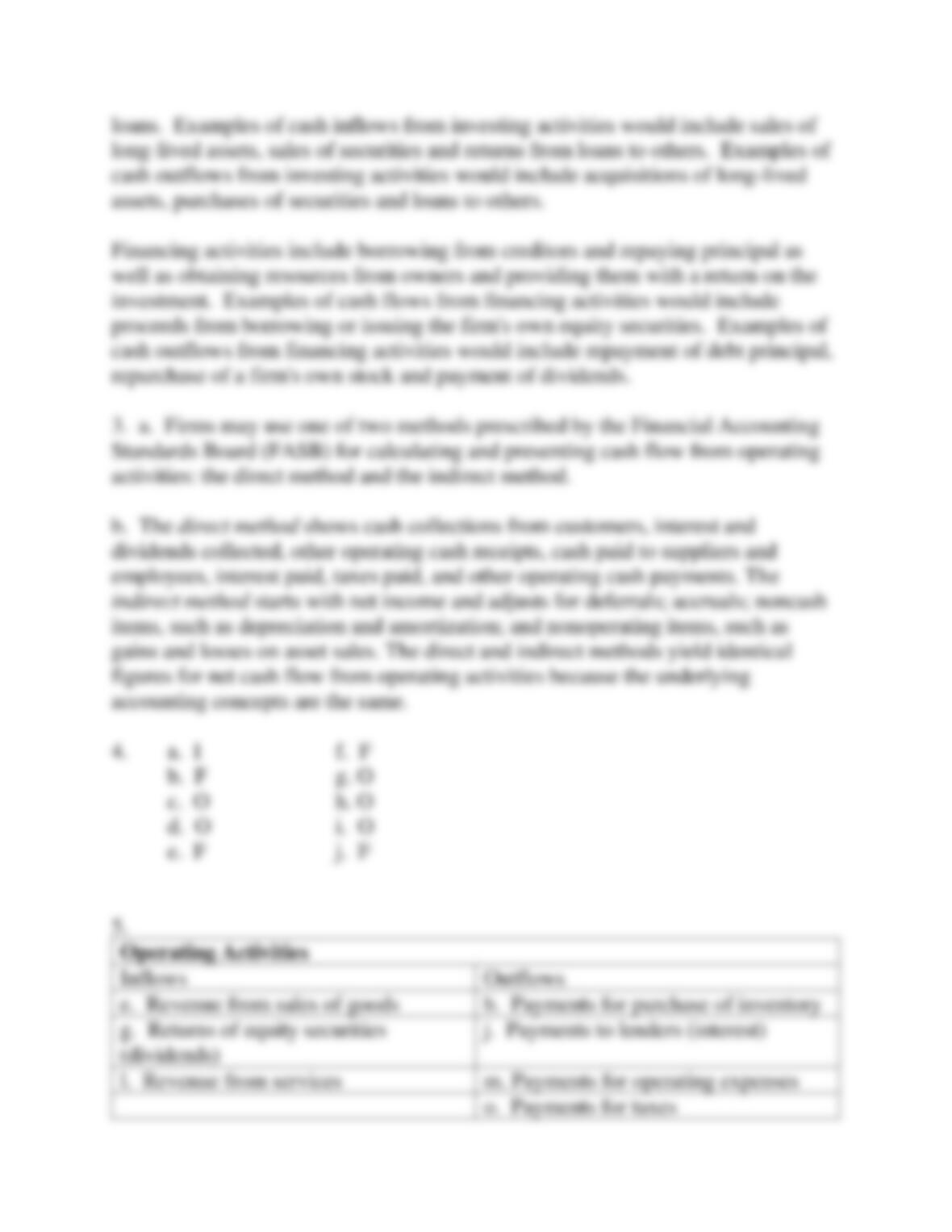
2. Explain the meaning of the three categories of a statement of cash flows:
operating, investing and financing activities. Give an example of an inflow and an
outflow for each category.
3. a. What are the two methods prescribed by the FASB for calculating and
presenting cash flow from operating activities?
b. Describe each of the two methods.
4. Identify the following items as operating (O), investing (I), or financing (F)
activities:
a. Property, plant and equipment
b. Current maturities of long-term debt
c. Inventories
d. Accounts receivable
e. Common stock
f. Short-term debt
g. Accounts payable
h. Net income
i. Accumulated depreciation
j. Dividends
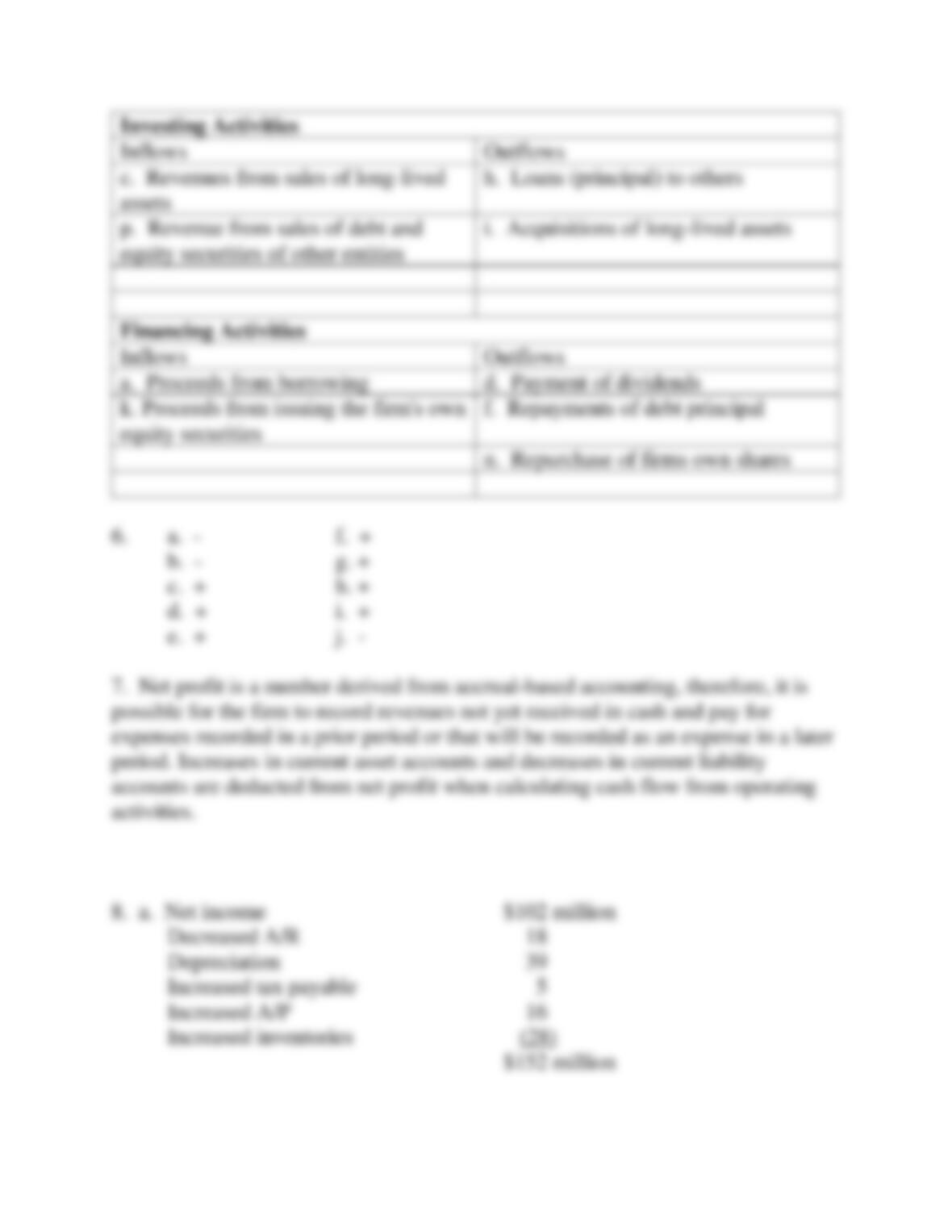
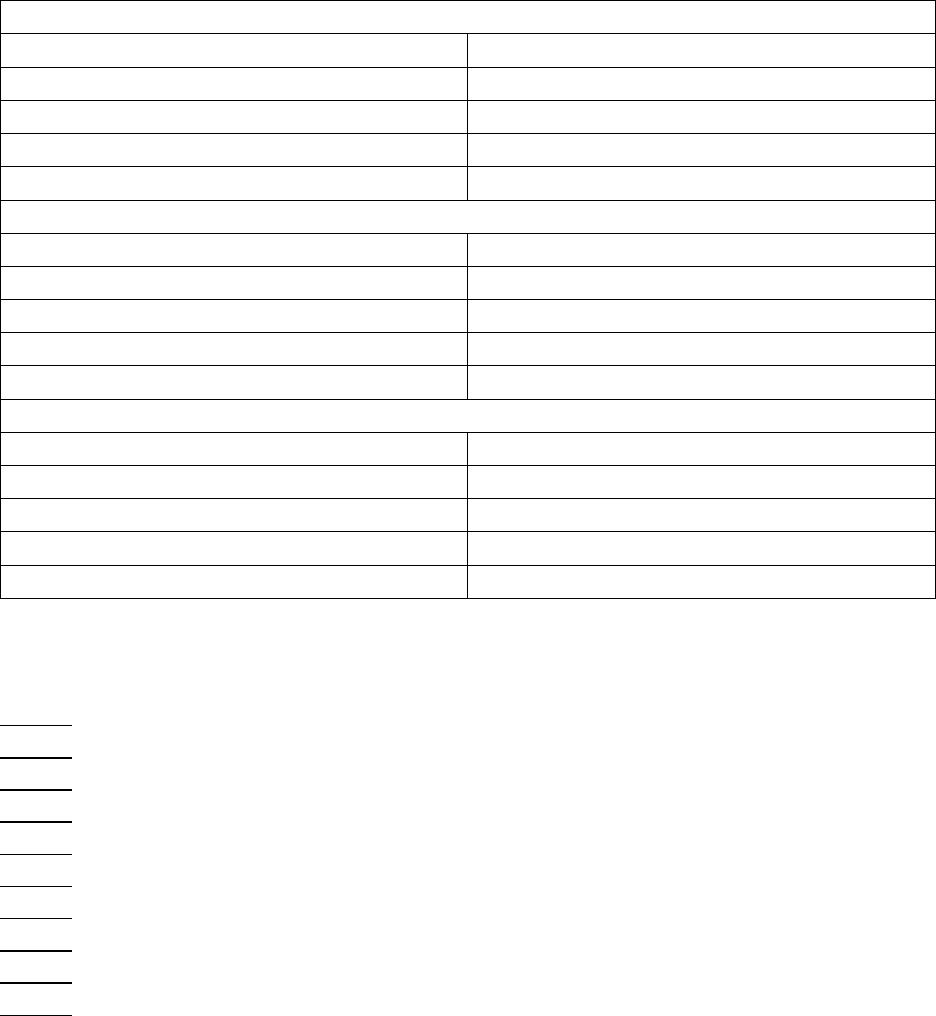
5. Using the following list of items, classify each item in the table given below:
a. Proceeds from borrowing
b. Payments for purchase of inventory
c. Revenues from sales of long-lived assets
d. Payment of dividends
e. Revenue from sales of goods
f. Repayments of debt principal
g. Returns of equity securities (dividends)
h. Loans (principal) to others
i. Acquisitions of long-lived assets
j. Payments to lenders (interest)
k. Proceeds from issuing the firm’s own equity securities
l. Revenue from services
m. Payments for operating expenses
n. Repurchase of firms own shares
o. Payments for taxes
p. Revenue from sales of debt and equity securities of other entities
Operating Activities
Inflows
Outflows
Investing Activities
Inflows
Outflows
Financing Activities
Inflows
Outflows
6. Indicate whether the following items would be added (+) or deducted (-) from net
income to determine cash flow from operating activities.
a. Increase in accounts receivable
b. Decrease in accrued liabilities
c. Loss on sale of assets
d. Decrease in inventory
e. Amortization expense
f. Increase in deferred revenue
g. Decrease in prepaid expenses
h. Increase in deferred tax liabilities
i. Increase in accounts payable
j. Increase in investment accounts from equity income

7. Explain how it is possible for a firm with a positive net profit to generate
negative cash flow from operating activities.
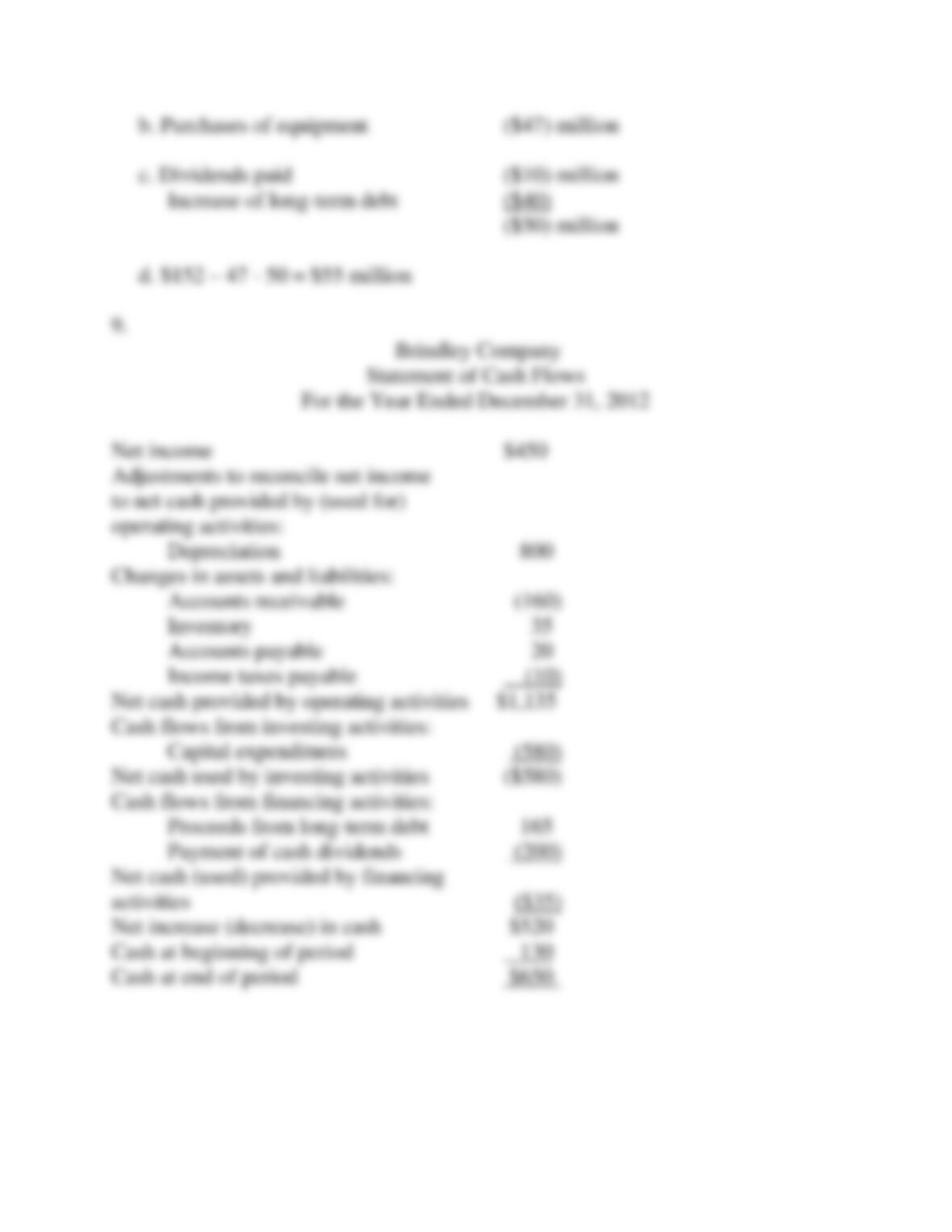
8. AJAR Corporation reported the following information for the current year:
(1) Net income is $102 million.
(2) Purchases of equipment were $47 million.
(3) Customer accounts receivable decreased by $18 million.
(4) Dividends paid to common shareholders were $10 million.
(5) Depreciation expense was $39 million.
(6) Income tax payable increased by $5 million.
(7) Long-term debt decreased by $40 million.
(8) Accounts payable increased by $16 million.
(9) Inventories increased by $28 million.
Required: Based on the above information, calculate the following items:
a. Cash flow from operating activities.
b. Cash flow from investing activities.
c. Cash flow from financing activities.
d. The increase or decrease in the cash balance.
9. Prepare the statement of cash flows for Brindley Company using the indirect
method.
Brindley Company
Income Statement
For the Year Ended December 31, 2012
Revenues $8,500
Depreciation expense $ 800
Other operating expenses 6,100 6,900
Income before income taxes $1,600
Interest expense 850
Income tax expense 300
Net income $ 450

Brindley Company
Balance Sheet
December 31, 2012 and 2011
2012 2011 2012 2011
Assets: Liab. & SE:
Cash $ 650 $ 130 A/P $ 520 $ 500
A/R 770 610 Inc.Taxes/Pay. 270 280
Inventories 835 870 LT debt 415 250
Plant & Equip. 3,450 2,870 Common Stock 1,260 1,260
Less: Acc. Depr. (1,690) (890) Retained Earnings 1,550 1,300
Total Assets $4,015 $3,590 Total Liab. & SE $4,015 $3,590
Use the following information for Cantor Co. to answer questions 10 and 11.
Cantor Co.
Balance Sheet
December 31, 2011 and 2010
2011 2010
Cash $220 $110
A/R 45 60
Inventory 110 90
Total current assets $375 $260
Property, plant & equipment 140 140
Less: Accumulated depreciation 40 25
Property, plant & equipment, net $100 $115
Total assets $475 $375
A/P $ 40 $ 30
Accrued expenses 10 15
Total current liabilities $ 50 $ 45
Stockholders’ equity:
Common stock 200 200
Retained earnings 225 130
Total liabilities and stockholders’ equity $475 $375
Cantor Co.
Income Statement
For the Year Ended December 31, 2011
Sales $600
COGS 240
Gross profit $360
Operating and other expenses 265
Net income $ 95
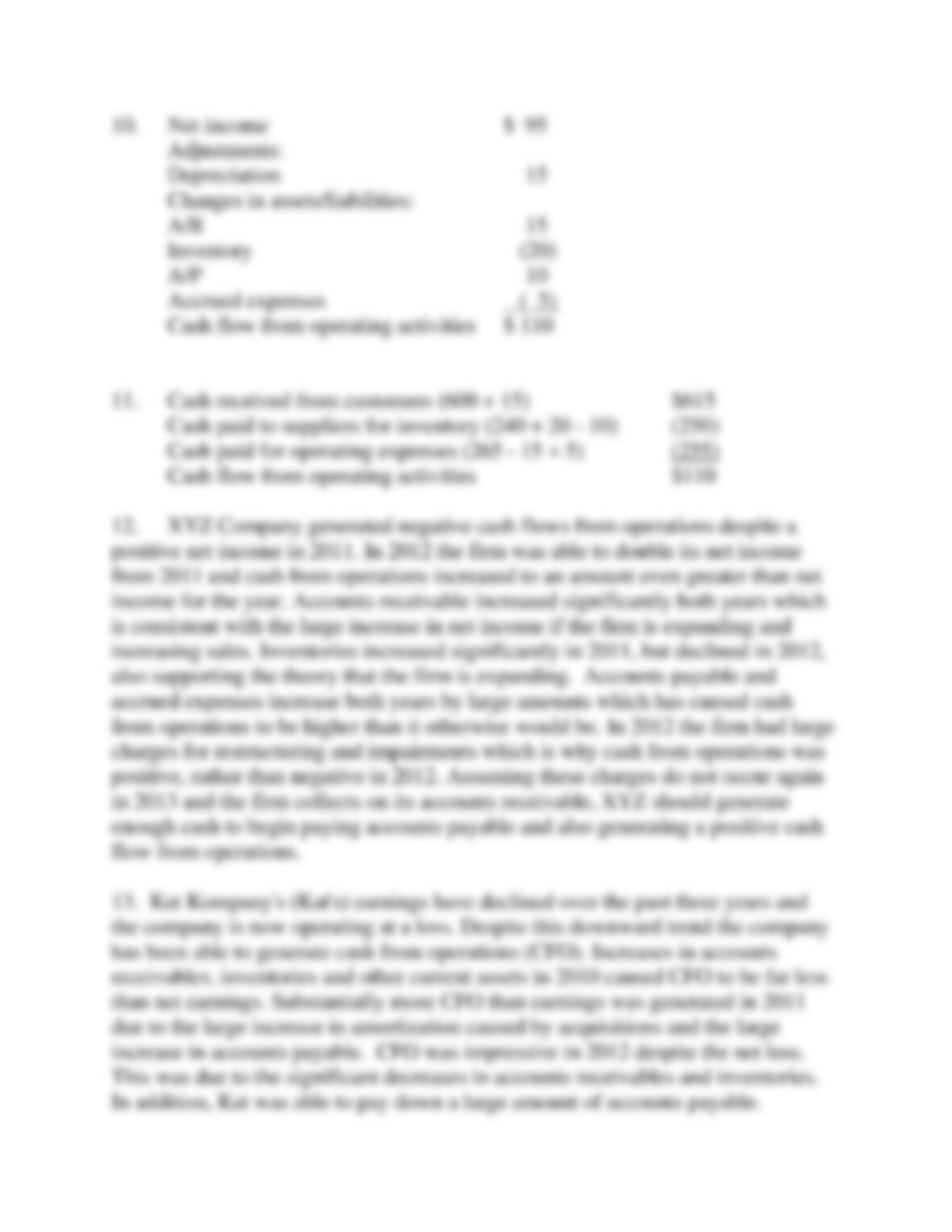
10. Compute cash flow from operating activities using the indirect method.
11. Compute cash flow from operating activities using the direct method.
12. Using the excerpt from the XYZ Company statement of cash flows analyze
thoroughly the cash flow from operating activities. Be sure to offer possible
reasons for the changes identified.
Operating Activities
2012
2011
Net income
200,870
108,500
Depreciation
156,428
141,762
Restructuring, and impairment charges
269,543
24,000
Equity in losses of investees
15,140
20,731
Deferred income tax benefit
(9,645)
(33,421)
Increase (decrease) in cash resulting from changes in:
Accounts receivable
(579,436)
(399,781)
Inventories
40,801
(165,782)
Accounts payable and accrued expenses
173,400
275,609
Net cash provided (used) by operating activities
267,101
(28,382)

13. Using the following statement of cash flows and summary analysis of the
statement of cash flows for Kat Kompany, analyze cash flow from operating
activities, cash inflows and cash outflows.
Kat Kompany
Statement of Cash Flows
For the Years Ended December 31, 2012, 2011, and 2010
2012 2011 2010
Net income (loss) ($145) $190 $206
Adjustments to reconcile net income
to net cash provided by (used for)
operating activities:
Depreciation 265 275 171
Deferred income taxes (70) (40) 20
Loss on sale of business assets 45 0 0
Changes in assets and liabilities:
Accounts receivable 395 (10) (125)
Inventory 70 (45) (145)
Other current assets (85) (25) (15)
Accounts payable (230) 75 31
Net cash provided by operating activities $245 $420 $143
Cash flows from investing activities:
Capital expenditures (125) (110) (142)
Acquisitions (140) (350) (668)
Net cash used by investing activities ($265) ($460) ($810)
Cash flows from financing activities:
Net proceeds (payments) of
short-term borrowings (340) 225 272
Proceeds from long-term debt 915 460 405
Repayments of long-term debt (292) (308) (25)
Purchase of common stock (368) (237) (179)
Stock options transactions 2 50 60
Payment of cash dividends (50) (50) (50)
Net cash (used) provided by financing
activities ($133) $140 $483
Net increase (decrease) in cash ($153) $100 ($184)
Cash at beginning of period 280 180 364
Cash at end of period $127 $280 $180

Kat Kompany
Summary Analysis of Statement of Cash Flows
2012
%
2011
%
2010
%
Inflows:
CFO
245
21
420
36
143
16
ST borrowings
0
0
225
20
272
31
LT debt
915
79
460
40
405
46
Stock Options
2
0
50
4
60
7
Total Inflows
1162
100
1155
100
880
100
Outflows:
Capital Expend.
125
9
110
10
142
13
Acquisitions
140
11
350
33
668
63
ST debt payments
340
26
0
0
0
0
LT debt payments
292
22
308
29
25
2
Purchase of stock
368
28
237
23
179
17
Dividends
50
4
50
5
50
5
Total Outflows
1315
100
1055
100
1064
100
Change in Cash
(153)
100
(184)

14. Using the statements of cash flows for BK Enterprises:
a. Prepare a summary analysis of the statements of cash flows for BK Enterprises
for all three years.
b. Write an analysis of the statements of cash flows for BK Enterprises for all three
years.
BK Enterprises
Statement of Cash Flows
For the Years Ended December 31, 2012, 2011, and 2010
2012 2011 2010
Net income $5,800 $3,300 $800
Adjustments to reconcile net income
to net cash provided by (used for)
operating activities:
Depreciation 1,200 520 380
Loss on sale of business assets 10 0 305
Changes in assets and liabilities:
Accounts receivable (490) (375) (135)
Inventory (6,900) (2,600) (1,700)
Other current assets 410 (495) (160)
Accounts payable and accrued exp. 1,300 570 1,100
Net cash provided by operating activities $1,330 $920 $590
Cash flows from investing activities:
Capital expenditures (740) (1,100) (550)
Proceeds from sales of equipment 0 10 2,020
Net cash used by investing activities ($740) ($1,090) $1,470
Cash flows from financing activities:
Exercise of stock options 2,000 380 0
Capital lease obligations 0 0 (250)
Payments on mortgage 0 0 (1,800)
Net cash (used) provided by financing
activities $2,000 $380 ($2,050)
Net increase (decrease) in cash $2,590 $210 $10
Cash at beginning of period 900 730 400
Cash at end of period $3,490 $940 $410

15. Using the summary analysis for ToyWorks, Inc. analyze the cash inflows and
cash outflows for the three years from 2010 to 2012.
ToyWorks, Inc.
Statement of Cash Flows
Summary Analysis
2012
%
2011
%
2010
%
Inflows:
CFO
162,556
14.0
391,512
33.8
126,587
14.4
Other investing
activities
82,863
7.1
30,793
2.7
16,986
1.9
Borrowings > 3 months
912,979
78.7
460,333
39.7
407,377
46.2
Short-term borrowings
0
0.0
226,103
19.5
271,895
30.9
Stock option/warrant
transactions
2,523
0.2
50,358
4.3
58,493
6.6
Total Inflows
1,160,921
100.0
1,159,099
100.0
881,338
100.0
Outflows:
Additions to PPE
125,055
9.5
107,468
10.2
141,950
13.3
Investments/acquisition
s
138,518
10.6
352,417
33.3
667,736
62.7
Repayments of
borrowings > 3 months
291,779
22.2
308,128
29.2
24,925
2.3
Repayments of short-
term borrowings
341,522
26.0
0
0.0
0
0.0
Purchase of common
stock
367,548
28.0
237,532
22.5
178,917
16.8
Dividends
42,494
3.2
45,526
4.3
42,277
4.0
Exchange rate changes
7,049
0.5
5,617
.5
9,570
0.9
Total Outflows
1,313,965
100.0
1,056,688
100.0
1,065,375
100.0
Change in cash
(153,044)
102,411
(184,037)
Solutions – Chapter 4
True-False
Multiple Choice
Short Answer