CHAPTER 4—THE TIME VALUE OF MONEY
TRUE/FALSE
1. Cash flow time lines are used primarily for decisions involving paying off debt or investing in
financial securities. They cannot be used when making decisions about investments in physical
assets.
2. One of the potential benefits of investing early for retirement is that an investor can receive
greater benefits from the compounding of interest.
3. Of all the techniques used in finance, the least important is the concept of the time value of
money.
4. Compounding is the process of converting today’s values, which are termed present value, to
future value.
5. The coupon rate is the rate of return you could earn on alternative investments of similar risk.
6. A perpetuity is an annuity with perpetual payments.
7. An amortized loan is a loan that requires equal payments over its life; its payments include both
interest and repayment of the debt.
8. The greater the number of compounding periods within a year, the greater the future value of a
lump sum invested initially, and the greater the present value of a given lump sum to be received
at maturity.
9. Suppose an investor can earn a steady 5% annually with investment A, while investment B will
yield a constant 12% annually. Within 11 years time, the compounded value of investment B will
be more than twice the compounded value of investment A (ignore risk).
10. Solving for the interest rate associated with a stream of uneven cash flows, without the use of a
calculator, usually involves a trial and error process.
Chapter 4 The Time Value of Money 39
11. When a loan is amortized, the largest portion of the periodic payment goes to reduce principal in
the early years of the loan such that the accumulated interest can be spread out over the life of the
loan.
12. The effective annual rate is always greater than the simple rate as a result of compounding
effects.
13. Because we usually assume positive interest rates in time value analyses, the present value of a
three-year annuity will always be less than the future value of a single lump sum, if the annuity
payment equals the original lump sum investment.
14. All else equal, a dollar received sooner is worth more than a dollar received at some later date,
because the sooner the dollar is received the more quickly it can be invested to earn a positive
return.
15. An annuity is a series of equal payments made at fixed equal-length intervals for a specified
number of periods.
16. The difference between an ordinary annuity and an annuity due is that each of the payments of
the annuity due earns interest for one additional year (period).
17. The difference between the PV of an annuity due and the PV of an ordinary annuity is that each
of the payments of the annuity due is discounted by one more year.
18. The effective annual rate is less than the simple rate when we have monthly compounding.
MULTIPLE CHOICE
1. Given some amount to be received several years in the future, if the interest rate increases, the
present value of the future amount will
a.
Be higher.
b.
Be lower.
c.
Stay the same.
d.
Cannot tell.
e.
Be variable.
2. You have determined the profitability of a planned project by finding the present value of all the
cash flows form that project. Which of the following would cause the project to look more
appealing in terms of the present value of those cash flows?
40 Chapter 4 The Time Value of Money
a.
The discount rate decreases.
b.
The cash flows are extended over a longer period of time, but the total amount of the cash
flows remains the same.
c.
The discount rate increases.
d.
Answers b and c above.
e.
Answers a and b above.
3. As the discount rate increases without limit, the present value of the future cash inflows
a.
Gets larger without limit.
b.
Stays unchanged.
c.
Approaches zero.
d.
Gets smaller without limit, i.e., approaches minus infinity.
e.
Goes to ekn.
4. Which of the following statements is most correct?
a.
If annual compounding is used, the effective annual rate equals the simple rate.
b.
If annual compounding is used, the effective annual rate equals the periodic rate.
c.
If a loan has a 12 percent simple rate with semiannual compounding, its effective annual
rate is equal to 11.66 percent.
d.
Both answers a and b are correct.
e.
Both answers a and c are correct.
5. Why is the present value of an amount to be received (paid) in the future less than the future
amount?
a.
Deflation causes investors to lose purchasing power when their dollars are invested for
greater than one year.
b.
Investors have the opportunity to earn positive rates of return, so any amount invested
today should grow to a larger amount in the future.
c.
Investments generally are not as good as those who sell them suggest, so investors usually
are not willing to pay full face value for such investments, thus the price is discounted.
d.
Because investors are taxed on the income received from investments they never will buy
an investment for the amount expected to be received in the future.
e.
None of the above is a correct answer.
Chapter 4 The Time Value of Money 41
6. By definition, what type of annuity best describes payments such as rent and magazine
subscriptions (assuming the costs do not change over time)?
a.
ordinary annuity
b.
annuity due
c.
nonconstant annuity
d.
annuity in arrears
7. What is the effective annual return (EAR) for an investment that pays 10 percent compounded
annually?
a.
equal to 10 percent
b.
greater than 10 percent
c.
less than 10 percent
d.
This question cannot be answered without knowing the dollar amount of the investment.
e.
None of the above is correct.
8. What is the term used to describe an annuity with an infinite life?
a.
perpetuity
b.
infinuity
c.
infinity due
d.
There is no special term for an infinite annuity.
9. Everything else equal, which of the following conditions will result in the lowest present value of
an amount to be received in the future?
a.
annual compounding
b.
quarterly compounding
c.
monthly compounding
d.
daily compounding
10. Suppose someone offered you your choice of two equally risky annuities, each paying $5,000 per
year for 5 years. One is an annuity due, while the other is a regular (or deferred) annuity. If you
are a rational wealth-maximizing investor which annuity would you choose?
a.
The annuity due.
b.
The deferred annuity.
c.
Either one, because as the problem is set up, they have the same present value.
d.
Without information about the appropriate interest rate, we cannot find the values of the
two annuities, hence we cannot tell which is better.
e.
The annuity due; however, if the payments on both were doubled to $10,000, the deferred
annuity would be preferred.
42 Chapter 4 The Time Value of Money
11. Which of the following statements is correct?
a.
For all positive values of k and n, FVIFk, n 1.0 and PVIFAk, n n.
b.
You may use the PVIF tables to find the present value of an uneven series of payments.
However, the PVIFA tables can never be of use, even if some of the payments constitute
an annuity (for example, $100 each year for Years 3, 4, and 5), because the entire series
does not constitute an annuity.
c.
If a bank uses quarterly compounding for saving accounts, the simple rate will be greater
than the effective annual rate.
d.
The present value of a future sum decreases as either the simple interest rate or the number
of discount periods per year increases.
e.
All of the above statements are false.
12. Which of the following statements is correct?
a.
Other things held constant, an increase in the number of discounting periods per year
increases the present value of a given annual annuity.
b.
Other things held constant, an increase in the number of discounting periods per year
increases the present value of a lump sum to be received in the future.
c.
The payment made each period under an amortized loan is constant, and it consists of
some interest and some principal. The later we are is the loan’s life, the smaller the interest
portion of the payment.
d.
There is an inverse relationship between the present value interest factor of an annuity and
the future value interest factor of an annuity, (i.e., one is the reciprocal of the other).
e.
Each of the above statements is true.
13. A $10,000 loan is to be amortized over 5 years, with annual end-of-year payments. Given the
following facts, which of these statements is correct?
a.
The annual payments would be larger if the interest rate were lower.
b.
If the loan were amortized over 10 years rather than 5 years, and if the interest rate were
the same in either case, the first payment would include more dollars of interest under the
5-year amortization plan.
c.
The last payment would have a higher proportion of interest than the first payment.
d.
The proportion of interest versus principal repayment would be the same for each of the 5
payments.
e.
The proportion of each payment that represents interest as opposed to repayment of
principal would be higher if the interest rate were higher.
Chapter 4 The Time Value of Money 43
14. Which of the following statements is correct?
a.
Simple rates can’t be used in present value or future value calculations because they fail to
account for compounding effects.
b.
The periodic interest rate can be used directly in calculations as long as the number of
payments per year is greater than or equal to the number of compounding periods per year.
c.
In all cases where interest is added or payments are made more frequently than annually,
the periodic rate is less than the annual rate.
d.
Generally, the APR is greater than the EAR as a result of compounding effects.
e.
If the compounding period is semiannual then the periodic rate will equal the effective
annual rate divided by two.
15. All else equal, if you expect to receive a certain amount in the future, say, $500 in ten (10) years,
the present value of that future amount will be lowest if the interest earned on such investments is
compounded
a.
daily
b.
weekly
c.
monthly
d.
quarterly
e.
annually
16. Which of the following payments (receipts) would probably not be considered an annuity due?
Based on your knowledge and using logic, think about the timing of the payments.
a.
rent payments associated with a five-year lease
b.
payments for a magazine subscription for a two-year period where the payments are made
annually
c.
interest payments associated with a corporate bond that was issued today
d.
annual payments associated with lottery winnings that are paid out as an annuity
17. All else equal, the future value of a lump-sum amount invested today will increase if the
a.
interest rate that is earned is lowered.
b.
number of compounding periods is increased.
c.
investment time period is shortened.
d.
amount initially invested is lowered.
e.
Two or more of the above answers are correct.
18. Susan just signed a long-term lease on a townhouse in New York City (near Central Park) that
requires her to make equal monthly payments for the next five years. The payments Susan has
promised to make represent a(n) __________ for the landlord.
a.
ordinary annuity
b.
annuity due
c.
series of uneven cash flows
d.
perpetuity
44 Chapter 4 The Time Value of Money
19. Suppose that the present value of receiving a guaranteed $450 in two years is $385.80. The
opportunity rate of return on similar risk investments is 8 percent. According to this information,
all else equal, which of the following statements is correct?
a.
It always would be preferable to wait two years to receive the $450 because this value is
greater than the present value.
b.
Risk averse investors always would prefer to take the $385.80 today because it is a
guaranteed amount whereas there is uncertainty as to whether the future amount will be
paid.
c.
No investor should be willing to pay more than $385.80 for such an investment.
d.
It is apparent the present value was computed incorrectly because the present value of a
future amount always should be greater than the future value.
e.
None of the above is a correct answer.
20. You plan to invest an amount of money in five-year certificate of deposit (CD) at your bank. The
stated interest rate applied to the CD is 12 percent, compounded monthly. How much must you
invest if you want the balance in the CD account to be $8,500 in five years?
a.
$4,678.82
b.
$4,823.13
c.
$13,600.00
d.
$14,979.90
e.
$7,589.29
21. Vegit Corporation needs to borrow funds to support operations during the summer. Vegit’s CFO
is trying to decide whether to borrow from the Bank of Florida or the Bank of Georgia. The loan
offered by Bank of Florida has a 12.5 percent simple interest rate with annual interest payments,
whereas the loan offered by the Bank of Georgia has a 12 percent simple interest rate with
monthly payments. Which bank should Vegit use for the loan?
a.
Bank of Georgia, because the 12 percent simple interest is cheaper than the 12.5 percent
simple interest at Bank of Florida.
b.
Bank of Georgia, because the effective interest rate on the loan is less than 12 percent,
whereas the effective interest rate on the loan at the Bank of Florida is greater than 12.5
percent.
c.
Bank of Florida, because the simple interest rate is higher, which means that Vegit will be
able to invest the proceeds from the loan at a higher rate of return.
d.
Bank of Florida, because the effective interest rate on the loan is 12.5 percent, which is less
than the 12.7 percent effective interest rate on the loan offered by the Bank of Georgia.
e.
There is not enough information to answer this question.

Chapter 4 The Time Value of Money 45
22. Alice’s investment advisor is trying to convince her to purchase an investment that pays $250 per
year. The investment has no maturity; therefore the $250 payment will continue every year
forever. Alice has determined that her required rate of return for such an investment should be 14
percent and that she would hold the investment for 10 years and then sell it. If Alice decides to
buy the investment, she would receive the first $250 payment one year from today. How much
should Alice be willing to pay for this investment?
a.
$1,304.03, because this is the present value of an ordinary annuity that pays $250 a year
for 10 years at 14 percent.
b.
$1,486.59, because this is the present value of an annuity due that pays $250 a year for 10
years at 14 percent.
c.
$1,785.71, because this is the present value of a $250 perpetuity at 14 percent.
d.
There is not enough information to answer this question, because the selling price of the
investment in 10 years is not known today.
e.
None of the above is correct.
23. At approximately what rate would you have to invest a lump-sum amount today if you need the
amount to triple in six years? Assume interest is compounded annually.
a.
20%
b.
12%
c.
24%
d.
Not enough information is provided to answer the question.
e.
None of the above is a correct answer.
24. Sarah is thinking about purchasing an investment from HiBond Investing. If she buys the
investment, Sarah will receive $100 every three months for five years. The first $100 payment
will be made as soon as she purchases the investment. If Sarah’s required rate of return is 16
percent, to the nearest dollar, how much should she be willing to pay for this investment?
a.
$1,359
b.
$1,413
c.
$1,112
d.
$1,519
e.
$1,310
25. Which of the following statements is most correct?
a.
The first payment under a 3-year, annual payment, amortized loan for $1,000 will include
a smaller percentage (or fraction) of interest if the interest rate is 5 percent than if it is 10
percent.
b.
If you are lending money, then, based on effective interest rates, you should prefer to lend
at a 10 percent simple, or quoted, rate but with semiannual payments, rather than at a 10.1
percent simple rate with annual payments. However, as a borrower you should prefer the
annual payment loan.
c.
The value of a perpetuity (say for $100 per year) will approach infinity as the interest rate
used to evaluate the perpetuity approaches zero.
d.
Statements a, b, and c are all true.
e.
Only statements b and c are true.
46 Chapter 4 The Time Value of Money
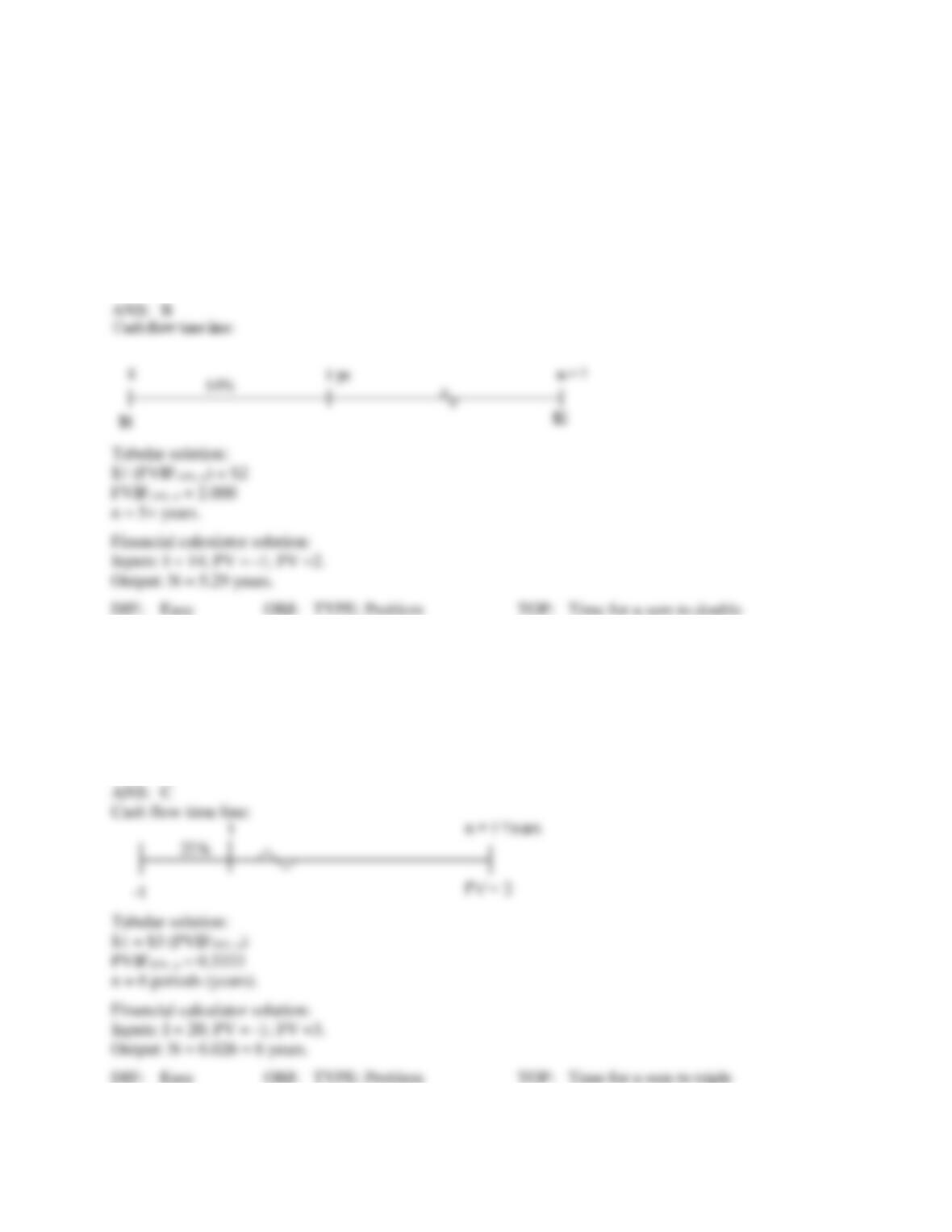
26. A recent advertisement in the financial section of a magazine carried the following claim: “Invest
your money with us at 14 percent, compounded annually, and we guarantee to double your
money sooner than you imagine.” Ignoring taxes, how long would it take to double your money at
a simple rate of 14 percent, compounded annually?
a.
Approximately 3.5 years
b.
Approximately 5 years
c.
Exactly 7 years
d.
Approximately 10 years
e.
Exactly 14 years
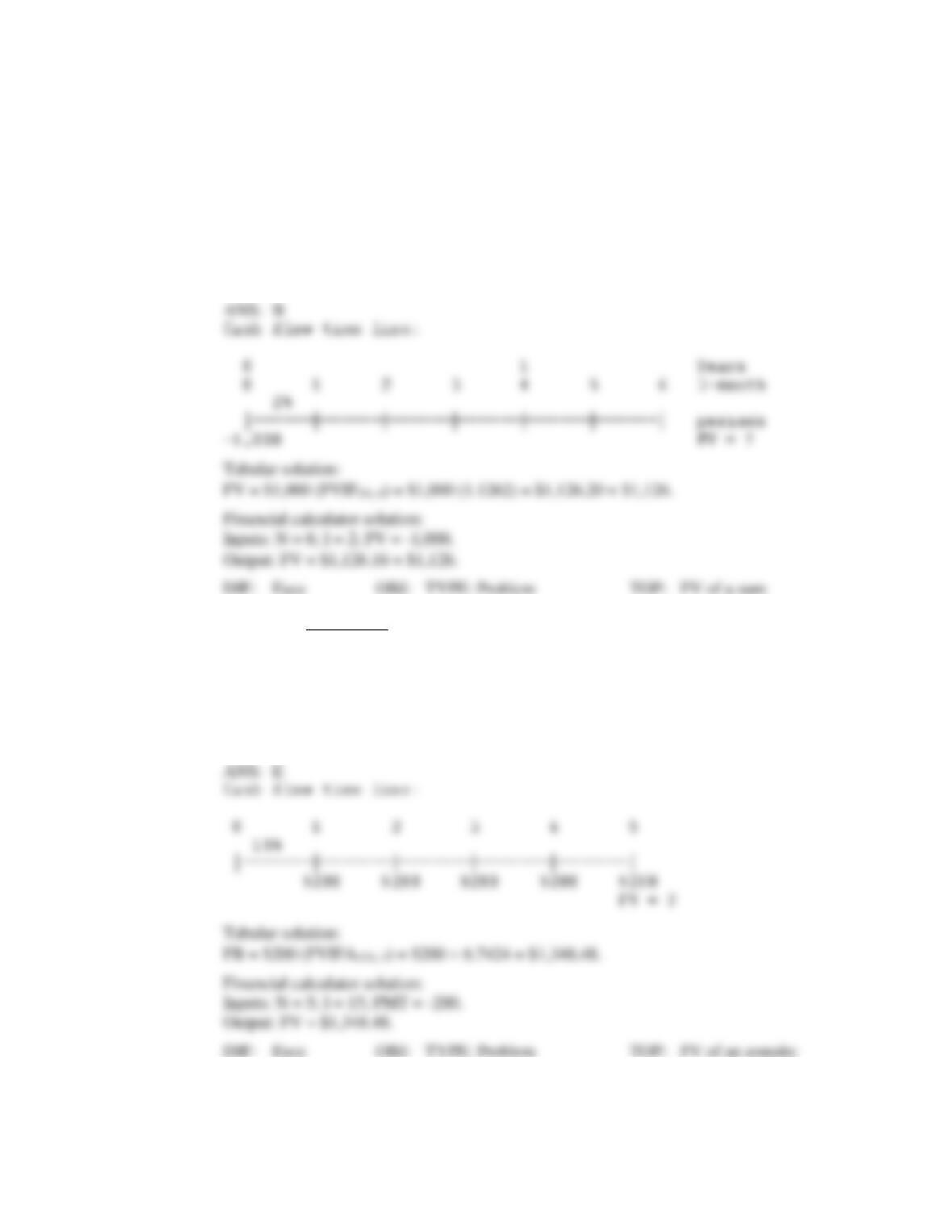
27. At an effective annual interest rate of 20 percent, how many years will it take a given amount to
triple in value? (Round to the closest year.)
a.
5
b.
8
c.
6
d.
10
e.
9
Chapter 4 The Time Value of Money 47
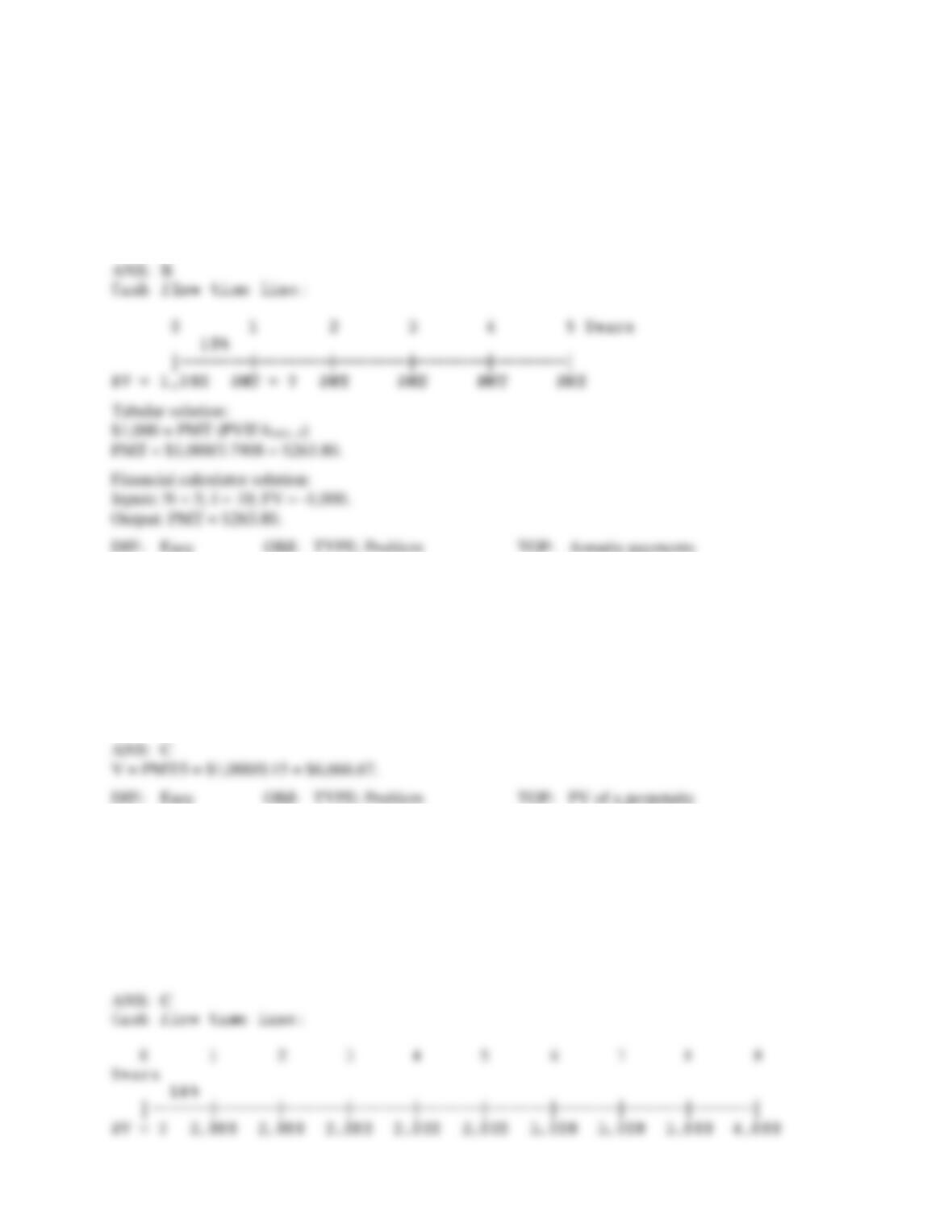
28. You deposited $1,000 in a savings account that pays 8 percent interest, compounded quarterly,
planning to use it to finish your last year in college. Eighteen months later, you decide to go to the
Rocky Mountains to become a ski instructor rather than continue in school, so you close out your
account. How much money will you receive?
a.
$1,171
b.
$1,126
c.
$1,082
d.
$1,163
e.
$1,008
29. What is the future value of a 5-year ordinary annuity with annual payments of $200, evaluated at
a 15 percent interest rate?
a.
$670.44
b.
$842.91
c.
$1,169.56
d.
$1,522.64
e.
$1,348.48
48 Chapter 4 The Time Value of Money
30. If a 5-year regular annuity has a present value of $1,000, and if the interest rate is 10 percent,
what is the amount of each annuity payment?
a.
$240.42
b.
$263.80
c.
$300.20
d.
$315.38
e.
$346.87
31. You have the opportunity to buy a perpetuity which pays $1,000 annually. Your required rate of
return on this investment is 15 percent. You should be essentially indifferent to buying or not
buying the investment if it were offered at a price of
a.
$5,000.00
b.
$6,000.00
c.
$6,666.67
d.
$7,500.00
e.
$8,728.50
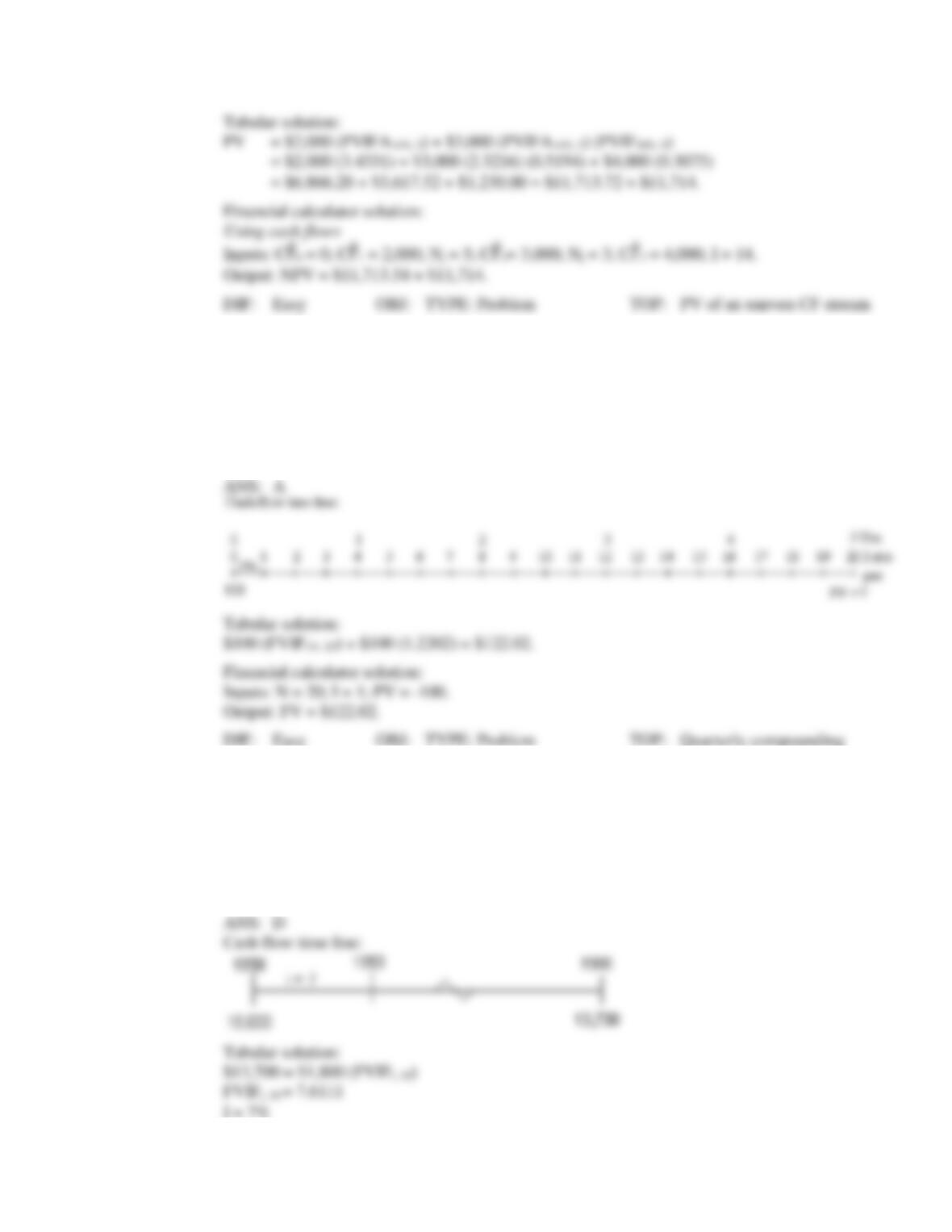
32. Assume that you will receive $2,000 a year in Years 1 through 5, $3,000 a year in Years 6
through 8, and $4,000 in Year 9, with all cash flows to be received at the end of the year. If you
require a 14 percent rate of return, what is the present value of these cash flows?
a.
$9,851
b.
$13,250
c.
$11,714
d.
$15,129
e.
$17,353
Chapter 4 The Time Value of Money 49
33. If $100 is placed in an account that earns a simple 4 percent, compounded quarterly, what will it
be worth in 5 years?
a.
$122.02
b.
$105.10
c.
$135.41
d.
$120.90
e.
$117.48
34. In 1958 the average tuition for one year at an Ivy League school was $1,800. Thirty years later, in
1988, the average cost was $13,700. What was the growth rate in tuition over the 30-year period?
a.
12%
b.
9%
c.
6%
d.
7%
e.
8%
50 Chapter 4 The Time Value of Money
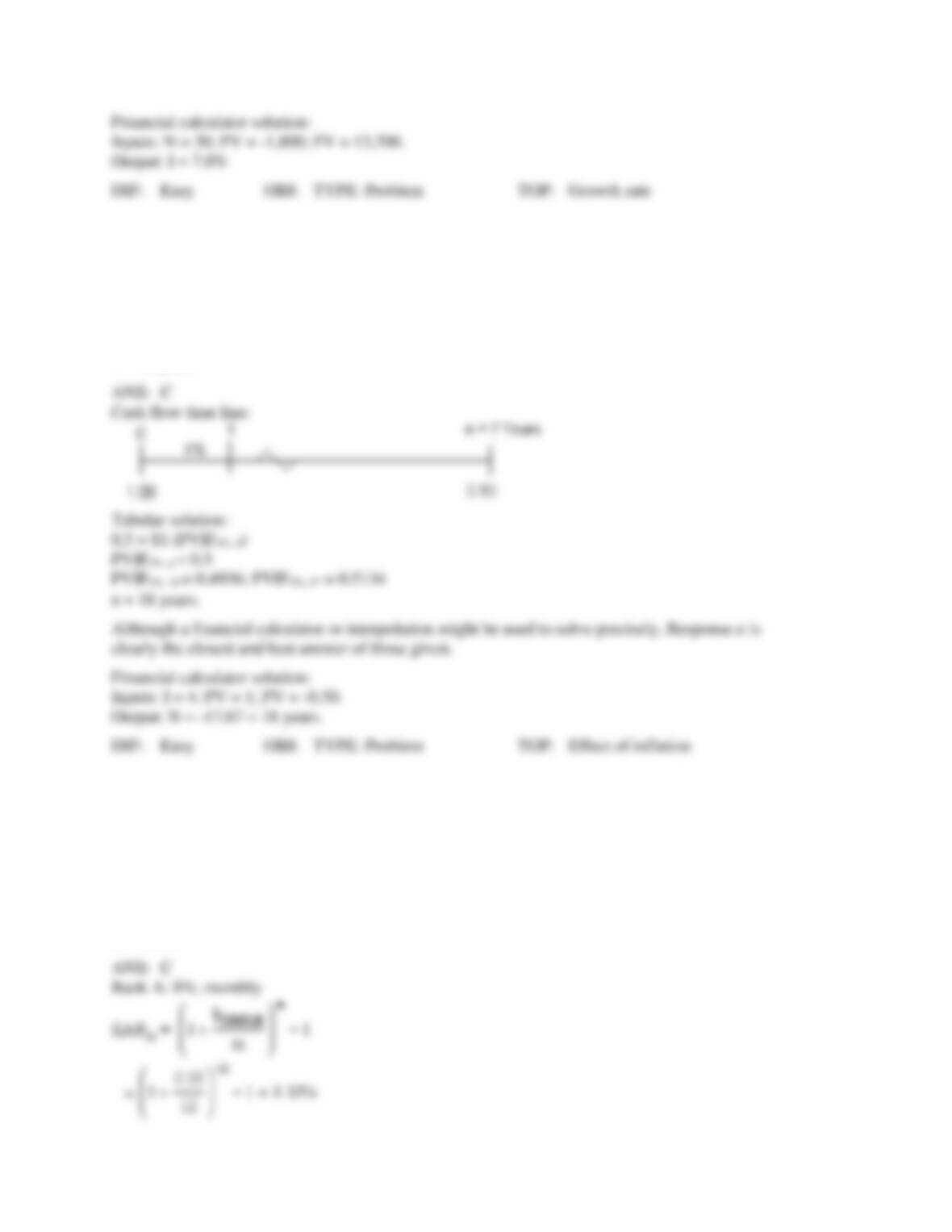
35. At an inflation rate of 9 percent, the purchasing power of $1 would be cut in half in 8.04 years.
How long to the nearest year would it take the purchasing power of $1 to be cut in half if the
inflation rate were only 4%?
a.
12 years
b.
15 years
c.
18 years
d.
20 years
e.
23 years
36. Gomez Electronics needs to arrange financing for its expansion program. Bank A offers to lend
Gomez the required funds on a loan where interest must be paid monthly, and the quoted rate is 8
percent. Bank B will charge 9 percent, with interest due at the end of the year. What is the
difference in the effective annual rates charged by the two banks?
a.
0.25%
b.
0.50%
c.
0.70%
d.
1.00%
e.
1.25%
Chapter 4 The Time Value of Money 51
37. Assume that you can invest to earn a stated annual rate of return of 12 percent, but where interest
is compounded semiannually. If you make 20 consecutive semiannual deposits of $500 each, with
the first deposit being made today, what will your balance be at the end of Year 20?
a.
$52,821.19
b.
$57,900.83
c.
$58,988.19
d.
$62,527.47
e.
$64,131.50
38. Assume you are to receive a 20-year annuity with annual payments of $50. The first payment will
be received at the end of Year 1, and the last payment will be received at the end of Year 20. You
will invest each payment in an account that pays 10 percent. What will be the value in your
account at the end of Year 30?
a.
$6,354.81
b.
$7,427.83
c.
$7,922.33
d.
$8,591.00
e.
$6,752.46
52 Chapter 4 The Time Value of Money
39. You expect to receive $1,000 at the end of each of the next 3 years. You will deposit these
payments into an account which pays 10 percent compounded semiannually. What is the future
value of these payments, that is, the value at the end of the third year?
a.
$3,000
b.
$3,310
c.
$3,318
d.
$3,401
e.
$3,438
40. You just graduated, and you plan to work for 10 years and then to leave for the Australian
“Outback” bush country. You figure you can save $1,000 a year for the first 5 years and $2,000 a
year for the next 5 years. These savings cash flows will start one year from now. In addition, your
family has just given you a $5,000 graduation gift. If you put the gift now, and your future
savings when they start, into an account which pays 8 percent compounded annually, what will
your financial “stake” be when you leave for Australia 10 years from now?
a.
$21,432
b.
$28,393
c.
$16,651
d.
$31,148
e.
$20,000
41. As the winning contestant in a television game show, you are considering the prizes to be
awarded. You must indicate to the sponsor which of the following two choices you prefer,
assuming you want to maximize your wealth. Assume it is now January 1, and there is no danger
whatever that the sponsor won’t pay off.
(1)
$1,000 now and another $1,000 at the beginning of each of the 11 subsequent months during
the remainder of the year, to be deposited in an account paying 12 percent simple annual
rate, but compounded monthly (to be left on deposit for the year).
(2)
$12,750 at the end of the year.
54 Chapter 4 The Time Value of Money
Which one would you choose?
a.
Choice 1
b.
Choice 2
c.
Choice 1, if the payments were made at the end of the year.
d.
The choice would depend on how soon you need the money.
e.
Either one, since they have the same present value.
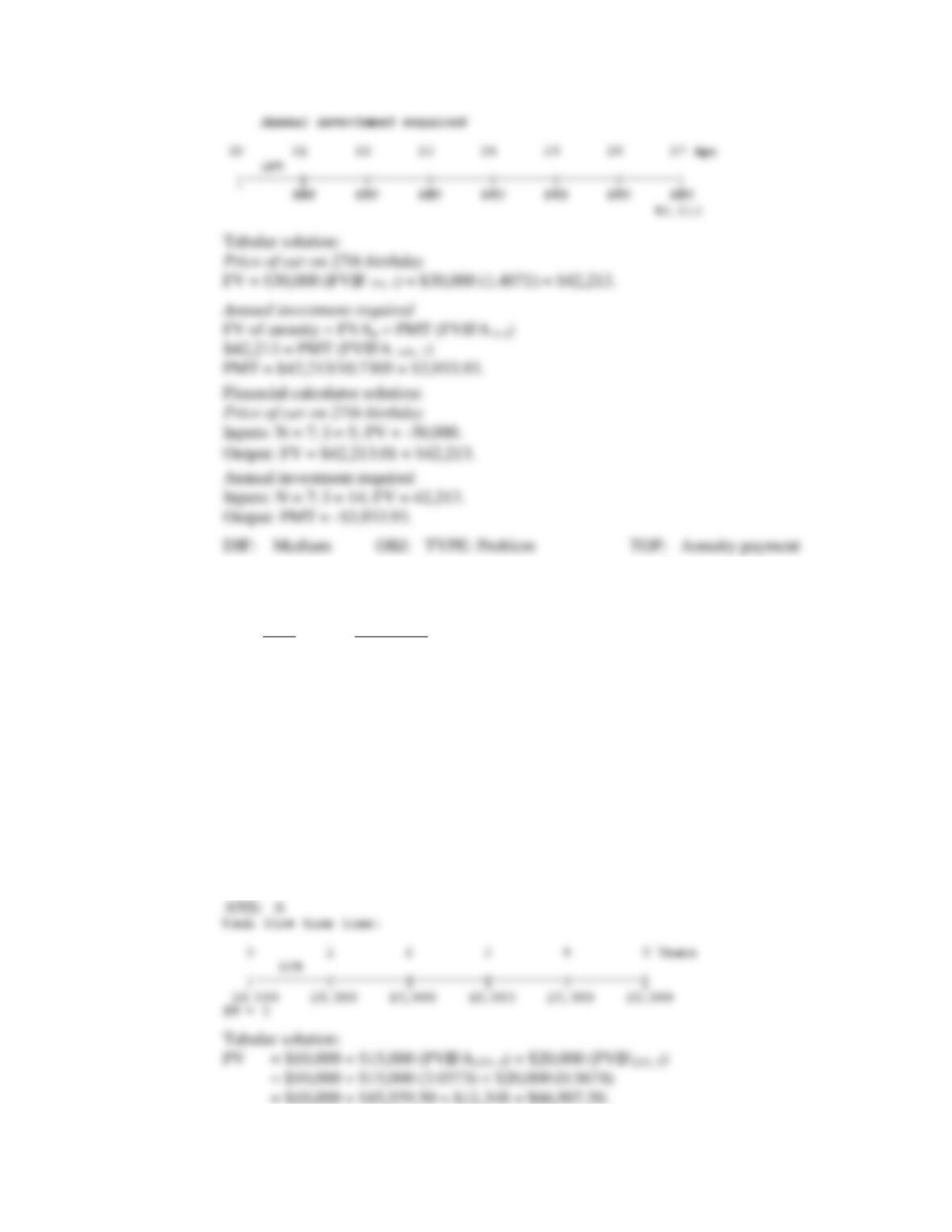
42. You want to buy a Nissan 300ZX on your 27th birthday. You have priced these cars and found
that they currently sell for $30,000. You believe that the price will increase by 5 percent per year
until you are ready to buy. You can presently invest to earn 14 percent. If you just turned 20 years
old, how much must you invest at the end of each of the next 7 years to be able to purchase the
Nissan in 7 years?
a.
$4,945.57
b.
$3,933.93
c.
$7,714.72
d.
$3,450.82
e.
$6,030.43
Chapter 4 The Time Value of Money 55
43. Assume that your required rate of return is 12 percent and you are given the following stream of
cash flows:
Year
Cash Flow
0
$10,000
1
15,000
2
15,000
3
15,000
4
15,000
5
20,000
If payments are made at the end of each period, what is the present value of the cash flow stream?
a.
$66,909
b.
$57,323
c.
$61,815
d.
$52,345
e.
$62,029
56 Chapter 4 The Time Value of Money
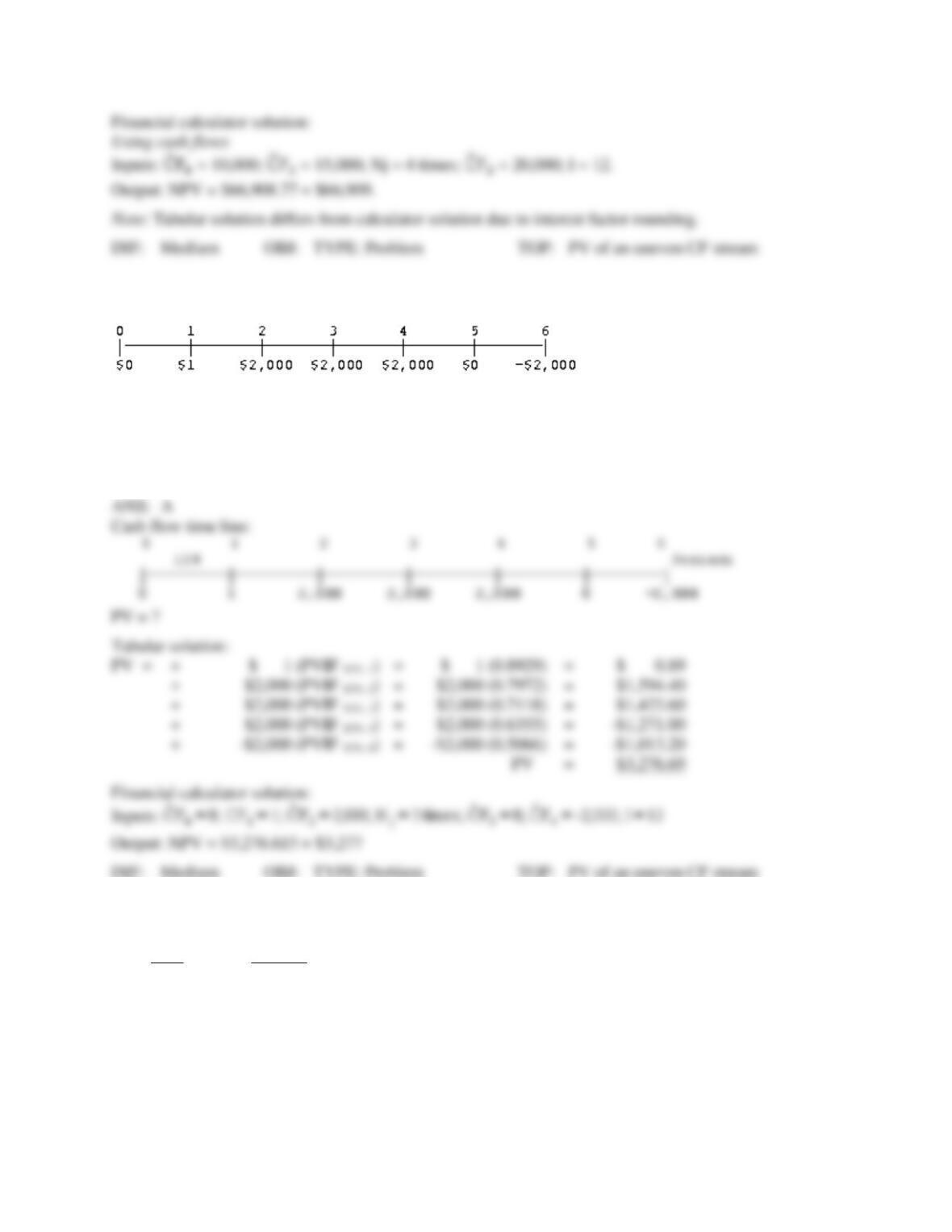
44. You are given the following cash flows. What is the present value (t = 0) if the discount rate is 12
percent?
a.
$3,277
b.
$4,804
c.
$5,302
d.
$4,289
e.
$2,804
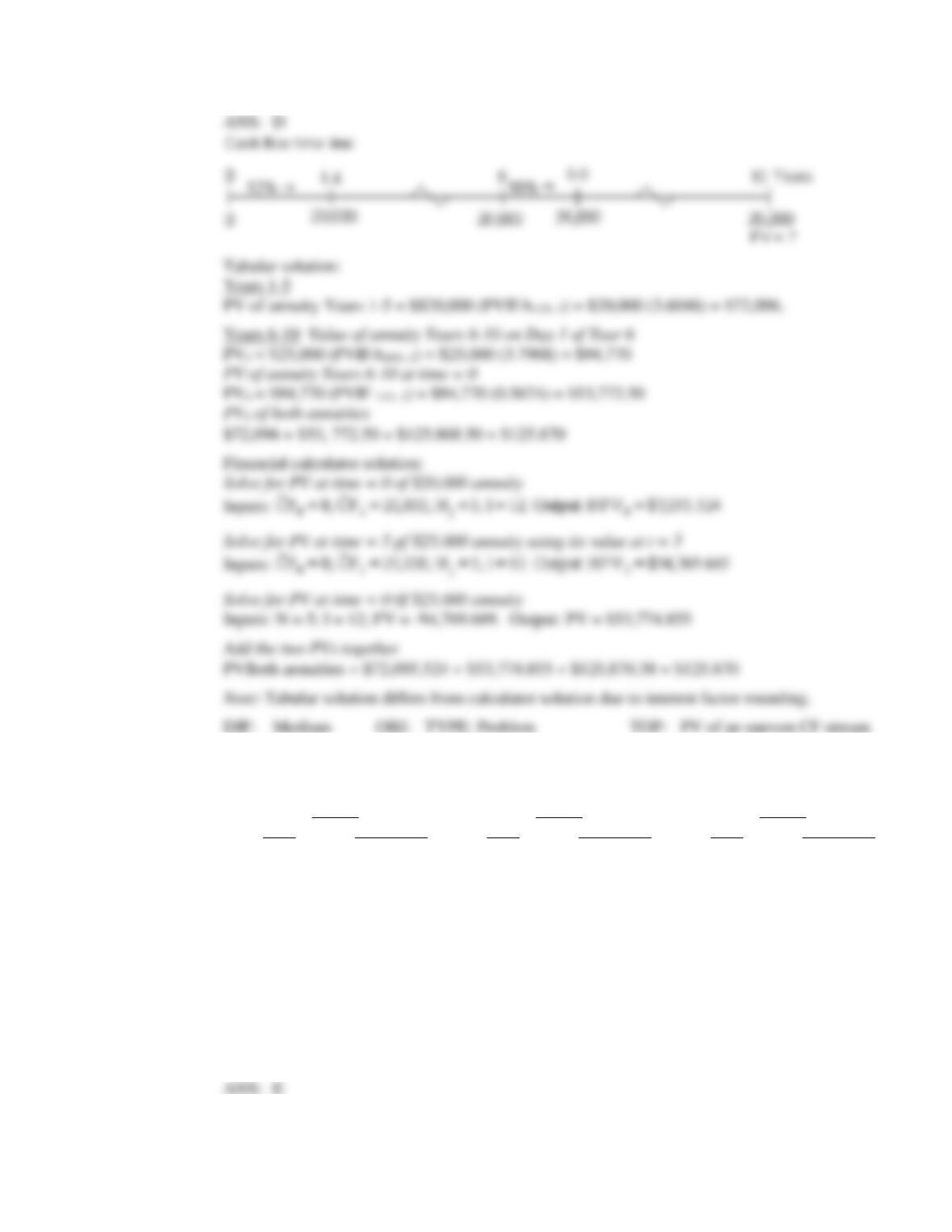
45. You are given the following cash flow information. The appropriate discount rate is 12 percent
for Years 1–5 and 10 percent for Years 6–10. Payments are received at the end of the year.
Year
Amount
1–5
$20,000
6–10
$25,000
What should you be willing to pay right now to receive the income stream above?
a.
$166,866
b.
$158,791
c.
$225,000
d.
$125,870
e.
$198,433
Chapter 4 The Time Value of Money 57
46. A project with a 3-year life has the following probability distributions for possible end of year
cash flows in each of the next three years:
Year 1
Year 2
Year 3
Prob
Cash Flow
Prob
Cash Flow
Prob
Cash Flow
0.30
$300
0.15
$100
0.25
$200
0.40
500
0.35
200
0.75
800
0.30
700
0.35
600
0.15
900
Using an interest rate of 8 percent, find the expected present value of these uncertain cash flows.
(Hint: Find the expected cash flow in each year, then evaluate those cash flows.)
a.
$1,204.95
b.
$835.42
c.
$1,519.21
d.
$1,580.00
e.
$1,347.61