Chapter 04 – Principles of Neural and Hormonal Communication
51. When a neuron terminates on a muscle or a gland, the neuron is said to innervate, or supply, the structure.
a.
True
b.
False
True
52. Electrical synapses are more common than chemical synapses in the human nervous system.
a.
True
b.
False
False
53. The space between the presynaptic and postsynaptic neurons is called the synaptic knob.
a.
True
b.
False
False
54. Neurotransmitter is released by exocytosis into the synaptic cleft.
a.
True
b.
False
True
55. Several mechanisms can remove the neurotransmitter, such as being inactivated by specific enzymes within the sub–
synaptic membrane.
a.
True
b.
False
True
56. Tetanus toxin prevents release of serotonin from inhibitory presynaptic inputs terminating at neurons that supply
Chapter 04 – Principles of Neural and Hormonal Communication
skeletal muscles.
a.
True
b.
False
False
57. The most common means by which cells communicate with one another is indirectly through signal molecules.
a.
True
b.
False
True
58. Hormones are long-range chemical messengers specifically secreted into the blood by endocrine glands in response to
an appropriate signal.
a.
True
b.
False
True
59. Many growth factors that help regulate cell growth and division, such as nerve growth factor and epidermal growth
factor, act via the JAK/STAT pathway.
a.
True
b.
False
False
60. Eicosanoids typically act locally as paracrines, but some travel in the blood, similar to hormones, to distant target cells
to produce systemic responses.
a.
True
b.
False
False
61. The enzyme cyclooxygenase (COX) initiates a pathway leading to formation of prostaglandins and thromboxanes.
a.
True
b.
False
Chapter 04 – Principles of Neural and Hormonal Communication
True
62. Hydrophilic hormones are highly water soluble and have low lipid solubility.
a.
True
b.
False
True
63. All lipophilic hormones bind with intracellular receptors and primarily produce effects in their target cells by
activating specific genes that cause the synthesis of new proteins.
a.
True
b.
False
True
64. Peptides are synthesized in the cytosol of cells.
a.
True
b.
False
False
65. The endocrine system is specialized to control activities that require speed rather than duration.
a.
True
b.
False
False
66. Nerve and muscle are considered ____________________ tissues because they produce electrical signals when
excited.
excitable
67. ____________________ gated channels respond to stretching or other mechanical deformation.
68. ____________________ potentials are local changes in membrane potential that occur in varying grades or degrees of
magnitude or strength.
69. ____________________ is the hindrance to electrical charge movement.
70. ____________________ conduction involves the spread of the action potential along every patch of membrane down
the length of the axon.
71. Neurons are saved from oscillating action potentials by the ____________________ period.
72. Action potentials occur in a(n) ____________________ fashion.
73. In myelinated fiber, impulses “jump” from node to node, skipping over the myelinated sections of the axon in a
process called ____________________ conduction.
74. Myelin forming cells in the peripheral nervous system are called ____________________ cells.
75. At a(n) ____________________ synapse, the receptor-channels to which the neurotransmitter binds are nonspecific
cation channels that permit simultaneous passage of sodium and potassium through them.
76. The amino acid ____________________ is a primary excitatory neurotransmitter in the central nervous system.
77. The total grand postsynaptic potential (GPSP) is a composite of all ____________________ and IPSPs occurring
around the same time.
78. In addition to neuromodulation, another means of depressing or enhancing synaptic effectiveness is presynaptic
____________________ or ____________________.
79. The socially abused drug ____________________ blocks the reuptake of the neurotransmitter dopamine at
presynaptic terminals.
80. Two important relationships exist between neurons: ____________________ and ____________________.
Chapter 04 – Principles of Neural and Hormonal Communication
81. ____________________are local chemical messengers whose effect is exerted only on neighboring cells in the
immediate environment of their site of secretion.
82. Tyrosine kinase is a key participant in two different signaling pathways: the tyrosine kinase pathway and the
____________________ pathway.
83. Binding of the first messenger to the receptor activates the ____________________, which is a membrane-bound
intermediary.
84. Synapses that lead to responses mediated by second messengers are known as ____________________ synapses.
85. ____________________ are a type of eicosanoids that promote platelet aggregation and constrict blood vessels.
86. ____________________ is the study of homeostatic chemical adjustments and other activities accomplished by
hormones.
87. Steroids are neutral lipids derived from ____________________.
88. Although the cAMP and Ca2+ pathways are the most prevalent second-messenger systems, some cells use cyclic
____________________.
89. Using Internet connectivity as an analogy, the nervous system is generally described as a(n) ____________________
system.
90. An example of a messenger that acts as a neurotransmitter when released from a nerve ending or a hormone when
secreted by an endocrine cell is ____________________.
Chapter 04 – Principles of Neural and Hormonal Communication
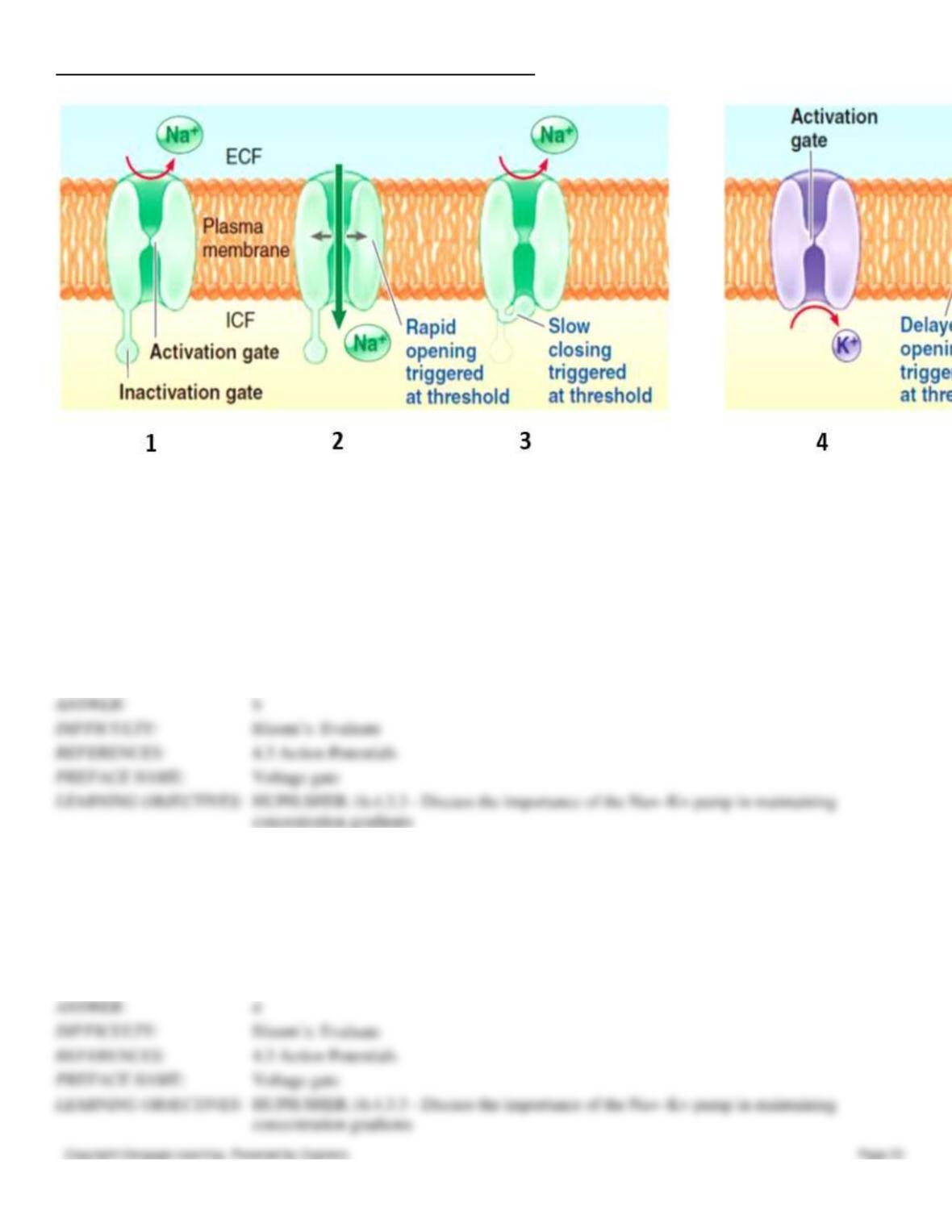
Figure 4-5
Use the accompanying diagram to answer the corresponding questions.
91. Which number in the figure represents an open or activated voltage-gated sodium channel?
a.
1
b.
2
c.
3
d.
4
e.
5
b
92. Which number in the figure represents a closed voltage-gated potassium channel?
a.
1
b.
2
c.
3
d.
4
e.
5
d
93. Which number in the figure represents a closed, but capable of opening, voltage-gated sodium channel?
a.
1
b.
2
c.
3
d.
4
e.
5
94. Which number in the figure represents a closed and inactivated voltage-gated sodium channel?
a.
1
b.
2
c.
3
d.
4
e.
5
95. Which number in the figure represents an open voltage-gated potassium channel?
a.
1
b.
2
c.
3
d.
4
e.
5
96. Describe action potentials.
97. Describe how drugs can modify synaptic transmission.
98. Outline the four types of signal molecules.
99. Describe how lipophilic hormones are transported.
100. Outline the main similarities and differences between the nervous and endocrine systems.
Chapter 04 – Principles of Neural and Hormonal Communication