Chapter 4: The Balance Sheet and the Statement of Shareholders’ Equity
119. A list of statements follows:
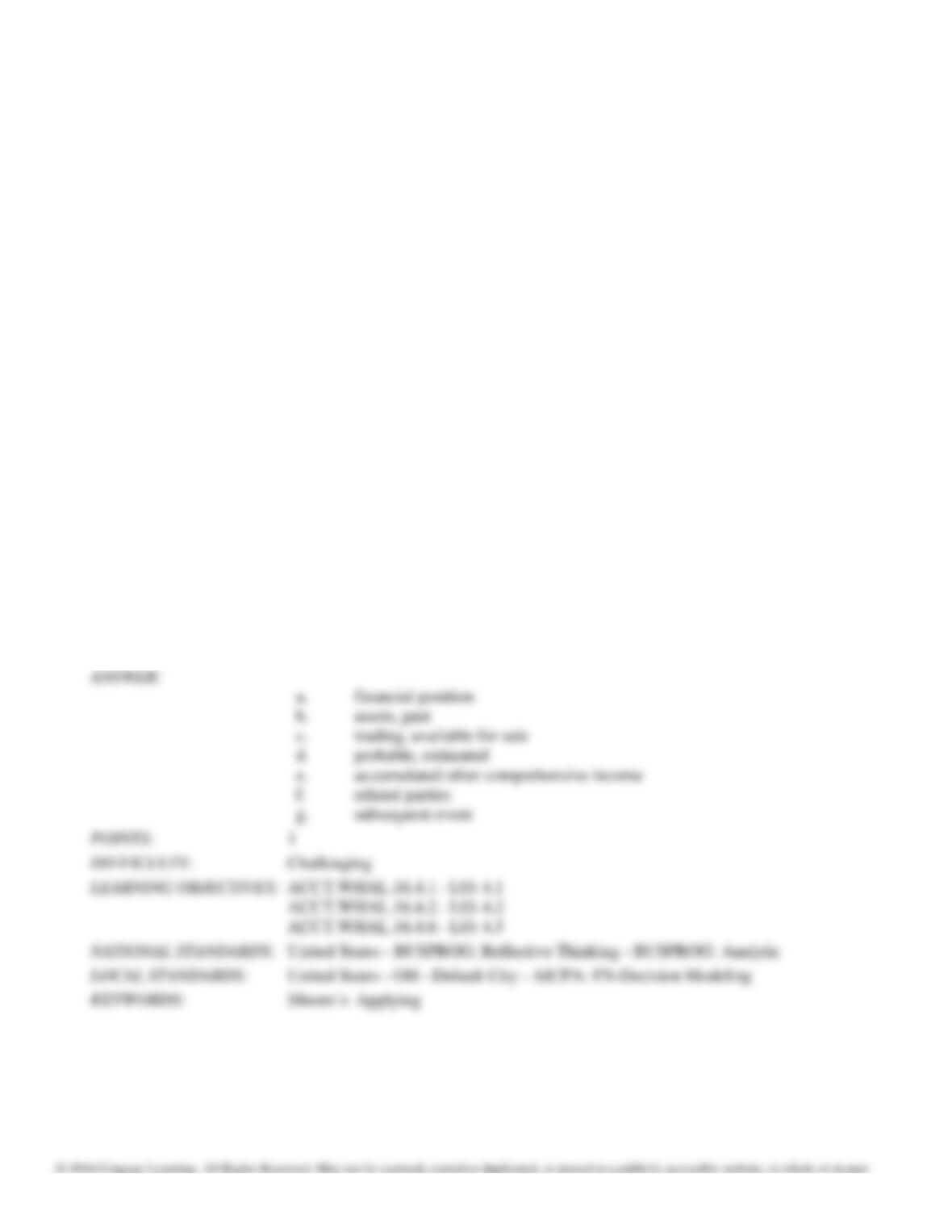
a.
A balance sheet summarizes the ____________________ ____________________ of a
company.
b.
____________________ are the probable future economic benefits obtained or controlled
by a company as a result of ____________________ transactions or events.
c.
Temporary investments in marketable securities are classified as either
__________________ securities or investment securities ________________ (3 words).
d.
A company must accrue a loss and a liability from a contingency if it is ____________ that
a liability has been incurred and the amount of the loss can be reasonably
_______________.
e.
Unrealized fair value increases in available-for-sale securities is an example of
_________________ (4 words).
f.
_____________ (2 words) of a company include affiliated entities such as subsidiaries,
trusts for the benefit of employees, its management, and its principal owners or their
immediate families.
g.
A ____________________ (2 words) is one that occurs between the balance sheet date
and the date the annual report is issued.
Required:
Fill in the words necessary to complete the statements.
120. The following data were taken from the Oxon Hill, Inc. balance sheet:
Accounts payable
$ 1,150
Inventory
1,250
Retained earnings
40
Accumulated depreciation
300
Cash
15,500
Serial bonds payable ($1,200 matures each year)
10,800
Prepaid insurance
1,200
Allowance for doubtful accounts
720
Capital stock
440
Property, plant, and equipment
1,000
Accounts receivable (gross)
3,110
Accrued salaries
1,310
Required:
Compute working capital.
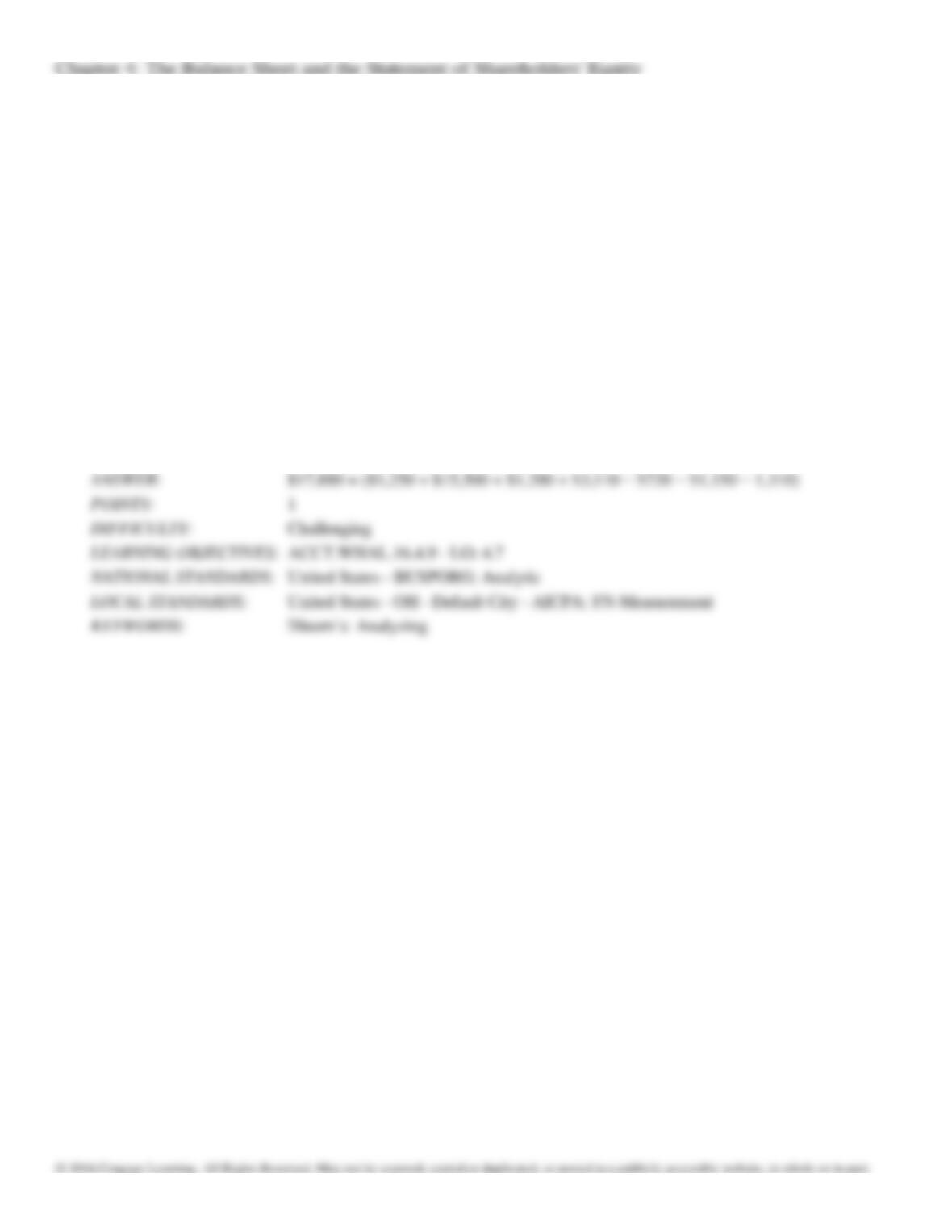
$17,880 = ($1,250 + $15,500 + $1,200 + $3,110 − $720 − $1,150 − 1,310)
1
Challenging
ACCT.WHAL.16.4.9 – LO: 4.7
United States – BUSPORG: Analytic
United States – OH – Default City – AICPA: FN-Measurement
Chapter 4: The Balance Sheet and the Statement of Shareholders’ Equity
121. The following information has been provided for Zero One Corp.:
Prepaid insurance
$ 1,200
Accrued salaries
2,170
Petty cash
675
Investment in trading securities
5,200
Cash
4,600
Inventory, at sales value (cost = $2,100)
4,500
Unearned rent
1,940
Allowance for bad debts
850
Office supplies
910
Accounts receivable
3,800
Required:
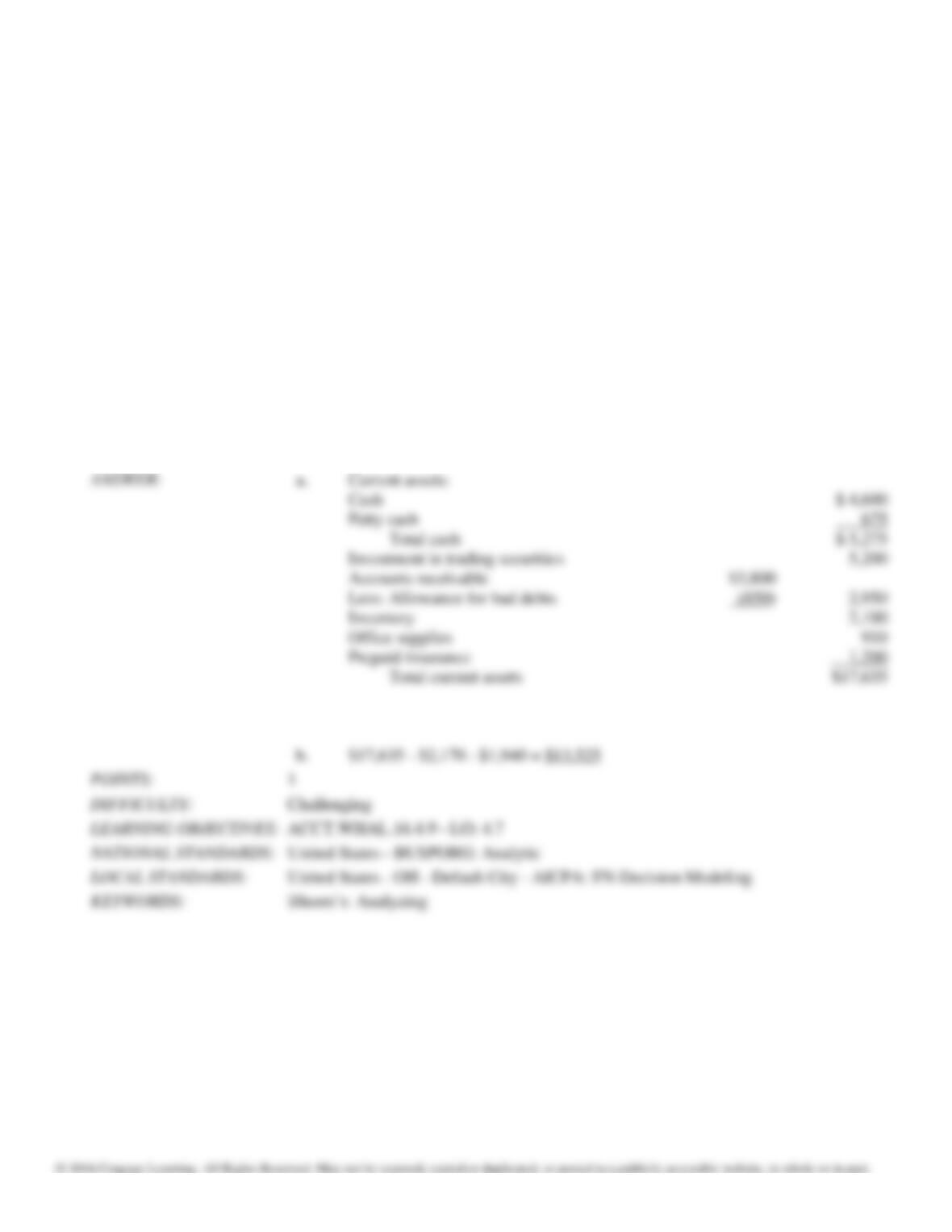
a.
Prepare the current asset section of Zero One’s balance sheet in the proper sequence
according to U.S. GAAP.
b.
Calculate Zero One’s working capital.
Cash
Total cash
Investment in trading securities
Less: Allowance for bad debts
Office supplies
Prepaid insurance
b.
$17,635 – $2,170 – $1,940 = $13,525
1
Challenging
ACCT.WHAL.16.4.9 – LO: 4.7
United States – BUSPORG: Analytic
United States – OH – Default City – AICPA: FN-Decision Modeling
Chapter 4: The Balance Sheet and the Statement of Shareholders’ Equity
122. Below is a list of common ratios necessary for financial statement analysis.
a.)
Debt-to-Assets
b.)
Return on Common Equity
c.)
Fixed Asset Turnover
d.)
Total Asset Turnover
f.)
Debt-to-Equity Ratio
g.)
Inventory Turnover
h.)
Current Ratio
i.)
Quick Ratio
Required:
Match the ratio with the appropriate formula.
______
1.)
Net Income ÷ Average Total Common Equity
______
2.)
Quick Assets ÷ Current Liabilities
______
3.)
Current Assets ÷ Current Liabilities
______
4.)
Cost of Goods Sold ÷ Average Inventory
______
5.)
Total Liabilities ÷ Total Common Equity
______
6.)
Total Revenues ÷ Average Net Fixed Assets
______
7.)
Total Revenues ÷ Average Total Assets
______
8.)
Total Liabilities ÷ Total Assets
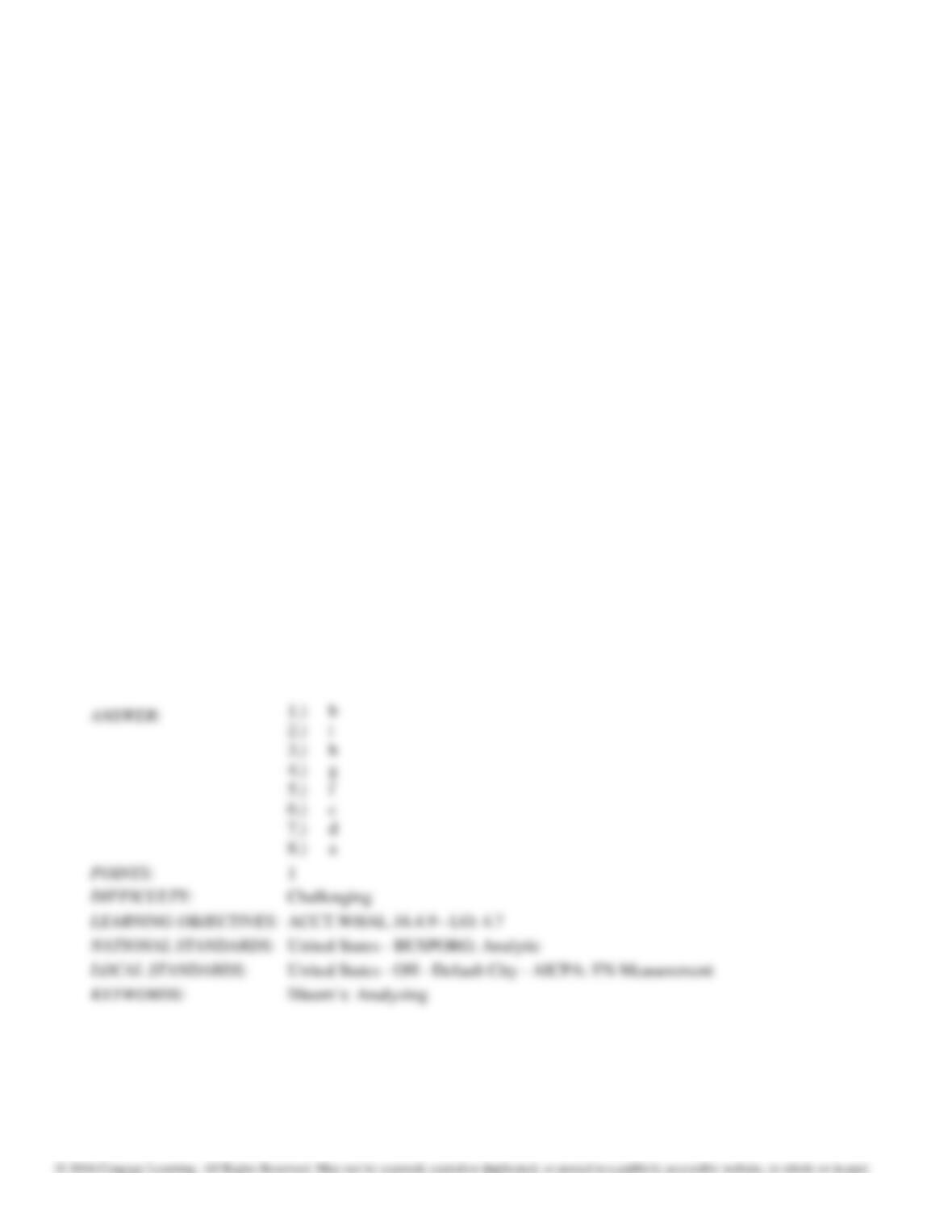
1.)
b
2.)
i
3.)
h
4.)
g
5.)
f
6.)
c
7.)
d
8.)
a
1
Challenging
ACCT.WHAL.16.4.9 – LO: 4.7
United States – BUSPORG: Analytic
United States – OH – Default City – AICPA: FN-Measurement
123. The following is from the financial reports of Sledge Company:
Credit Sales
$ 1,250,000
Average Accounts Receivable
250,000
Inventory Purchases
450,000
Costs of Goods Sold
550,000
Change in Inventory
(145,000)
Average Accounts Payable
123,500
Total Revenues
1,500,000
Average Net Fixed Assets
275,000
Average Total Assets
385,000
Required:
Calculate the following to three decimal places:
a.)
Fixed Asset Turnover
b.)
Total Asset Turnover
c.)
Accounts Payable Turnover
d.)
Accounts Payable Turnover in Days
e.)
Accounts Receivable Turnover
f.)
Accounts Receivable Turnover in Days
a.)
Fixed Asset Turnover
=
Total Revenues
÷
Average Net Fixed Assets
5.455
=
$1,500,000
÷
$275,000
b.)
Total Asset Turnover
=
Total Revenues
÷
Average Total Assets
3.896
=
$1,500,000
÷
$385,000
c.)
3.279
=
$405,000
÷
$123,500
d.)
Accounts Payable Turnover in Days
=
365 Days
÷
Accounts Payable Turnover
111.314
=
365 Days
÷
3.279
e.)
Turnover
5.000
=
$1,250,000
÷
$250,000
f.)
Days
Turnover
73.000
=
365 Days
÷
5.000
1
Challenging
ACCT.WHAL.16.4.9 – LO: 4.7
United States – BUSPORG: Analytic
124. What is meant by liquidity? Rank the following items according to their liquidity (from most to least):
Goodwill
Inventory
Short-term investment
Building
Accounts receivable
125. List the financial statements that report changes in the financial position of a company during a period.
ANSWER:
126. What three characteristics must an economic resource have in order be considered an asset?
ANSWER:
127. What is FASB’s definition of fair value?
128. List the three primary elements recognized on the balance sheet and provide the primary classifications of accounts
within each element.
129. What are the three categories of intangible assets?
Chapter 4: The Balance Sheet and the Statement of Shareholders’ Equity
130. What is FASB’s Statement of Financial Accounting Concepts No. 6 definition of investments by owners and
distributions to owners?
131. ABC Company entered into some relatively large transactions with family members of the chairman of the board of
directors. List four types of disclosures required by GAAP about related party transactions.
ANSWER:
132. List four measurement methods that reflect current values of accounts (or a combination of current values and
historical values)./
ANSWER:
133. When analyzing financial statement data across companies, users must take into account differences in business
strategies and accounting practices in order to draw correct inferences from common-size analysis, rate of change
analysis, and ratio analysis. List five categories of ratio analysis used to evaluate a company’s performance.
134. Briefly describe how the sequence of accounts presented on the balance sheet is different for IFRS and U.S. GAAP?
135. A client of your accounting firm is impressed with the precision and detail in the financial statements that you have
just prepared for his company. However, he wants to know if there are any limitations to the information contained
in them.
Required:
Briefly describe four limitations of the balance sheet.
136. A friend of the family has just received her first set of financial statements from her accountant. When she finds out
that you are an accounting major, she asks you, “Why aren’t my employees listed as an asset on my company’s
balance sheet?”
Required:
Write an explanation describing the characteristics that an economic resource must possess in order to be considered
an asset. Include in your discussion the primary reason why “human resources” are not recognized as assets.
137. With all of the turmoil in the financial markets in 2008, one of your friends has emailed you because she has been
wondering about the financial disclosure requirements for the banks and brokerage firms affected by the market
turbulence. Explain the general accounting requirements for financial instruments to your friend.
138. Discuss how intracompany and intercompany comparisons help fulfill the qualitative characteristics of consistency
and comparability.
139. What is working capital and how does it relate to the company’s operating cycle?
140. A friend comes to you with a set of financial statements that he thinks contains an error. The footnotes contain a note
on a bond issue sold after the end of the reporting period. Your friend is sure this is an error because the transaction
occurred after the cutoff date for the financial statements.
Required:
Explain to your friend why certain items that occur after the end of an accounting period are included in the financial
statements and the manner in which they can be disclosed.