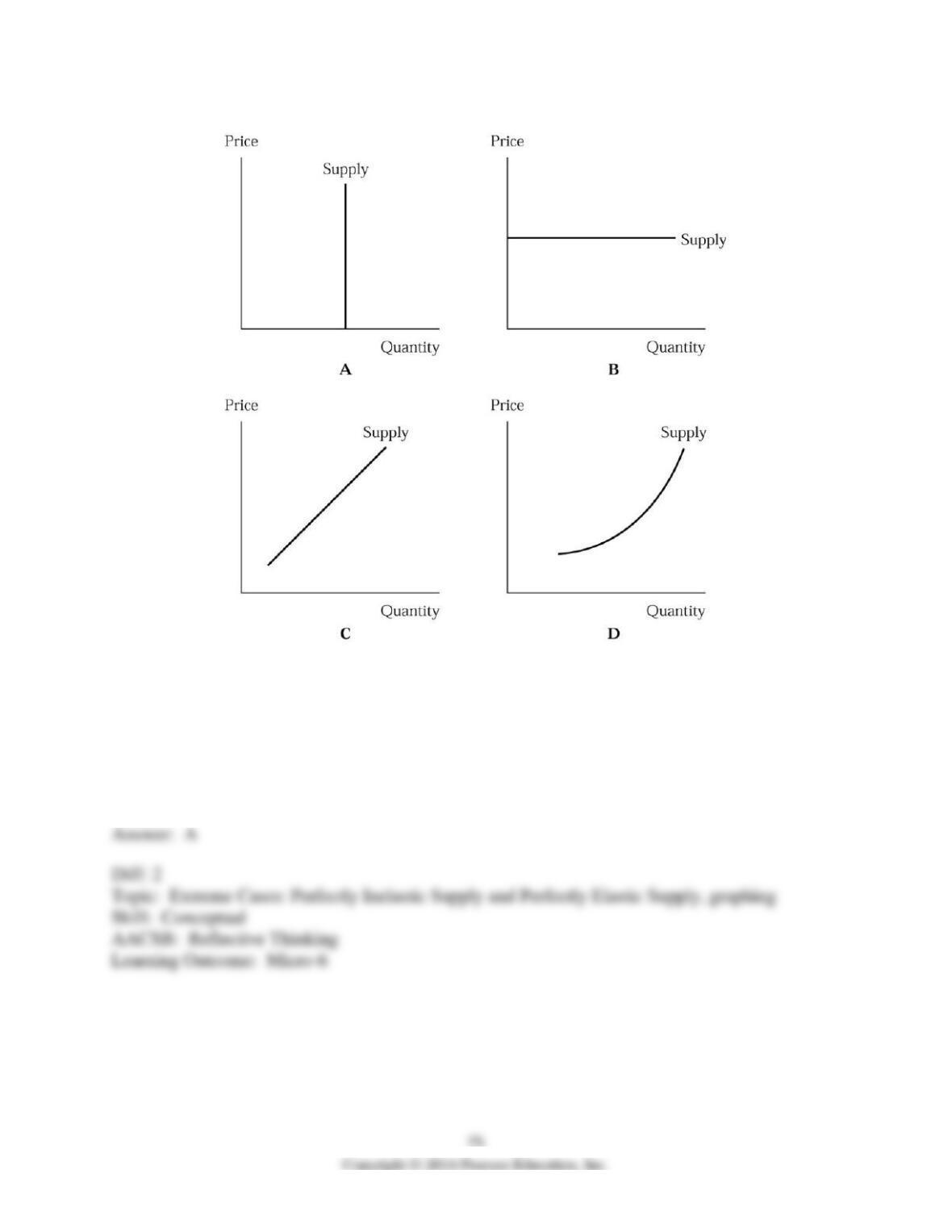
Figure 4.4
31) In Figure 4.4 supply is perfectly inelastic in graph
A) A.
B) B.
C) C.
D) D.
32) In Figure 4.4 supply elasticity is zero in graph
A) A.
B) B.
C) C.
D) D.
33) In Figure 4.4 supply is perfectly elastic in graph
A) A.
B) B.
C) C.
D) D.
34) In Figure 4.4 supply elasticity is infinite in graph
A) A.
B) B.
C) C.
D) D.
35) Suppose that the price elasticity of supply is 0.8 and the price increases by 10%. We would
predict
A) an 8% increase in quantity supplied.
B) a 12.5% increase in quantity supplied.
C) a 0.8% increase in quantity supplied.
D) a 1.25% increase in quantity supplied.
36) Suppose that the price elasticity of supply is 1.25 and the quantity supplied increases by
10%. Other things being equal, the percentage change in the price should be
A) a 0.8% increase in the price.
B) an 8% increase in the price.
C) a 1.25% increase in the price.
D) a 12.5% increase in the price.
37) Suppose that the price elasticity of supply is 0.5 and the price increases by 4%. We would
predict
A) an 8% increase in quantity supplied.
B) a 2% increase in quantity supplied.
C) a 0.8% increase in quantity supplied.
D) a 0.2% increase in quantity supplied.
38) Suppose that the price elasticity of supply is one and the quantity supplied increases by 5%.
Other things being equal, the percentage change in the price should be
A) a 0.5% increase in the price.
B) a 5% increase in the price.
C) a 0.2% increase in the price.
D) a 2% increase in the price.
Recall the Application about the short-run and long-run elasticity of supply of milk to
answer the following question(s). According to the Application, the price elasticity of
supply of milk over a one-year period is about 0.10, and in the long run, the price elasticity
of supply is 2.5.
39) Recall the Application. If the price of milk increases by 100% and stays there for a year, the
quantity of milk supplied will rise by about
A) 1%.
B) 10%.
C) 100%.
D) 1,000%.
40) Recall the Application. If the price of milk increases by 100%, then in the long run, the
quantity of milk supplied will rise by
A) 2.5%.
B) 25%.
C) 250%.
D) 2,500%.
41) If a 10% increase in price increases the quantity supplied by 15%, the price elasticity of
supply is 0.67.
42) Suppose that the price elasticity of supply of cheese is 0.80. If the price of cheese rises by
20%, the quantity supplied will increase by 16%.
43) If the quantity supplied is infinitely responsive to any change in price, the supply curve has a
price elasticity of supply equal to infinity.
44) If the quantity supplied is perfectly inelastic then quantity does not respond to price changes.
45) A vertical supply curve is infinitely elastic.
46) Suppose that last year the Tulane University men’s basketball team, the Green Wave, won
the NCAA tournament. As a result, attendance at Green Wave basketball games has increased
dramatically. Explain the difference between the supply of seats for Green Wave games in the
short term and in the long term. How would you describe the elasticity of supply of seats in the
long term?
47) One of the business revolutions of the 1980s is “just in time” inventory, a system where
businesses estimate their requirements for raw materials and keep no more on hand than is
necessary to complete that period’s production. What affect did the change to “just in time”
inventory have on short-term supply elasticities?
48) Draw the supply curve for a good whose price elasticity of supply is equal to zero. Be sure to
label both axes.
4.6 Using Elasticities to Predict Changes in Prices
1) Under which of the following conditions will an increase in demand cause a relatively small
increase in price?
A) If the shift of the demand curve is relatively small, the gap between the new demand and the
old supply will be relatively small.
B) If there is highly elastic demand, consumers are very responsive to changes in price.
C) If there is highly elastic supply, producers are very responsive to changes in price.
D) All of the above.
2) How is the price-change formula to predict the change in the equilibrium price resulting from
a change in demand calculated?
A) by dividing the percentage change in price by the sum of the price elasticities of supply and
demand
B) by dividing the percentage change in demand by the sum of the price elasticities of supply
and demand
C) by dividing the percentage change in supply by the sum of the price elasticities of supply and
demand
D) by dividing the percentage change in income by the sum of the price elasticities of supply and
demand
3) Suppose that the percentage change in demand is 10%, the price elasticity of supply is 2, and
the percentage change in the equilibrium price is 3.33%. What is the price elasticity of demand?
A) 0
B) 1
C) 2
D) 3
4) Suppose that the percentage change in demand is 20%, the price elasticity of demand is 3, and
the price elasticity of supply is 2. What is the percentage change in the equilibrium price?
A) 4%
B) 5%
C) 15%
D) 20%
5) Suppose that the percentage change in demand is 20%, the price elasticity of demand is 3, and
the percentage change in the equilibrium price is 4%. What is the price elasticity of supply?
A) 0
B) 2
C) 4
D) 5
6) Suppose that the percentage change in demand is 20%, the price elasticity of supply is 2, and
the percentage change in the equilibrium price is 4%. What is the price elasticity of demand?
A) 0
B) 1
C) 2
D) 3
7) Suppose that the percentage change in supply is 20%, the price elasticity of demand is 3, and
the price elasticity of supply is 2. What is the percentage change in the equilibrium price?
A) 4%
B) 5%
C) 15%
D) 20%
8) Suppose that the percentage change in supply is 20%, the price elasticity of supply is 2, and
the percentage change in the equilibrium price is 4%. What is the price elasticity of demand?
A) 0
B) 1
C) 2
D) 3
9) An increase in demand will cause a relatively small increase in price when
A) the increase in demand is small.
B) demand is highly elastic.
C) supply is highly elastic.
D) all of the above
10) An increase in demand will cause a relatively small increase in price when
A) the increase in demand is large.
B) demand is highly inelastic.
C) supply is highly elastic.
D) all of the above
11) An increase in demand will cause a relatively small increase in price when
A) the increase in demand is large.
B) demand is highly elastic.
C) supply is highly inelastic.
D) all of the above
12) Suppose that the percentage change in demand is 10%, the price elasticity of demand is 1,
and the percentage change in the equilibrium price is 3.33%. What is the price elasticity of
supply?
A) 0
B) 1
C) 2
D) 3
13) Suppose that the percentage change in supply is 20%, the price elasticity of demand is 3, and
the percentage change in the equilibrium price is 4%. What is the price elasticity of supply?
A) 0
B) 2
C) 4
D) 5
Recall the Application about how changes in supply affect the price of gasoline to answer
the following question(s).
14) Recall the Application. Suppose the price elasticity of demand for gasoline is 0.20 and the
price elasticity of supply for gasoline is 0.55. If supply decreases by 50%, the equilibrium price
will increase by
A) 67%.
B) 70%.
C) 143%.
D) 150%.
15) Recall the Application. Suppose the price elasticity of demand for gasoline is 0.20 and the
price elasticity of supply for gasoline is 0.55. If supply increases by 20%, the equilibrium price
will decrease by
A) 27%.
B) 57%.
C) 175%.
D) 375%.
16) If the demand for a product decreases by 16% and the supply elasticity is 1.2 and demand
elasticity is 0.80. Then the equilibrium price will decrease by 6%.
17) If demand increases, the increase in price will be smaller if demand and supply are highly
inelastic.
18) If supply decreases, the increase in price will be smaller if demand and supply are highly
elastic.
19) Given percentage change in supply and the price elasticity of supply, percentage change in
equilibrium price is zero if demand curve is perfectly inelastic
20) What will make a change in demand cause a large change in price?
21) Given percentage change in supply and the price elasticity of supply, explain how percentage
change in equilibrium price varies as the price elasticity of demand changes from 0 to infinity.
22) What will make a change in supply cause a small change in price?