Use properties of logarithms to condense the logarithmic expression. Write the expression as a single logarithm whose
coefficient is 1. Where possible, evaluate logarithmic expressions.
177)
1
4(log4 x +log4 y) –3log4 (x +7)
177)
A)
log4
4xy
(x +7)3
B)
log4
4xy
3(x +7)
C)
log4
4x + y
(x +7)3
D)
log4
4x+4y
(x +7)3
Use properties of logarithms to expand the logarithmic expression as much as possible. Where possible, evaluate
logarithmic expressions without using a calculator.
178)
log35x4y
9
178)
A)
1
5(log3x4y –log39)
B)
4
5log3 x +1
5log3 y –2
5
C)
4
5log3 x –1
5log3 y +2
5
D)
1
5(log3x4+log3 y – 2)
Solve the exponential equation. Express the solution set in terms of natural logarithms.
179)
e3x =8
179)
A)
ln 8
3
B)
{3 ln 8}
C)
ln 3
8
D)
8
3e
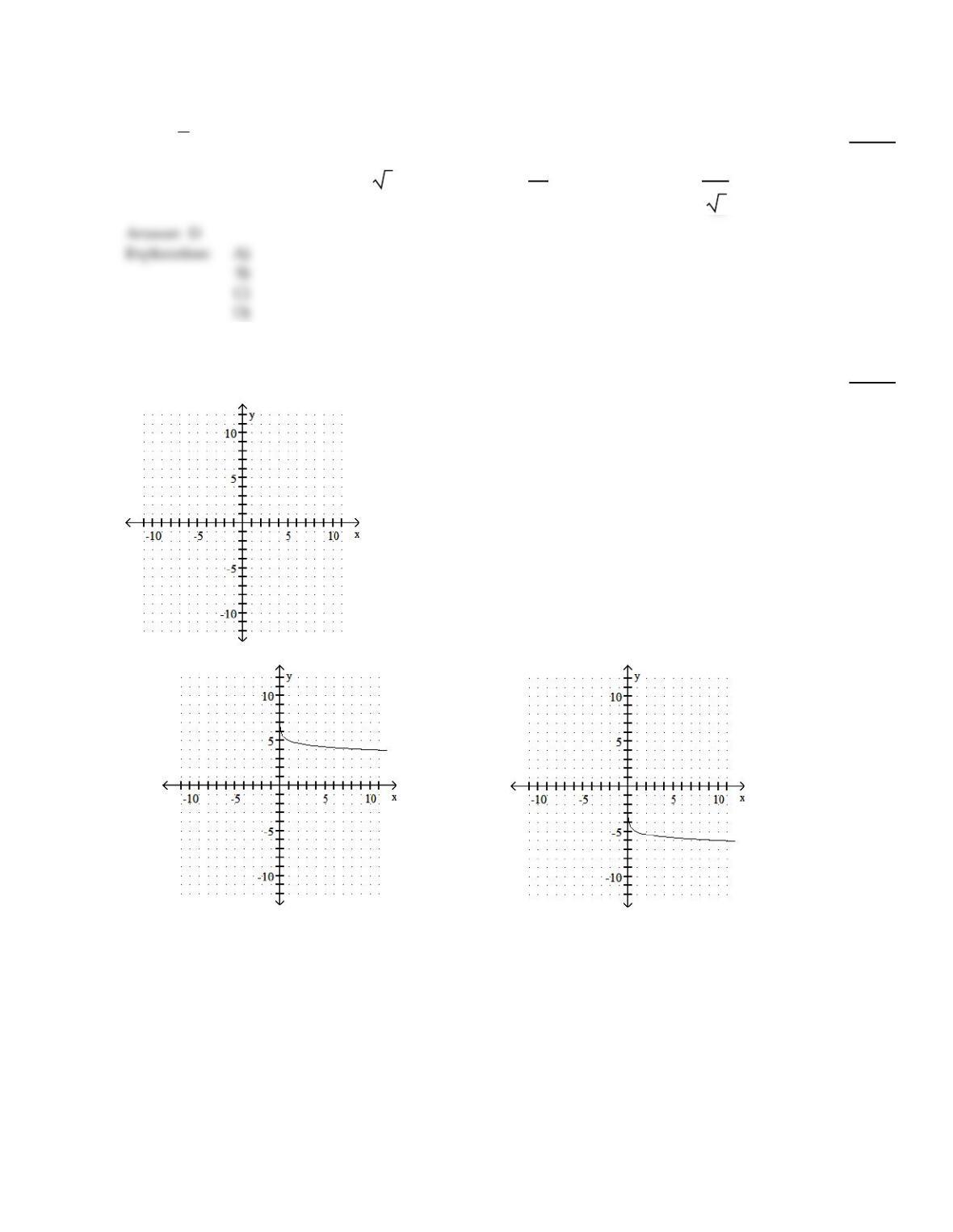
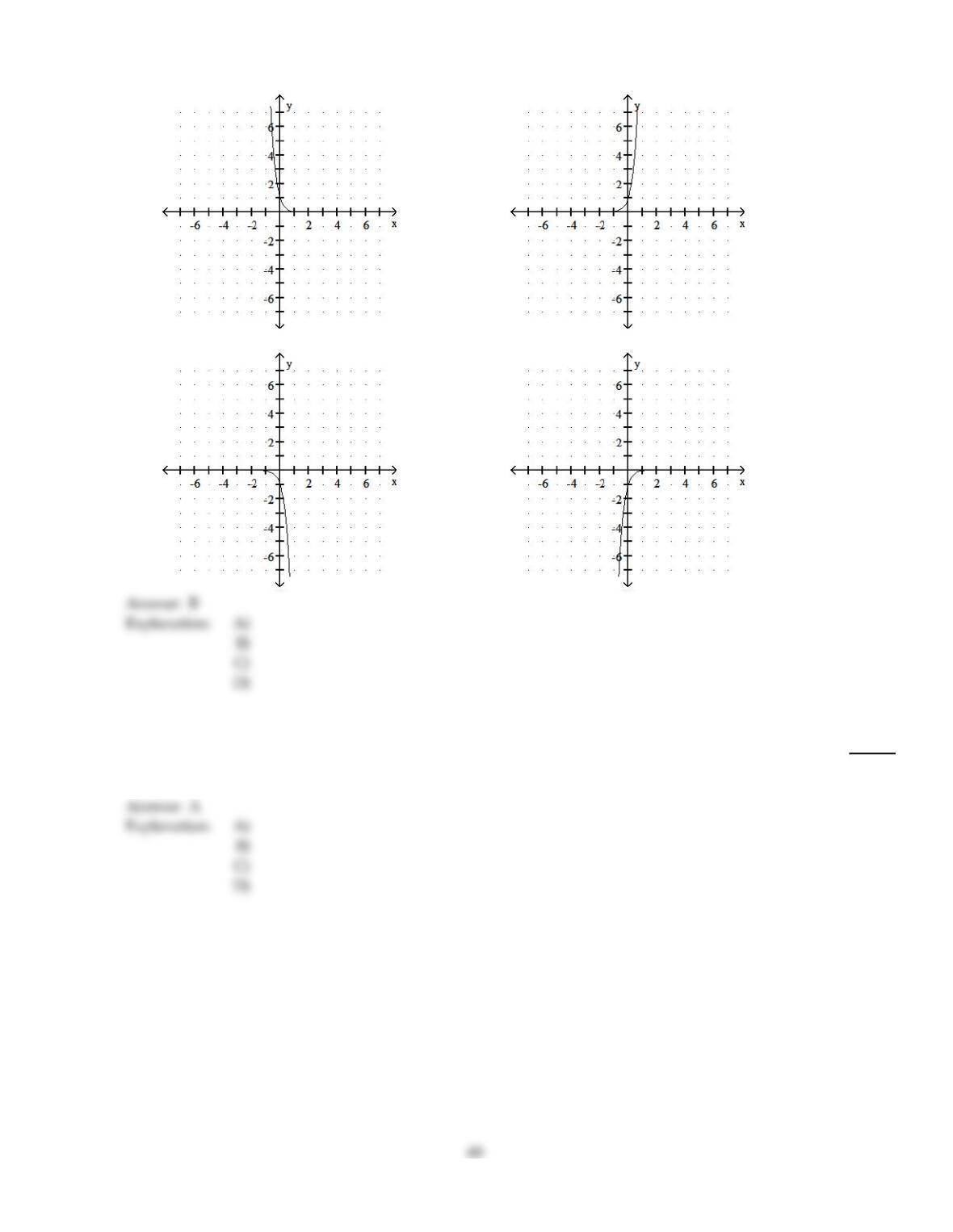
Graph the function.
61
180)
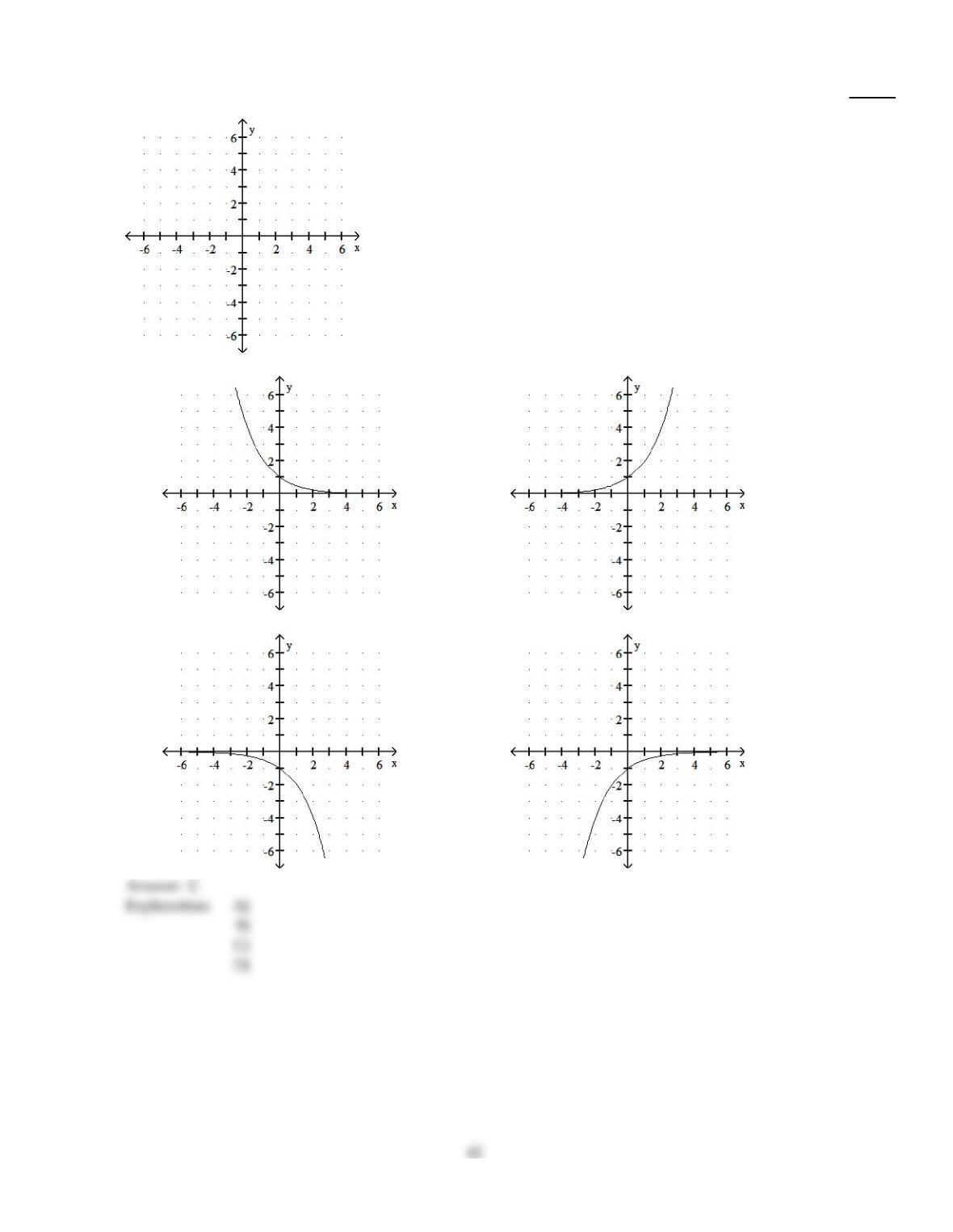
Use the graph of f(x) =2x to obtain the graph of g(x) = – 2x.
180)
A)
B)
C)
D)
Solve the exponential equation. Express the solution set in terms of natural logarithms.
181)
4x + 4 =52x + 5
181)
A)
ln 55
44–4
52
B)
5 ln 5 – 4 ln 4
ln 4 – 2 ln 5
C)
{7 ln 5 – 5 ln 4}
D)
{ln 5 – ln 4}
Solve.
182)
The half–life of silicon–32 is 710 years. If 30 grams is present now, how much will be present in 300
years? (Round your answer to three decimal places.)
182)
A)
22.383
B)
0
C)
29.134
D)
1.604
Solve the logarithmic equation. Be sure to reject any value that is not in the domain of the original logarithmic
expressions. Give the exact answer.
183)
log2 (x + 4) –log2 (x – 2) =2
183)
A)
{– 4}
B)
{4}
C)
{2}
D)
Use the compound interest formulas A = P 1 +r
n
nt and A = Pert to solve.
184)
Find the accumulated value of an investment of $10,000 at 4% compounded semiannually for 5
years.
184)
A)
$12,189.94
B)
$12,000.00
C)
$11,040.81
D)
$12,166.53
63
Evaluate or simplify the expression without using a calculator.
185)
ln 6e
185)
A)
6
B)
1
6
C)
6e
D)
e
6
Use properties of logarithms to expand the logarithmic expression as much as possible. Where possible, evaluate
logarithmic expressions without using a calculator.
186)
log X–2
186)
A)
2+ log X
B)
–2+ log X
C)
–2log X
D)
2log X
Graph the function.
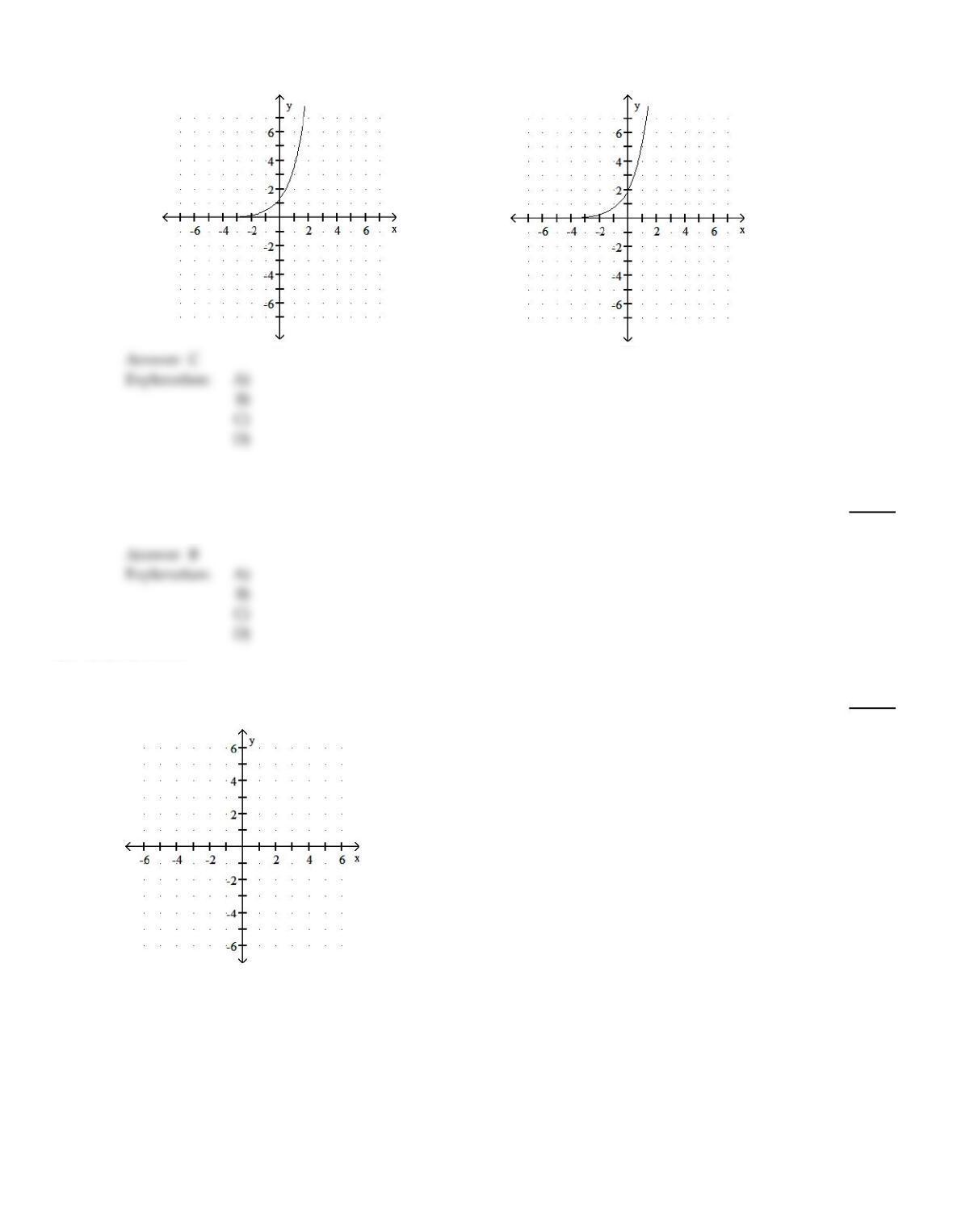
187)
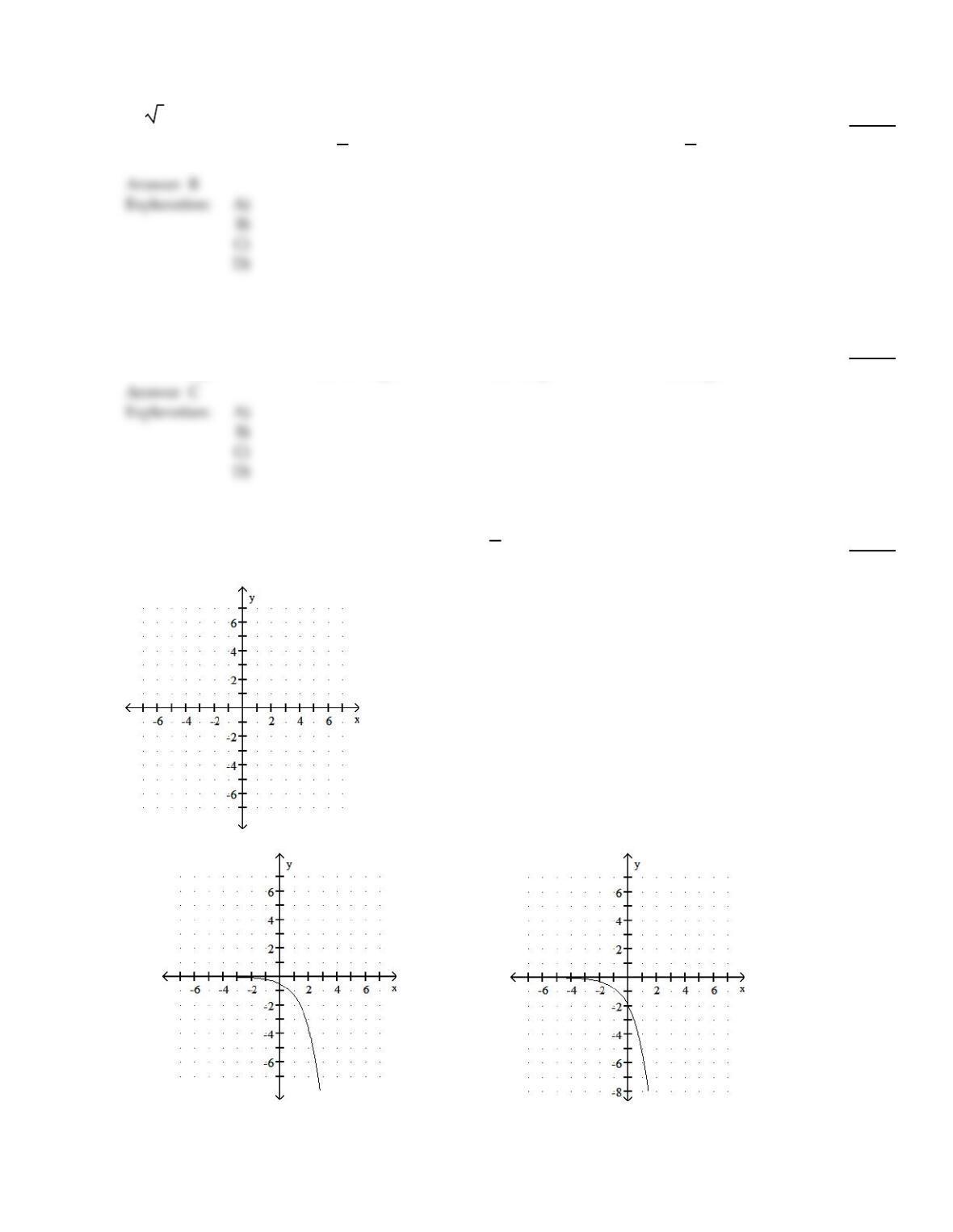
Use the graph of f(x) =ex to obtain the graph of g(x) =1
2ex.
187)
A)
B)
64
C)
D)
Write the equation in its equivalent logarithmic form.
188)
52=25
188)
A)
log 25 5=2
B)
log 525 =2
C)
log 52=25
D)
log 225 =5
Graph the function.
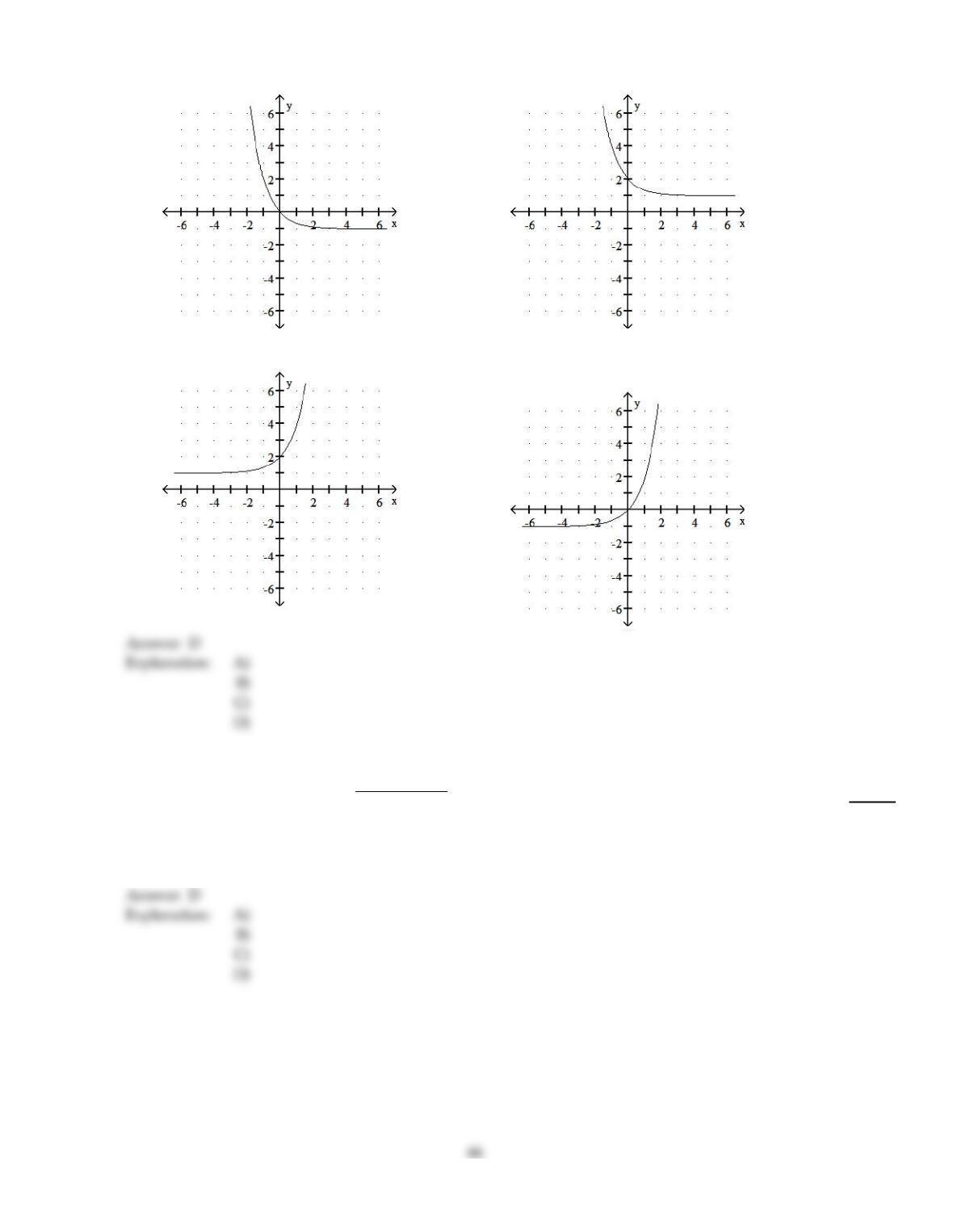
189)
Use the graph of f(x) =3x to obtain the graph of g(x) =3x– 1.
189)
65
A)
B)
C)
D)
Solve the problem.
190)
The logistic growth function f(t) =560
1 +5.2e–0.16t describes the population of a species of butterflies
t months after they are introduced to a non–threatening habitat. What is the limiting size of the
butterfly population that the habitat will sustain?
190)
A)
1120 butterflies
B)
90 butterflies
C)
5 butterflies
D)
560 butterflies
Use properties of logarithms to condense the logarithmic expression. Write the expression as a single logarithm whose
coefficient is 1. Where possible, evaluate logarithmic expressions.
191)
2 ln x –1
4 ln y
191)
A)
ln x2y4
B)
ln x24y
C)
ln x2
y4
D)
ln x2
4y
Graph the function.
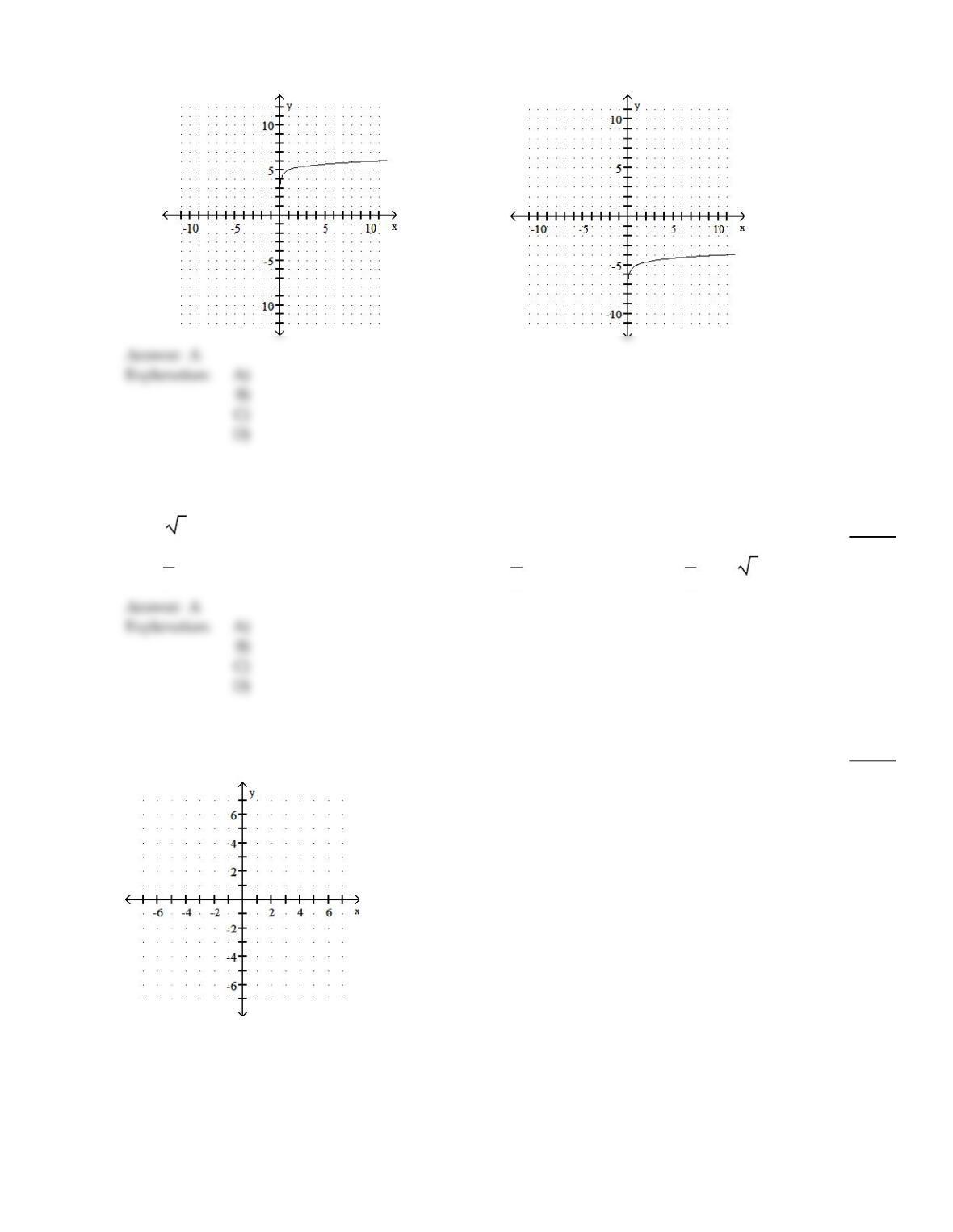
192)
Use the graph of f(x) = log x to obtain the graph of g(x) =5– log x.
192)
A)
B)
67
C)
D)
Use properties of logarithms to expand the logarithmic expression as much as possible. Where possible, evaluate
logarithmic expressions without using a calculator.
193)
log 8
3y
193)
A)
1
3log 8y
B)
3log 8y
C)
1
8log 3y
D)
1
3log 8
3y
Graph the function.
194)
Use the graph of f(x) =ex to obtain the graph of g(x) =e3x.
194)
68
A)
B)
C)
D)
Solve.
195)
A fossilized leaf contains 15% of its normal amount of carbon 14. How old is the fossil (to the
nearest year)? Use 5600 years as the half–life of carbon 14.
195)
A)
15,299
B)
35,828
C)
21,839
D)
1311
Solve the problem.
196)
The logistic growth function f(t) =92,000
1 +1313.3e–1.4t models the number of people who have
become ill with a particular infection t weeks after its initial outbreak in a particular community.
What is the limiting size of the population that becomes ill?
196)
A)
1313 people
B)
184,000 people
C)
1314 people
D)
92,000 people
Use properties of logarithms to expand the logarithmic expression as much as possible. Where possible, evaluate
logarithmic expressions without using a calculator.
197)
log 2
x2
y7
197)
A)
2log 2x +7log 2y
B)
2log 2x –7log 2y
C)
2
7log 2(x
y)
D)
7log 2y –2log 2x
198)
log5
125
x – 1
198)
A)
3log55–1
2log5(x – 1)
B)
3–log5x – 1
C)
3–1
2log5(x – 1)
D)
log5125 –log5x – 1
Write the equation in its equivalent exponential form.
199)
log 39=2
199)
A)
92=3
B)
23=9
C)
39=2
D)
32=9
Use properties of logarithms to condense the logarithmic expression. Write the expression as a single logarithm whose
coefficient is 1. Where possible, evaluate logarithmic expressions.
200)
3log 6x + 5 log 6(x – 6)
200)
A)
log 6x(x – 6)
B)
log 6x(x – 6)15
C)
15 log 6x(x – 6)
D)
log 6x3(x – 6)5
201)
log cm+log cn
201)
A)
log c(mn)
B)
log c(m + n)
C)
log cm·log cn
D)
log c(m
n)
Solve the exponential equation. Use a calculator to obtain a decimal approximation, correct to two decimal places, for the
solution.
202)
4x=19
202)
A)
0.47
B)
4.08
C)
0.77
D)
2.12
Solve.
203)
The function A =A0e–0.01386x models the amount in pounds of a particular radioactive material
stored in a concrete vault, where x is the number of years since the material was put into the vault.
If 300 pounds of the material are placed in the vault, how much time will need to pass for only 38
pounds to remain?
203)
A)
300 years
B)
155 years
C)
149 years
D)
160 years
Evaluate the expression without using a calculator.
204)
log 10 10,000
204)
A)
4
B)
1
10000
C)
40
D)
–4
Solve the problem.
205)
A sample of 900 g of lead–210 decays to polonium–210 according to the function given by
A(t) =900e–0.032t, where t is time in years. What is the amount of the sample after 50 years (to the
nearest g)?
205)
A)
132 g
B)
182 g
C)
4458 g
D)
28 g
Solve the logarithmic equation. Be sure to reject any value that is not in the domain of the original logarithmic
expressions. Give the exact answer.
206)
log 8(4x + 2) =log 8(4x + 5)
206)
A)
{3}
B)
7
3
C)
{0}
D)
Use properties of logarithms to expand the logarithmic expression as much as possible. Where possible, evaluate
logarithmic expressions without using a calculator.
207)
log 3x344– x
4(x +4)2
207)
A)
log 3+ log x3+ log (4 – x)1/4– log 4– log (x +4)2
B)
log 3+3log x +1
4log (4– x) – log 4– 2log (x +4)
C)
log 3+3log x +1
4log (4– x) – log 4+ 2log (x +4)
D)
log (3x344– x) – log (4(x +4)2)
Solve the problem.
208)
The pH of a solution ranges from 0 to 14. An acid has a pH less than 7. Pure water is neutral and
has a pH of 7. The pH of a solution is given by pH = – log x where x represents the concentration of
the hydrogen ions in the solution in moles per liter. Find the pH if the hydrogen ion concentration
is 1 x 10⁻².
208)
A)
12
B)
–2
C)
2
D)
–12
Use properties of logarithms to expand the logarithmic expression as much as possible. Where possible, evaluate
logarithmic expressions without using a calculator.
209)
log 57–3
209)
A)
7log 53
B)
–15 log 7
C)
–3log 57
D)
5log 37
Solve the exponential equation. Use a calculator to obtain a decimal approximation, correct to two decimal places, for the
solution.
210)
e2x –3–4=1402
210)
A)
1.57
B)
3.62
C)
3.07
D)
5.12
Approximate the number using a calculator. Round your answer to three decimal places.
211)
2–3.3
211)
A)
10.890
B)
0.102
C)
–6.600
D)
0.402
73
Use properties of logarithms to condense the logarithmic expression. Write the expression as a single logarithm whose
coefficient is 1. Where possible, evaluate logarithmic expressions.
212)
log x + log 9
212)
A)
log (x +9)
B)
log x
9
C)
(log x)(log 9)
D)
log 9x
Solve the problem.
213)
The logistic growth function f(t) =720
1 +8.0e–0.13t describes the population of a species of butterflies
t months after they are introduced to a non–threatening habitat. How many butterflies were
initially introduced to the habitat?
213)
A)
8 butterflies
B)
2 butterflies
C)
720 butterflies
D)
80 butterflies
214)
The pH of a solution ranges from 0 to 14. An acid has a pH less than 7. Pure water is neutral and
has a pH of 7. The pH of a solution is given by pH = – log x where x represents the concentration of
the hydrogen ions in the solution in moles per liter. Find the hydrogen ion concentration if the
pH =4.4.
214)
A)
2.51 x 10⁻⁴
B)
3.98 x 10⁻⁵
C)
3.98 x 10⁻⁴
D)
2.51 x 10⁻⁵
Answer Key
Testname: C4
Answer Key
Testname: C4
Answer Key
Testname: C4
Answer Key
Testname: C4
78
Answer Key
Testname: C4