219)
Rent controls primarily benefit
219)
A)
property owners.
B)
builders.
C)
people who already occupy rental units.
D)
people looking for rental units.
220)
Rationing of resources, goods, and services
220)
A)
must be done by the government.
B)
happens only when the price is zero.
C)
is not required under the price system.
D)
is required because of scarcity.
221)
In order to be effective, a price floor
221)
A)
must be set at equilibrium price.
B)
must be set below equilibrium price.
C)
must be set above equilibrium price.
D)
must be a zero price.
222)
In the United States, government–imposed price supports are most often associated with
222)
A)
consumer electronics.
B)
agricultural products.
C)
industrial products.
D)
commercial building products.
223)
In a price system, changes in prices
223)
A)
make it difficult for the system to function well.
B)
signal to everyone in the system what goods are relatively more or less scarce.
C)
signal to policy makers what goods should and should not be taxed more.
D)
imply that people have made mistakes in the past.
224)
The price of labor in the agricultural industry has just increased. For agricultural products, this will
lead to
224)
A)
an increase in price and a decrease in quantity.
B)
a decrease in price and an increase in quantity.
C)
an increase in price and an increase in quantity.
D)
a decrease in price and a decrease in quantity.
225)
What is the result of an agricultural support price established above the equilibrium price?
225)
A)
The market gravitates toward and remains in equilibrium.
B)
There will be excess quantity demanded the product in this market.
C)
There will be excess quantity supplied of the product involved.
D)
Since the support price is set above the equilibrium price, it will have no impact on the
market price.
C
226)
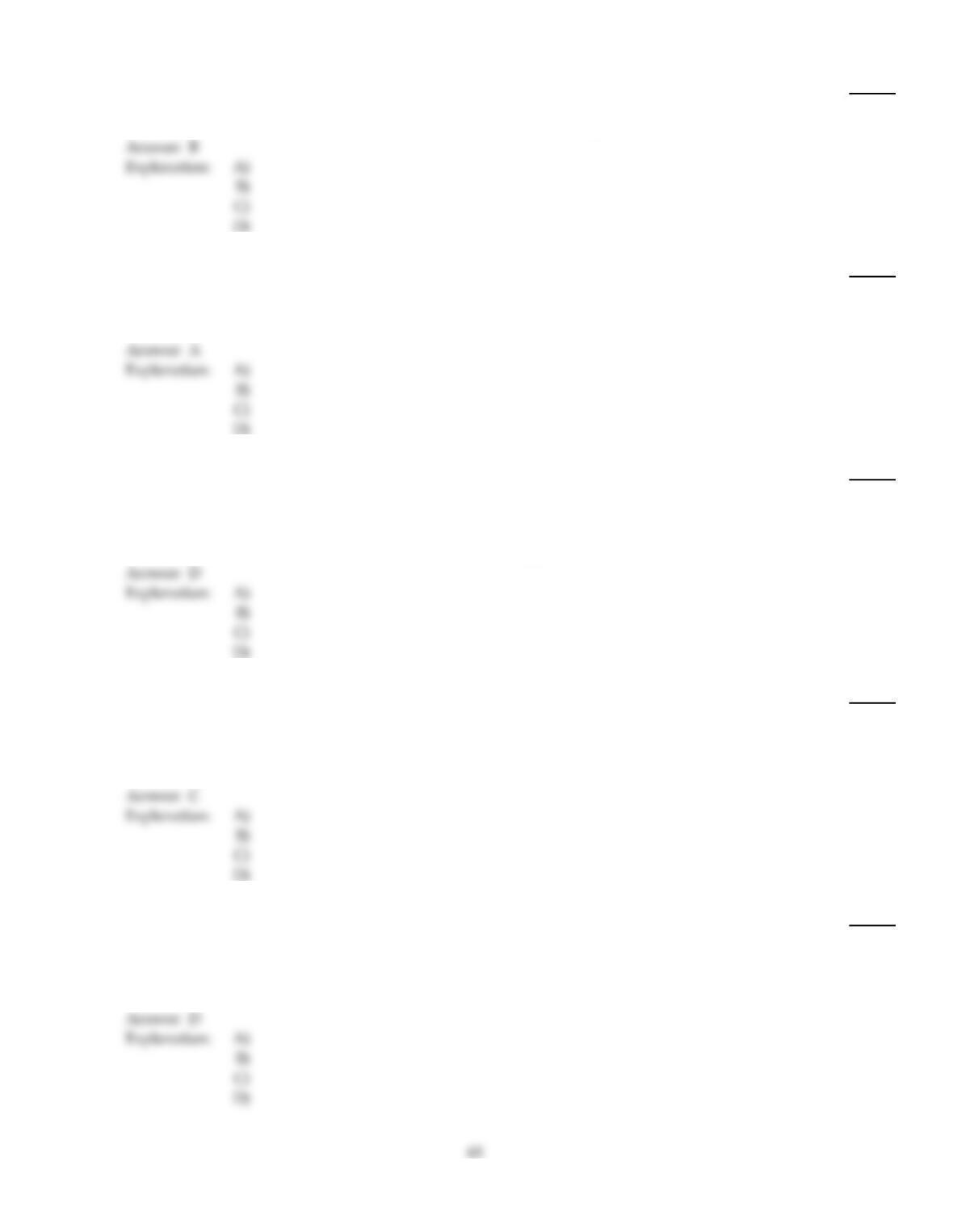
Refer to the above figure. If the government imposes a price floor of $60
226)
A)
the quantity of goods that will be traded is 200.
B)
the quantity of goods that will be traded is 100.
C)
the quantity of goods that will be traded is 150.
D)
the quantity of goods that will be traded is 0.
B
A
227)
Which rationing system leads to the most efficient use of available resources?
227)
A)
first come, first served
B)
free market
C)
physical force
D)
random assignment
228)
Suppose the equilibrium quantity of ethanol has decreased. Which of the following could have
caused this change?
228)
A)
a decrease in demand
B)
an increase in supply
C)
an increase in quantity supplied
D)
an increase in quantity demanded
A
229)
Suppose you are told that the equilibrium price of gasoline has increased, while the equilibrium
quantity of gasoline has fallen. You are also told that either the demand changed or supply
changed, but not both. Which of the following must have occurred?
229)
A)
Demand decreased.
B)
Demand increased.
C)
Supply increased.
D)
Supply decreased.
D
230)
Which of the following will likely occur when price floors in agriculture are implemented?
230)
A)
Supply will decrease.
B)
Farmland will be underutilized.
C)
Quantity supplied will exceed quantity demanded.
D)
Quantity demanded will exceed quantity supplied.
C
231)
Rationing through the price system
231)
A)
leads to high prices.
B)
leads to an inefficient use of available resources.
C)
works only with government interference.
D)
leads to an efficient use of available resources.
D
B
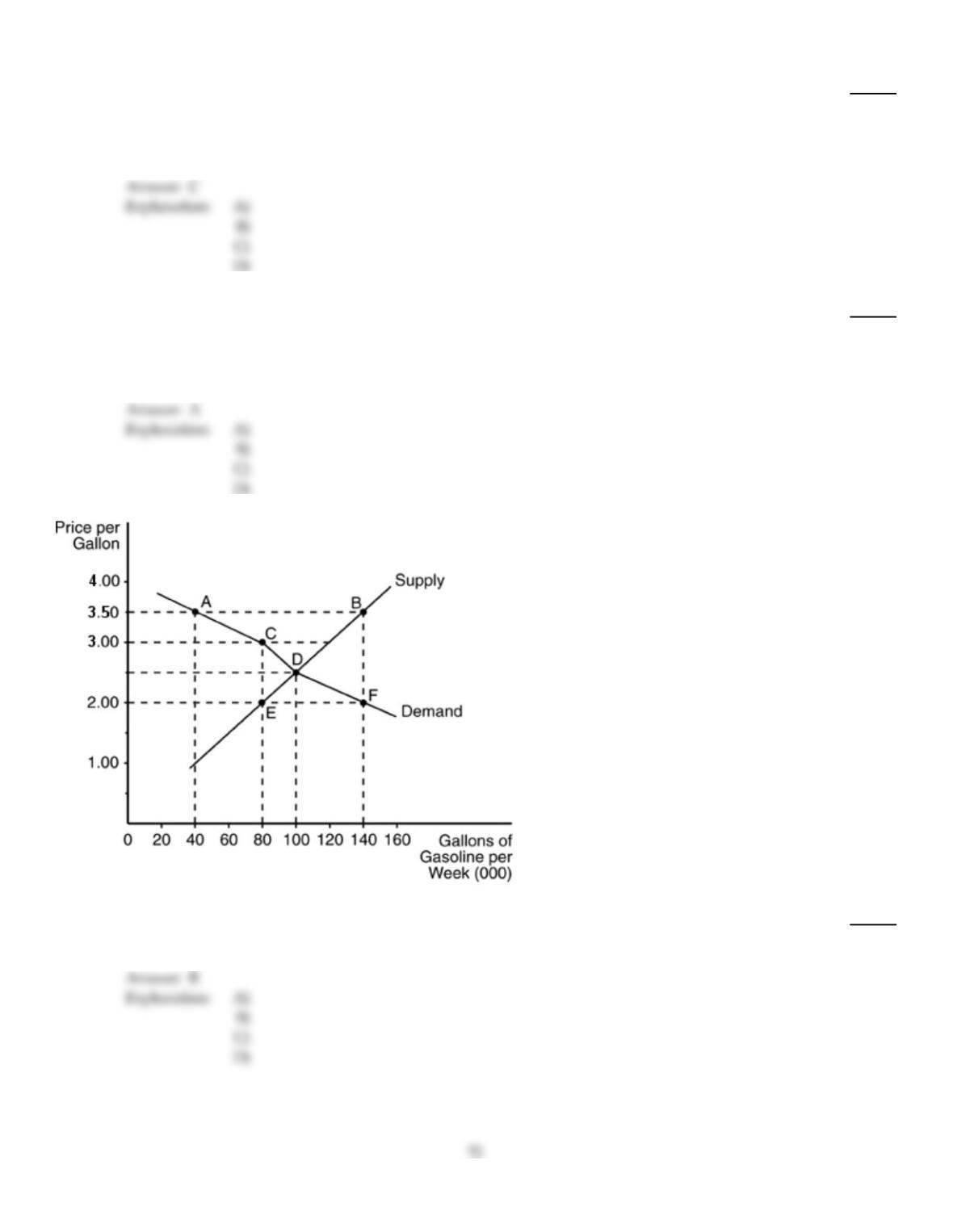
232)
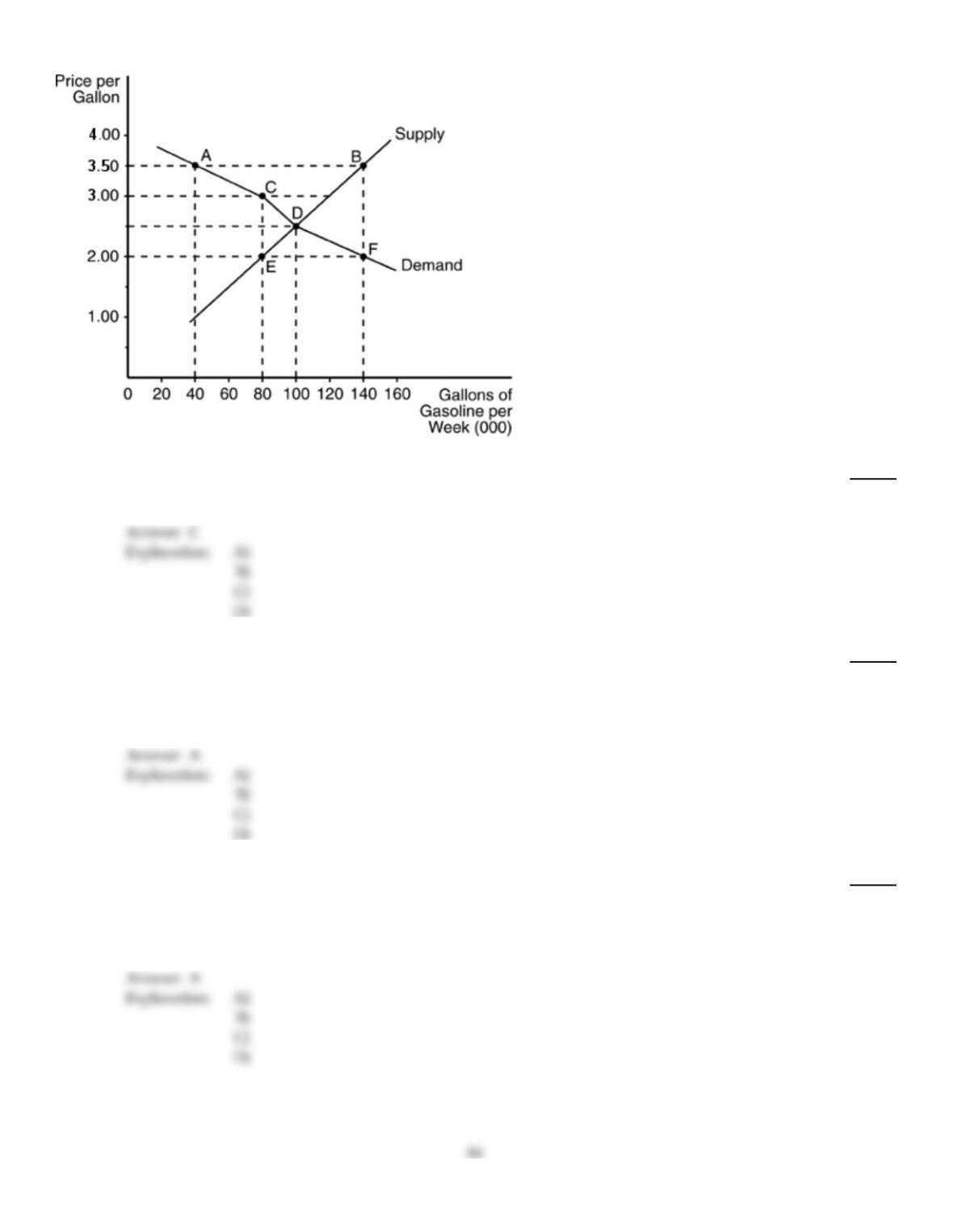
Refer to the above figure. At a price of $2 per gallon, the quantity demanded of gasoline is
232)
A)
60,000 gallons per month.
B)
80,000 gallons per month.
C)
140,000 gallons per month.
D)
100,000 gallons per month.
233)
Price floors
233)
A)
create surpluses by setting the price above equilibrium.
B)
create shortages by setting the price above equilibrium.
C)
provide free market incentives for producers.
D)
are used by advocates of the free market.
A
234)
Excess quantity demanded may result from
234)
A)
a government–imposed maximum price below market equilibrium.
B)
an oversupply of output.
C)
technological progress.
D)
a government–imposed minimum price above market equilibrium.
A
C
235)
If one day it was discovered that lime juice caused cancer, which of the following would likely
result?
235)
A)
The demand curve for lime juice would shift to the right.
B)
The supply curve for lime juice would shift to the right.
C)
The demand curve for lime juice would shift to the left.
D)
The supply curve for lime juice would shift to the left.
236)
Price ceilings often generate
236)
A)
black markets.
B)
market clearing prices.
C)
rapid increases in supply to meet the excess demand.
D)
equilibriums that utilize rationing by price.
A
237)
Rent controls are an example of a
237)
A)
price floor for the consumer and a price ceiling for the producer.
B)
nonprice rationing device.
C)
price ceiling.
D)
price floor.
C
C
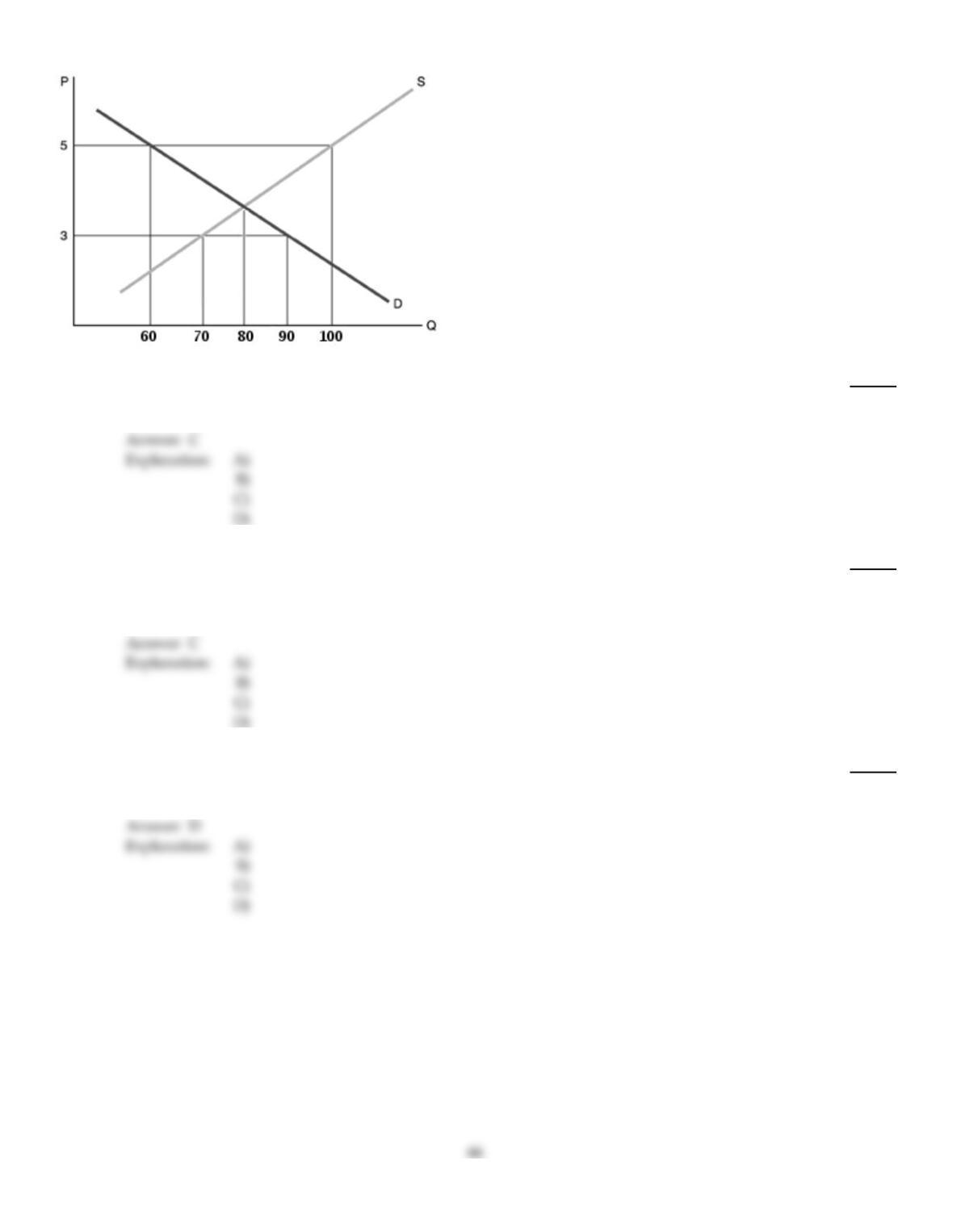
238)
Refer to the above figure. If a price floor of $3 was set
238)
A)
there would be a surplus of 40 units.
B)
there would be a shortage of 40 units.
C)
the quantity sold would be 80 units.
D)
there would be a shortage of 20 units.
239)
Which of the following statements about markets is correct?
I. A market helps resources move to their highest–valued uses by means of prices changes.
II. A market represents the exchanges of both buyers and sellers.
239)
A)
I only
B)
II only
C)
Both I and II
D)
Neither I nor II
240)
A price floor set below the equilibrium price will cause which of the following?
240)
A)
a surplus
B)
a shortage
C)
an increase in demand
D)
none of the above
241)
When a government increases an effective price ceiling for a product
241)
A)
the shortage in the market will be increased.
B)
the surplus in the market will increase.
C)
the surplus in the market will be reduced.
D)
the shortage in the market will be reduced.
242)
Suppose there is a simultaneous increase in demand and increase in supply. Given this
information, we know with certainty that
242)
A)
both the equilibrium price and the equilibrium quantity will increase.
B)
the equilibrium price will increase, and the equilibrium quantity will increase.
C)
the equilibrium price will increase.
D)
the equilibrium quantity will increase.
243)
An example of a quantity restriction is
243)
A)
the minimum wage.
B)
rent controls.
C)
an import quota.
D)
price supports in agriculture.
244)
Because of scarcity, rationing is
244)
A)
unimportant because prices clear markets.
B)
unimportant because people get what they want.
C)
not a problem because governments can determine what everybody wants.
D)
necessary because people cannot get everything they want.
245)
In a freely operating market system, queuing is most likely to occur when
245)
A)
selling necessities.
B)
the market clearing price increases.
C)
demand increases gradually over time.
D)
demand fluctuates unpredictably and quickly.
246)
Price floors are designed to
246)
A)
allow free market prices to be achieved.
B)
establish a minimum allowable price.
C)
create shortages where none existed before.
D)
none of the above.
B
247)
Which of the following statements is NOT true about the rationing of goods?
247)
A)
Goods can be rationed by the use of coupons.
B)
Goods can be rationed by random.
C)
Goods can be rationed on a first come first serve basis.
D)
Goods can only be rationed by price.
D
248)
Who benefits primarily from rent controls?
248)
A)
poor people looking for low–income housing
B)
all who want to rent
C)
construction workers
D)
only renters who are able to get units at below–market rates
D
D
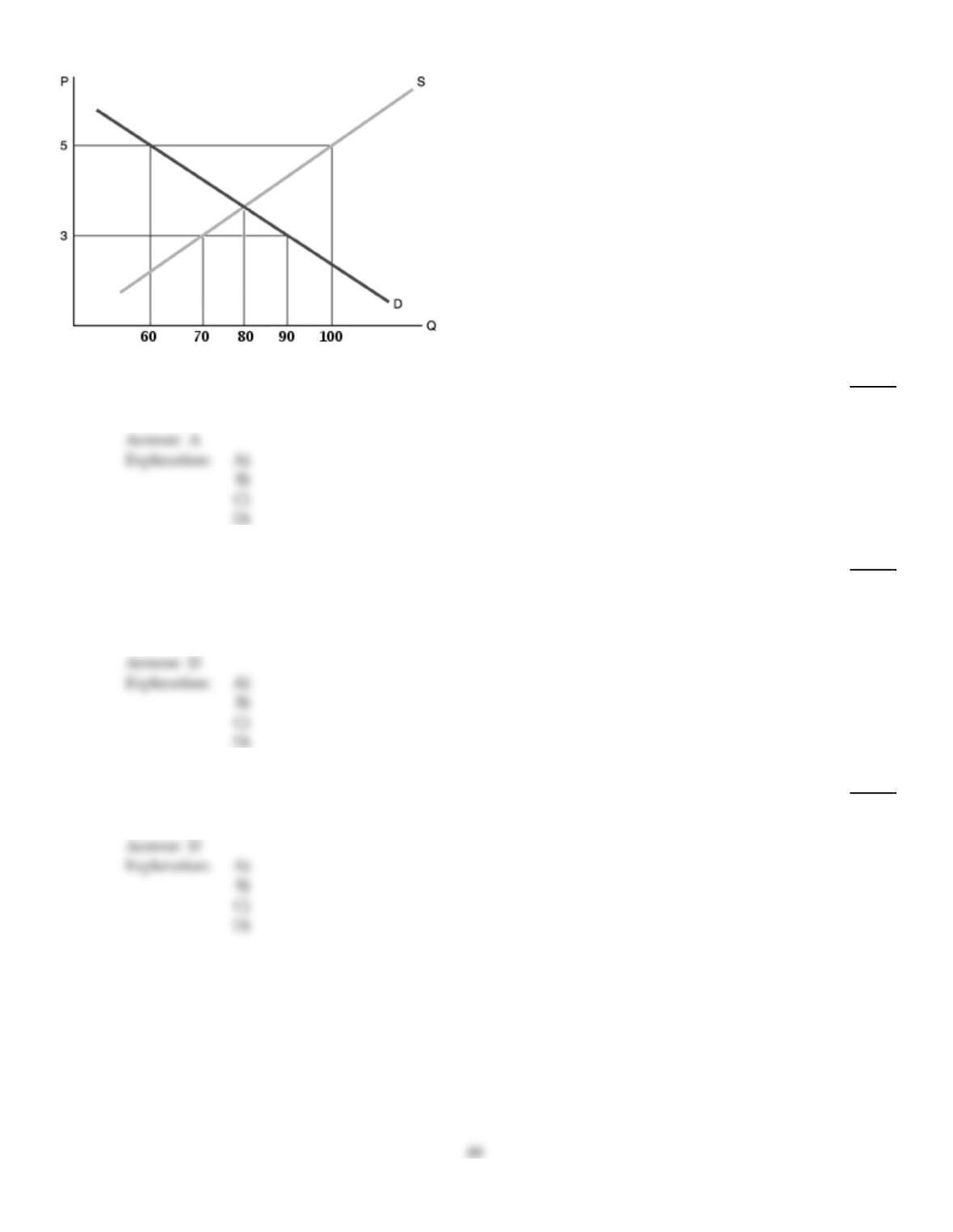
249)
Refer to the above figure. If a price floor of $5 was set
249)
A)
there would be a surplus of 40 units.
B)
there would be a shortage of 40 units.
C)
the quantity sold would be 80 units.
D)
there would be a shortage of 20 units.
250)
Suppose a price ceiling is set above the equilibrium price. Now suppose that policy makers decide
to raise the price ceiling. This increase in the price ceiling will cause which of the following to
occur?
250)
A)
The surplus in the market will decrease.
B)
The shortage in the market will increase.
C)
The surplus in the market will increase.
D)
none of the above
D
251)
Which of the following are ways to ration goods and services?
251)
A)
political power
B)
price
C)
physical force
D)
All of the above are correct.
D
A
252)
In the labor market, adjustments to changes in supply and demand
252)
A)
usually occur instantly.
B)
do not apply, since the labor market does not respond to supply and demand forces.
C)
do not apply, since wages in the labor market always go up.
D)
usually take time to occur.
253)
Nonprice rationing devices are required
253)
A)
so that prices will go back to equilibrium.
B)
to allocate goods when there is a price ceiling.
C)
when there are price floors but not when there are price ceilings.
D)
because the price system does not allocate resources efficiently.
B
254)
The income of consumers increases. and the wage rate in the DVD industry increases. As a result
254)
A)
the equilibrium quantity sold increases and price can either increase or decrease, depending
on whether the change in demand is greater than the change in supply.
B)
the equilibrium quantity sold can either increase or decrease and the price can either increase
or decrease, depending on whether the change in demand was greater than the change in
supply.
C)
the price of DVDs increases and the quantity sold can either increase, decrease or stay the
same depending on whether the change in demand was greater than the change in supply.
D)
the price of DVDs stays the same and the quantity sold can either increase or decrease,
depending on whether the change in demand is greater than the change in supply.
C
255)
Government policies such as price controls, rent controls, and quantity restrictions have the effect
of
255)
A)
promoting the attainment of an unhindered market equilibrium.
B)
creating excess quantities demanded or excess quantities supplied.
C)
allowing quantity demanded to adjust to equality with aggregate supply.
D)
pushing prices to market clearing levels more rapidly than private market forces.
B
D
256)
Who ultimately benefits from price supports in agriculture?
256)
A)
grocery store owners
B)
farmers
C)
consumers
D)
exporters
257)
If the government should decide to legalize marijuana, all other things remaining the same, we
should expect to see
257)
A)
an increase in the use of imported versus domestic marijuana.
B)
a decrease in the demand for marijuana.
C)
a decrease in the price of marijuana.
D)
an increase in the price of marijuana.
258)
Suppose a hurricane causes a great deal of destruction in Florida. After the hurricane, it takes much
longer than usual for the reconstruction to take place. A possible explanation for this is
258)
A)
government prevented price gouging during the reconstruction period.
B)
environmental restrictions on lumbering in the Pacific Northwest were relaxed.
C)
prices of construction materials fell in the Midwest.
D)
greed by suppliers of construction materials increased.
259)
An example of a black market is
259)
A)
scalping.
B)
barter.
C)
a discount market.
D)
a retail market.
260)
An effective price ceiling usually generates
260)
A)
happy sellers and dissatisfied buyers.
B)
higher nominal prices.
C)
the use of nonprice rationing devices.
D)
fire sales as firms try to unload their excess inventories.
261)
In economic terms, the total price of a pound of meat for an individual who has waited in line is
261)
A)
the money price of the meat plus the opportunity cost of time spent waiting in line.
B)
the money price of meat relative to the price of bread or other necessity.
C)
the money price paid to the butcher for the pound of meat.
D)
the money price of an equal amount of meat substitute, such as beans and rice.
262)
Refer to the above figure. At a price of $2 per gallon, there is
262)
A)
a surplus of 20,000 gallons per month.
B)
a shortage of 60,000 gallons per month.
C)
a shortage of 80,000 gallons per month.
D)
a shortage of 40,000 gallons per month.
263)
If demand and supply both increase
263)
A)
market clearing price definitely will increase but the change in the equilibrium quantity
cannot be determined without further information.
B)
the equilibrium quantity definitely will increase and market clearing price definitely will
decrease.
C)
the equilibrium quantity definitely will increase but the change in market clearing price
cannot be determined without more information.
D)
the equilibrium quantity definitely will increase and market clearing price definitely will
increase.
264)
Hospitals announce that there are not enough nurses available to keep them fully staffed.
Economically speaking, what does this announcement mean?
264)
A)
The market wage for trained nurses is currently above the equilibrium wage.
B)
The market wage for nurses will eventually rise to the market clearing wage.
C)
The market will adjust very rapidly to correct this imbalance because anyone can be a nurse
without any training.
D)
There is currently a surplus of nurses in this market.
265)
Rationing occurs for goods
265)
A)
that have a negative price.
B)
that have a positive price.
C)
that have a zero price.
D)
that are not manufactured.
266)
The City Council of Happy Village is thinking about imposing rent controls. If they put rent
controls in place, which constituency are they trying to please?
266)
A)
existing tenants
B)
landlords
C)
all taxpayers
D)
all voters
267)
A price floor represents
267)
A)
a lottery imposed upon producers by the government.
B)
a minimum price that can be legally charged for a good or service.
C)
a maximum price that can be legally charged for a product or service.
D)
a first come, first served mechanism for controlling prices.
268)
Markets tend to
268)
A)
increase transaction costs.
B)
make exchange more difficult.
C)
reduce transaction costs.
D)
exist primarily in towns or cities.
C
269)
Holding demand constant, an increase in supply leads to
269)
A)
higher prices and higher quantity demanded.
B)
lower prices and higher quantity demanded.
C)
higher prices and lower quantity demanded.
D)
lower prices and lower quantity demanded.
B
270)
In which decade did the U.S. federal government first establish a system of agricultural price
supports?
270)
A)
1990s
B)
1970s
C)
1930s
D)
1950s
C
271)
All other factors being constant, a reduction in price tends to cause which of the following?
271)
A)
a reduction in quantity supplied and an increase in quantity demanded
B)
a reduction in supply and an increase in demand
C)
an increase in quantity supplied and a reduction in quantity demanded
D)
an increase in supply and an increase in demand
A
B
272)
The total gains from trade within a price system is
272)
A)
the area beneath the market demand curve and above the market clearing price minus the
area beneath the market supply curve and beneath the market clearing price.
B)
the area beneath the market demand curve and above the market clearing price plus the area
above the market supply curve and beneath the market clearing price.
C)
always equal to zero.
D)
the area beneath the market supply curve and above the market clearing price plus the area
above the market demand curve and beneath the market clearing price.
273)
Economists assume that when there is a change in supply and/or demand, the market clearing price
returns to the equilibrium
273)
A)
after a protracted negotiation process.
B)
quickly.
C)
slowly.
D)
after an adjustment period.
274)
When rent controls establish a legal maximum rental rate below the equilibrium rental rate
274)
A)
quantity supplied exceeds quantity demanded.
B)
demand exceeds supply.
C)
supply exceeds demand.
D)
quantity demanded exceeds quantity supplied.
275)
Which of the following is an example of a price ceiling?
275)
A)
agricultural price supports
B)
the minimum wage
C)
rent controls
D)
None of the above is correct.
276)
The economy is undergoing a recession that has reduced consumers’ incomes. In the computer chip
market, this will lead to
276)
A)
an increase in price and a decrease in quantity.
B)
an increase in price and an increase in quantity.
C)
a decrease in price and a decrease in quantity.
D)
a decrease in price and an increase in quantity.
277)
An import quota
277)
A)
is a price ceiling imposed on an imported good.
B)
is a supply restriction limiting the quantity of a good that can be imported.
C)
is a price floor imposed on an imported good.
D)
is a legislative requirement stating that firms which import some of their merchandise must
hire a certain number of immigrant workers.
278)
Which one of the following statements is TRUE?
278)
A)
When the market clearing price of a good is the equilibrium, then everyone can afford it.
B)
An effective price floor results in a shortage of the good.
C)
An effective price ceiling results in a surplus of the good.
D)
The market clearing price of a good reflects its relative scarcity.
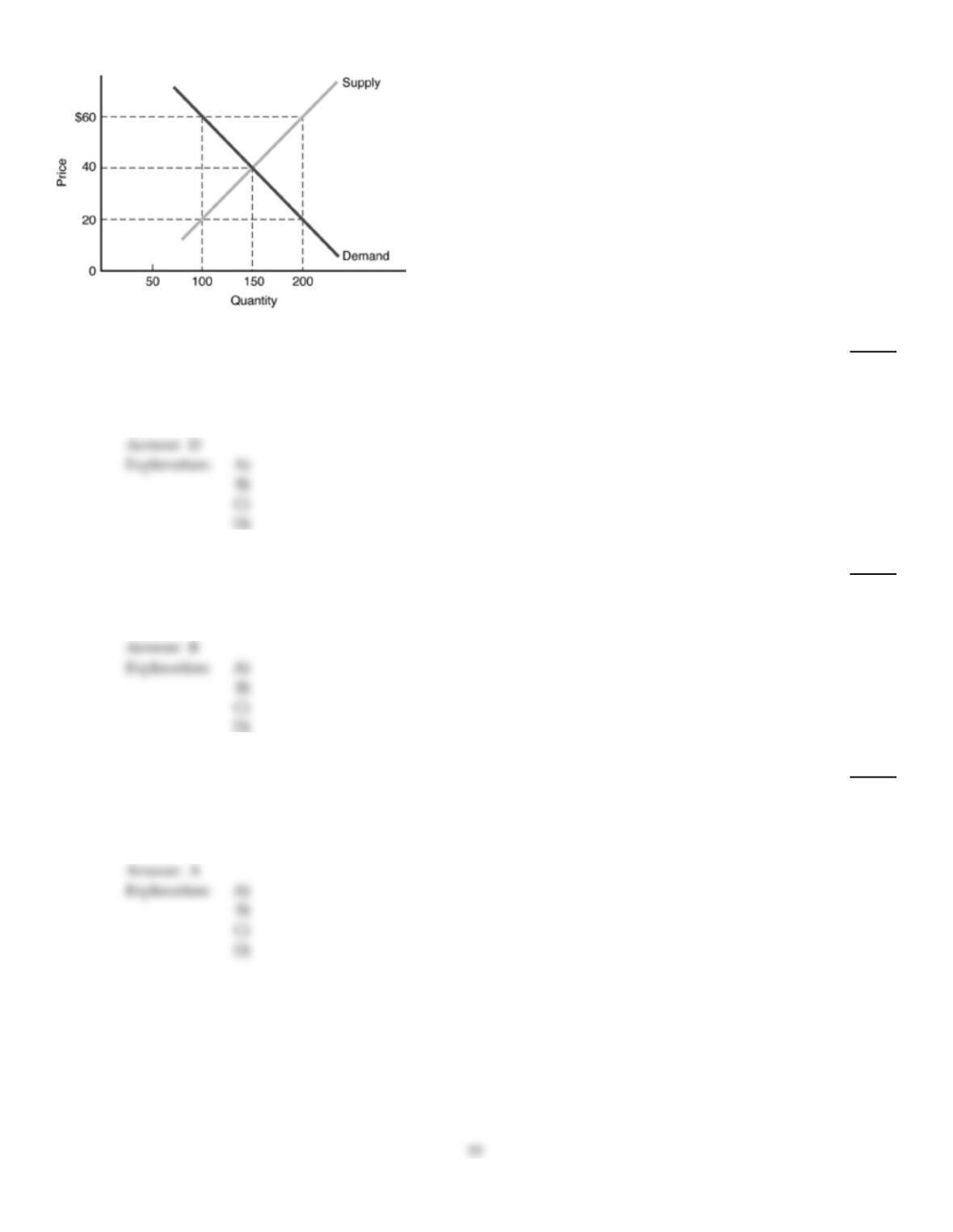
279)
Refer to the above figure. If the government imposes a price floor of $20
279)
A)
the quantity traded will be 100, and the price will be $20.
B)
the quantity traded will be 150, and the price will be $20.
C)
the quantity traded will be 200, and the price will be $20.
D)
none of the above.
280)
An economic system in which relative prices change to reflect changes in supply and demand for
different commodities is known as a
280)
A)
queuing system.
B)
market system.
C)
socialist system.
D)
communist system.
B
281)
If the demand for a product remains the same and the supply falls,
281)
A)
the market clearing price will rise and the equilibrium quantity will fall.
B)
both the market clearing price and the equilibrium quantity will rise.
C)
the market clearing price will fall and the equilibrium quantity will rise.
D)
both the market clearing price and the equilibrium quantity will fall.
A
D
282)
A newspaper headline asserts: “Rising Demand Pushes Up Housing Prices.” This headline
282)
A)
incorrectly implies that the demand for housing can change, whereas in fact only the quantity
of housing demanded can change.
B)
incorrectly implies that more housing will be demanded at higher prices.
C)
correctly implies that an increase in demand will increase the market clearing price.
D)
incorrectly implies that the price of housing will rise when demand increases.
283)
According to the text, during World War II rationing was conducted in the U.S. through the use of
283)
A)
queuing.
B)
coupons.
C)
sharing.
D)
lotteries.
B
284)
Total producer surplus in a market is measured as the
284)
A)
area bounded below the market clearing price and above the market supply curve.
B)
horizontal distance from the vertical (price) axis to the equilibrium quantity.
C)
vertical distance from the horizontal (quantity) axis to the market clearing price.
D)
area bounded above the market clearing price and beneath the market demand curve.
A
285)
Suppose you observe that the price of a good increases and that the quantity of this good sold also
increases. If only the demand curve or the supply curve shifts this suggests that
285)
A)
demand decreased over time while supply remained the same.
B)
supply increased over time while demand remained the same.
C)
demand increased over time while supply remained the same.
D)
supply decreased over time while demand remained the same.
C
C
286)
Chocolate has just been found to increase your expected life span by 5 years if you eat it every day.
In the market for chocolate, this information will lead to
286)
A)
an increase in price and a decrease in quantity.
B)
an increase in price and an increase in quantity.
C)
a decrease in price and a decrease in quantity.
D)
a decrease in price and an increase in quantity.
287)
Relative scarcities are indicated by
287)
A)
relative prices.
B)
surpluses.
C)
excess demand and excess supply.
D)
supply and demand being out of equilibrium.
Explanation:
288)
When supply and demand for a product increase simultaneously, we
288)
A)
can predict that both the market clearing price and the equilibrium quantity will decrease.
B)
cannot predict the change in either the equilibrium quantity or the market clearing price.
C)
cannot predict the market clearing price, but know that the equilibrium quantity will increase.
D)
can predict that both the market clearing price and the equilibrium quantity will increase.
Explanation:
289)
Which of the following is NOT an attempt to evade rent controls?
289)
A)
using the courts to challenge the sublease of a tenant
B)
require tenants to get furniture from the landlord
C)
make life unpleasant for tenants
D)
subletting
Explanation:
Explanation:
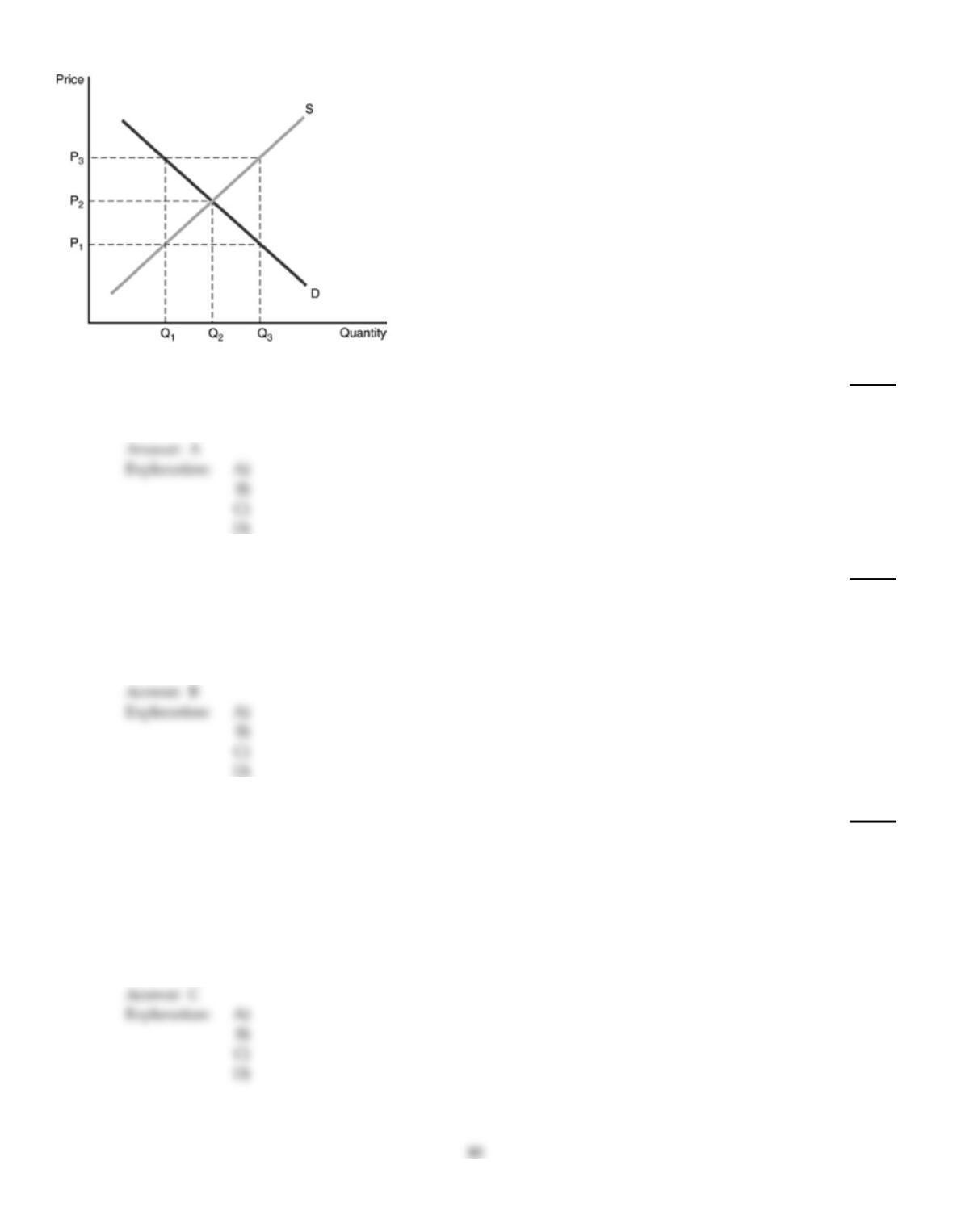
290)
Refer to the above figure. A price support set at P3 will
290)
A)
lead to a surplus of Q3 minus Q1.
B)
be ineffective.
C)
lead to a shortage of Q3 minus Q1.
D)
lead to an equilibrium quantity of Q2.
291)
If a price floor is set below the current market clearing price, then
291)
A)
a surplus must immediately occur.
B)
quantity demanded will remain equal to quantity supplied at the current market clearing
price.
C)
a shortage must immediately occur.
D)
there will be incentives for black markets to develop.
292)
Consumer surplus is
292)
A)
the total difference between the total amount that consumers actually pay for an item and the
total amount that they would have been willing to pay.
B)
the total difference between the utility consumers derive from purchasing an item and the
total costs firms incur in producing the item.
C)
the total difference between the total amount that consumers would have been willing to pay
for an item and the total amount that they actually pay.
D)
the total difference between the total costs firms incur in producing an item and the utility
consumers derive from purchasing the item.