25) If an increase in the price of good X results in a decrease in the quantity of Y demanded,
A) good X and good Y are substitutes.
B) good X and good Y are complements.
C) the cross-price elasticity of demand for good Y is positive.
D) There is not sufficient information to determine the relationship between good X and good Y.
26) If a decrease in the price of good X results in a decrease in the quantity of Y demanded,
A) good X and good Y are substitutes.
B) good X and good Y are complements.
C) the cross-price elasticity of demand for good Y is negative.
D) There is not sufficient information to determine the relationship between good X and good Y.
Recall the Application about finding estimates elasticities of demand to answer the
following question(s).
27) Recall the application. ________ has a Web site that provides estimates of demand
elasticities for hundreds of food products for dozens of countries.
A) The U.S. Department of Agriculture
B) The U.S. State Department
C) The United Nations
D) The World Bank
28) Recall the application. The regular price elasticities of demand found at www.ers.usda.gov
are reported as
A) positive numbers.
B) negative numbers.
C) dollars per unit of foreign currency.
D) foreign currency units per dollar.
29) Suppose that income increases and the quantity demanded of guitars stays the same. This
means that the income elasticity of guitars is unitary.
30) Inferior goods are substandard.
31) If the cross-price elasticity of salt and pepper is positive the goods must be complements.
32) The Department of Justice could use the cross-price elasticity between products sold at
Staples and Office Max to show that the firms are very similar.
33) If peanut butter and jelly are complements, then an increase in the price of peanut butter will
reduce the demand for jelly.
34) If butter and margarine are substitutes, then an increase in the price of butter will reduce the
demand for margarine.
35) For most goods and services, income elasticity of demand tends to be smaller in the short run
than in the long run. However, a recent study shows that the demand for a durable good such as
automobiles tends to be more income-elastic in the short run than in the long run. Explain why.
36) How do you interpret the value of income elasticity?
37) How do you interpret the value of cross-price elasticity?
38) Put the following products in order from lowest to highest based on their cross-price
elasticity of demand with peanut butter: bread, bologna, floppy disks. Justify your answer.
4.5 The Price Elasticity of Supply
1) The price elasticity of supply is a measure of the responsiveness of
A) the change in price to the quantity supplied.
B) the suppliers with respect to the change in price.
C) the quantity supplied to the change in income.
D) the quantity supplied to the changes in price.
2) The price elasticity of supply is calculated by
A) dividing the percentage change in quantity supplied by the price.
B) dividing the percentage change in income by the percentage quantity supplied.
C) dividing the percentage change in price by the percentage quantity supplied.
D) dividing the percentage change in quantity supplied by the percentage change in price.
3) Suppose that in a month the price of movie rentals increases from $2 to $2.20. At the same
time, the quantity of movie rentals supplied increases from 100 to 110. The price elasticity of
supply for movie rentals (calculated using the initial value formula) is
A) 0.02.
B) 0.2.
C) 1.
D) 50.
4) Suppose that in a month the price of movie rentals increases from $2 to $2.20. At the same
time, the quantity of movie rentals supplied increases from 100 to 110. The price elasticity of
supply for movie rentals (calculated using the initial value formula) is
A) negative.
B) inelastic.
C) unitary elastic.
D) elastic.
5) Suppose that in a month the price of a liter of soda increases from $1 to $1.50. At the same
time, the quantity of liters of soda supplied increases from 200 to 210. The price elasticity of
supply for liters of soda (calculated using the initial value formula) is
A) 0.1.
B) 0.5.
C) 10.
D) 20.
6) Suppose that in a month the price of a liter of soda increases from $1 to $1.50. At the same
time, the quantity of liters of soda supplied increases from 200 to 210. The price elasticity of
supply for liters of soda (calculated using the initial value formula) is
A) negative.
B) inelastic.
C) unitary elastic.
D) elastic.
7) If the price elasticity of supply is 3, supply is
A) unaffected by price changes.
B) inelastic.
C) unitary elastic.
D) elastic.
8) If the price elasticity of supply is 0.3, supply is
A) unaffected by price changes.
B) inelastic.
C) unitary elastic.
D) elastic.
9) If the price elasticity of supply is 1.3, supply is
A) unaffected by price changes.
B) inelastic.
C) unitary elastic.
D) elastic.
10) If the price elasticity of supply is 1, supply is
A) unaffected by price changes.
B) inelastic.
C) unitary elastic.
D) elastic.
11) If the price elasticity of supply is elastic, which of the following could be a possible value of
the elasticity?
A) 3
B) 1
C) 0.3
D) 0
12) If the price elasticity of supply is inelastic, which of the following could be a possible value
of the elasticity?
A) 3
B) 1
C) 0.3
D) -0.3
13) If the percentage change in price is 2 and the percentage change in quantity supplied is 10,
supply is
A) unaffected by price changes.
B) inelastic.
C) unitary elastic.
D) elastic.
14) If the percentage change in price is 20 and the percentage change in quantity supplied is 10,
supply is
A) unaffected by price changes.
B) inelastic.
C) unitary elastic.
D) elastic.
15) If the percentage change in price is 10 and the percentage change in quantity supplied is 10,
supply is
A) unaffected by price changes.
B) inelastic.
C) unitary elastic.
D) elastic.
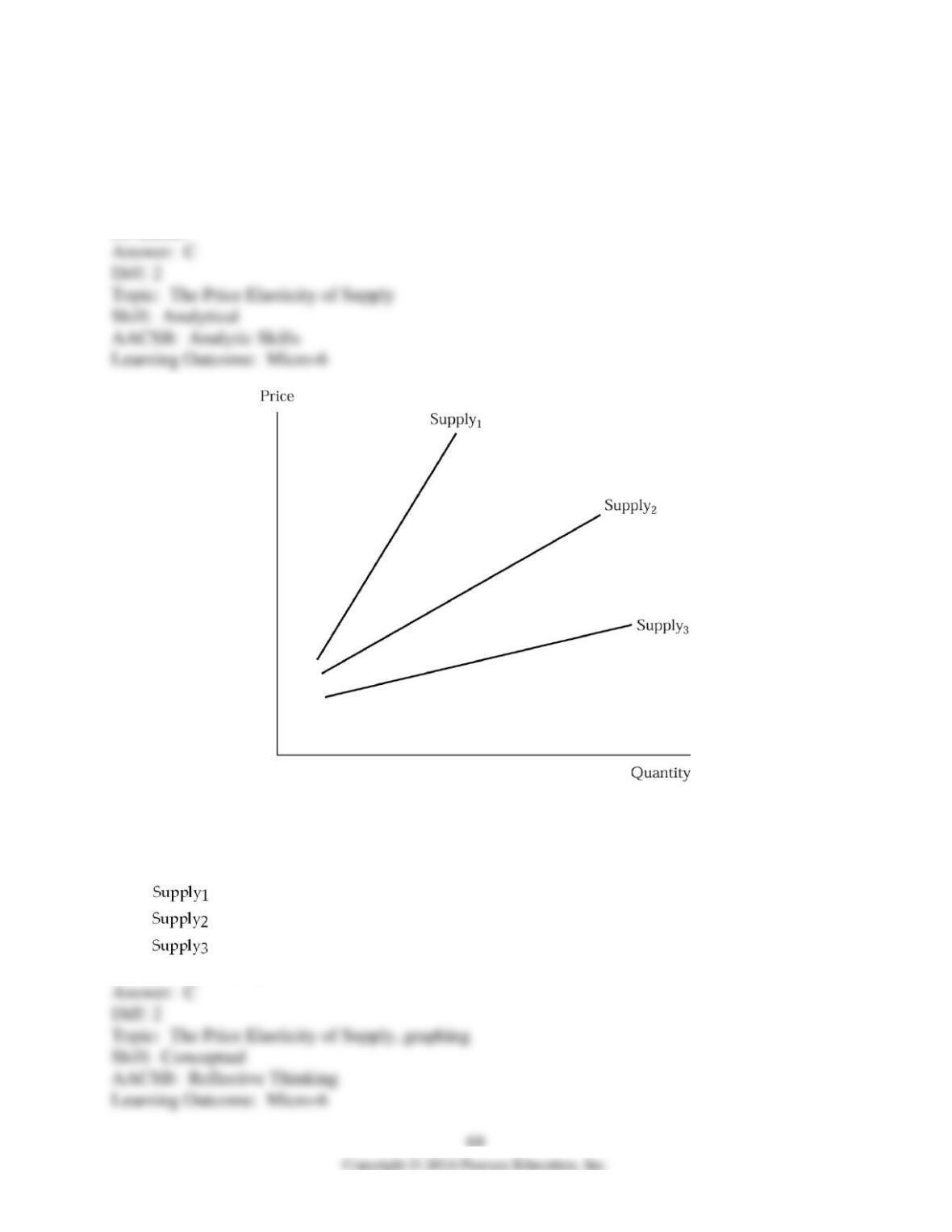
Figure 4.3
16) In Figure 4.3 the most elastic supply curve
A) is .
B) is .
C) is .
D) Cannot be determined.
17) In Figure 4.3 the most inelastic supply curve
A) is .
B) is .
C) is .
D) Cannot be determined.
18) The supply curve for gasoline will be more elastic in
A) the short-run because of the principle of diminishing returns.
B) the long-run because of the principle of diminishing returns.
C) the short-run because firms have more time in which to respond to the price change.
D) the long-run because firms have more time in which to respond to the price change.
19) The quantity supplied of bagels is 100 at the unit price $1. Suppose the price elasticity of
supply by the initial value method is 1.5, and you would like to induce sellers to increase the
quantity of bagels supplied to 130. Then the new price for bagels must be
A) $11.
B) $10.20.
C) $1.20.
D) $1.10.
20) The quantity supplied of hot dogs is 200 at the unit price of $3.50. Suppose the price
elasticity of supply by the initial value method is 2, and you would like to induce sellers to
increase the quantity of hot dogs supplied to 220. Then new price must be
A) $1.5.
B) $2.
C) $2.5.
D) $3.
21) The supply curve will be more inelastic when
A) inputs to production are scarce.
B) firms’ response to a price change is limited by the limited capacity of their production
facilities.
C) a good has many substitutes.
D) the firm is experiencing diminishing returns to a variable input.
22) Which of the following statements is correct with respect to price elasticity of supply?
A) The price elasticity of supply tends to be greater as new firms can easily enter the market.
B) The price elasticity of supply tends to be greater as expanding existing production facilities is
less costly.
C) The price elasticity of supply tends to be smaller as firms have limited production facilities.
D) All of the above are correct.
23) If the supply curve is a vertical line, it means that
A) regardless of price, the quantity supplied is a constant amount.
B) regardless of quantity, the price is a constant amount.
C) the good is inferior.
D) the good has many substitutes.
24) If, regardless of price, the quantity supplied is a constant amount, then the supply curve is
A) horizontal.
B) vertical.
C) upward sloping.
D) downward sloping.
25) If the quantity supplied is infinitely responsive to any change in price, the supply curve is
A) upward sloping.
B) downward sloping.
C) horizontal.
D) vertical.
26) In the case of perfectly elastic supply, the supply curve is
A) upward sloping.
B) downward sloping.
C) vertical.
D) horizontal.
27) If supply is perfectly inelastic, the price elasticity of supply is equal to
A) 1.
B) 0.
C) infinity.
D) a negative number between 0 and infinity.
28) If supply is perfectly elastic, the price elasticity of supply is equal to
A) 1.
B) 0.
C) infinity.
D) a positive number between 0 and infinity.
29) If the price elasticity of supply is equal to infinity and the price were to fall, the quantity
supplied would
A) decrease slightly.
B) fall to zero.
C) not change.
D) increase.
30) If the price elasticity of supply is equal to zero and the price were to rise, the quantity
supplied would
A) decrease slightly.
B) fall to zero.
C) not change.
D) increase.