Use properties of logarithms to condense the logarithmic expression. Write the expression as a single logarithm whose
coefficient is 1. Where possible, evaluate logarithmic expressions.
107)
9logby +6logbz
107)
A)
15logbyz
B)
logb(yz)15
C)
54logbyz
D)
logby9z6
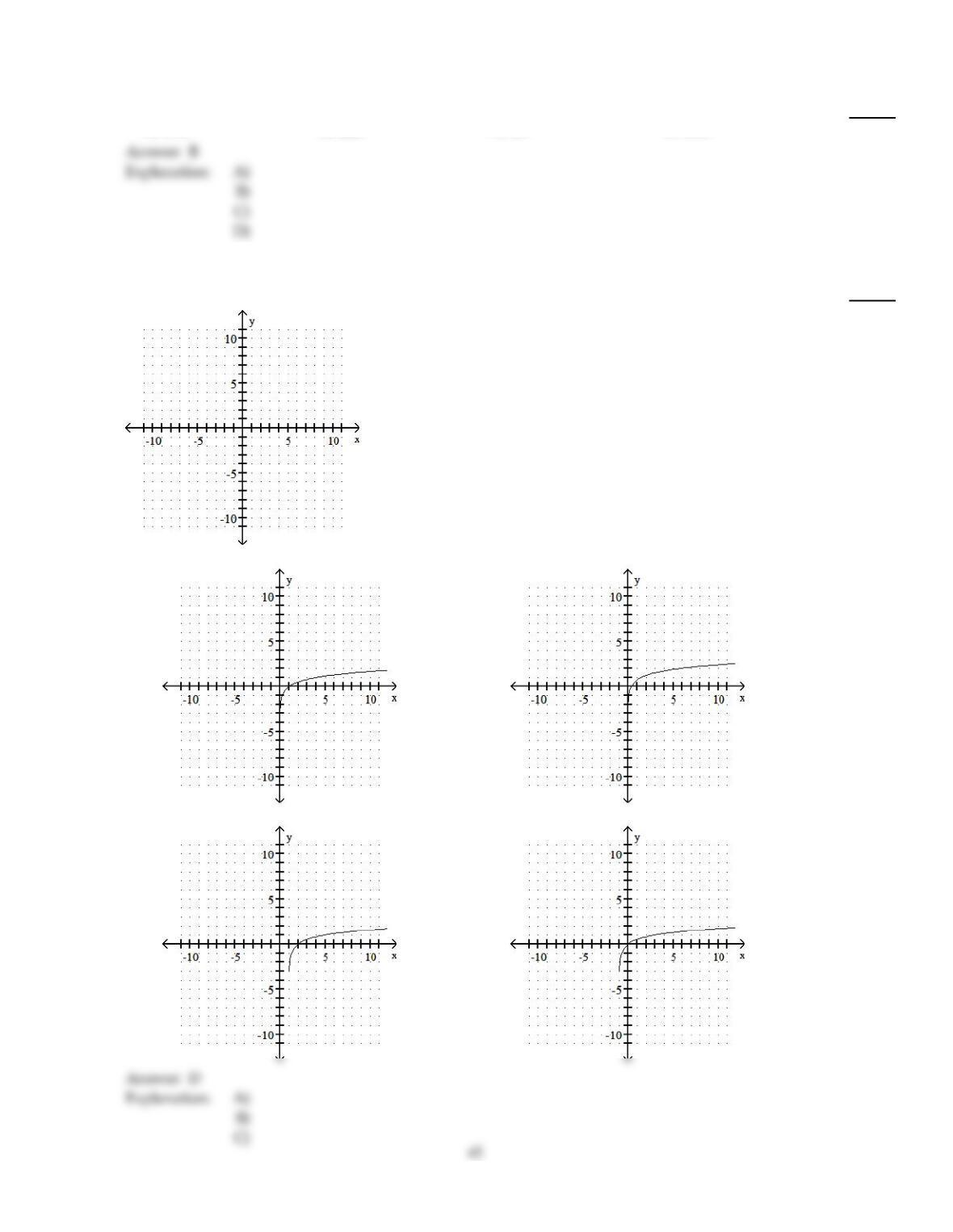
Graph the function.
108)
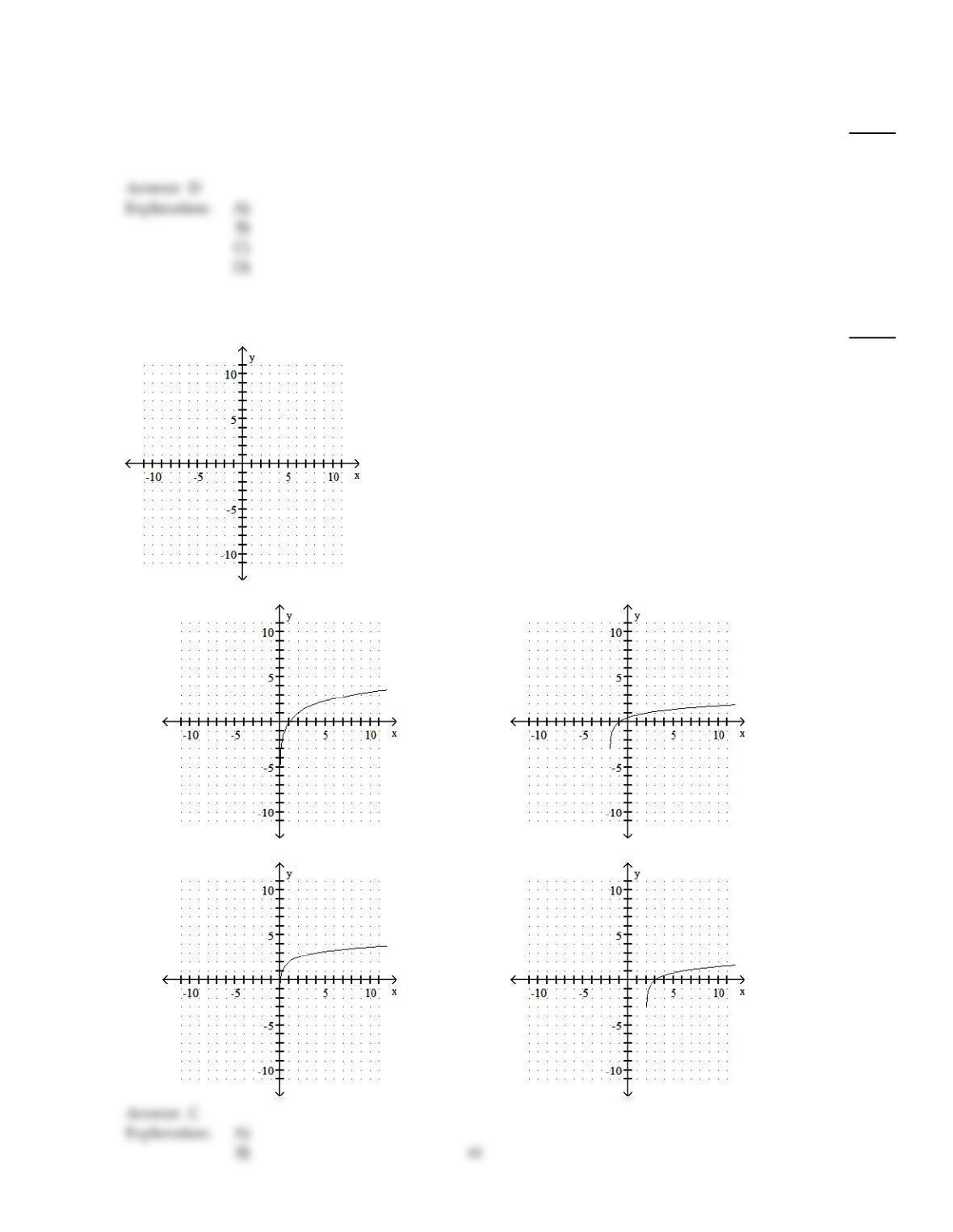
Use the graph of log 4x to obtain the graph of f(x) =2+log 4x.
108)
A)
B)
C)
D)
Use common logarithms or natural logarithms and a calculator to evaluate to four decimal places
109)
log 58
109)
A)
1.2920
B)
0.2041
C)
0.7740
D)
1.6021
Solve the exponential equation. Use a calculator to obtain a decimal approximation, correct to two decimal places, for the
solution.
110)
4x +6=6
110)
A)
–4.71
B)
6.77
C)
–0.60
D)
1.55
Solve the equation by expressing each side as a power of the same base and then equating exponents.
111)
2(3x + 7)=1
4
111)
A)
1
2
B)
{–3}
C)
{1}
D)
{3}
Solve the logarithmic equation. Be sure to reject any value that is not in the domain of the original logarithmic
expressions. Give the exact answer.
112)
log 3(x + 1) =2
112)
A)
{7}
B)
{9}
C)
{10}
D)
{8}
42
113)
log 6(x + 2) = – 1
113)
A)
13
6
B)
–11
6
C)
– 11
D)
13
Solve the problem.
114)
Use the mathematical model for power gain, G = log P0
Pi
10
, where P0 is the output power in watts
and Pi is the input power in watts. Determine the power gain G, in decibels, for an amplifier with
an output P0 of 19 watts and an input Pi of 1.9 watts. Round to five decimal places if necessary.
114)
A)
11 dB
B)
10 dB
C)
15.57507 dB
D)
12.32996 dB
Use the compound interest formulas A = P 1 +r
n
nt and A = Pert to solve.
115)
Suppose that you have $3000 to invest. Which investment yields the greater return over 9 years:
5.4% compounded monthly or 5.5% compounded quarterly?
115)
A)
Both investment plans yield the same return.
B)
$3000 invested at 5.5% compounded quarterly over 9 years yields the greater return.
C)
$3000 invested at 5.4% compounded monthly over 9 years yields the greater return.
Solve the equation by expressing each side as a power of the same base and then equating exponents.
116)
8(x –10)/6=8
116)
A)
12
B)
{13}
C)
{22}
D)
{16}
Evaluate the expression without using a calculator.
117)
eln 271
117)
A)
ln 271
B)
271
C)
e271
D)
–271
Use common logarithms or natural logarithms and a calculator to evaluate to four decimal places
118)
log 26 390
118)
A)
1.1761
B)
0.5461
C)
1.8312
D)
4.0060
Use properties of logarithms to expand the logarithmic expression as much as possible. Where possible, evaluate
logarithmic expressions without using a calculator.
119)
log 53x
119)
A)
1
2log 53+1
2log 5x
B)
1
2log 53x
C)
log 53+log 5x
D)
log 53+1
2log 5x
120)
log (100x)
120)
A)
2log x
B)
2+ log x
C)
20 + log x
D)
2x
121)
log 7x6
121)
A)
7 log x
B)
6log 7x
C)
6log 7x6
D)
7log 6x
Solve the equation by expressing each side as a power of the same base and then equating exponents.
122)
4x +2=8x –6
122)
A)
{10}
B)
{22}
C)
{8}
D)
{20}
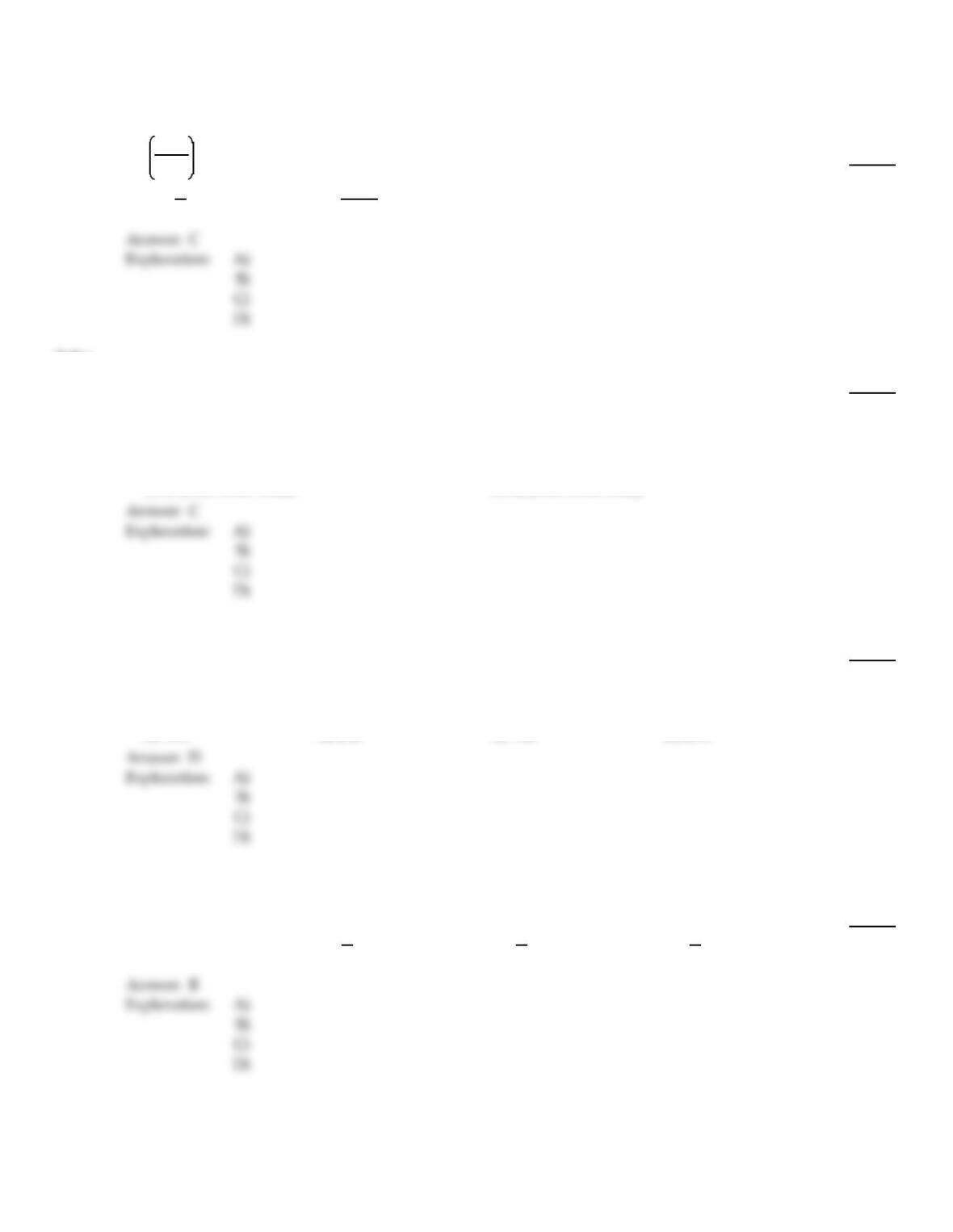
Graph the function.
123)
Use the graph of log 4x to obtain the graph of f(x) =log 4(x + 1).
123)
A)
B)
C)
D)
C)
D)
Evaluate or simplify the expression without using a calculator.
124)
log 1
1000
124)
A)
–1
3
B)
1
1000
C)
–3
D)
3
Solve.
125)
An endangered species of fish has a population that is decreasing exponentially (A =A0ekt). The
population 6 years ago was 1600. Today, only 900 of the fish are alive. Once the population drops
below 100, the situation will be irreversible. When will this happen, according to the model?
(Round to the nearest whole year.)
125)
A)
24 years from today
B)
25 years from today
C)
23 years from today
D)
22 years from today
C)
D)
Solve the problem.
126)
The pH of a solution ranges from 0 to 14. An acid has a pH less than 7. Pure water is neutral and
has a pH of 7. The pH of a solution is given by pH = – log x where x represents the concentration of
the hydrogen ions in the solution in moles per liter. Find the pH if the hydrogen ion concentration
is 2.8 x 10⁻³.
126)
A)
3.55
B)
2.45
C)
3.45
D)
2.55
C)
D)
Solve the logarithmic equation. Be sure to reject any value that is not in the domain of the original logarithmic
expressions. Give the exact answer.
127)
ln 4+ ln (x – 1) = 0
127)
A)
{1}
B)
{5
4}
C)
{1
4}
D)
{4
5}
C)
D)
46
C)
D)
Rewrite the equation in terms of base e. Express the answer in terms of a natural logarithm, and then round to three
decimal places.
128)
y =2.2(0.9)x
128)
A)
y =2.2ex ln 0.9, y =2.2e–0.105x
B)
y = (ln 2.2)ex ln 0.9, y =0.788e–0.105x
C)
y =2.2e0.9x, y =2.22.718–0.105x
D)
y =0.9ex ln 2.2, y =0.9e0.788x
Solve the logarithmic equation. Be sure to reject any value that is not in the domain of the original logarithmic
expressions. Give the exact answer.
129)
log 3x = log 4+ log (x – 1)
129)
A)
3
2
B)
–4
7
C)
{4}
D)
{–4}
Solve the equation by expressing each side as a power of the same base and then equating exponents.
130)
5x=25
130)
A)
{1}
B)
{3}
C)
{5}
D)
{2}
Solve the logarithmic equation. Be sure to reject any value that is not in the domain of the original logarithmic
expressions. Give the exact answer.
131)
log54+log5 x = 1
131)
A)
{1
4}
B)
{4
5}
C)
{5
4}
D)
{45}
47
Use properties of logarithms to expand the logarithmic expression as much as possible. Where possible, evaluate
logarithmic expressions without using a calculator.
132)
log 5
x
125
132)
A)
log 5x –3
B)
–3log 5x
C)
15 –1
2log 5x
D)
1
2log 5x –3
133)
log w
13x
2
133)
A)
log w11x
B)
log w13 +log wx +log w2
C)
log w13x –log w2
D)
log w13 +log wx –log w2
Use properties of logarithms to condense the logarithmic expression. Write the expression as a single logarithm whose
coefficient is 1. Where possible, evaluate logarithmic expressions.
134)
3log x2+log x3
134)
A)
log x24
B)
log x18
C)
log x2
D)
3log x6
Evaluate the expression without using a calculator.
135)
log61
6
135)
A)
1
2
B)
–1
2
C)
–1
6
D)
1
6
Solve the problem.
136)
The rabbit population in a forest area grows at the rate of 5% monthly. If there are 150 rabbits in
September, find how many rabbits (rounded to the nearest whole number) should be expected by
next September. Use y =150(2.7)0.05t.
136)
A)
272
B)
259
C)
243
D)
285
Write the equation in its equivalent logarithmic form.
137)
b3=2744
137)
A)
log32744 =b
B)
log2744 b=3
C)
logb2744 =3
D)
logb3=2744
Solve the logarithmic equation. Be sure to reject any value that is not in the domain of the original logarithmic
expressions. Give the exact answer.
138)
ln x +2=6
138)
A)
{e12 – 2}
B)
e6
2+2
C)
{e12 +2}
D)
{e6– 2}
Evaluate the expression without using a calculator.
139)
log51
5
139)
A)
1
B)
–1
C)
5
D)
–5
Solve the logarithmic equation. Be sure to reject any value that is not in the domain of the original logarithmic
expressions. Give the exact answer.
140)
log 3 (x + 6) +log 3 (x – 6) –log 3 x = 2
140)
A)
{12}
B)
{–3}
C)
{12, –3}
D)
49
Use properties of logarithms to condense the logarithmic expression. Write the expression as a single logarithm whose
coefficient is 1. Where possible, evaluate logarithmic expressions.
141)
log 248 –log 23
141)
A)
log 2144
B)
log 245
C)
4
D)
log 248 1/3
Solve the equation by expressing each side as a power of the same base and then equating exponents.
142)
3(6 – 3x) =1
27
142)
A)
{–3}
B)
{3}
C)
1
9
D)
{9}
Solve the logarithmic equation. Be sure to reject any value that is not in the domain of the original logarithmic
expressions. Give the exact answer.
143)
8 ln (4x) =56
143)
A)
e7
B)
e7/4
C)
7
ln 4
D)
e7
4
Evaluate the expression without using a calculator.
144)
log 12 12
144)
A)
1
B)
1
2
C)
12
D)
1
12
145)
ln e14x
145)
A)
1
14x
B)
–14x
C)
14x
D)
e14x
Rewrite the equation in terms of base e. Express the answer in terms of a natural logarithm, and then round to three
decimal places.
146)
y =3(8)x
146)
A)
y = (ln 3)ex ln 8, y =1.099e2.079x
B)
y =3e8x, y =32.7182.079x
C)
y =3ex ln 8, y =3e2.079x
D)
y =8ex ln 3, y =8e1.099x
Solve the logarithmic equation. Be sure to reject any value that is not in the domain of the original logarithmic
expressions. Give the exact answer.
147)
log (3+ x) – log (x – 5) = log 3
147)
A)
{–9}
B)
{9}
C)
D)
5
2
Use properties of logarithms to condense the logarithmic expression. Write the expression as a single logarithm whose
coefficient is 1. Where possible, evaluate logarithmic expressions.
148)
1
3(log8 x +log8 y)
148)
A)
log83x+log83y
B)
3log8(xy)
C)
log83x + y
D)
log83xy
Solve the logarithmic equation. Be sure to reject any value that is not in the domain of the original logarithmic
expressions. Give the exact answer.
149)
log 6x2=log 6(4x + 32)
149)
A)
{8, –4}
B)
{8}
C)
D)
4
3
Solve the equation by expressing each side as a power of the same base and then equating exponents.
150)
1024x=64
150)
A)
3
4
B)
{3}
C)
5
3
D)
3
5
Write the equation in its equivalent logarithmic form.
151)
123= y
151)
A)
log y12 =3
B)
log y3=12
C)
log 12 y =3
D)
log 3 y =12
Solve the logarithmic equation. Be sure to reject any value that is not in the domain of the original logarithmic
expressions. Give the exact answer.
152)
log 35 (x – 70) =3–log 35 x
152)
A)
{245}
B)
{175}
C)
{–175}
D)
{–245}
Solve the exponential equation. Use a calculator to obtain a decimal approximation, correct to two decimal places, for the
solution.
153)
ex=4.3
153)
A)
11.7
B)
0.63
C)
73.9
D)
1.46
Evaluate or simplify the expression without using a calculator.
154)
910log 5.4
154)
A)
486
B)
4.86
C)
15.1776
D)
48.6
D)
Use properties of logarithms to expand the logarithmic expression as much as possible. Where possible, evaluate
logarithmic expressions without using a calculator.
155)
log 3
7
13
155)
A)
log 37+log 313
B)
log 313 –log 37
C)
log 37
log 313
D)
log 37–log 313
D)
Solve the problem.
156)
Find out how long it takes a $3000 investment to earn $400 interest if it is invested at 8%
compounded quarterly. Round to the nearest tenth of a year. Use the formula A = P 1 +r
n
nt.
156)
A)
1.4 years
B)
1.8 years
C)
2 years
D)
1.6 years
D)
D)
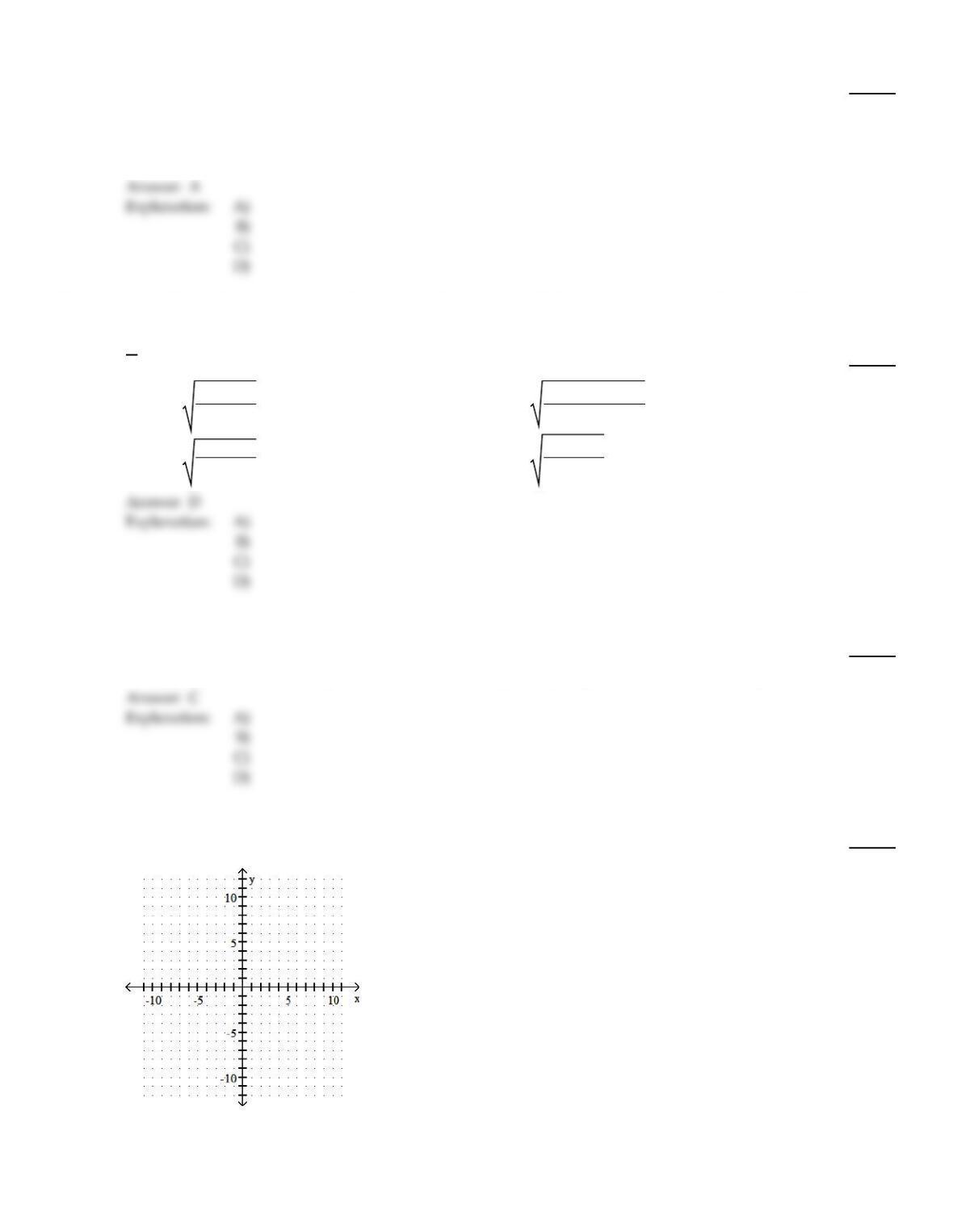
157)
The function f(x) = 1 +1.5 ln (x + 1) models the average number of free–throws a basketball player
can make consecutively during practice as a function of time, where x is the number of consecutive
days the basketball player has practiced for two hours. After how many days of practice can the
basketball player make an average of 9 consecutive free throws?
157)
A)
206 days
B)
785 days
C)
787 days
D)
208 days
Use properties of logarithms to condense the logarithmic expression. Write the expression as a single logarithm whose
coefficient is 1. Where possible, evaluate logarithmic expressions.
158)
1
3[3ln (x +3) – ln x – ln (x2–3)]
158)
A)
ln 3x(x +3)3
(x2–3)
B)
ln 3(x +3)3(x2–3)
x
C)
ln 33(x +3)
x(x2–3)
D)
ln 3(x +3)3
x(x2–3)
Find the domain of the logarithmic function.
159)
f(x) =log 5(x – 2)2
159)
A)
(2, )
B)
(–2, )
C)
(–, 2) or (2, )
D)
(–, 0) or (0, )
Graph the function.
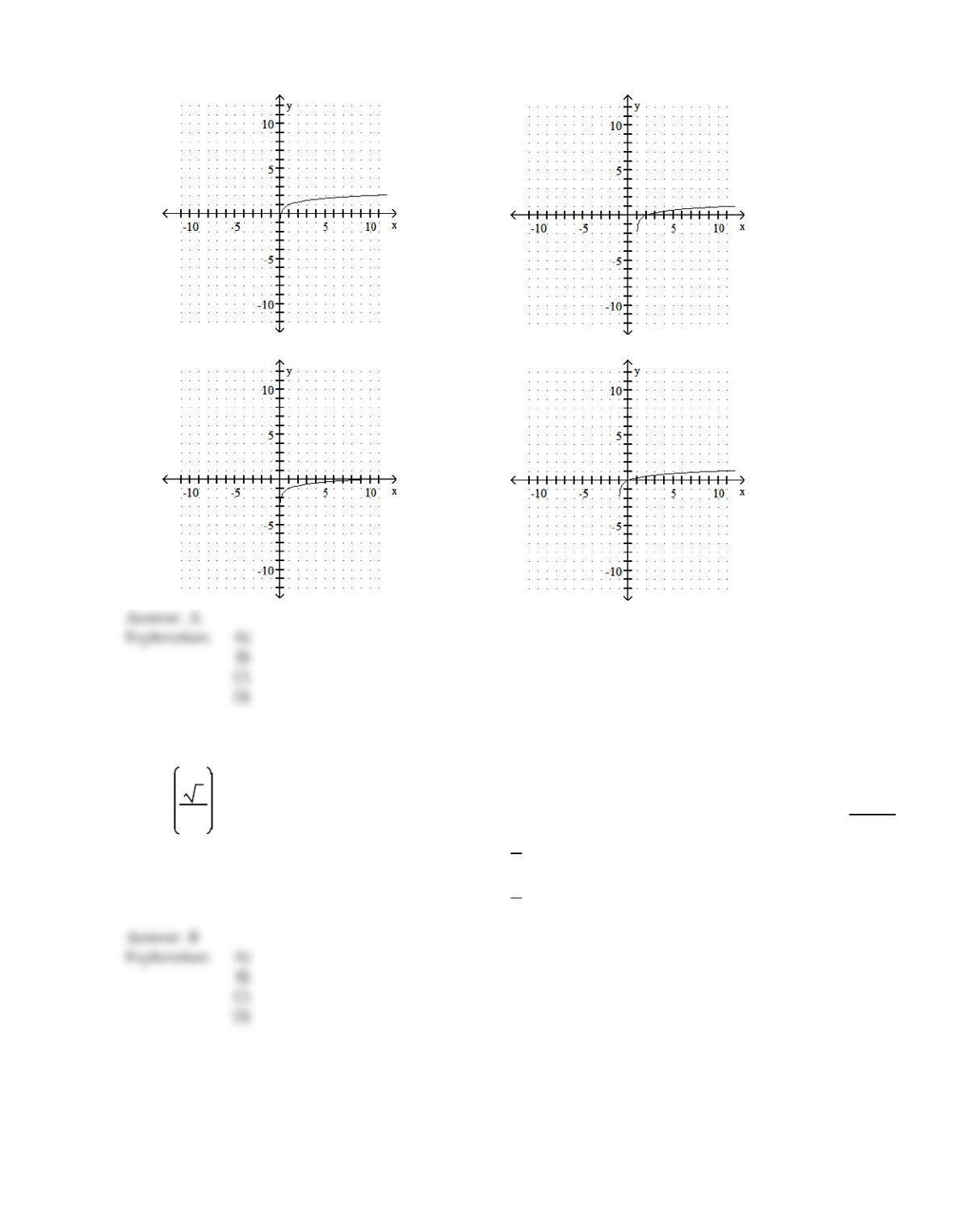
160)
Use the graph of f(x) = log x to obtain the graph of g(x) = log x + 1.
160)
54
A)
B)
C)
D)
Use properties of logarithms to expand the logarithmic expression as much as possible. Where possible, evaluate
logarithmic expressions without using a calculator.
161)
log 11
73
y2x
161)
A)
log 11 3–log 11 y–log 11 x
B)
1
7log 11 3– 2 log 11 y–log 11 x
C)
7log 11 3– 2 log 11 y–log 11 7
D)
1
7log 11 3– 2 log 11 y– 2 log 11 x
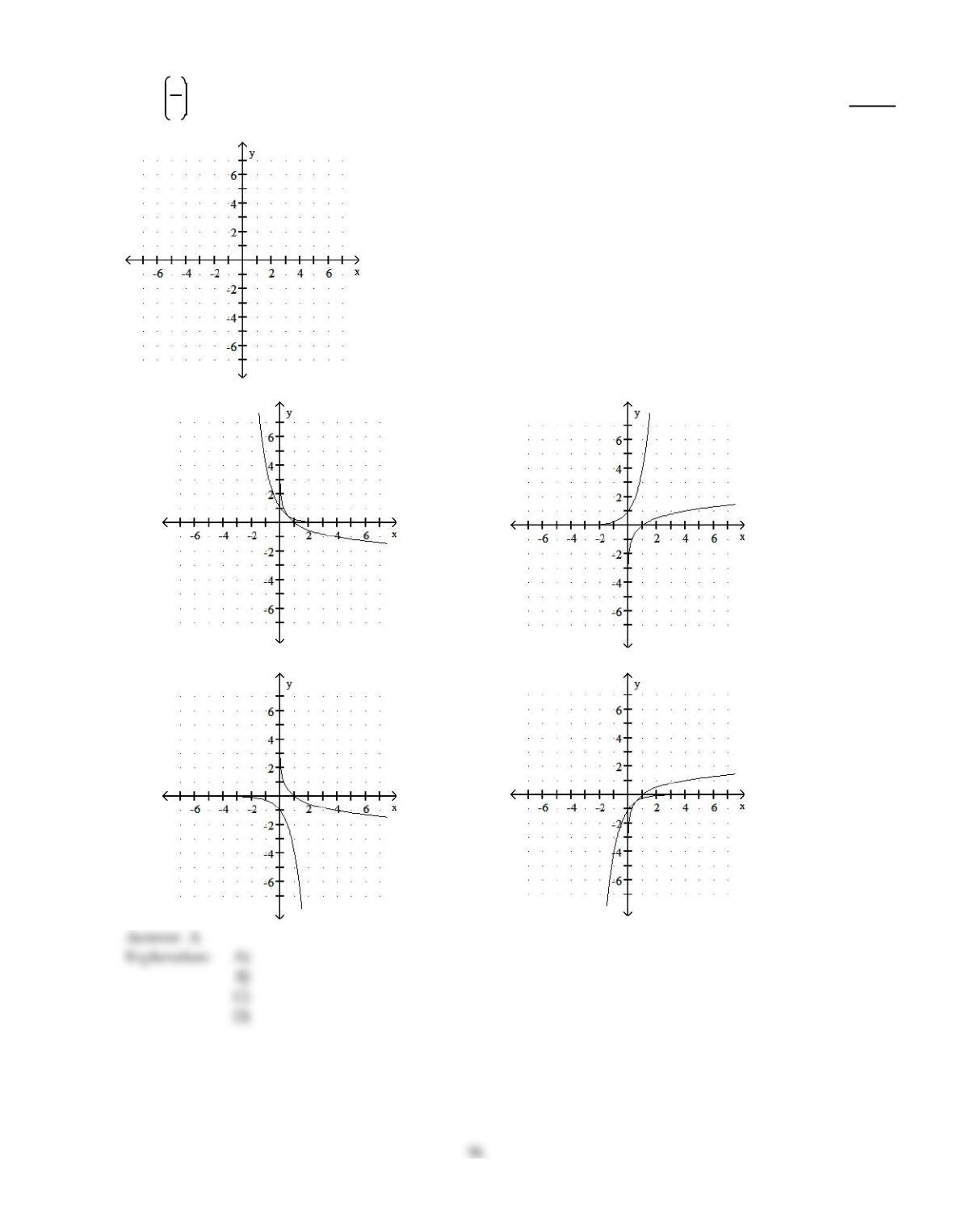
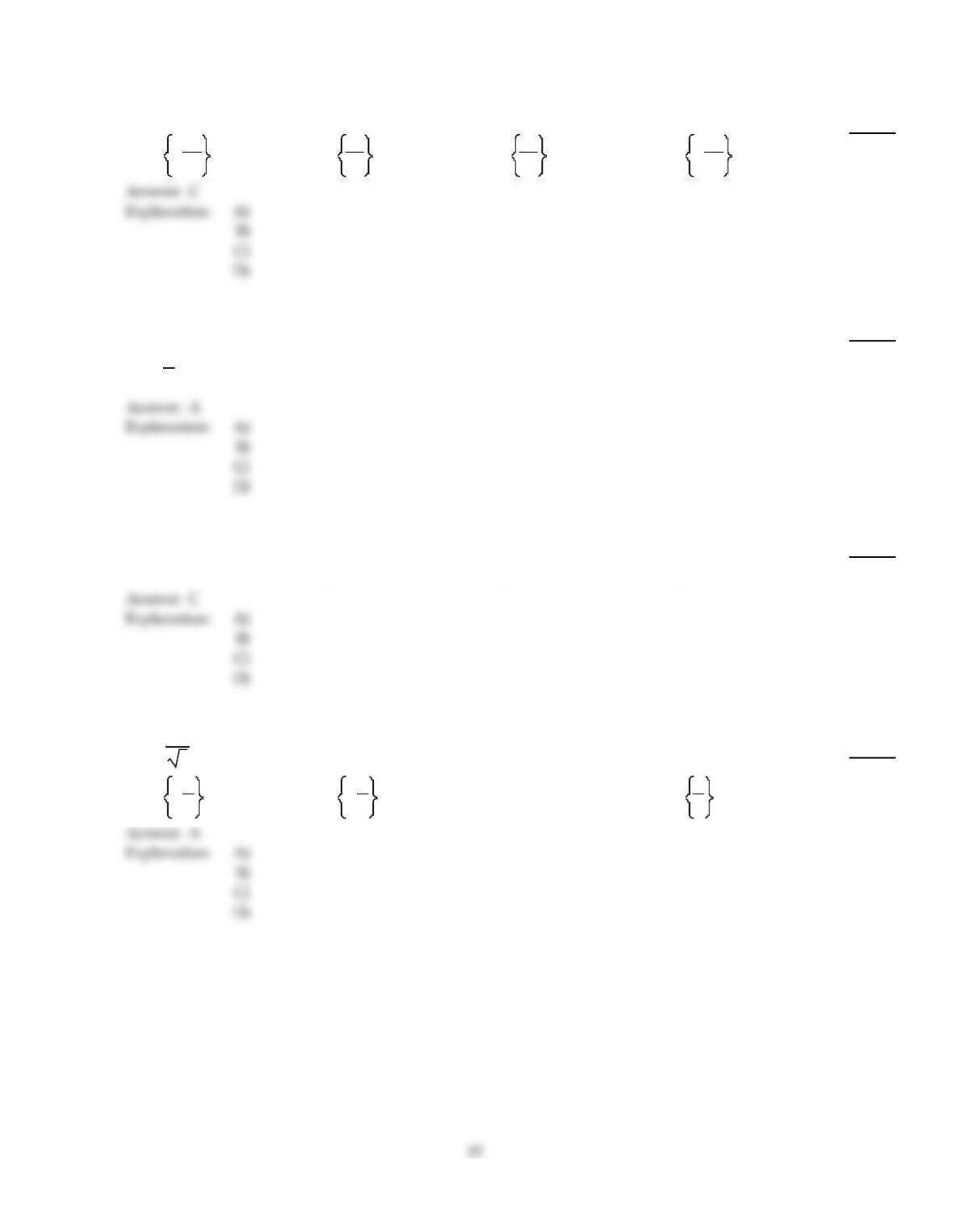
Graph the functions in the same rectangular coordinate system.
55
162)
f(x) =1
4
x and g(x) =log1/4 x
162)
A)
B)
C)
D)
Solve the logarithmic equation. Be sure to reject any value that is not in the domain of the original logarithmic
expressions. Give the exact answer.
163)
log (x +25) – log 2= log (5x +1)
163)
A)
–23
9
B)
49
3
C)
23
9
D)
–49
3
Evaluate the expression without using a calculator.
164)
log 27 3
164)
A)
1
3
B)
1
C)
9
D)
3
A
Use common logarithms or natural logarithms and a calculator to evaluate to four decimal places
165)
log 12 63.2
165)
A)
0.5993
B)
2.8799
C)
1.6686
D)
0.7215
C
Solve the equation by expressing each side as a power of the same base and then equating exponents.
166)
81x=1
3
166)
A)
–1
8
B)
–1
4
C)
{–4}
D)
1
8
A
C
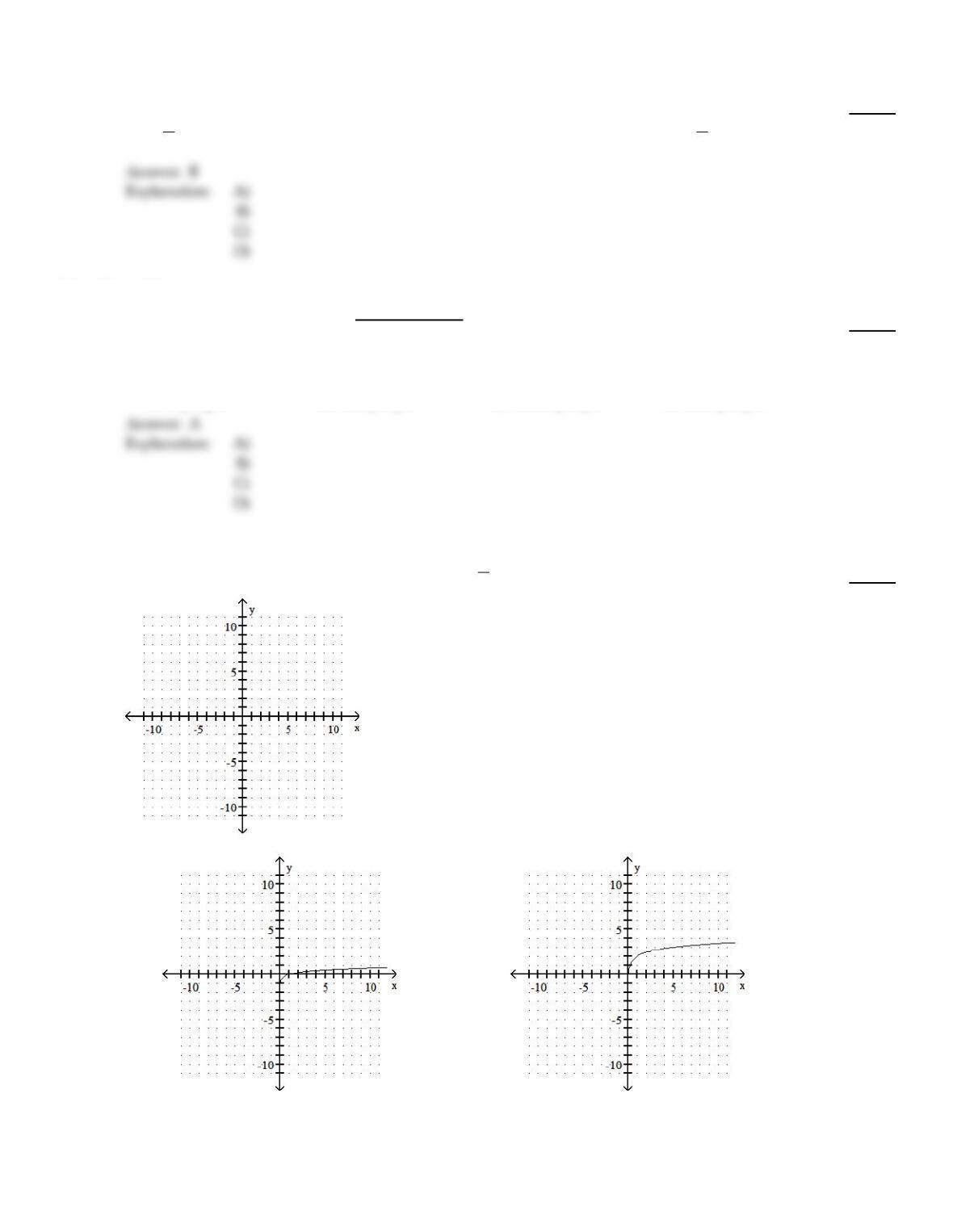
Evaluate or simplify the expression without using a calculator.
167)
log 0.001
167)
A)
1
3
B)
–3
C)
3
D)
–1
3
Solve the problem.
168)
The logistic growth function f(t) =53,000
1 +1324.0e–1.3t models the number of people who have
become ill with a particular infection t weeks after its initial outbreak in a particular community.
How many people became ill with this infection when the epidemic began?
168)
A)
40 people
B)
1324 people
C)
53,000 people
D)
1325 people
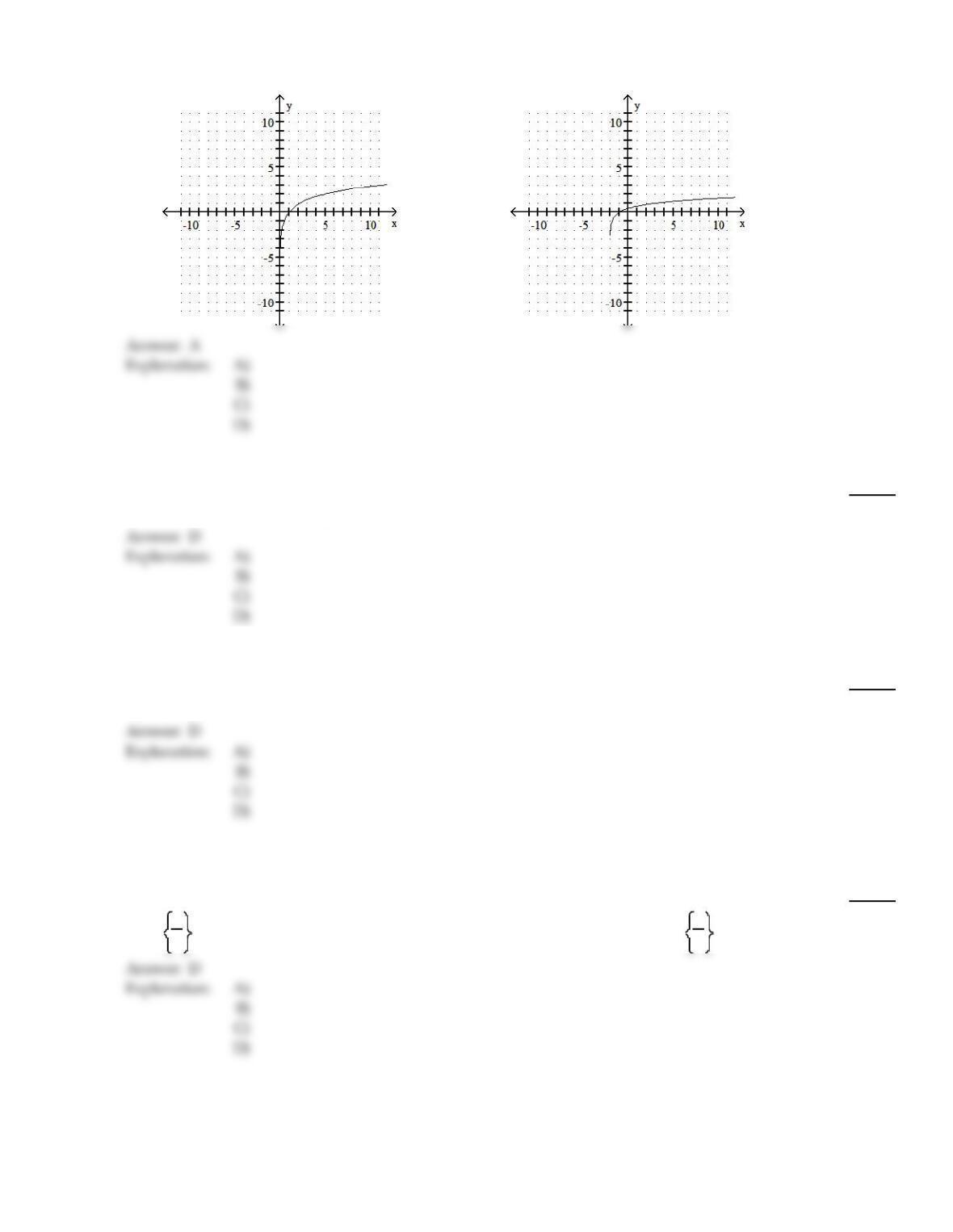
Graph the function.
169)
Use the graph of log 5x to obtain the graph of f(x) =1
2log 5x.
169)
A)
B)
58
C)
D)
Find the domain of the logarithmic function.
170)
f(x) =log 8(x +6)
170)
A)
(8, )
B)
(–, 0) or (0, )
C)
(6, )
D)
(–6, )
Write the equation in its equivalent logarithmic form.
171)
53= x
171)
A)
log x5=3
B)
log 53= x
C)
log 3 x =5
D)
log 5 x =3
Solve the logarithmic equation. Be sure to reject any value that is not in the domain of the original logarithmic
expressions. Give the exact answer.
172)
log 8(7x – 1) =log 8(5x + 4)
172)
A)
3
2
B)
C)
{3}
D)
5
2
59
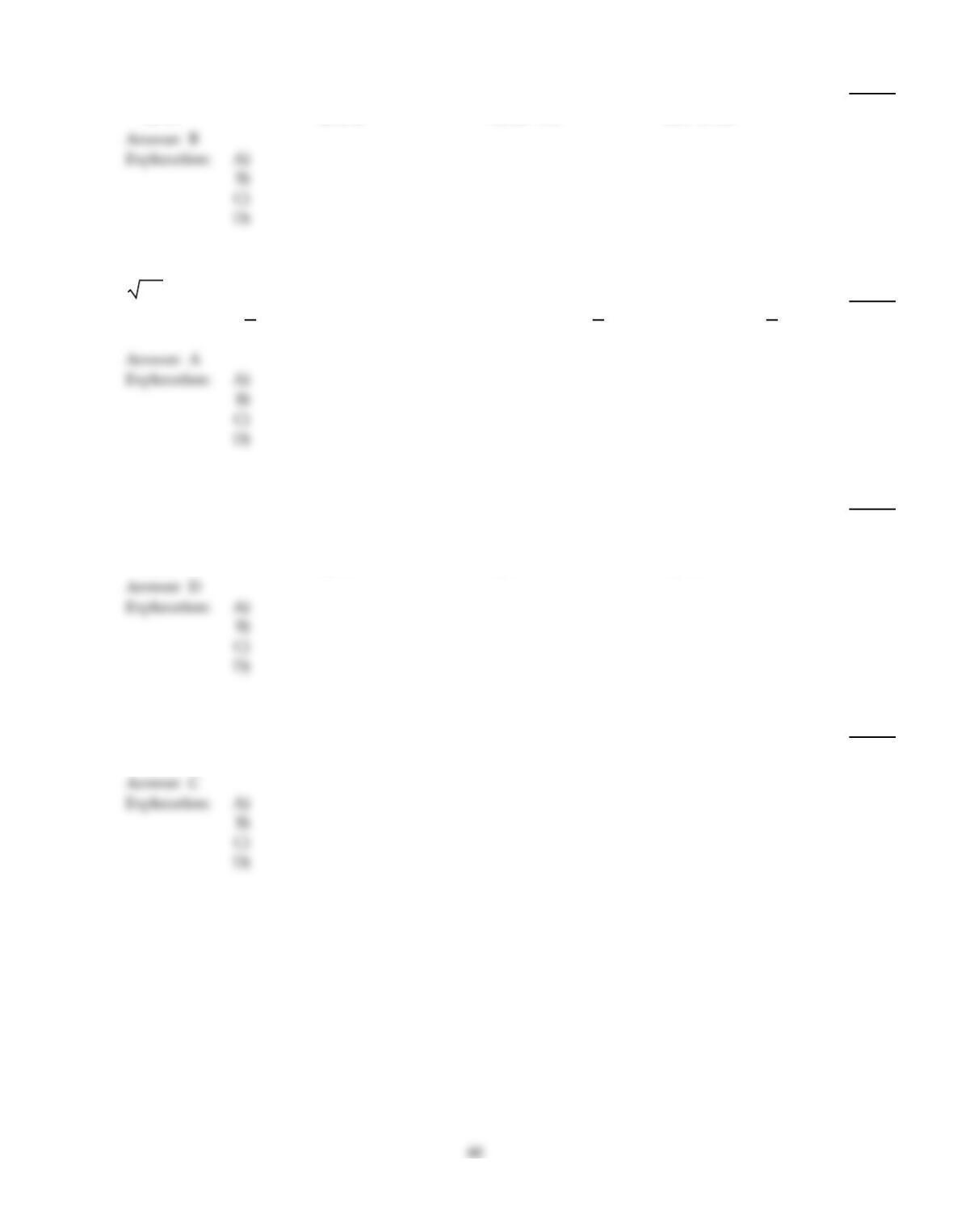
173)
log9 x +log9 (x –80) = 2
173)
A)
{9}
B)
{81}
C)
{1, –81}
D)
{–1, 81}
Write the equation in its equivalent logarithmic form.
174)
3125 =5
174)
A)
log 125 5=1
3
B)
log 5125 =3
C)
log 125 3=1
5
D)
log 5125 =1
3
Solve the problem.
175)
The size of the raccoon population at a national park increases at the rate of 4.3% per year. If the
size of the current population is 157, find how many raccoons there should be in 4 years. Use the
function f(x) =157e0.043t and round to the nearest whole number.
175)
A)
184
B)
188
C)
190
D)
186
Write the equation in its equivalent exponential form.
176)
log 232 = x
176)
A)
32x=2
B)
322= x
C)
2x=32
D)
x2=32