31) Why would a bumper crop be bad news for farmers?
A) Their crop has an inelastic demand and the resulting drop in price reduces their total revenue.
B) Their crop has an elastic demand and the resulting drop in price reduces their total revenue.
C) Their crop has an inelastic demand and the resulting drop in price raises their total revenue.
D) Their crop has an elastic demand and the resulting drop in price raises their total revenue.
32) A bumper crop would be bad news for farmers if their crop has an inelastic demand because
their total revenue would
A) rise along with price.
B) rise as price falls.
C) fall as price rises.
D) fall along with price.
33) If the demand for illegal drugs is inelastic, then a government policy to cause their price to
increase would cause total revenue from drug sales to
A) rise.
B) fall.
C) stay the same.
D) drop to zero.
34) If the demand for illegal drugs is inelastic, then a government policy that causes illegal drug
price to rise would cause those who support their drug habit by property theft to
A) increase their theft to pay for their drugs.
B) increase their drug dependency.
C) reduce their theft to pay for their drugs.
D) end their drug dependency.
Recall the Application about the price of vanity license plates in Virginia to answer the
following question(s).
35) Recall the Application. Which of the following is a reason for the state of Virginia to
increase its revenue while the price for vanity plates increases?
A) The demand for vanity plates in Virginia is inelastic.
B) The demand for vanity plates in Virginia is elastic.
C) The demand for vanity plates in Virginia is equal to 1.
D) There is insufficient information to draw a conclusion.
36) If the elasticity of demand for sugar cookies is 2.5, then a 10% change in price will lead to a
5% change in quantity demanded.
37) If the elasticity of demand for cheddar cheese is 1.5, then a 20% change in price will lead to
a 10% change in quantity demanded.
38) If an increase in the price of accordions does not change total revenue from accordion sales,
we can infer that demand for accordions is inelastic.
39) If total revenue is unrelated to price, then demand is unitary elastic.
40) If demand is inelastic, then price and total revenue are directly related.
41) If demand is elastic, then when price rises, total revenue will decrease.
42) A bumper crop of wheat could be bad news to farmers if the price elasticity of demand for
wheat is greater than one.
Recall the Application about the price of vanity license plates in Virginia to answer the
following question(s).
43) Recall the application. In 1987, the price elasticity of demand for vanity plates in Ohio was
2.60. If the state’s objective was to maximize its revenue from vanity plates, it should increase its
price.
44) How do you calculate a percentage change in quantity if given an elasticity of demand and a
percentage change in price?
45) If demand elasticity of airline tickets is 3, what percentage change in quantity would the
airlines expect from a 10% increase in price?
46) What is total revenue for a firm?
47) Suppose that you’re the manager of a firm. You notice that when you raised your price from
$10 to $11, sales fell from 500 to 400. Should you raise your price more?
48) What is the relationship between price elasticity of demand and total revenue for the firm?
4.3 Elasticity and Total Revenue for a Linear Demand Curve
1) Which of the following characteristics are of a linear demand curve?
A) It has a constant slope.
B) It has a constant elasticity of demand.
C) The upper half of the liner demand curve is inelastic.
D) all of the above
2) On a linear demand curve, demand is ________ at small quantities than it is at the middle of
the demand curve.
A) more elastic
B) less elastic
C) equally elastic
D) impossible to tell
3) As we move upward along a linear demand curve, the price elasticity of the demand
A) increases.
B) decreases.
C) remains the same.
D) increases up to the midpoint and then decreases.
4) On a linear demand curve, demand is ________ at large quantities than it is at the middle of
the demand curve.
A) more elastic
B) less elastic
C) equally elastic
D) impossible to tell
5) On a linear demand curve, demand is ________ at the middle of the demand curve than it is at
small quantities.
A) more elastic
B) less elastic
C) equally elastic
D) impossible to tell
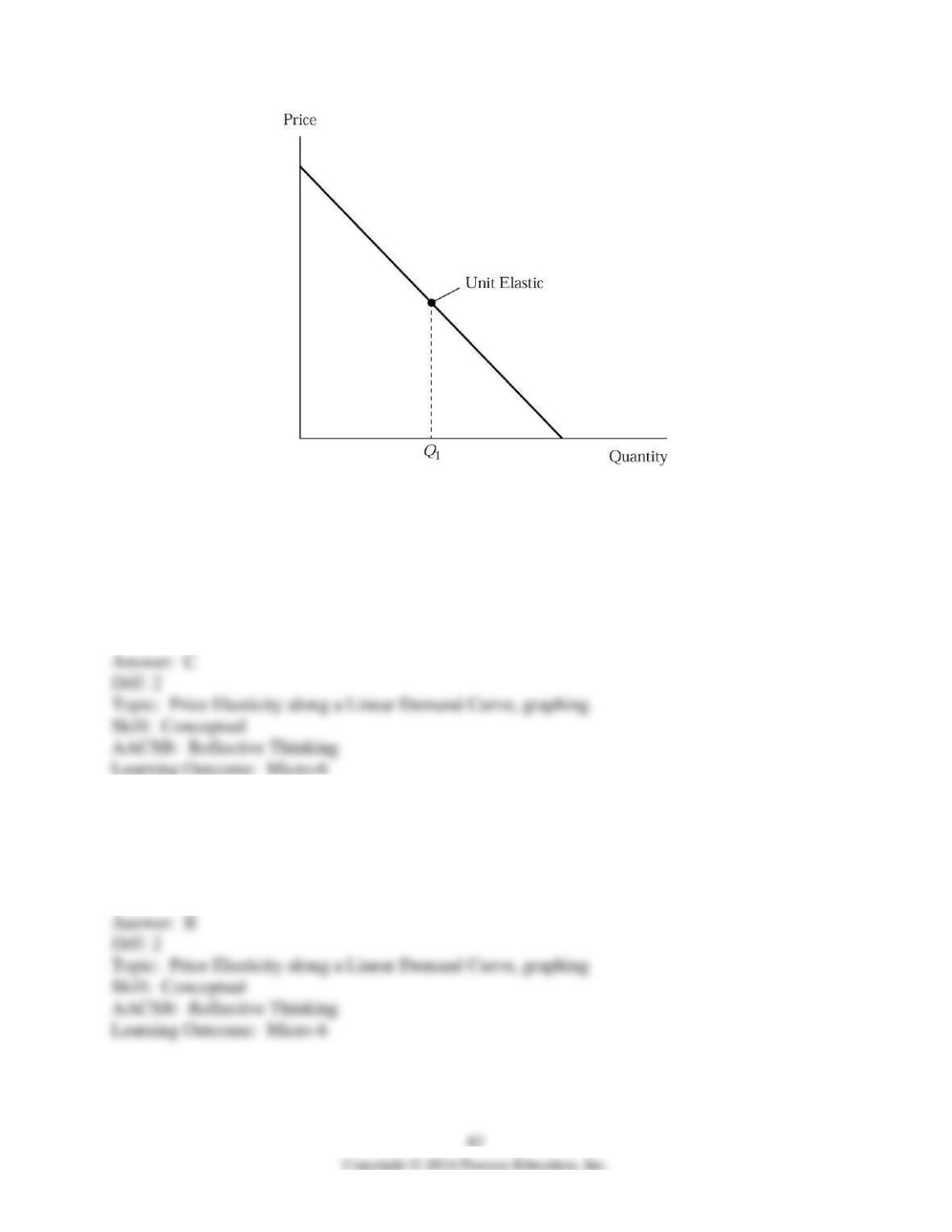
Figure 4.2
6) In Figure 4.2 at quantities larger than Q1 demand is
A) inferior.
B) elastic.
C) inelastic.
D) unit elastic.
7) In Figure 4.2 at quantities smaller than Q1 demand is
A) inferior.
B) elastic.
C) inelastic.
D) unit elastic.
8) In Figure 4.2 at quantities at Q1
A) price and total revenue are unrelated.
B) total revenue is maximized.
C) price elasticity equals 1.
D) all of the above
9) In Figure 4.2 at quantities smaller than Q1
A) total revenue is falling.
B) price elasticity is greater than 1.
C) price and total revenue are directly related.
D) all of the above
10) In Figure 4.2 at quantities larger than Q1
A) total revenue is rising.
B) price elasticity is greater than 1.
C) price and total revenue are directly related.
D) all of the above
11) Suppose that ABC Beer Brewer faces a linear demand curve and that the current price for its
beer is set at a point where the price elasticity is 1.6. If ABC Beer Brewer increases the product
price,
A) the demand becomes more elastic and total revenue increases.
B) the demand becomes less elastic and total revenue increases.
C) the demand becomes more elastic and total revenue decreases.
D) the demand becomes less elastic and total revenue decreases.
12) Suppose that an Italian ice cream firm is facing a linear demand curve and that the current
price for the Italian ice cream is set at a point where the price elasticity is 0.7. If the firm
decreases the product price,
A) the demand becomes more inelastic and total revenue increases.
B) the demand becomes more inelastic and total revenue decreases.
C) the demand becomes less inelastic and total revenue increases.
D) the demand becomes less inelastic and total revenue decreases.
13) If a firm facing a linear demand curve experiences an increase in total revenue after lowering
the price,
A) the initial price was set at a point where the demand is inelastic.
B) the initial price was set at a point where the demand is elastic.
C) the new price is set where the demand is perfectly elastic.
D) the new price is set where the demand is perfectly inelastic.
14) A firm facing a linear demand curve maximizes its total revenue where demand is
A) perfectly inelastic.
B) inelastic.
C) elastic.
D) unitary elastic.
15) Firms like to know the price elasticity of demand because it determines how price changes
affect
A) the supply curve.
B) costs.
C) revenues.
D) taxes.
Recall the Application about choosing a price for trampolines based on a linear demand
curve to answer the following question(s).
16) Recall the Application. Suppose a firm that produces trampolines has a linear demand curve
for its product, with a vertical intercept of $1,500. If the firm does NOT want the demand for its
product to be price-inelastic, the minimum price it should charge is
A) $500.
B) $750.
C) $1,000.
D) $1,500.
17) Recall the Application. Suppose a firm that produces trampolines has a linear demand curve
for its product, with a vertical intercept of $1,500. If the firm initially charged a price of $500
and then raised its price to $750, the firm’s total revenue would ________ and total cost would
________
A) increase; increase
B) increase; decrease
C) decrease; increase
D) decrease; decease
18) Demand is elastic along the upper half of a linear demand curve, which means that a
decrease in price will increase the quantity sold by a larger percentage amount.
19) If the slope of a demand curve is constant, then so is the elasticity on that demand curve.
20) If a firm currently sells a product at a point where the price elasticity of demand is 0.5, the
firm needs to raise the price to maximize its total revenue.
21) On a straight line demand curve, total revenue is maximized where demand is unitary elastic.
22) Explain why the price elasticity varies even when a firm faces a linear demand curve.
23) What happens to total revenue associated with a linear demand curve as price falls?
4.4 Other Elasticities of Demand
1) The demand for a particular good depends on variables such as
A) consumer income.
B) price of substitutes.
C) price of complements.
D) all of the above
2) A good is said to be “inferior” if
A) it is of low quality.
B) consumers buy less of it at a high price.
C) it has a negative income elasticity of demand.
D) it has many substitutes.
3) A good is said to be “normal” if
A) it is of high quality.
B) consumers buy more of it at a high price.
C) it has few substitutes.
D) it has a positive income elasticity of demand.
4) If the income elasticity of a good is greater than one, we say that its demand is
A) price sensitive.
B) income-inelastic.
C) income-elastic.
D) price insensitive.
5) The income elasticity of demand is
A) the percentage change in quantity demanded divided by the percentage change in price.
B) the percentage change in quantity demanded divided by the percentage change in income.
C) the percentage change in income divided by the percentage change quantity demanded.
D) the percentage change in price divided by the percentage change in income.
6) If the quantity demanded of restaurant meals increases by 20% when income increases by
10%, the demand for restaurant meals is
A) price sensitive.
B) income-inelastic.
C) income-elastic.
D) price insensitive.
7) If quantity demanded of a good falls by 2% when income falls by 10%, the good’s demand is
A) price sensitive.
B) income-inelastic.
C) income-elastic.
D) price insensitive.
8) If the quantity demanded of peanut butter falls by 12% when income rises by 10%, then
peanut butter is
A) an inferior good.
B) a normal good.
C) income-elastic demand.
D) both A and C
9) Suppose that the income elasticity of demand for new clothes is positive. Other things being
equal, which of the following statements is correct?
A) New clothes are a normal good.
B) The quantity demanded of new clothes decreases as a consumer’s income declines.
C) There exists a positive relationship between income and the demand for new clothes.
D) all of the above
10) Suppose that the income elasticity of demand for frozen dinners is negative. Other things
being equal, which of the following statements is INCORRECT?
A) Frozen dinners are an inferior good.
B) The quantity demanded of frozen dinners increases as a consumer’s income declines.
C) There exists a negative relationship between income and the demand for frozen dinners.
D) The share of income spent on good X must decrease as a consumer’s income decreases.
11) Suppose that the income elasticity of demand for good X is positive but less than 1. Other
things being equal, which of the following statements is INCORRECT?
A) Good X is a normal good.
B) The quantity demanded of good X decreases as a consumer’s income declines.
C) A consumer buys more X as income rises, but the share of income spent on good X falls.
D) A consumer buys more X as income rises and the share of income spent on good X also rises.
12) Suppose that the income elasticity of demand for good X is greater than 1. Other things being
equal, which of the following statements is INCORRECT?
A) Good X is a normal good.
B) The quantity demanded of good X decreases as a consumer’s income declines.
C) A consumer buys more X as income rises, but the share of income spent on good X falls.
D) A consumer buys more X as income rises and the share of income spent on good X also rises.
13) The cross-price elasticity of demand measures
A) the relationship between the demand for one good and the supply of another.
B) the relationship between the demand for one good and the price of another.
C) the relationship between the demand and supply of one good at the intersection of the curves.
D) the elasticity of demand at the intersection of the supply and demand curves.
14) The percentage change in the quantity of peanut butter demanded divided by the percentage
change in price of jelly measures
A) the price elasticity of demand for peanut butter.
B) the price elasticity of demand for jelly.
C) the cross-price elasticity of demand for peanut butter with respect to the price of jelly.
D) the cross-price elasticity of demand for jelly with respect to the price of peanut butter.
15) The percentage change in the quantity of bread demanded divided by the percentage change
in price of jelly measures
A) the cross-price elasticity of demand for bread with respect to jelly.
B) the cross-price elasticity of demand for jelly with respect to bread.
C) the price elasticity of demand for bread.
D) the price elasticity of demand for jelly.
16) The cross-price elasticity of demand between spaghetti and spaghetti sauce is most likely
A) positive.
B) negative.
C) zero.
D) More information is needed to determine.
17) The cross-price elasticity of demand between bananas and apples is most likely
A) positive.
B) negative.
C) zero.
D) More information is needed to determine.
18) The cross-price elasticity of demand between telephones and ramen noodles is most likely
A) positive.
B) negative.
C) zero.
D) greater than one.
19) When the price of hamburger went from $3 to $4 a pound, the quantity demanded of buns
changed from 30 to 25 packages a day. The cross-price elasticity of demand for buns (using the
initial value formula) is
A) 1.4.
B) 0.5.
C) -0.5.
D) -1.4.
20) When the price of hamburger went from $3 to $4 a pound, the quantity demanded of buns
changed from 30 to 25 packages a day. The cross-price elasticity of demand for hamburger
(using the initial value formula) is
A) 1.4.
B) 0.6.
C) -0.6.
D) Not enough information to answer this question.
21) When the price of pens went from $1 to $1.50, the quantity demanded of pencils changed
from 50 to 75 a day. The cross-price elasticity of demand for pencils (using the initial value
formula) is
A) 1.
B) 0.4.
C) 0.2.
D) -0.2.
22) When the price of pens went from $1 to $1.50, the quantity demanded of pencils changed
from 50 to 75 a day. The cross-price elasticity of demand for pens (using the initial value
formula) is
A) 0.8.
B) 0.4.
C) 0.2.
D) Cannot be determined from the information provided.
23) When the price of tacos went from $2 to $3 dollars each, the quantity demanded of burritos
changed from 100 to 120 a day. The cross-price elasticity of demand for burritos calculated using
the initial value method is
A) 1.33.
B) 0.75.
C) 0.4.
D) -0.75.
24) The cross-price elasticity between good X and good Y is positive. Other things being equal,
if the price of X rises
A) quantity of Y demanded decreases.
B) quantity of Y demanded increases.
C) a consumer spends more on good Y than on good X.
D) a consumer spends more on good X than on good Y.