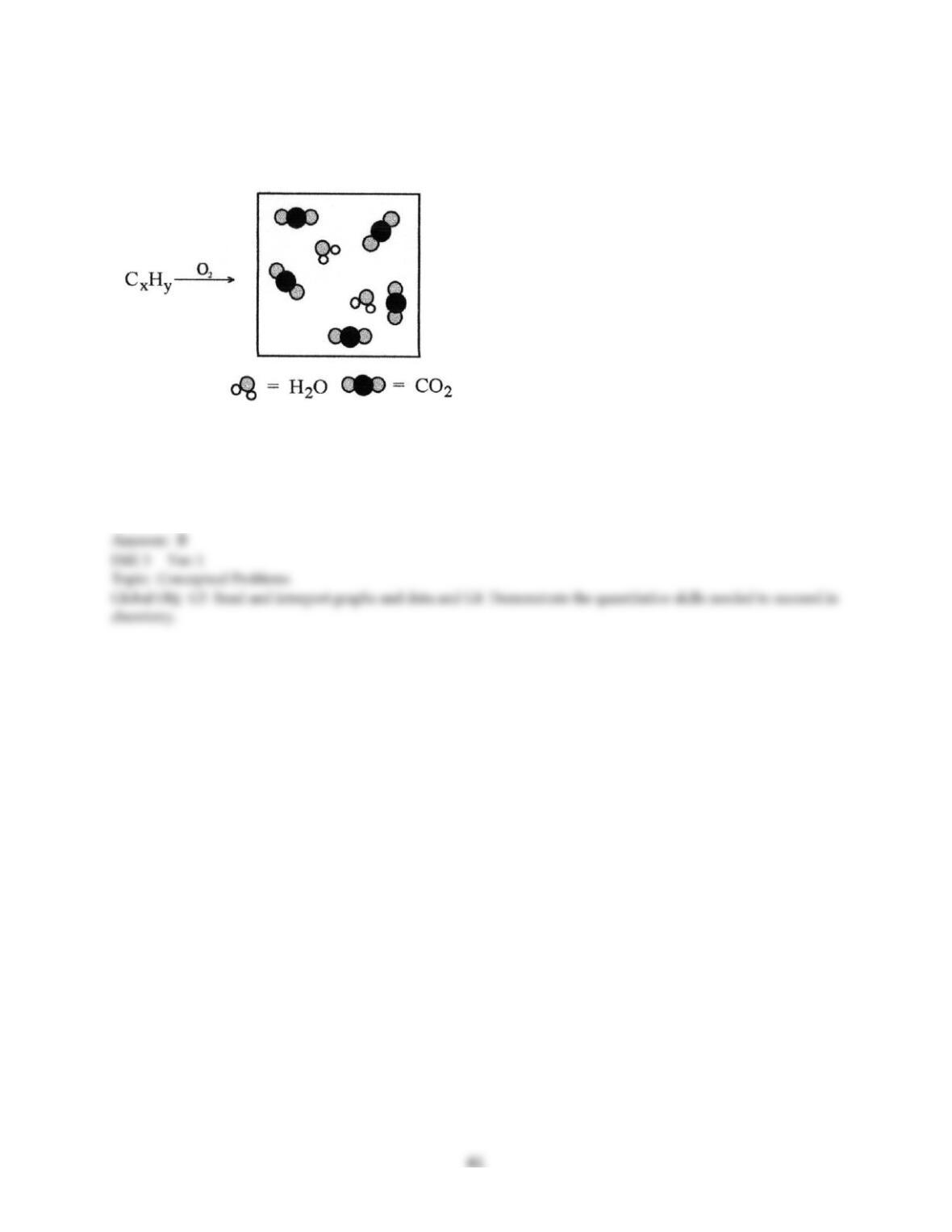
111) A hydrocarbon of unknown formula CxHy was submitted to combustion analysis with the following
results. What is the empirical formula of the hydrocarbon?
A) C5H2
B) C5H4
C) C10H4
D) C10H8
4.2 Algorithmic Questions
1) What is the concentration of FeCl3 in a solution prepared by dissolving 10.0 g of FeCl3 in enough water
to make 275 mL of solution?
A) 2.24 × 10⁻⁴ M
B) 0.224 M
C) 4.46 M
D) 4.46 × 10³ M
2) How many grams of AgNO3 are needed to make 250. mL of a solution that is 0.140 M?
A) 0.0951 g
B) 0.168 g
C) 5.95 g
D) 95.1 g
3) What volume of a 0.540 M NaOH solution contains 13.5 g of NaOH?
A) 0.182 L
B) 0.625 L
C) 1.60 L
D) 5.49 L
4) What is the concentration of 200. mL of 0.500 M LiF?
A) 0.500 M
B) 1.00 M
C) 0.250 M
D) 0.400 M
5) What is the concentration of HCl in the final solution when 65 mL of a 6.0 M HCl solution is diluted
with pure water to a total volume of 0.15 L?
A) 1.4 × 10⁻² M
B) 2.6 M
C) 14 M
D) 2.6 × 10³ M
6) How many milliliters of a 9.0 M H2SO4 solution are needed to make 0.45 L of a 3.5 M solution?
A) 0.18 mL
B) 1.2 mL
C) 180 mL
D) 1200 mL
7) A student prepared a stock solution by dissolving 15.0 g of KOH in enough water to make 150. mL of
solution. She then took 15.0 mL of the stock solution and diluted it with enough water to make water to
make 65.0 mL of a final solution. What is the concentration of KOH for the final solution?
A) 0.411 M
B) 0.534 M
C) 1.87 M
D) 2.43 M
8) A student left 40.0 mL of a bottle of 12.0 M HCl out overnight. The next morning, the bottle has only
35.7 mL of liquid left. Assuming that the volume change is only due to loss of water, what will be the
molarity if the remaining solution is diluted to 150 mL?
A) 6.0 M
B) 2.86 M
C) 3.20 M
D) 12.0 M
9) Which contains the greatest number of bromide ions?
A) 50 mL of 2.0 M KBr
B) 100 mL of 1.0 M BaBr2
C) 20 mL of 2.5 M FeBr3
D) All contain the same number of chloride ions.
10) What is the concentration of NO3– ions in a solution prepared by dissolving 20.0 g of Ca(NO3)2 in
enough water to produce 300. mL of solution?
A) 0.203 M
B) 0.406 M
C) 0.537 M
D) 0.813 M
11) If the reaction of phosphate ion with water is ignored, what is the total concentration of ions in a
solution prepared by dissolving 7.00 g of K3PO4 in enough water to make 350. mL of solution?
A) 0.0236 M
B) 0.0943 M
C) 0.377 M
D) 0.754 M
12) What is the concentration of an AlCl3 solution if 150. mL of the solution contains 250. mg of Cl– ion?
A) 1.57 × 10⁻² M
B) 3.75 × 10⁻² M
C) 4.70 × 10⁻² M
D) 1.41 × 10⁻¹ M
13) How many mL of a 0.175 M FeCl3 solution are needed to make 550. mL of a solution that is 0.300 M in
Cl– ion?
A) 0.943 mL
B) 314 mL
C) 943 mL
D) It is not possible to make a more concentrated solution from a less concentrated solution.
14) How many mL of a 0.350 M AlI3 solution are needed to make 700. mL of a solution that is 0.350 M in
I– ion?
A) 500 mL
B) 167 mL
C) 125 mL
D) It is not possible to make a more concentrated solution from a less concentrated solution.
15) A student dissolved 3.00 g of Co(NO3)2 in enough water to make 100. mL of stock solution. He took
4.00 mL of the stock solution and then diluted it with water to give 275. mL of a final solution. How many
grams of NO3– ion are there in the final solution?
A) 0.0148 g
B) 0.0296 g
C) 0.0407 g
D) 0.0813 g
16) H Br , HCl , H ClO4, K Br , and NaCl are all classified as
A) acids.
B) nonelectrolytes.
C) strong electrolytes.
D) weak electrolytes.
46
17) What is the molar concentration of sodium ions in a 0.750 M Na3PO4 solution?
A) 0.250 M
B) 0.750 M
C) 2.25 M
D) 3.00 M
18) What is the molarity of chloride ions when 10.4 grams of MgCl2 is dissolved in 753 mL of water?
A) 0.00 M
B) 0.145 M
C) 0.000290 M
D) 0.290 M3
19) What is the molar concentration of sulfate ions in a 0.450 M K2SO4 solution?
A) 0.225 M
B) 0.450 M
C) 0.900 M
D) 1.35 M
20) The reaction HNO3(aq) + KOH(aq) → KNO3(aq) + H2O(l) is best classified as a(n)
A) acid-base neutralization reaction.
B) oxidation-reduction reaction.
C) precipitation reaction.
D) single replacement reaction.
21) The reaction Sr(NO3)2(aq) + Cs2SO4(aq) → SrSO4(s) + 2 CsNO3(aq) is best classified as a(n)
A) acid-base neutralization reaction.
B) oxidation-reduction reaction.
C) precipitation reaction.
D) single replacement reaction.
22) The reaction Ba(s) + 2 AgNO3(aq) → Ba(NO3)2(aq) + 2 Ag(s) is best classified as a(n)
A) acid-base neutralization reaction.
B) double replacement reaction.
C) oxidation-reduction reaction.
D) precipitation reaction.
23) Write a balanced net ionic equation for the reaction of Li2CO3(s) and HCl(aq).
A) Li2CO3(s) + 2 HCl(aq) → 2 LiCl(aq) + H2O(l) + CO2(g)
B) 2Li+(aq) + CO32-(aq) + 2H+(aq) + 2Cl–(aq) → 2Li+(aq) + 2Cl–(aq) + H2O(l) + CO2(g)
C) Li2CO3(s) + 2 H+(aq) → 2 Li+(aq) + H2O(l) + CO2(g)
D) CO32-(aq) + 2 H+(aq) → H2O(l) + CO2(g)
24) Write a balanced net ionic equation for the reaction of AgNO3(aq) with LiCl(aq).
A) AgNO3(aq) + LiCl(aq) → AgCl(aq) + LiNO3(s)
B) Ag+(aq) + NO3–(aq) + Li+(aq) + Cl–(aq) → Ag+(aq) + Cl–(aq) + LiNO3(s)
C) Ag+(aq) + NO3–(aq) + Li+(aq) + Cl–(aq) → AgBr(s) + Li+(aq) + NO3–(aq)
D) Ag+(aq) + Br–(aq) → AgBr(s)
25) Write a balanced net ionic equation for the reaction of CaI2(aq) with K2S(aq).
A) CaI2(aq) + K2S(aq) → CaS (aq) + 2 KI(aq)
B) Ca2+(aq) + 2 I–(aq) + 2 K+(aq) + S2-(aq) → CaS(s) + 2 KI(aq)
C) Ca2+(aq) + S2-(aq) → CaS(s)
D) Ca2+(aq) + 2 I–(aq) + 2 K+(aq) + S2-(aq) → CaS(s) + 2 KI(s)
26) Which one of the following compounds is insoluble in water?
A) Na2SO4
B) KNO3
C) Ba SO4
D) Li2CO3
27) Which one of the following compounds is soluble in water?
A) Cu3(PO4)2
B) FeS
C) Hg(NO3)2
D) SrCO3
28) Which pair of compounds is soluble in water?
A) Hg2Br2 and Hg2I2
B) CuS and Na2S
C) LiI and Ca(NO3)2
D) K NO3 and CaCO3
49
29) The mixing of which pair of reactants will result in a precipitation reaction?
A) CsI(aq) + NaOH(aq)
B) HCl(aq) + Ca(OH)2(aq)
C) K2SO4(aq) + Pb (NO3)2(aq)
D) NaNO3(aq) + NH4Cl(aq)
30) The mixing of which pair of reactants will result in a precipitation reaction?
A) CsCl(aq) + KOH(aq)
B) HCl(aq) + Ca(OH)2(aq)
C) Li2CO3(aq) + Ca(NO3)2(aq)
D) NaClO4(aq) + NH4Cl(aq)
31) The mixing of which pair of reactants will result in a precipitation reaction?
A) Ni(NO3)2(aq) + Na2CO3(aq)
B) K2SO4(aq) + Cu(NO3)2(aq)
C) NaClO4(aq) + (NH4)2S(aq)
D) NH4Br(aq) + NH4I(aq)
32) The mixing of which pair of reactants will result in a precipitation reaction?
A) Cu(NO3)2(aq) + Na3PO4(aq)
B) Na2SO4(aq) + KNO3(aq)
C) LiClO4(aq) + (NH4)2S(aq)
D) NH4Br(aq) + LiI(aq)
33) What reagent could be used to separate I– from CH3CO2– when added to an aqueous solution
containing both?
A) AgNO3 (aq)
B) Ba(OH)2 (aq)
C) CuSO4 (aq)
D) NaI (aq)
34) What reagent could not be used to separate Br– from CO32- when added to an aqueous solution
containing both?
A) AgNO3 (aq)
B) Ca(NO3)2 (aq)
C) Cu(NO3)2 (aq)
D) Fe(NO3)2(aq)
35) Predict the products of a reaction between AgNO3(aq) and CsBr(aq).
A) Ag(s) and NO(g)
B) Ag(s) and Br2(l)
C) AgBr(s) and CsNO3(aq)
D) AgNO3(aq) and CsBr(aq)
36) Predict the products of a reaction between Sr(NO3)2(aq) and Rb2SO4(aq).
A) Sr(s), RbNO3(aq) and Rb2SO3(aq)
B) SrSO3(s) and RbNO2(aq)
C) SrSO3(s) and RbNO3(aq)
D) SrSO4(s) and RbNO3(aq)
37) Which pair of reactants will produce a precipitate when mixed together?
A) HI(aq) and KOH(aq)
B) HCl(aq) and Li2CO3(aq)
C) HCl(aq) and K2S(aq)
D) HBr(aq) and Pb(NO3)2(aq)
38) What reagent would distinguish between Ba2+ and Pb2+?
A) KCl
B) LiNO3
C) K2SO4
D) Li2S2O3
39) Which of the following compounds is not an Arrhenius acid?
A) CH3CO2H
B) C3H7NH2
C) HNO2
D) H2SO4
40) Which of the following compounds is an Arrhenius base?
A) C6H12O6
B) HOCl
C) H2SO4
D) CH3NH2
41) Which of the following compounds is an Arrhenius base?
A) CH3OH
B) CH3CO2H
C) HOCl
D) LiOH
42) Which one of the following compounds behaves as an acid when dissolved in water?
A) SrO
B) C3H8
C) HCl
D) LiOH
43) Which of the compounds of H NO2, Ra(OH)2, FrOH, and HI, behave as acids when they are
dissolved in water?
A) Ra(OH)2 and FrOH
B) H NO2 and HI
C) only HI
D) only FrOH
44) Which of the compounds H3PO4, Mg(OH)2, LiOH, and HCl, behave as bases when they are dissolved
in water?
A) Mg(OH)2 and LiOH
B) H3PO4 and HCl
C) only HCl
D) only LiOH
45) When dissolved in water, NaOH behaves as
A) an acid that forms Na+ and OH– ions.
B) an acid that forms NaO– and H+ ions.
C) a base that forms Na+ and OH– ions.
D) a base that forms NaO– and H+ ions.
46) An aqueous solution of H Cl is named
A) hydrochloric acid.
B) hydrochlorous acid.
C) chloric acid.
D) chlorous acid.
47) The chemical formula for iodous acid is
A) H IO(aq).
B) HIO2(aq).
C) HIO3(aq).
D) H I O4(aq).