Use properties of logarithms to expand the logarithmic expression as much as possible. Where possible, evaluate
logarithmic expressions without using a calculator.
117)
log 53x
117)
A)
log 53+log 5x
B)
1
2log 53x
C)
log 53+1
2log 5x
D)
1
2log 53+1
2log 5x
Solve the logarithmic equation. Be sure to reject any value that is not in the domain of the original logarithmic
expressions. Give the exact answer.
118)
log (x + 5) = log (5x – 4)
118)
A)
1
4
B)
9
4
C)
–9
4
D)
3
2
B
Evaluate the expression without using a calculator.
119)
eln 9x3
119)
A)
ln 9x3
B)
3
C)
e9x3
D)
9x3
D
Solve.
120)
The population of a certain country is growing at a rate of 1.9% per year. How long will it take for
this country’s population to double? Use the formula t =ln 2
k, which gives the time, t, for a
population with growth rate k, to double. (Round to the nearest whole year.)
120)
A)
37 years
B)
38 years
C)
35 years
D)
36 years
D
Graph the function.
41
D
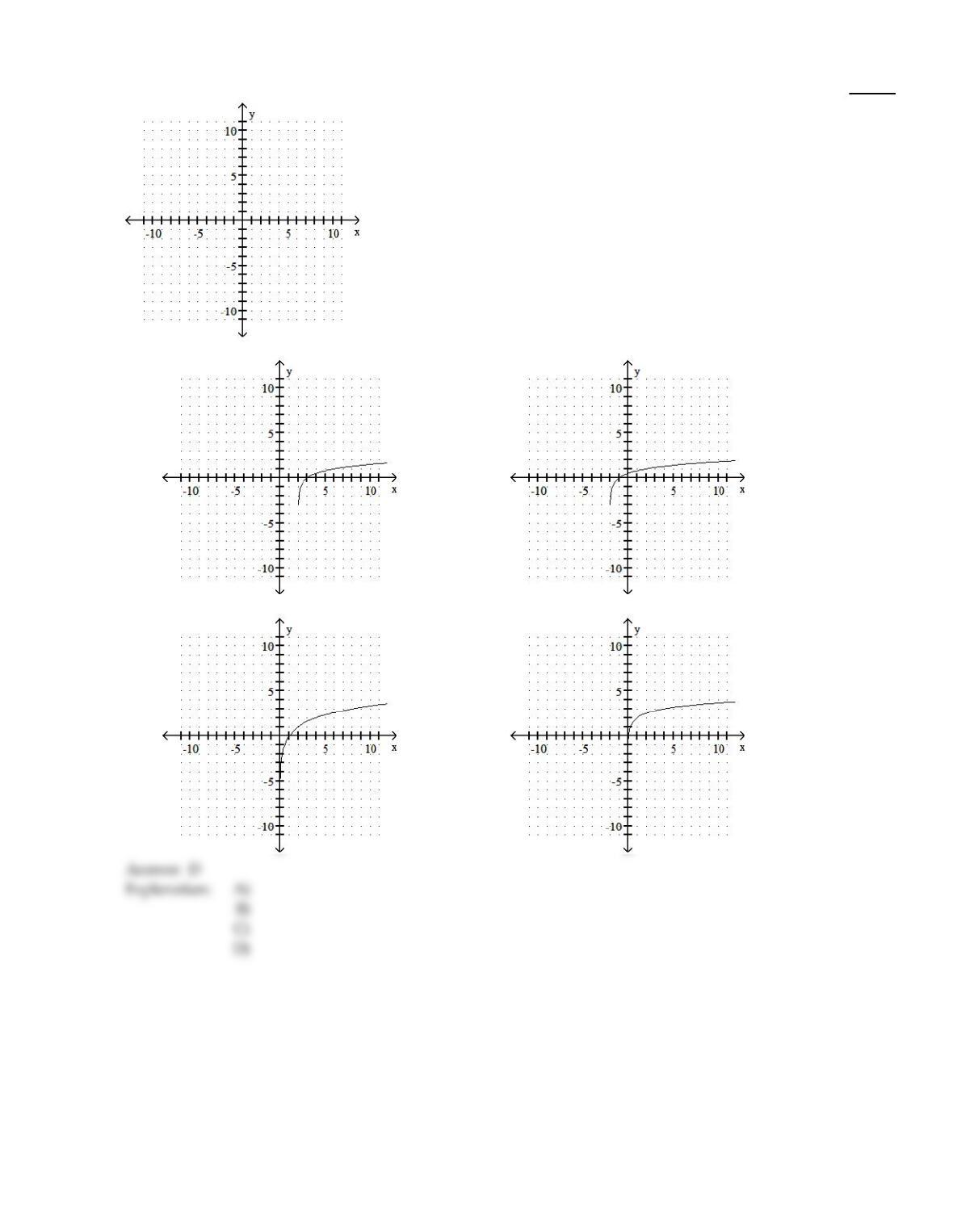
121)
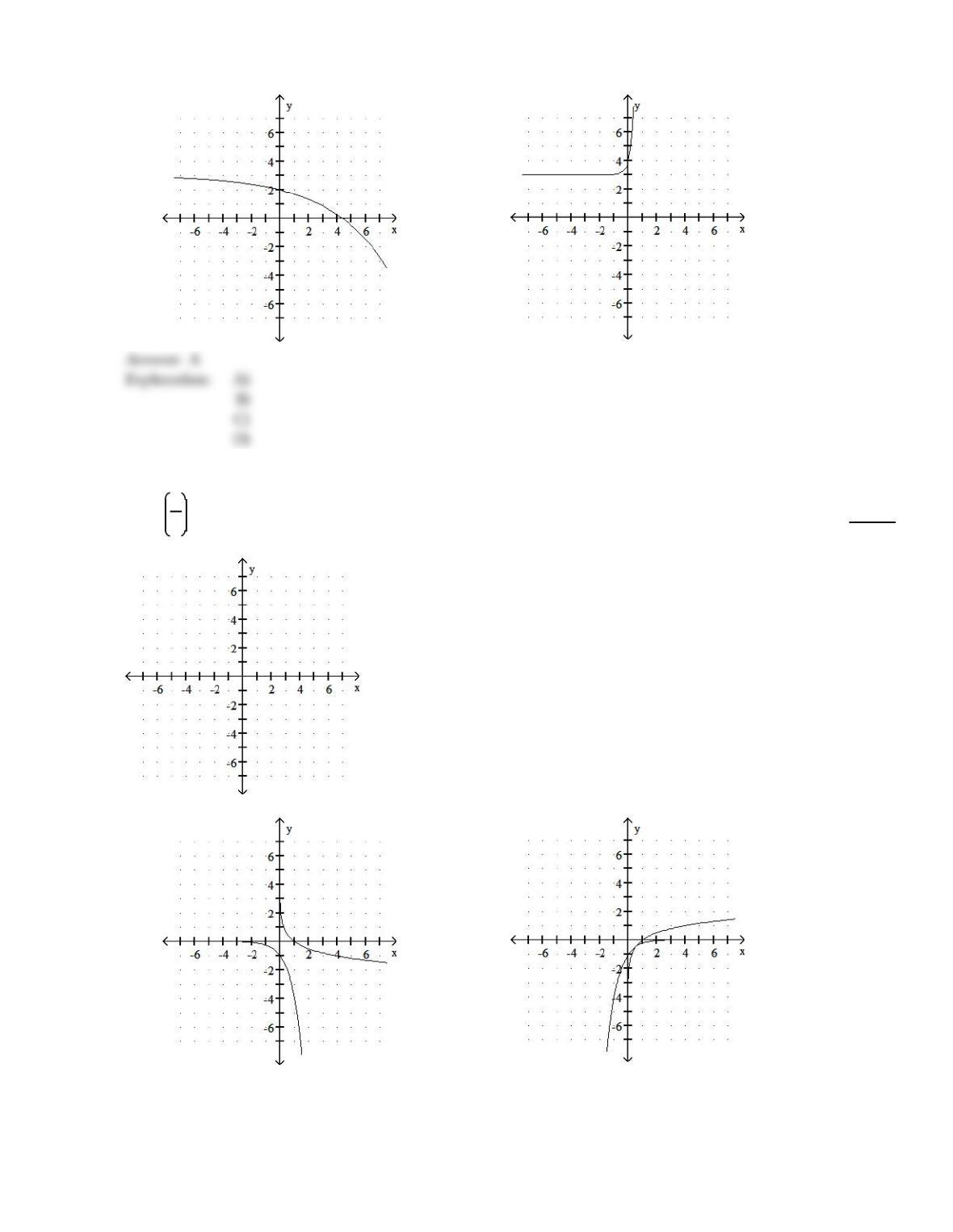
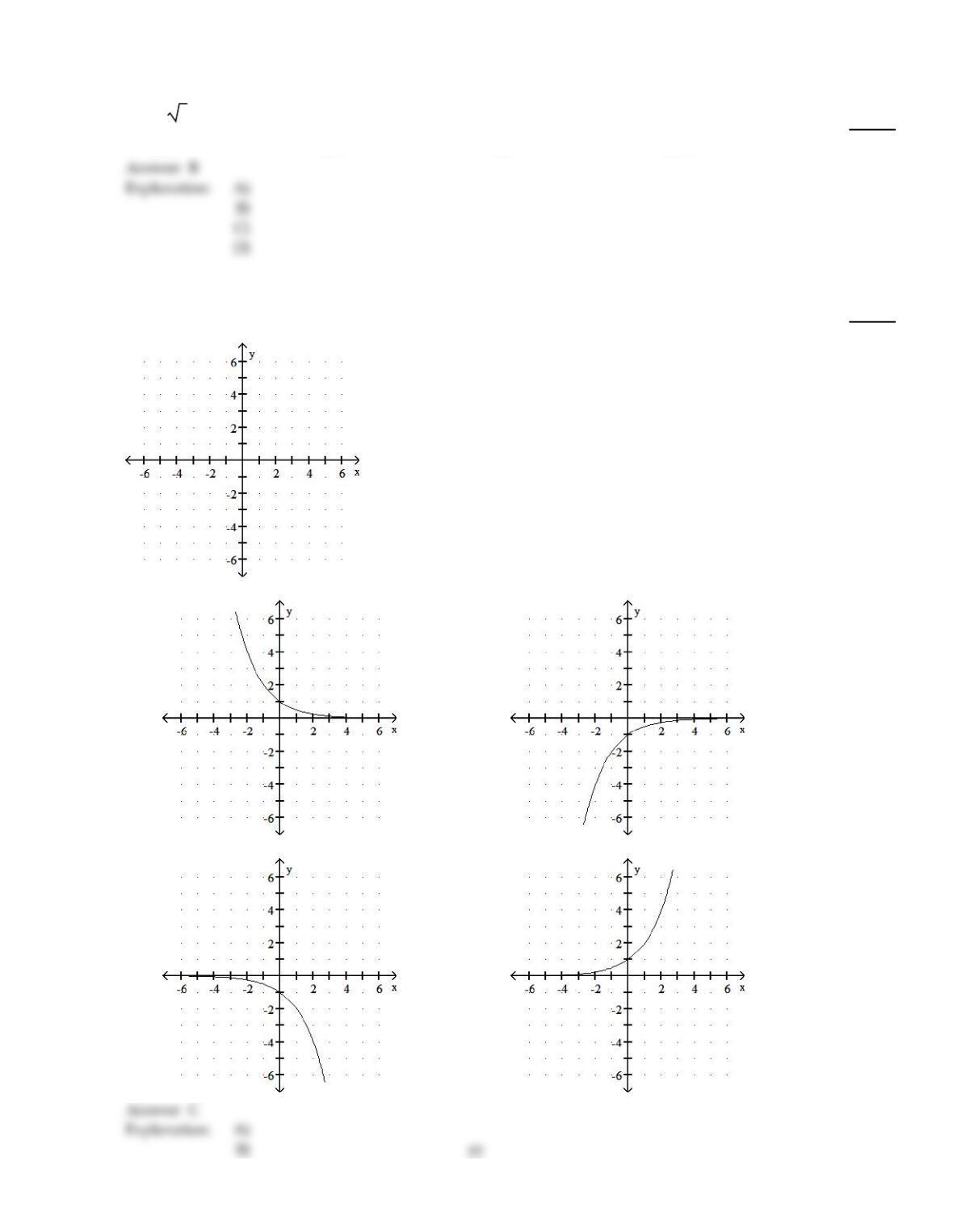
Use the graph of log 4x to obtain the graph of f(x) =2+log 4x.
121)
A)
B)
C)
D)
42
Solve.
122)
The value of a particular investment follows a pattern of exponential growth. In the year 2000, you
invested money in a money market account. The value of your investment t years after 2000 is
given by the exponential growth model A =1500e0.045t. By what percentage is the account
increasing each year?
122)
A)
4.8%
B)
5.0%
C)
5.1%
D)
4.5%
Use the compound interest formulas A = P 1 +r
n
nt and A = Pert to solve.
123)
Find the accumulated value of an investment of $5000 at 5% compounded monthly for 8 years.
123)
A)
$12,911.25
B)
$9093.60
C)
$8060.16
D)
$7452.93
Use properties of logarithms to condense the logarithmic expression. Write the expression as a single logarithm whose
coefficient is 1. Where possible, evaluate logarithmic expressions.
124)
log10125 +log108
124)
A)
3
B)
log10133
C)
log101000
D)
3log1010
Use properties of logarithms to expand the logarithmic expression as much as possible. Where possible, evaluate
logarithmic expressions without using a calculator.
125)
log5
125
x – 1
125)
A)
log5125 –log5x – 1
B)
3log55–1
2log5(x – 1)
C)
3–1
2log5(x – 1)
D)
3–log5x – 1
Rewrite the equation in terms of base e. Express the answer in terms of a natural logarithm, and then round to three
decimal places.
126)
y =16(2.8)x
126)
A)
y =2.8ex ln 16, y =2.8e2.773x
B)
y =16e2.8x, y =162.7181.030x
C)
y =16ex ln 2.8, y =16e1.030x
D)
y = (ln 16)ex ln 2.8, y =2.773e1.030x
Use the compound interest formulas A = P 1 +r
n
nt and A = Pert to solve.
127)
Suppose that you have $3000 to invest. Which investment yields the greater return over 9 years:
5.4% compounded monthly or 5.5% compounded quarterly?
127)
A)
Both investment plans yield the same return.
B)
$3000 invested at 5.4% compounded monthly over 9 years yields the greater return.
C)
$3000 invested at 5.5% compounded quarterly over 9 years yields the greater return.
Graph the function.
128)
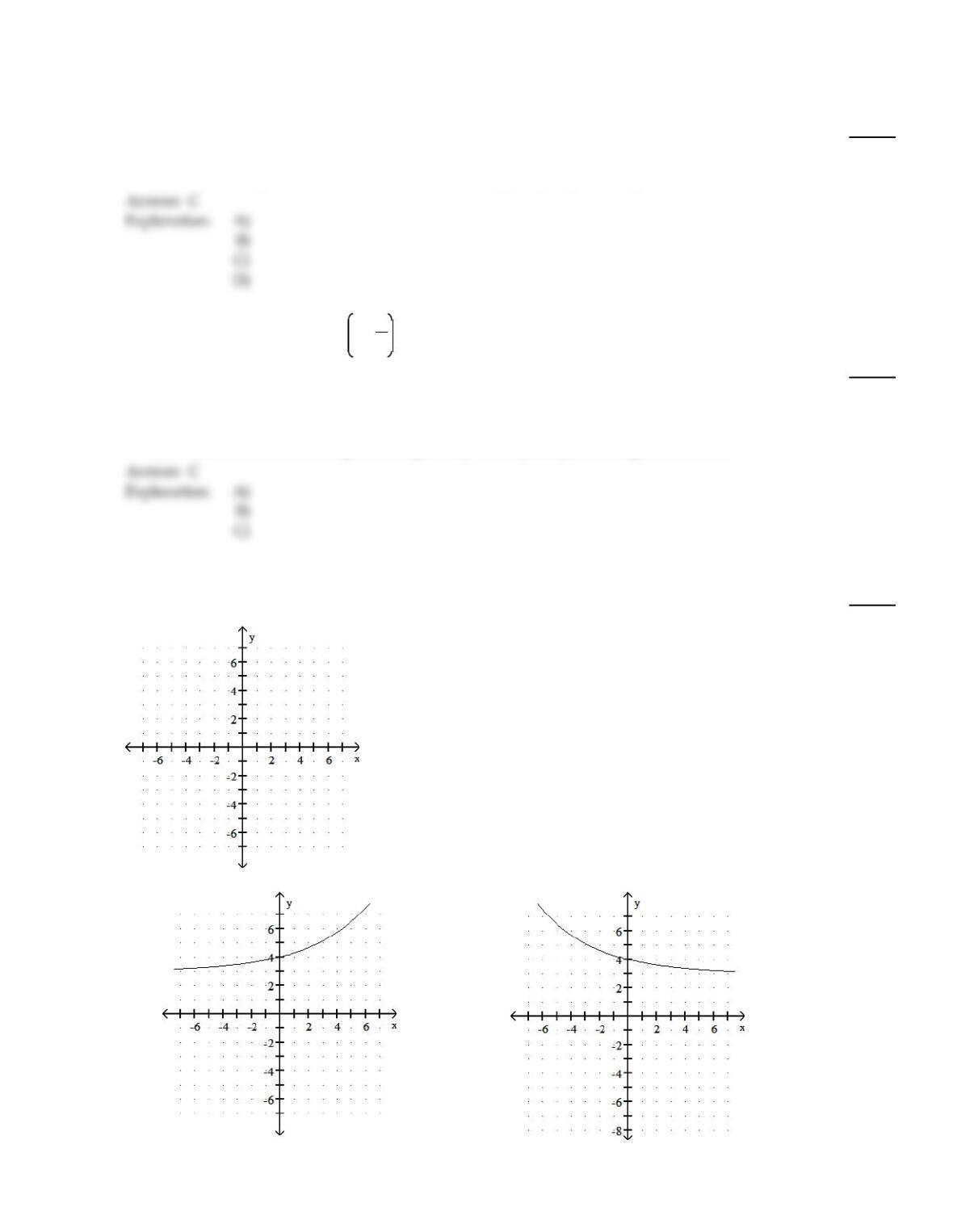
Use the graph of f(x) =ex to obtain the graph of g(x) =ex/4+ 3.
128)
A)
B)
44
C)
D)
Graph the functions in the same rectangular coordinate system.
129)
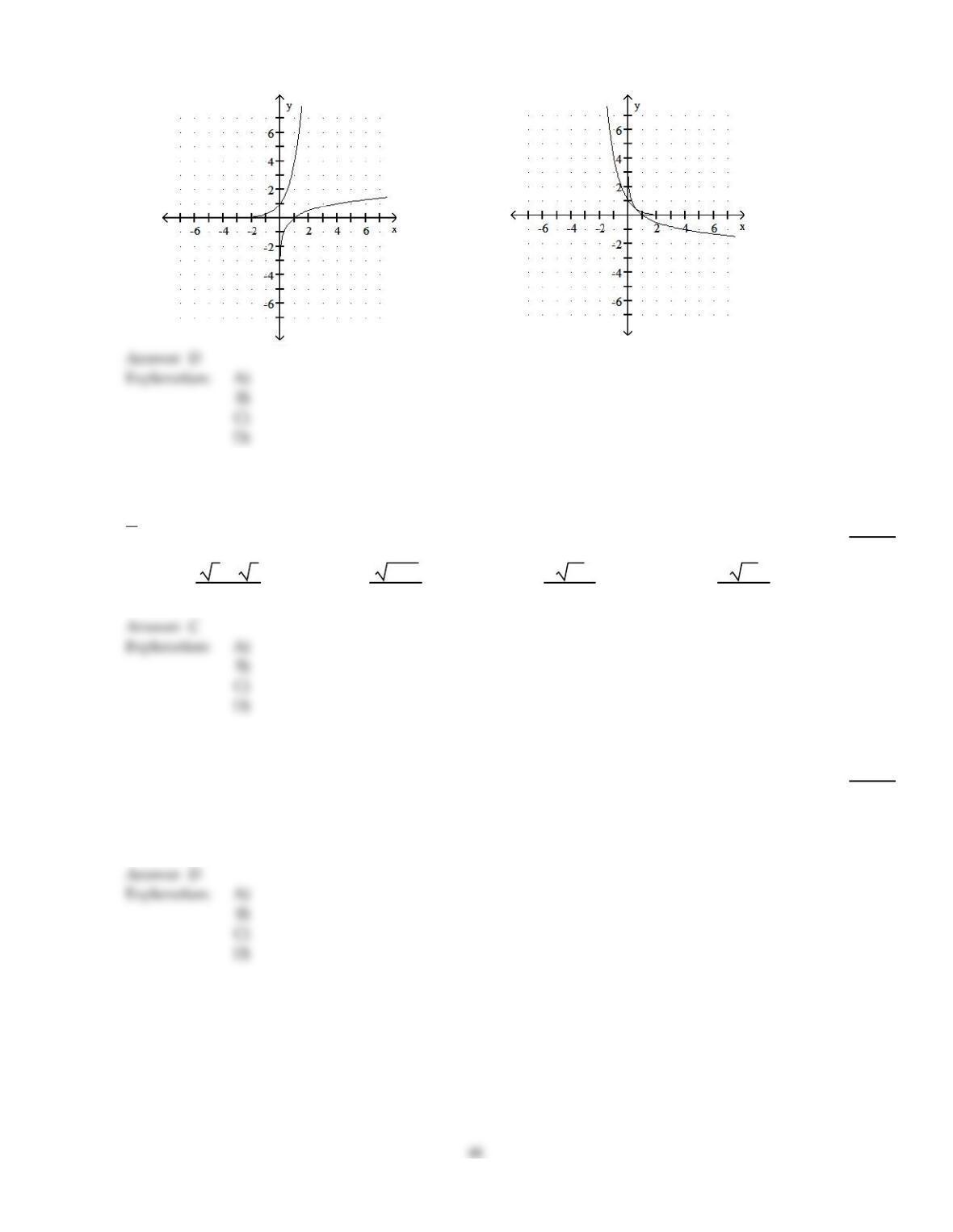
f(x) =1
4
x and g(x) =log1/4 x
129)
A)
B)
45
C)
D)
Use properties of logarithms to condense the logarithmic expression. Write the expression as a single logarithm whose
coefficient is 1. Where possible, evaluate logarithmic expressions.
130)
1
4(log4 x +log4 y) –3log4 (x +7)
130)
A)
log4
4x+4y
(x +7)3
B)
log4
4x + y
(x +7)3
C)
log4
4xy
(x +7)3
D)
log4
4xy
3(x +7)
Solve the problem.
131)
The function f(x) =600(0.5)x/80 models the amount in pounds of a particular radioactive material
stored in a concrete vault, where x is the number of years since the material was put into the vault.
Find the amount of radioactive material in the vault after 140 years. Round to the nearest whole
number.
131)
A)
404 pounds
B)
525 pounds
C)
171 pounds
D)
178 pounds
Find the domain of the logarithmic function.
132)
f(x) = ln 1
x + 10
132)
A)
(10, )
B)
(0, )
C)
(–10, )
D)
(1, )
Solve the problem.
133)
If Emery has $2000 to invest at 11% per year compounded monthly, how long will it be before he
has $3000? If the compounding is continuous, how long will it be? (Round your answers to three
decimal places.)
133)
A)
0.324 yrs, 0.307 yrs
B)
56.274 yrs, 3.868 yrs
C)
0.052 yrs, 0.369 yrs
D)
3.703 yrs, 3.686 yrs
Graph the function.
134)
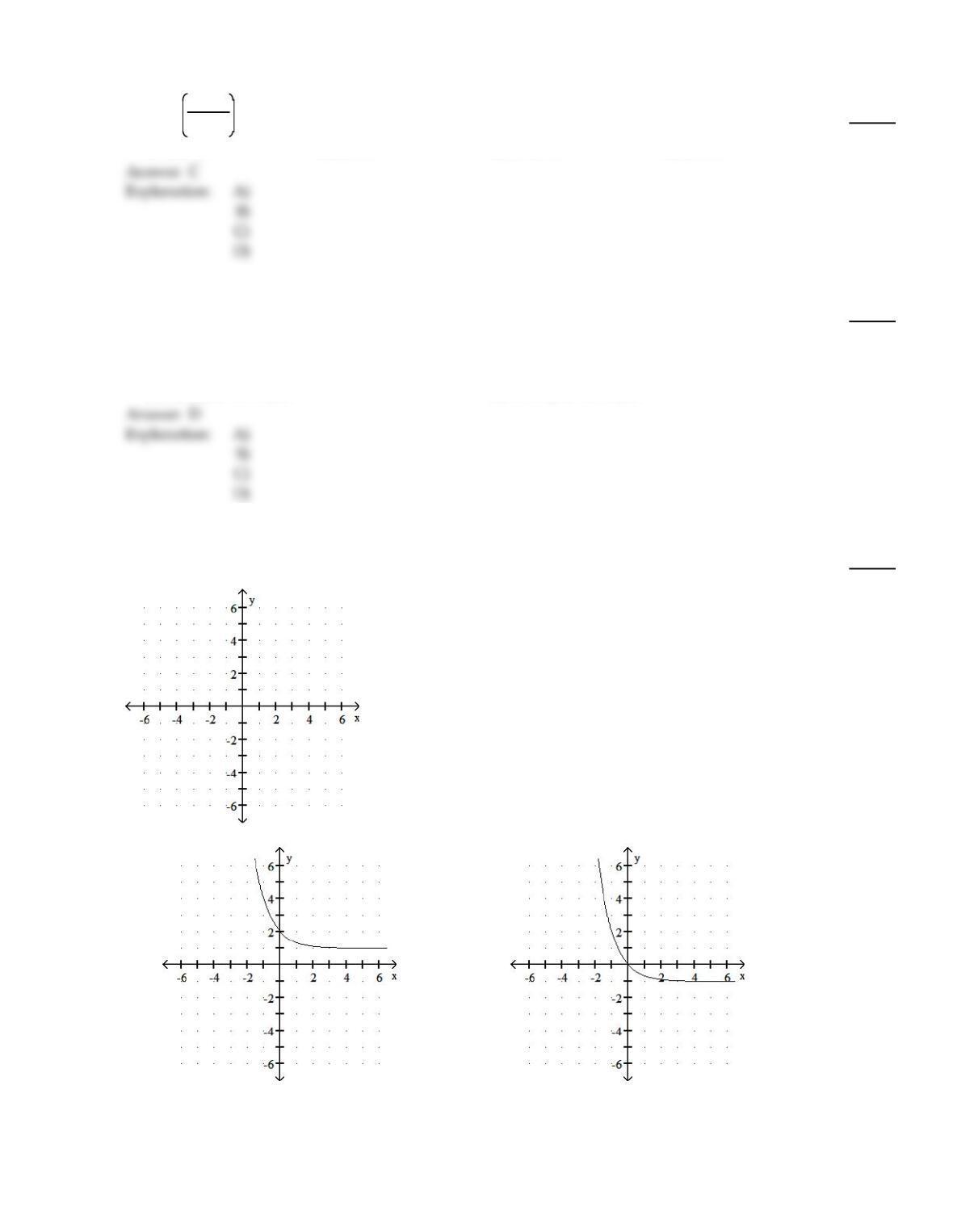
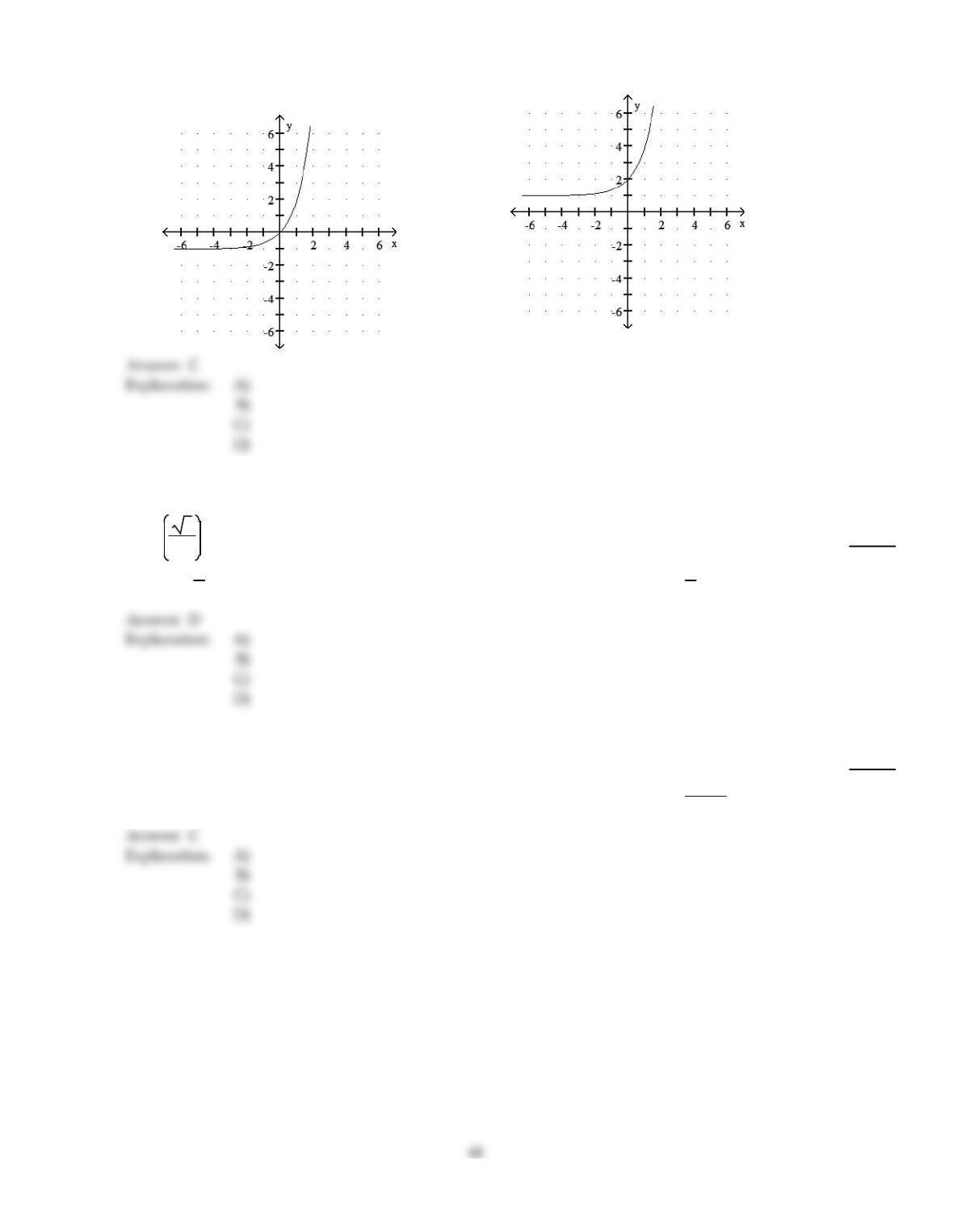
Use the graph of f(x) =3x to obtain the graph of g(x) =3x– 1.
134)
A)
B)
47
C)
D)
Use properties of logarithms to expand the logarithmic expression as much as possible. Where possible, evaluate
logarithmic expressions without using a calculator.
135)
log 5
x
125
135)
A)
15 –1
2log 5x
B)
–3log 5x
C)
log 5x –3
D)
1
2log 5x –3
Evaluate the expression without using a calculator.
136)
log 10 10,000
136)
A)
40
B)
–4
C)
4
D)
1
10000
Solve the problem.
137)
The long jump record, in feet, at a particular school can be modeled by f(x) =20.1 +2.5 ln (x + 1)
where x is the number of years since records began to be kept at the school. What is the record for
the long jump 6 years after record started being kept? Round your answer to the nearest tenth.
137)
A)
22.6 feet
B)
24.1 feet
C)
25.0 feet
D)
24.6 feet
Use common logarithms or natural logarithms and a calculator to evaluate to four decimal places
138)
log 0.1 17
138)
A)
–0.8127
B)
0.2304
C)
–1.2304
D)
2.2304
139)
log 58
139)
A)
1.6021
B)
0.2041
C)
0.7740
D)
1.2920
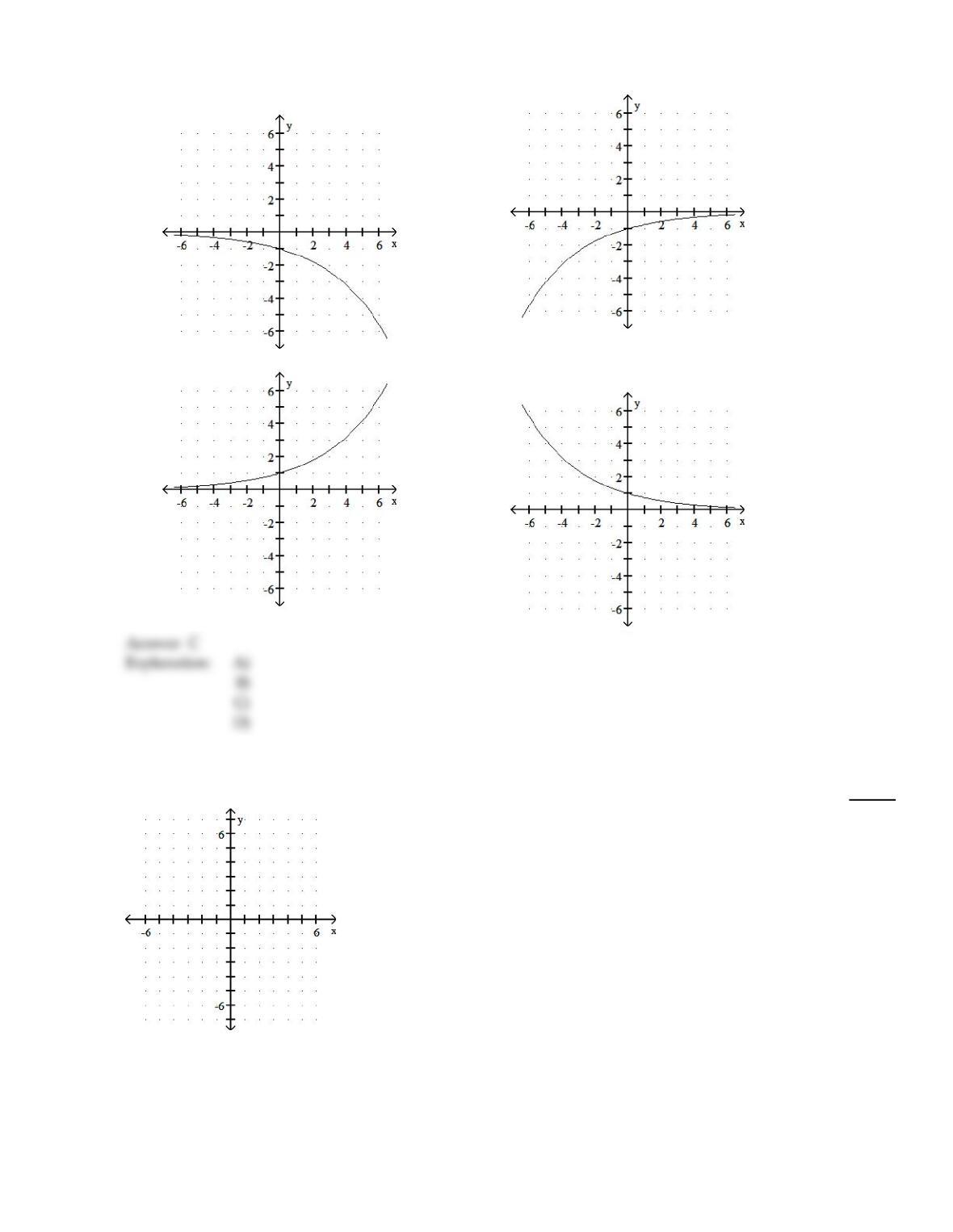
Graph the function by making a table of coordinates.
140)
f(x) =4
3
x
140)
49
A)
B)
C)
D)
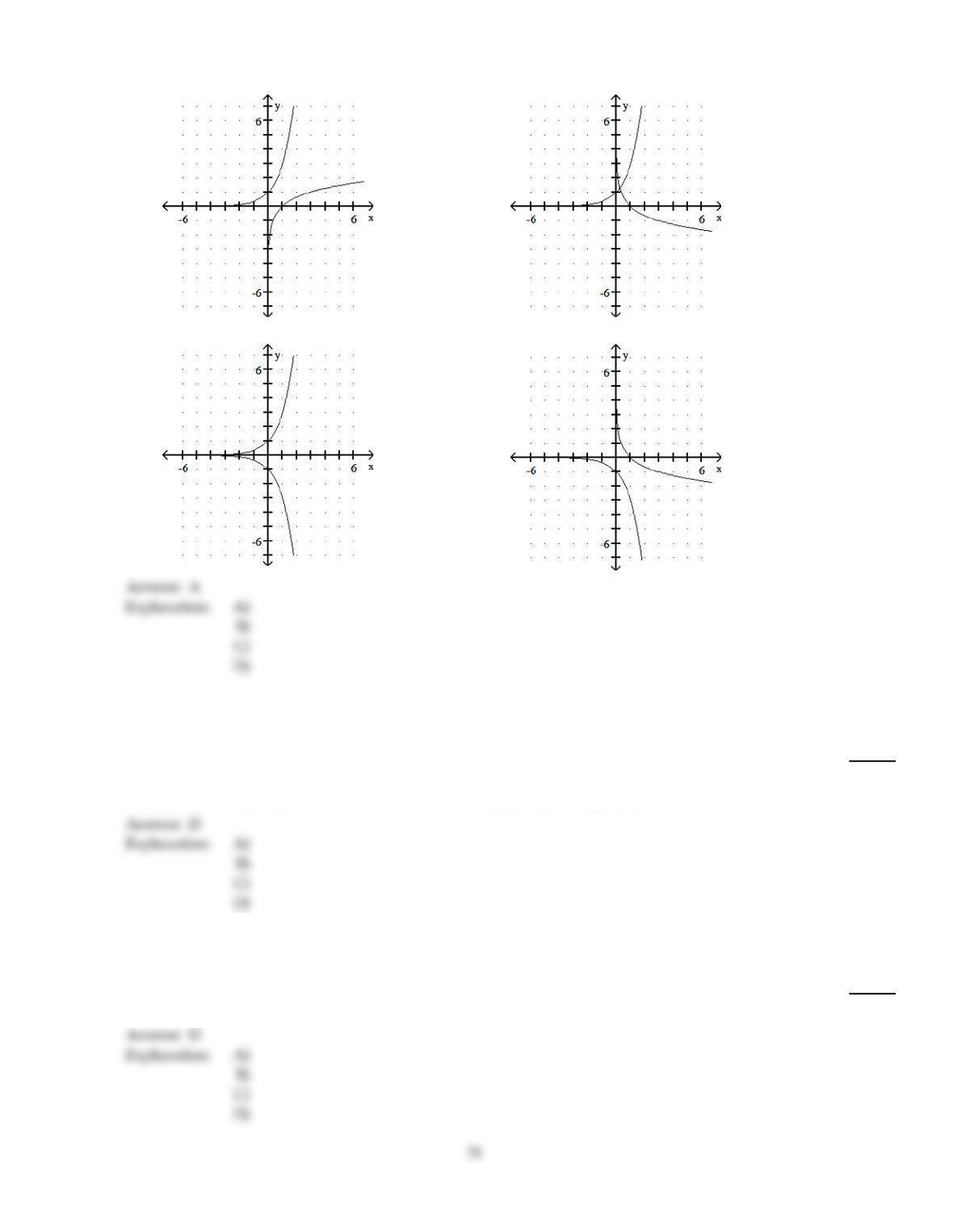
Graph the functions in the same rectangular coordinate system.
141)
f(x) =3x and g(x) =log3x
141)
50
A)
B)
C)
D)
Rewrite the equation in terms of base e. Express the answer in terms of a natural logarithm, and then round to three
decimal places.
142)
y =3(8)x
142)
A)
y = (ln 3)ex ln 8, y =1.099e2.079x
B)
y =3e8x, y =32.7182.079x
C)
y =8ex ln 3, y =8e1.099x
D)
y =3ex ln 8, y =3e2.079x
Solve the logarithmic equation. Be sure to reject any value that is not in the domain of the original logarithmic
expressions. Give the exact answer.
143)
log 4(x + 5) +log 4(x – 1) =2
143)
A)
{3, –7}
B)
{–7}
C)
{4}
D)
{3}
Solve the exponential equation. Use a calculator to obtain a decimal approximation, correct to two decimal places, for the
solution.
144)
4x +6=6
144)
A)
–4.71
B)
–0.60
C)
6.77
D)
1.55
Solve the logarithmic equation. Be sure to reject any value that is not in the domain of the original logarithmic
expressions. Give the exact answer.
145)
2log x – log 5= log 180
145)
A)
{30, –30}
B)
450
C)
{30}
D)
{–30}
146)
log 3(x + 1) =2
146)
A)
{9}
B)
{7}
C)
{8}
D)
{10}
147)
log 2x =5
147)
A)
{2.32}
B)
{25}
C)
{32}
D)
{10}
Evaluate the expression without using a calculator.
148)
ln 1
e7
148)
A)
1
7
B)
–7
C)
–1
7
D)
7
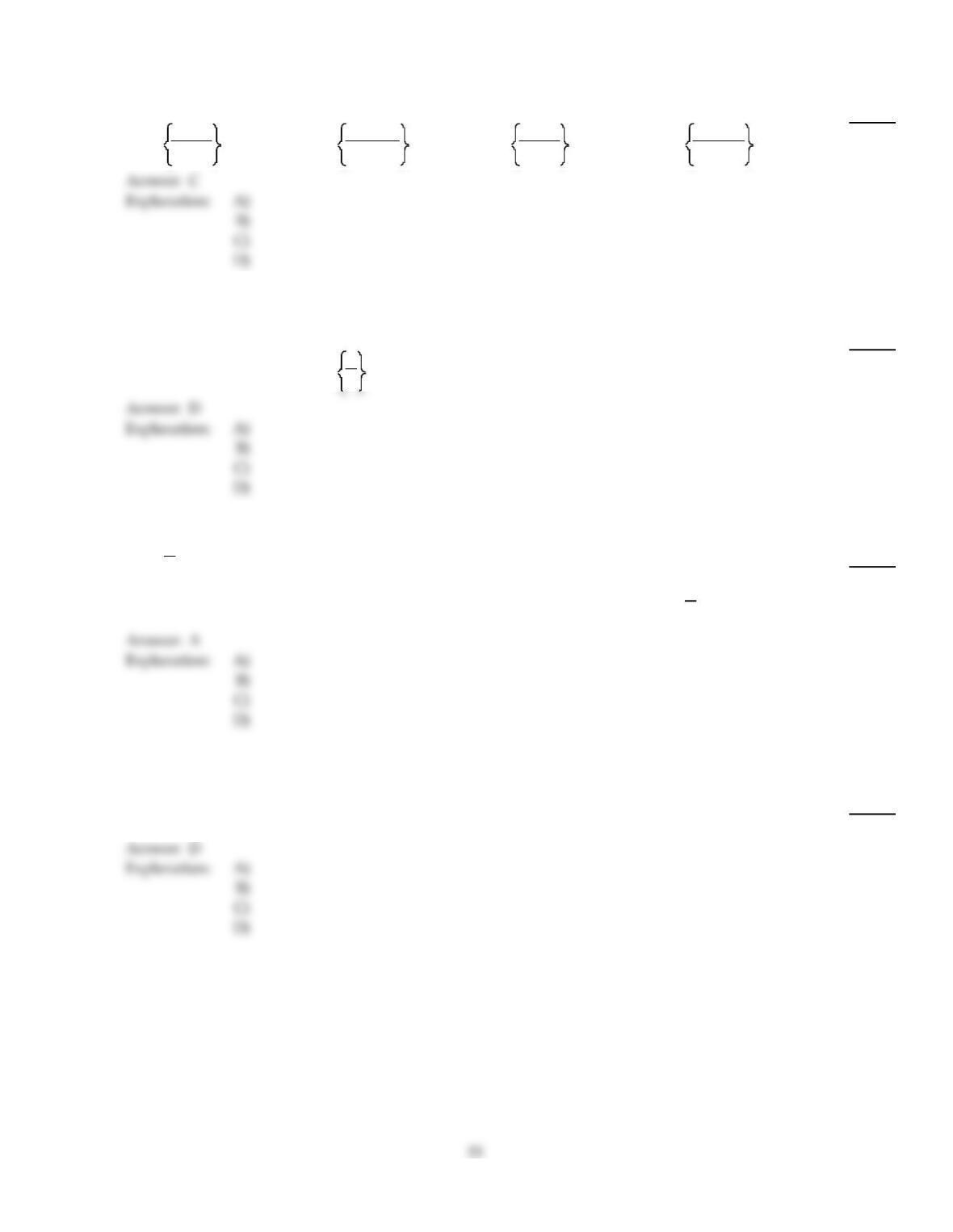
Solve the exponential equation. Express the solution set in terms of natural logarithms.
149)
85x =4.4
149)
A)
ln 4.4
8 ln 5
B)
5 ln 4.4
ln 8
C)
ln 4.4
5 ln 8
D)
4.4 ln 5
ln 8
Solve the logarithmic equation. Be sure to reject any value that is not in the domain of the original logarithmic
expressions. Give the exact answer.
150)
log (3+ x) – log (x – 5) = log 3
150)
A)
B)
5
2
C)
{–9}
D)
{9}
Evaluate the expression without using a calculator.
151)
log 2
1
4
151)
A)
–2
B)
2
C)
4
D)
1
2
Solve the exponential equation. Use a calculator to obtain a decimal approximation, correct to two decimal places, for the
solution.
152)
ex=4.3
152)
A)
73.9
B)
11.7
C)
0.63
D)
1.46
Use common logarithms or natural logarithms and a calculator to evaluate to four decimal places
153)
log 26 390
153)
A)
0.5461
B)
1.1761
C)
1.8312
D)
4.0060
Evaluate or simplify the expression without using a calculator.
154)
log 1
1000
154)
A)
1
1000
B)
3
C)
–3
D)
–1
3
Graph the function.
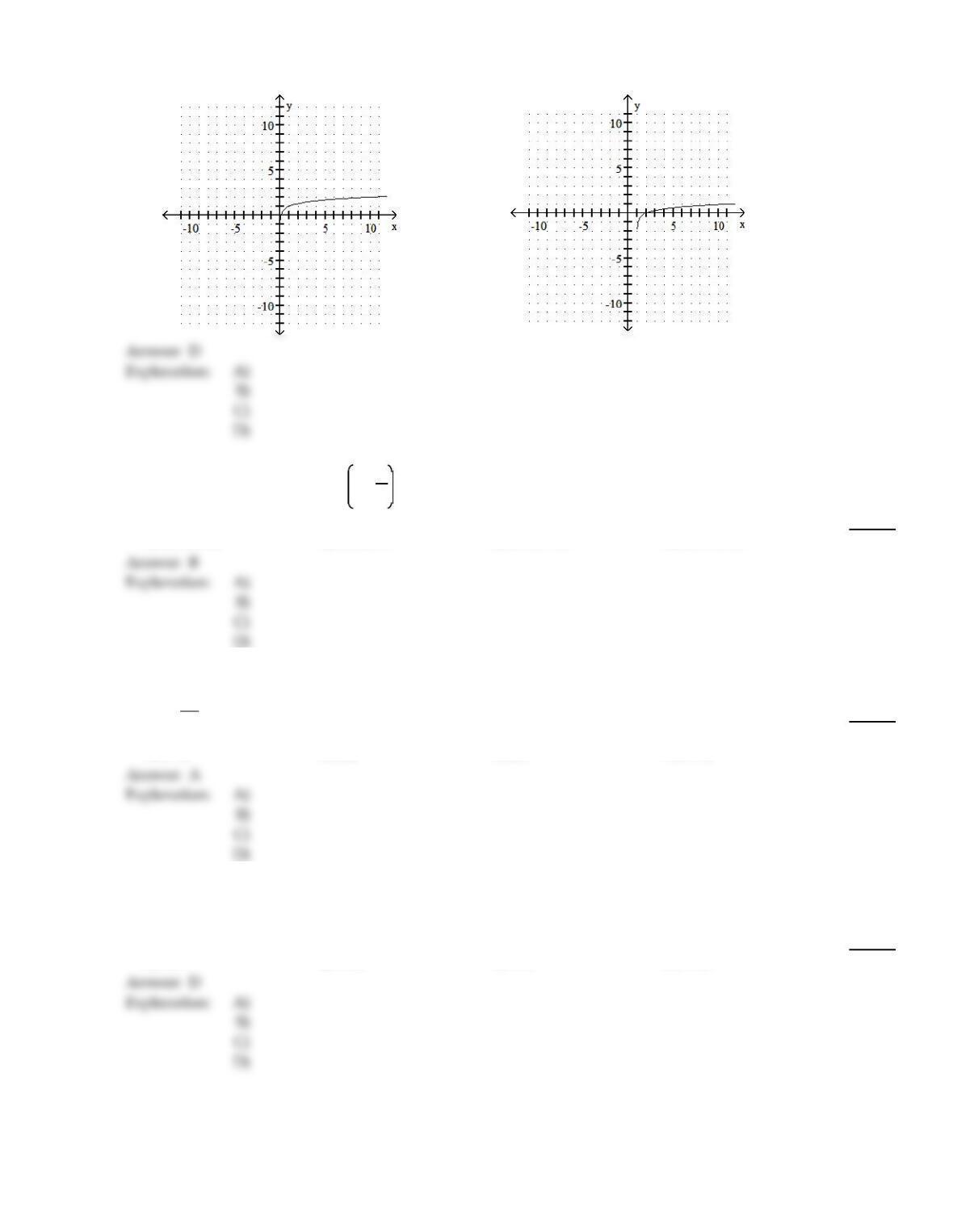
155)
Use the graph of f(x) = log x to obtain the graph of g(x) = log (x – 1).
155)
A)
B)
54
C)
D)
Use the compound interest formulas A = P 1 +r
n
nt and A = Pert to solve.
156)
Find the accumulated value of an investment of $940 at 6% compounded annually for 6 years.
156)
A)
$1222.00
B)
$1333.41
C)
$1257.93
D)
$1278.40
Solve the equation by expressing each side as a power of the same base and then equating exponents.
157)
ex +2=1
e4
157)
A)
{–6}
B)
{2}
C)
{6}
D)
{–2}
Solve the exponential equation. Use a calculator to obtain a decimal approximation, correct to two decimal places, for the
solution.
158)
e2x –3–4=1402
158)
A)
1.57
B)
3.62
C)
3.07
D)
5.12
Graph the function.
55
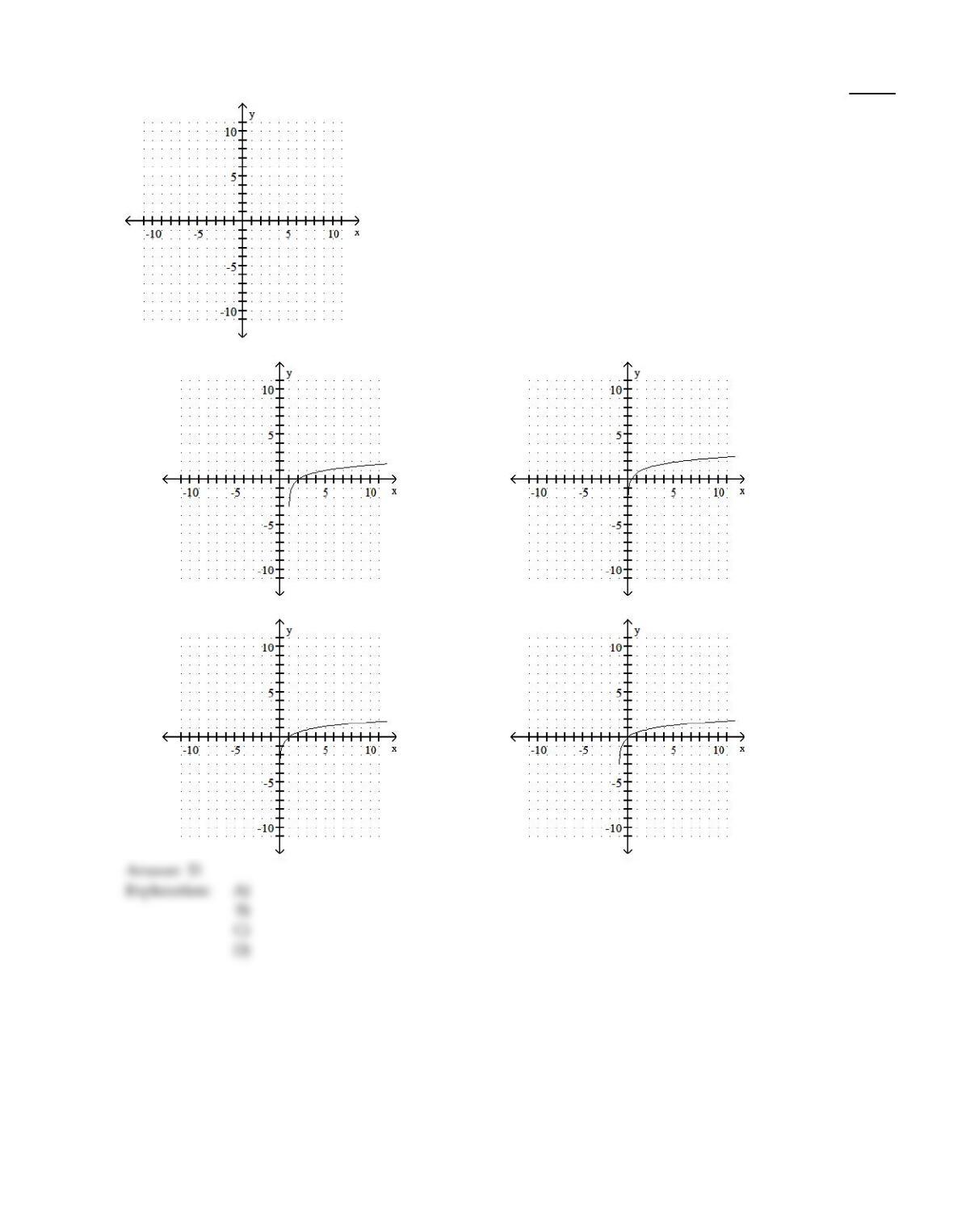
159)
Use the graph of log 4x to obtain the graph of f(x) =log 4(x + 1).
159)
A)
B)
C)
D)
56
Evaluate or simplify the expression without using a calculator.
160)
10log 5x
160)
A)
x5
B)
x1/5
C)
5
D)
x–1/5
Graph the function.
161)
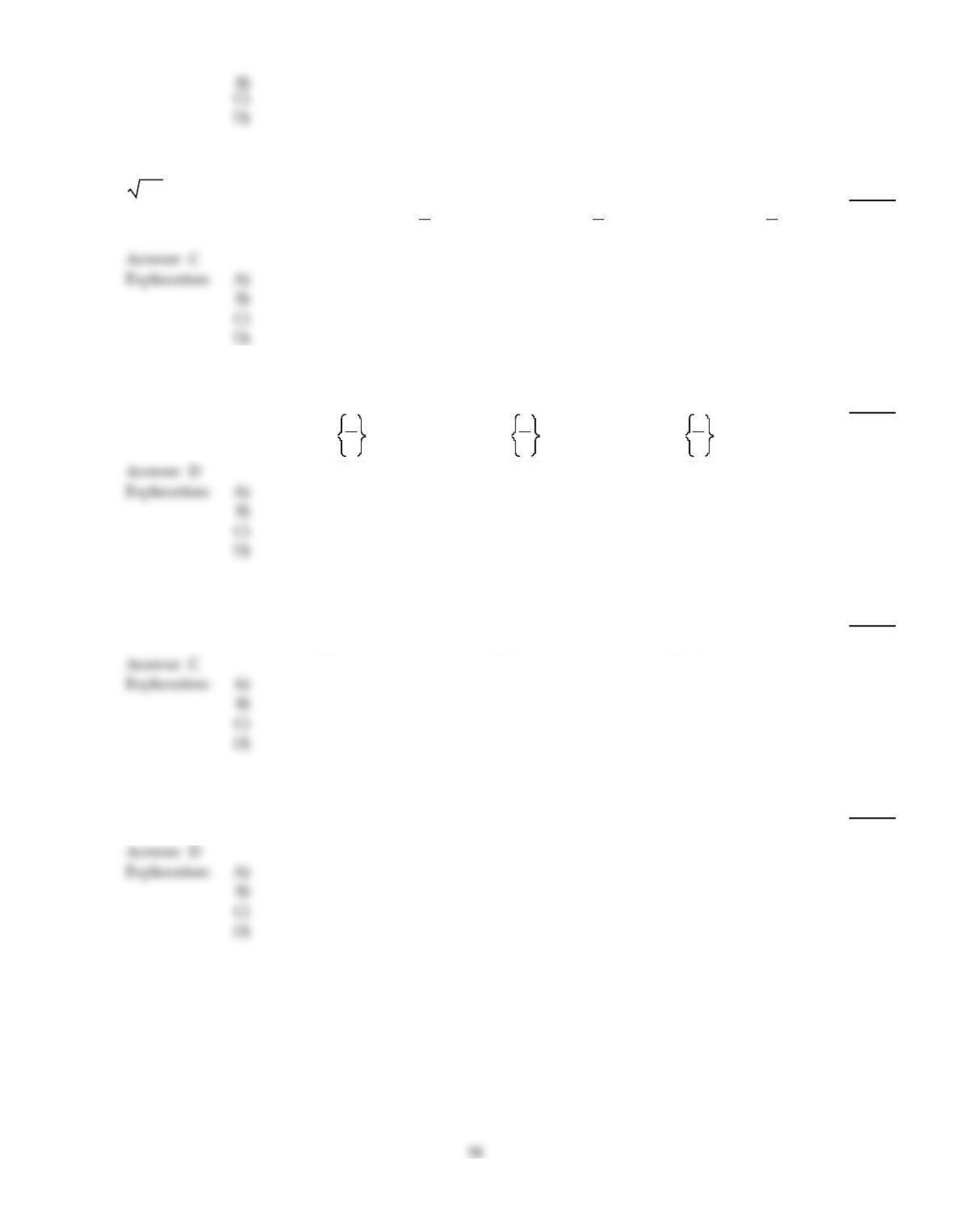
Use the graph of f(x) =2x to obtain the graph of g(x) = – 2x.
161)
A)
B)
C)
D)
Write the equation in its equivalent logarithmic form.
162)
3125 =5
162)
A)
log 5125 =3
B)
log 125 3=1
5
C)
log 125 5=1
3
D)
log 5125 =1
3
Solve the equation by expressing each side as a power of the same base and then equating exponents.
163)
1024x=64
163)
A)
{3}
B)
3
4
C)
5
3
D)
3
5
Evaluate the expression without using a calculator.
164)
eln 271
164)
A)
ln 271
B)
e271
C)
271
D)
–271
Approximate the number using a calculator. Round your answer to three decimal places.
165)
e–1.4
165)
A)
0.547
B)
–3.806
C)
–0.247
D)
0.247
Use properties of logarithms to expand the logarithmic expression as much as possible. Where possible, evaluate
logarithmic expressions without using a calculator.
166)
log 3x344– x
4(x +4)2
166)
A)
log 3+3log x +1
4log (4– x) – log 4– 2log (x +4)
B)
log 3+ log x3+ log (4 – x)1/4– log 4– log (x +4)2
C)
log 3+3log x +1
4log (4– x) – log 4+ 2log (x +4)
D)
log (3x344– x) – log (4(x +4)2)
Use properties of logarithms to condense the logarithmic expression. Write the expression as a single logarithm whose
coefficient is 1. Where possible, evaluate logarithmic expressions.
167)
3log bm–log bn
167)
A)
log b
m3
n
B)
log b(m3– n)
C)
log b(3m
n)
D)
log bm3÷log bn
Solve the exponential equation. Use a calculator to obtain a decimal approximation, correct to two decimal places, for the
solution.
168)
ex +8=5
168)
A)
–6.30
B)
–6.39
C)
–5.44
D)
2.56
Graph the function.
59
169)
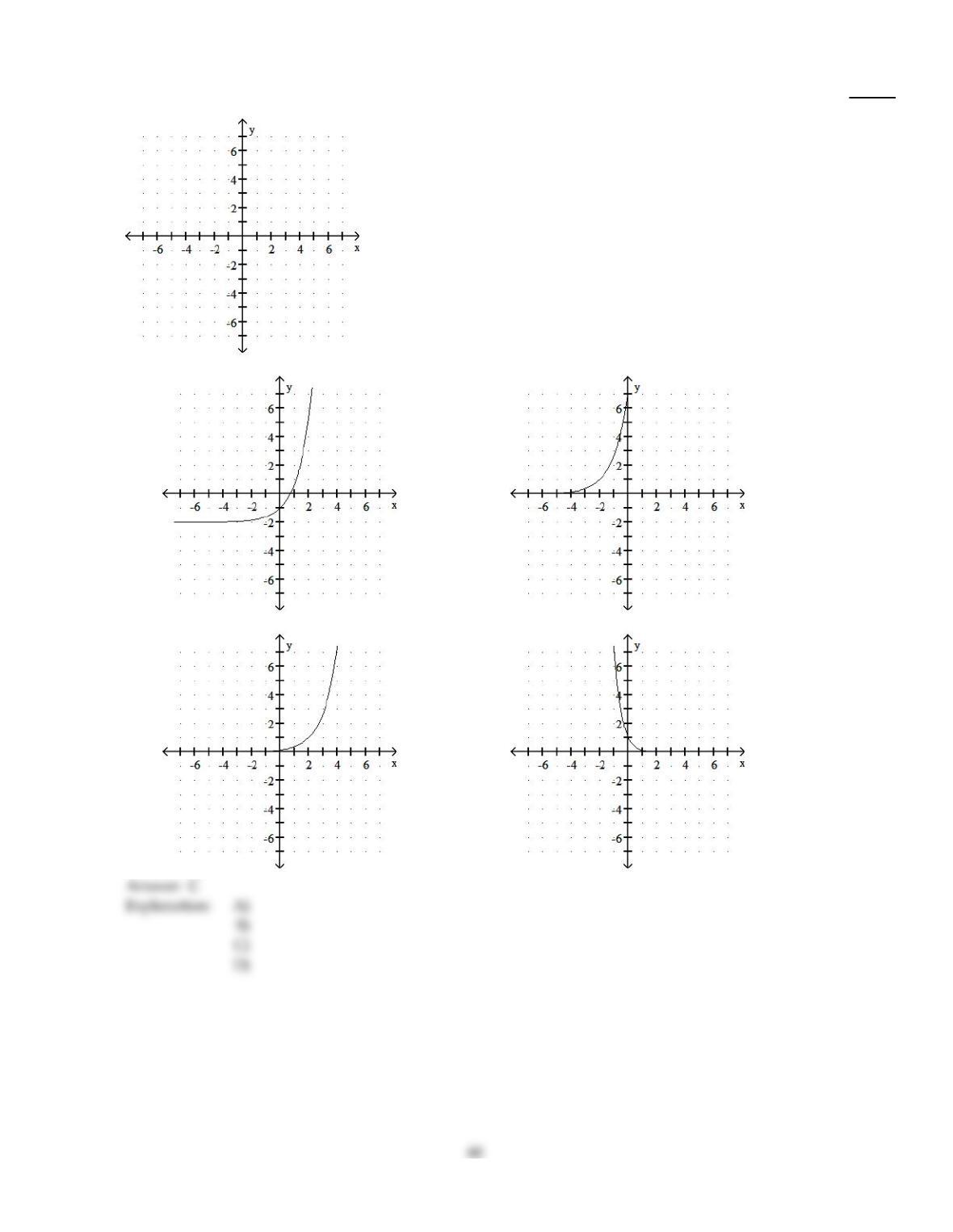
Use the graph of f(x) =ex to obtain the graph of g(x) =ex – 2.
169)
A)
B)
C)
D)