Test Bank for Intermediate Accounting, Fifteenth Edition
4 – 36
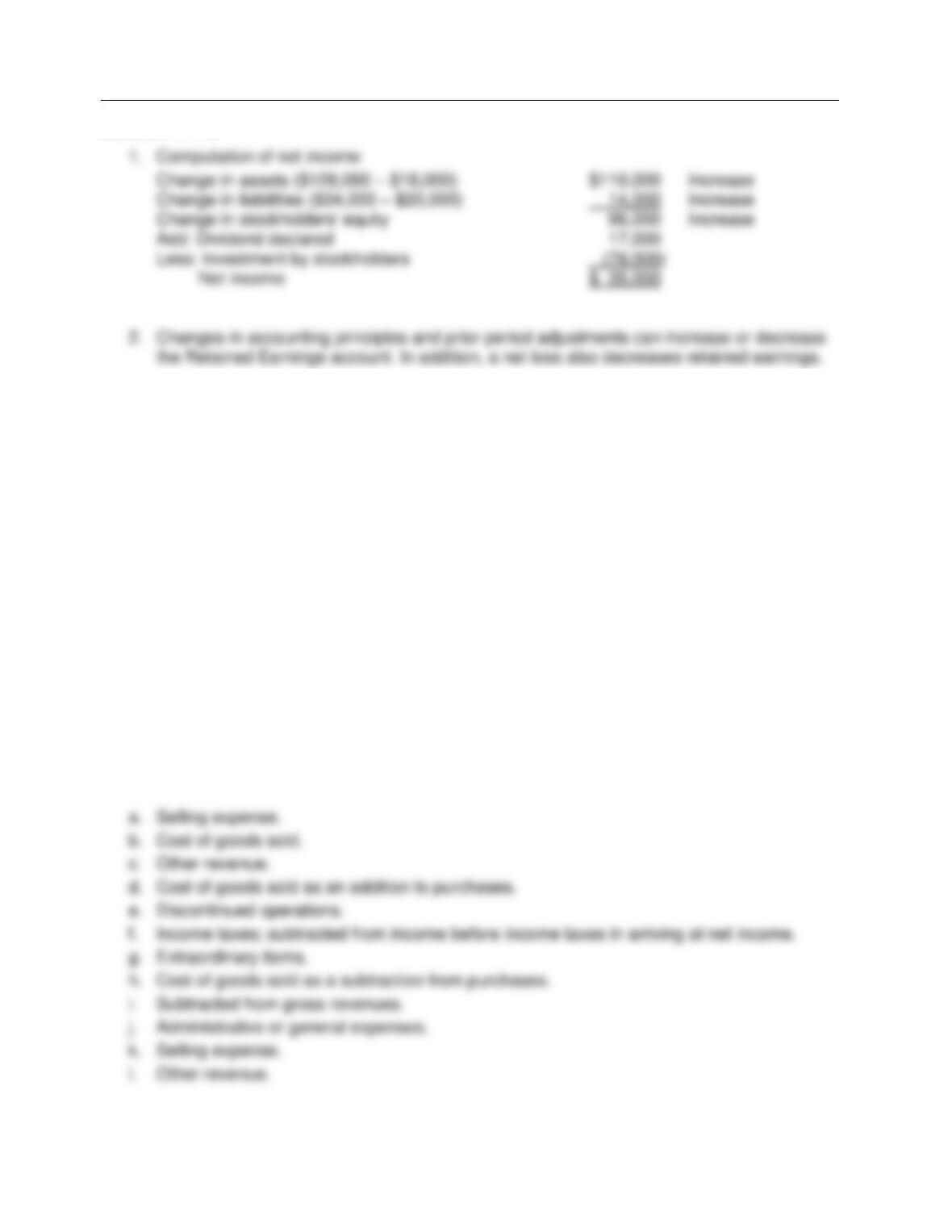
Solution 4-119
Ex. 4-120—Income statement classifications.
Indicate the major section or subsection of a multiple-step income statement in which each of the
following items would usually appear:
a. Advertising
b. Depletion
c. Dividend revenue
d. Freight-in
e. Loss on disposal of a component of a business, net of tax
f. Income taxes
g. Major casualty loss, net of tax
h. Purchase discounts
i. Sales discounts
j. Officers’ salaries
k. Freight-out
l. Interest income
Solution 4-120

Income Statement and Related Information
4 – 37
Ex. 4-121—Income statement relationships.
Fill in the appropriate blanks for each of the independent situations below.
Company A Company B Company C
Sales revenue (a) $_______ $343,400 $540,000
Beginning inventory 52,600 (d) _______ 90,000
Net purchases 195,300 255,600 (g) _______
Ending inventory 52,200 108,000 63,000
Cost of goods sold (b) _______ (e) _______ 427,000
Gross profit 75,300 118,000 (h) _______
Operating expenses (c) _______ 50,000 48,000
Income before taxes 6,000 (f) _______ (i) _______
Solution 4-121
Ex. 4-122—Multiple-step income statement.
Listed below in scrambled order are 13 income statement categories. Use the numerals 1 through
13 to indicate the order in which these categories should appear on a multiple-step income
statement.
( ) Discontinued operations.
( ) Cost of goods sold.
( ) Other revenues and gains.
( ) Net income.
( ) Income taxes.
( ) Sales revenue.
( ) Gross profit on sales.
( ) Income from operations.
( ) Income from continuing operations before income taxes.
( ) Operating expenses.
( ) Extraordinary item.
( ) Income before extraordinary items.
( ) Income from continuing operations.
Solution 4-122

Test Bank for Intermediate Accounting, Fifteenth Edition
4 – 38
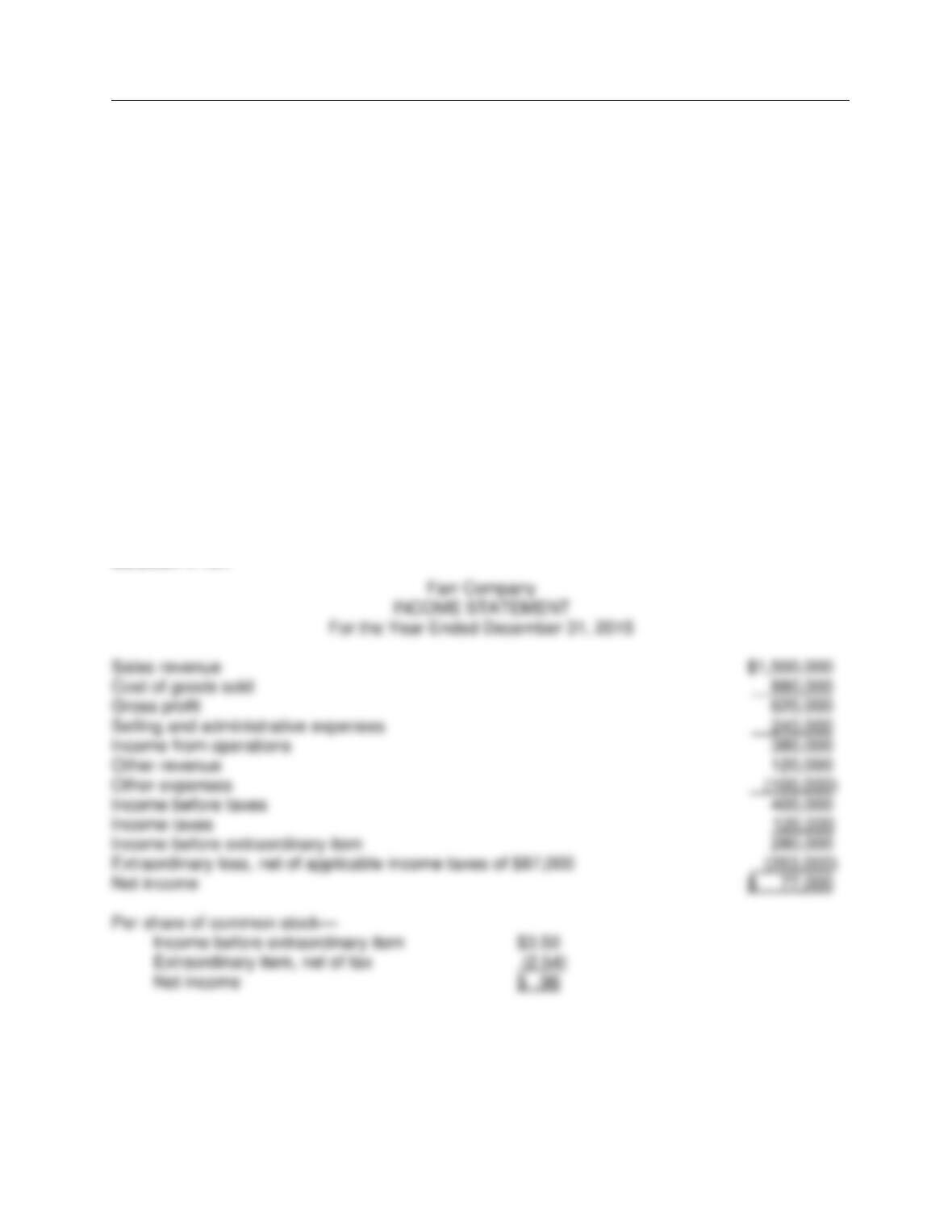
Ex. 4-123—Classification of income statement and retained earnings statement items.
For each of the items listed below, indicate how it should be treated in the financial statements.
Use the following letter code for your selections:
a. Ordinary or unusual (but not extraordinary) item on the income statement
b. Discontinued operations
c. Extraordinary item on the income statement
d. Prior period adjustment
_____ 1. The bad debt rate was increased from 1% to 2%, thus increasing bad debt
expense.
_____ 2. Obsolete inventory was written off. This was the first loss of this type in the
company’s history.
_____ 3. An uninsured casualty loss was incurred by the company. This was the first loss of
this type in the company‘s 50-year history.
_____ 4. Recognition of income earned last year which was inadvertently omitted from last
year’s income statement.
_____ 5. The company sold one of its warehouses at a loss.
_____ 6. Settlement of litigation with federal government related to income taxes of three
years ago. The company is continually involved in various adjustments with the
federal government related to its taxes.
_____ 7. A loss incurred from expropriation (the company owned resources in South
America which were taken over by a dictator unsympathetic to American
business).
_____ 8. The company neglected to record its depreciation in the previous year.
_____ 9. Discontinuance of all production in the United States. The manufacturing
operations were relocated in Mexico.
_____ 10. Loss on sale of investments. The company last sold some of its investments two
years ago.
_____ 11. Loss on the disposal of a component of a business.
Solution 4-123
Income Statement and Related Information
4 – 39
PROBLEMS
Pr. 4-124—Multiple-step income statement.
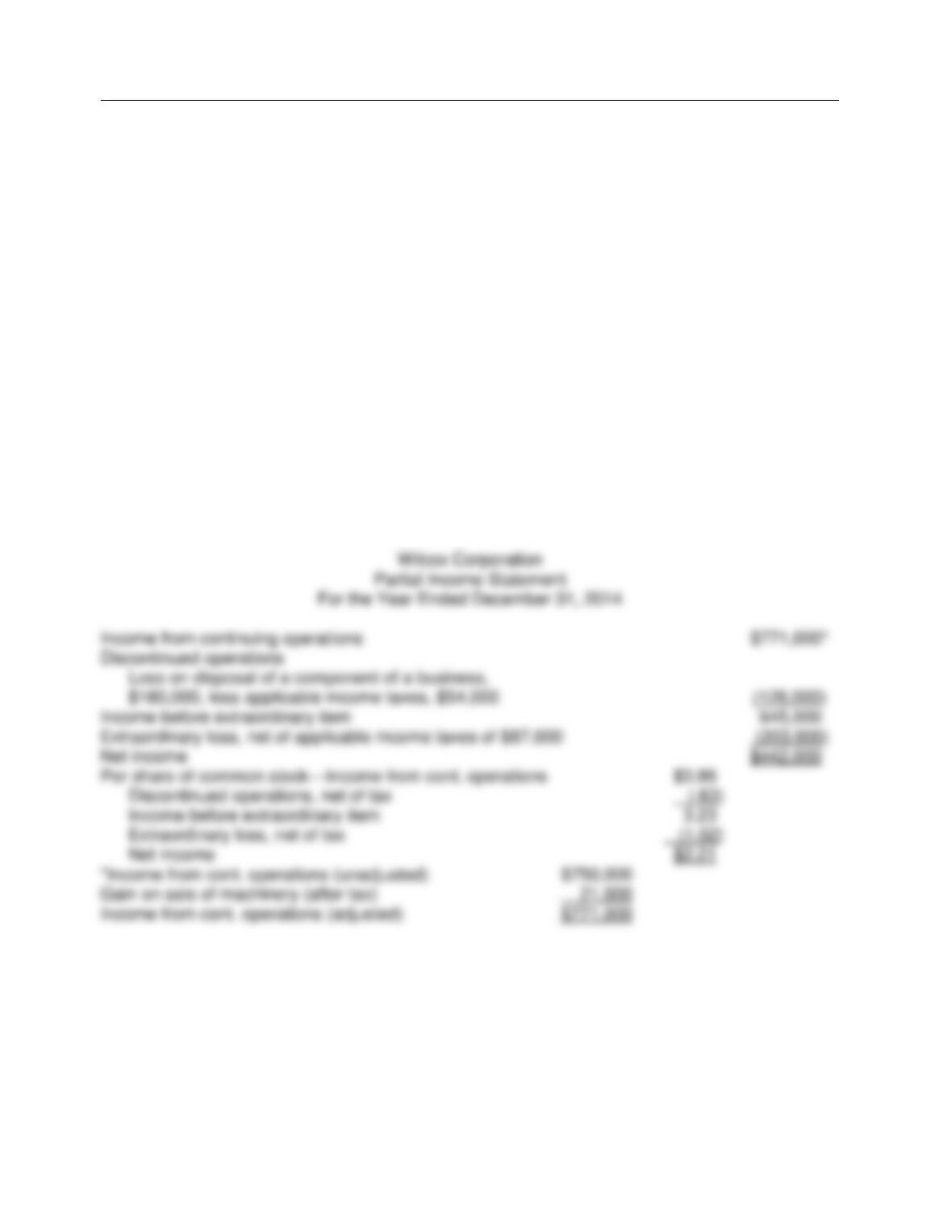
Presented below is information related to Farr Company.
Retained earnings, December 31, 2014 $ 650,000
Sales revenue 1,500,000
Selling and administrative expenses 240,000
Hurricane loss (pre-tax) on plant (extraordinary item) 290,000
Cash dividends declared on common stock 33,600
Cost of goods sold 880,000
Gain resulting from computation error on depreciation charge in 2013 (pre-tax) 520,000
Other revenue 120,000
Other expenses 100,000
Instructions
Prepare in good form a multiple-step income statement for the year 2015. Assume a 30% tax rate
and that 80,000 shares of common stock were outstanding during the year.
Solution 4-124
Test Bank for Intermediate Accounting, Fifteenth Edition
4 – 40
Pr. 4-125—Income statement form.
Wilcox Corporation had income from continuing operations of $750,000 (after taxes) in 2014. In
addition, the following information, which has not been considered, is as follows.
1. In 2014, Wilcox experienced an uninsured earthquake loss in the amount of $290,000.
2. A machine was sold for $140,000 cash during the year at a time when its book value was
$110,000. (Depreciation has been properly recorded.) The company often sells machinery of
this type.
3. Wilcox decided to discontinue its stereo division in 2014. During the current year, the loss on
the disposal of this component of the business was $180,000 less applicable taxes.
Instructions
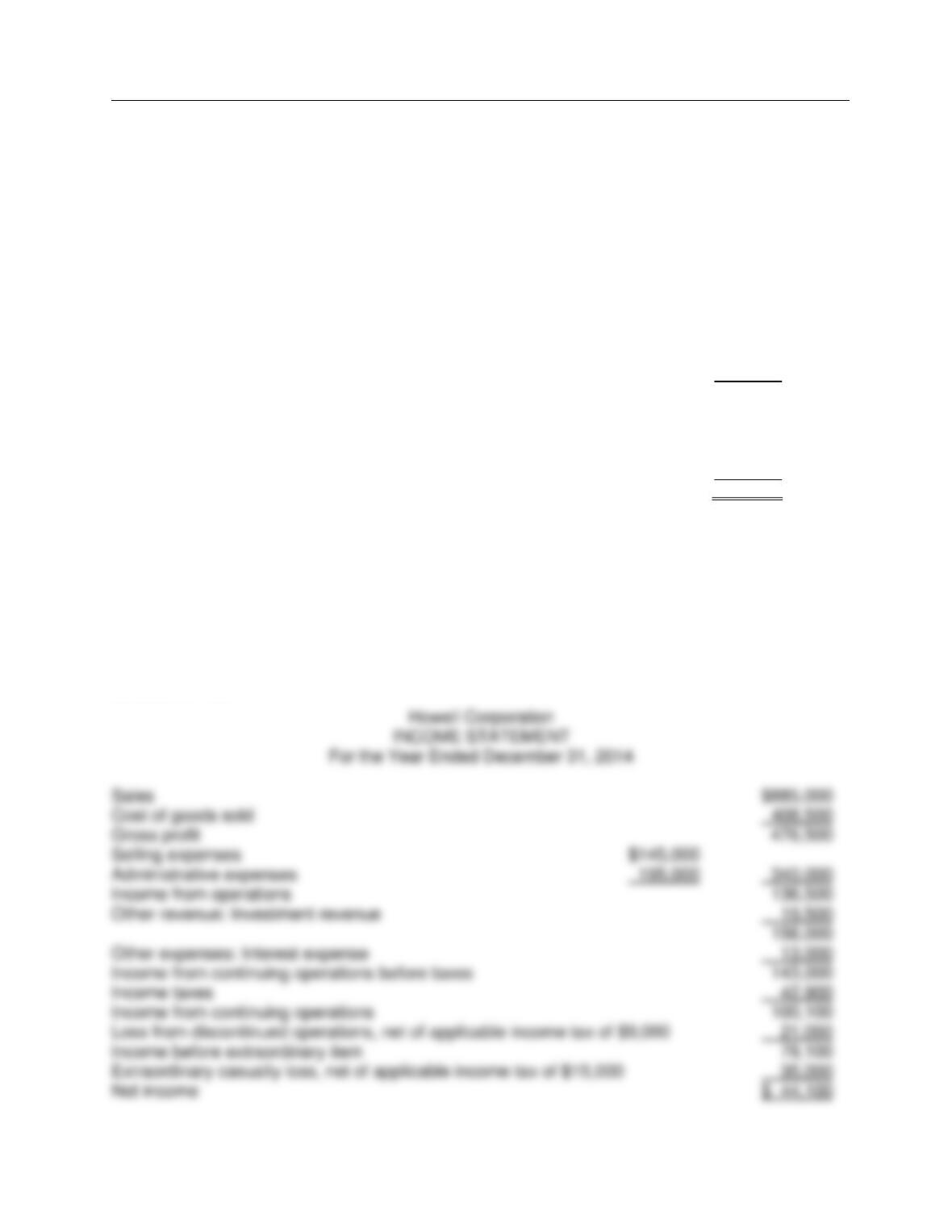
Present in good form the income statement of Wilcox Corporation for 2014 starting with “income
from continuing operations.” Assume that Wilcox’s tax rate is 30% and 200,000 shares of
common stock were outstanding during the year.
Solution 4-125
Income Statement and Related Information
4 – 41
Pr. 4-126—Multiple-step income statement.
Shown below is an income statement for 2014 that was prepared by a poorly trained bookkeeper
of Howell Corporation.
Howell Corporation
INCOME STATEMENT
December 31, 2014
Sales revenue $ 885,000
Investment revenue 19,500
Cost of goods sold (408,500)
Selling expenses (145,000)
Administrative expenses (195,000)
Interest expense (13,000)
Income before special items 143,000
Special items
Loss on disposal of a component of the business (30,000)
Major casualty loss (extraordinary item) (50,000)
Net federal income tax liability (18,900)
Net income $ 44,100
Instructions
Prepare a multiple-step income statement for 2014 for Howell Corporation that is presented in
accordance with generally accepted accounting principles (including format and terminology).
Howell Corporation has 50,000 shares of common stock outstanding and has a 30% federal
income tax rate on all tax related items. Round all earnings per share figures to the nearest cent.
Solution 4-126

Test Bank for Intermediate Accounting, Fifteenth Edition
4 – 42
Solution 4-126 (cont.)
Pr. 4-127—Single-step income statement.
Presented below is an income statement for Kinder Company for the year ended December 31,
2014.
Kinder Company
Income Statement
For the Year Ended December 31, 2014
Net sales $800,000
Costs and expenses:
Cost of goods sold 560,000
Selling, general, and administrative expenses 70,000
Other, net 30,000
Total costs and expenses 660,000
Income before income taxes 140,000
Income taxes 42,000
Net income $98,000
Additional information:
1. “Selling, general, and administrative expenses” included a usual but infrequent charge of
$7,000 due to a loss on the sale of investments.
2. “Other, net” consisted of interest expense, $10,000, and an extraordinary loss of $20,000
before taxes due to earthquake damage. If the extraordinary loss had not occurred, income
taxes for 2014 would have been $48,000 instead of $42,000.
4. Kinder had 20,000 shares of common stock outstanding during 2014.
Instructions
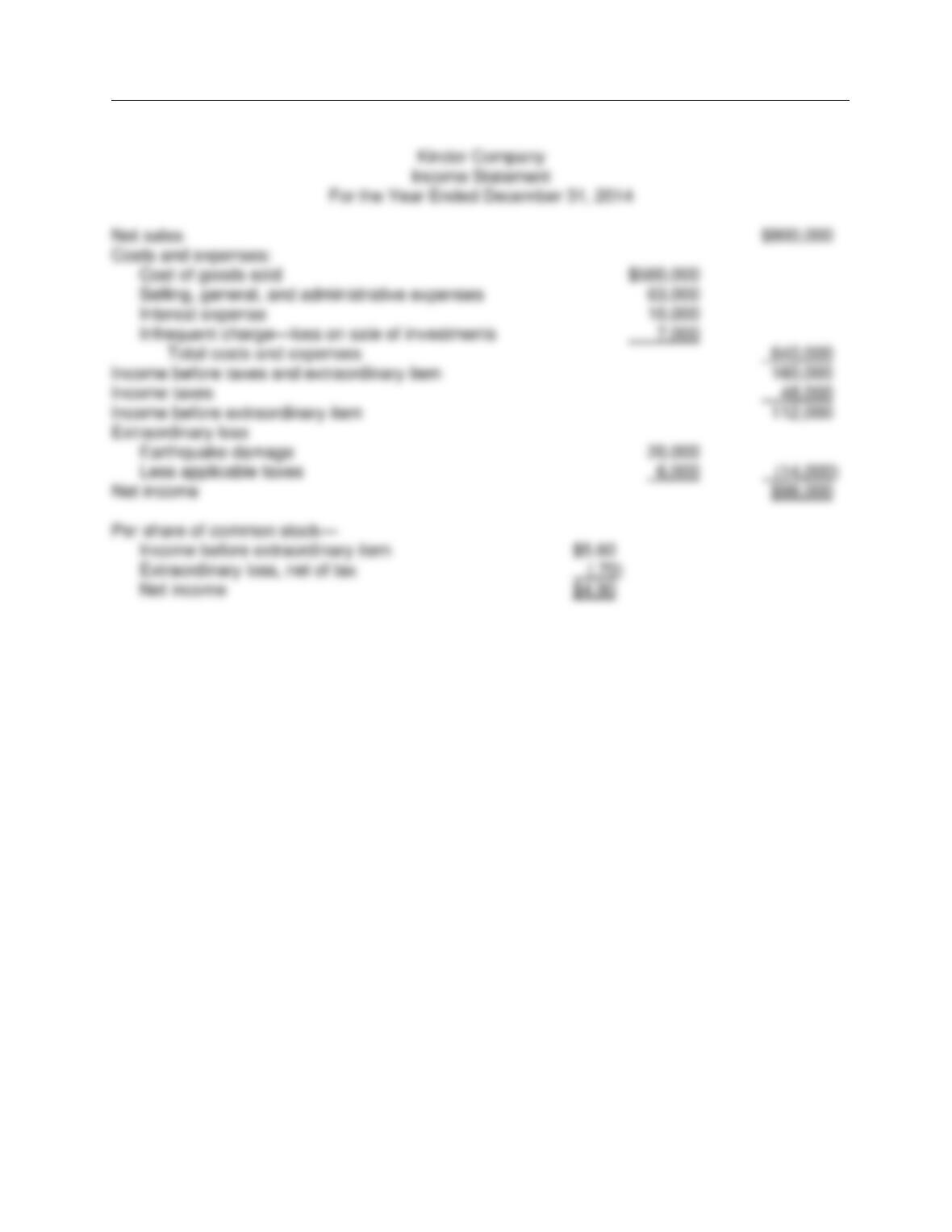
Using the single-step format, prepare a corrected income statement, including the appropriate per
share disclosures.
Income Statement and Related Information
4 – 43
Solution 4-127

Test Bank for Intermediate Accounting, Fifteenth Edition
4 – 44
Pr. 4-128—Income statement and retained earnings statement.
Porter Corporation’s capital structure consists of 50,000 shares of common stock. At December
31, 2014 an analysis of the accounts and discussions with company officials revealed the
following information:
Sales revenue $1,200,000
Earthquake loss (net of tax) (extraordinary item) 56,000
Selling expenses 128,000
Cash 60,000
Accounts receivable 90,000
Common stock 200,000
Cost of goods sold 701,000
Accumulated depreciation-machinery 180,000
Dividend revenue 8,000
Unearned service revenue 4,400
Interest payable 1,000
Land 370,000
Patents 100,000
Retained earnings, January 1, 2014 290,000
Interest expense 17,000
Administrative expenses 170,000
Dividends declared 24,000
Allowance for doubtful accounts 5,000
Notes payable (maturity 7/1/17) 200,000
Machinery 450,000
Materials 40,000
Accounts payable 60,000
The amount of income taxes applicable to ordinary income was $57,600, excluding the tax effect
of the earthquake loss which amounted to $24,000.
Instructions
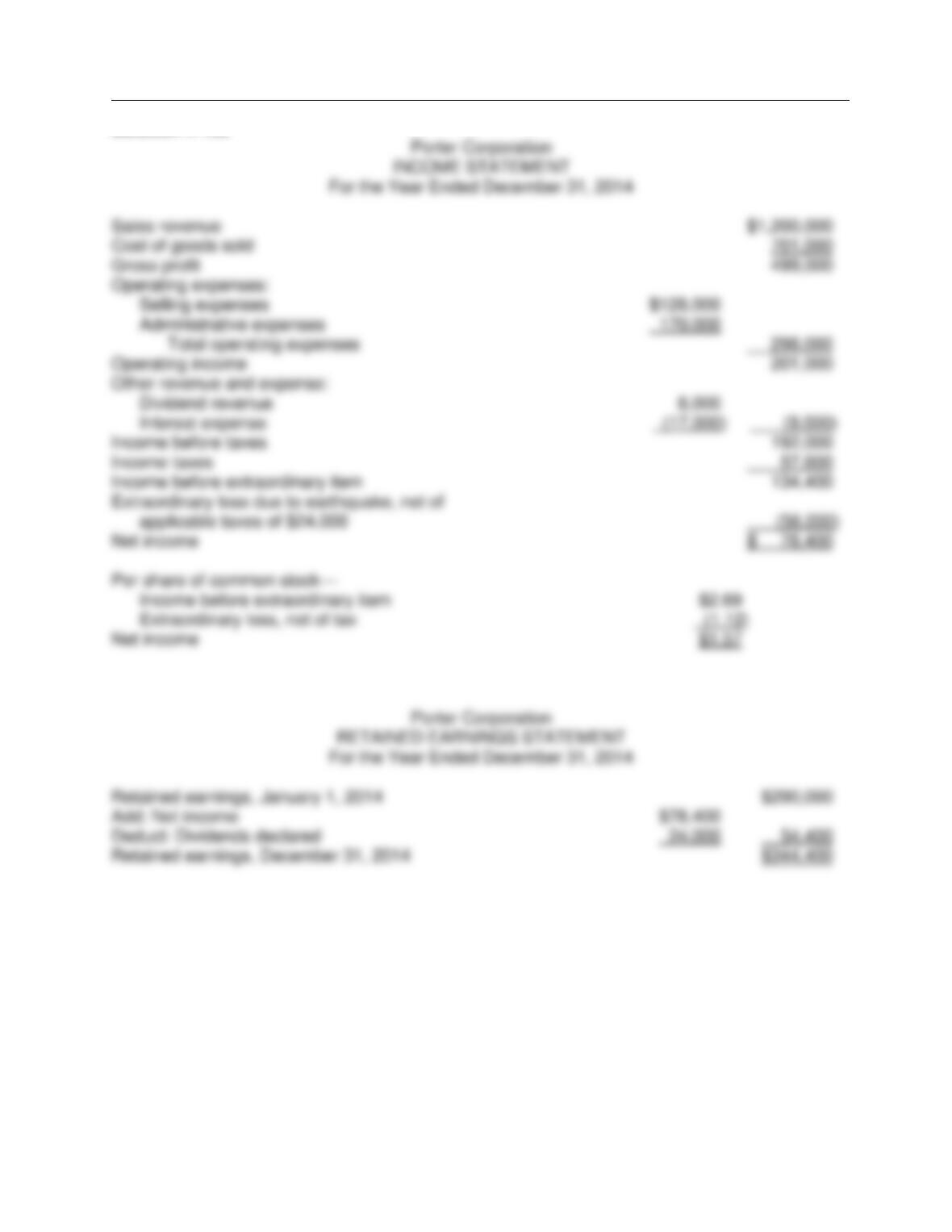
(a) Prepare a multiple-step income statement.
(b) Prepare a retained earnings statement.
Income Statement and Related Information
4 – 45
Solution 4-128

Test Bank for Intermediate Accounting, Fifteenth Edition
4 – 46
Pr. 4-129—Irregular items and financial statements.
The accountant preparing the income statement for Bakersfield, Inc. had some doubts about the
appropriate accounting treatment of the seven items listed below during the fiscal year ending
December 31, 2014. Assume a tax rate of 40 percent.
1. The corporation experienced an uninsured flood loss of $70,000 before taxes. While this
loss meets the criteria of an extraordinary item, it has not been recorded.
2. The corporation disposed of its sporting goods division during 2014. This disposal meets
the criteria for discontinued operations. The division correctly calculated income from
operating this division of $110,000 before taxes and a loss of $12,000 before taxes on the
disposal of the division. All of these events occurred in 2014 and have not been recorded.
3. The company recorded advances of $10,000 to employees made December 31, 2014 as
Salaries and Wages Expense.
4. Dividends of $10,000 during 2014 were recorded as an operating expense.
5. In 2014, Bakersfield changed its method of accounting for inventory from the first–in-first-
out method to the average cost method. Inventory in 2014 was correctly recorded using
the average cost method. The new inventory method would have resulted in an additional
$125,000 of cost of goods sold (before taxes) being reported on prior years’ income
statement.
6. Office equipment purchased January 1, 2014 for $60,000 was incorrectly charged to
Supplies Expense at the time of purchase. The office equipment has an estimated three–
year service life with no expected salvage value. Bakersfield uses the straight-line method
to depreciate office equipment for financial reporting purposes. This error has not been
recorded.
7. On January 1, 2010, Bakersfield bought a building that cost $85,000, had an estimated
useful life of ten years, and had a salvage value of $5,000. Bakersfield uses the
straight-line depreciation method to depreciate the building. In 2014, it was estimated that
the remaining useful life was eight years and the salvage value was zero. Depreciation
expense reported on the 2014 income statement was correctly calculated based on the
new estimates. No adjustment for prior years’ depreciation estimates was made.
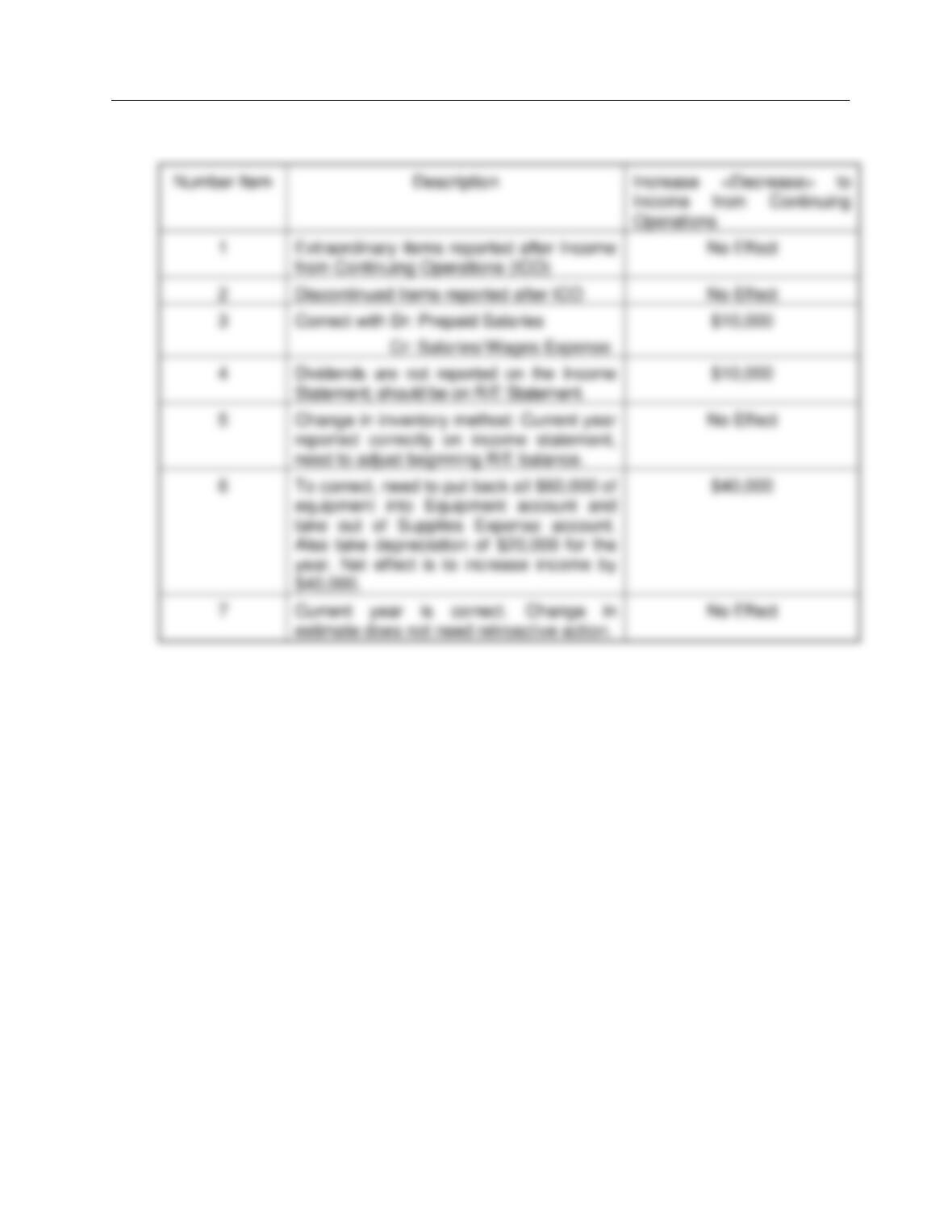
Part A. For each item, record corrections to income from continuing operations before
taxes, if any. Denote any negative numbers by using brackets < >.
Income Statement and Related Information
4 – 47
Solution 4-129
Test Bank for Intermediate Accounting, Fifteenth Edition
4 – 48
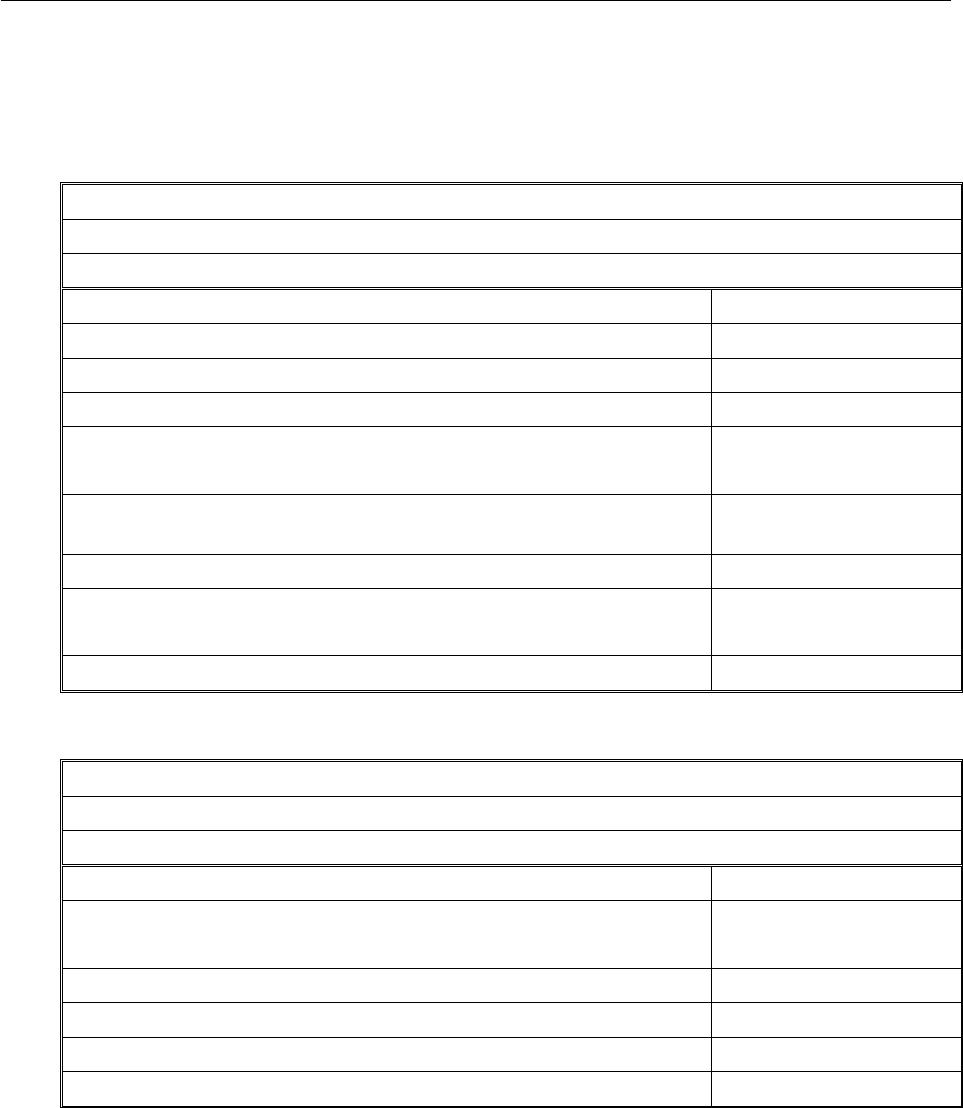
Part B. At January 1, 2014, Bakersfield, Inc.’s retained earnings balance was $200,000.
Assume that income from continuing operations (before taxes) and after correctly
considering any of the seven additional items was $1,400,000. Prepare the income
statement and retained earnings statement. Denote negative numbers by using
brackets < >. Do not disclose earnings per share data.
Bakersfield Incorporated
Partial Income Statement
For the Year Ending December 31, 2014
Income from continuing operations before income taxes
1,400,000
Less: Income tax expense ($1,400,000 × 40%)
<560,000>
Income from continuing operations
840,000
Discontinued operations
Add: Income from discontinued operations, net of tax
($110,000 × .6)
66,000
Less: Loss on disposal of discontinued operations, net of
tax ($12,000 × .6)
<7,200>
Income before extraordinary item
898,800
Less: Loss due to extraordinary item, net of tax
($70,000 × .6)
<42,000>
Net income
856,800
Bakersfield Incorporated
Retained Earnings Statement
For the Year Ending December 31, 2014
Beginning Retained earnings as of January 1, 2014
200,000
Adjustment for change in inventory method
($125,000 × .6)
<75,000>
Beginning Retained earnings adjusted
125,000
Add: Net Income
856,800
Less: Dividends
<10,000>
Ending Retained earnings
971,800

Income Statement and Related Information
4 – 49
IFRS QUESTIONS
True/False
1. Both U.S. GAAP and IFRS discuss income statement presentation using either a
single-step or multi-step approach.
2. Under IFRS, both revenues and expenses and other income and expenses are reported as
part of income from operations.
3. IFRS allows for revaluation of long-term tangible and intangible assets with the differences
impacting equity but not net income.
4. Both IFRS and U.S. GAAP allow for comprehensive income to be reported in either a
Statement of Stockholders’ Equity or a Statement of Recognized Income and Expense.
5. Under IFRS, a company may classify expenses by function, but must also disclose the
classification of expenses by nature.
Answers to True/False:
Multiple Choice:
6. The IFRS income statement classification of expenses by nature results in descriptions
which include all of the following except
a. salaries
b. depreciation
c. distribution
d. utilities
7. Boston Company owns more than 50 percent of the ordinary shares of Dynamic Company.
Assume Boston net income of $225,000 is allocated as $180,000 to Boston and $45,000 to
noncontrolling interest. In Boston’s consolidated income statement that includes Dynamic,
under IFRS, how will the amount of non-controlling interest be reported?
a. $45,000 will be presented as an item of expense below the net income.
b. $45,000 will be presented as an item of expense above the net income.
c. $45,000 will be presented as an allocation to net income below the net income.
d. $45,000 will not be presented on the face of the income statement.
8. An IFRS statement might include all of the following except
a. net income or loss
b. unrealized gains or losses on the revaluation of long-term assets
c. cumulative effect of a change in accounting principle
d. extraordinary gain or loss
9. Discontinued operations of a component of a business are classified as a separate item in the
income statement:
a. after “income from continuing operations”.
b. before “income from continuing operations”.
c. between income from operations and income before income tax.
d. immediately after “gross profit”.
Test Bank for Intermediate Accounting, Fifteenth Edition
4 – 50
10. If a company prepares a consolidated income statement, IFRS requires that net income be
reported for:
a. the controlling interest only.
b. the noncontrolling interest only.
c. both the controlling and the noncontrolling interest.
d. as a single amount only.
11. Which of the following is true of expense classification under IFRS?
a. The nature-of-expense method identifies the major cost drivers of the company.
b. The nature-of-expense method does not classify the expenses into various subtotals.
c. The function-of-expense method is simple to apply because allocations of expense to
different functions are not necessary.
d. IFRS allows only function-of-expense method for expense classification.
Answers to Multiple Choice:
Short Answer:
12. What are the IFRS requirements with respect to expense classification?
13. Bradshaw Company experienced a loss that was deemed to be both unusual in nature and
infrequent in occurrence. How should Bradshaw report this item in accordance with IFRS?