33
A)
B)
C)
D)
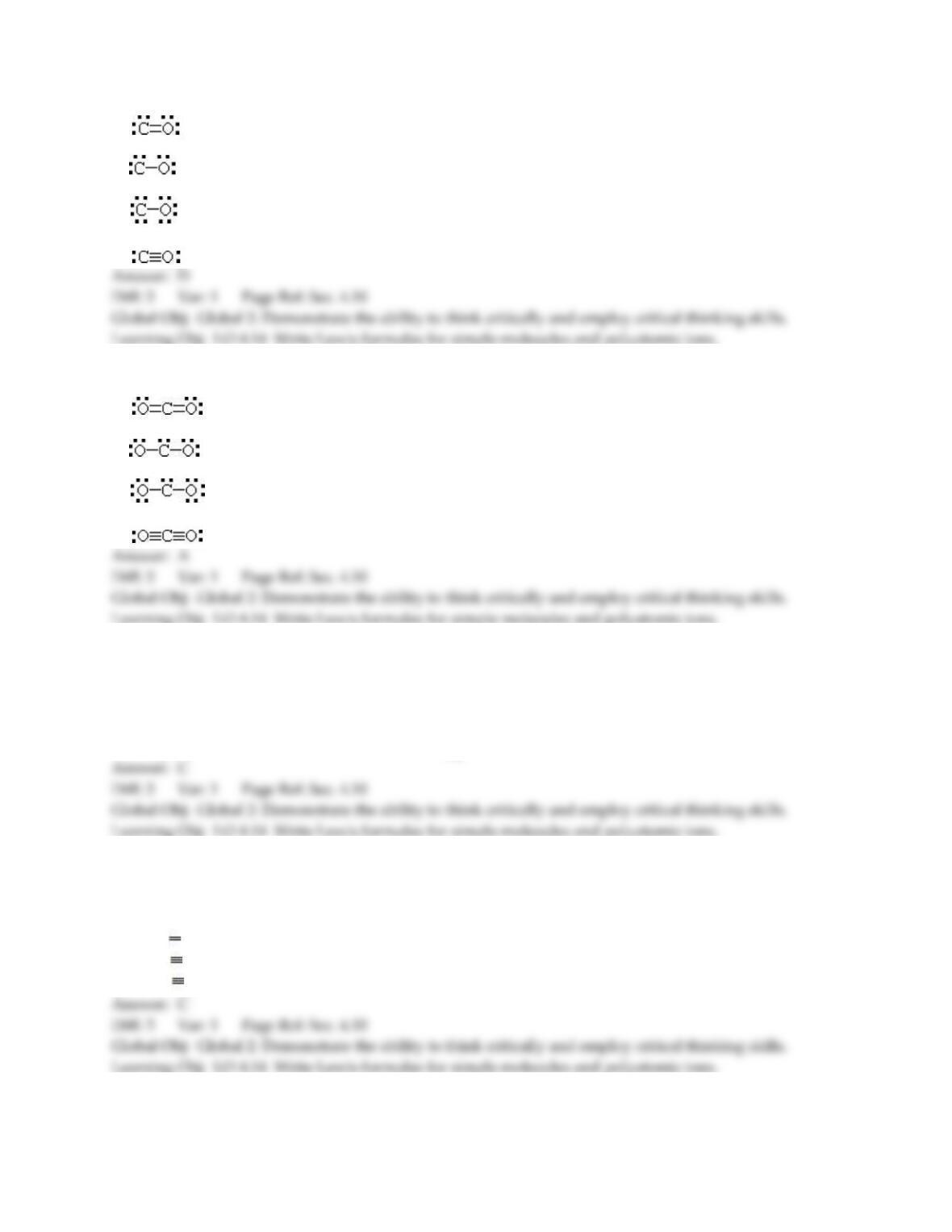
130) The electron dot formula for carbon dioxide, CO2, is
A)
B)
C)
D)
131) The structure of formaldehyde, CH2O, has
A) all ionic bonds.
B) all single covalent bonds.
C) a double covalent bond between carbon and oxygen.
D) a triple covalent bond between carbon and oxygen.
132) Acetylene is used in high temperature metal cutting torches. The formula of acetylene is C2H2. The
structure of acetylene is
A) H—C—C—H.
B) H—CC—H.
C) H—CC—H.
D) C—HH—C.
133) When a phosphorus atom combines with hydrogen to form a molecule, how many bonds are
formed?
A) 1
B) 2
C) 4
D) 3
134) Which of the following elements can form four bonds with other atoms?
A) S
B) Br
C) Si
D) P
135) Which one of the following compounds does NOT obey the “octet rule”?
A) H2O
B) CBr4
C) LiF
D) BF3
136) Which one of the following compounds does NOT obey the “octet rule”?
A) CO2
B) CH4
C) SCl6
D) NH3
137) Atoms and molecules with odd numbers of electrons are called
A) ions.
B) odd.
C) covalent.
D) free radicals.
138) The number of electrons contained in several molecules and ions is shown below. Which of the
following is most likely to be a free radical?
A) 12
B) 13
C) 16
D) 18
139) Which one of the following is a free radical?
A) H2S
B) NO
C) NH3
D) CF4
140) The valence shell electron pair repulsion theory (VSEPR) is used to
A) predict the bonding pattern in molecules.
B) predict the three dimensional structure of molecules.
C) predict the electronegativity of atoms.
D) predict the number of multiple bonds in a molecule.
141) If a central atom has a total of two electron sets and no lone pairs attached to it, the geometry about
the central atom is
A) linear.
B) trigonal planar.
C) tetrahedral.
D) pyramidal.
142) If a central atom has a total of three electron sets and no lone pairs attached to it, the geometry about
the central atom is
A) linear.
B) trigonal planar.
C) tetrahedral.
D) pyramidal.
143) If a central atom has four electron sets attached to it, the geometry about the central atom is
A) linear.
B) trigonal planar.
C) tetrahedral.
D) pyramidal.
144) The VSEPR theory is based on
A) the neutralization of ionic charge in a molecule.
B) the minimization of repulsion among valence electron pairs.
C) the arrangement of core electrons in a molecule.
D) the loss and gain of electrons based on electronegativity.
145) The shape of a water molecule is
A) linear.
B) bent.
C) tetrahedral.
D) trigonal planar.
146) The shape of a methane molecule is best described as
A) linear.
B) trigonal planar.
C) bent.
D) tetrahedral.
147) The best description of the shape of an ammonia molecule is
A) linear.
B) bent.
C) trigonal pyramidal.
D) tetrahedral.
148) The best description of the shape of a boron trifluoride (BF3) molecule is
A) pyramidal.
B) trigonal planar.
C) tetrahedral.
D) linear.
149) The shape of the carbon dioxide molecule is
A) pyramidal.
B) trigonal planar.
C) tetrahedral.
D) linear.
150) The shape of the sulfur dioxide molecule, where sulfur is the central atom is
A) linear.
B) bent.
C) trigonal planar.
D) tetrahedral.
151) A central atom that has tetrahedral geometry will have a total of
A) 4 electron sets and 0 lone pairs.
B) 3 electron sets and 1 lone pairs.
C) 2 electron sets and 1 lone pairs.
D) 3 electron sets and 0 lone pairs.
152) Interaction between molecules caused by the geometric orientations of their atoms is known as
A) medicinal chemistry.
B) molecular recognition.
C) polar recognition.
D) the VESPR effect.
153) A molecule that has a partial positive charge on one end and a partial negative charge on the other
end is a
A) dipole.
B) nonpolar molecule.
C) linear molecule.
D) binary molecule.
154) A lone pair of electrons
A) occupies a smaller volume than a bonding pair.
B) occupies a larger volume than a bonding pair.
C) occupies the same volume as a bonding pair.
D) will cause the bond angles to be larger.
155) Which of the following compounds is NOT polar?
A) CBr4
B) CH2F2
C) NF3
D) NH2I
156) Which of the following statements about molecules is correct?
A) A compound that contains only nonpolar bonds can be polar.
B) A compound that contains only polar bonds can be nonpolar.
C) A compound that contains only polar bonds must be polar.
D) A compound that contains both polar and nonpolar bonds must be nonpolar.
157) Which of the following molecules is polar?
A) O2
B) CCl4
C) CH2Cl2
D) CO2
158) All of the following statements about molecular recognition processes are true EXCEPT
A) they require smaller amounts of solvents than traditional methods do.
B) they contribute greatly to polluting the environment than traditional methods do.
C) they can be carried out at lower temperatures than traditional methods do.
D) they use less energy than traditional methods do.
4.2 True/False Questions
1) The Cl– ion and the K+ ion are isoelectronic.
2) The Lewis structure for oxygen has two electrons.
3) Sodium chloride has properties that are very similar to those of sodium.
4) The calcium metal is needed for healthy bones and teeth.
5) Ionic compounds generally form between metals and nonmetals.
6) Atoms will tend to gain or lose electrons in order to form a noble gas configuration.
7) All electrons around a central atom are in bonding pairs.
8) Electrons in a nonpolar covalent bond are shared equally between two atoms.
9) An atom with eight valence electrons will form a bond with only one other atom.
10) KCl is a polyatomic ion.
11) CrO42– is the chromic ion.
12) NO is a free radical.
13) The valence shell electron pair repulsion theory (VSEPR) can be used to predict the arrangement of
atoms around a central atom.
14) A compound with polar bonds must be polar.
15) A trigonal pyramidal molecule that contains polar bonds will be polar.
16) Medicinal chemists use the shapes of molecules and forces between them to create new life-saving or
life-changing medicines.
4.3 Short Answer Questions
1) The number of protons in a cation must always be ________ the number of electrons.
2) The number of protons in an anion must always be ________ the number of electrons.
3) When sodium and chlorine react to form sodium chloride, sodium and chlorine ________ are changed
into sodium and chloride ________.
4) What is the name of the compound with the formula, K2S?
5) What is the formula of copper(I) sulfide?
6) What is the name of the compound with the formula N2O4?
7) What is the formula of the compound with the name tetraphosphorus pentoxide?
8) What is the formula of potassium sulfate?
9) What is the formula of iron(III) phosphate?
10) The formula of sodium dichromate is ________.
4.4 Essay Questions
1) Write the electron dot symbol for potassium.
2) Write the electron dot symbol for selenium.
3) Write the electron dot symbol for carbon.
4) Draw the electron dot formula for carbon monoxide, CO.
5) Acetylene is used in high temperature metal cutting torches. The formula of acetylene is C2H2. Draw
the electron dot structure for acetylene.