
95. Fun and Games, Inc. (FGI), headquartered in Boston, is a software consulting company specializing in
games. It has been growing at an alarming pace. Mr. Furst, president of the company is considering expanding
his operations by opening his seventh office in Portsmouth. FGI recently completed an ABC analysis of its
Boston office to better understand the supply and use of facility-level resources. Mr. Furst does not expect the
Portsmouth office to be different from the one in Boston in terms of resource requirement and consumption. For
example, he expects to hire as many employees as in the Portsmouth office and also exert as much sales effort.
However, he expects that business (# of projects) and sales revenue will be only 75% of that in Boston during
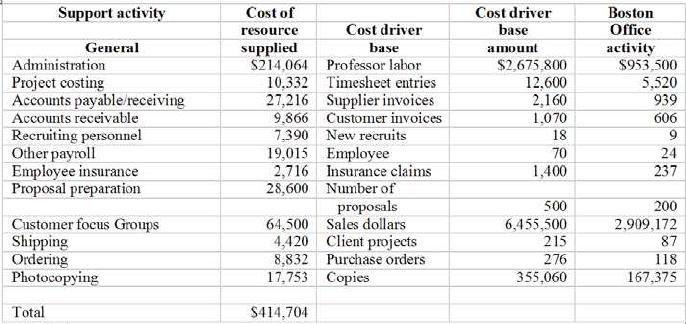
the first year. Miss Bridges tracked the following information to assist in the decision.
Required
(a) Using the information given above, estimate the cost of supporting the new office in Portsmouth. Assume
that the resources used is the same as resources supplied.
(b) Should the level of resources used always be equal to the level of resources supplied? Why or why not?
(c) Is activity-based information always better than average–cost information? Explain.
96. Richmond Research Institute (RRI) is a private research organization specializing in medical research. It
specializes in performing research about the awareness of the general public with respect to common ailments
Colds, flu, etc.). Various health organizations contract with RRI to conduct research on their behalf. It carries
out this research through phone surveys. The results of such research are then provided to health organizations
that use the information to develop pamphlets about these common ailments.
In order to better understand its costs, RRI has decided to implement an activity–based information system. It
collected the following data for the month of January:
Ⴠ 60 tele-researchers (labor) to complete 24,000 surveys and 115,000 calls, $110,000. Each survey takes 9
minutes to complete and each call takes 4 minutes.
Ⴠ Long-distance phone charges for the surveys, $22,000.
Ⴠ Preparation of scripts for surveys (2), $7,000, and sales pitches (4), $5,000
Ⴠ Training of tele-research labor by the training department of RRI to conduct surveys for specific customers,
$14,200
Ⴠ Automated dialing equipment, $23,000
Ⴠ Occupancy costs, $20,000
Ⴠ Three supervisors, $30,000
Ⴠ Human resources, $11,000
Required
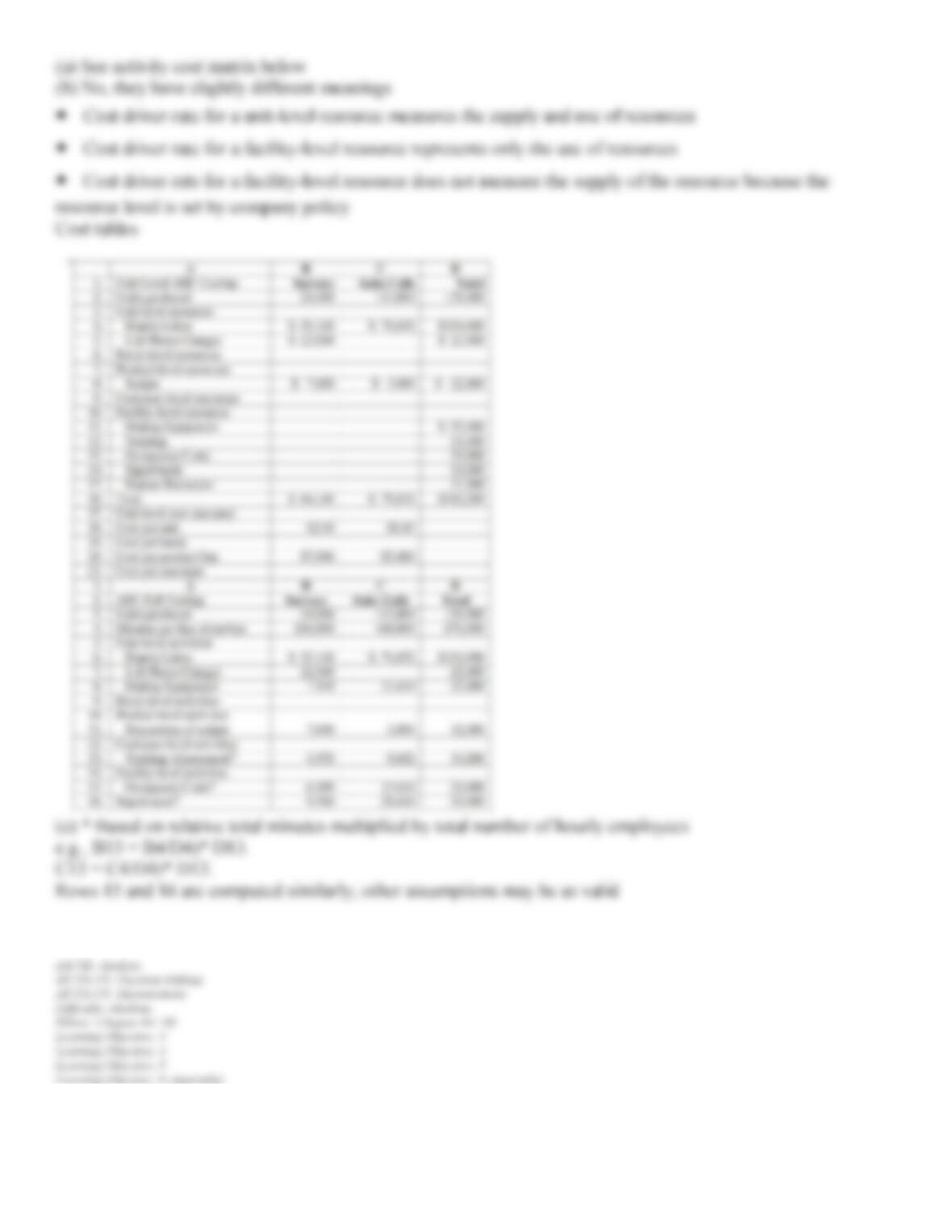
(a) Prepare an activity matrix as follows: In column 1, list all the activities according to their level of usage (i.e.,
unit–level, batch-level, etc.). In column 2, list the cost driver base for each activity listed in the previous column.
In the remaining columns (3 through 10), fill in the appropriate numbers
Note that columns 3 through 10 are to be labeled as follows: unit–level resources, batch resources, product
resources, customer resources, facility resources, total resources supplied, total driver base level and cost driver
rate
(b) Does the cost driver rate for unit-level resources have the same meaning as the cost driver rate for a facility
level resource? Explain
(c) Compute the unit–level and full-ABC costs per unit for the surveys and sales calls
97. In its advertising, Ford Motor Company says “Quality is Job One.“ Ford is indicating that good quality is the
most important consideration for its customers. This would include customer satisfaction on delivery dates and
specific areas of car performance, including properly closing doors, defect rates on parts. Explain how Activity
Based Costing ABC. can help supply this information to Ford’s management
98. Dayton Extruded Plastics is a manufacturer of injection–molded extrusions. Scrapped or defective extrusions
were ground into powder and fed back into the extruders as raw materials. Defective extrusions were
inspected out during line work and in handling returns from customers; they were then ground up in special
grinding machines and mixed with new raw material and reused in manually controlled injection-molding
machines. The molding machines use utilities provided for the main manufacturing facility. After grinding,
maintenance and cleanup of the facilities were performed by general maintenance personnel. Because all
scrapped extruders were reused in this way, company management felt that the cost of scrap was “free.” The
company’s traditional cost accounting system did not associate any cost with the cost of processing scrap
Required:
(a) Identify the activities in bold as unit–level, batch-level, product-level, customer-level or facility-level.
(b) Explain why the company’s traditional cost accounting system is giving misleading results related to Dayton
Extruded Plastics processing of scrap
99. Activity based costing identifies five different levels of activities and costs that are used in business and
production processes.
a) Identify the five activity levels an provide a brief definition of each.
b) For each activity level, give and example of an activity that would fall into that category
100. Activity-Based Accounting information can provide unit level costs or full ABC costs. Explain why
operating profits may differ depending upon which cost is used in management’s analysis. Explain when each
can be useful to management

101. Briefly distinguish between the top down approach, the interview approach and the recycling approach of
identifying activities. Identify any major advantages or deficiencies of each approach.
102. Tubes of All Sizes (TAS) manufactures a variety of tubes for many different customers. These pipes are
different with respect to size (length, thickness and diameter), material, finish Coarse versus fine) and even
color (green, red, yellow, black and navy blue). The typical manufacturing process consists of cutting the
materials to desired lengths, grinding the cut pieces, forming (shaping) them, finishing the formed pipes, spray
painting the finished pipes and packaging them in bundles of 25 pipes each. The pipes range from 2 feet to 6
feet in length, ½ an inch to 3 inches in thickness, and 6 to 18 inches in diameter
TAS caters to three different types of customers: large, medium and small. The large customers buy only three
times during a year in large quantities. The delivery is also made three times as per the order quantities. On the
other hand, the smaller customers order many times and in smaller quantities. Besides, the smaller customers
buy a greater variety of tubes (i.e., each order is likely to be different from the previous one). Consequently,
TAS cannot anticipate the needs of the smaller customers
TAS’s cost accounting system is tailored for the large customers in terms of how the data are captured. The
activity cost driver rates are set based on the large customer’s use of resources extrapolated for all customers.
Prices are also set based on the large customers’ consumption of resources. Karen Kent, the marketing manager,
has not been very happy about the accounting system because the actual marketing costs have turned out to be
much greater than what the accounting system has been suggesting. Similarly, Norman Neusom, the operations
manager has also been troubled by the cost numbers. Both Kent and Neusom decided to meet with the
controller Janet Hines, to discuss their concerns
Hines: Karen and Norman, in my office together? I’m surprised!
Neusom: You shouldn’t be, Janet. Didn’t you guys tell us that we should all work together as a team? I have
stopped fighting with my colleagues in marketing.
Kent: Let’s just say that we are beginning to behave like reasonable adults
Hines: Isn’t it nice to work as a team? However, it looks like we have a serious problem given that the two of
you have come to my office together. Am I under attack?
Neusom: No attacks, no blame. We have a problem and we don’t quite know where and how to begin
Kent: Both Norman and I are getting messages that conflict with our wisdom regarding our individual functions
(or processes, as we should say these days). It looks like our costing system is designed to handle the big guys (I
mean our large customers) but does not estimate the marketing and sales related costs for the smaller customers.
Consequently, I am unable to determine which customers are profitable and which are not. I would love it if our
costing system could provide finer information
Neusom: Added to that, Janet, is the fact that these smaller customers seem to be upsetting my people too.
There is something about these small customers‘ orders that throw my people off guard. They would love it if
we got rid of all our small customers and take one or two more big guys. I am sure that would make Karen’s life
easy too
Kent: You are right, Norman. It would make my life easier but I do not know if I want to make that conclusion
before I can better assess the situation
Hines:Let me see what I can do. I will also talk to a couple of my old buddies who are top CMAs and well
regarded for their knowledge in cost management
Required:
Assume the role of one of the top, well-regarded CMAs. Identify the crucial issues in the case and address the
problem. What can be done?
103. Chatham Company provides internet services to various types of clients. Similar to most internet
companies, Chatham has also grown rapidly, thereby breaking all records. Cary Koch, the executive director of
Chatham, recently returned from a conference which featured leading companies sharing their experiences of
ABC implementation in their respective organizations. After returning, she called Tom Lake, one of her new
recruits and a fresh business graduate from a reputed mid-western university, into her office. She instructed him
to prepare a one-hour presentation to introduce the notion of activity–based costing to members of the executive
committee All old-timers with little knowledge of modern management accounting practices)
Although Lake studied about ABC in his cost management systems course, he has no real world experience,
and is nervous about the presentation. He meets you and expresses his concern
Lake: The big boss has asked me to prepare this presentation
You: What are you worried about? You know all about ABC
Lake: You don’t seem to understand. I have to present to the top most people in our company. This is going to
be very important. I feel like my whole life depends on this.
You: How can I help?
Lake: I just wanted your opinion of what you think I should cover in my presentation
Required:
Assist Lake in identifying all the relevant issues you believe he should include in his presentation and briefly
explain why it is important to cover the issue

104. Popular Toy Company (PTC. grew out of a family business that the Neville family owned and ran from the
basement of a large house. PTC currently manufactures over 50 types of plastic toys for various age groups.
Belinda Taylor, the controller of PTC, has been concerned about the archaic costing system existing within the
company. She approached Joan Neville, the president, to express her concern
Joan listened patiently to Taylor and decided to call a meeting. Taylor suggested that the production and
marketing personnel also should be part of the meeting
The following people were invited: John Baxter (general manager), Rita MacDonald (marketing manager) and
Peter Lindsay (production supervisor)
The meeting began with Taylor thanking everyone for their time and explaining to them the reason for calling
the meeting
Taylor: Thank you all for coming to this meeting at such short notice. As you all know, our competition is
getting tougher each day. It is important that we take steps to confront the situation.
Lindsay: I don’t see the problem. My men and machines are constantly busy, so we must be doing well
MacDonald: We don’t have to panic yet but there are signs that we should think about our future; competition
is closing in on us. For example, of late, we have not been getting orders for the more profitable products
Baxter: Our men and machines are busy, but this is no good if all we do is produce and stock the goods in our
warehouse. Therefore, I agree with Belinda that we should get our minds together and think about our future
Neville: Where do we begin?
Taylor: I think we should begin with our costing system. In particular, we should implement an activity-based
costing system.
Neville: That’s easy. Belinda, why don’t you call a consultant and have them do the job
Taylor: I don’t think that we should hire a consultant. Instead, we should do it ourselves as it will be a valuable
learning exercise. We should start with an activity analysis by listing all the activities conducted in our company
and all the resources consumed by these activities
MacDonald: That sounds complicated. How do you propose to go about this?
Taylor: We would have to get everybody’s input regarding what they do
Lindsay: I don‘t think there is a need to talk to my men. I can tell you all that they do
Baxter: I agree with Peter. There’s no need to talk to the boys. They should not
be disturbed from their work. Besides, they may hide certain activities. You may not get an accurate picture
from them
Required:
Assume the role of Belinda Taylor. Think of the concerns raised by the different individuals at the meeting and
address each of them. Do you think there is a role in this for an outside consultant? Explain