93) What is the oxidation half reaction in the following chemical reaction?
Cr2O72-(aq) + 6 Cl–(aq) + 14 H+(aq) → 2 Cr3+(aq) + 3 Cl2(aq) + 7 H2O(l)
A) Cr2O72-(aq) + 14 H+(aq) + 6e– → 2 Cr3+(aq) + 7 H2O(l)
B) Cr2O72-(aq) + 14 H+(aq) → 2 Cr3+(aq) + 7 H2O(l) + 6e–
C) 2 Cl–(aq) → Cl2(aq) + 2e–
D) Cl2(aq) + 2e– → 2 Cl–(aq)
94) What is the reduction half reaction for the following chemical reaction in a basic solution?
Mn2+(aq) + 2 ClO3–(aq) + OH–(aq) → MnO2(s) + 2 ClO2(aq) + H2O(l)
A) Mn2+(aq) + 4 OH–(aq) → MnO2(s) + 2 H2O(l) + 2e–
B) Mn2+(aq) + 2 H2O(l) → MnO2(s) + 4 H+(aq) + 2e–
C) ClO3–(aq) + H2O(l) + e– → ClO2(aq) + 2 OH–(aq)
D) ClO3–(aq) + 2 H+(aq) + e– → ClO2(aq) + H2O(l)
95) What is the reduction half reaction for the following chemical reaction in a basic solution?
ClO–(aq) + Cr(OH)4–(aq) → CrO42-(aq) + Cl–(aq)
A) ClO–(aq) + 2 H+(aq) + 2e– → Cl–(aq) + H2O(l)
B) ClO–(aq) + H2O(l) + 2e– → Cl–(aq) + 2 OH–(aq)
C) Cr(OH)4–(aq) + 4 OH–(aq) → CrO42-(aq) + 4 H2O(l) + 3e–
D) Cr(OH)4–(aq) → CrO42-(aq) + 4 H+(aq) + 3e–
96) According to the balanced equation shown below, 1.00 mole of oxalic acid, H2C2O4, reacts with
________ moles of permanganate ion, MnO4–.
5 H2C2O4(aq) + 2 MnO4–(aq) + 6 H+(aq) → 10 CO2(g) + 2 Mn2+(aq) + 8 H2O(l)
A) 0.400
B) 1.00
C) 2.00
D) 2.25
97) According to the balanced chemical equation
5 H2C2O4(aq) + 2 MnO4–(aq) + 6 H+(aq) → 10 CO2(g) + 2 Mn2+(aq) + 8 H2O(l)
0.3500 grams of oxalic acid, H2C2O4 will react with ________ moles of permanganate, MnO4–.
A) 0.001554
B) 0.003887
C) 0.007774
D) 0.009718
98) According to the balanced chemical equation
5 H2C2O4(aq) + 2 MnO4–(aq) + 6 H+(aq) → 10 CO2(g) + 2 Mn2+(aq) + 8 H2O(l)
0.3500 grams of oxalic acid, H2C2O4 will react with ________ mL of 0.100 M potassium
permanganate, KMnO4 solution.
A) 15.5 mL
B) 38.9 mL
C) 77.7 mL
D) 97.2 mL
99) Based on the balanced chemical equation shown below, what volume of 0.250 M K2S2O3(aq) is
needed to completely react with 12.44 mL of 0.125 M KI3(aq)?
2 S2O32-(aq) + I3–(aq) → S4O62-(aq) + 3 I–(aq)
A) 3.11 mL
B) 6.22 mL
C) 12.4 mL
D) 49.8 mL
100) What is the molarity of a potassium triiodide solution, KI3(aq), if 30.00 mL of the solution is
required to completely react with 25.00 mL of a 0.200 M thiosulfate solution, Na2S2O3(aq)? The
chemical equation for the reaction is:
2 S2O32-(aq) + I3–(aq) → S4O62-(aq) + 3 I–(aq)
A) 0.0833 M
B) 0.120 M
C) 0.167 M
D) 0.333 M
101) Based on the balanced chemical equation shown below, determine the molarity of a solution
containing Fe2+(aq), if 40.00 mL of the Fe2+(aq) solution is required to completely react with 30.00
mL of a 0.125 M potassium bromate, KBrO3(aq), solution.The chemical equation for the reaction is:
6 Fe2+(aq) + BrO3–(aq) + 6 H+(aq) → 6 Fe3+(aq) + Br–(aq) + 3 H2O(l).
A) 0.0156 M
B) 0.0938 M
C) 0.562 M
D) 1.00 M
102) Based on the balanced chemical equation shown below, determine the mass percent of Fe3+ in a
0.6450 gram sample of iron ore, if 22.40 mL of a 0.1000 M stannous chloride, SnCl2(aq), solution is
required to completely react with the Fe3+ present in the ore sample. The chemical equation for the
reaction is:
2 Fe3+(aq) + Sn2+(aq) → 2 Fe2+(aq) + Sn4+(aq).
A) 6.196%
B) 9.697%
C) 19.40%
D) 38.79%
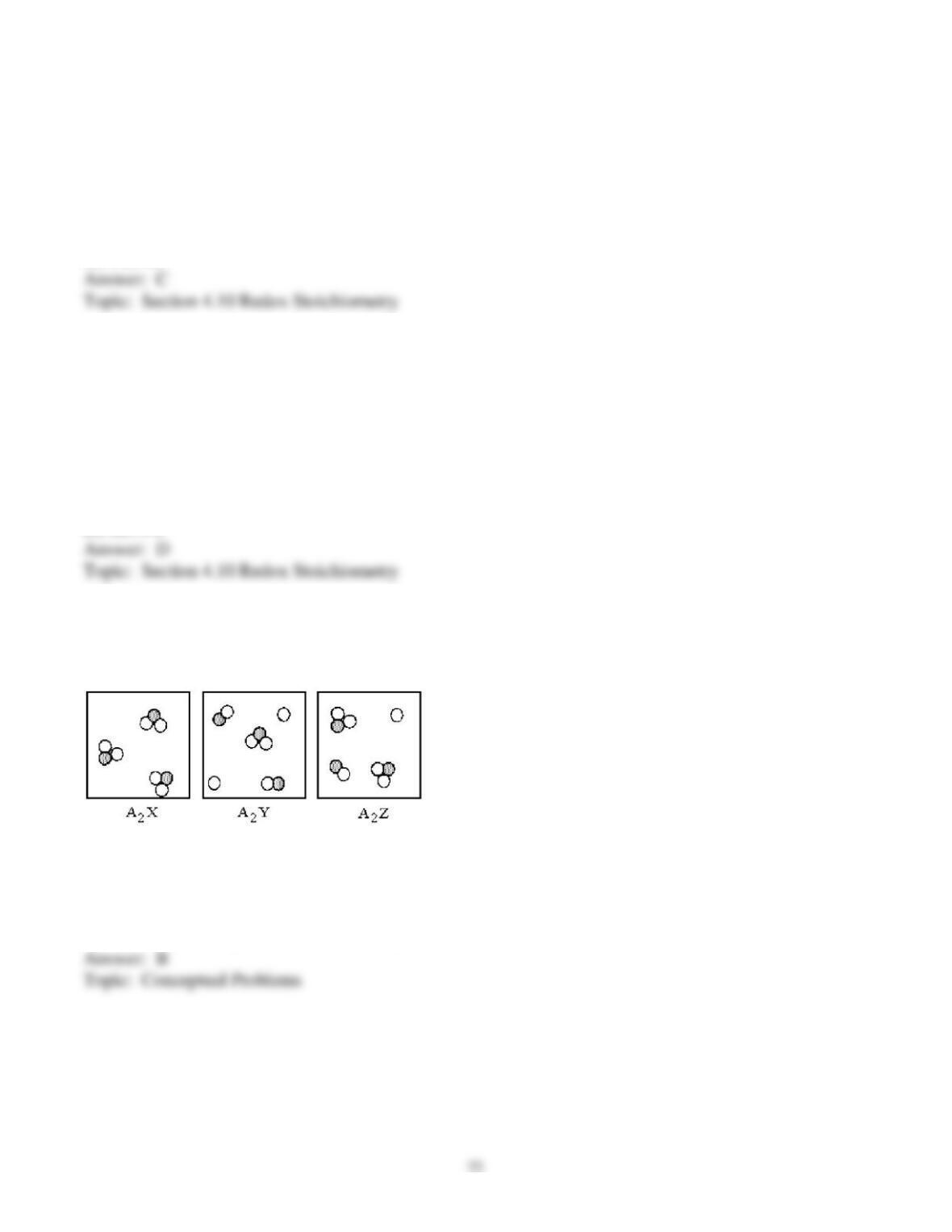
103) Three different substances, A2X, A2Y, and A2Z, were dissolved in water with the following
results. (Water molecules are omitted for clarity.) Which of the substances is the strongest electrolyte,
and which is the weakest?
A) A2X is the strongest electrolyte and A2Y is the weakest electrolyte.
B) A2Y is the strongest electrolyte and A2X is the weakest electrolyte.
C) A2Y is the strongest electrolyte and A2Z is the weakest electrolyte.
D) A2Z is the strongest electrolyte and A2Y is the weakest electrolyte.
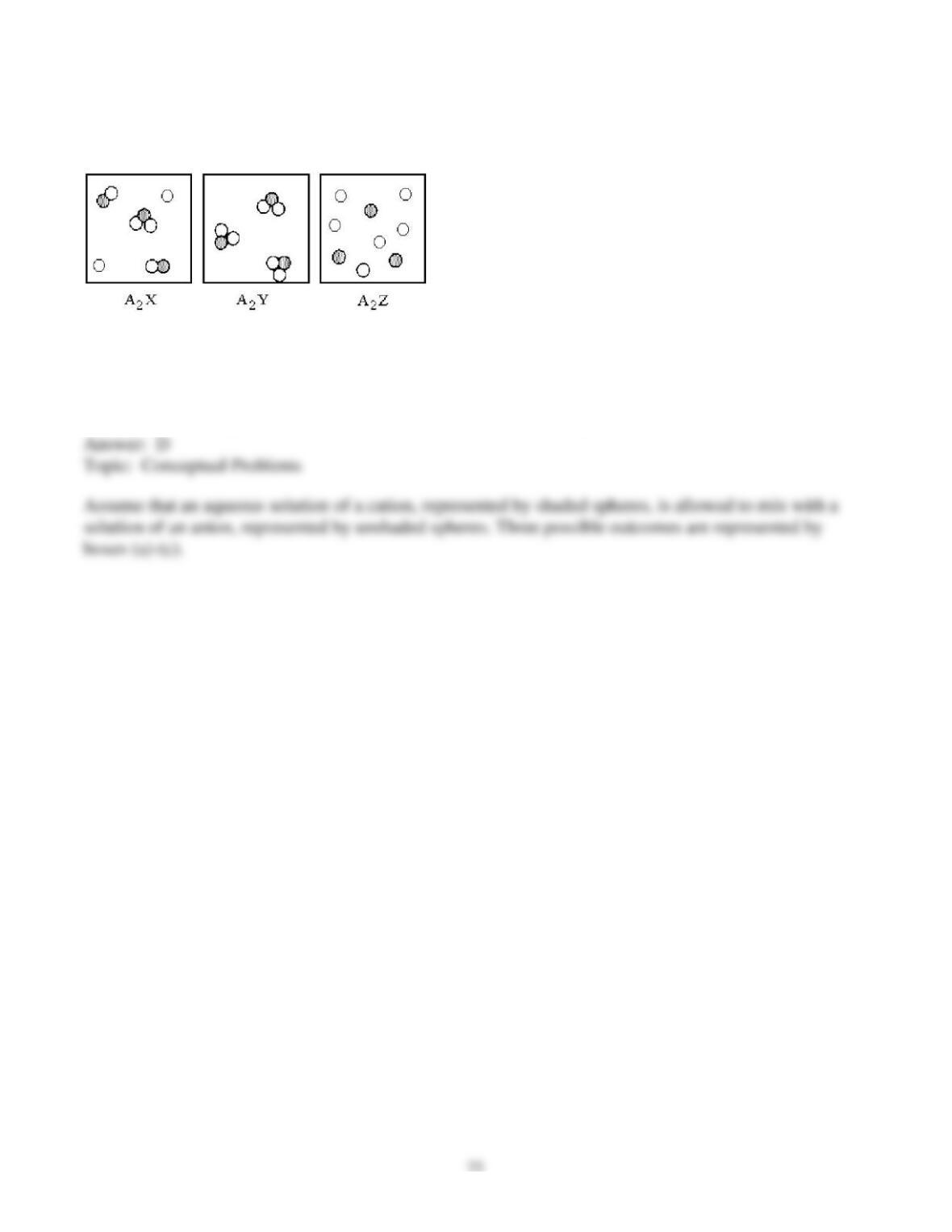
104) Three different substances, A2X, A2Y, and A2Z, were dissolved in water with the following
results. (Water molecules are omitted for clarity.) Which of the substances is the strongest electrolyte,
and which is the weakest?
A) A2X is the strongest electrolyte and A2Y is the weakest electrolyte.
B) A2Y is the strongest electrolyte and A2X is the weakest electrolyte.
C) A2Y is the strongest electrolyte and A2Z is the weakest electrolyte.
D) A2Z is the strongest electrolyte and A2Y is the weakest electrolyte.
24
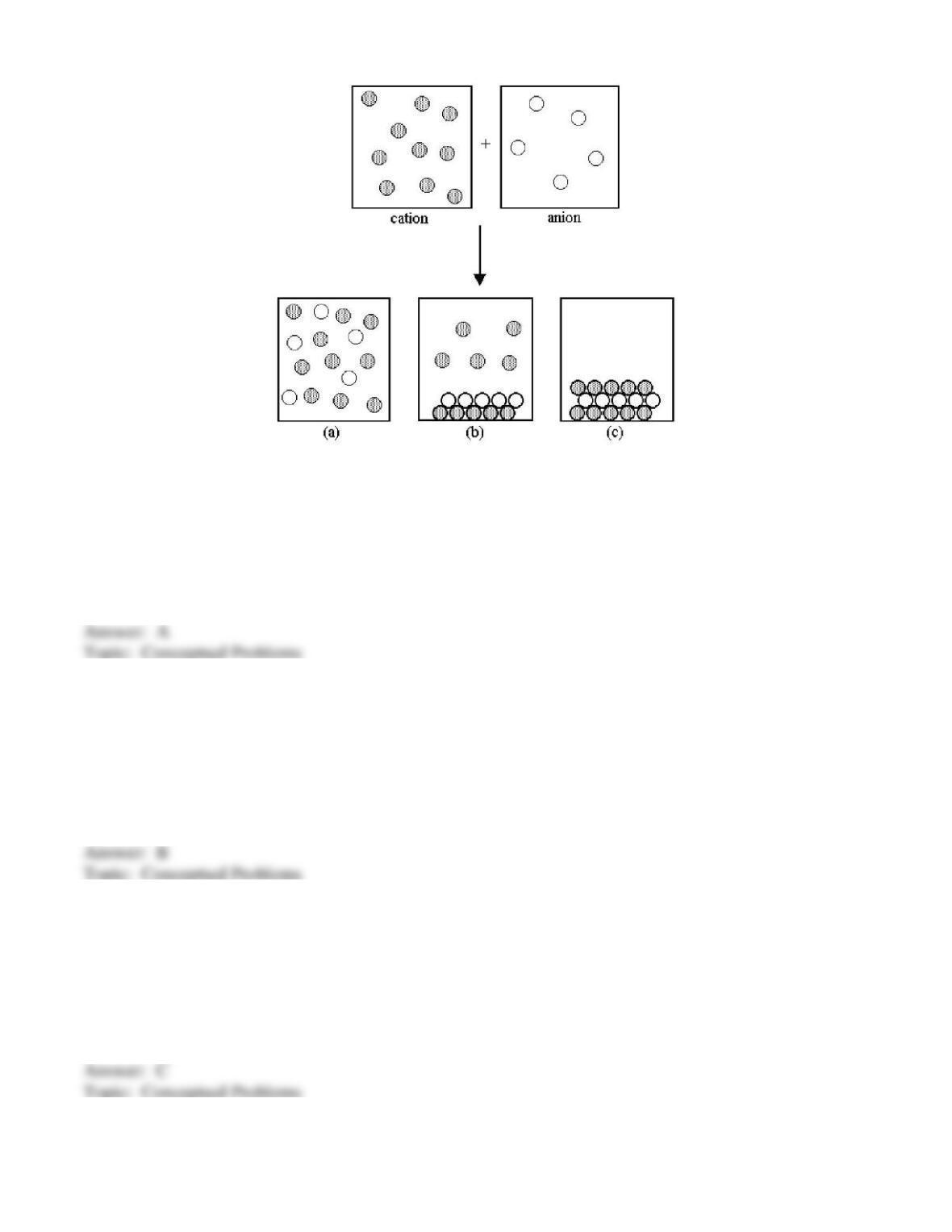
105) Which outcome corresponds to the mixing of potassium and sulfide ions shown in the following
equation?
2 K+(aq) + S2-(aq) → ?
A) box (a)
B) box (b)
C) box (c)
D) None of these
106) Which outcome corresponds to the combination of calcium and carbonate ions shown in the
following equation?
Ca2+(aq) + CO32-(aq) → ?
A) box (a)
B) box (b)
C) box (c)
D) None of these
107) Which outcome corresponds to the combination of silver and chromate ions shown in the following
equation?
Ag+(aq) + CrO42-(aq) → ?
A) box (a)
B) box (b)
C) box (c)
D) None of these
108) Which outcome corresponds to the mixing of sodium and sulfate ions shown in the following
25
equation?
2 Na+(aq) + SO42-(aq) → ?
A) box (a)
B) box (b)
C) box (c)
D) None of these
109) Which outcome corresponds to the combination of copper(II) and sulfide ions shown in the
following equation?
Cu2+(aq) + S2-(aq) → ?
A) box (a)
B) box (b)
C) box (c)
D) None of these
110) Which outcome corresponds to the combination of silver and carbonate ions shown in the
following equation?
Ag+(aq) + CO32-(aq) → ?
A) box (a)
B) box (b)
C) box (c)
D) None of these
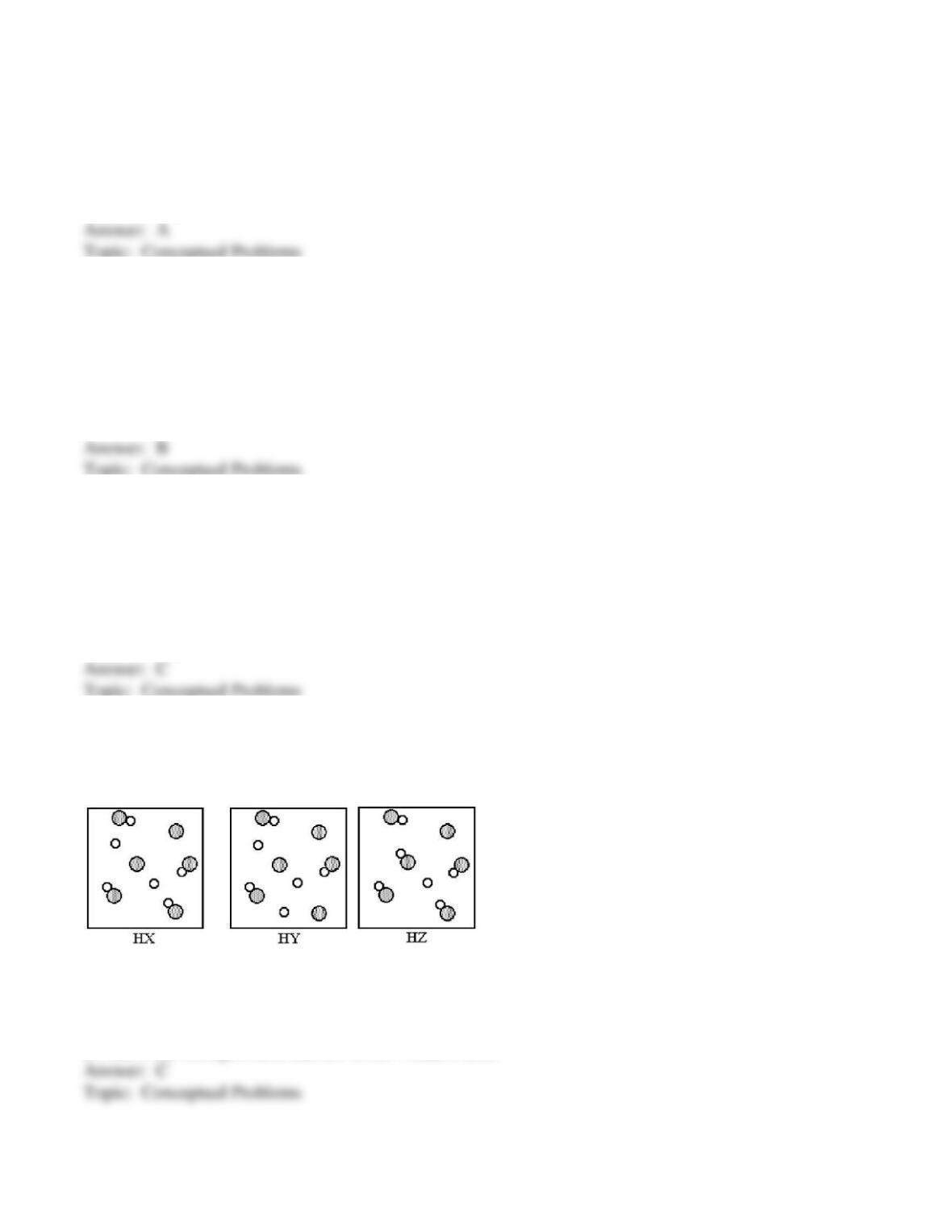
111) The following pictures represent aqueous solutions of three acids HA (A = X, Y, or Z), with water
molecules omitted for clarity. Unshaded spheres represent hydrogen atoms or ions and gray spheres
represent A atoms or ions. Which of the three is the strongest acid, and which is the weakest?
A) HX is the strongest acid and HY is the weakest acid.
B) HY is the strongest acid and HX is the weakest acid.
C) HY is the strongest acid and HZ is the weakest acid.
D) HZ is the strongest acid and HY is the weakest acid.
Assume that an aqueous solution of hydroxide ion, OH–, represented by unshaded spheres, is allowed to
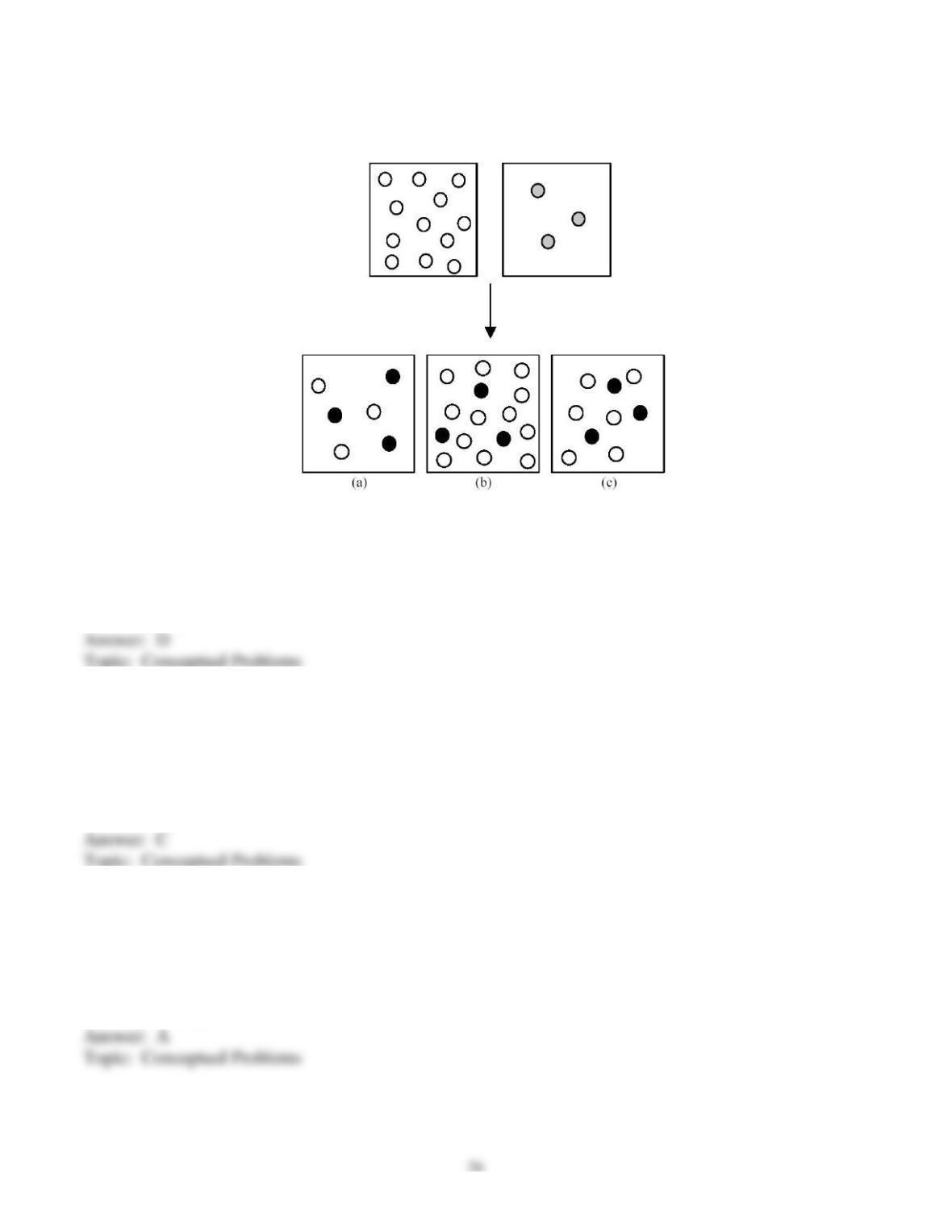
mix with a solution of an acid, HnA, represented by gray spheres. Three possible outcomes are
represented by boxes (a)-(c), where the black spheres represent An–, the anion of the acid. For clarity
H2O molecules are not shown.
112) Which outcome corresponds to the reaction:
HCN + OH– → H2O + CN–?
A) box (a)
B) box (b)
C) box (c)
D) None of these
113) Which outcome corresponds to the reaction:
H2SO4 + 2 OH– → 2 H2O + SO42-?
A) box (a)
B) box (b)
C) box (c)
D) None of these
114) Which outcome corresponds to the reaction:
H3AsO4 + 3 OH– → 3 H2O + AsO43-?
A) box (a)
B) box (b)
C) box (c)
D) None of these
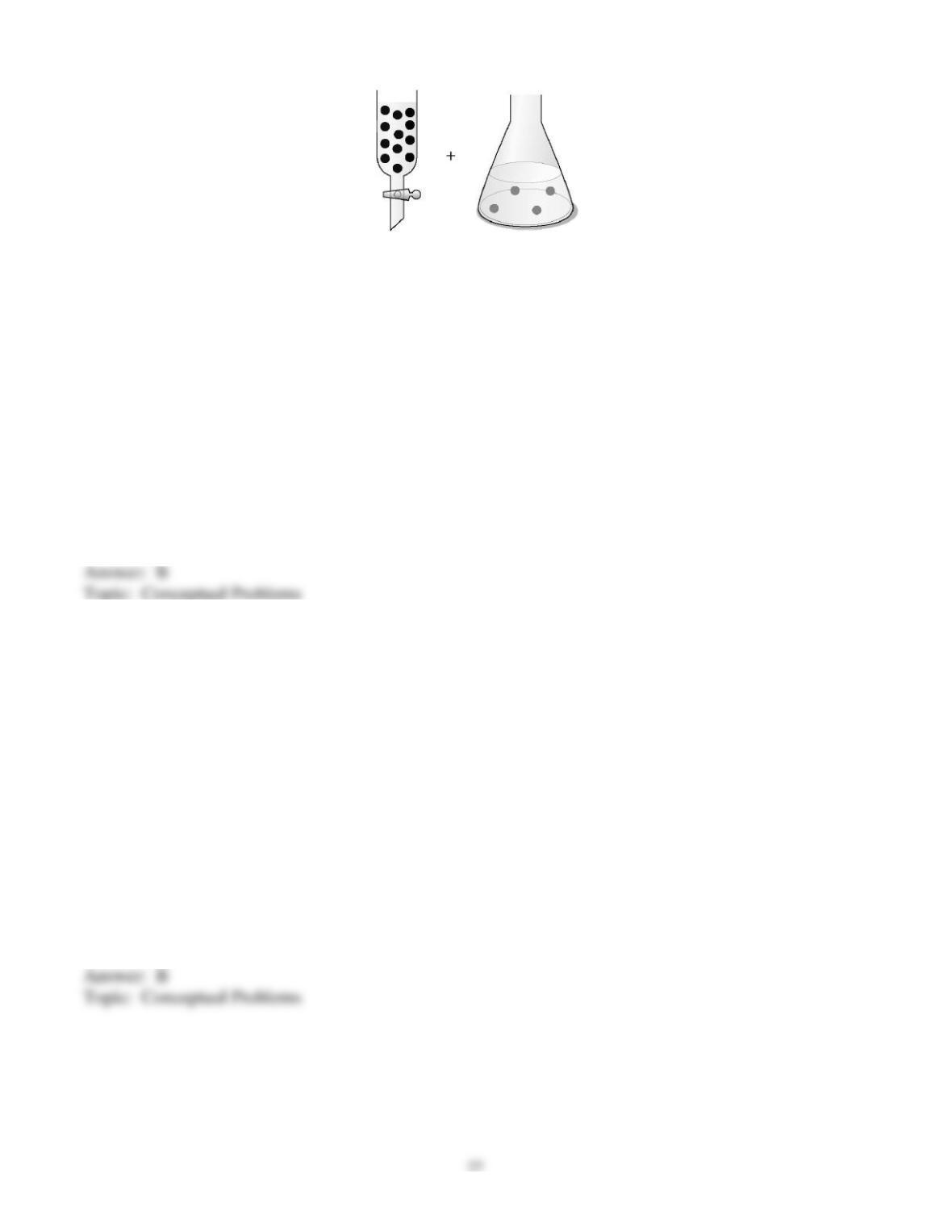
115) The concentration of an aqueous solution of NaOCl can be determined by a redox titration with
iodide ion in acidic solution:
OCl– (aq) + 2 I– (aq) + 2 H⁺ (aq) → Cl⁻ (aq) + I2 (aq) + H2O (l)
Assume that the black spheres in the buret represent I⁻ ions, the gray spheres in the flask represent OCl⁻
ions, the concentration of the I⁻ ions in the buret is 0.120 M, and the volumes in the buret and the flask
are identical. What is the concentration of the NaOCl in the flask, and what fraction of the I⁻ solution in
the buret must be added to the flask to react with all the OCl⁻ ions?
A) 0.0400 M NaOCl; 1/3 of the I⁻ must be added.
B) 0.0400 M NaOCl; 2/3 of the I⁻ must be added.
C) 0.0600 M NaOCl; 1/3 of the I⁻ must be added.
D) 0.0600 M NaOCl; 2/3 of the I⁻ must be added.
116) The concentration of an aqueous solution of I3⁻ can be determined by a redox titration with
aqueous sodium thiosulfate, Na2S2O3:
2 S2O32- (aq) + I3⁻ (aq) + → S4O62- (aq) + 3 I⁻ (aq)
Assume that the black spheres in the buret represent S2O32- ions, the gray spheres in the flask represent
I3– ions, the concentration of the S2O32- ions in the buret is 0.120 M, and the volumes in the buret and
the flask are identical. What is the concentration of the I3– in the flask, and what fraction of the S2O32-
solution in the buret must be added to the flask to react with all the I3– ions?
A) 0.0400 M I3–; 1/3 of the S2O32- must be added.
B) 0.0400 M I3–; 2/3 of the S2O32- must be added.
C) 0.0600 M I3–; 1/3 of the S2O32- must be added.
D) 0.0600 M I3–; 2/3 of the S2O32- must be added.
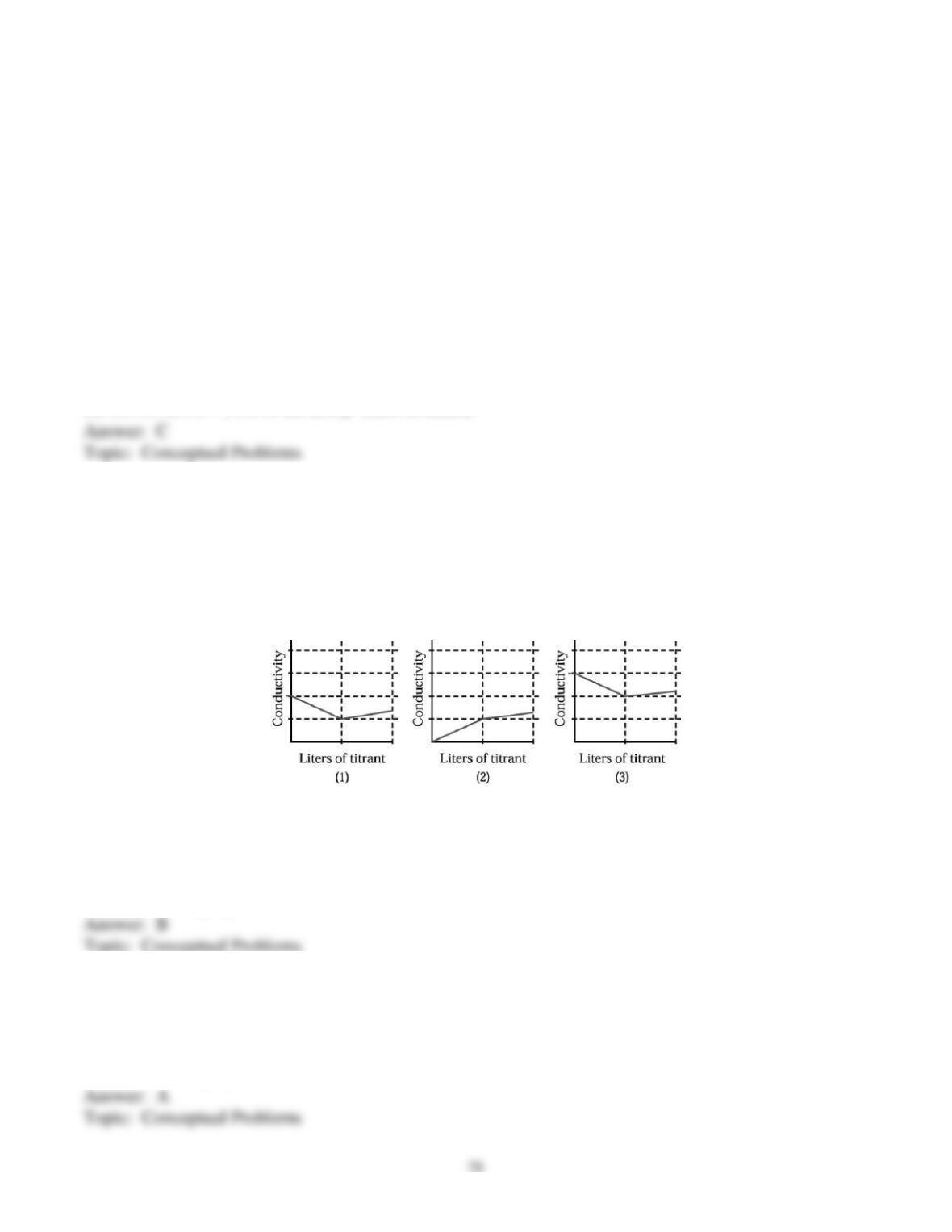
117) The concentration of an aqueous solution of Fe2+ can be determined by a redox titration with
aqueous bromate ion, BrO3⁻:
6 Fe2+ (aq) + BrO3⁻ (aq) + 6 H⁺ (aq) → 6 Fe3+ (aq) + Br⁻ (aq) + 3 H2O (l)
Assume that the black spheres in the buret represent BrO3⁻ ions, the gray spheres in the flask represent
Fe2+ ions, the concentration of the BrO3⁻ ions in the buret is 0.120 M, and the volumes in the buret and
the flask are identical. What is the concentration of the Fe2+ in the flask, and what fraction of the BrO3⁻
solution in the buret must be added to the flask to react with all the Fe2+ ions?
A) 0.0200 M Fe2+; 1/18 of the BrO3⁻ must be added.
B) 0.0200 M Fe2+; 1/3 of the BrO3⁻ must be added.
C) 0.0400 M Fe2+; 1/18 of the BrO3⁻ must be added.
D) 0.0400 M Fe2+; 1/3 of the BrO3⁻ must be added.
Assume that the conductivity of a solution depends only on the total concentration of dissolved ions and
that you measure the conductivity of three different solutions while performing titrations in which
I. 50.00 mL of 0.100 M aqueous CH3CO2H is titrated by addition of 0.100 M NaOH.
II. 50.00 mL of 0.100 M aqueous NaBr is titrated by addition of 0.100 M AgNO3.
III. 50.00 mL of 0.100 M aqueous CaCl2 is titrated by addition of 0.100 M Na2CO3.
118) Which of the above graphs corresponds to titration I?
A) graph (1)
B) graph (2)
C) graph (3)
D) None of the graphs
119) Which of the above graphs corresponds to titration II?
A) graph (1)
B) graph (2)
C) graph (3)
D) None of the graphs
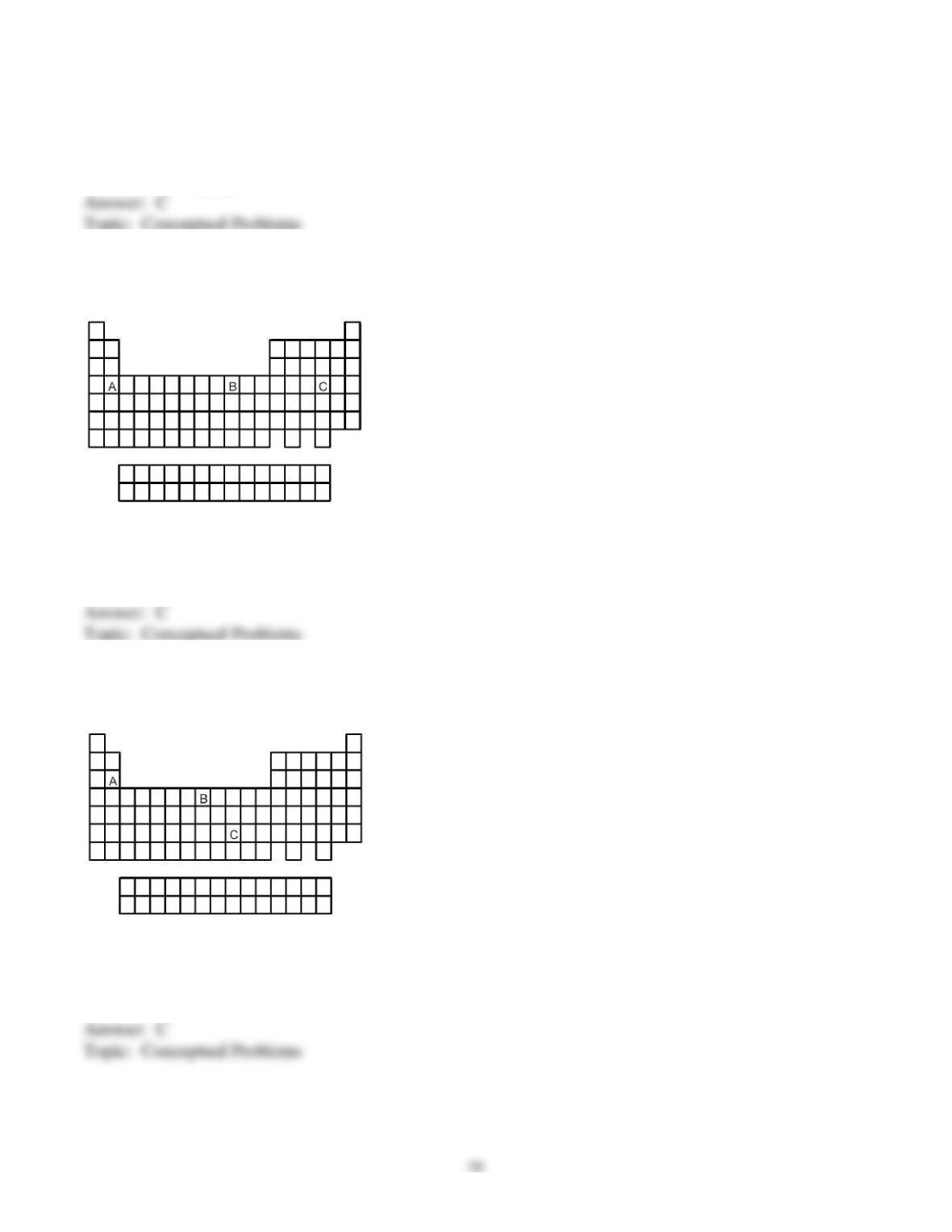
120) Which of the above graphs corresponds to titration III?
A) graph (1)
B) graph (2)
C) graph (3)
D) None of the graphs
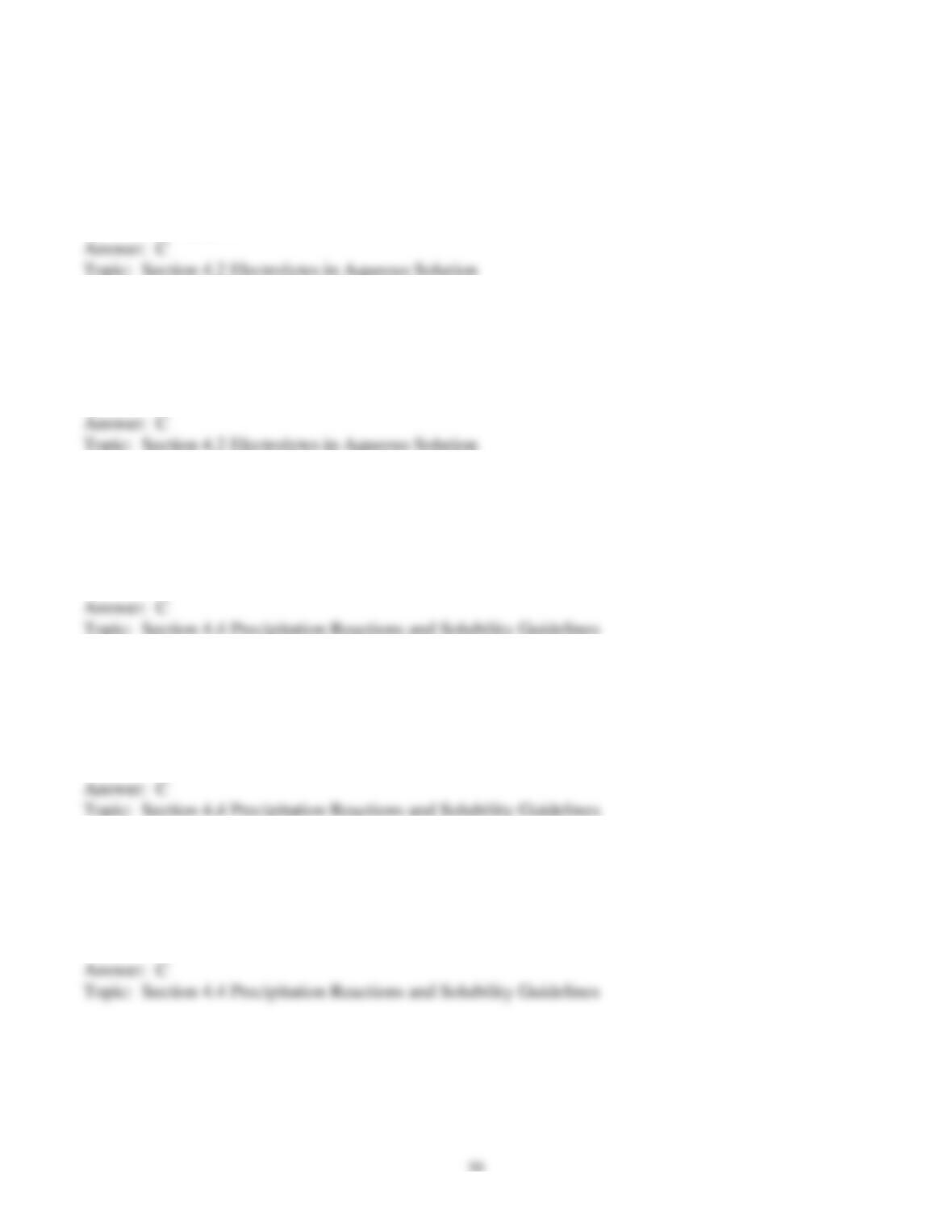
121) Based on the positions in the periodic table of elements A, B, and C, which of the following
reactions would you expect to occur?
A) A2+ + B → A + B2+
B) B2+ + C → B + C2+
C) C + A → C2- + A2+
D) None of the reactions would be expected to occur.
122) Based on the positions in the periodic table of elements A, B, and C, which of the following
reactions would you expect to occur?
A) A2+ + B → A + B2+
B) B2+ + C → B + C2+
C) C2+ + A → C + A2+
D) None of the reactions would be expected to occur.
4.2 Algorithmic Questions
1) H Cl , H I , H2SO4, Li Cl , and KI are all classified as
A) acids.
B) nonelectrolytes.
C) strong electrolytes.
D) weak electrolytes.
2) What is the molar concentration of sodium ions in a 0. 450 M Na3PO4 solution?
A) 0. 150 M
B) 0. 450 M
C) 1.35 M
D) 1.80 M
3) Which one of the following compounds is insoluble in water?
A) Ca Cl2
B) NaNO3
C) Pb Cl2
D) K2CO3
4) Which one of the following compounds is soluble in water?
A) Cu3(PO4)2
B) CoS
C) Pb(NO3)2
D) ZnCO3
5) Which pair of compounds is soluble in water?
A) Ag Cl and AgBr
B) CoS and K2S
C) NaI and Cu(NO3)2
D) NH4NO3 and BaCO3
6) The mixing of which pair of reactants will result in a precipitation reaction?
A) CsI(aq) + NaOH(aq)
B) HCl(aq) + Ca(OH)2(aq)
C) K2SO4(aq) + Hg2(NO3)2(aq)
D) NaNO3(aq) + NH4Cl(aq)
7) The mixing of which pair of reactants will result in a precipitation reaction?
A) Ba(NO3)2(aq) + Na2CO3(aq)
B) K2SO4(aq) + Cu(NO3)2(aq)
C) NaClO4(aq) + (NH4)2S(aq)
D) NH4Br(aq) + NH4I(aq)
8) What reagent could be used to separate Br– from CH3CO2– when added to an aqueous solution
containing both?
A) AgNO3 (aq)
B) Ba(OH)2 (aq)
C) CuSO4 (aq)
D) NaI (aq)
9) What reagent could not be used to separate Br– from CO32- when added to an aqueous solution
containing both?
A) AgNO3 (aq)
B) Ca(NO3)2 (aq)
C) Cu(NO3)2 (aq)
D) Fe(NO3)2(aq)
10) Which of the following compounds is not an Arrhenius acid?
A) CH3CO2H
B) C H3CH2NH2
C) HNO2
D) H2SO4
11) Which of the following compounds is an Arrhenius base?
A) C6H12O6
B) HOCl
C) H2SO4
D) C6H5NH2
12) Which of the following compounds is an Arrhenius base?
A) CH3OH
B) CH3CO2H
C) HOCl
D) CsOH
13) Which one of the following compounds behaves as an acid when dissolved in water?
A) RaO
B) C4H10
C) H I
D) RbOH
14) Which of the compounds of H2C2O4, Ca(OH)2, KOH, and H I, behave as acids when they are
dissolved in water?
A) Ca(OH)2 and KOH
B) H2C2O4 and HI
C) only H I
D) only KOH
15) Which of the compounds H2C2O4, Ca(OH)2, KOH, and HI, behave as bases when they are
dissolved in water?
A) Ca(OH)2 and KOH
B) H2C2O4 and H I
C) only H I
D) only KOH
16) When dissolved in water, KOH behaves as
A) an acid that forms K+ and OH– ions.
B) an acid that forms KO– and H+ ions.
C) a base that forms K+ and OH– ions.
D) a base that forms KO– and H+ ions.
17) An aqueous solution of H2S is named
A) hydrosulfuric acid.
B) hydrosulfurous acid.
C) sulfuric acid.
D) sulfurous acid.
18) The chemical formula for nitrous acid is
A) H3N(aq).
B) H NO2(aq).
C) H NO3(aq).
D) H2N2O6(aq).
19) What is the oxidation number of the sulfur atom in K2SO4 ?
A) -2
B) +2
C) +4
D) +6
20) What is the oxidation number of the chromium atom in K2Cr2O4 ?
A) -2
B) +2
C) +6
D) +7
21) What is the oxidation number of the oxygen atom in Na2O2 ?
A) -2
B) -1
C) +1
D) +2
22) What is the oxidation number change for the bromine atom in the following unbalanced reduction
half reaction?
Br O3– (aq) + H+(aq) → Br–(aq) + H2O(l)
A) -7
B) – 6
C) + 6
D) + 7
23) Using the following portion of the activity series for oxidation half reactions, determine which
combination of reactants will result in a reaction.
Na(s) → Na +(aq) + e–
Cr(s) → Cr3+(aq) + 3 e–
A) Na(s) with Cr(s)
B) Na(s) with Cr3+(aq)
C) Na +(aq) with Cr3+(aq)
D) Na +(aq) with Cr(s)
24) What are the coefficients in front of NO3–(aq) and Cu(s) when the following redox equation is
balanced in an acidic solution?
_____ NO3–(aq) + _____ Cu(s) → _____ NO(g) + _____ Cu2+(aq)
A) 2, 3
B) 2, 6
C) 3, 4
D) 3, 6
25) According to the balanced equation shown below, 4.00 mole of oxalic acid, H2C2O4, reacts with
________ moles of permanganate, MnO4–.
5 H2C2O4(aq) + 2 MnO4–(aq) + 6 H+(aq) → 10 CO2(g) + Mn2+(aq) + 8 H2O(l)
A) 1.60
B) 4.00
C) 8.00
D) 9.00
35
26) Based on the balanced chemical equation shown below, what volume of 0.250 M K2S2O3(aq), is
needed to completely react with 24.88 mL of 0.125 M KI3(aq)?
2 S2O32-(aq) + I3–(aq) → S4O62-(aq) + 3 I–(aq)
A) 6.22 mL
B) 12.4 mL
C) 24.9 mL
D) 99.5 mL
27) What is the molarity of a potassium triiodide solution, KI3(aq), if 30.00 mL of the solution is
required to completely react with 25.00 mL of a 0. 200 M thiosulfate solution, K2S2O3(aq)? The
chemical equation for the reaction is:
2 S2O32-(aq) + I3–(aq) → S4O62-(aq) + 3 I–(aq).
A) 0. 0833 M
B) 0. 120 M
C) 0. 167 M
D) 0.333 M
28) Based on the balanced chemical equation shown below, determine the molarity of a solution
containing Fe2+(aq), if 40.00 mL of the Fe2+(aq) solution is required to completely react with 30.00
mL of a 0. 250 M potassium bromate, KBrO3(aq), solution. The chemical equation for the reaction is:
6 Fe2+(aq) + BrO3–(aq) + 6 H+(aq) → 6 Fe3+(aq) + Br–(aq) + 3 H2O(l).
A) 0. 0312 M
B) 0. 188 M
C) 1.12 M
D) 2.00 M
29) Based on the balanced chemical equation shown below, determine the mass percent of Fe3+ in a
0.7450 g sample of iron ore, if 22.40 mL of a 0.1000 M stannous chloride, SnCl2(aq), solution is
required to completely react with the Fe3+ present in the ore sample. The chemical equation for the
reaction is:
2 Fe3+(aq) + Sn2+(aq) → 2 Fe2+(aq) + Sn4+(aq).
A) 5.365%
B) 8.396%
C) 16.79%
D) 33.58%
4.3 Short Answer Questions
1) The reaction shown below is classified as a(n) ________ reaction.
AgNO3(aq) + HCl(aq) → AgCl(s) + HNO3(aq)
2) The reaction shown below is classified as a(n) ________ reaction.
Pb(OH)2(s) + 2 HNO3(aq) → Pb(NO3)2(aq) + 2 H2O(l)
3) What are the two products of the reaction H3PO4(aq) + 3 KOH(aq) → ?
4) CH3CO2H is an example of a ________ electrolyte.
5) Assuming complete dissociation, the molar concentration of Cl– ions in 0.250 M CaCl2 is ________.
6) The balanced net ionic equation for the reaction Na2SO4(aq) + Pb(NO3)2(aq) → PbSO4(s) + 2
NaNO3(aq) is ________.
7) The balanced net ionic equation for the reaction H2SO4(aq) + 2 KOH(aq) → K2SO4(aq) + 2 H2O(l)
is ________.
8) The compound K2S is predicted to be soluble based on the solubility guideline that all ________ are
soluble.
9) When NaOH(aq) is mixed with CuSO4(aq) a precipitate forms. Based on solubility guidelines the
formula of the precipitate is ________.
10) The hydrogen ion, H+, is also referred to as a ________, and a hydrated hydrogen ion, H3O+, is
called a ________ ion.
11) Because it forms some H+ and OCl– ions when dissolved in water, the molecule HOCl is classified
as a(n) ________.
12) In the reaction CH3CO2H(aq) + Ca(OH)2(aq) → Ca(CH3CO2)2(aq) + 2 H2O(l)the acid is
________ and the base is ________.
13) The acids HNO3 and HNO2 are named ________ and ________, respectively.
14) The oxidation number of hydrogen in CaH2 is ________.
15) The oxidation number of chromium in Na2Cr2O7 is ________.
16) The substance is undergoing oxidation in the reaction below is ________.
2 S2O32-(aq) + I3–(aq) → S4O62-(aq) + 3 I–(aq)
17) In the reaction 2 MnO4–(aq) + 10 Br–(aq) + 16 H+(aq) → 2 Mn2+(aq) +5 Br2(aq) + 8 H2O(aq) the
reducing agent is ________.
18) The best oxidizing agents are found at the ________ of the activity series.
19) Metals that do not dissolve in non-oxidizing acids are found at the ________ of the activity series.
38
20) Metals that do not react with hydrochloric acid to produce hydrogen gas are found ________ H2 in
the activity series.
21) The reaction Cu(s) + 2 HCl(aq) → CuCl2(aq) + H2(g) is predicted not to occur because Cu is
________ than H+ in the activity series.
22) Redox reactions occurring in acid are evident by the appearance of ________ in the balanced
equation, and redox reactions occurring in base are evident by the appearance of ________ in the
balanced equation.
23) When the equation MnO4–(aq) + C2O42–(aq) → Mn2+(aq) + CO2(g) is balanced in acidic solution
using the smallest whole numbers, the coefficient in front of the CO2(g) is ________.
24) When the equation below is balanced in acidic solution using the smallest whole numbers, the
coefficient in front of the H2O(l) is ________.
Fe2+(aq) + BrO3–(aq) → Fe3+(aq) + Br–(aq)
25) When the equation below is balanced in basic solution using the smallest whole numbers, the
coefficient in front of the OH–(aq) is ________.
CN–(aq) + MnO4–(aq) → CNO–(aq) + MnO2(s)
26) In the redox reaction 2 S2O32-(aq) + I3–(aq) → S4O62-(aq) + 3 I–(aq), if 18.75 mL of 0.2500 M
Na2S2O3 is needed for complete reaction with 15.00 mL of the I3– solution, what is the molar
concentration of I3–?