15) Refer to Figure 4-4. The figure above represents the market for pecans. Assume that this is
a competitive market. If the price of pecans is $3, what changes in the market would result in an
economically efficient output?
A) The price would increase, the quantity supplied would decrease, and the quantity demanded
would increase.
B) The quantity supplied would increase, the quantity demanded would decrease and the
equilibrium price would increase.
C) The price would increase, the demand would decrease and the supply would increase.
D) The price would increase, the quantity demanded would decrease and the quantity supplied
would increase.
16) Refer to Figure 4-4. The figure above represents the market for pecans. Assume that this is
a competitive market. If 8,000 pounds of pecans are sold
A) the deadweight loss is equal to economic surplus.
B) producer surplus equals consumer surplus.
C) the marginal benefit of each of the 8,000 pounds of pecans equals $9.
D) marginal benefit is equal to marginal cost.
17) Refer to Figure 4-4. The figure above represents the market for pecans. Assume that this is
a competitive market. Which of the following is true?
A) If the price of pecans is $3 the output will be economically efficient but there will be a
deadweight loss.
B) If the price of pecans is $9 consumers will purchase more than the economically efficient
output.
C) Both 40,000 pounds and 12,000 pounds are economically inefficient rates of output.
D) If the price of pecans is $3 producers will sell 12,000 pounds of pecans but this output will be
economically inefficient.
18) If equilibrium is achieved in a competitive market
A) there is no deadweight loss.
B) the deadweight loss will be maximized.
C) the deadweight loss will equal the sum of consumer surplus and producer surplus.
D) the deadweight loss will be the same as the opportunity cost of the last unit of output sold.
19) If there is a market outcome in which the marginal benefit to consumers of the last unit
produced is equal to its marginal cost of production and consumer surplus plus producer surplus
is maximized, then
A) maximum deadweight loss occurs.
B) economic efficiency is achieved.
C) profits are maximized.
D) costs are minimized.
20) Economic efficiency is a market outcome in which the marginal benefit of consumers is
equal to the marginal cost of production and the sum of consumer surplus and producer surplus is
maximized.
21) Deadweight loss refers to the reduction in economic surplus resulting from a market not
being in competitive equilibrium.
22) The sum of consumer surplus and producer surplus is called economic surplus.
23) Will equilibrium in a market always result in an outcome that is economically efficient?
Explain.
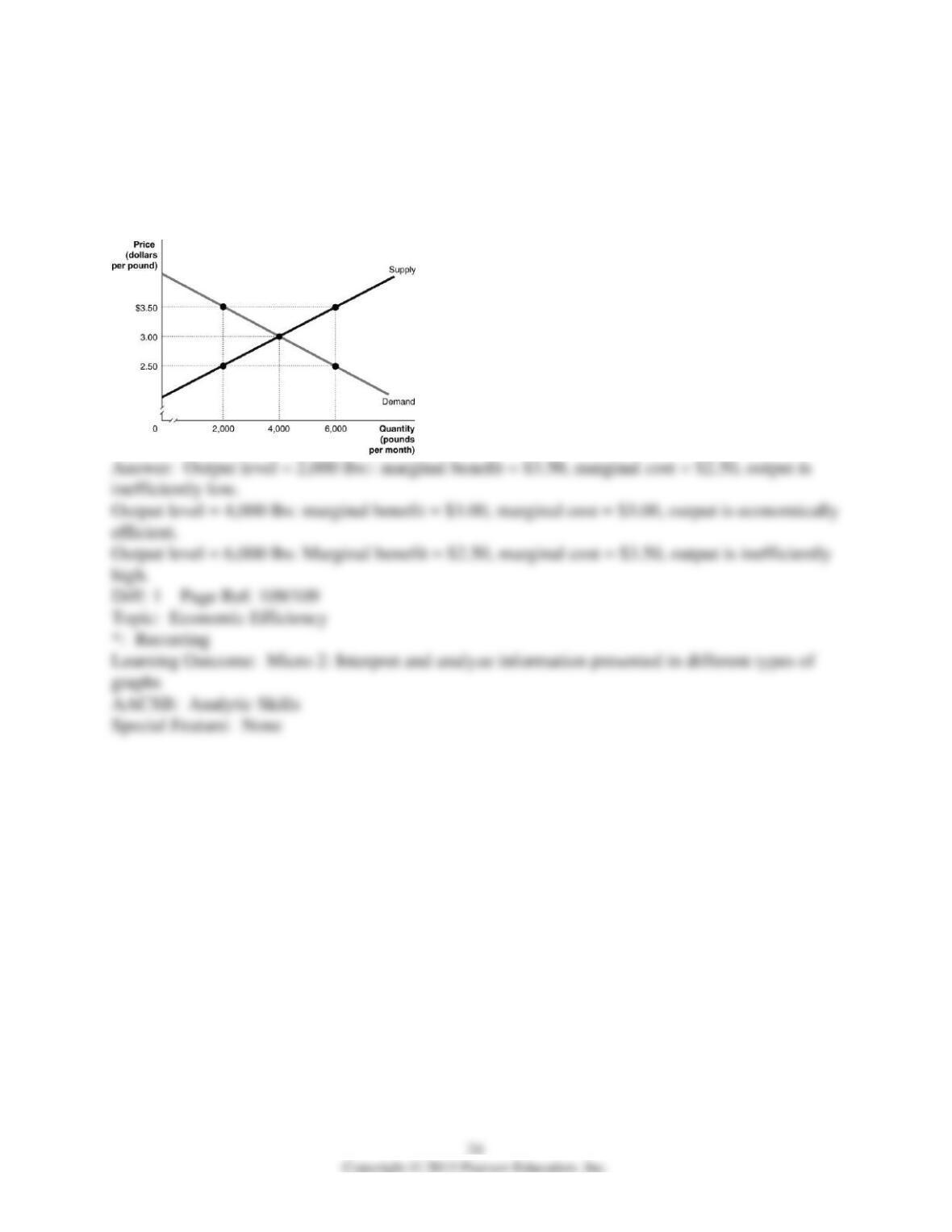
24) The graph below represents the market for walnuts. Identify the values of the marginal
benefit and the marginal cost at the output levels of 2,000 pounds, 4,000 pounds and 6,000
pounds. At each of these output levels, state whether output is inefficiently high, inefficiently
low, or economically efficient.
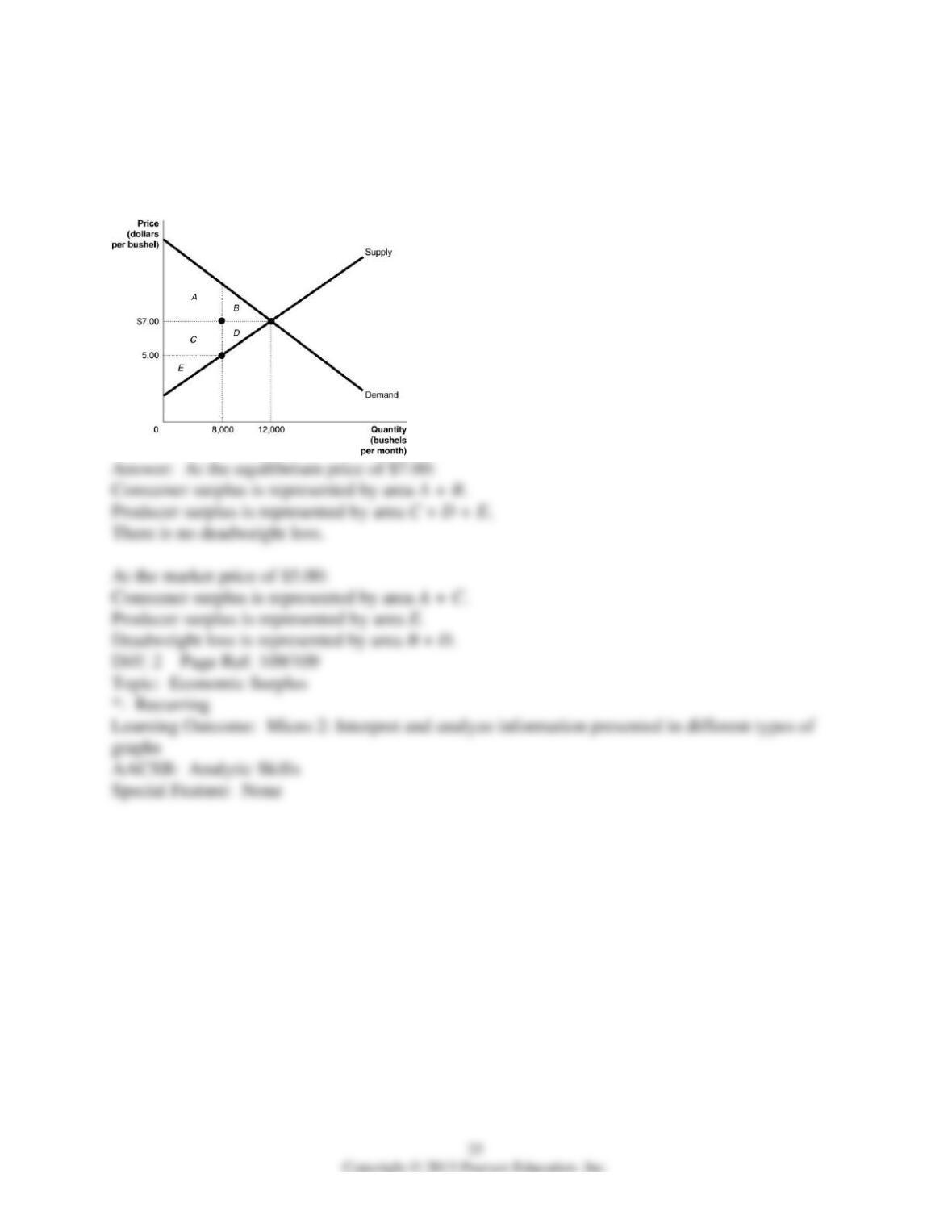
25) The graph below represents the market for lychee nuts. The equilibrium price is $7.00 per
bushel, but the market price is $5.00 per bushel. Identify the areas representing consumer
surplus, producer surplus, and deadweight loss at the equilibrium price of $7.00 and at the
market price of $5.00.
4.3 Government Intervention in the Market: Price Floors and Price Ceilings
1) When a competitive equilibrium is achieved in a market
A) all individuals are better off than they would be if a price ceiling or price floor was imposed
by government.
B) the total net benefit to society is maximized.
C) the total benefits to consumers are equal to the total benefits to producers.
D) economic surplus equals the deadweight loss.
Table 4-3
Hourly Wage
(dollars)
Quantity of
Labor
Supplied
Quantity of
Labor
Demanded
$7.50
530,000
650,000
8.50
550,000
630,000
9.50
570,000
610,000
10.50
590,000
590,000
11.50
610,000
570,000
12.50
630,000
550,000
Table 4-3 shows the demand and supply schedules for labor market in the city of Pixley.
2) Refer to Table 4-3. What is the equilibrium hourly wage (W*) and the equilibrium quantity of
labor (Q*)?
A) W* = $10.50; Q* = 590,000
B) W* = $11.50; Q* = 570,000
C) W* = $9.50; Q* = 570,000
D) W* = $10.50; Q* = 1,200,000
3) Refer to Table 4-3. If a minimum wage of $9.50 an hour is mandated, what is the quantity of
labor demanded?
A) 40,000
B) 570,000
C) 610,000
D) 1,180,000
4) Refer to Table 4-3. If a minimum wage of $9.50 an hour is mandated, what is the quantity of
labor supplied?
A) 40,000
B) 570,000
C) 610,000
D) 1,180,000
5) Refer to Table 4-3. If a minimum wage of $9.50 is mandated there will be a
A) shortage of 20,000 units of labor.
B) surplus of 20,000 units of labor.
C) shortage of 40,000 units of labor.
D) surplus of 40,000 units of labor.
6) Refer to Table 4-3. Suppose that the quantity of labor demanded decreases by 80,000 at each
wage level. What are the new free market equilibrium hourly wage and the new equilibrium
quantity of labor?
A) W = $8.50; Q = 550,000
B) W = $12.50; Q = 630,000
C) W = $9.50; Q = 570,000
D) W = $9.50; Q = 590,000
7) Which of the following is not a consequence of minimum wage laws?
A) Low skilled workers are hurt because minimum wage reduces the number of jobs providing
low skilled workers with training.
B) Employers will be reluctant to offer low-skill workers jobs with training.
C) Producers have an incentive to offer workers non-wage benefits such as health care benefits
and convenient working hours rather than a higher wage.
D) Some workers benefit when the minimum wage is increased.
8) Rent control is an example of
A) a subsidy for low-skilled workers.
B) a price floor.
C) a price ceiling.
D) a black market.
9) To affect the market outcome, a price ceiling
A) must be set below the black market price.
B) must be set below the legal price.
C) must be set below the price floor.
D) must be set below the equilibrium price.
10) Government intervention in agricultural markets in the U.S. began in the
A) 1920s.
B) 1930s.
C) 1950s.
D) 1970s.
11) Economists refer a to a market where buying and selling take place at prices that violate
government price regulations as
A) a black market.
B) an outlaw market.
C) a noncompetitive market.
D) a restricted market.
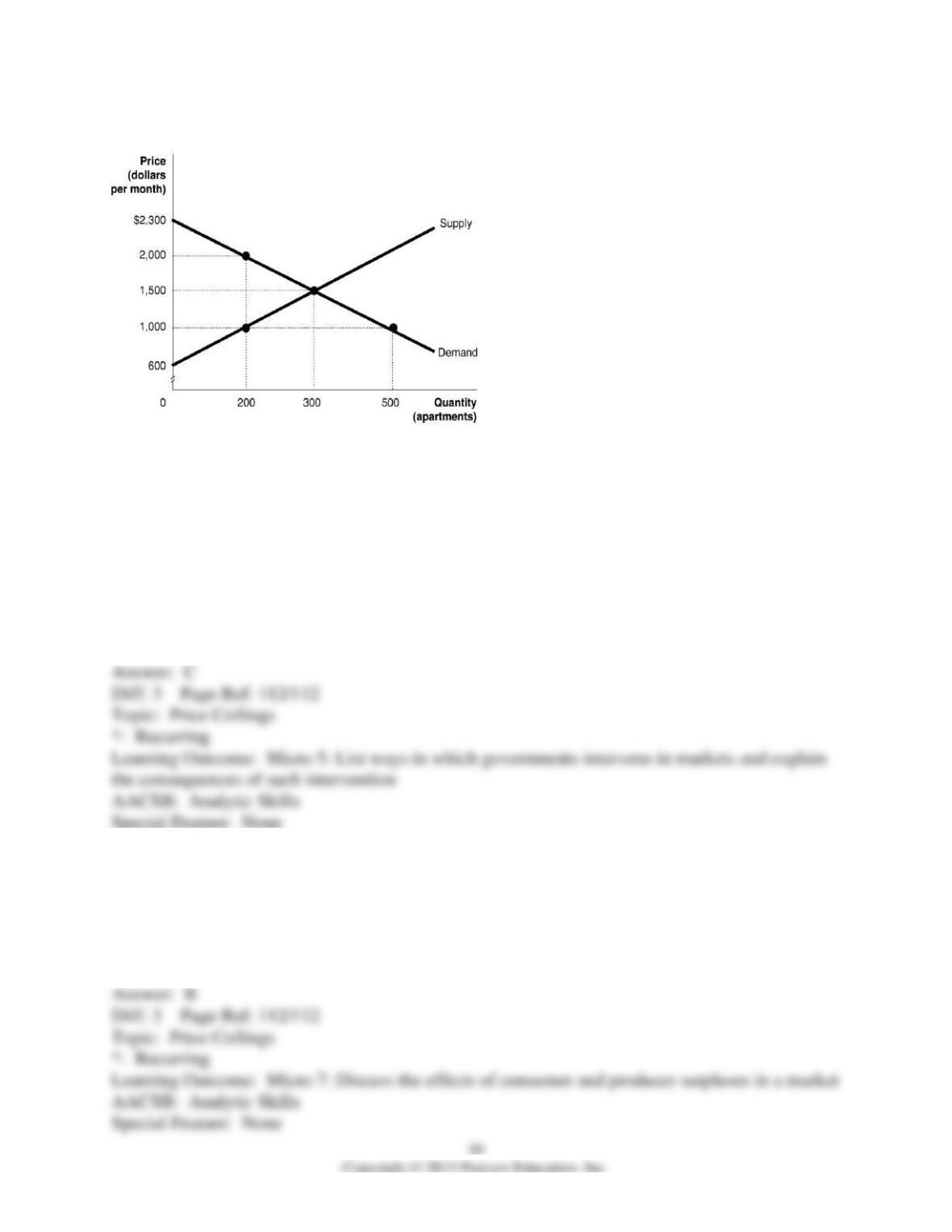
Figure 4-5
Figure 4-5 shows the market for apartments in Springfield. Recently, the government imposed a
rent ceiling of $1,000 per month.
12) Refer to Figure 4-5. With rent control, the quantity supplied is 200 apartments. Suppose
apartment owners ignore the law and rent this quantity for the highest rent they can get. What is
the highest rent they can get per month?
A) $1,000
B) $1,500
C) $2,000
D) $2,300
13) Refer to Figure 4-5. What is the value of consumer surplus after the imposition of the
ceiling?
A) $120,000
B) $230,000
C) $270,000
D) $430,000
14) Refer to Figure 4-5. What is the value of producer surplus after the imposition of the
ceiling?
A) $40,000
B) $100,000
C) $300,000
D) $430,000
15) Refer to Figure 4-5. What is the value of the portion of producer surplus transferred to
consumers as a result of the rent ceiling?
A) $40,000
B) $100,000
C) $125,000
D) $140,000
16) Refer to Figure 4-5. What is the value of the deadweight loss after the imposition of the
ceiling?
A) $50,000
B) $125,000
C) $175,000
D) $260,000
17) Which term refers to a legally established minimum price that firms may charge?
A) a price ceiling
B) a subsidy
C) a price floor
D) a tariff
18) In order to be binding, a price ceiling
A) must lie above the free market equilibrium price.
B) must lie below the free market equilibrium price.
C) must coincide with the free market equilibrium price.
D) must be high enough for firms to earn a profit.
19) A minimum wage law dictates
A) the minimum quantity of labor that a firm must employ.
B) the lowest wage that firms may pay for labor.
C) the highest wage that firms must pay for labor.
D) the minimum qualifications for labor.
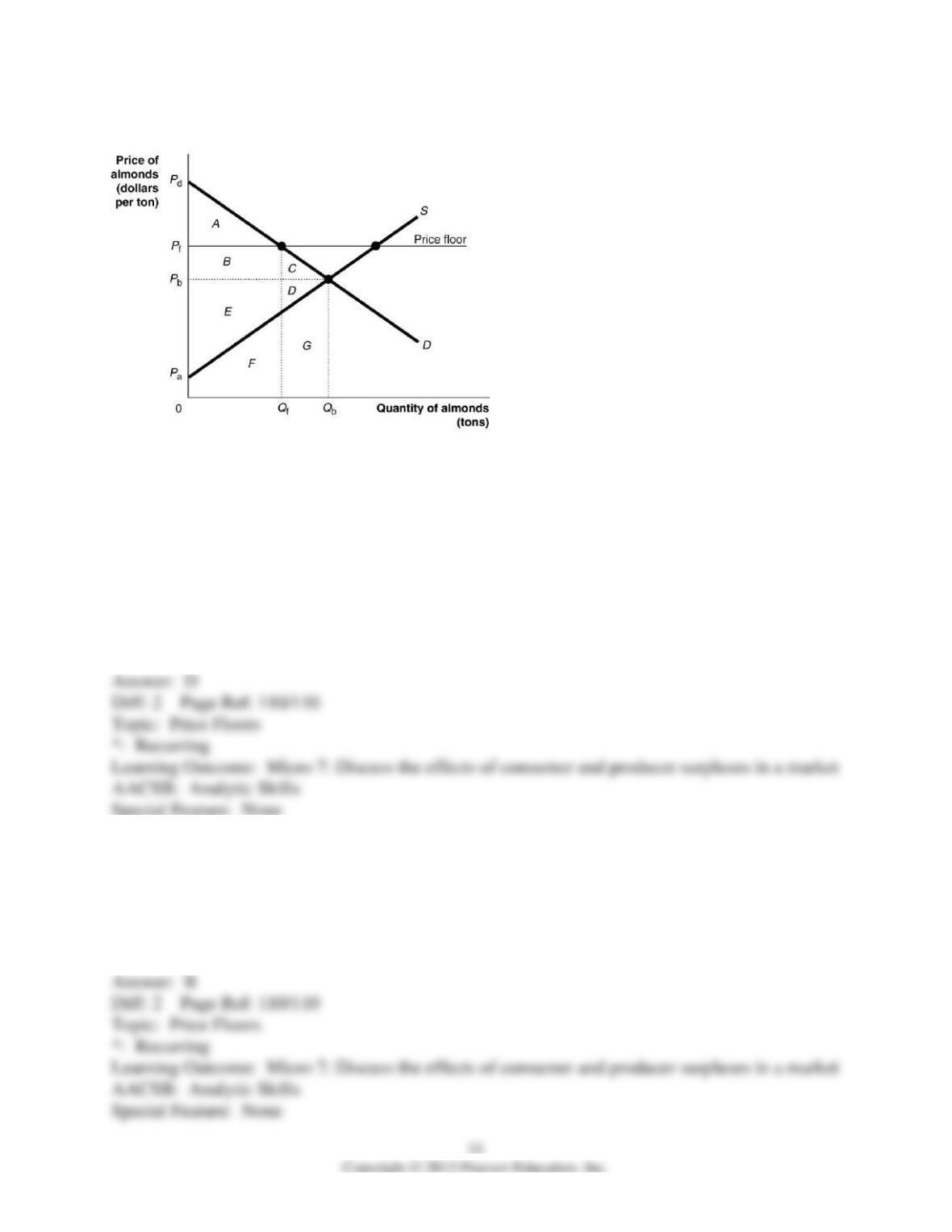
Figure 4-6
Figure 4-6 shows the demand and supply curves for the almond market. The government
believes that the equilibrium price is too low and tries to help almond growers by setting a price
floor at Pf.
20) Refer to Figure 4-6. What area represents consumer surplus after the imposition of the price
floor?
A) A + B + E
B) A + B
C) A + B + E + F
D) A
21) Refer to Figure 4-6. What is the area that represents producer surplus after the imposition of
the price floor?
A) A + B + E
B) B + E
C) B + E + F
D) B + C + D + E
22) Refer to Figure 4-6. What area represents the portion of consumer surplus that has been
transferred to producer surplus as a result of the price floor?
A) B
B) B + C
C) B + E
D) E
23) Refer to Figure 4-6. What area represents the deadweight loss after the imposition of the
price floor?
A) C + D + G
B) F + G
C) C + D
D) C + D + F + G
24) Congress passed the ________ in 1996, the purpose of which was to phase out price floors
and return to a free market in agriculture
A) Rice and Beans Act
B) Smoot-Hawley Act
C) Agribusiness Act
D) Freedom to Farm Act
25) David Card and Alan Kruger conducted a study of fast-food restaurants in New Jersey and
Pennsylvania. The study found that
A) there was a large reduction in employment of low-skilled workers when the minimum wage
was raised in these states.
B) the earned income tax credit is more effective in raising the incomes of low-skilled workers
than increases in the minimum wage.
C) increases in the minimum wage had a very small impact on employment.
D) increases in the prices of food have a greater effect on wage increases in New Jersey than in
Pennsylvania.
26) Which of the following is not a result of imposing a rent ceiling?
A) Some consumer surplus is converted to producer surplus.
B) There is a reduction in the quantity supplied of apartments.
C) There is an increase in the quantity demanded of apartments.
D) The marginal benefit of the last apartment rented is greater than the marginal cost of
supplying it.
27) In the economic sense, almost everything is scarce. ________ of a good or service occurs
when the quantity demanded is greater than the quantity supplied at the current market price.
A) Scarcity
B) A shortage
C) A surplus
D) An overstock
28) In cities with rent controls, the actual rents paid can be higher than the legal maximum. One
explanation for this is
A) rent control laws are so complicated that landlords and tenants may not be aware of what the
legal price is.
B) landlords are allowed to charge more than the legal maximum on some apartments so long as
they charge less on others.
C) because there is a shortage of apartments, tenants often are willing to pay rents higher than the
law allows.
D) the legal penalty landlords face for charging more than the legal maximum rent is less than
the revenue earned by charging their tenants more than the maximum rent.
29) Suppose a price floor on sparkling wine is proposed by the Health Minister of the country of
Vinyardia. What will be the likely effect on the market for sparkling wine in Vinyardia?
A) Quantity demanded will decrease, quantity supplied will increase, and a surplus will result.
B) Quantity demanded will increase, quantity supplied will decrease, and a surplus will result.
C) Quantity demanded will decrease, quantity supplied will increase, and a shortage will result.
D) Quantity demanded will increase, quantity supplied will decrease, and a shortage will result.
30) Suppose a price floor on sparkling wine is proposed by the Health Minister of the country of
Vinyardia. What will be the likely effect on the market for sparkling wine in Vinyardia?
A) Consumer surplus will increase.
B) Producer surplus will increase.
C) Deadweight loss will increase.
D) Market efficiency will increase.
31) Which of the following is not a result of government price controls?
A) Some people win and some people lose.
B) Price controls benefit poor consumers but harm producers and wealthy consumers.
C) Price controls decrease economic efficiency.
D) A deadweight loss will occur.
32) Economists are reluctant to state that price controls are desirable or undesirable because
A) it is impossible to evaluate the impact on quantity demanded and quantity supplied as a result
of price controls.
B) whether the gains from the winners exceed the losses from the losers is not strictly an
economic question.
C) sometimes price controls result in increases in economic efficiency and sometimes they result
in decreases in economic efficiency.
D) economists are reluctant to conduct positive analysis of price controls.
33) The minimum wage is an example of a price ceiling.
34) Shortage means the same thing as scarcity.
35) Rent control is an example of a price ceiling.
36) What is the difference between a price ceiling and a price floor? Compared to the
competitive equilibrium price, where must price ceilings and price floors be set to have an effect
on the market.
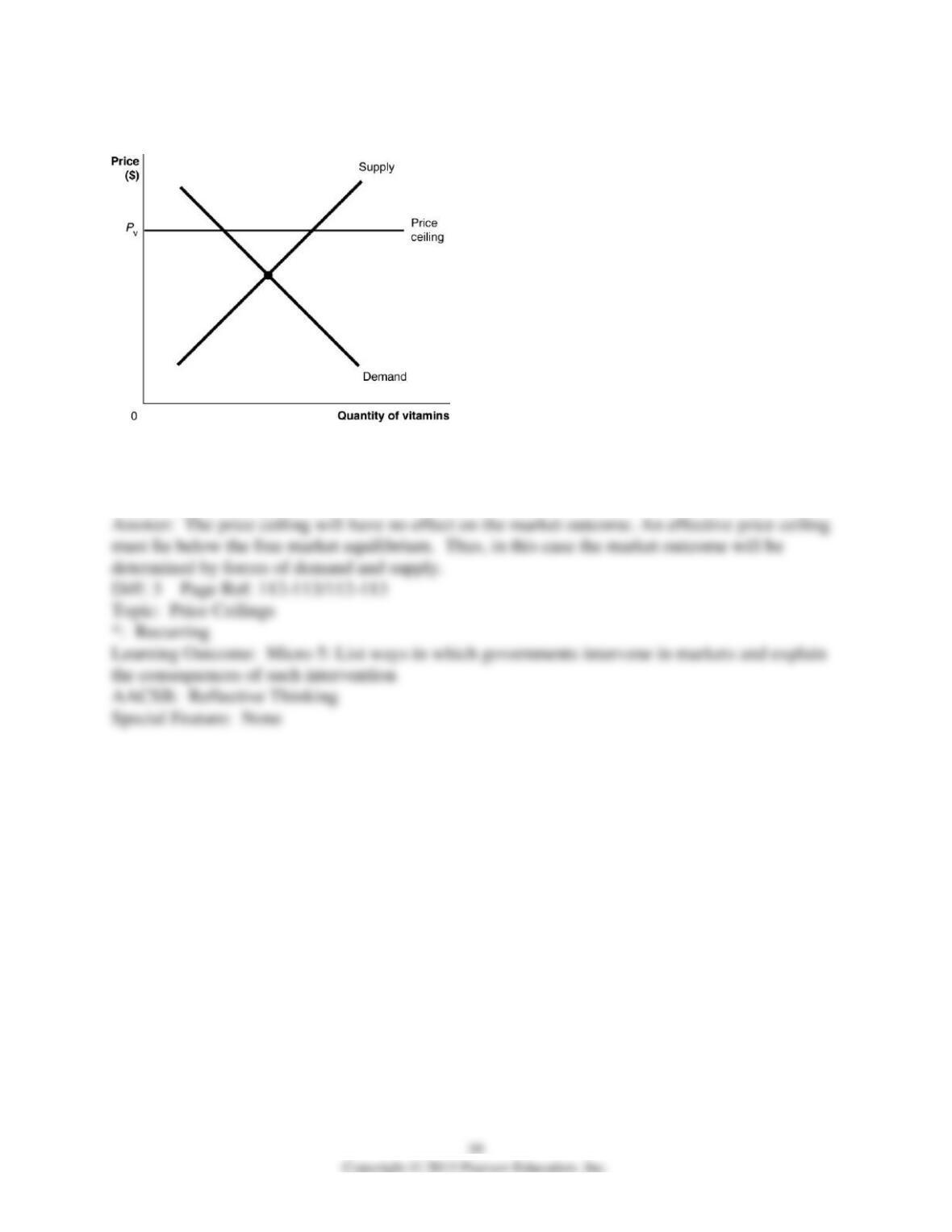
Figure 4-7
37) Refer to Figure 4-7 which shows the market for vitamins. Suppose the government imposes
a price ceiling of Pv. How will the price ceiling affect the quantity supplied, quantity demanded
and quantity exchanged?