55)
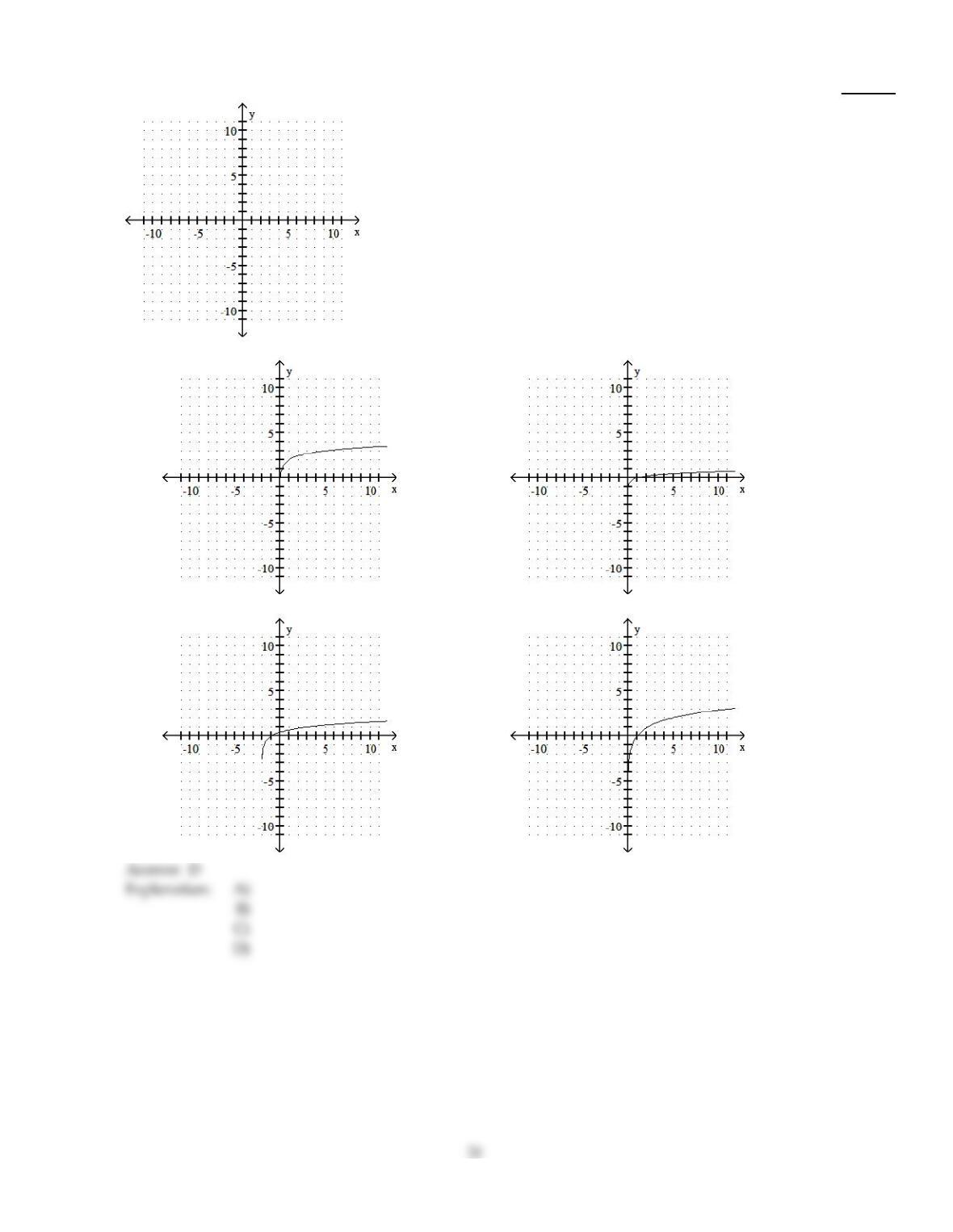
Use the graph of log 5x to obtain the graph of f(x) =2log 5x.
55)
A)
B)
C)
D)
56)
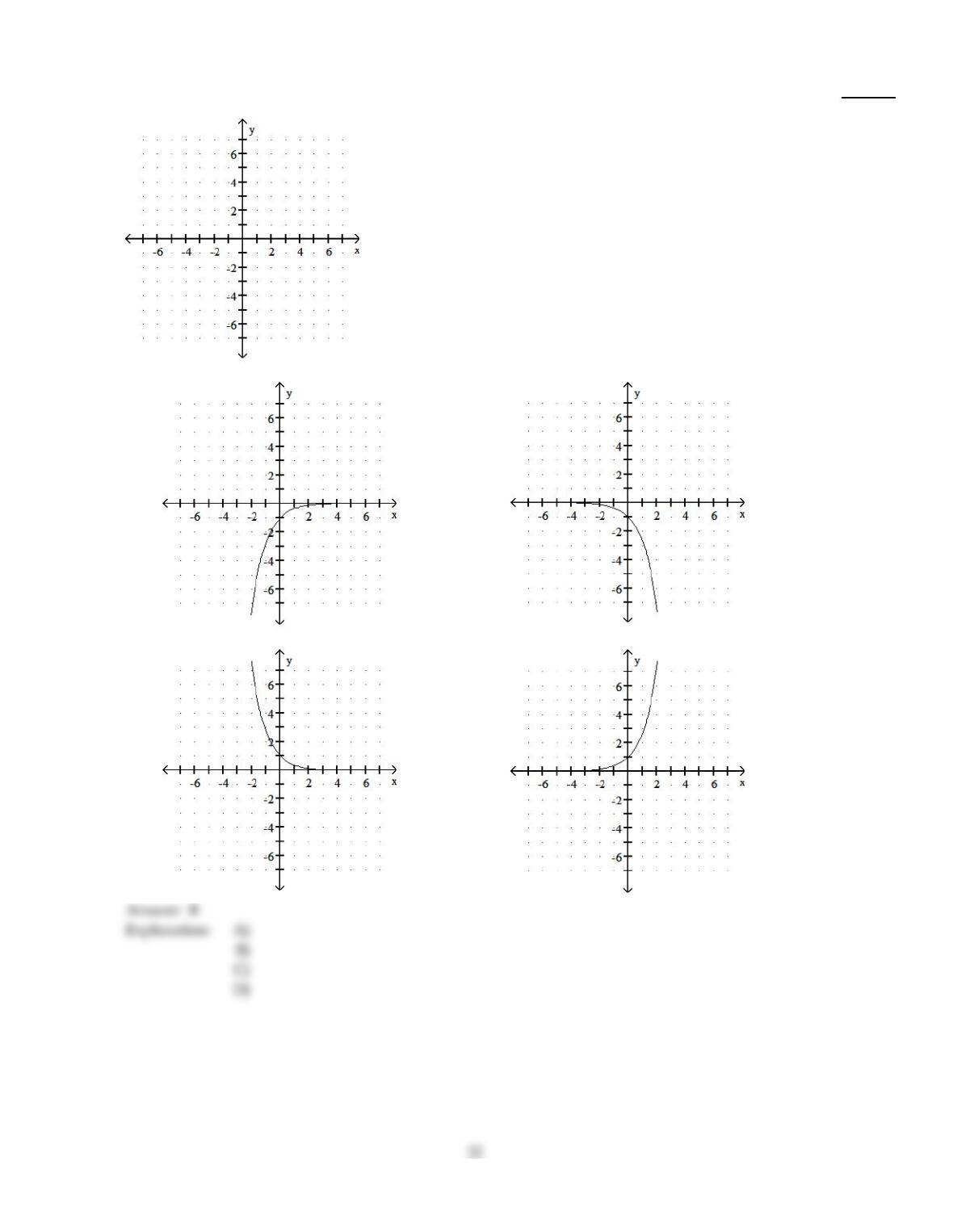
Use the graph of f(x) =ex to obtain the graph of g(x) = – ex.
56)
A)
B)
C)
D)
Use properties of logarithms to condense the logarithmic expression. Write the expression as a single logarithm whose
coefficient is 1. Where possible, evaluate logarithmic expressions.
57)
1
3(log8 x +log8 y)
57)
A)
log83x + y
B)
3log8(xy)
C)
log83x+log83y
D)
log83xy
Solve the problem.
58)
The population of a particular country was 22 million in 1984; in 1993, it was 30 million. The
exponential growth function A =22ekt describes the population of this country t years after 1984.
Use the fact that 9 years after 1984 the population increased by 8 million to find k to three decimal
places.
58)
A)
0.721
B)
0.044
C)
0.231
D)
0.034
Evaluate or simplify the expression without using a calculator.
59)
log 0.001
59)
A)
–1
3
B)
–3
C)
3
D)
1
3
Solve the exponential equation. Use a calculator to obtain a decimal approximation, correct to two decimal places, for the
solution.
60)
e2x =8
60)
A)
4.16
B)
0.09
C)
10.87
D)
1.04
23
Solve the equation by expressing each side as a power of the same base and then equating exponents.
61)
81x=1
3
61)
A)
–1
4
B)
1
8
C)
{–4}
D)
–1
8
Use properties of logarithms to condense the logarithmic expression. Write the expression as a single logarithm whose
coefficient is 1. Where possible, evaluate logarithmic expressions.
62)
3log 6x + 5 log 6(x – 6)
62)
A)
log 6x(x – 6)
B)
log 6x3(x – 6)5
C)
log 6x(x – 6)15
D)
15 log 6x(x – 6)
Solve the problem.
63)
A city is growing at the rate of 0.9% annually. If there were 3,619,000 residents in the city in 1994,
find how many (to the nearest ten–thousand) are living in that city in 2000. Use
y =3,619,000(2.7)0.009t.
63)
A)
9,770,000
B)
3,820,000
C)
530,000
D)
3,850,000
Use properties of logarithms to condense the logarithmic expression. Write the expression as a single logarithm whose
coefficient is 1. Where possible, evaluate logarithmic expressions.
64)
9ln a –7 ln b
64)
A)
ln a9
ln b7
B)
ln a
b
16
C)
ln 9a
7b
D)
ln a9
b7
Solve the equation by expressing each side as a power of the same base and then equating exponents.
65)
5x=25
65)
A)
{5}
B)
{3}
C)
{2}
D)
{1}
Use properties of logarithms to expand the logarithmic expression as much as possible. Where possible, evaluate
logarithmic expressions without using a calculator.
66)
log 6
7·11
13
66)
A)
log 6(77
13 )
B)
log 65
C)
log 67+log 611 –log 613
D)
log 677 –log 613
67)
log 5(25x)
67)
A)
10 +log 5x
B)
2x
C)
2+log 5x
D)
2log 5x
Solve the logarithmic equation. Be sure to reject any value that is not in the domain of the original logarithmic
expressions. Give the exact answer.
68)
ln (x – 6) + ln (x + 1) = ln (x – 15)
68)
A)
{3, –3}
B)
{–3}
C)
{3}
D)
Write the equation in its equivalent exponential form.
69)
log b64 =3
69)
A)
643= b
B)
b3=64
C)
3b=64
D)
64b=3
Evaluate or simplify the expression without using a calculator.
70)
ln e2
70)
A)
1
2
B)
1
C)
2
D)
e
Solve the problem.
71)
The logistic growth function f(t) =560
1 +5.2e–0.16t describes the population of a species of butterflies
t months after they are introduced to a non–threatening habitat. What is the limiting size of the
butterfly population that the habitat will sustain?
71)
A)
90 butterflies
B)
560 butterflies
C)
1120 butterflies
D)
5 butterflies
Use properties of logarithms to expand the logarithmic expression as much as possible. Where possible, evaluate
logarithmic expressions without using a calculator.
72)
log 2
8
x
72)
A)
3
x
B)
–3log 2x
C)
3–log 2x
D)
6–log 2x
Solve the logarithmic equation. Be sure to reject any value that is not in the domain of the original logarithmic
expressions. Give the exact answer.
73)
log x +log (x +1) =log 30
73)
A)
{6, –5}
B)
{5}
C)
31
2
D)
{6}
Graph the function.
26
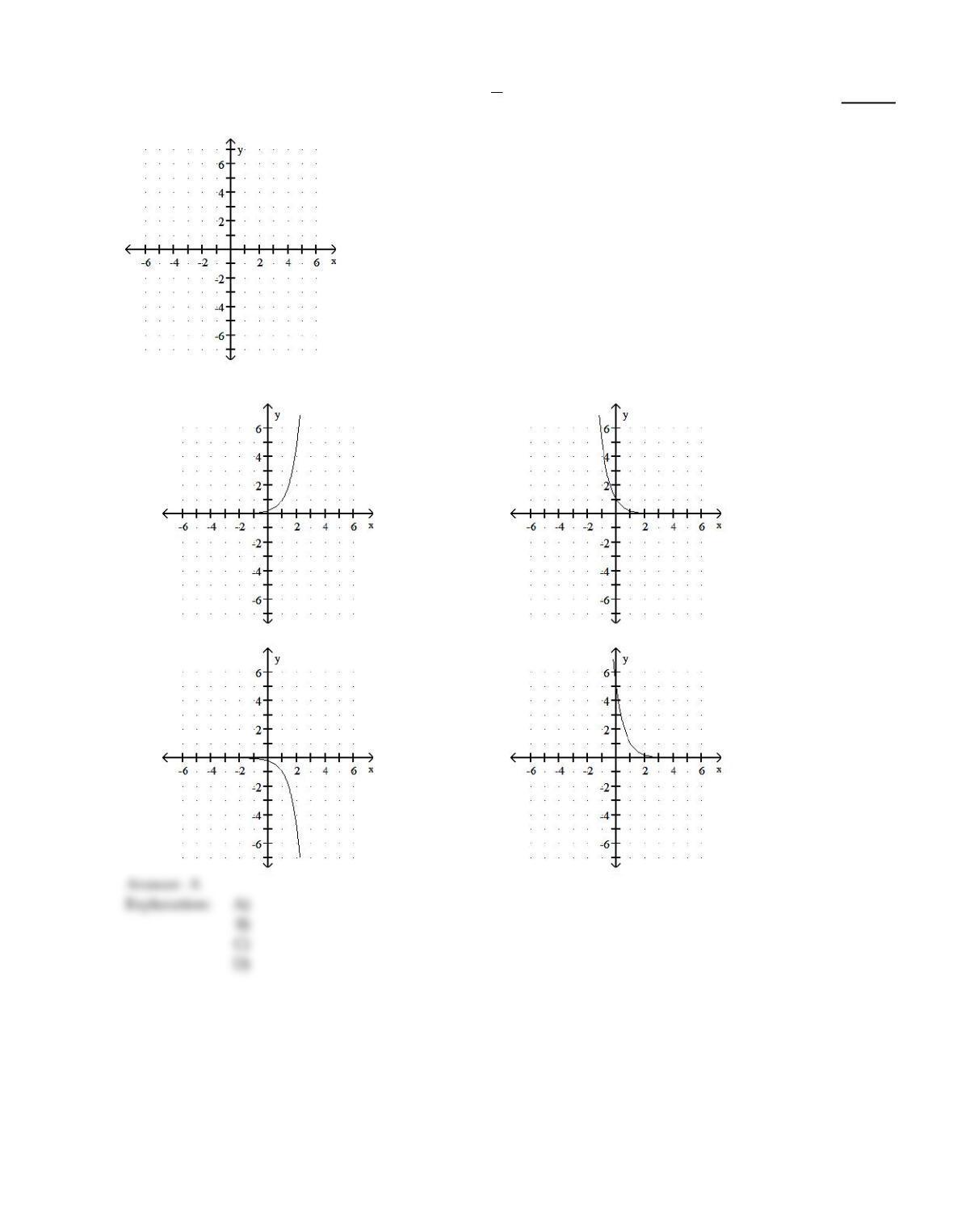
74)
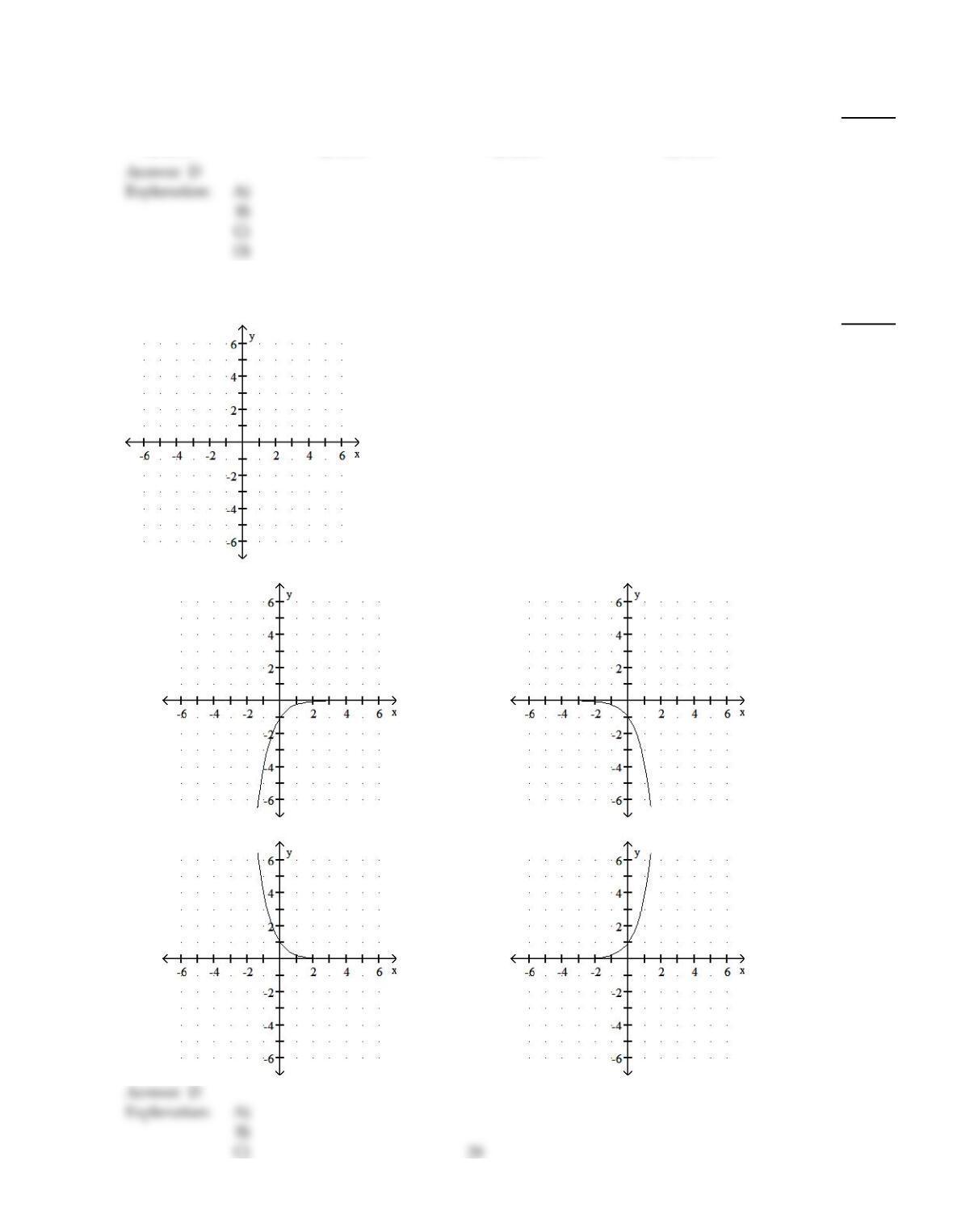
Use the graph of f(x) =5x to obtain the graph of g(x) =1
5·5x.
74)
A)
B)
C)
D)
27
Use properties of logarithms to expand the logarithmic expression as much as possible. Where possible, evaluate
logarithmic expressions without using a calculator.
75)
ln 3ey
75)
A)
3 ln y +3
B)
1
3 ln y +1
3
C)
y
3
D)
1
3 ln 3ey +1
3
Use common logarithms or natural logarithms and a calculator to evaluate to four decimal places
76)
log 12 63.2
76)
A)
0.7215
B)
2.8799
C)
0.5993
D)
1.6686
Solve the problem.
77)
The pH of a solution ranges from 0 to 14. An acid has a pH less than 7. Pure water is neutral and
has a pH of 7. The pH of a solution is given by pH = – log x where x represents the concentration of
the hydrogen ions in the solution in moles per liter. Find the hydrogen ion concentration if the
pH =4.4.
77)
A)
2.51 x 10⁻⁵
B)
3.98 x 10⁻⁴
C)
3.98 x 10⁻⁵
D)
2.51 x 10⁻⁴
Evaluate the expression without using a calculator.
78)
log981
78)
A)
9
B)
81
C)
2
D)
18
Approximate the number using a calculator. Round your answer to three decimal places.
79)
27
79)
A)
5.292
B)
7.000
C)
64.000
D)
6.258
Solve the problem.
80)
The formula A =173e0.046t models the population of a particular city, in thousands, t years after
1998. When will the population of the city reach 329 thousand?
80)
A)
2015
B)
2013
C)
2014
D)
2012
Graph the function by making a table of coordinates.
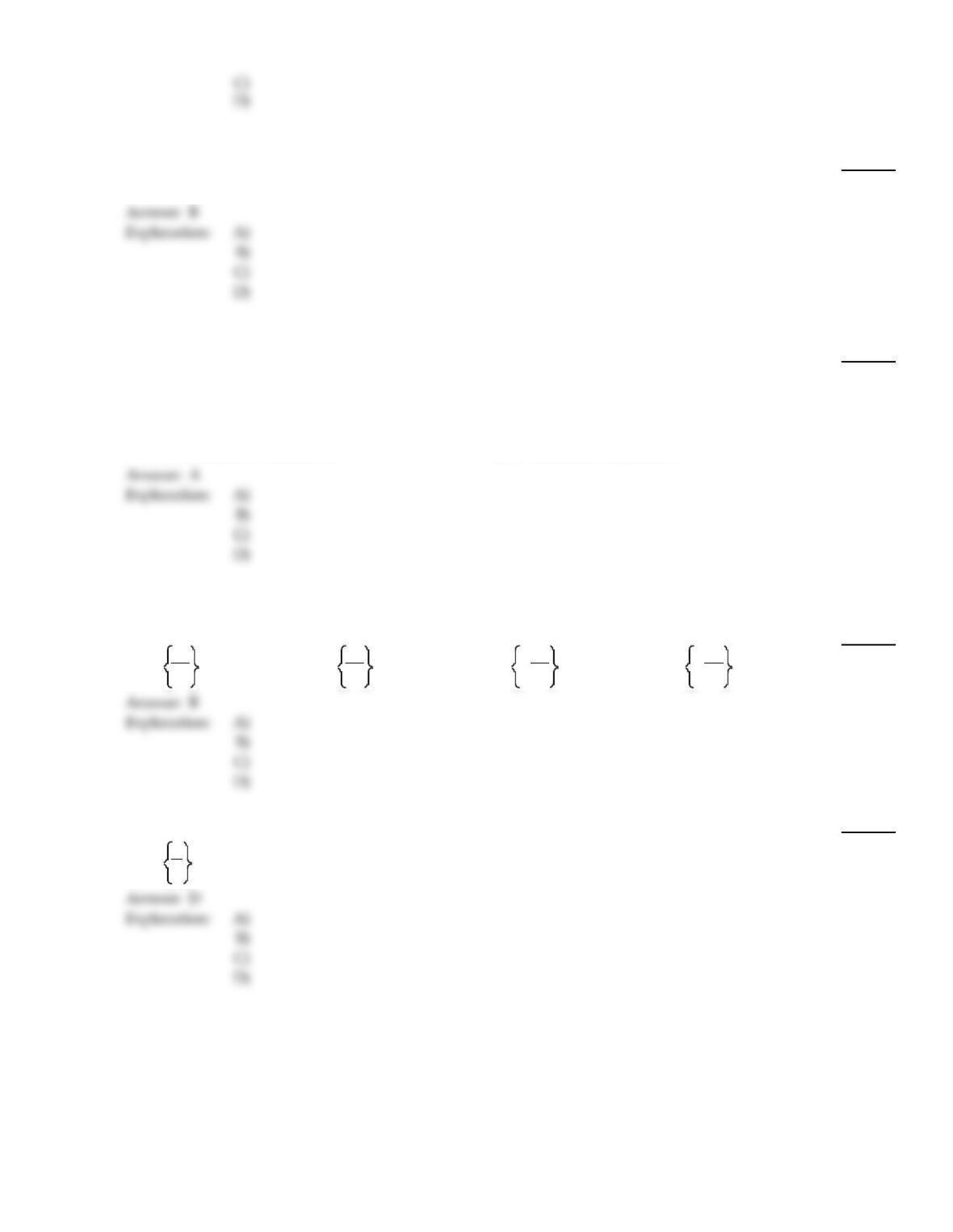
81)
f(x) =4x
81)
A)
B)
C)
D)
Find the domain of the logarithmic function.
82)
f(x) =log 4(x – 2)
82)
A)
(–2, )
B)
(2, )
C)
(–, 2) or (2, )
D)
(–, 0) or (0, )
B
Solve the problem.
83)
The function f(x) = 1 +1.5 ln (x + 1) models the average number of free–throws a basketball player
can make consecutively during practice as a function of time, where x is the number of consecutive
days the basketball player has practiced for two hours. After 206 days of practice, what is the
average number of consecutive free throws the basketball player makes?
83)
A)
9 consecutive free throws
B)
12 consecutive free throws
C)
10 consecutive free throws
D)
13 consecutive free throws
A
Solve the logarithmic equation. Be sure to reject any value that is not in the domain of the original logarithmic
expressions. Give the exact answer.
84)
log (x +25) – log 2= log (5x +1)
84)
A)
49
3
B)
23
9
C)
–23
9
D)
–49
3
B
85)
log 8(4x + 2) =log 8(4x + 5)
85)
A)
7
3
B)
{0}
C)
{3}
D)
D
30
Solve.
86)
The population of a particular country was 25 million in 1982; in 1992, it was 35 million. The
exponential growth function A =25ekt describes the population of this country t years after 1982.
Use the fact that 10 years after 1982 the population increased by 10 million to find k to three
decimal places.
86)
A)
0.034
B)
0.044
C)
0.230
D)
0.677
Rewrite the equation in terms of base e. Express the answer in terms of a natural logarithm, and then round to three
decimal places.
87)
y =200(1.2)x
87)
A)
y = (ln 200)ex ln 1.2, y =5.298e0.182x
B)
y =1.2ex ln 200, y =1.2e5.298x
C)
y =200e1.2x, y =2002.7180.182x
D)
y =200ex ln 1.2, y =200e0.182x
Solve the problem.
88)
The pH of a solution ranges from 0 to 14. An acid has a pH less than 7. Pure water is neutral and
has a pH of 7. The pH of a solution is given by pH = – log x where x represents the concentration of
the hydrogen ions in the solution in moles per liter. Find the pH if the hydrogen ion concentration
is 1 x 10⁻².
88)
A)
2
B)
–2
C)
–12
D)
12
Write the equation in its equivalent logarithmic form.
89)
3–3=1
27
89)
A)
log 3
1
27 = – 3
B)
log 3–3=1
27
C)
log –3
1
27 =3
D)
log 1/33= – 3
31
Write the equation in its equivalent exponential form.
90)
log 232 = x
90)
A)
32x=2
B)
322= x
C)
2x=32
D)
x2=32
Use properties of logarithms to expand the logarithmic expression as much as possible. Where possible, evaluate
logarithmic expressions without using a calculator.
91)
log 57–3
91)
A)
–15 log 7
B)
–3log 57
C)
5log 37
D)
7log 53
B
Find the domain of the logarithmic function.
92)
f(x) =log 9(x +1)2
92)
A)
(1, )
B)
(–, –1) or (–1, )
C)
(–, 0) or (0, )
D)
(–1, )
B
Evaluate or simplify the expression without using a calculator.
93)
10log 7
93)
A)
10,000,000
B)
70
C)
7
D)
0.0000001
C
Graph the function.
32
C
94)
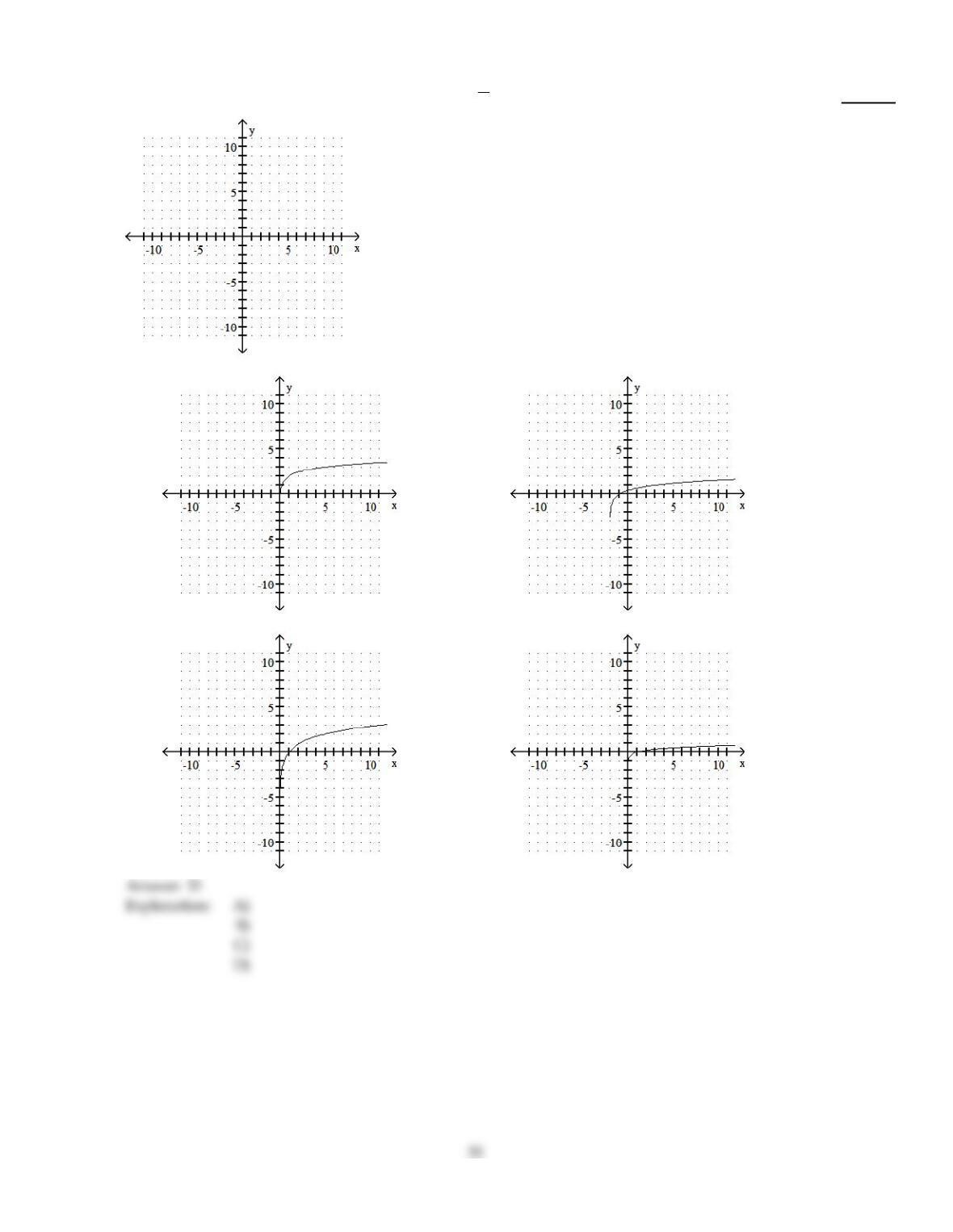
Use the graph of log 5x to obtain the graph of f(x) =1
2log 5x.
94)
A)
B)
C)
D)
Use properties of logarithms to expand the logarithmic expression as much as possible. Where possible, evaluate
logarithmic expressions without using a calculator.
95)
log 3
7
13
95)
A)
log 37+log 313
B)
log 37
log 313
C)
log 313 –log 37
D)
log 37–log 313
Graph the function.
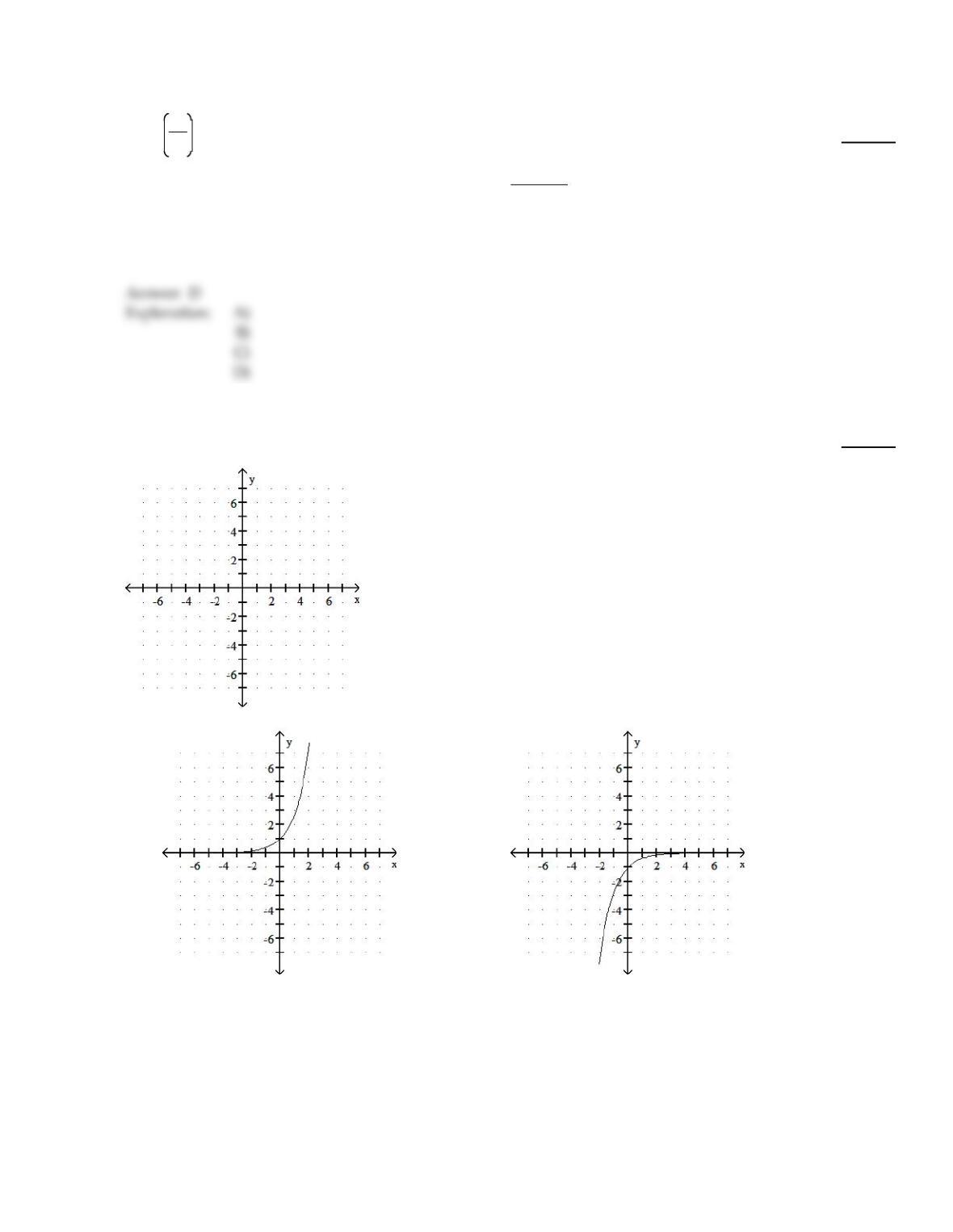
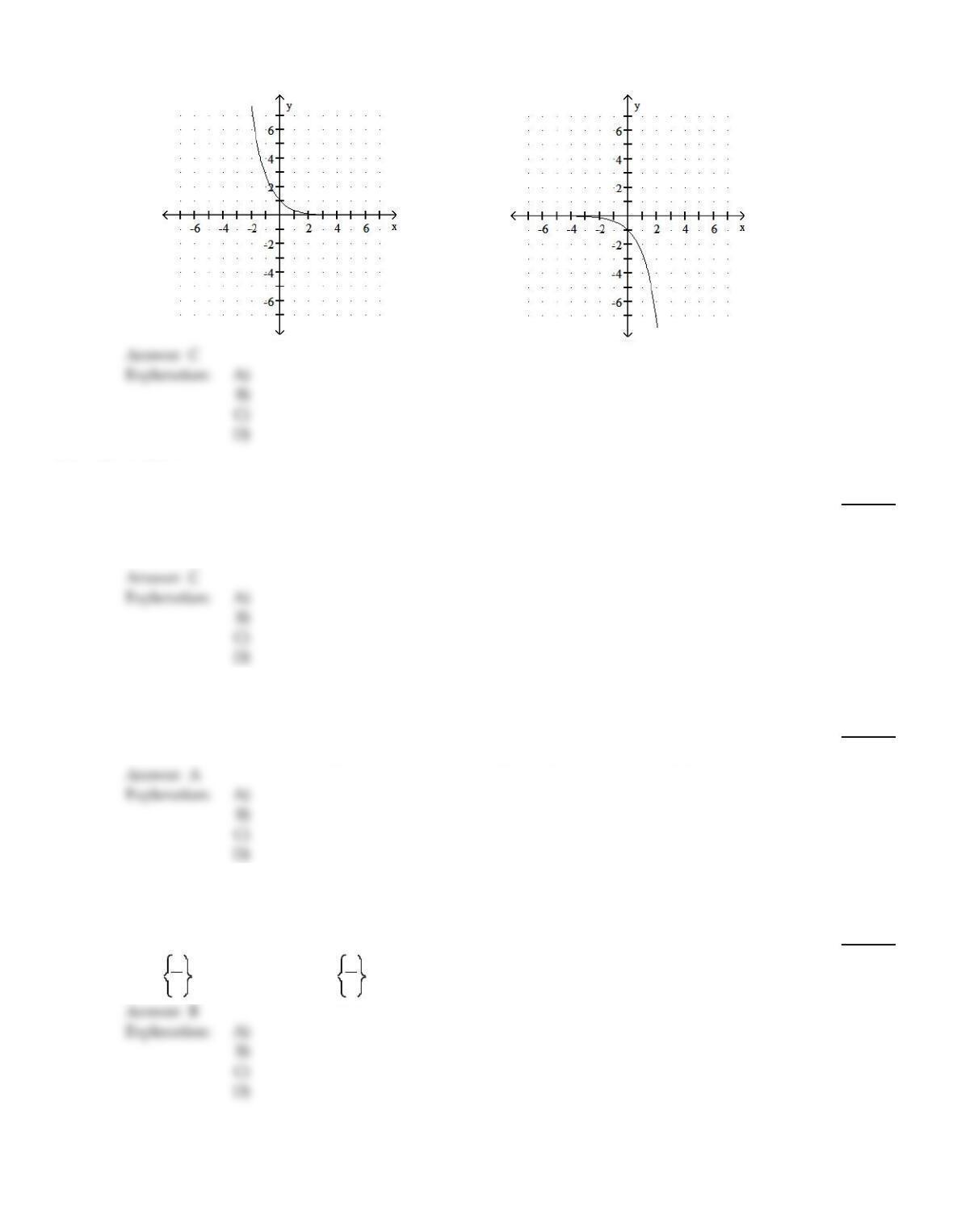
96)
Use the graph of f(x) =ex to obtain the graph of g(x) =e–x.
96)
A)
B)
34
C)
D)
Solve the problem.
97)
Cindy will require $13,000 in 2 years to return to college to get an MBA degree. How much money
should she ask her parents for now so that, if she invests it at 12% compounded continuously, she
will have enough for school? (Round your answer to the nearest dollar.)
97)
A)
$10,364
B)
$8044
C)
$10,226
D)
$16,526
Solve the exponential equation. Express the solution set in terms of natural logarithms.
98)
ex +5=2
98)
A)
{ln 2–5}
B)
{ln 7}
C)
{e2+5}
D)
{e10}
Solve the logarithmic equation. Be sure to reject any value that is not in the domain of the original logarithmic
expressions. Give the exact answer.
99)
log 8(7x – 1) =log 8(5x + 4)
99)
A)
3
2
B)
5
2
C)
{3}
D)
35
Use properties of logarithms to expand the logarithmic expression as much as possible. Where possible, evaluate
logarithmic expressions without using a calculator.
100)
log w
13x
2
100)
A)
log w13 +log wx +log w2
B)
log w13 +log wx –log w2
C)
log w13x –log w2
D)
log w11x
Use the compound interest formulas A = P 1 +r
n
nt and A = Pert to solve.
101)
Find the accumulated value of an investment of $3000 at 8% compounded annually for 9 years.
101)
A)
$5997.01
B)
$5552.79
C)
$5160.00
D)
$4920.00
Graph the function.
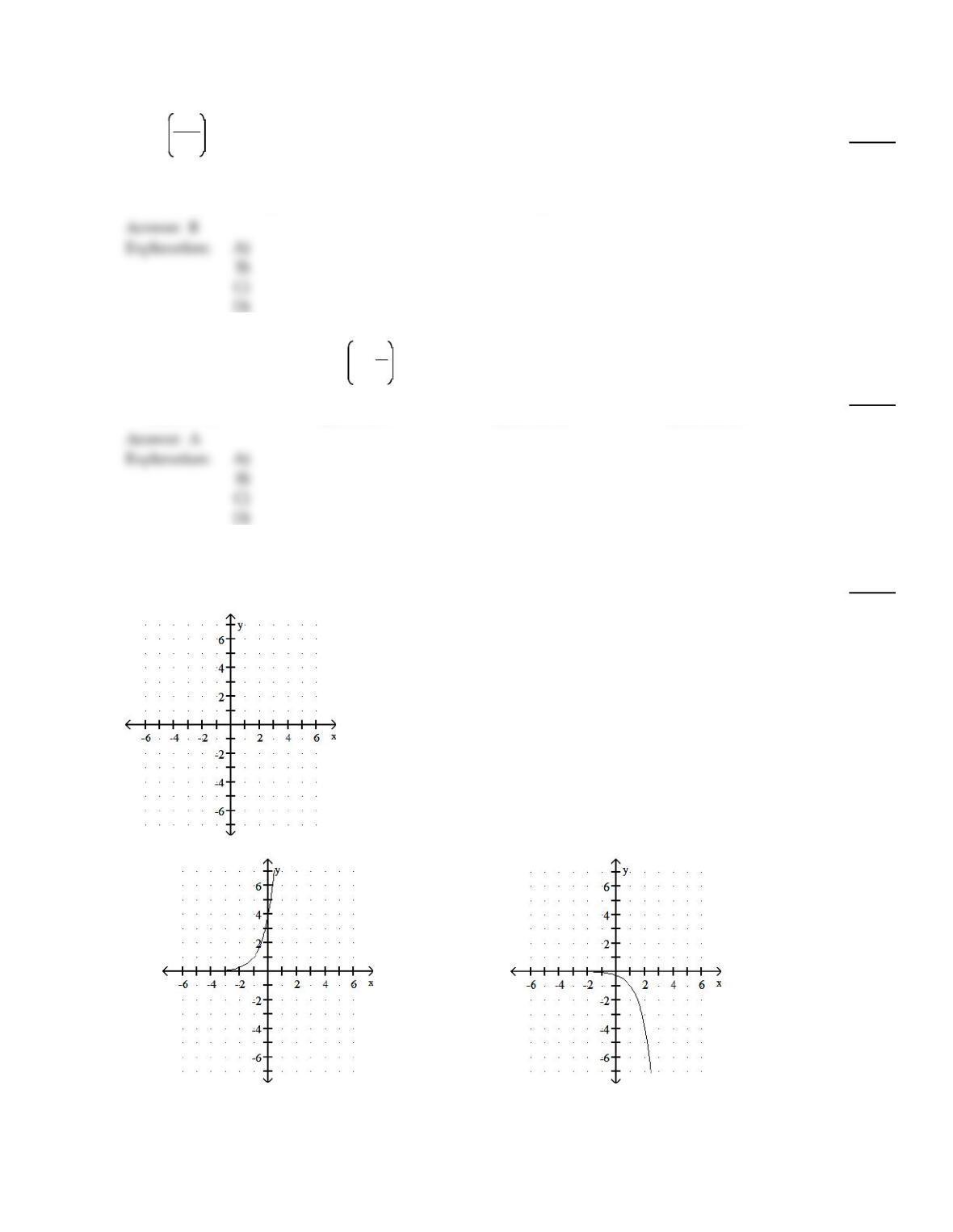
102)
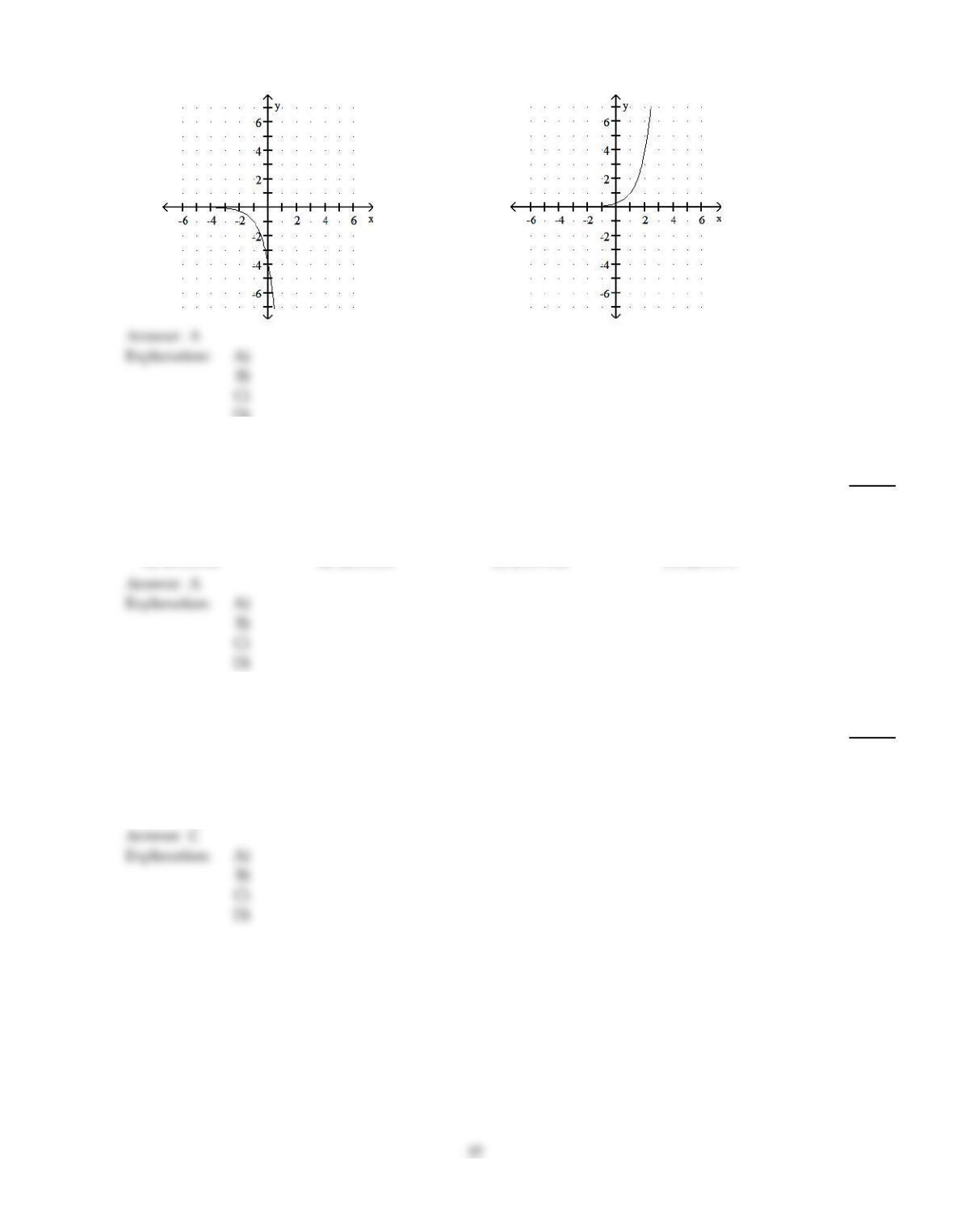
Use the graph of f(x) =4x to obtain the graph of g(x) =4·4x.
102)
A)
B)
36
C)
D)
D)
Solve.
103)
The value of a particular investment follows a pattern of exponential growth. In the year 2000, you
invested money in a money market account. The value of your investment t years after 2000 is
given by the exponential growth model A =5100e0.057t. How much did you initially invest in the
account?
103)
A)
$5100.00
B)
$2550.00
C)
$5399.14
D)
$290.70
D)
Solve the problem.
104)
The function A =A0e–0.01155x models the amount in pounds of a particular radioactive material
stored in a concrete vault, where x is the number of years since the material was put into the vault.
If 900 pounds of the material are placed in the vault, how much time will need to pass for only 159
pounds to remain?
104)
A)
300 years
B)
155 years
C)
150 years
D)
160 years
D)
Solve the logarithmic equation. Be sure to reject any value that is not in the domain of the original logarithmic
expressions. Give the exact answer.
105)
log 4(x + 5) =3+log 4(x + 2)
105)
A)
–41
21
B)
–1
21
C)
1
21
D)
41
21
Evaluate the expression without using a calculator.
106)
log 12 12
106)
A)
1
2
B)
1
C)
12
D)
1
12
Use properties of logarithms to expand the logarithmic expression as much as possible. Where possible, evaluate
logarithmic expressions without using a calculator.
107)
log 6(7 ·3)
107)
A)
(log 67)(log 63)
B)
log 67–log 63
C)
log 621
D)
log 67+log 63
Use properties of logarithms to condense the logarithmic expression. Write the expression as a single logarithm whose
coefficient is 1. Where possible, evaluate logarithmic expressions.
108)
2 ln x –1
4 ln y
108)
A)
ln x2
4y
B)
ln x24y
C)
ln x2
y4
D)
ln x2y4
Solve the exponential equation. Express the solution set in terms of natural logarithms.
109)
e3x =8
109)
A)
ln 3
8
B)
8
3e
C)
{3 ln 8}
D)
ln 8
3
Use the compound interest formulas A = P 1 +r
n
nt and A = Pert to solve.
110)
Find the accumulated value of an investment of $10,000 at 4% compounded semiannually for 5
years.
110)
A)
$12,189.94
B)
$11,040.81
C)
$12,000.00
D)
$12,166.53
Use properties of logarithms to expand the logarithmic expression as much as possible. Where possible, evaluate
logarithmic expressions without using a calculator.
111)
ln x
y
111)
A)
1
2ln x – ln y
B)
ln x– ln y
C)
1
2ln x –1
2ln y
D)
1
2ln x
y
Solve the problem.
112)
The logistic growth function f(t) =53,000
1 +1324.0e–1.3t models the number of people who have
become ill with a particular infection t weeks after its initial outbreak in a particular community.
How many people became ill with this infection when the epidemic began?
112)
A)
53,000 people
B)
1325 people
C)
40 people
D)
1324 people
Solve the exponential equation. Express the solution set in terms of natural logarithms.
113)
4x +8=7
113)
A)
ln 7
ln 4– 8
B)
{ln 7– ln 4– ln 8}
C)
ln 4
ln 7+ ln 8
D)
ln 4
ln 7+8
Use properties of logarithms to expand the logarithmic expression as much as possible. Where possible, evaluate
logarithmic expressions without using a calculator.
114)
lognx5
114)
A)
–5logn x
B)
5logn x
C)
nlog5 x
D)
–nlog5 x
Approximate the number using a calculator. Round your answer to three decimal places.
115)
2–3.3
115)
A)
0.402
B)
–6.600
C)
0.102
D)
10.890
Solve the problem.
116)
The logistic growth function f(t) =680
1 +21.7e–0.15t describes the population of a species of
butterflies t months after they are introduced to a non–threatening habitat. How many butterflies
are expected in the habitat after 10 months?
116)
A)
117 butterflies
B)
6800 butterflies
C)
300 butterflies
D)
685 butterflies