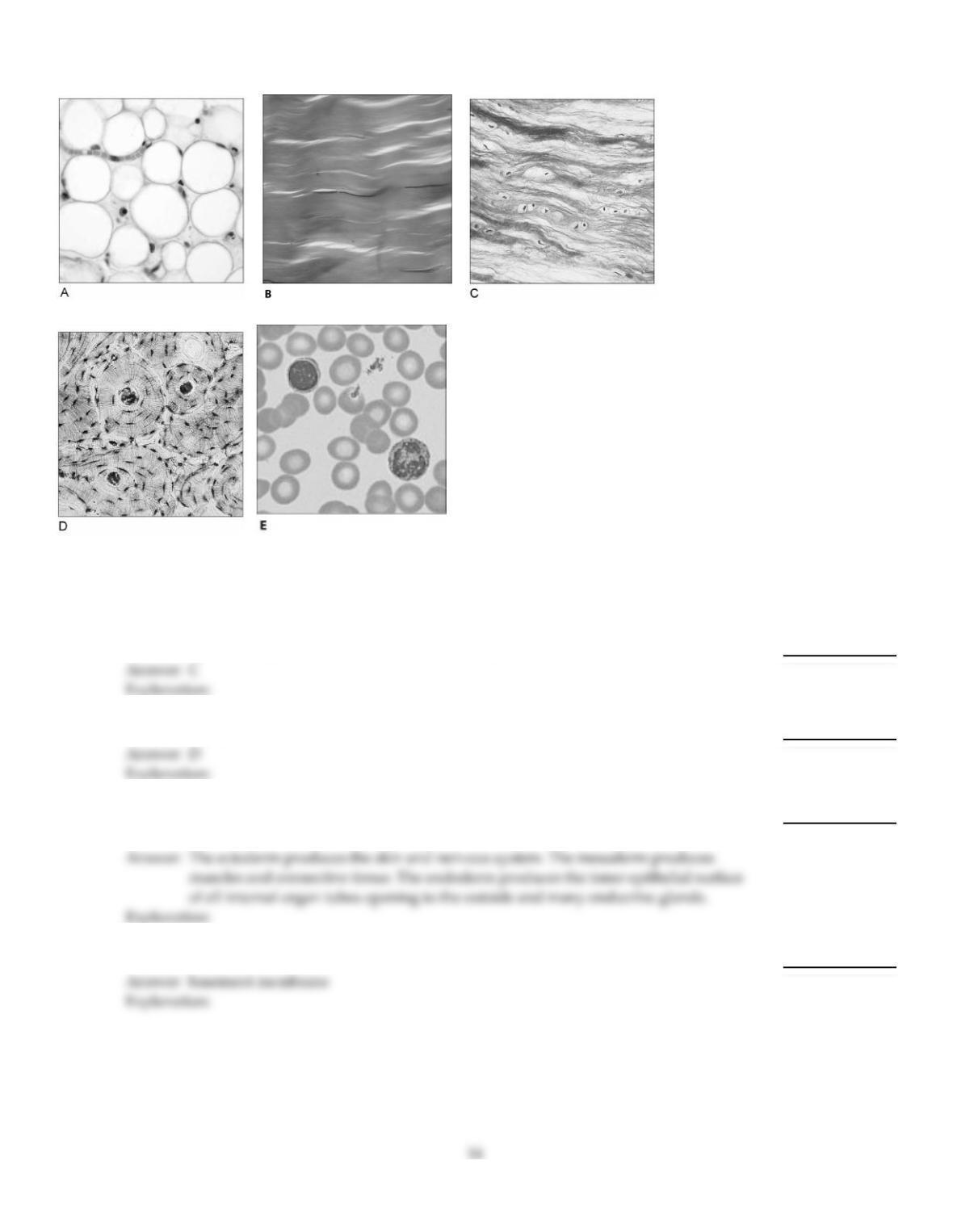
Figure 4.1
Using Figure 4.1, match the following:
49)
Provides tensile strength with the ability to absorb compressive shock.
49)
50)
Supports and protects; stores calcium.
50)
51)
What are the primary germ layers during embryonic development and what do they
ultimately produce?
51)
52)
All epithelial tissue rests upon a(n) ________ composed of connective tissue.
52)
53)
How is epithelial tissue the opposite of connective tissue?
53)
54)
The salivary glands are a good example of a(n) ________ exocrine gland.
54)
55)
Explain what is meant by epithelial tissue being avascular but innervated.
55)
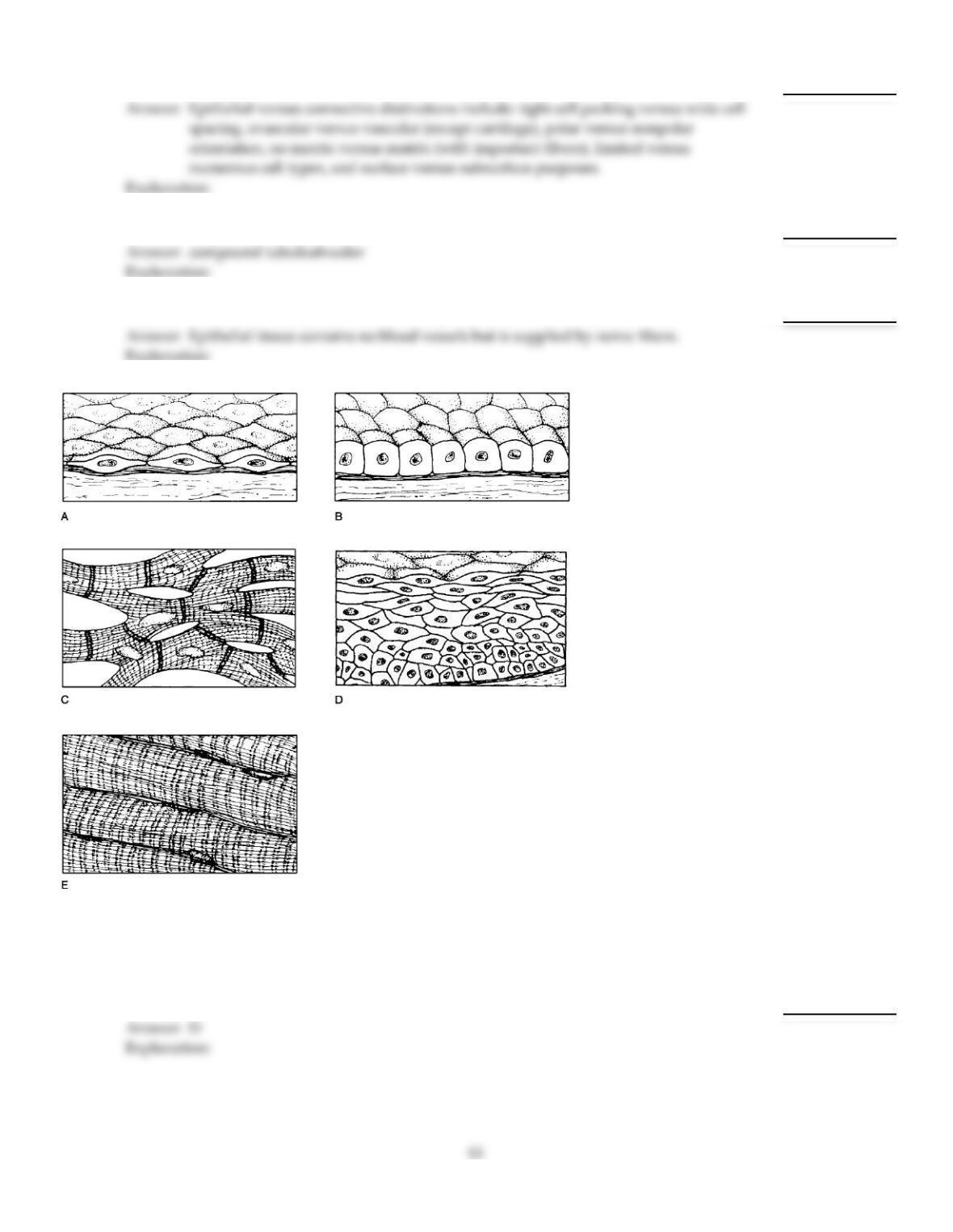
Figure 4.2
Using Figure 4.2, match the following:
56)
Stratified squamous epithelium.
56)
57)
The tissue that forms the framework for the lamina propria of mucous membranes is
________ connective tissue.
57)
58)
How is blood unique among connective tissues?
58)
Explanation:
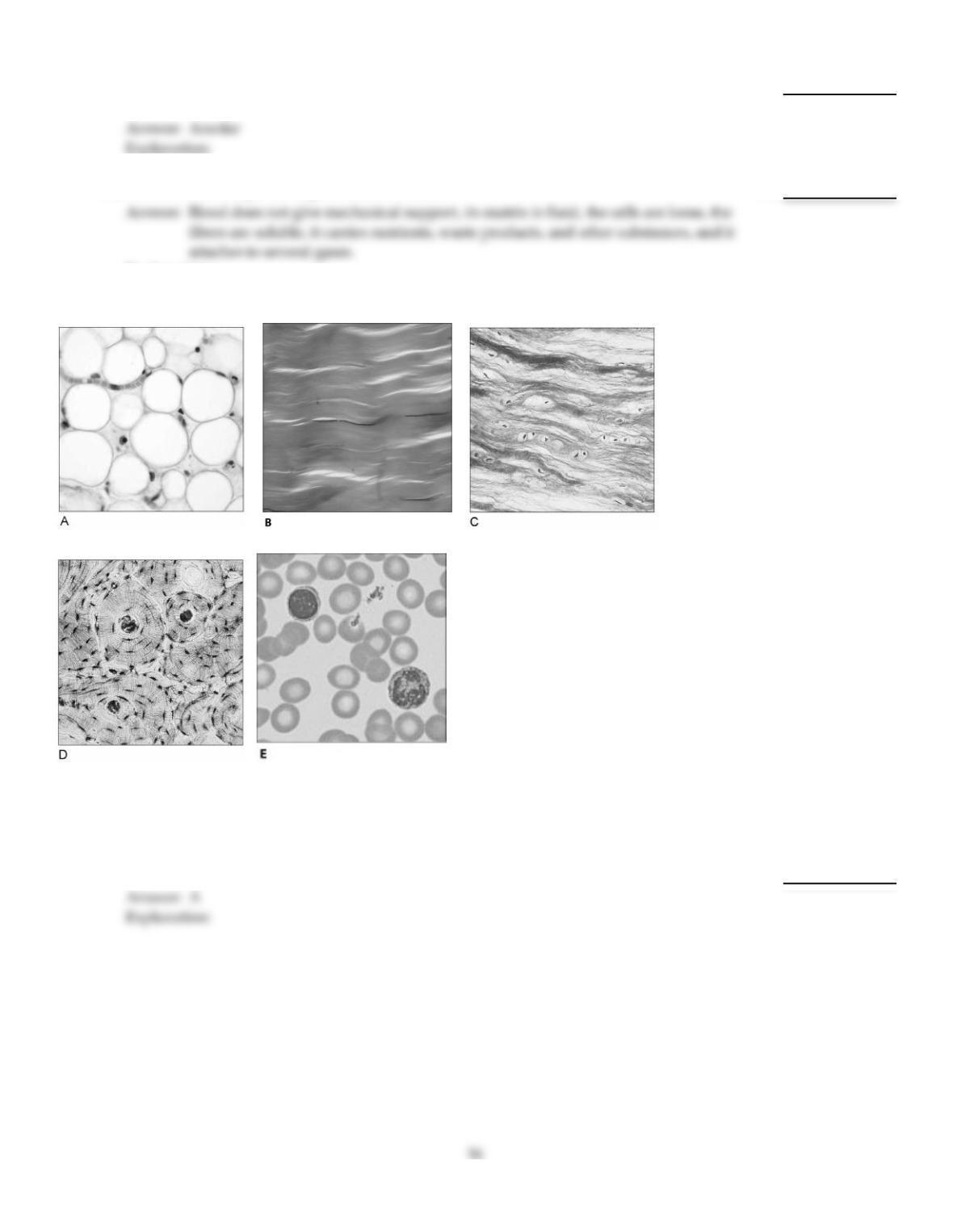
Figure 4.1
Using Figure 4.1, match the following:
59)
Supports and protects; insulates against heat loss; reserve source of fuel.
59)
Explanation:
Explanation:
60)
All of the following statements refer to events of tissue repair. Put the events in proper
numbered order according to the sequence of occurrence. The initial event, the injury, is
already indicated as number one.
1. The skin receives a cut that penetrates into the dermis and bleeding begins.
2. Epithelial regeneration is nearly complete.
3. Granulation tissue is formed.
4. Blood clotting occurs and stops the blood flow.
5. The wound retracts.
6. Macrophages engulf and clean away cellular debris.
7. Fibroblasts elaborate connective tissue fibers to span the break.
60)
61)
Macrophage–like cells are found in many different tissues, and may have specific names
that reflect their location or specializations. What is the one functional characteristic
common to all macrophage–like cells?
61)
62)
Tendon tears or breaks are difficult to repair both physiologically and surgically. Why?
62)
63)
Cardiac muscle tissue is uninucleated, has intercalated discs, and is ________.
63)
64)
What distinguishes cancer cells from the cells of benign neoplasms?
64)
65)
The ________ muscle cells are multinucleated due to the fusion of myoblasts.
65)
TRUE/FALSE. Write ‘T’ if the statement is true and ‘F’ if the statement is false.
66)
Cartilage tissue tends to heal less rapidly than bone tissue.
66)
67)
Merocrine glands produce their secretions by accumulating their secretions internally until the cell
ruptures.
67)
68)
Functions of connective tissues include binding, support, insulation, and protection.
68)
69)
Endocrine glands are often called ducted glands.
69)
70)
Connective tissues that possess a large quantity of collagen fibers often provide the framework for
organs such as the spleen and lymph nodes.
70)
71)
The shock–absorbing pads between the vertebrae are formed of fibrocartilage.
71)
72)
Nervous tissue consists mainly of neurons and collagen fibers.
72)
73)
The basic difference between dense irregular and dense regular connective tissues is in the amount
of elastic fibers and adipose cells present.
73)
74)
A major characteristic of fibrocartilage is its unique amount of flexibility and elasticity.
74)
75)
Squamous cells are flattened and scalelike when mature.
75)
76)
Simple cuboidal epithelia are usually found in areas where secretion and absorption occur.
76)
77)
Epithelial tissues always exhibit polarity; that is, they have a free surface and a basal surface.
77)
78)
Cartilage has good regenerative capacity, while most epithelial tissues do not.
78)
79)
Tendons and ligaments are composed mainly of dense irregular connective tissue.
79)
80)
Elastic cartilage tissue is found in the walls of the large arteries that leave the heart.
80)
81)
The role of brown fat is to warm the body; whereas, the role of white fat is to store nutrients.
81)
82)
Intercalated discs and striations are found in skeletal muscle.
82)
83)
Healing of a surgical incision through the body wall will tend to increase the amount of areolar
tissue.
83)
84)
Blood is considered a type of connective tissue.
84)
85)
Salivary glands exhibit simple tubuloalveolar glandular arrangement.
85)
86)
Aging tends to increase bony spread within the body as chondrocytes die.
86)
87)
Smooth muscle cells possess central nuclei but lack striations.
87)
88)
Goblet cells are found within pseudostratified ciliated columnar epithelium.
88)
89)
Depending on the functional state of the bladder, transitional epithelium may resemble stratified
squamous or stratified cuboidal epithelium.
89)
90)
Macrophages are found in areolar and lymphatic tissues.
90)
MATCHING. Choose the item in column 2 that best matches each item in column 1.
Match the regeneration capacity of the following tissues:
91)
Tendons and ligaments.
A)
Moderate regenerative ability
91)
Match the following:
92)
Moves blood through the body
93)
Has a surface to which nothing is
attached
A)
Cardiac muscle
92)
93)
Match the following:
94)
The epithelial membrane that lines the
closed ventral cavities of the body.
A)
Serous membrane
94)
Match the regeneration capacity of the following tissues:
95)
Areolar connective tissue.
96)
Cardiac muscle.
Moderate regenerative ability
97)
Smooth muscle.
97)
A)
Regenerates extremely well
95)
96)
Match the following:
98)
Makes up the pleura and pericardium.
98)
A)
Serous membrane
Match the following:
99)
Derived from mesenchyme
99)
A)
Tendon
Match the following:
100)
Found lining the digestive and
respiratory tracts.
A)
Mucous membrane
100)
101)
Lines blood vessels and the heart.
A)
Endothelium
Match the following:
102)
Moves food through the GI tract
102)
A)
Smooth muscle
Match the following:
103)
Consists of keratinized stratified
squamous epithelium.
104)
The epithelial membrane that lines
body cavities open to the exterior
membrane
A)
Mucous membrane
103)
104)
Match the regeneration capacity of the following tissues:
105)
Skeletal muscle.
A)
Weak regenerative ability
105)
ESSAY. Write your answer in the space provided or on a separate sheet of paper.
106)
Explain why an open wound would need a bed of granulation tissue for wound healing to occur.
107)
Without macrophages, wound healing is delayed. Why?
108)
A 6–year–old child fell off his bike and scraped his knee. Describe the first stage of wound healing.
109)
John, a 72–year–old grandfather, had been smoking heavily for 24 years and had a persistent cough. A biopsy of
his lung tissue revealed considerable amounts of carbon particles. How could this happen considering the
natural cleaning mechanism of the respiratory system?
101)
110)
In adult humans, most cancers are carcinomas or adenocarcinomas. These include cancers of the skin, lung,
colon, breast, and prostate. Which of the four basic tissue types is involved? Why do you think this is so?
111)
Explain why an infection may occur in a tissue injury.
112)
Aunt Jessie woke up one morning with excruciating pain in her chest. She had trouble breathing for several
weeks. Following a visit to the doctor, she was told she had pleurisy. What is this condition and what did it
affect?
113)
A 45–year–old woman is admitted to the hospital for surgical removal of a tumor on her thyroid gland. The
surgeon informs her that she will have only a very thin scar. How could this be possible?
Answer Key
Testname: C4
23
Answer Key
Testname: C4
24
Answer Key
Testname: C4
25