59) Which of the following products has the most elastic demand?
A) Ben and Jerry’s Chunky Monkey ice cream in the pint container
B) all Ben and Jerry’s ice cream
C) all premium ice cream
D) all ice cream
60) If consumers have a long time to respond to an increase in electricity prices their demand is
likely to be ________ than if they are only given a short time.
A) no different
B) higher
C) more elastic
D) less elastic
61) Demand for low budget items, such as candy, is generally ________ than demand for large
budget items, such as automobiles.
A) higher
B) lower
C) more elastic
D) less elastic
62) Demand for items people do not really need for their survival, such as cars, is generally
________ than demand for items such as water.
A) higher
B) lower
C) more elastic
D) less elastic
63) Which of the following goods is likely to have the most elastic demand?
A) movie
B) cigarettes
C) electricity
D) gasoline
64) Which of the following goods is likely to have the most inelastic demand?
A) restaurant meals
B) air travel
C) movies
D) cigarettes
65) Which of the following products has elastic demand?
A) water
B) coffee
C) cars
D) all ice cream
66) The price elasticity of demand for a good is relatively elastic if
A) there are a large number of substitutes.
B) the consumer has more time to make decisions about purchasing the good.
C) the good is less of a necessity.
D) all of the above
67) In wealthy countries such as the United States, the price elasticity of the demand for food is
________ it is in poorer countries.
A) greater than
B) less than
C) the same as
D) None of the above; it is not possible to make international comparisons of price elasticity.
68) Which of the following factors would indicate more elastic demand?
A) The good is a necessity, rather than a luxury.
B) The good represents a small fraction of the budget.
C) Demand is measured over a longer period of time.
D) There are few substitutes for the good.
69) Which of the following factors would indicate an inelastic demand?
A) The good is a necessity, rather than a luxury.
B) The good represents a small fraction of the budget.
C) Demand is measured over a shorter period of time.
D) all of the above
70) Which of the following factors would indicate less elastic demand?
A) The good represents a large fraction of the budget.
B) Demand is measured over a longer period of time.
C) There are few substitutes.
D) The price of the good is high.
71) Which of the following factors would indicate less elastic demand?
A) The good represents a large fraction of the budget.
B) Demand is measured over a shorter period of time.
C) The price of the good is low.
D) New substitutes are created.
Recall the Application regarding the elasticity of demand for gasoline varying over time to
answer the following question(s).
72) Recall the application. The demand for gasoline is
A) less elastic in the long run because consumers have less opportunity to change their behavior.
B) more elastic in the long run because consumers have time to respond to changes in price.
C) inelastic in the long run and in the short run.
D) elastic in the short run.
73) The price elasticity of demand measures the responsiveness of changes in price to the
quantity demanded.
74) If a 10% increase in price decreases the quantity demanded by 12%, the price elasticity of
demand is 1.2.
75) Suppose that the price elasticity of demand for bagels is 1.60, a 10% increase in price will
decrease the quantity demanded by 6%.
76) If we are on the upper portion of the market demand curve and the price increases by 10%,
the quantity demanded will decrease by more than 10%.
77) Demand for a particular brand of clothing is likely to be less elastic than demand for all
clothing.
78) In general, the demand for a product is more elastic in the long run than in the short run.
79) The price elasticity of demand for business travel tends to be greater than that of leisure
travel.
80) The demand for a product tends to be less elastic as the product accounts for a larger fraction
of a consumer’s budget.
81) The market demand for school supplies is more elastic at the beginning of the semester than
it is at the start of summer vacation.
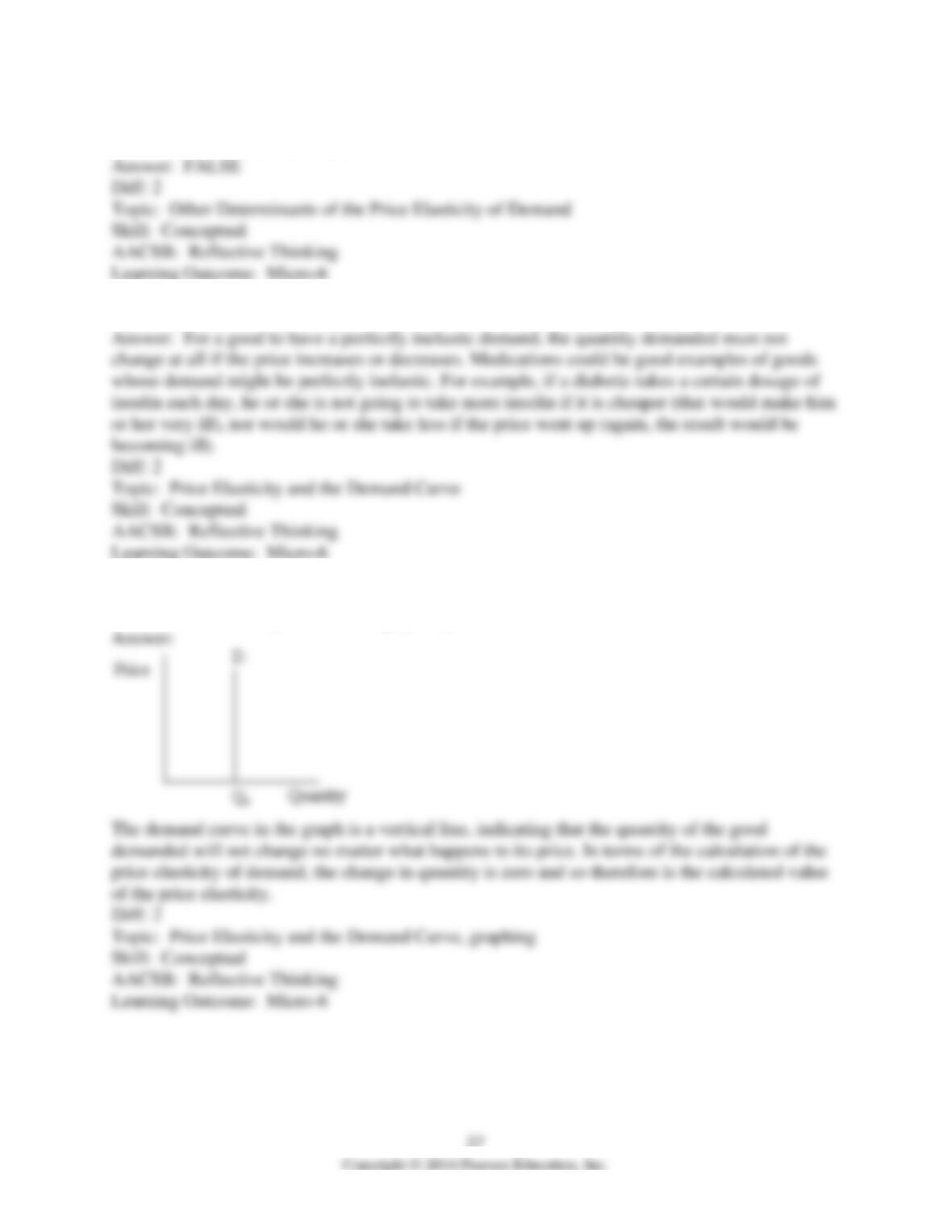
82) Can you think of an example of a good whose demand could be perfectly inelastic?
83) Draw the demand curve for a good whose price elasticity of demand is equal to zero. Be sure
to label both axes. Explain what the graph represents.
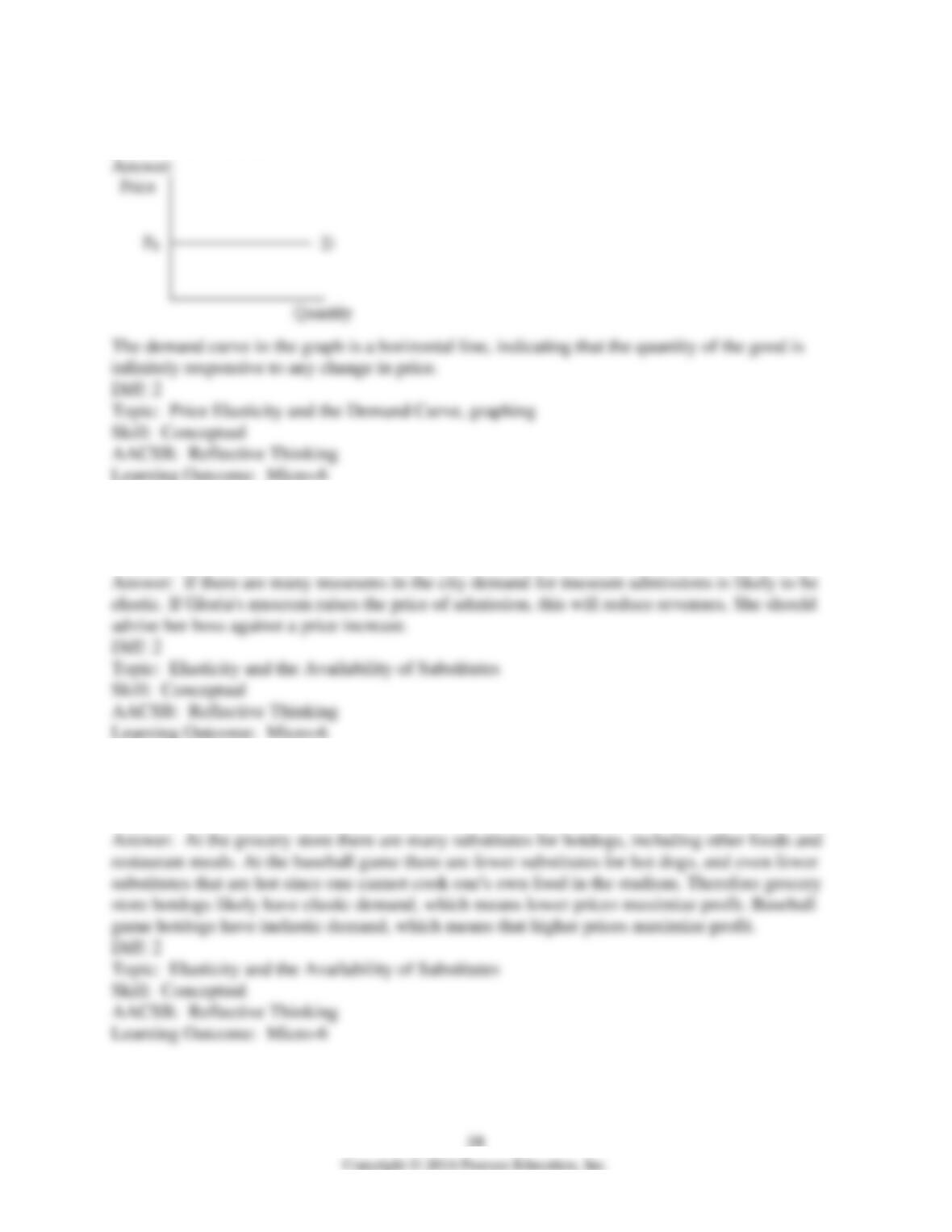
84) Draw the demand curve for a good whose price elasticity of demand is equal to infinity. Be
sure to label both axes.
85) Gloria works for a museum in a large city with many other museums. Her boss proposes that
the museum should raise the price of admission to increase revenues. Gloria was a good student
in her economics principles course. How should she advise her boss?
86) Hotdogs are very cheap at the grocery store—about $2 for a package of 8, or 25 cents each.
At a baseball game they cost $3 each. Use the concept of price elasticity of demand to explain
why.
87) Explain why the demand for a particular brand of fast food tends to be more elastic than
demand for all fast food.
88) Why do you think that the demand for coffee is less elastic than the demand for restaurant
meals?
89) Your boss, the mayor of a city, thought that she’d come up with a great way to raise city
revenue: increase the tax on gasoline in the city! However, she discovered that the city was
actually receiving less tax revenue after the gas tax increase than before. Incensed, she declared
that the economic policy prescription of taxing goods with inelastic demand must be flawed.
Comment.
90) Restaurants and retail stores often give 10% senior citizen discounts. Use the concept of
elasticity to explain how this can be profit maximizing behavior.
91) Is demand for electricity more price elastic when measured over a short period of time or a
long period of time? Explain.
4.2 Using Price Elasticity
1) The price elasticity of demand for color printers is 1.6 and you would like to see the quantity
demanded for color printers to increase by 32%. Then the percentage change in price should be
A) 10%.
B) 15%.
C) 20%.
D) 25%.
2) The price elasticity of demand for higher education is about 1.4. A 5% increase in tuition
would lead to
A) a decrease in enrollment by 7%.
B) a decrease in enrollment by 6.4%.
C) a decrease in enrollment by 3.6%.
D) a decrease in enrollment by 2.8%.
3) Suppose that the elasticity of demand for hamburgers is 2.5 and price decreases by 14%. By
what percentage will quantity demanded for hamburgers increase?
A) 2.5%
B) 5.6%
C) 25%
D) 35%
4) Suppose that the elasticity of demand for newspapers is 2.0 and quantity demanded decreases
by 40%. What must the percentage increase in price have been?
A) 2%
B) 20%
C) 80%
D) 200%
5) Suppose that the elasticity of demand for chocolate is 3.0 and price decreases by 20%. By
what percentage will quantity demanded for chocolate increase?
A) 20%
B) 30%
C) 60%
D) 200%
6) Suppose that the elasticity of demand for a product is 4.0 and quantity demanded increases by
20%. What must the percentage decrease in price have been?
A) 5%
B) 20%
C) 80%
D) 200%
7) Suppose that the elasticity of demand for a product is 0.5 and price decreases by 20%. By
what percentage will quantity demanded increase?
A) 0.5%
B) 5%
C) 10%
D) 40%
8) Suppose that the elasticity of demand for a product is 0.5 and quantity demanded increases by
20%. What must the percentage decrease in price have been?
A) 0.5%
B) 5%
C) 10%
D) 40%
9) If the number of highway deaths among young people is roughly proportional to their beer
consumption and young peoples’ elasticity of demand for beer is 1.5, then to decrease highway
deaths of young people by 15%, taxes would need to be increased enough to increase the price of
beer by
A) 1%.
B) 1.5%.
C) 10%.
D) 15%.
10) If the number of highway deaths among young people is roughly proportional to their beer
consumption and young peoples’ elasticity of demand for beer is 1.5, then a tax increase that
increases the price of beer by 20% would roughly reduced highway deaths of young people by
A) 1.5%.
B) 13.33%.
C) 20%.
D) 30%.
11) If the elasticity of demand for cigarettes by teenagers is 1.5, then to reduce teen smoking by
60%, tobacco companies would need to raise their prices by
A) 15%.
B) 40%.
C) 60%.
D) 90%.
12) If the elasticity of demand for cigarettes by teenagers is 1.5, then the price and total revenue
from teens buying cigarettes are
A) zero.
B) unrelated.
C) inversely related.
D) directly related.
13) Suppose that if poor households have a price elasticity of demand for medical care of 0.50
and rich households have a price elasticity of demand for medical care of 0.25, then a price
increase of 10% would lead to the poor households reducing their quantity demanded for medical
care by
A) 2.5%.
B) 5%.
C) 25%.
D) 50%.
14) Suppose that if poor households have a price elasticity of demand for medical care of 0.70
and wealthy households have a price elasticity of demand for medical care of 0.10, then a 10%
increase in the price of medical care would lead to poor households reducing their quantity
demanded for medical care by
A) seven times the amount that wealthy household reduce their quantity demanded for medical
care.
B) one-seventh the amount that wealthy households reduce their quantity demanded for medical
care.
C) one-tenth the amount that wealthy households reduce their quantity demanded for medical
care.
D) ten times the amount that wealthy household reduce their quantity demanded for medical
care.
15) What is the total revenue of a shoe company equal to?
A) income minus explicit and implicit costs
B) the change in quantity sold divided by the change in price
C) price of shoes times quantity sold
D) elasticity of demand divided by percentage change in quantity
16) The total revenue of Grandma’s Fudge Factory is equal to
A) average cost times quantity sold.
B) elasticity of demand divided by percentage change in quantity.
C) price of fudge times quantity sold.
D) income minus explicit and implicit costs.
17) If Maria spends a fixed dollar amount per week on movie rentals regardless of changes in the
price, Maria’s demand for movie rental can be considered
A) elastic.
B) unit elastic.
C) inelastic.
D) There is not sufficient information to determine the price elasticity.
18) Suppose that OPEC currently sets the oil price at $1.50 per gallon, and the current
consumption is 100 million gallons per day. The price elasticity of demand for oil is estimated to
be 0.7 by the initial value method. If OPEC raises the oil price to $1.80 per gallon,
A) quantity demanded decreases by 10 million gallons while total sales revenue increases by
$4.4 million per day.
B) quantity demanded decreases by 14 million gallons while total sales revenue increases by
$4.8 million per day.
C) quantity demanded decreases by 10 million gallons and total sales revenue decreases by $4.4
million per day.
D) quantity demanded decreases by 14 million gallons and total sales revenue decreases by $4.8
million per day.
19) Suppose that there is only one seller in the computer industry. If the demand curve that the
only seller in the industry faces is a straight-line, downward sloping curve, at which point would
the seller’s total revenue be maximized?
A) at the highest point on the demand curve, where price is the highest
B) at a point high on the demand curve, where elasticity is elastic
C) at the midpoint of the demand curve, where elasticity is unitary
D) at a point low on the demand curve, but not at the very bottom
20) Suppose that you observe that as a TV manufacturer increases its price its total revenue
decreases. This could be due to
A) demand being price inelastic.
B) demand being price elastic.
C) demand being unitary elastic.
D) demand being perfectly price inelastic.
21) Suppose that when a particular firm decreases its price its total revenue decreases. What kind
of demand does this particular firm face?
A) Demand is price inelastic.
B) Demand is price elastic.
C) Demand is unitary elastic.
D) Demand is perfectly price elastic.
22) Assume that when a lamp manufacturer decreases its price its total revenue does not change.
What do we know?
A) Demand is price inelastic.
B) Demand is price elastic.
C) Demand is unitary elastic.
D) Demand is perfectly price elastic.
23) Suppose that the elasticity of demand for a product is 2.0. What will happen to total revenue
as a firm increases the price?
A) Total revenue will increase.
B) Total revenue will decrease.
C) Total revenue will stay the same.
D) Cannot be determined from the information provided.
24) Suppose that the elasticity of demand for a product is 0.5. What will happen to total revenue
as a firm increases the price?
A) Total revenue will increase.
B) Total revenue will decrease.
C) Total revenue will stay the same.
D) Cannot be determined from the information provided.
25) Suppose we observe that as a firm increases its price its total revenue decreases. Which of
the following is a possible value of its price elasticity of demand?
A) 0.25
B) 0.5
C) 1
D) 2
26) Assume that as a firm decreases its price its total revenue decreases. Which of the following
is a possible value of its price elasticity of demand?
A) 0.4
B) 1
C) 1.4
D) 4
27) Suppose we observe that a firm’s total revenue doesn’t change when price and quantity
change by the same percentage. Which of the following is a possible value of its price elasticity
of demand?
A) 0
B) 0.5
C) 1
D) 2
28) If the demand for school ball caps is inelastic, an increase in price will result in
A) a decrease in profits.
B) an increase in total revenue.
C) a decrease in total revenue.
D) an increase in the quantity demanded.
29) If the demand for new cars is elastic, an increase in price will result in
A) an increase in profits.
B) an increase in total revenue.
C) a decrease in total revenue.
D) an increase in the quantity demanded.
30) Governments like to know the price elasticity of demand because it helps them determine
how changes in sales tax rates will affect
A) tax revenues.
B) government spending.
C) income.
D) profits.