Test Bank – Chapter 4 – Using Financial Statements to Analyze Value Creation 4-15
37. Assume that the following financial ratios were computed from the 2009 financial
statements of Carolina Industries:
Return on sales (profit margin)
0.30
Return on assets
0.17
Common equity leverage
0.87
Capital structure leverage
2.22
Asset turnover
1.69
If Carolina holds its other ratios constant in 2010, but increases its profit margin to 35%,
what will be the 2010 return on assets?
a. 5%
b. 78%
c. 59%
d. 51%
MATCHING QUESTIONS
1. Match the correct ratio name from the list below labeled a through g with each formula
appearing in items 1 through 5.
Ratios
a. Return on sales
b. Quick ratio
c. Average tax rate
d. Current ratio
e. Return on assets
f. Return on equity
g. Inventory turnover
____ 1. (Cash + accounts receivable + marketable securities) / current liabilities
____ 2. (Net income + interest expense) / average total assets
____ 3. Current assets / current liabilities
____ 4. Income tax expense / income before tax
____ 5. (Net income + interest expense [1-tax rate]) / sales
4-16 Test Bank – Chapter4 – Using Financial Statements to Analyze Value Creation
2. Match the correct ratio name from the list below labeled a through f with the ratio
formulas appearing in items 1 through 4.
Ratios
a. Debt/equity ratio
b. Capital structure leverage
c. Return on sales
d. Long term debt ratio
e. Return on equity
f. Common equity leverage
____ 1. Long-term debt / total assets
____ 2. Net income / (net income + interest expense x [1 – tax rate])
____ 3. Average total liabilities / average total shareholders’ equity
____ 4. Net income / average shareholders’ equity
3. Match the correct value driver category from the list below labeled a through c with each
ratio that appears in items 1 through 12.
Ratio Categories
a. Sales and expense management
b. Working capital management
c. Capital structure management
1.
Current ratio
7.
Debt/equity ratio
2.
Average tax rate
8.
Inventory turnover
3.
Receivables turnover
9.
Accounts payable turnover
4.
Return on sales
10.
Long–term debt ratio
5.
Interest coverage ratio
11.
Profit margin
6.
Quick ratio
12.
Common equity leverage
Test Bank – Chapter 4 – Using Financial Statements to Analyze Value Creation 4-17
SHORT PROBLEMS
1. Adams Company has total assets, liabilities, and shareholders’ equity of $20,000,
$7,000, and $13,000, respectively, at the beginning of 2010. At the end of 2010, total
assets, liabilities, and shareholders’ equity were reported at $16,000, $5,000, and
$11,000, respectively.
A. How much additional debt can Adams incur and still have its debt/equity ratio remain
less than or equal to 1.00?
B. What information does the debt/equity ratio provide you?
2. Jefferson Company has current assets, current liabilities, and long-term liabilities of
$9,000, $3,000, and $7,000, respectively. Within these amounts, $1,000 is accounts
payable, and $1,500 is accounts receivable. What effect will the payment of the
accounts payable have on the current ratio? Should Jefferson pay the accounts payable
on the last day of the year? Explain.
4-18 Test Bank – Chapter4 – Using Financial Statements to Analyze Value Creation
Use the information that follows taken from Jackson Company’s financial statements for the
years ending December 31, 2010 and 2009 to answer problems 3 through 9.
Balance Sheet Information
2010
2009
Assets
Cash
$ 50
$ 60
Accounts receivable
40
40
Inventory
40
60
Land, building, and equipment
290
310
Total Assets
$420
$470
Liabilities and Shareholders’ Equity
Accounts payable
$ 85
$ 235
Common stock
200
200
Retained earnings
135
35
Total Liabilities & Shareholders’ Equity
$420
$470
Income Statement Information
Sale revenue
$900
Cost of goods sold
300
Gross profit
$600
Operating expenses
500
Net income
$100
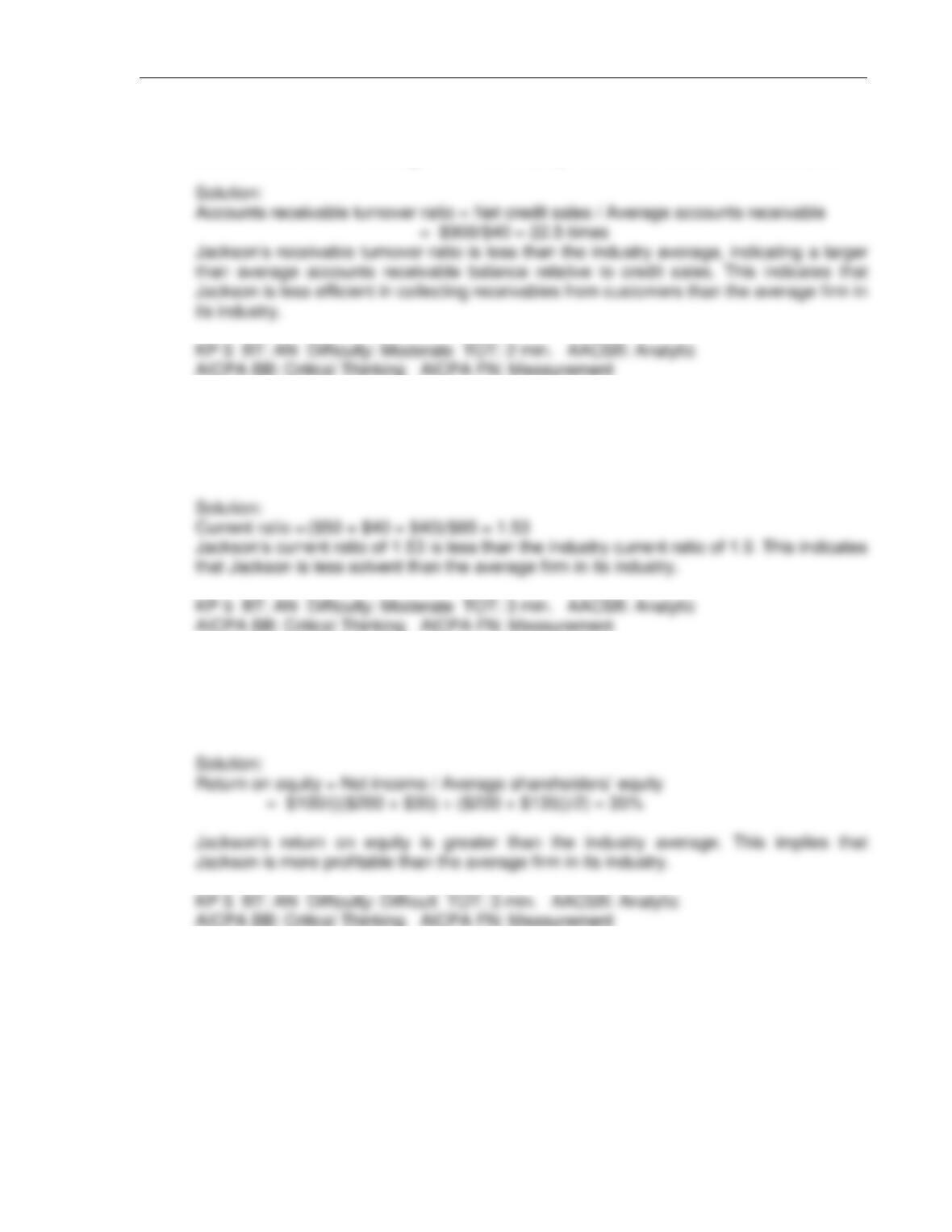
3. Using the two solvency ratios (current and quick), indicate whether Jackson’s solvency
position improved or deteriorated during 2010.
Current:
Quick:
Quick:
Test Bank – Chapter 4 – Using Financial Statements to Analyze Value Creation 4-19
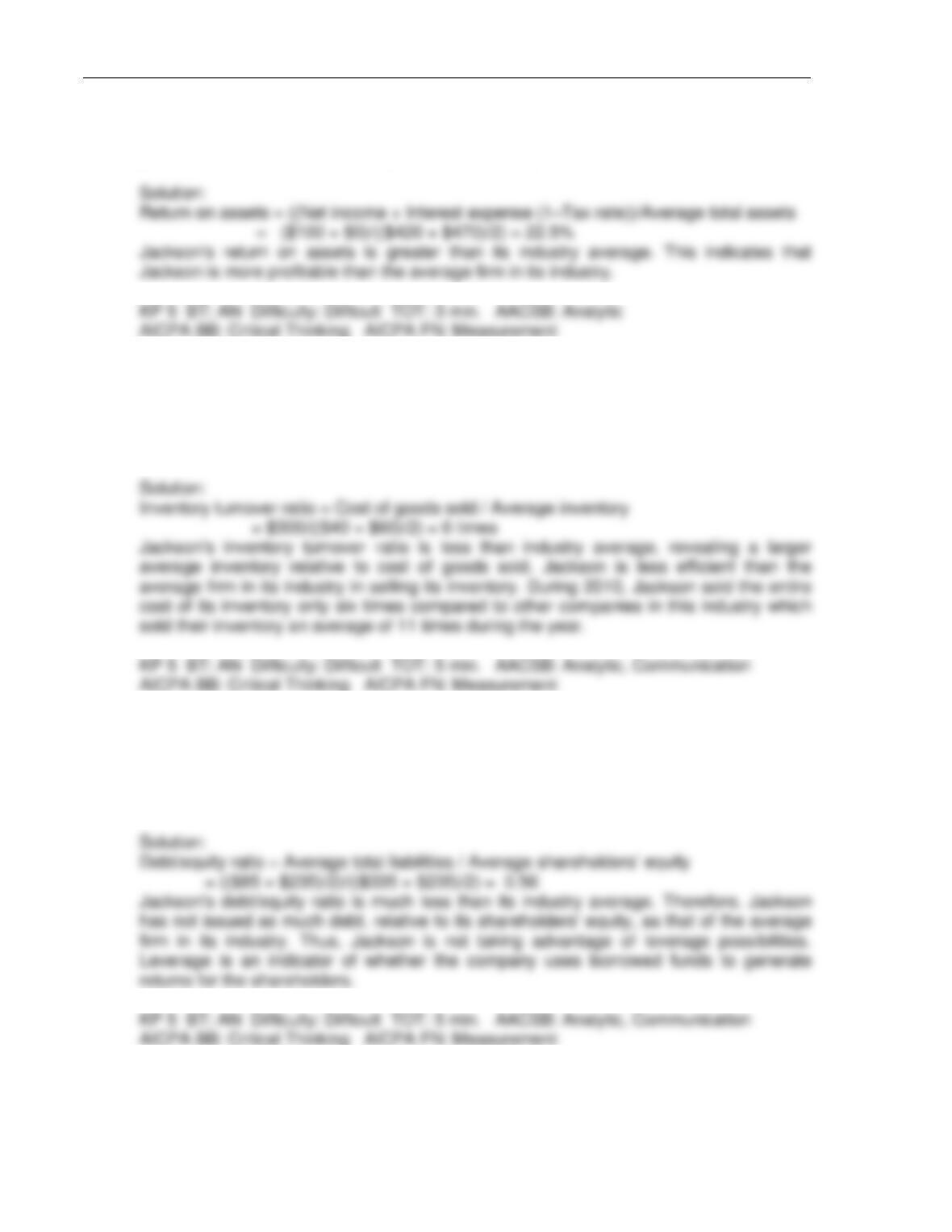
4. If the industry in which Jackson is a member has an average accounts receivable
turnover of 27 times, determine if in 2010, Jackson is more or less efficient at converting
sales to cash than the average firm in its industry. Assume all sales were credit sales.
5. If the industry in which Jackson is a member has an average current ratio of 1.9,
determine if, on December 31, 2010, Jackson is more or less solvent than the average
firm in its industry as measured by its current ratio.
6. If the industry in which Jackson is a member has an average return on equity of 22%,
determine if in 2010, Jackson is more or less profitable than the average firm in its
industry.
4-20 Test Bank – Chapter4 – Using Financial Statements to Analyze Value Creation
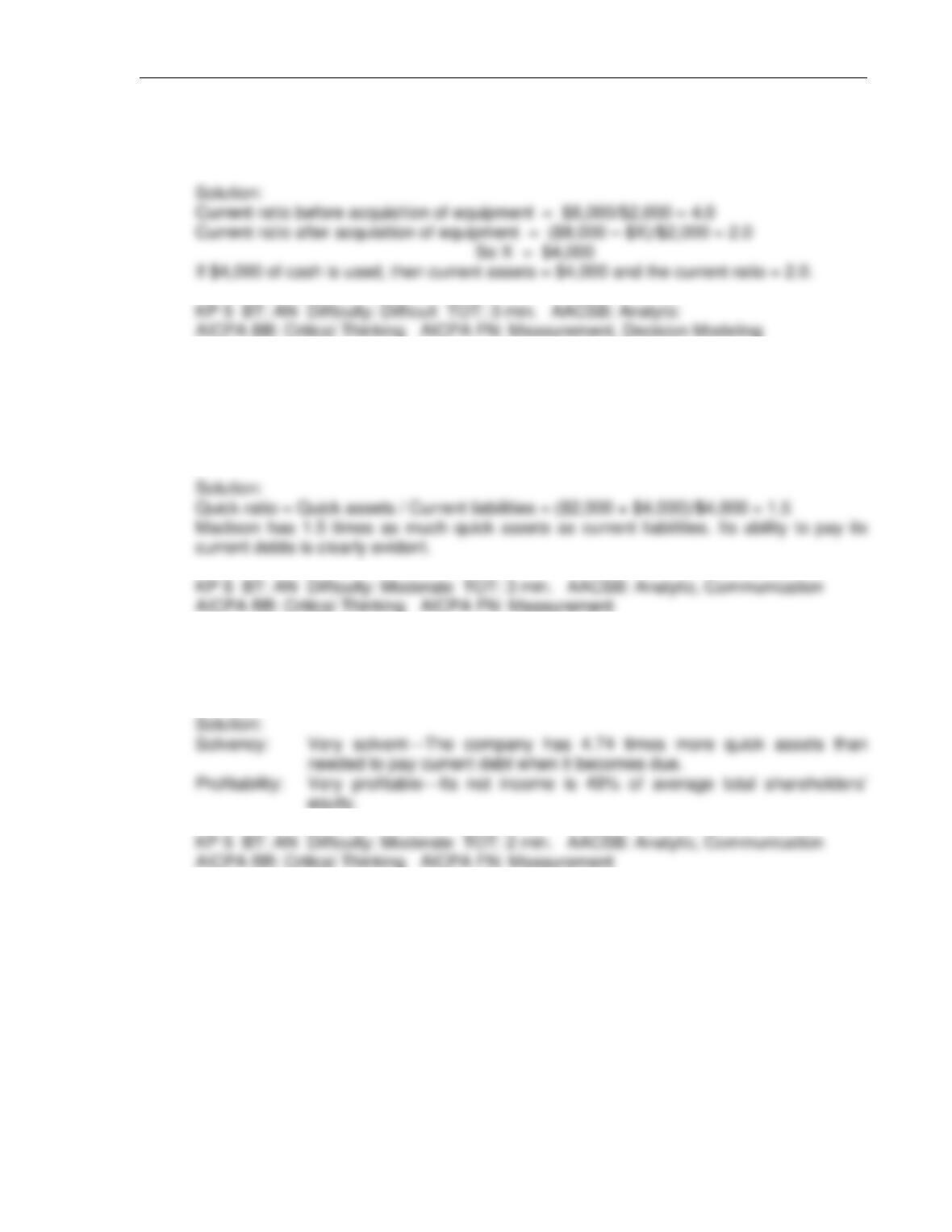
7. The industry in which Jackson is a member has an average return on assets of 18%.
Jackson reported no interest expense during 2010. Determine if Jackson is more or less
profitable in 2010 than the average firm in its industry.
8. If the industry in which Jackson is a member has an inventory turnover of 11 times,
determine if in 2010, Jackson is more or less efficient at converting inventory into sold
units than the average firm in its industry. Explain what information this ratio provides
you.
9. The industry in which Jackson is a member has an average debt/equity ratio of 0.83.
Determine if, as measured by the debt/equity ratio on December 31, 2010, Jackson is
taking full advantage of investing borrowed capital in its operations relative to that of the
average firm in its industry. Explain.
Test Bank – Chapter 4 – Using Financial Statements to Analyze Value Creation 4-21
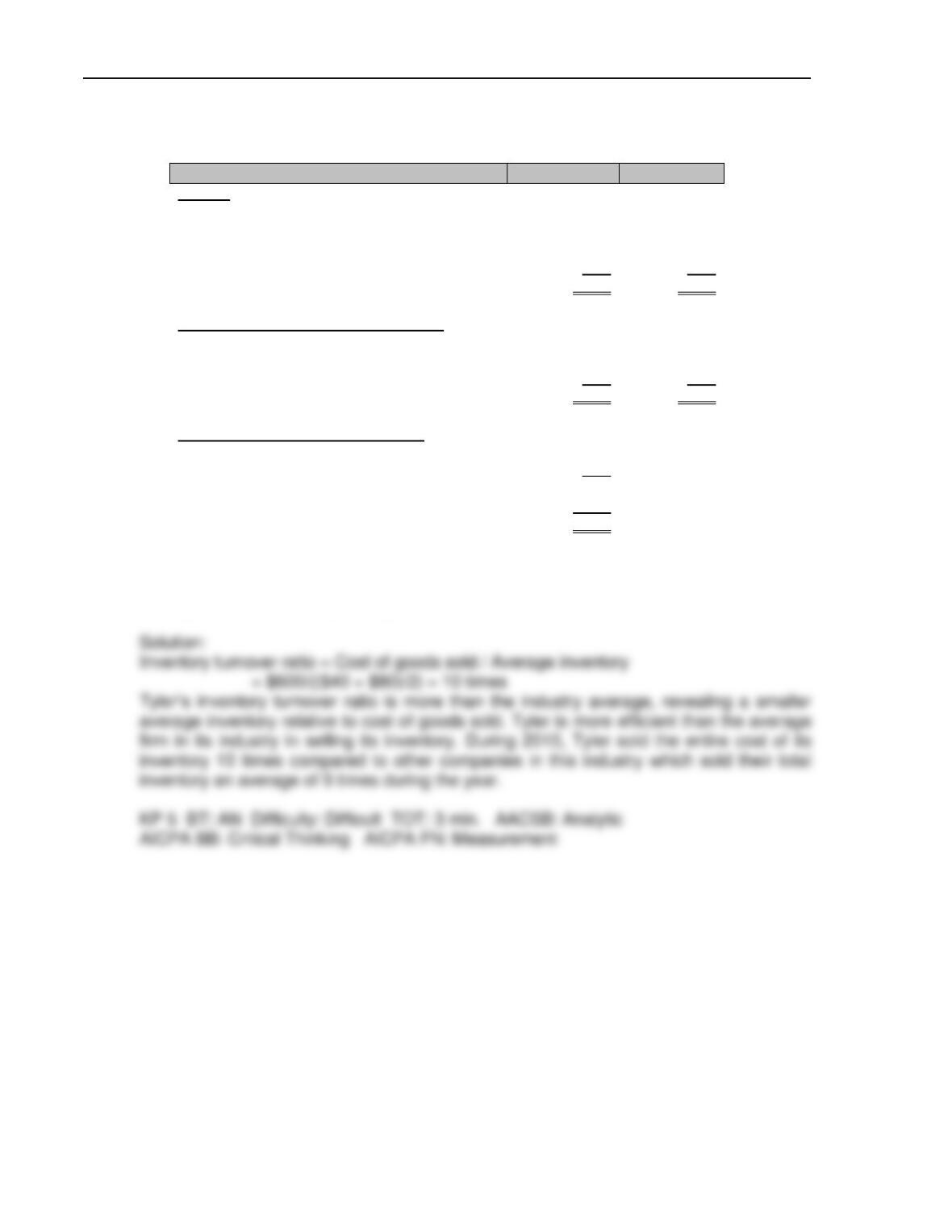
10. Washington Company has current assets, current liabilities, and long-term liabilities of
$8,000, $2,000, and $5,000, respectively at the end of 2010. How much cash can
Washington use to acquire equipment and retain a current ratio of at least 2.0?
11. Madison Company has current assets, current liabilities, and long-term liabilities of
$8,000, $4,000, and $6,000, respectively. Within these amounts, inventory was $2,000,
receivables were $2,000, cash was $4,000, and payables were $1,000. Calculate
Madison’s quick ratio. What information does this provide?
12. Briefly describe the solvency and profitability of a company with a quick ratio of 4.74 and
return on equity of 0.49.
4-22 Test Bank – Chapter4 – Using Financial Statements to Analyze Value Creation
Use the information that follows taken from Tyler Company’s financial statements for the years
ending December 31, 2010 and 2009 to answer problems 13 through 19.
Balance Sheet Information
2010
2009
Assets
Cash
$ 80
$ 40
Accounts receivable
60
80
Inventory
40
80
Land, building, and equipment
230
270
Total Assets
$410
$470
Liabilities and Shareholders’ Equity
Accounts payable
$ 5
$ 85
Common stock
250
250
Retained earnings
155
135
Total Liabilities & Shareholders’ Equity
$410
$470
Income Statement Information
Sale revenue
$850
Cost of goods sold
600
Gross profit
$250
Operating expenses
230
Net income
$ 20
13. If the industry in which Tyler is a member has an inventory turnover of 9 times,
determine if Tyler is more or less efficient at converting inventory into sales than the
average firm in its industry during 2010.
Test Bank – Chapter 4 – Using Financial Statements to Analyze Value Creation 4-23
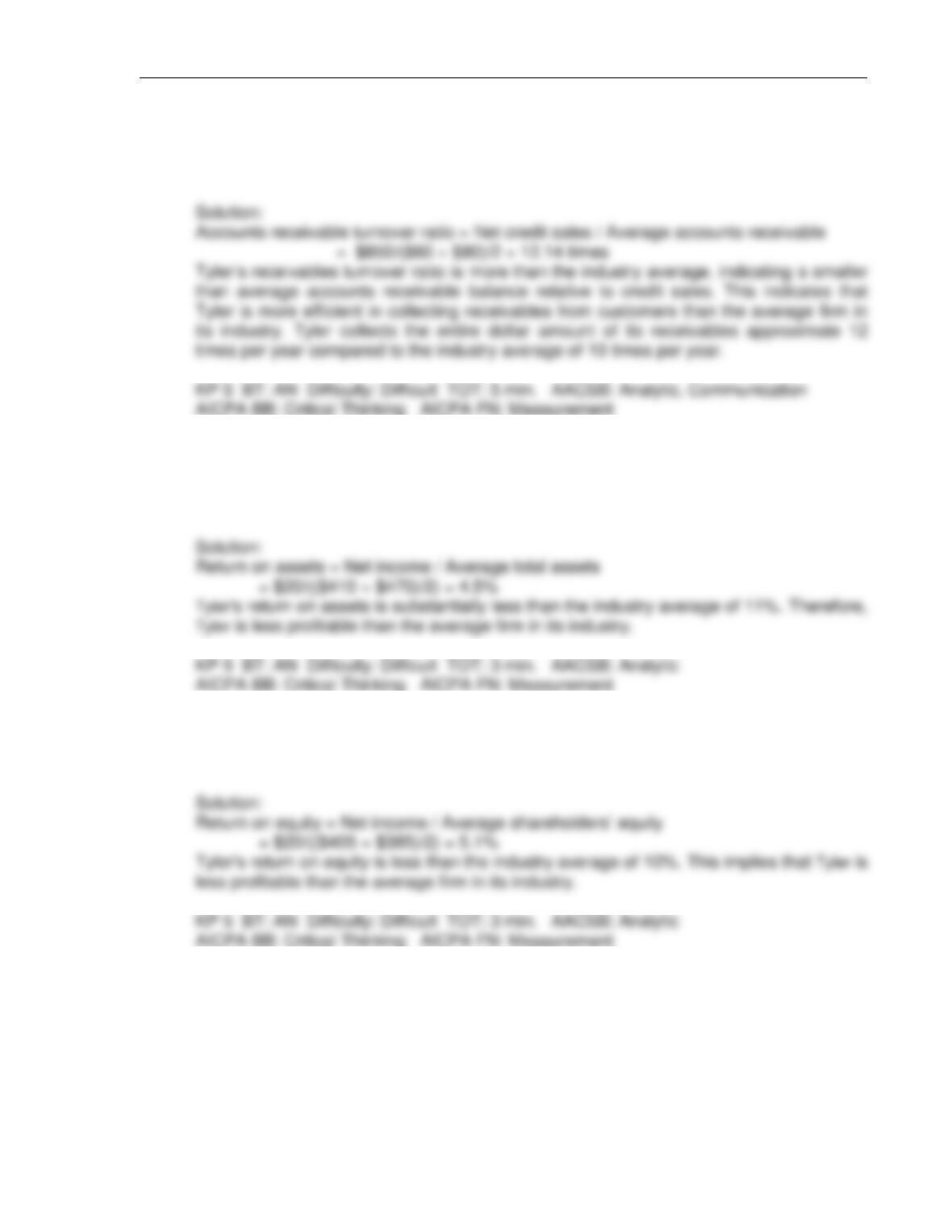
14. The industry in which Tyler is a member has an average accounts receivable turnover of
10 times. How does Tyler compare in 2010? Comment on what information is provided
with this calculation and how credit managers might use it to make decisions. Assume all
sales were credit sales.
15. If the industry in which Tyler is a member has an average return on assets of 11%,
determine if in 2010, Tyler is more or less profitable than the average firm in its industry.
Assume Tyler has no interest expense.
16. The industry in which Tyler is a member has an average return on equity of 10%. For
2010, determine how Tyler compares.
4-24 Test Bank – Chapter4 – Using Financial Statements to Analyze Value Creation
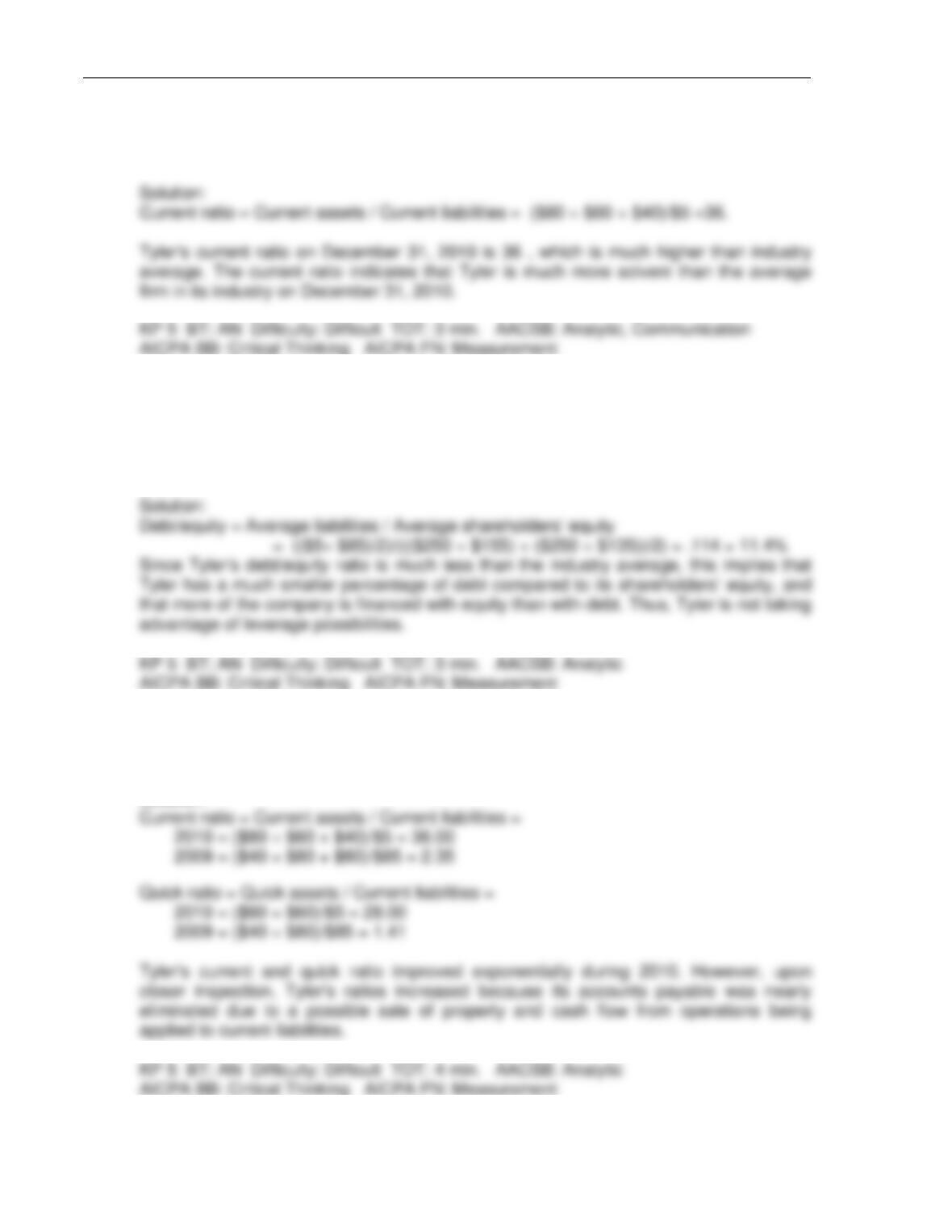
17. The industry in which Tyler operates has an average current ratio of 2.1 on December
31, 2010. Comment on Tyler’s solvency compared to the industry average as measured
by its current ratio.
18. The industry in which Tyler is a member has an average debt/equity ratio of 0.98.
Determine if, as measured by Tyler’s debt/equity ratio on December 31, 2010, Tyler is
taking full advantage of investing borrowed capital in its operations relative to that of the
average firm in its industry.
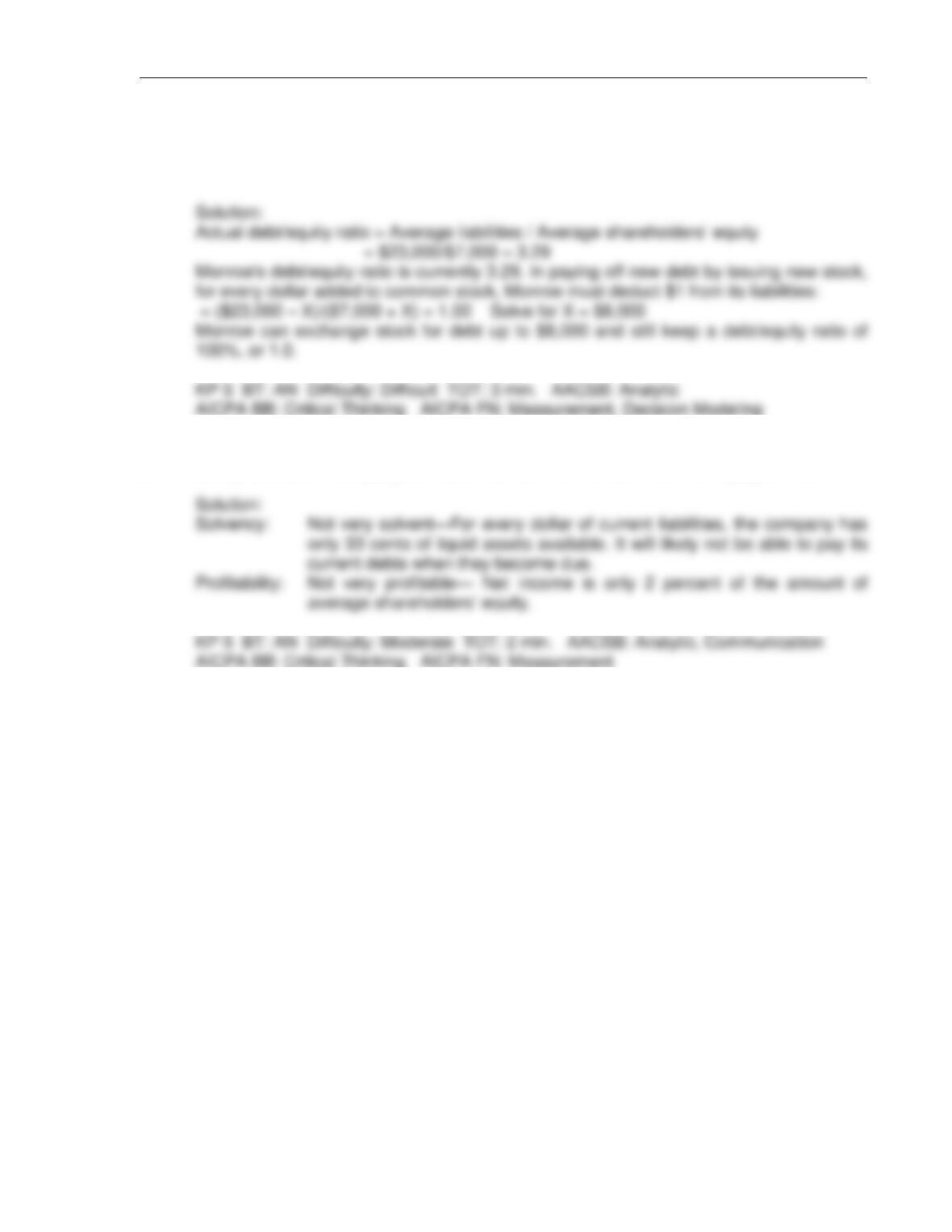
19. Using the two solvency ratios (current and quick), indicate whether Tyler’s solvency
position improved or deteriorated during 2010.
Solution:
Test Bank – Chapter 4 – Using Financial Statements to Analyze Value Creation 4-25
20. Monroe Company has total assets, liabilities, and shareholders’ equity of $30,000,
$23,000, and $7,000, respectively. Assume no material change occurred during the year
to totals on the balance sheet. What amount of long-term debt must Monroe exchange
for new shares of common stock issued in order to decrease its debt/equity ratio to 1.0?
21. Briefly describe a company with a current ratio of 0.33 and return on equity of 0.02.
4-26 Test Bank – Chapter4 – Using Financial Statements to Analyze Value Creation
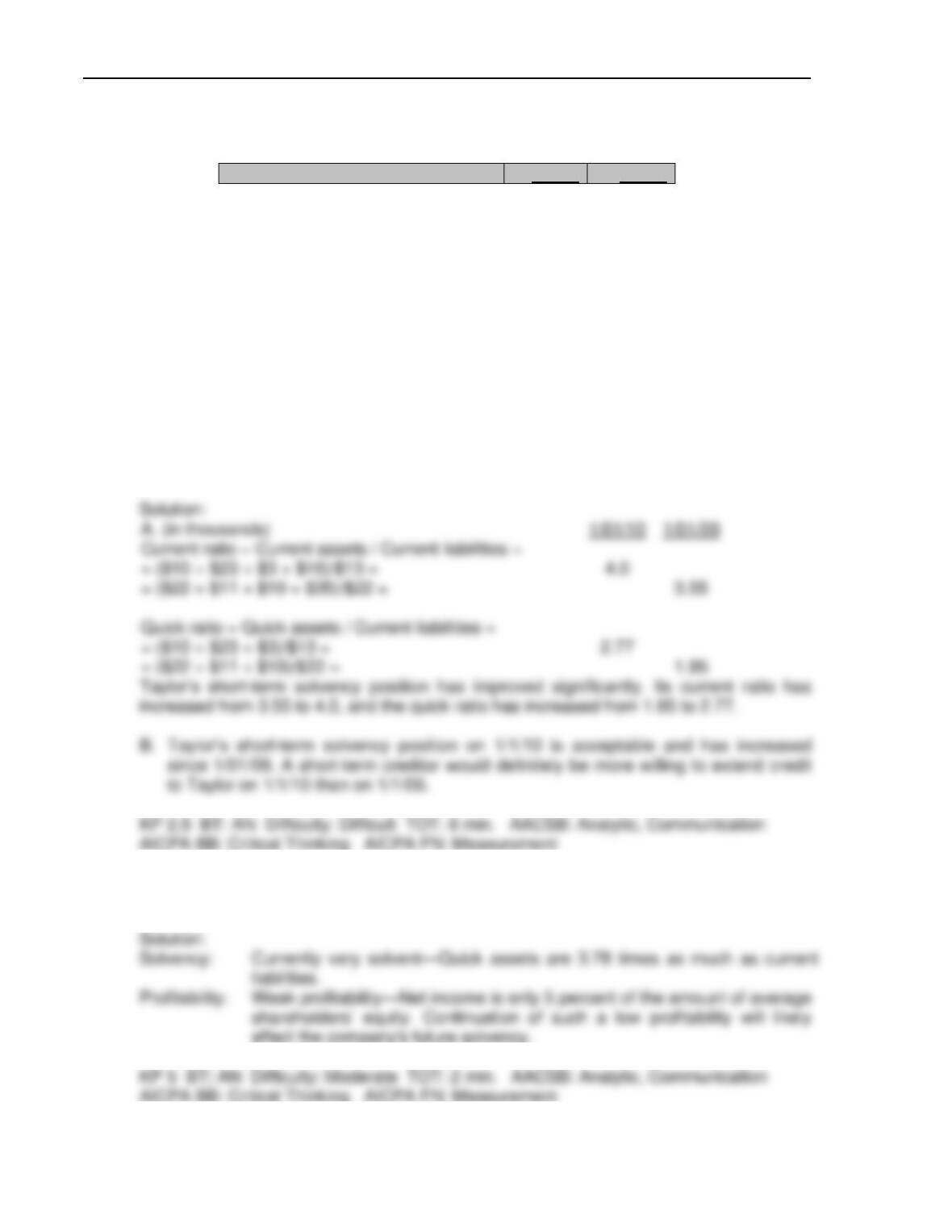
22. Taylor Company has the following financial data on January 1, 2010 and January 1,
2009.
1/1/10
1/1/09
Cash
$10,000
$22,000
Accounts receivable
23,000
11,000
Marketable securities
3,000
10,000
Inventory
16,000
35,000
Net plant and equipment
40,000
32,000
Current liabilities
$13,000
$22,000
Long-term debt
49,000
30,000
Shareholders’ equity
30,000
58,000
A. In terms of the quick and current ratio, has the short-term solvency position of Taylor
improved, remained the same, or declined?
B. If you were a potential short-term creditor to Taylor, would you be more willing to
extend credit on either January 1, 2009 or 2010? Explain.
23. Briefly describe a company with a quick ratio of 3.78 and return on equity of 0.05.
A. (in thousands)
1/01/10
1/01/09
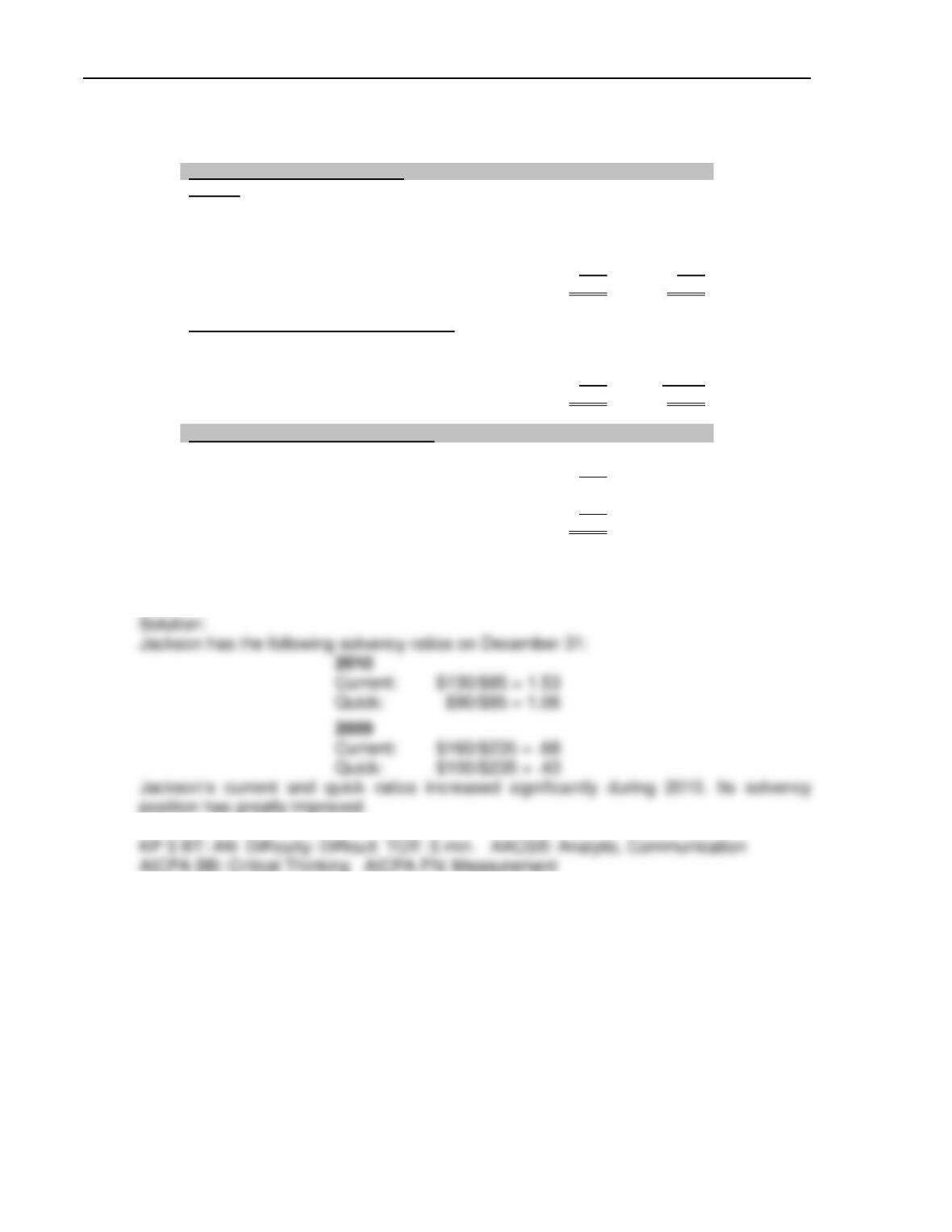
Current ratio = Current assets / Current liabilities =
= ($10 + $23 + $3 + $16)/$13 =
= ($22 + $11 + $10 + $35)/$22 =
Quick ratio = Quick assets / Current liabilities =
= ($10 + $23 + $3)/$13 =
= ($22 + $11 + $10)/$22 =
Test Bank – Chapter 4 – Using Financial Statements to Analyze Value Creation 4-27
SHORT ESSAY QUESTIONS
1. Buchanan Company has the following financial data on December 31, 2010 and 2009:
12/31/09
12/31/10
Cash
$14,000
$19,000
Accounts receivable
12,000
4,000
Inventory
15,000
12,000
Net plant and equipment
5,000
3,000
Current liabilities
8,000
18,000
Common stock
5,000
5,000
Retained earnings
31,000
2,000
Buchanan ‘s 2010 income statement reported:
Revenue
$160,000
Cost of goods sold
150,000
Gross margin
$ 10,000
Depreciation expense
2,000
Net income
$ 8,000
Buchanan ‘s 2010 data from its statement of cash flows:
Cash flow from operations
$ 42,000
Cash flow from investing activities
0
Cash flow from financing activities, including dividends paid
(22,000)
Required: Using appropriate ratios, comment on the change in Buchanan’s solvency
position and assess the probable cause of the change from 2009 to 2010.
4-28 Test Bank – Chapter4 – Using Financial Statements to Analyze Value Creation
2. Explain the concept of leverage.