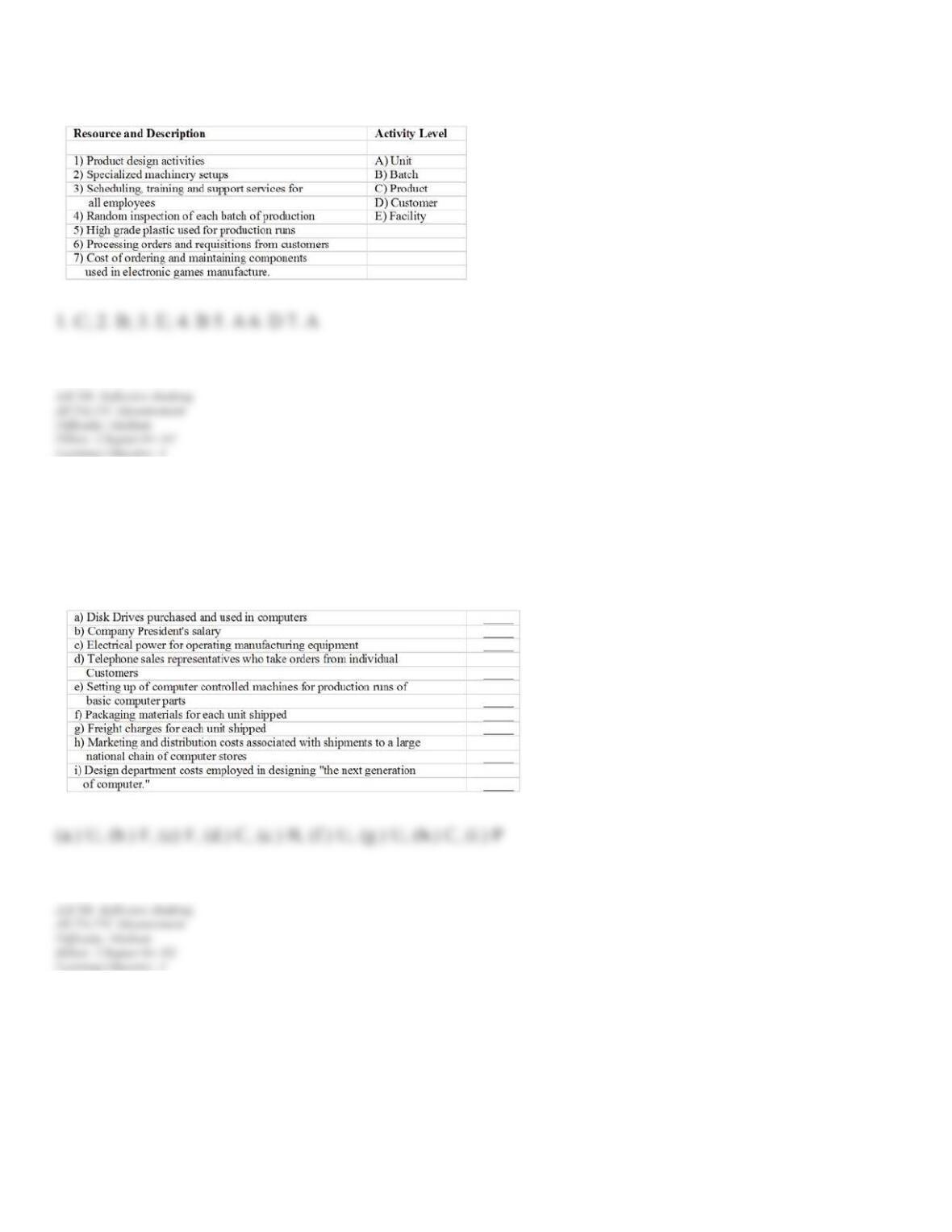
81. Listed below are activities incurred by Richardson Manufacturing Company. The company manufactures a
variety of products for sale to large department stores
Required: Match each of the following resources and activities with the most likely activity level
82. Match each of the following resources with the most likely resource level at a personal computer
manufacturer. Each computer is custom manufactured to the specifications of the individual customer. Identify
the resource levels as: U = Unit–level; B = Batch–level;
P = Product–level; C = Customer-level; F = Facility–level
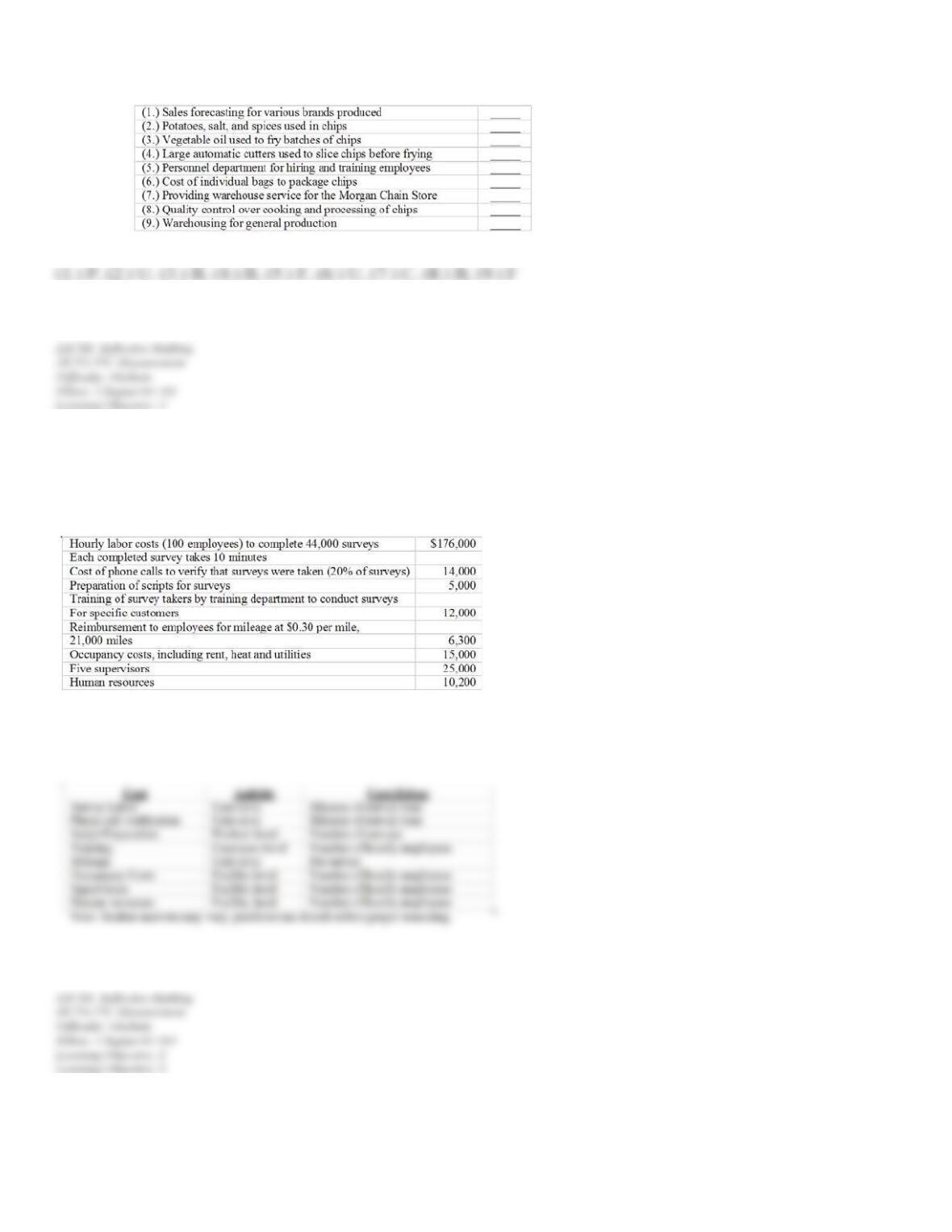
83. Match each of the following resources with the most likely resource level at a potato chip manufacturer.
Identify the resource levels as: U = Unit; B = Batch; P = Product; C = Customer; F =
Facility
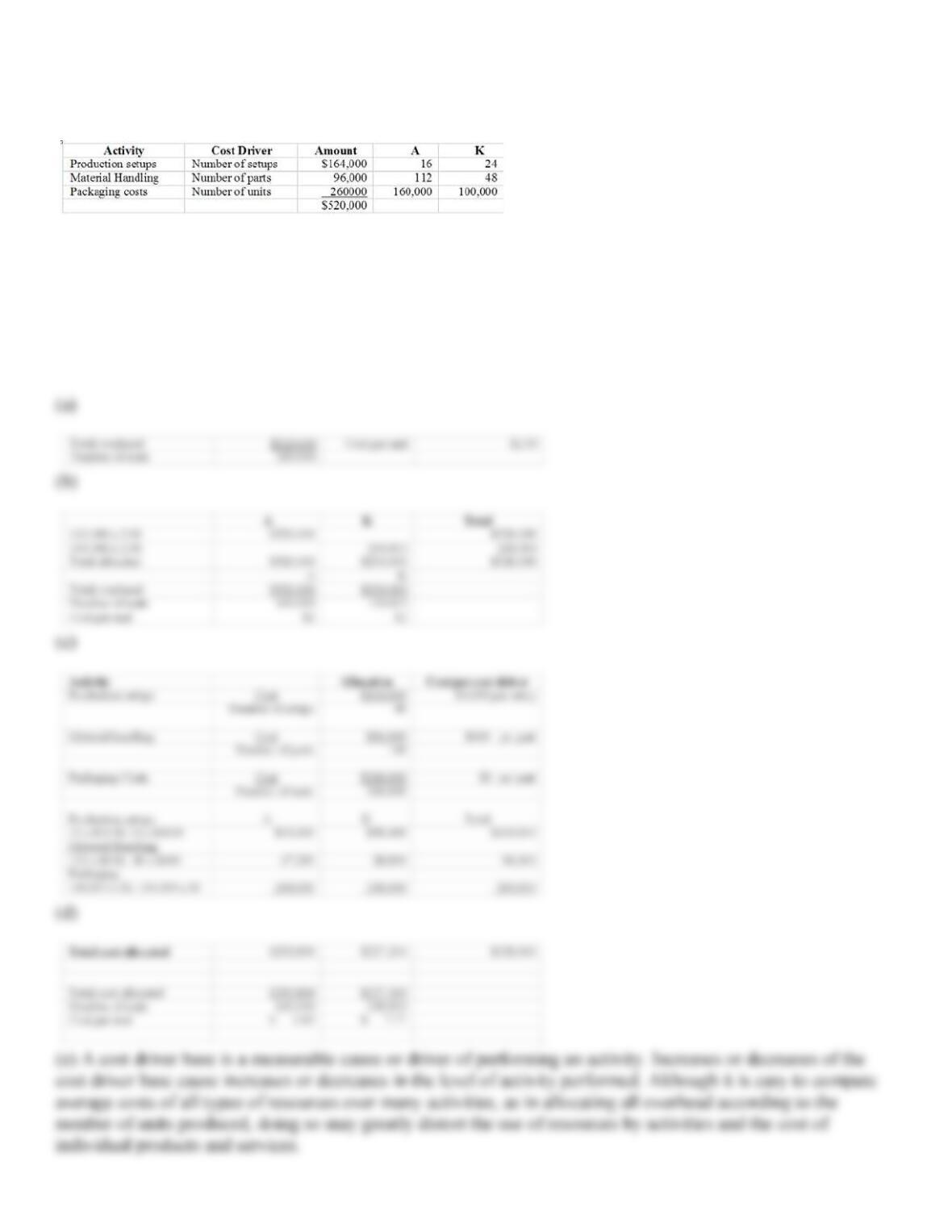
84. Arlington Marketing Research is a local market research firm, which provides on site interviews at local
malls and retail outlets. The basic unit of service is a completed marketing research survey. All telemarketing
personnel, mostly college students, are paid by the hour. Supervisory labor is salaried
Required: For each cost listed, indicate whether the activity should be classified as Unit–level, Product-level,
Batch- level, Customer–level or Facility-level. Indicate an appropriate cost driver to be used to allocate the cost
to products. Justify your answers, if necessary.
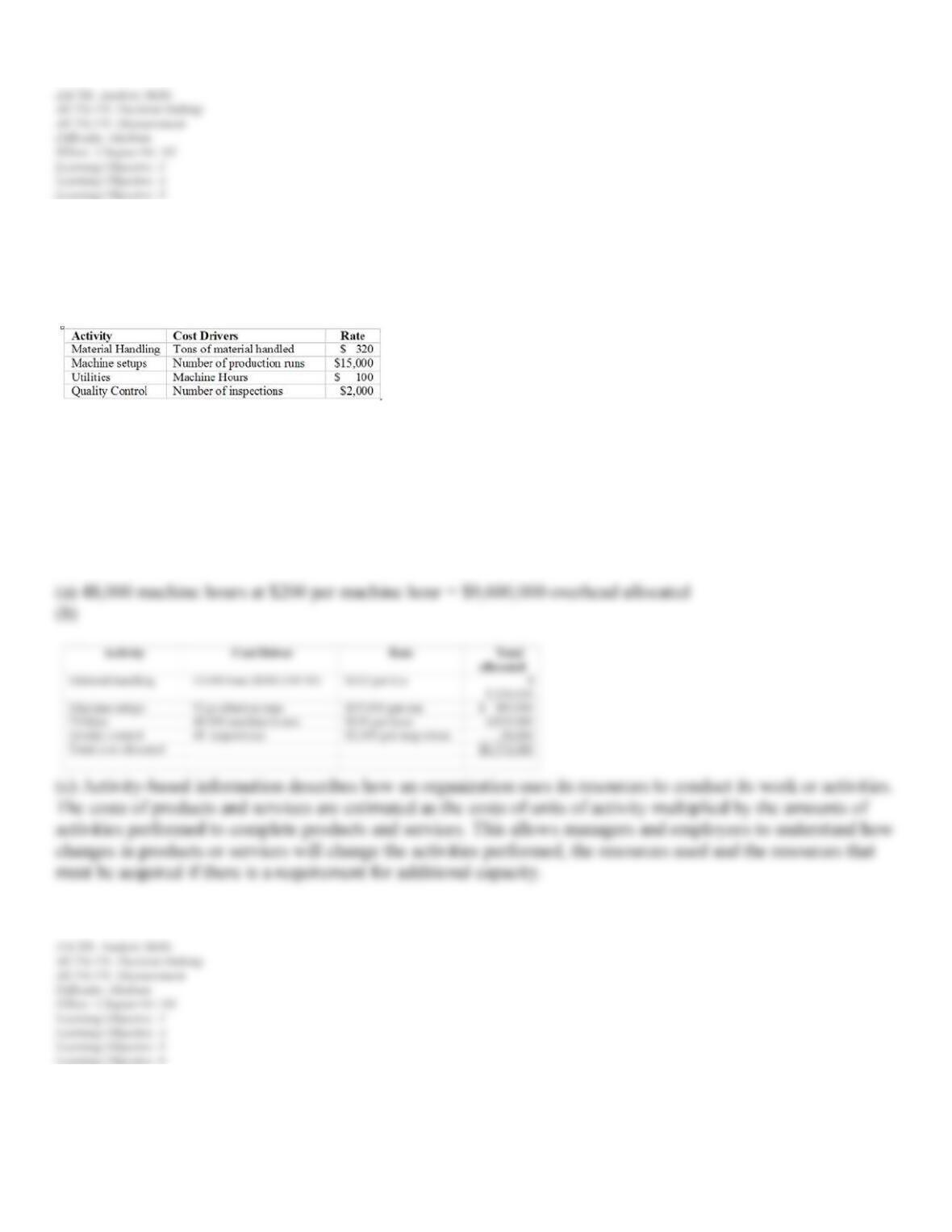
85. Hutchings Company manufactures and distributes two products, A and K. Overhead costs are currently
allocated using the number of units produced as the allocation base. The controller has changing to an
activity-based costing ABC. system. She has collected the following information:
Required
A. What is the overhead cost per unit under the current system?
B. What is the total overhead allocated to each product using the current system?
C. What would be the total overhead allocated to each product under ABC costing?
D. What would be the overhead cost per unit under ABC costing?
E. Explain how traditional cost systems can lead to inaccurate product information and poor management
decisions.
86. The Bridgewater Company recently switched to activity based costing ABC. The prior method allocated
overhead costs at the rate of $200 per machine hour. The manager of Department J has estimated the following
cost drivers and rates:
During May, Bridgewater purchased and used $400,000 of direct materials at $40 per ton. There were 32
production runs using a total of 48,000 machine hours in May. The manager of Department J needed 48
inspections
Required:
(a) Calculate the total overhead costs that would have been allocated to production using the prior method
(b) Calculate the total overhead costs that would be allocated using Activity-Based Costing
(c) Why is activity-based information useful for making business decisions?
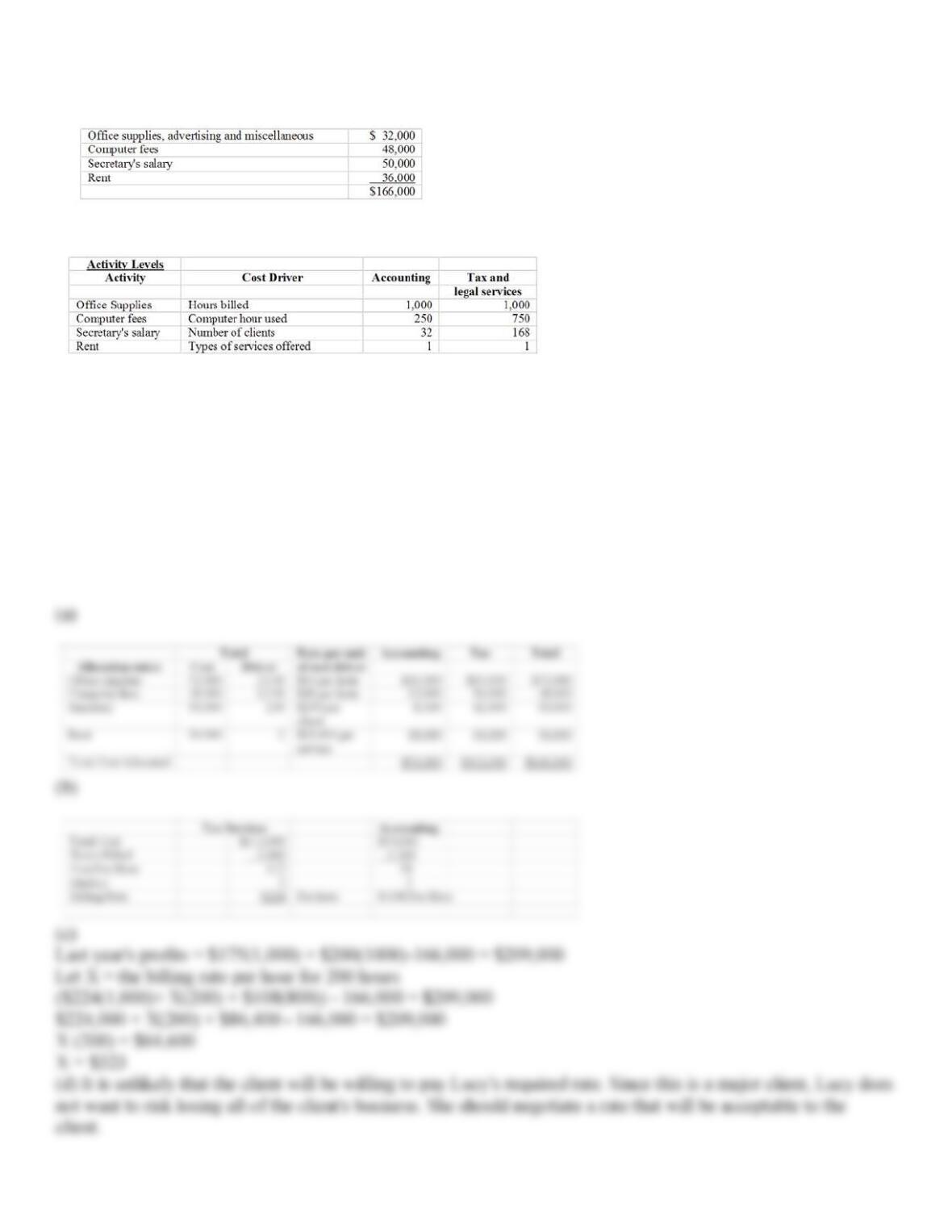
87. Lucy Cook, CPA, J.D., provides accounting and tax and legal services to her clients. In 2007, she charged
$175 per hour for accounting and $200 per hour for tax and legal services. Erin estimates the following costs for
the year 2008.
Operating profits declined last year and Ms. Cook has decided to use activity based costing ABC. procedures to
evaluate her hourly fees. She has gathered the following information from last year‘s records:
Required:
(a) What is the total cost allocated to Accounting services using Activity-Based costing ABC.?
(b) Lucy wants her hourly fees for the tax and legal services to be 200% of their activity-based costs. What is
the fee per hour for each type of service Lucy offers?
(c) A major client has requested accounting services. However, Lucy is already billing 100% of her capacity
(2,000 hours per year) and is reluctant to shift 200 hours away from her tax and legal services to meet this
client’s request. What is the minimum fee per hour that Lucy could charge this client for accounting services
and be no worse off than last year? Assume that Activity-Based Costing ABC. is used.
(d) Without regard to your answer in requirement c, assume that Lucy must charge $300 per hour to shift the
client’s work from tax and legal services to accounting services. What would you advise Lucy to do?

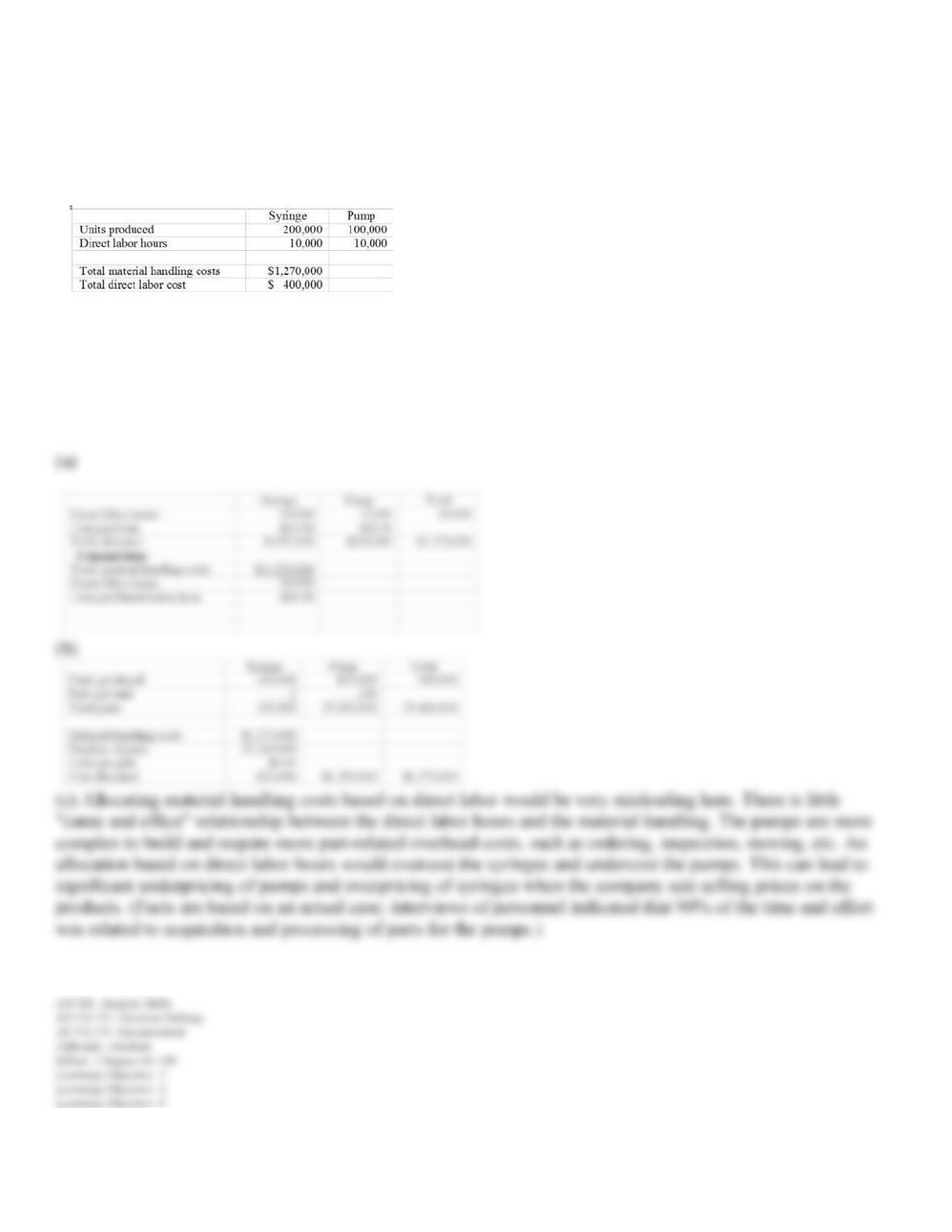
88. A medical equipment manufacturer produces two major products. One is a plastic disposable syringe with
two parts per unit. The other is a high tech pump used for hospital procedures involving heart patients. The
device has 250 parts. Both products require direct labor, which is split 50/50 between the two products. The
company has identified various cost pools, including one that is material handling costs. The costs in this pool
include wages and employee benefits of the workers receiving materials, inspecting materials, storing materials
and moving materials to workstations, depreciation and maintenance of forklift trucks, and the cost of supplies
and other related costs. Cost information related to the production process appears below:
Required:
a) Determine the total material handling cost and cost per unit that would be assigned to Syringes and Pumps if
material handling costs are allocated based on direct labor hours.
b) Determine the total material handling cost and cost per unit that would be assigned to Syringes and Pumps if
material handling costs are allocated based on the number of parts using Activity–Based Costing ABC.
c) Which method of cost allocation is more appropriate? Explain your answer.
89. Consider the following information for Basin Head Door Company for the production of two types of doors:
Standard and Superior:
Material costs used and supplied for 2,000 Standard Doors, $400,000; 800 Superior Doors, $200,000.
Labor supplied for production of both products, $125,000; each door is physically cut and assembled by an
individual employee.
Facility–level saws and sanding equipment used on a per unit basis for both products, $20,000.
Special packaging and shipping provided on a per-unit basis to customers: $56,000 shipping, $14,000 for
material, $28,000 for labor.
Custodial and security service for the manufacturing area, allocated based on number of doors manufactured:
$10,000.
Electrical cost, allocated based on the number of doors manufactured, $20,000.
Special designs and alterations for Superior Doors, $10,000.
Required: Compute the unit–level and full ABC costs per unit for the Standard and Superior Doors.
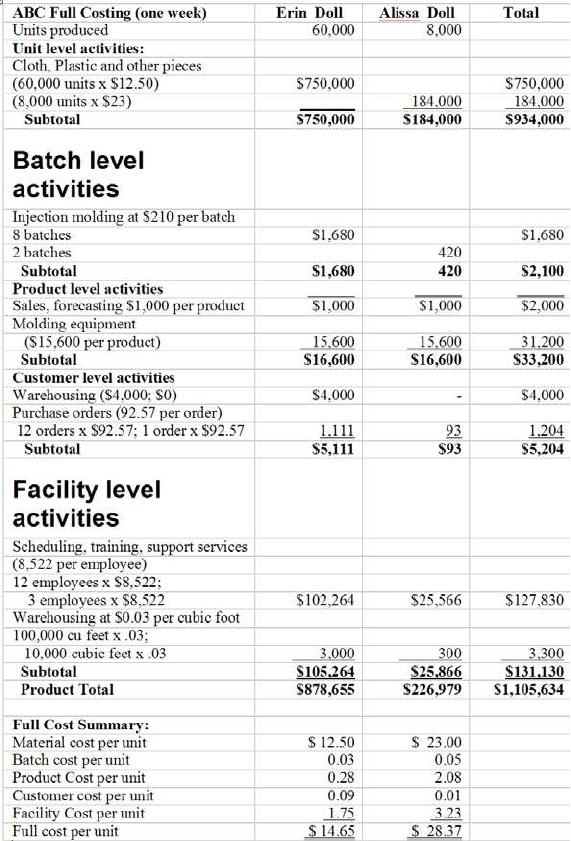
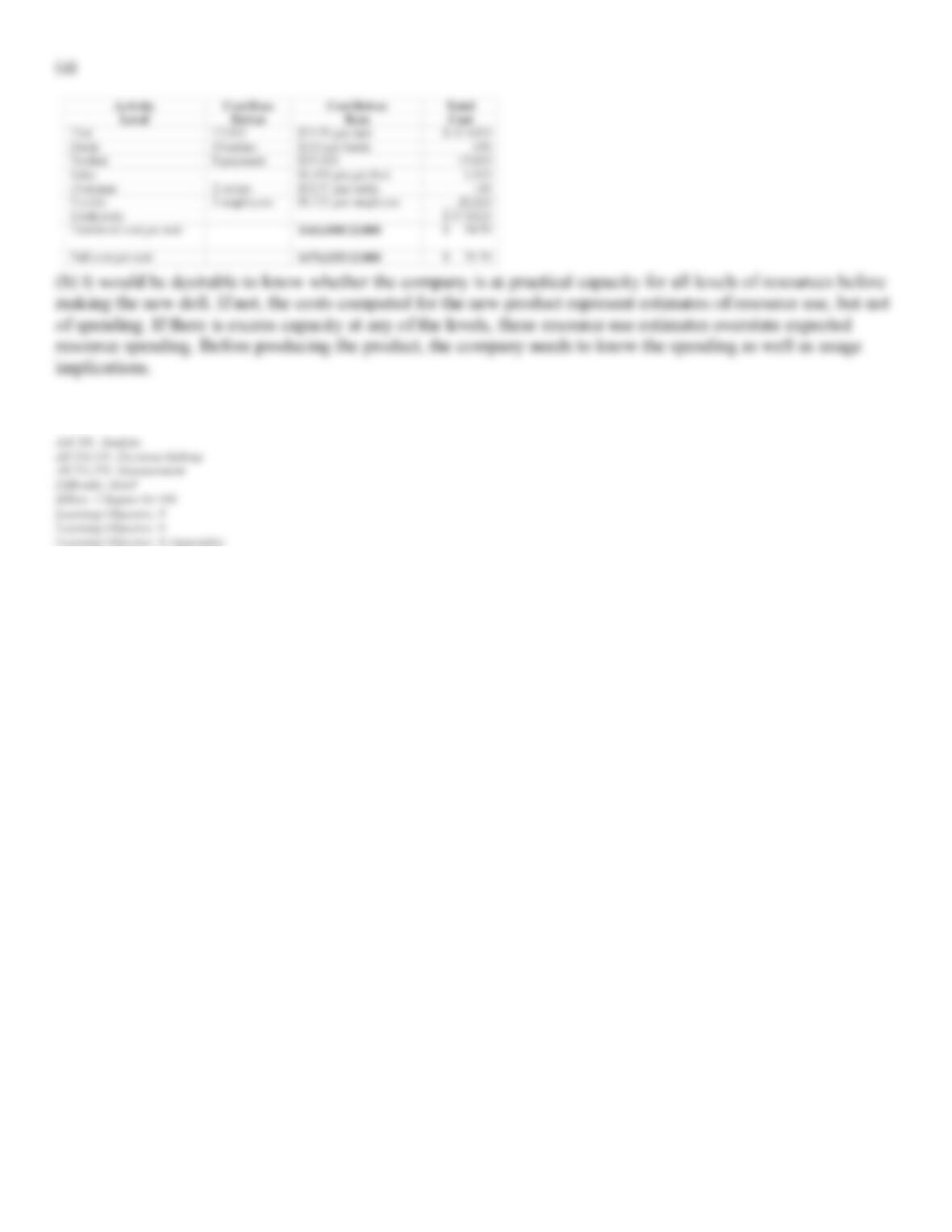
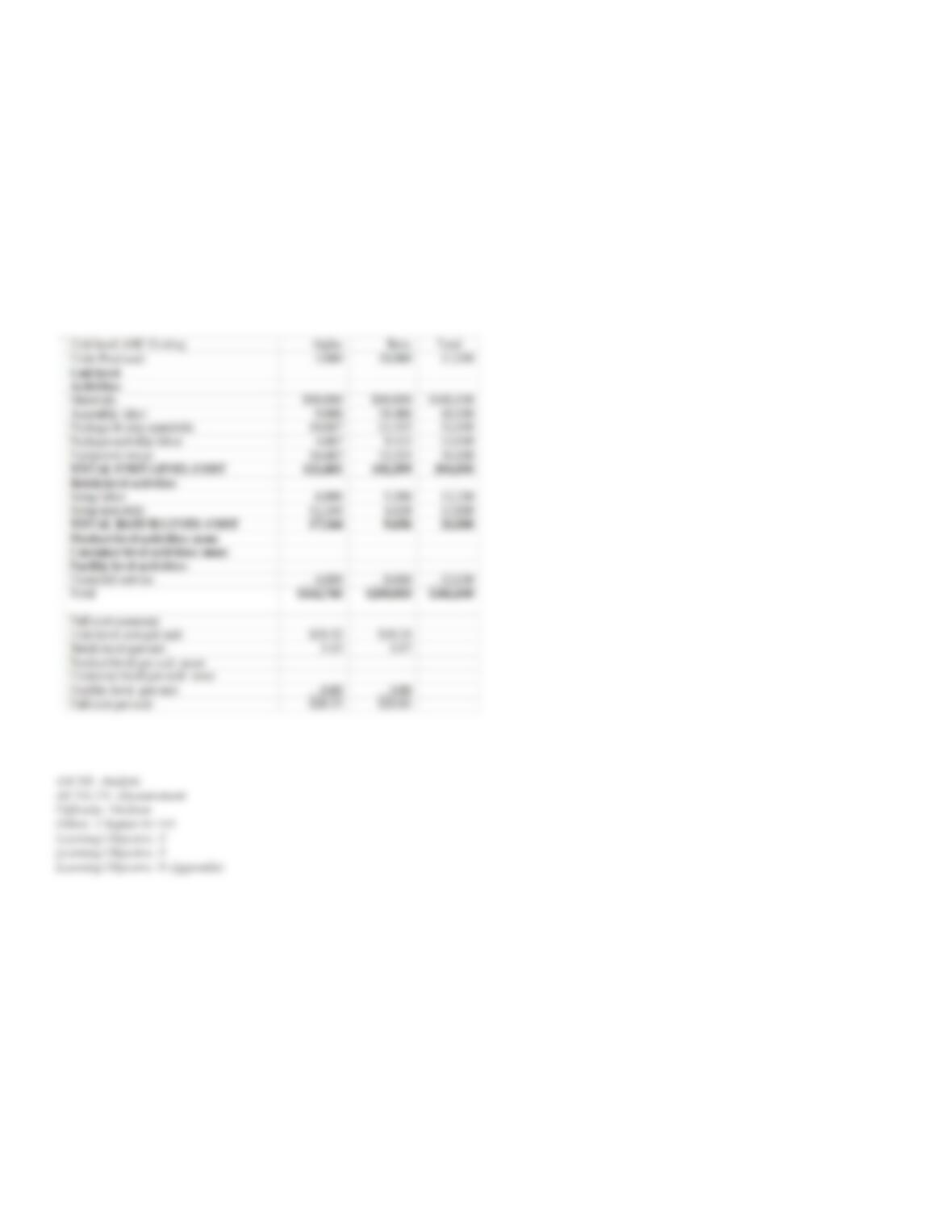
90. Consider the following ABC Full Costing Report by the Sacks Toy Company, which manufactures specialty
dolls:
Management is considering adding a third product line, the Riana doll. Assume the company obtains sufficient
additional capacity to offer this product line that has the following characteristics:
Ⴠ Uses 50% more materials than the Alissa doll
Ⴠ Is made on a new, dedicated molding machine
Ⴠ A week‘s production would be 12,000 dolls in three batches
Ⴠ Customers would place two orders per week and there would be no warehousing
Ⴠ Sales and forecasting costs would be the same as other products
Ⴠ A team of five employees would produce the product
Required:
a) Estimate the unit–level and full ABC cost of this product.
b) What additional information would you like to have before deciding whether to recommend this product?
91. Refer to the following information concerning products Alpha and Beta for Bayside Manufacturing
Corporation:
Material costs used and supplied for 5,000 units of Alpha, $80,000; 10,000 units of Beta, $80,000
Batch setup labor cost used for 20 batches of Alpha, $6,000, 8 batches of product Beta, $5,200
Batch setup materials used and supplied for 28 batches, $15,600
Labor supplied for production of both products, $48,000; usage based on number
of manually assembled parts per unit: 16 for Alpha; 32 for Beta
Facility–level equipment used on a per-unit basis for both products, $50,000
Special packaging and shipping provided on a per unit basis to customers: $25,000 shipping, $7,000 for
material, $14,000 for labor
Custodial and security service for the manufacturing area, $12,000
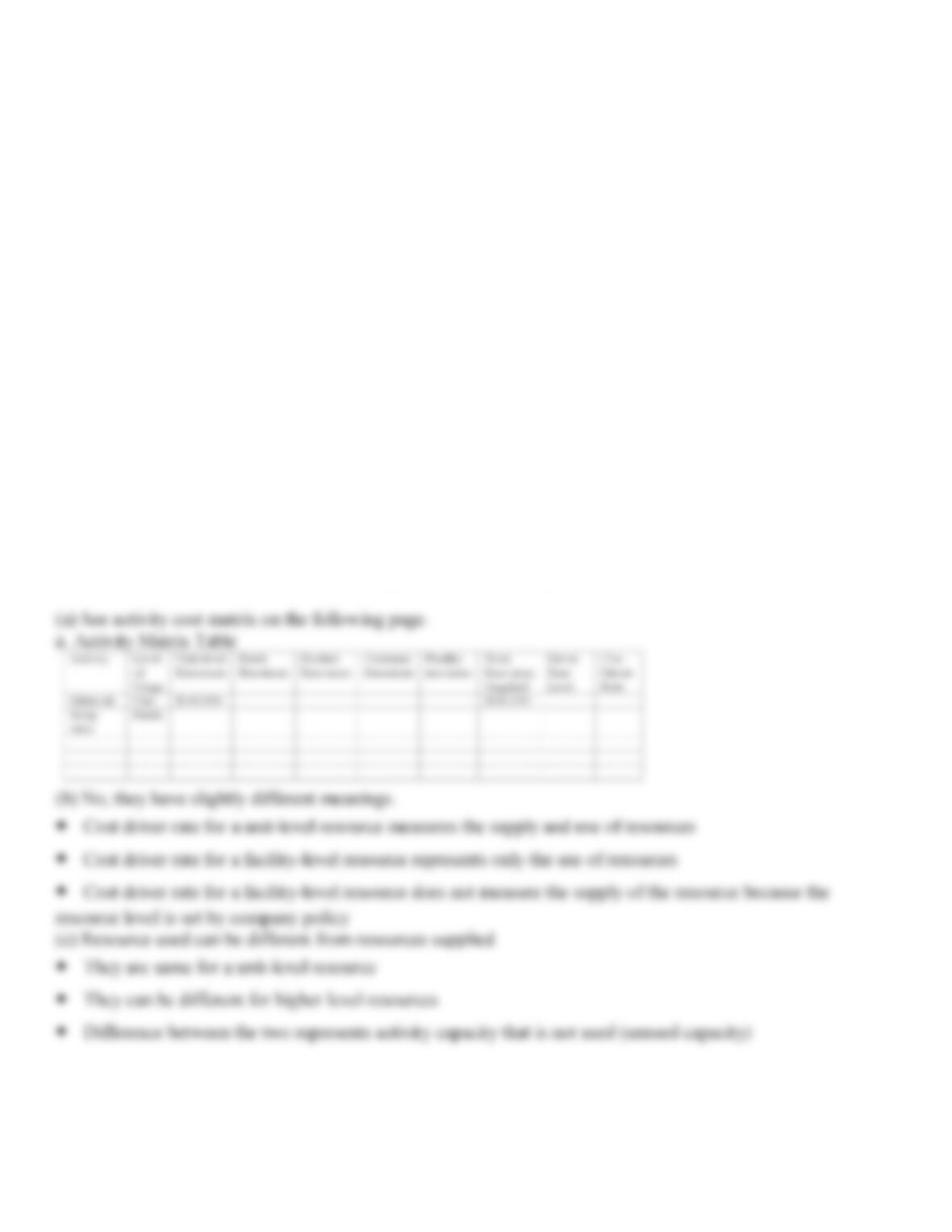
Required: Compute the Unit–level and ABC full costs per unit for Products Alpha and Beta
92. Badger Boards, Inc. BBI) is a manufacturer of circuit boards for a handful of computer manufacturers. The
following data pertains to the month of February for the assembly of circuit boards for two of BBI‘s major
customers: MBI, Inc. and CAM, Inc.
Ⴠ Material costs used and supplied for 14,000 boards for MBI, $80,000; 8,000 boards for CAM $80,000
Ⴠ Batch setup labor cost used for 20 batches of boards for MBI, $4,000; 8 batches of boards for CAM, $2,400
Ⴠ Batch setup materials used and supplied for 28 batches, $11,200
Ⴠ Labor supplied for production of boards for both customers, $56,000; usage based on number of manually
assembled parts: 8 for each of the boards for MBI and 16 for each of the boards for CAM
Ⴠ Facility–level equipment used on a per unit basis for both products, $50,000
Ⴠ Special packaging and shipping provided on a per unit basis to customers, $21,000 shipping, $14,000 for
materials, and $28,000 for labor
Ⴠ Custodial and security service for the manufacturing area, $1,500
Required
(a) Prepare an activity matrix as follows: In column 1, list all the activities according to their level of usage (i.e.,
unit–level, batch-level, etc.). In column 2, list the cost driver base for each activity listed in the previous column.
In the remaining columns (3 through 10), fill in the appropriate numbers.
Note that columns 3 through 10 are to be labeled as follows: unit–level resources, batch resources, product
resources, customer resources, facility resources, total resources supplied, driver base level and cost driver rate.
(b) Does the cost driver rate for unit-level resources have the same meaning as the cost driver rate for a facility
level resource? Explain.
(c) Is resource used the same as resource supplied? What is the significance of any difference between the two?

93. Badger Boards, Inc.(BBI) is a manufacturer of circuit boards for a handful of computer manufacturers. The
following data pertains to the month of February for the assembly of circuit boards for two of BBI‘s major
customers: MBI, Inc. and CAM, Inc.
Ⴠ Material costs used and supplied for 14,000 boards for MBI, $80,000; 8,000 boards for CAM $80,000
Ⴠ Batch setup labor cost used for 20 batches of boards for MBI, $4,000; 8 batches of boards for CAM, $2,400
Ⴠ Batch setup materials used and supplied for 28 batches, $11,200
Ⴠ Labor supplied for production of boards for both customers, $56,000; usage based on number of manually
assembled parts: 8 for each of the boards for MBI and 16 for each of the boards for CAM
Ⴠ Facility–level equipment used on a per unit basis for both products, $50,000
Ⴠ Special packaging and shipping provided on a per unit basis to customers, $21,000 shipping, $14,000 for
materials, and $28,000 for labor
Ⴠ Custodial and security service for the manufacturing area, $1,500
Required
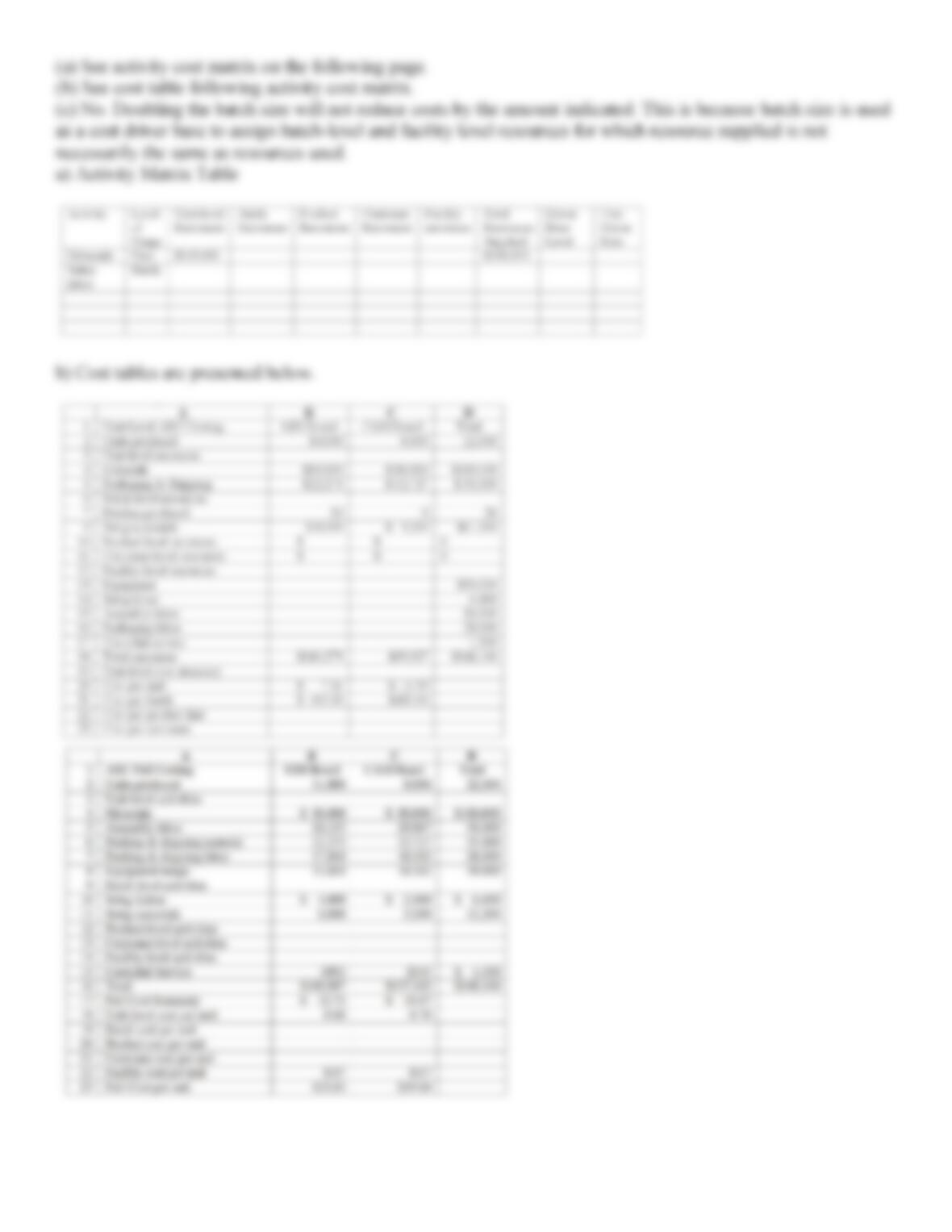
a) Prepare an activity matrix as follows: In column 1, list all the activities according to their level of usage (i.e.,
unit–level, batch-level, etc.). In column 2, list the cost driver base for each activity listed in the previous column.
In the remaining columns (3 through 10), fill in the appropriate numbers.
Note that columns 3 through 10 are to be labeled as follows: unit–level resources, batch resources, product
resources, customer resources, facility resources, total resources supplied, driver base level and cost driver rate.
b) Compute the unit–level and full–ABC costs per unit for the boards produced for the two different customers.
c) Brenda Baker, the production supervisor at BBI, suggests that doubling the batch size will reduce the costs
driven by the number of batches by 50%. Do you agree? Explain.

94. Badger Boards, Inc.(BBI) is a manufacturer of circuit boards for a handful of computer manufacturers. The
following data pertains to the month of February for the assembly of circuit boards for two of BBI‘s major
customers: MBI, Inc. and CAM, Inc.
Ⴠ Material costs used and supplied for 14,000 boards for MBI, $80,000; 8,000 boards for CAM $80,000
Ⴠ Batch setup labor cost used for 20 batches of boards for MBI, $4,000; 8 batches of boards for CAM, $2,400
Ⴠ Batch setup materials used and supplied for 28 batches, $11,200
Ⴠ Labor supplied for production of boards for both customers, $56,000; usage based on number of manually
assembled parts: 8 for each of the boards for MBI and 16 for each of the boards for CAM
Ⴠ Facility–level equipment used on a per unit basis for both products, $50,000
Ⴠ Special packaging and shipping provided on a per unit basis to customers, $21,000 shipping, $14,000 for
materials, and $28,000 for labor
Ⴠ Custodial and security service for the manufacturing area, $1,500
Required
(a) Prepare an activity matrix as follows: In column 1, list all the activities according to their level of usage (i.e.,
unit–level, batch-level, etc.). In column 2, list the cost driver base for each activity listed in the previous column.
In the remaining columns (3 through 10), fill in the appropriate numbers.
Note that columns 3 through 10 are to be labeled as follows: unit–level resources, batch resources, product
resources, customer resources, facility resources, total resources supplied, driver base level and cost driver rate.
(b) Assume that the boards for MBI and CAM are priced at $11 and $23 per unit respectively. Prepare unit–level
and full-ABC profitability reports.
(c) Do you think BBI should drop either board? Explain.