Test Bank – Chapter 4 – The Mechanics of Financial Accounting 4-21
74. Able Industries has the following information related to its adjusting entries at the end of
December.
• On December 31, 2018, the insurance expired amounted to $100.
• Of the unearned revenue, $300 of services had been performed.
What is the net effect that the necessary adjusting entries for this information have on
net income for Able?
a. $400 increase.
b. $400 decrease.
c. $200 increase.
d. $200 decrease.
75. Able Industries has the following information related to its adjusting entries at the end of
December.
• Services have been performed for customers that have not yet been billed or
received totaling $200.
• The office equipment computation for 2018 depreciation amounts to $580.
What is the net effect that the necessary adjusting entries for this information have on
net income for Able?
a. $380 increase.
b. $380 decrease.
c. $780 increase.
d. $780 decrease.
76. Interest receivable on January 1 and December 31 totals $3,780 and $3,450,
respectively. During the year, cash received from interest is $11,000. Determine interest
revenue for the current year.
a. $3,115
b. $1,330
c. $12,330
d. $10,670
4-22 Test Bank – Chapter 4 – The Mechanics of Financial Accounting
77. Employees were paid $10,000 on June 9, 2018 for five days work through Friday, June
3. What adjusting entry was necessary at the company’s year-end, Tuesday, May 31,
2018, as a result of this?
a. Debit Salaries and Wages Expense and credit Cash for $10,000
b. Debit Salaries and Wages Expense and credit Equity Income for $6,000.
c. Debit Salaries and Wages Payable and credit Salaries and Wages Expense for
$6,000.
d. Debit Salaries and Wages Expense and credit Salaries and Wages Payable for
$4,000.
78. Accounts receivable on January 1 and December 31 is $19,500 and $22,400,
respectively. During the year, sales revenue is $223,000. What is the current year’s cash
received from customers?
a. $3,900
b. $263,900
c. $220,100
d. $226,900
79. Inventory on January 1 and December 31 is $29,500 and $43,000, respectively. During
the year, cash paid to suppliers of inventory is $85,000. If all purchases of inventory are
for cash, how much is the current year’s cost of goods sold?
a. $14,500
b. $71,500
c. $99,500
d. $157,500
Test Bank – Chapter 4 – The Mechanics of Financial Accounting 4-23
80. Inventory on January 1 and December 31 is $46,000 and $42,000, respectively.
Accounts payable on January 1 and December 31 are $31,000 and $29,000,
respectively. During the year, cost of goods sold is $186,000. How much is the current
year’s cash payments to suppliers of inventory?
a. $184,000
b. $213,000
c. $181,000
d. $191,000
81. Retained earnings on January 1 and December 31 is $65,000 and $58,000, respectively.
During the year, net income is $113,000. How much dividends did the company declare
and pay to the shareholders?
a. $177,000
b. $171,000
c. $107,000
d. $120,000
82. Phoenix Corp. paid rent of $15,000 for 3 months in advance on November 1, 2018.
Phoenix accounting period ends on December 31, 2018. Which amount will be reported
at December 31, 2018?
a. Prepaid Rent of $5,000 on its December 31, 2018 balance sheet
b. Accounts Payable of $15,000 on its December 31, 2018 balance sheet
c. Rent Expense of $15,000 on its income statement for the year ending December 31,
2018
d. Rent Expense of $5,000 on its income statement for the year ending December 31,
2018
4-24 Test Bank – Chapter 4 – The Mechanics of Financial Accounting
83. During Bisbee’s first year of business, office supplies were purchased for cash in the
amount of $5,600 and the amount was debited to Supplies Expense. At the end of the
first year, the physical count indicated that $425 of supplies were unused. How much
should be reported on the income statement at year end for supplies expense?
a. $5,600
b. $5,175
c. $6,025
d. $425
84. During Bisbee’s first year of business, office supplies were purchased for cash in the
amount of $5,600 and the amount was debited to Supplies Expense. At the end of the
first year, the physical count indicated that $425 of supplies were unused. How much
should be reported on the balance sheet for supplies?
a. $5,600
b. $5,175
c. $6,025
d. $425
Test Bank – Chapter 4 – The Mechanics of Financial Accounting 4-25
MATCHING QUESTIONS
1. For each transaction numbered 1 through 12 below, identify its effect on the accounting
equation by selecting from a through h below. You may use each letter more than once
or not at all.
Accounting Equation Effects
a. + A and + L
b. + A and + SE (Contributed Capital)
c. + A and + SE (Retained Earnings)
d. − A and − L
e. − A and − SE (Contributed Capital)
f. − A and − SE (Retained Earnings)
g. + A and − A
h. Not communicated by the formal accounting system
Effects
Transaction
1.
Purchased computer equipment for cash
2.
Received cash in exchange for the issuance of a note payable
3.
Purchased building and land in exchange for a mortgage note payable
4.
Received cash in exchange for the issuance of common stock
5.
Purchased computer supplies on account
6.
Provided computer services to customers for cash
7.
Paid an account payable
8.
Provided computer services to customers on account
9.
Used computer supplies in the regular operations of the business (acquired
during a previous accounting period)
10.
Recognize part of the cost of the service potential of the company’s computer
11.
Secured a large contract with Allegheny Company to provide computer
services during the forthcoming year
12.
Declared and paid dividends to the owners of common stock
4-26 Test Bank – Chapter 4 – The Mechanics of Financial Accounting
2. For each transaction numbered 1 through 7 below, identify the effect (a through g) on
the accounting equation by placing the letter of the effect in the space provided. You
may use each letter more than once or not at all.
Accounting Equation Effects
a. Decrease in revenue and decrease in an asset
b. Increase in revenue and increase in an asset
c. Decrease in expense and increase in an asset
d. Increase in expense and decrease in an asset
e. Increase in revenue and decrease in a liability
f. Increase in expense and increase in a liability
g. Decrease in revenue and increase in a liability
1. Adjusting for the accrual of wages
2. Adjusting for the earning of unearned revenue
3. Adjusting for the accrual of interest revenue
4. Adjusting for the accrual of interest expense
5. Adjusting supplies expense reflecting that part of the supplies
expense that was not used
6. Adjusting inventory downward to reflect shrinkage resulting from
shoplifting
7. Adjusting prepaid rent for the portion used
Test Bank – Chapter 4 – The Mechanics of Financial Accounting 4-27
3. For each transaction numbered 1 through 5 below, identify the effect (a through h) on
the accounting equation by placing the letter of the effect in the space provided. You
may use each letter more than once or not at all.
Accounting Equation Effects
a. Debit assets and credit liabilities
b. Debit assets and credit contributed capital
c. Debit assets and credit revenue
d. Debit retained earnings and credit assets
e. Debit contributed capital and credit assets
f. Debit expenses and credit assets
g. Debit one asset and credit another asset
h. Not communicated by the formal accounting system
1.
Received payment from a customer for amount owed from a previous
accounting period
2.
Provided computer services to customers on account
3.
Used supplies in the regular operations of the business
4.
Used up part of the service potential of the computer equipment
5.
Hired a new office manager to start to work next week
4-28 Test Bank – Chapter 4 – The Mechanics of Financial Accounting
4. For each transaction numbered 1 through 6, identify its effect on the accounting equation
by selecting from a through h below. You may use each letter more than once or not at
all.
Accounting Equation Effects
a. Debit assets and credit liabilities
b. Debit one asset and credit another asset
c. Debit assets and credit retained earnings/revenue
d. Debit liabilities and credit assets
e. Debit contributed capital and credit assets
f. Debit retained earnings and credit assets
g. Debit assets and credit contributed capital
h. Not communicated by the formal accounting system
____ 1. Received cash in exchange for the issue of common stock
____ 2. Received cash in exchange for the issue of a note payable
____ 3. Purchased building and land in exchange for a mortgage note payable
____ 4. Purchased computer equipment for cash
____ 5. Purchased computer supplies on account
____ 6. Provided computer services to customers for cash
Test Bank – Chapter 4 – The Mechanics of Financial Accounting 4-29
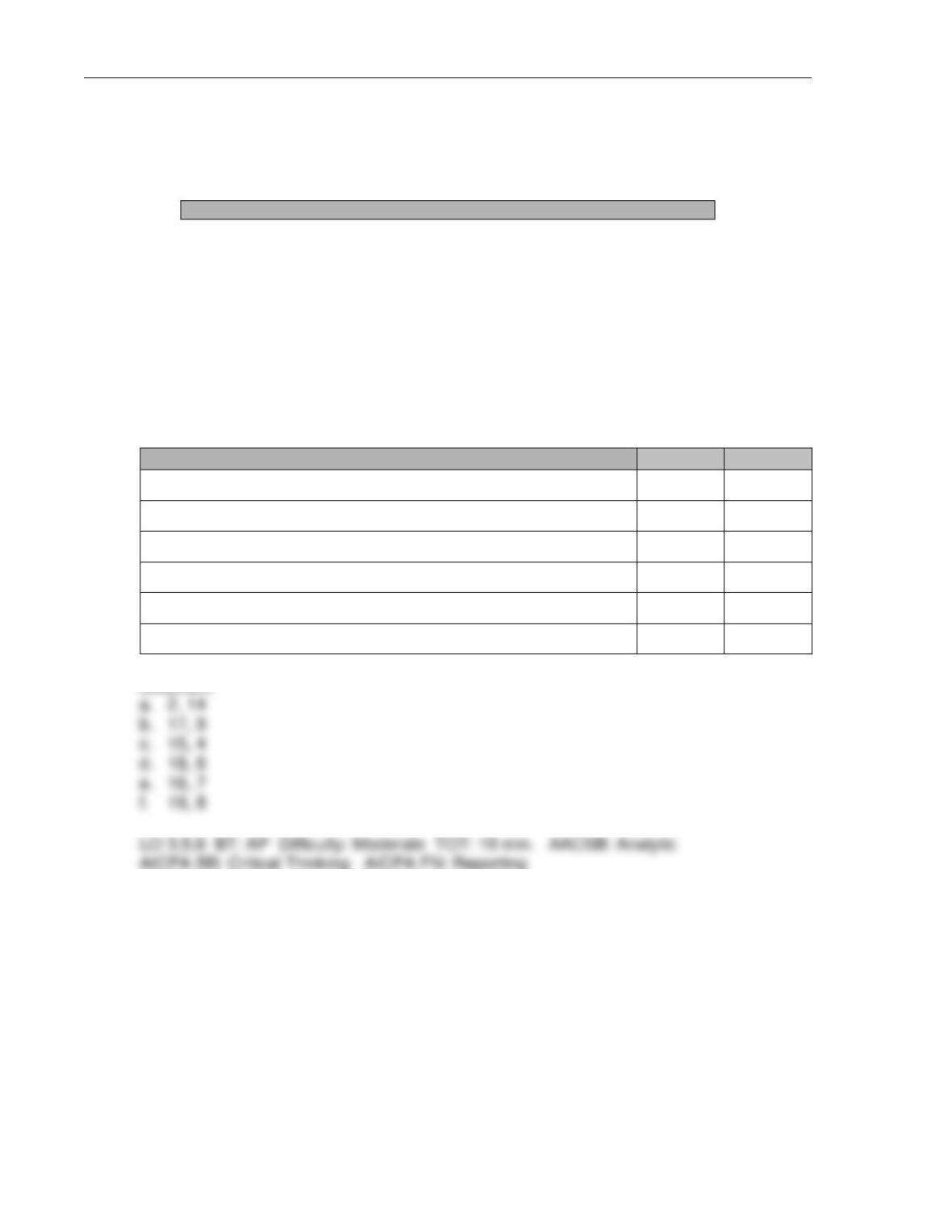
5. For each of the transactions listed in 1 through 5 below, indicate whether it involves a
deferral (D) or an accrual (A) by placing the letter of the correct response in the space
provided.
Answers
Transactions
1. ________ Industrial conveyer belt system acquired for cash
2. ________ Cash collected from customers for rental of office space for next year
3. ________ One year’s premium on equipment insurance paid in advance
4. ________ Property taxes owed to the state but not paid at year end
5. ________ Rent owed to a landlord for the current month
4-30 Test Bank – Chapter 4 – The Mechanics of Financial Accounting
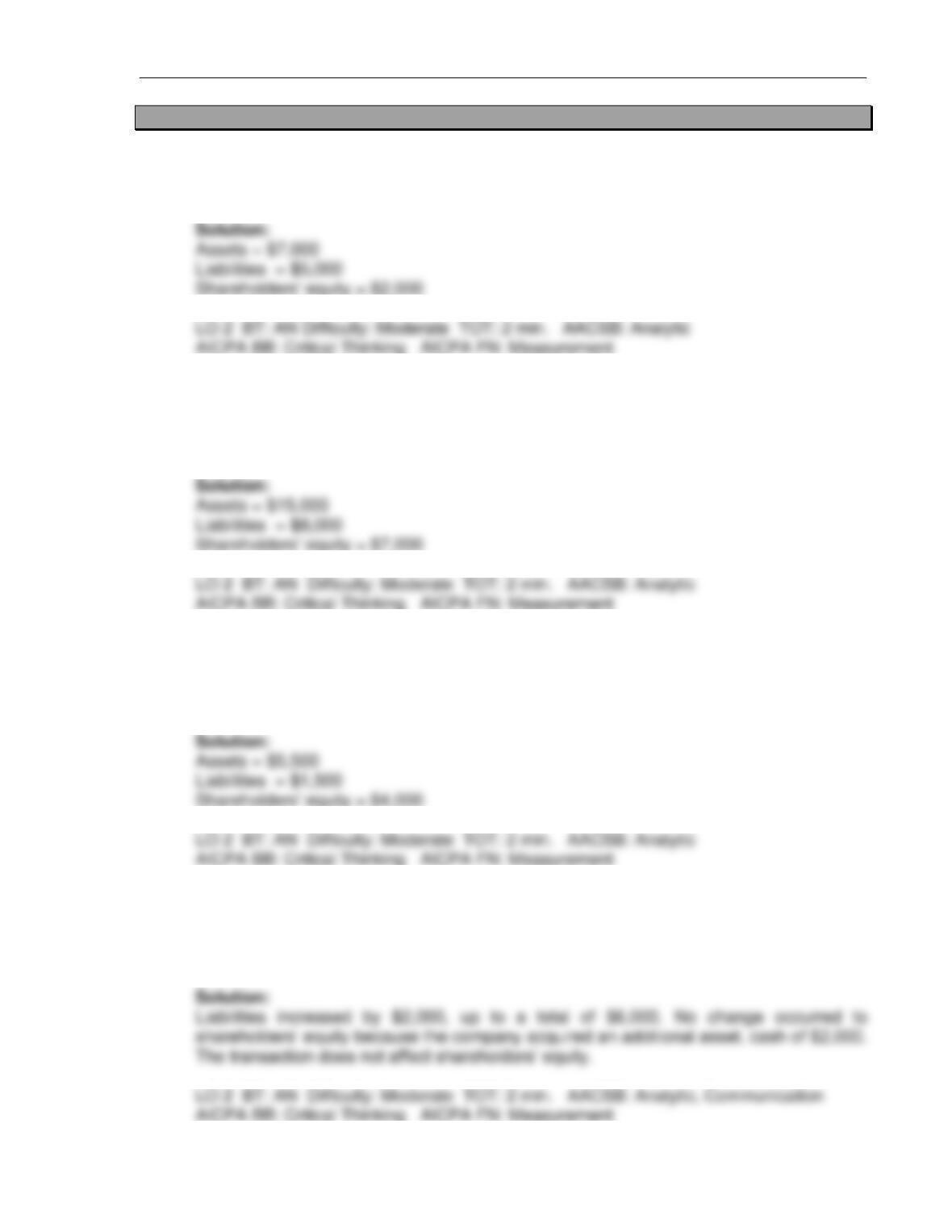
6. The accounts for Jalisa Company are listed below, identified by number. Following the
list of accounts is a series of adjusting entries (a through f) prepared by Jalisa Company.
For each entry, identify the number(s) of the accounts to be debited and credited and
place them in the space provided adjacent to each adjusting entry.
Accounts
1. Cash
11. Notes Payable
2. Accounts Receivable
12. Common Stock
3. Prepaid Rent
13. Retained Earnings
4. Supplies
14. Service Revenue
5. Automobiles
15. Supplies Expense
6. Accumulated Depreciation
16. Utilities Expense
7. Accounts Payable
17. Salaries and Wages Expense
8. Interest Payable
18. Depreciation Expense
9. Salaries and Wages Payable
19. Interest Expense
10. Income Tax Payable
20. Income Tax Expense
Adjusting Entries
Debit
Credit
a. Provided legal services to clients that will pay next month
b. Accrued wages earned by employees that will be paid next month
c. Recognized office supplies used during the month
d. Recorded the current month of depreciation expense
e. Recorded monthly utilities expenses which are not yet paid
f. Recognized the amount of interest due to the bank on a note
Solution:
Test Bank – Chapter 4 – The Mechanics of Financial Accounting 4-31
EXERCISES
1. Total assets, liabilities, and shareholders’ equity are $7,000, $5,000, and $2,000 before
a new machine is purchased for $500 cash. What are the new amounts of assets,
liabilities, and shareholders’ equity after this event?
2. Total assets, liabilities, and shareholders’ equity are $14,000, $7,000, and $7,000 before
a new copy machine is purchased in exchange for a $1,000 note payable. What are the
new amounts of assets, liabilities, and shareholders’ equity after this event?
3. Total assets, liabilities, and shareholders’ equity are $5,000, $1,500, and $3,500 before
common stock is issued for $500 cash. What are the new amounts of assets, liabilities,
and shareholders’ equity after this event?
4. Total assets, liabilities, and shareholders’ equity are $7,000, $4,000, and $3,000 before
$2,000 is received in exchange for a $2,000 bond payable. What change occurred to
liabilities? Why is there no change in shareholders’ equity?
4-32 Test Bank – Chapter 4 – The Mechanics of Financial Accounting
5. Total assets, liabilities, and shareholders’ equity are $4,000, $1,000, and $3,000 before
current period wages of $200 are paid. What are the new amounts of assets, liabilities,
and shareholders’ equity after this event?
6. Total assets, liabilities, and shareholders’ equity are $15,000, $6,000, and $9,000 before
a $2,000 note payable is paid. Determine the new amounts of assets, liabilities, and
shareholders’ equity after this event?
7. Salaries and Wages Payable on January 1 equals $12,000. By the end of the current
year, Salaries and Wages Expense equals $420,000, and cash payments for wages
were $424,000. What is the balance in the T-account, Salaries and Wages Payable, on
December 31?
Test Bank – Chapter 4 – The Mechanics of Financial Accounting 4-33
8. Dena, Inc. began operations during 2018. During January of 2018, the following
transactions occurred:
• Received $80,000 from shareholders as initial investments
• Received cash of $55,000 for services performed during January
• Billed customers an additional $15,000 for services performed during January
• Borrowed $12,000 from NationsBank Company, and signed a one-year note
payable
• Paid rent in the amount of $5,000 for January
• Paid dividends in January amounting to $8,000
• Paid wages of $35,000 for January
How much Net Income should Dena, Inc. report for January?
9. Mingo Company has been in business several years. During January of 2018, the
following transactions occurred:
• Paid employees $6,000 for wages during January.
• Paid $2,000 cash for other operating expenses of which $1,000 related to
December and the balance related to January.
• Paid utilities and rent for January in the amount of $1,800.
• Paid a cash dividend to shareholders in the amount of $900 during January.
How much is total Expenses that Mingo Company will report for January 2018? Why is
this amount different than the amount paid during the month?
4-34 Test Bank – Chapter 4 – The Mechanics of Financial Accounting
10. Ohio Company, a corporation, began operations on December 1, 2017. During January
of 2018, the following transactions occurred:
• Billed customers $12,000 for services performed during January.
• Received payment from customers in the amount of $6,000 for services
performed and billed in December.
• Received cash of $7,000 for services performed during January for customers
who paid cash immediately. (No bills were mailed.)
A. How much total Revenue should Ohio Company report for January, 2018?
B. Determine the increase in cash during January of 2018 as a result of these
transactions.
11. When a landlord records rent received in advance from a tenant in a revenue account,
the adjusting entry required at year end to allocate the rent to the proper periods has an
impact on financial statement elements. What effect (increase, decrease, no effect) does
the required adjustment have on each of the following elements?
Assets
Revenues
Liabilities
Expenses
Shareholders’ equity
Test Bank – Chapter 4 – The Mechanics of Financial Accounting 4-35
12. Houston Times Publishing Inc. sells two-year magazine subscriptions. Cash receipts
from subscribers are credited to Unearned Subscription. Revenue On December 31,
2018, immediately before the company made adjusting entries, the Unearned
Subscription Revenue account had a balance of $8,000. Outstanding subscriptions
relating to magazines that have not been delivered as of December 31, 2018, will be
mailed to customers as follows:
During 2019 $2,800
During 2020 2,200
At December 31, 2018, what amount should Houston Times Publishing Inc. report as the
balance for Unearned Subscription Revenue? Where should this amount be reported?
13. Total assets, liabilities, and shareholders’ equity are $22,000, $5,000, and $17,000
before land costing $10,000 is purchased in exchange for a $1,000 note payable and
$9,000 cash. During the year, the company earned $50,000 of revenues of which only
$45,000 was collected. Expenses totaling $44,000 were incurred, but $2,000 of this had
not been paid by the end of the year. Show the amounts that would be reported on the
accounting equation as a result of these transactions.
14. Interest receivable on January 1 is $5,000. During the current year interest revenue is
$65,000, and cash receipts from interest is $60,000. How much is the balance of Interest
Receivable on December 31?

4-36 Test Bank – Chapter 4 – The Mechanics of Financial Accounting
15. Retained earnings on January 1 was $27,000. During the current year net income is
$160,000. Cash payments for dividends declared totals $145,000. What is the Retained
Earnings balance on December 31?
Test Bank – Chapter 4 – The Mechanics of Financial Accounting 4-37
16. Lebron Company provides you, its auditor, with the following information that pertains to
its income for the year ending December 31, 2018:
Service revenue
$20,000
Salaries and wages
expense
3,000
Rent expense
10,400
After you review the process Lebron used to derive this income statement, you discover
that the company had omitted adjusting entries on December 31, 2018. The following
adjusting information was omitted:
1. $500 of the $20,000 service revenue is for plumbing that will not be done until
January 10, 2019.
2. Employees earned $700 of salaries for work done on December 31, 2018, but they
will not be paid until January 2, 2019.
3. Depreciation for Lebron’s truck and tools amounted to $2,400 for 2018.
4. Rent expense is $800 a month. On December 31, 2018, Lebron paid $800 rent for
January, 2019, which is included in the rent expense given above.
Prepare Lebron Company’s income statement after you include the results of the
adjusting information provided.