100. For each of the following items, indicate whether the item meets all of the criteria in the definition of a
liability [Yes or No]. If so, how does the firm value it? If not, why not?
a.. Bonds payable.
b. Interest accrued but not paid on a note.
c. Confirmed orders from customers for goods and services to be delivered later.
d. Advances from customers for goods and services to be delivered later.
e. Promises by an airline to provide flights in the future in exchange for miles flown,
if customers accumulate a certain number of miles at regular fares.
f. Product warranties.
g. Contractual promises to purchase specific quantities of natural gas for each
of the next 10 years.
h. Damages the company must pay if it loses a pending lawsuit.
i. Future costs of restoring strip-mining sites after completing mining operations.
101. What is the amount of the liability that the company recognizes in each of the following independent
cases?
102. Balance sheet relations. Colonial Group, an investment management company, reported the following data
for four recent years. Compute the missing balance sheet amounts for each of the four years. (In answering this
question, assume that Colonial Group uses U.S. GAAP.)
2015 2014 2013 2012
Current Assets $10,999.20 ? ? 6,882.60
Noncurrent Assets _____ ? 18,717.40 11,289.10 9,713.90
Total Assets ? 28,224.70 ? ?
Current Liabilities ? $4,351.30 1,494.20 1,755.20
Noncurrent Liabilities 5,721.70 ? ? 3,540.70
Shareholders’ Equity 21,537.30 16,666.90 9,002.00 __ ?
Total Liabilities and
Shareholders’
Equity 30,178.90 28,224.70 18,491.30 16,596.
103. Balance sheet relations. George Group, an investment management company, reported the following data
for four recent years. Compute the missing balance sheet amounts for each of the four years. (In answering this
question, assume that George Group uses U.S. GAAP.)
2015 2014 2013 2012
Current Assets $12,000 ? ? $7,000
Noncurrent Assets _____ ? 18,000 11,000 9,700
Total Assets ? 28,000 ? ?
Current Liabilities ? $4,000 $1,500 $1,700
Noncurrent Liabilities 6,000 ? ? 3,500
Shareholders’ Equity 10,000 16,000 9,000 ?
Total Liabilities and
Shareholders’
Equity $19,000 $28,000 $18,500 $16,700
104. Assets of one firm can correspond to the liabilities of another firm. For example,
an account receivable on the seller’s balance sheet is an account payable on the buyer’s
balance sheet.
Required: For each of the following items, indicate whether it is an asset or a liability
and give the corresponding account title on the balance sheet of the other party to the
transaction:
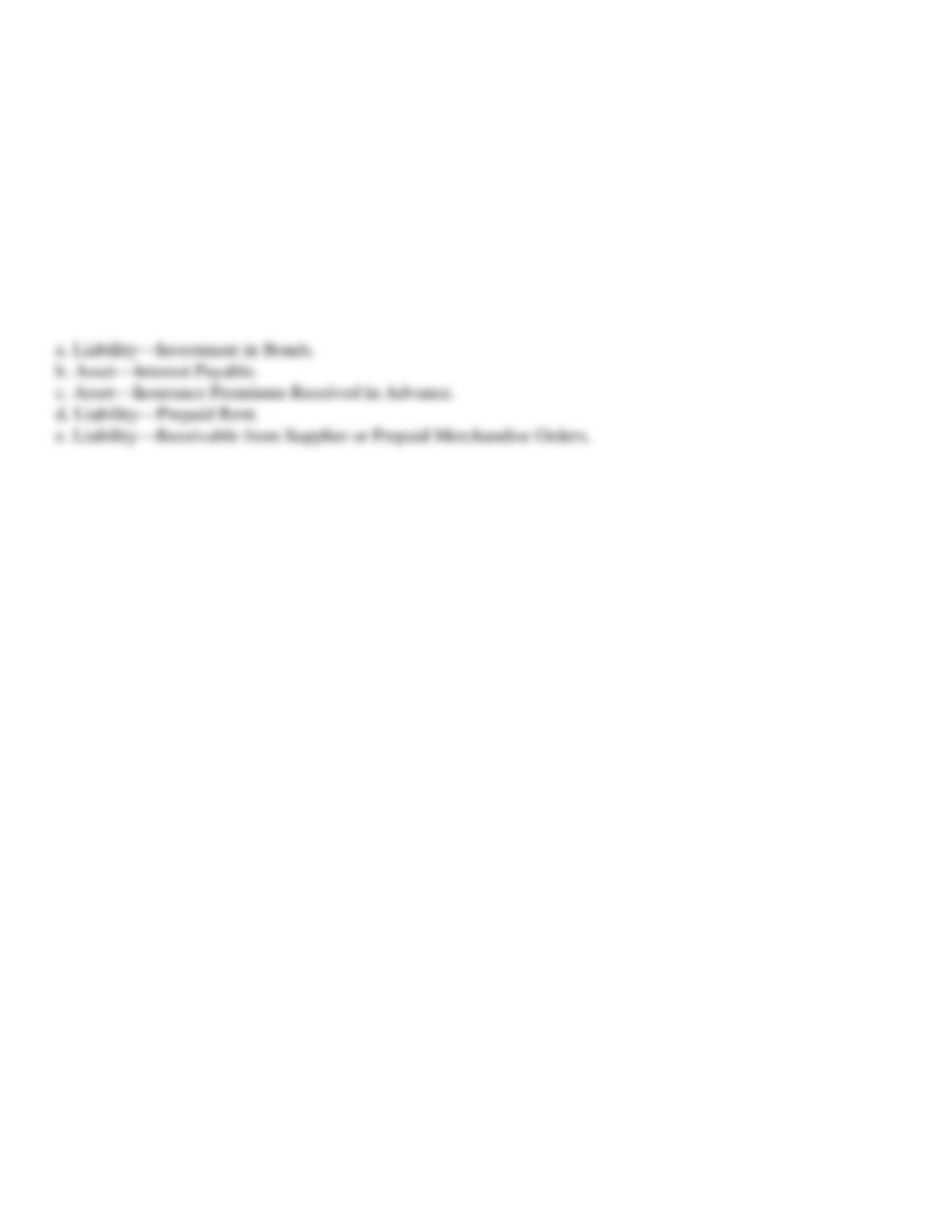
a. Bonds Payable.
b. Interest Receivable.
c. Prepaid Insurance.
d. Rental Fees Received in Advance.
e. Advances from Customers.
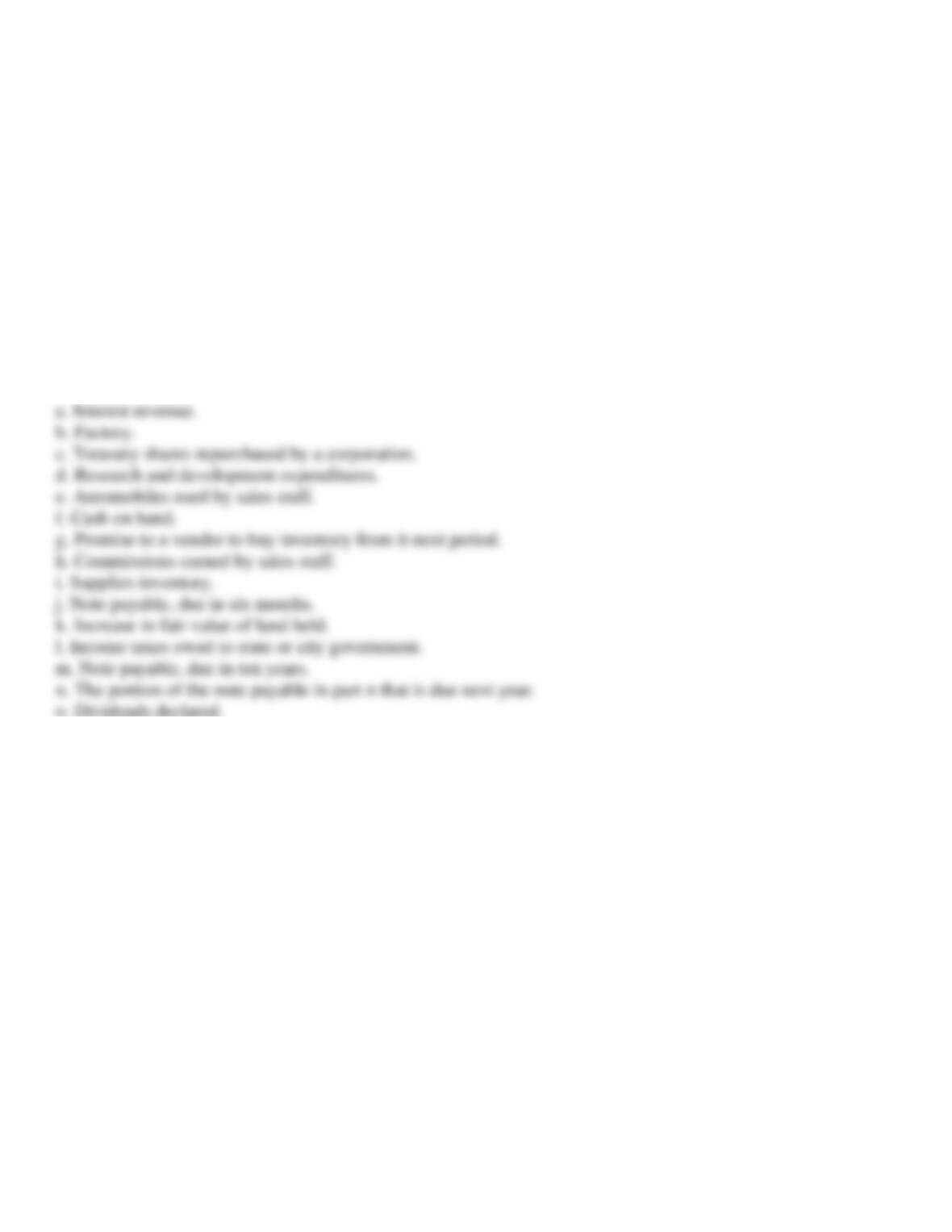
105. Classifying financial statement accounts. The balance sheet or income statement classifies various items in
one of the following ways:
CA—Current assets
NA—Noncurrent assets
CL—Current liabilities
NL—Noncurrent liabilities
CC—Contributed capital
RE—Retained earnings
NI—Income statement item (revenue or expense)
X—Item generally does not appear on a balance sheet or an income statement
Using the abbreviations in the previous list, indicate the classification of each of the following items under U.S.
GAAP and IFRS. If the classifications differ between U.S. GAAP and IFRS, indicate what that difference
would be.
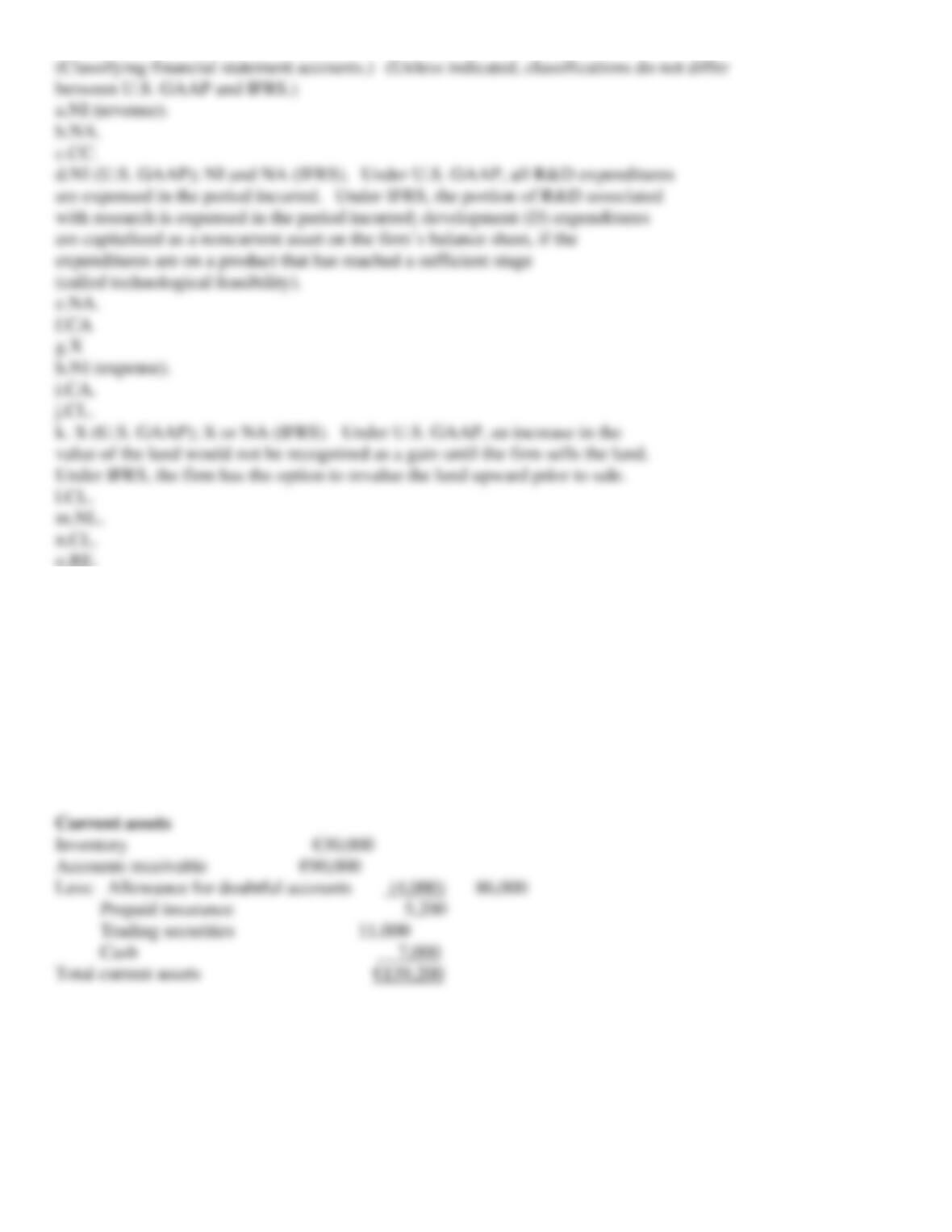
106. Calcas Corporation, a Portuguese company, has an adjusted trial balance that contained the following asset
accounts at December 31, 2013: Cash €7,000; Land €40,000; Patents €12,500; Accounts Receivable €90,000;
Prepaid Insurance €5,200; Inventory €30,000; Allowance for Doubtful Accounts €4,000; Trading Securities
€11,000.
Required: Prepare the current assets section of the statement of financial position, using most common IFRS
sequence of accounts.
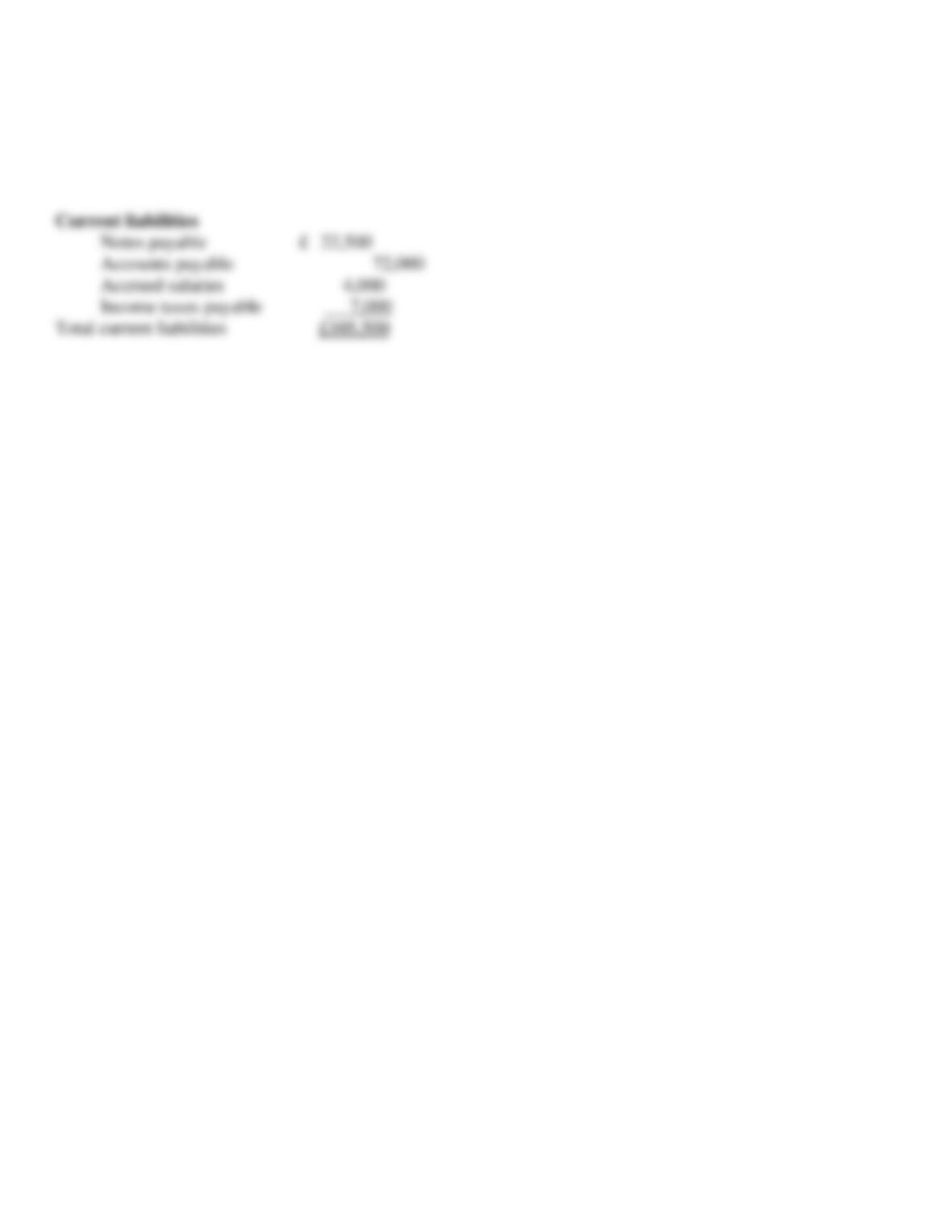
107. Marcus Corporation, a British firm, has an adjusted trial balance that contained the following liability
accounts at December 31, 2013. Bonds Payable (due in 3 years) £100,000; Accounts Payable £72,000; Notes
Payable (due in 90 days) £22,500; Accrued Salaries £4,000; Income Taxes Payable £7,000.
Required: Prepare the current liabilities section of the statement of financial position, using the most common
IFRS sequence of accounts presentation.
108. The following transactions relate to MicroChip, a manufacturer located in Thailand. Indicate whether each
transaction immediately gives rise to an asset of the company under U.S. GAAP and separately, under IFRS. If
MicroChip recognizes an asset, state the account title, the amount, and the classification of the asset on the
balance sheet as either a current asset or a noncurrent asset. MicroChip reports its results in millions of baht
(Bt).
109. Describe Asset recognition, definition, and measurement.
ASSET RECOGNITION, DEFINITION AND MEASUREMENT
110. Describe Current Replacement Cost, Net Realizable Value, Fair Value, and the Present Value of Future
Net Cash Flow use in valuing assets.
Current Replacement Cost

111. Describe the following concepts: (1) going concern, (2) recognition and realization, and (3) relevance and
reliability,
GOING CONCERN
112. What is conservatism?
CONSERVATISM
113. Define liability. When is it recognized?
114. Discuss shareholders’ equity, how it is measured and disclosed.
SHAREHOLDERS’ EQUITY MEASUREMENT AND DISCLOSURE
115. How does one assess the impact of asset and liability recognition and their measurement?
ASSESSING THE IMPACT OF ASSET AND LIABILITY RECOGNITION AND MEASUREMENT ISSUES
116. All-American University, a U.S. university, provides tuition support for up to eight semesters of
undergraduate education for up to two children of faculty and staff of the university. To qualify for this tuition
benefit, the faculty or staff member must have at least seven contiguous years of full-time service and be a full-
time employee when the benefits are received. All-American estimates that this tuition benefit helps retain and
attract employees. How should All-American treat its expenditures on these tuition benefits each year?
117. Assume that Boxer Company can no longer satisfy the going concern assumption. If that is the case, how
should each of the following be presented on Boxer’s financial statements?
a. Land
b. Depreciation expense on production equipment
c. Merchandise inventory
d. Prepaid insurance
118. Assume that an investment group owns a high-rise, oceanfront condominium building that it rents
unfurnished to tenants. The group purchased the building five years ago from a construction company. At that
time, it expected the building to have a useful life of 40 years. Explain the procedures you might follow as the
investor group’s accountant to ascertain the measurement amount for this building under each of the following
approaches:
a. Acquisition cost.
b. Adjusted acquisition cost (reduced for services already consumed).
c. Current replacement cost.
d. Net realizable value.
e. Fair value.
119. The balance sheet imperfectly describes both resources and financing (claims on those resources). Explain
why applying asset and liability definitions and recognition criteria under
U.S. GAAP and IFRS does not result in the balance sheet including all economic benefits (resources) and
obligations.
The terms assets and liabilities, mean resources and obligations that appear on the balance sheet. Further,
measurement rules do not always ensure that the balance sheet shows amounts for assets, liabilities, and
shareholders’ equity that reflect current economic conditions, even though presumptively an investor would
view measurements that reflect current conditions as the most relevant for making investment decisions.
Although analysts should keep these limitations in mind, they should not ignore the balance sheet. U.S. GAAP
and IFRS require that balance sheets recognize most resources and claims (sources of financing), and
measurement guidance has increasingly focused on fair values, at least for financial assets and financial
liabilities. In addition, even if authoritative guidance introduces biases into the reported amounts, these biases
usually affect firms consistently, so the financial statements are reasonably comparable. By adjusting for known
biases, users can accommodate many of the deficiencies in the balance sheet caused by the application of U.S.
GAAP and IFRS.
The balance sheet displays three classes of items: assets, liabilities, and shareholders’ equity. These items depict
a firm’s financial position at a point in time. Broadly speaking, assets represent future economic benefits in the
form of resources available to carry out operations; liabilities and shareholders’ equity show the sources of
funds the firm used to acquire the resources and show the claims on them. Two key factors in preparing a
balance sheet are:
1. Deciding whether items meet the definitions and recognition criteria for assets and liabilities and, if so,
2. Deciding how to measure the items.
120. The word “probable”appears in the definitions of assets and liabilities and in the recognition
criteria for liabilities with uncertain amount and/or timing.
a. What is the meaning of probable as used in the definitions of assets and liabilities?
b. How does the meaning of probable as used in the recognition criteria for liabilities with
uncertain amount and/or timing differ between U.S. GAAP and IFRS?