73) Disproportionation is a reaction in which a substance is both oxidized and reduced in the reaction.
Which is a disproportionation reaction?
A) ClO3–(aq) + 3 Cu(s) + 6 H+(aq) → Cl–(aq) + 3 Cu2+(aq) + 3 H2O(l)
B) ClO–(aq) + Pb(OH)4–(aq) → Cl–(aq) + PbO2(s) + H2O(l) + 2 OH–(aq)
C) 6 Cl–(aq) + Cr2O72-(aq) + 14 H+(aq) → 3 Cl2(g) + 2 Cr3+(aq) + 7 H2O(l)
D) Cl2(g) + 2 OH–(aq) → Cl–(aq) + ClO–(aq) + H2O(l)
74) In the reaction 2 H2O2(l) → 2 H2O(l) + O2(g) oxygen is
A) both oxidized and reduced.
B) neither oxidized nor reduced.
C) only oxidized.
D) only reduced.
75) Using the following portion of the activity series for oxidation half-reactions, determine which
combination of reactants will result in a reaction.
Li(s) → Al3+(aq) + e–
Cr(s) → Al3+(aq) + 3e–
A) Li(s) with Al(s)
B) Li(s) with Al3+(aq)
C) Li+(aq) with Al3+(aq)
D) Li+(aq) with Al(s)
76) Using the following portion of the activity series for oxidation half reactions
K(s) → K+(aq) + e–
Al(s) → Al3+(aq) + 3e–
Fe(s) → Fe2+(aq) + 2e–
Sn(s) → Sn2+(aq) + 2e–
determine which reaction will occur.
A) Al3+(aq) with Fe(s)
B) Al(s) with Sn(s)
C) K+(aq) with Fe2+(aq)
D) K(s) with Sn2+(aq)
77) Using the following portion of the activity series for oxidation half reactions
Ca(s) → Ca2+(aq) + 2e–
Mg(s) → Mg2+(aq) + 2e–
Zn(s) → Zn2+(aq) + 2e–
Cu(s) → Cu2+(aq) + 2e–
determine which reaction will not occur.
A) Ca(s) with Cu2+(aq)
B) Ca(s) with Zn2+(aq)
C) Zn(s) with Cu2+(aq)
D) Zn(s) with Mg2+(aq)
78) Using the following sequence of reactions, determine the order of reducing agents (strongest to
weakest).
A + B+ → A+ + B
A + C+ → A+ + C
B + C+ → no reaction
A) A > B > C
B) A > C > B
C) B > C > A
D) C+ > B+ > A+
79) Using the following sequence of reactions, determine the order of oxidizing agents (strongest to
weakest).
Q + U+ → Q+ + U
U + W+ → U+ + W
Q + W+ → Q+ + W
A) Q > U > W
B) W > U > Q
C) Q+ > U+ > W+
D) W+ > U+ > Q+
80) How many milliliters of 0.550 M hydriodic acid are needed to react with 25.00 mL of 0.330 M CsOH?
HI(aq) + CsOH(aq) → CsI(aq) + H2O(l)
A) 0.133 mL
B) 0.0667 mL
C) 15.0 mL
D) 41.7 mL
81) In an acid-base neutralization reaction 23.74 mL of 0.400 M sodium hydroxide reacts with 50.00 mL of
sulfuric acid solution. What is the concentration of the H2SO4 solution?
A) 0.0950 M
B) 0.190 M
C) 0.380 M
D) 0.760 M
82) Balance the chemical equation given below, and determine the number of milliliters of 0.0600 M
phosphoric acid required to neutralize 25.00 mL of 0.0150 M calcium hydroxide.
________ Ca(OH)2(aq) + ________ H3PO4(aq) → ________ Ca3(PO4)2(s) + ________ H2O(l)
A) 1.69 mL
B) 4.17 mL
C) 6.25 mL
D) 12.50 mL
83) When 200. mL of 1.50 × 10⁻⁴ M hydrochloric acid is added to 100. mL of 1.75 × 10⁻⁴ M Mg(OH)2, the
resulting solution will be
A) acidic.
B) basic.
C) neutral.
D) It is impossible to tell from the information given.
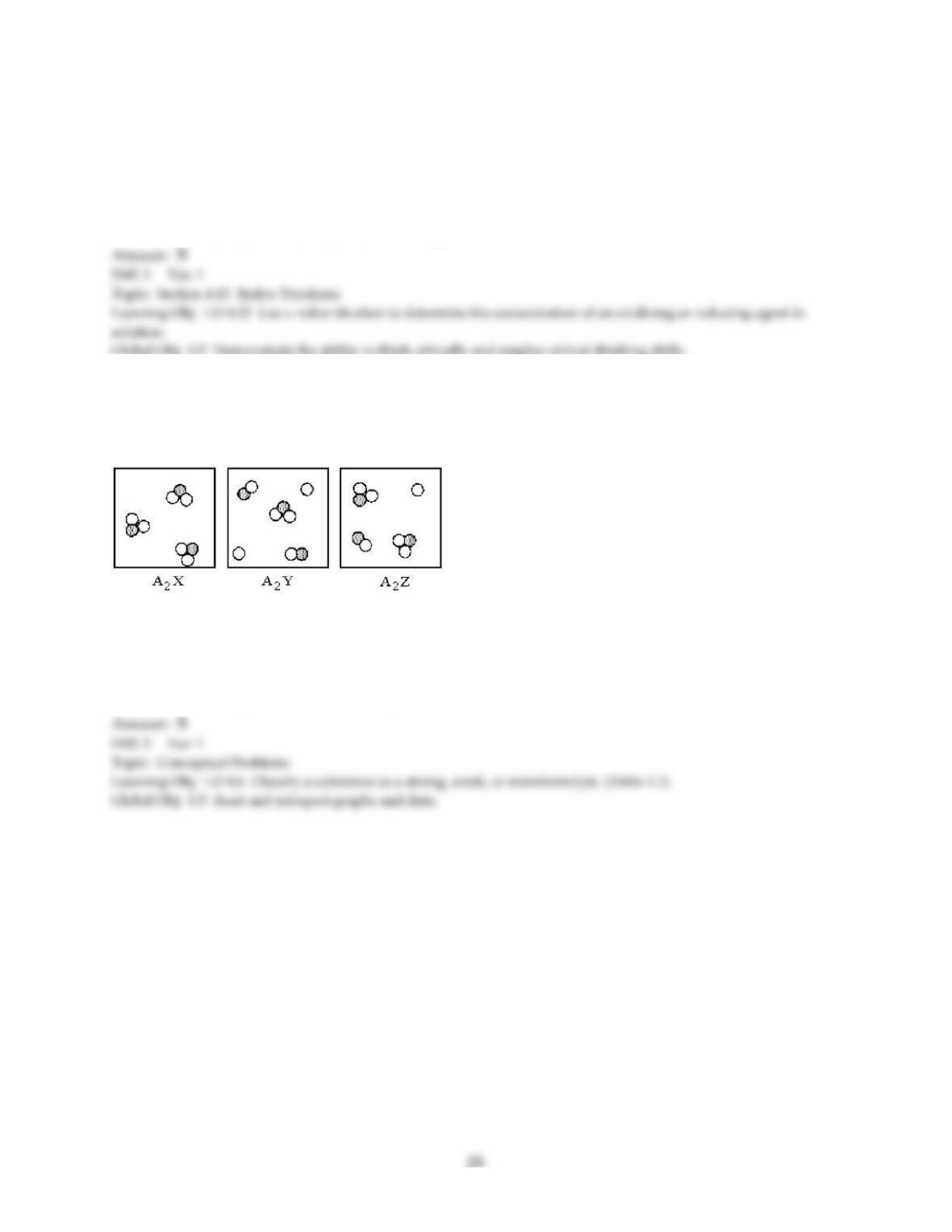
84) Three different substances, A2X, A2Y, and A2Z, were dissolved in water with the following results.
(Water molecules are omitted for clarity.) Which of the substances is the strongest electrolyte, and which
is the weakest?
A) A2X is the strongest electrolyte and A2Y is the weakest electrolyte.
B) A2Y is the strongest electrolyte and A2X is the weakest electrolyte.
C) A2Y is the strongest electrolyte and A2Z is the weakest electrolyte.
D) A2Z is the strongest electrolyte and A2Y is the weakest electrolyte.
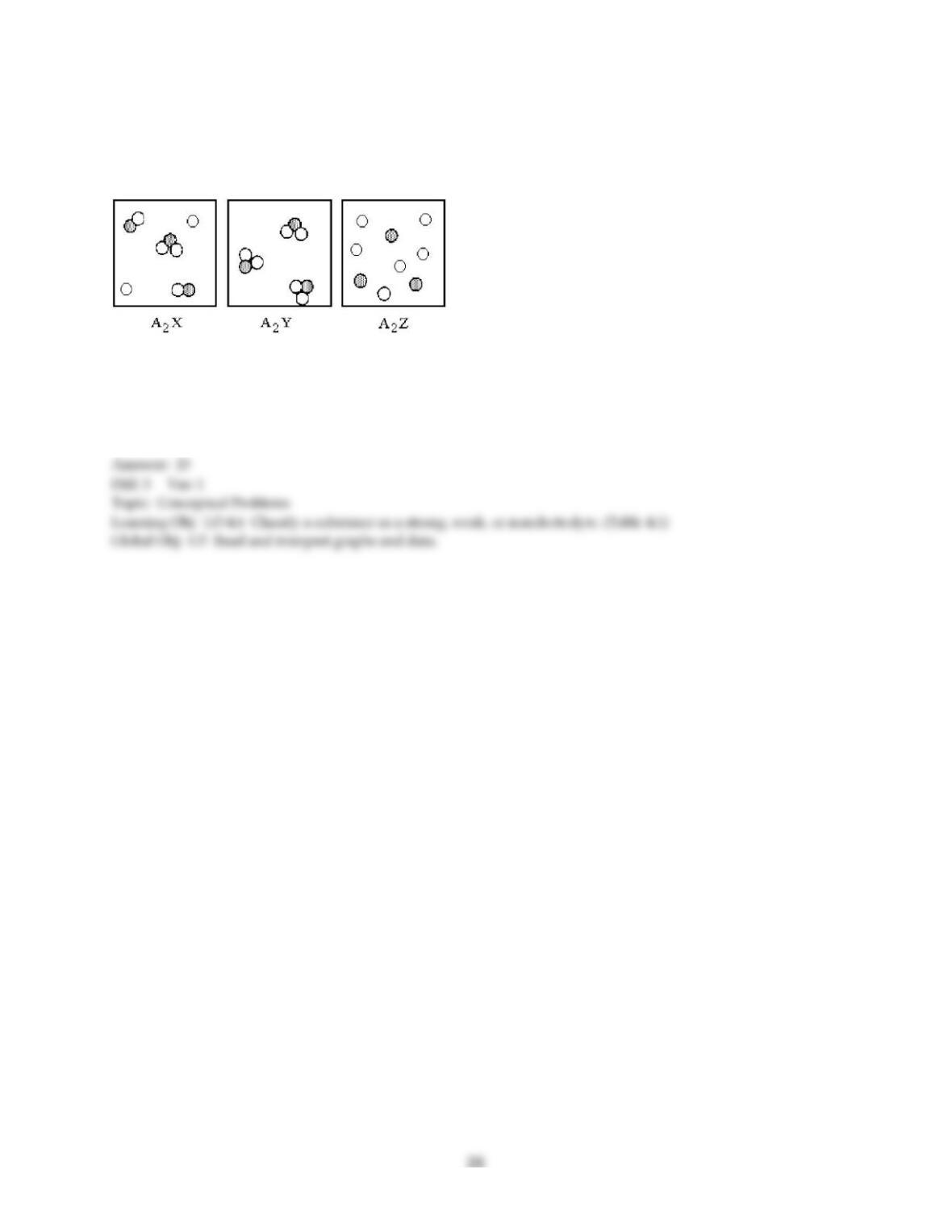
85) Three different substances, A2X, A2Y, and A2Z, were dissolved in water with the following results.
(Water molecules are omitted for clarity.) Which of the substances is the strongest electrolyte, and which
is the weakest?
A) A2X is the strongest electrolyte and A2Y is the weakest electrolyte.
B) A2Y is the strongest electrolyte and A2X is the weakest electrolyte.
C) A2Y is the strongest electrolyte and A2Z is the weakest electrolyte.
D) A2Z is the strongest electrolyte and A2Y is the weakest electrolyte.
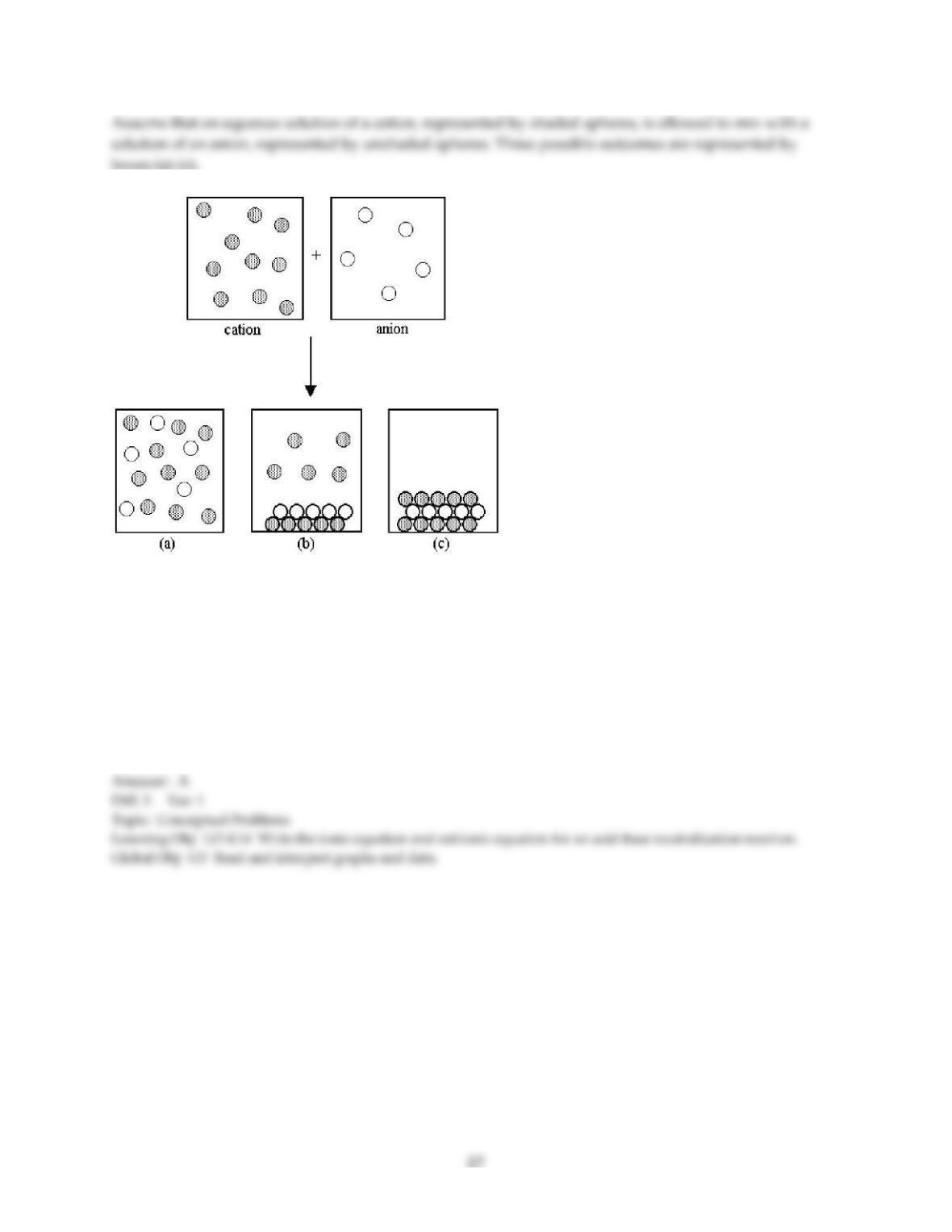
86) Which outcome corresponds to the mixing of potassium and sulfide ions shown in the following
equation?
2 K+(aq) + S2-(aq) → ?
A) box (a)
B) box (b)
C) box (c)
D) None of these
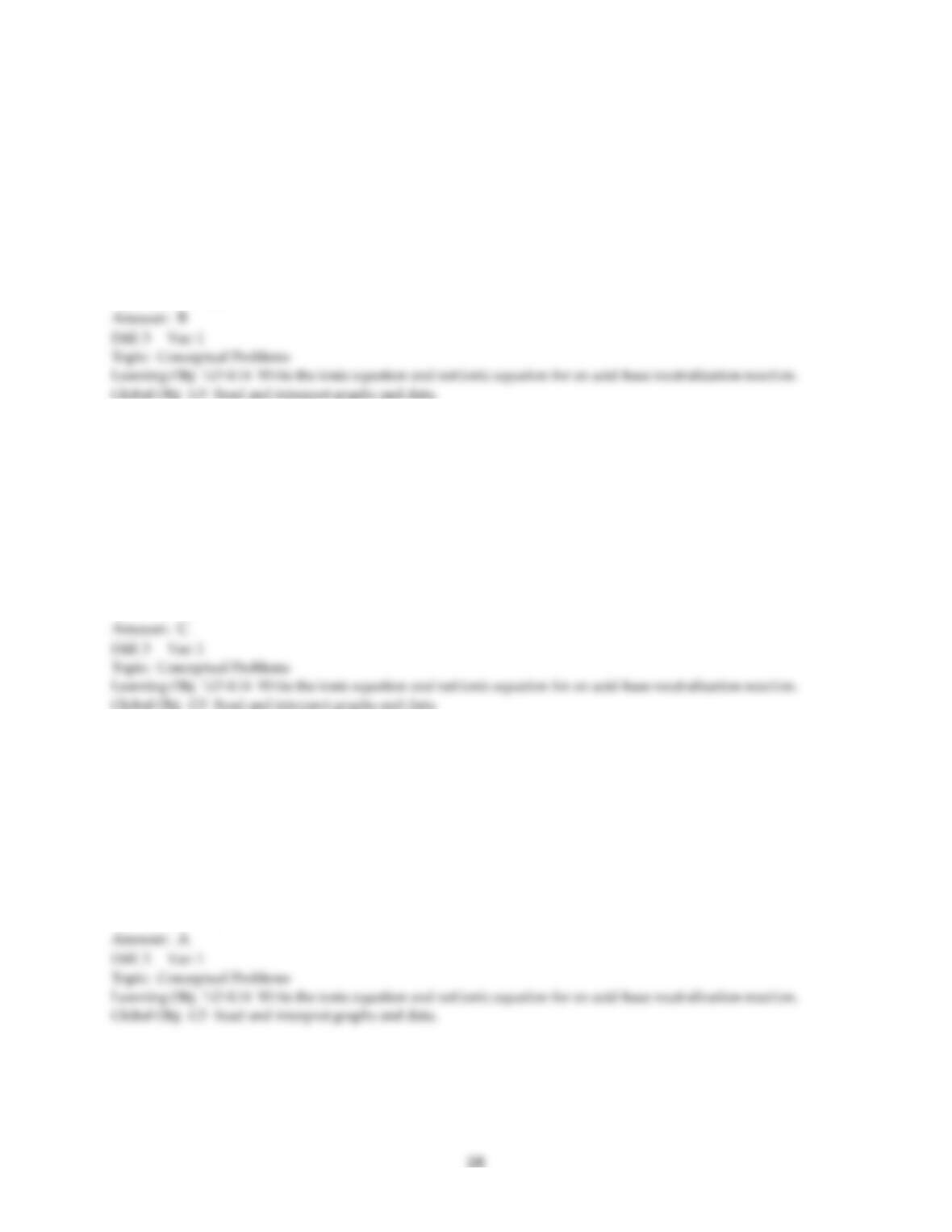
87) Which outcome corresponds to the combination of calcium and carbonate ions shown in the following
equation?
Ca2+(aq) + CO32-(aq) → ?
A) box (a)
B) box (b)
C) box (c)
D) None of these
88) Which outcome corresponds to the combination of silver and chromate ions shown in the following
equation?
Ag+(aq) + CrO42-(aq) → ?
A) box (a)
B) box (b)
C) box (c)
D) None of these
89) Which outcome corresponds to the mixing of sodium and sulfate ions shown in the following
equation?
2 Na+(aq) + SO42-(aq) → ?
A) box (a)
B) box (b)
C) box (c)
D) None of these
90) Which outcome corresponds to the combination of copper(II) and sulfide ions shown in the following
equation?
Cu2+(aq) + S2-(aq) → ?
A) box (a)
B) box (b)
C) box (c)
D) None of these
91) Which outcome corresponds to the combination of silver and carbonate ions shown in the following
equation?
Ag+(aq) + CO32-(aq) → ?
A) box (a)
B) box (b)
C) box (c)
D) None of these
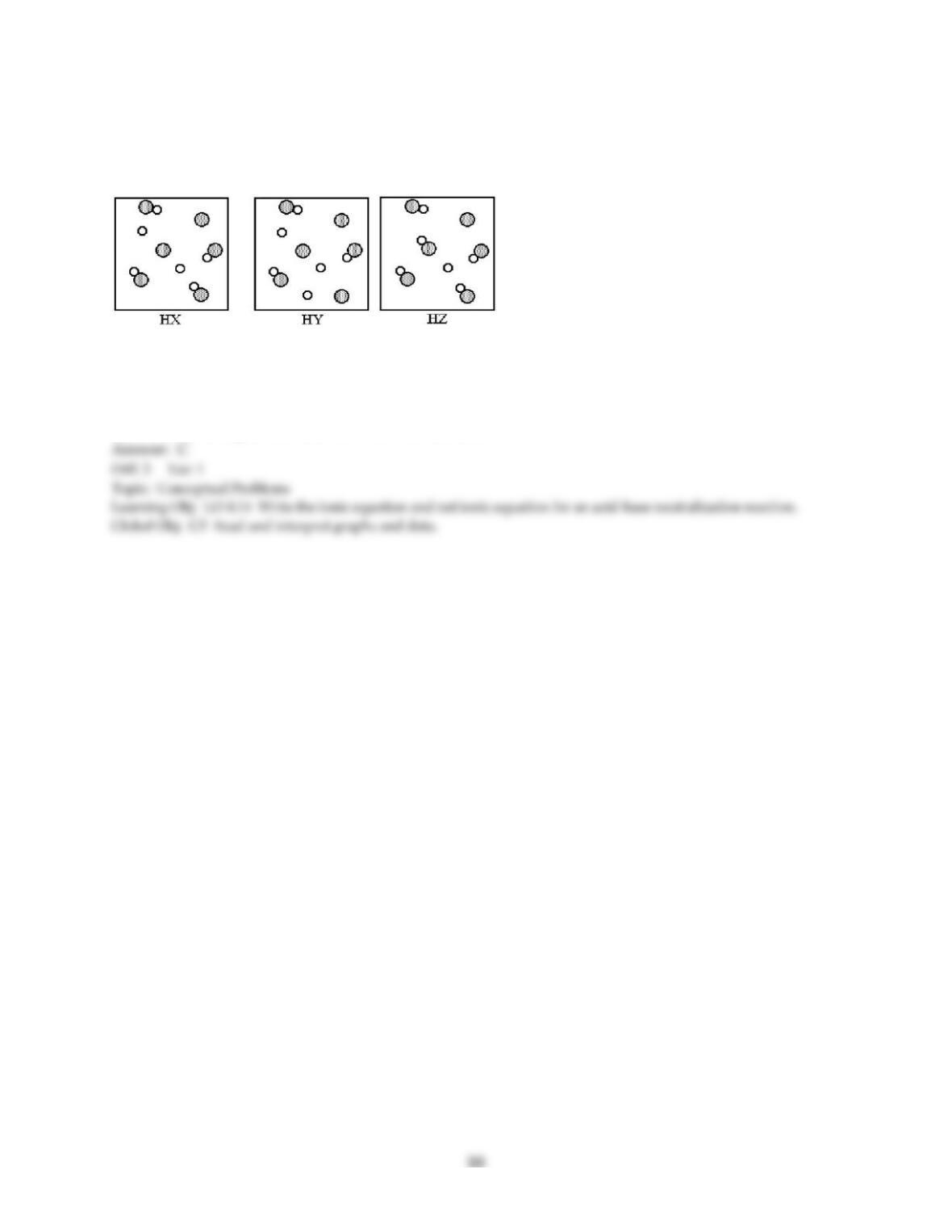
92) The following pictures represent aqueous solutions of three acids HA (A = X, Y, or Z), with water
molecules omitted for clarity. Unshaded spheres represent hydrogen atoms or ions and gray spheres
represent A atoms or ions. Which of the three is the strongest acid, and which is the weakest?
A) HX is the strongest acid and HY is the weakest acid.
B) HY is the strongest acid and HX is the weakest acid.
C) HY is the strongest acid and HZ is the weakest acid.
D) HZ is the strongest acid and HY is the weakest acid.
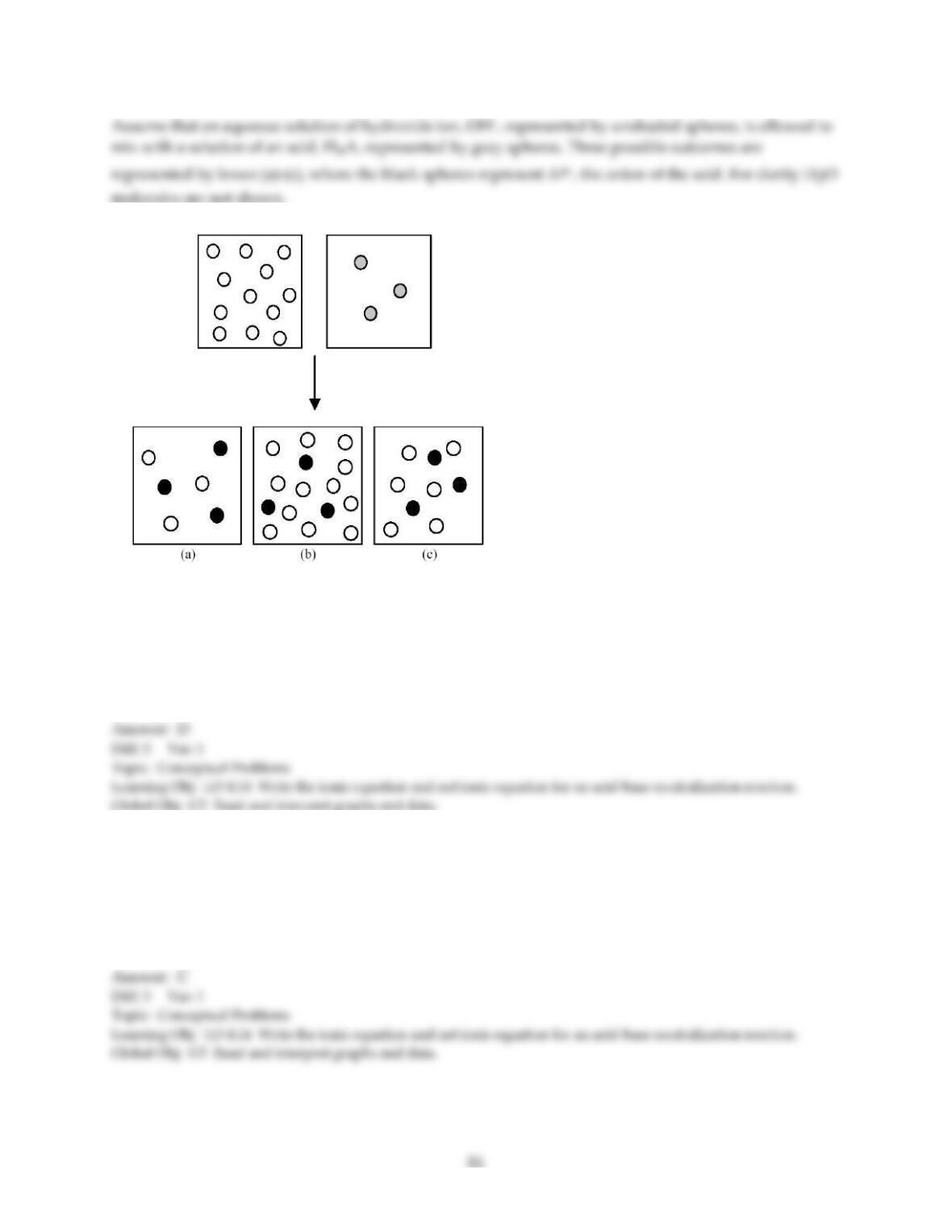
93) Which outcome corresponds to the reaction:
HCN + OH– → H2O + CN–?
A) box (a)
B) box (b)
C) box (c)
D) None of these
94) Which outcome corresponds to the reaction:
H2SO4 + 2 OH– → 2 H2O + SO42-?
A) box (a)
B) box (b)
C) box (c)
D) None of these
95) Which outcome corresponds to the reaction:
H3AsO4 + 3 OH– → 3 H2O + AsO43-?
A) box (a)
B) box (b)
C) box (c)
D) None of these
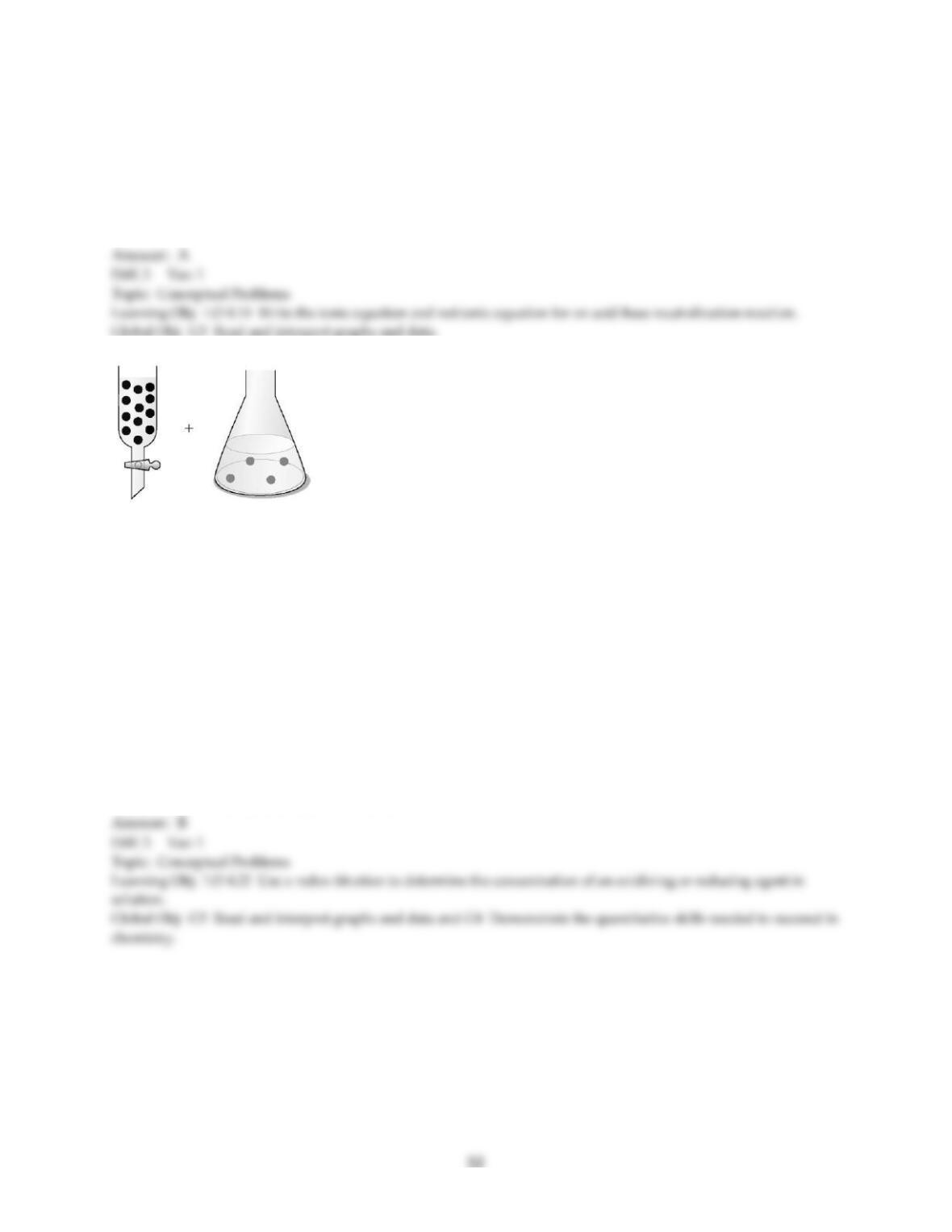
96) The concentration of an aqueous solution of NaOCl can be determined by a redox titration with
iodide ion in acidic solution:
OCl– (aq) + 2 I– (aq) + 2 H⁺ (aq) → Cl⁻ (aq) + I2 (aq) + H2O (l)
Assume that the black spheres in the buret represent I⁻ ions, the gray spheres in the flask represent OCl⁻
ions, the concentration of the I⁻ ions in the buret is 0.120 M, and the volumes in the buret and the flask are
identical. What is the concentration of the NaOCl in the flask, and what fraction of the I⁻ solution in the
buret must be added to the flask to react with all the OCl⁻ ions?
A) 0.0400 M NaOCl; 1/3 of the I⁻ must be added.
B) 0.0400 M NaOCl; 2/3 of the I⁻ must be added.
C) 0.0600 M NaOCl; 1/3 of the I⁻ must be added.
D) 0.0600 M NaOCl; 2/3 of the I⁻ must be added.
33
97) The concentration of an aqueous solution of I3⁻ can be determined by a redox titration with aqueous
sodium thiosulfate, Na2S2O3:
2 S2O32- (aq) + I3⁻ (aq) + → S4O62- (aq) + 3 I⁻ (aq)
Assume that the black spheres in the buret represent S2O32– ions, the gray spheres in the flask represent
I3– ions, the concentration of the S2O32- ions in the buret is 0.120 M, and the volumes in the buret and the
flask are identical. What is the concentration of the I3– in the flask, and what fraction of the S2O32-
solution in the buret must be added to the flask to react with all the I3– ions?
A) 0.0400 M I3–; 1/3 of the S2O32- must be added.
B) 0.0400 M I3–; 2/3 of the S2O32- must be added.
C) 0.0600 M I3–; 1/3 of the S2O32- must be added.
D) 0.0600 M I3–; 2/3 of the S2O32- must be added.
98) The concentration of an aqueous solution of Fe2+ can be determined by a redox titration with aqueous
bromate ion, BrO3⁻:
6 Fe2+ (aq) + BrO3⁻ (aq) + 6 H⁺ (aq) → 6 Fe3+ (aq) + Br⁻ (aq) + 3 H2O (l)
Assume that the black spheres in the buret represent BrO3⁻ ions, the gray spheres in the flask represent
Fe2+ ions, the concentration of the BrO3⁻ ions in the buret is 0.120 M, and the volumes in the buret and
the flask are identical. What is the concentration of the Fe2+ in the flask, and what fraction of the BrO3⁻
solution in the buret must be added to the flask to react with all the Fe2+ ions?
A) 0.0200 M Fe2+; 1/18 of the BrO3⁻ must be added.
B) 0.0200 M Fe2+; 1/3 of the BrO3⁻ must be added.
C) 0.0400 M Fe2+; 1/18 of the BrO3⁻ must be added.
D) 0.0400 M Fe2+; 1/3 of the BrO3⁻ must be added.
Assume that the conductivity of a solution depends only on the total concentration of dissolved ions and
that you measure the conductivity of three different solutions while performing titrations in which
I. 50.00 mL of 0.100 M aqueous CH3CO2H is titrated by addition of 0.100 M NaOH.
II. 50.00 mL of 0.100 M aqueous NaBr is titrated by addition of 0.100 M AgNO3.
III. 50.00 mL of 0.100 M aqueous CaCl2 is titrated by addition of 0.100 M Na2CO3.
99) Which of the above graphs corresponds to titration I?
A) graph (1)
B) graph (2)
C) graph (3)
D) None of the graphs
100) Which of the above graphs corresponds to titration II?
A) graph (1)
B) graph (2)
C) graph (3)
D) None of the graphs
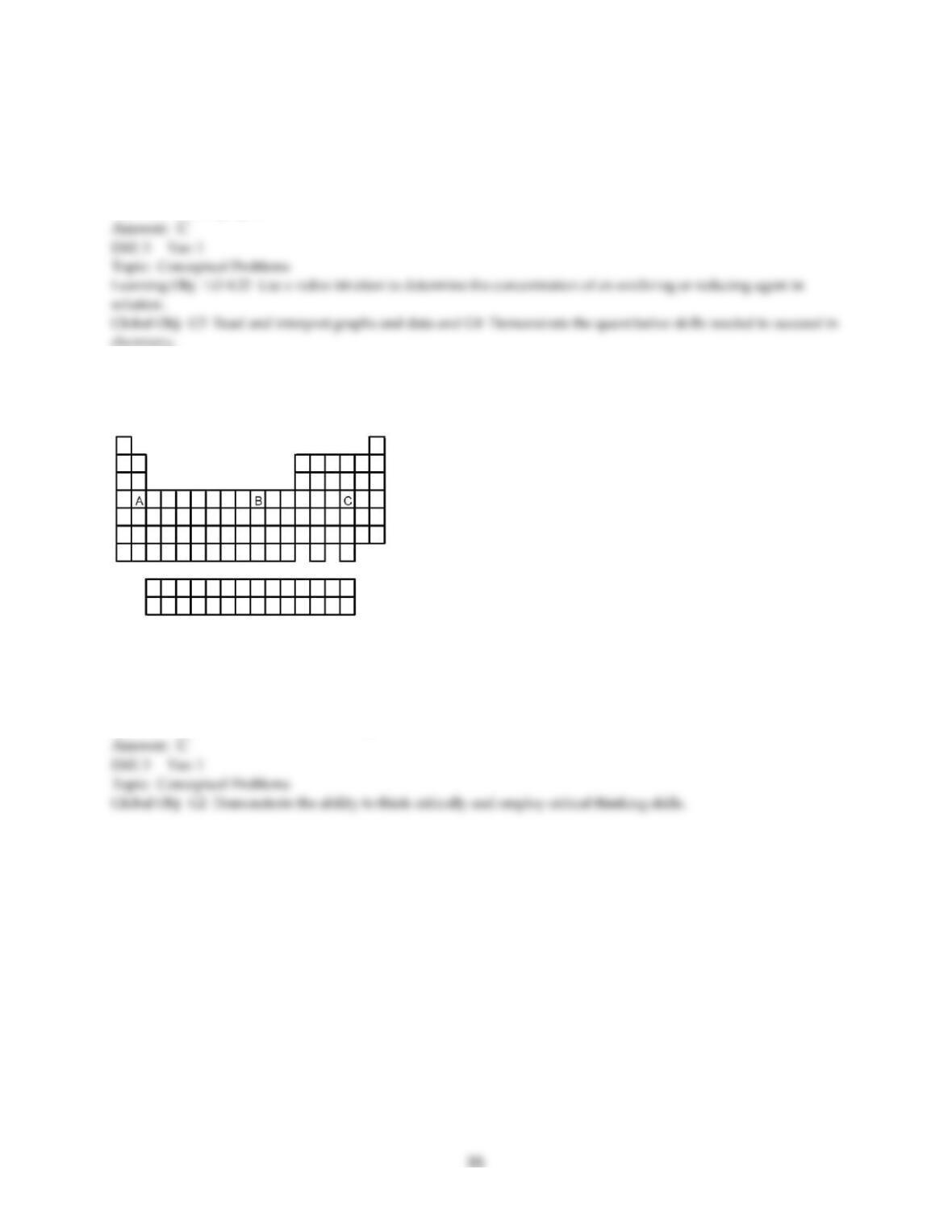
101) Which of the above graphs corresponds to titration III?
A) graph (1)
B) graph (2)
C) graph (3)
D) None of the graphs
102) Based on the positions in the periodic table of elements A, B, and C, which of the following reactions
would you expect to occur?
A) A2+ + B → A + B2+
B) B2+ + C → B + C2+
C) C + A → C2- + A2+
D) None of the reactions would be expected to occur.
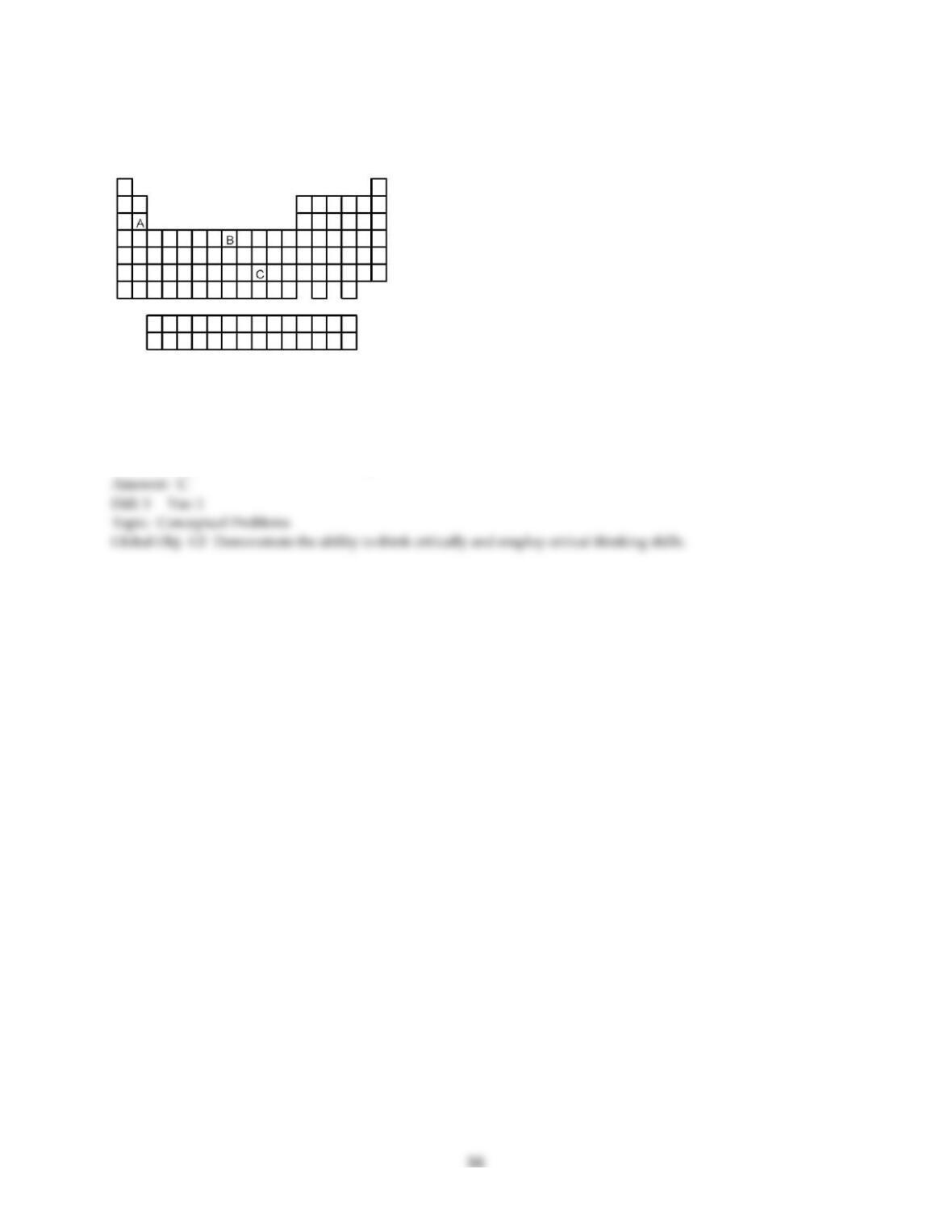
103) Based on the positions in the periodic table of elements A, B, and C, which of the following reactions
would you expect to occur?
A) A2+ + B → A + B2+
B) B2+ + C → B + C2+
C) C2+ + A → C + A2+
D) None of the reactions would be expected to occur.
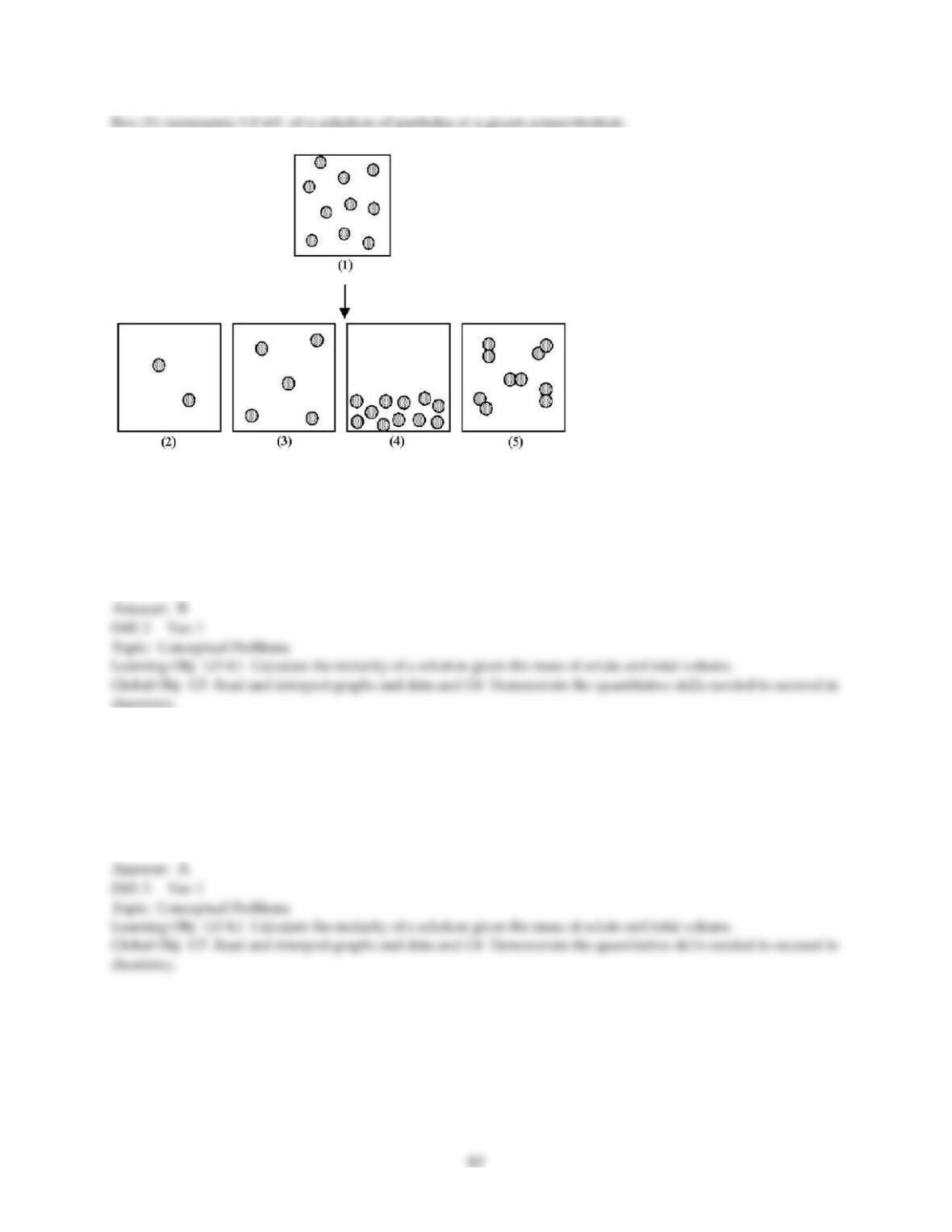
104) Which of the boxes (2)-(5) represents 1.0 mL of the solution that results after (1) has been diluted by
adding enough solvent to make 2.0 mL of solution?
A) box (2)
B) box (3)
C) box (4)
D) box (5)
105) Which of the boxes (2)-(5) represents 1.0 mL of the solution that results after (1) has been diluted by
adding enough solvent to make 5.0 mL of solution?
A) box (2)
B) box (3)
C) box (4)
D) box (5)
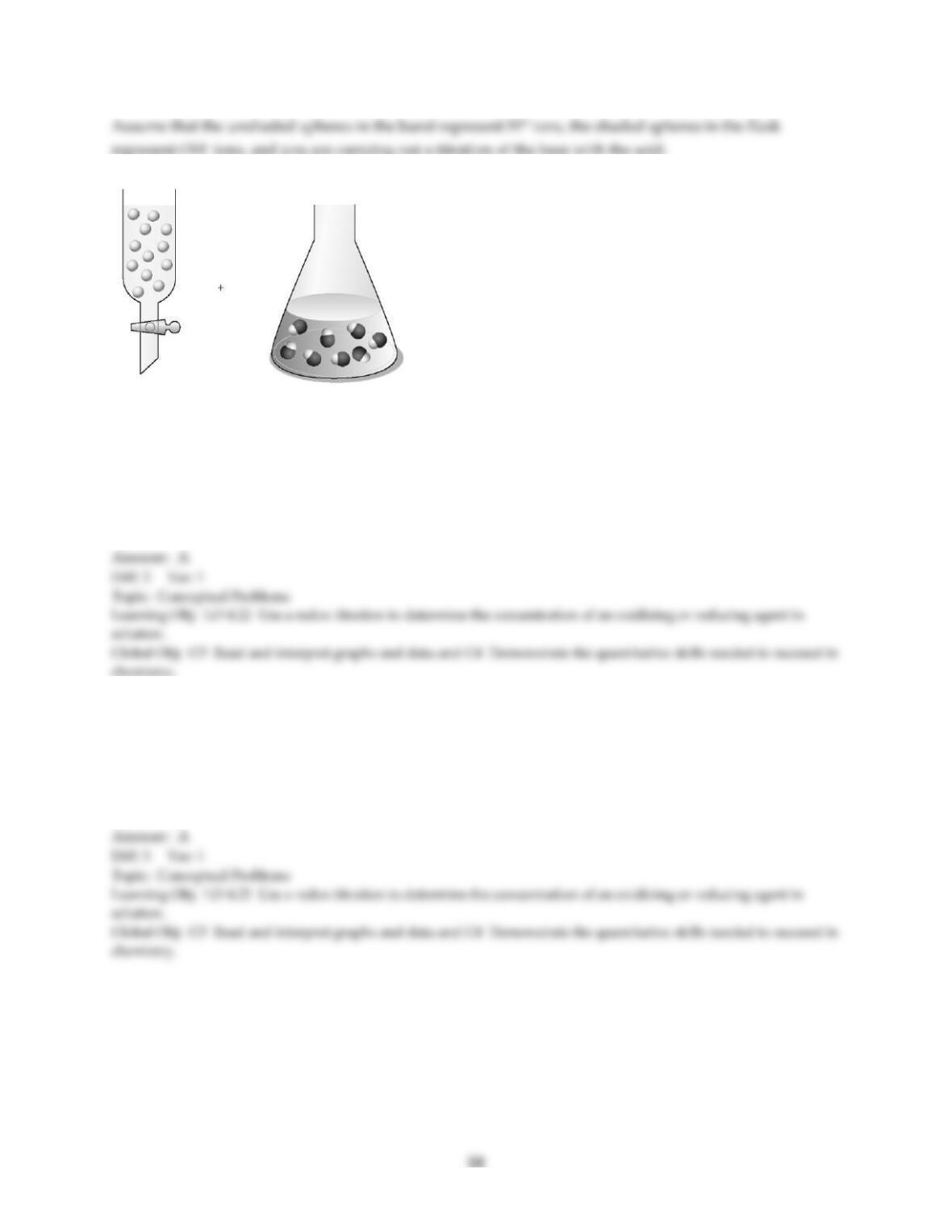
106) If the volumes in the buret and the flask are identical and the concentration of the acid in the buret is
0.250 M, what is the concentration of the base in the flask?
A) 0.167 M
B) 0.250 M
C) 0.375 M
D) 0.667 M
107) If the volumes in the buret and the flask are identical and the concentration of the acid in the buret is
0.500 M, what is the concentration of the base in the flask?
A) 0.333 M
B) 0.500 M
C) 0.667 M
D) 0.750 M
39
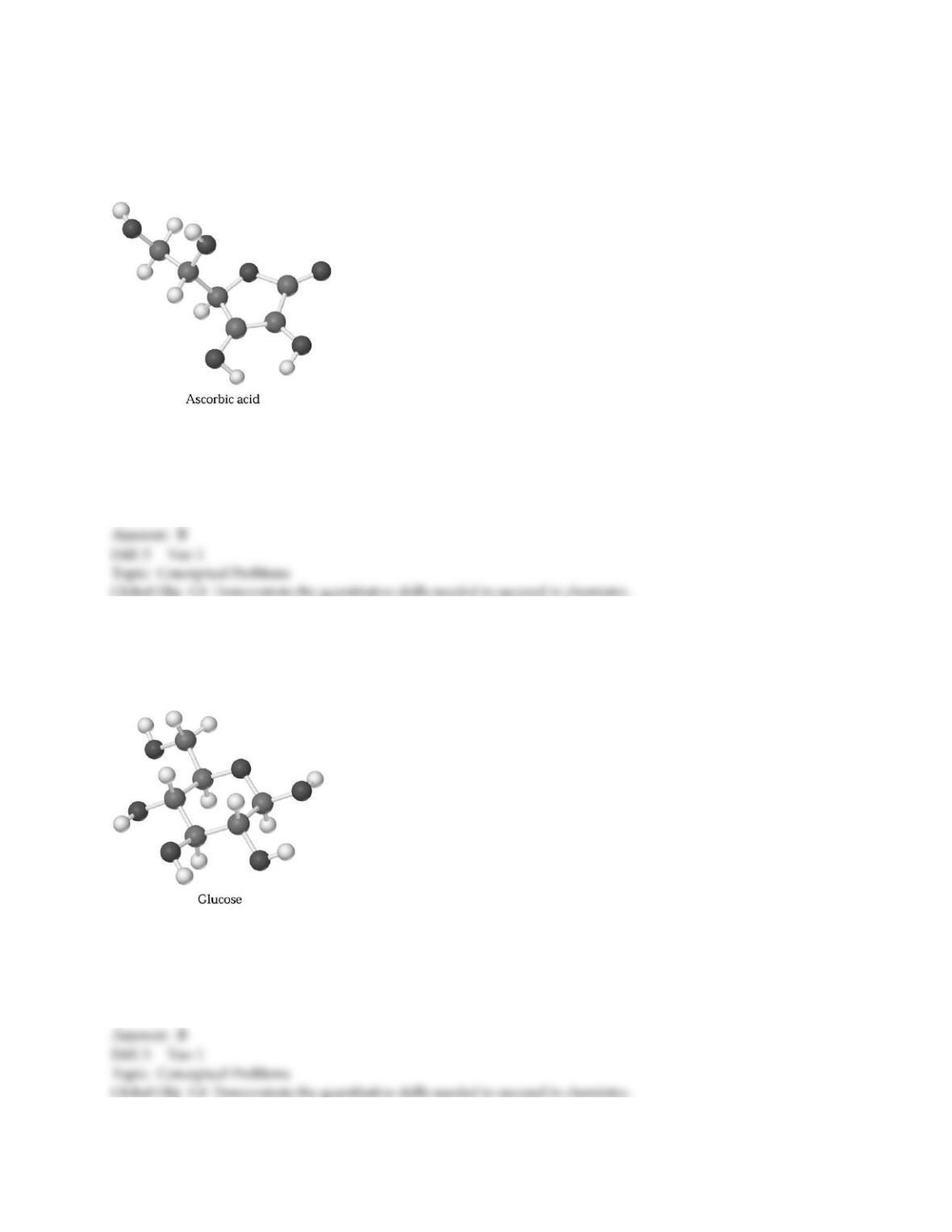
108) Ascorbic acid, C6H806, can be represented by the molecular model shown below. If 1.00 mol of
ascorbic acid is submitted to combustion analysis, how many moles of CO2 and how many moles of H2O
would be formed?
A) 3.00 mol CO2 and 2.00 mol H2O
B) 6.00 mol CO2 and 4.00 mol H2O
C) 6.00 mol CO2 and 8.00 mol H2O
D) 12.0 mol CO2 and 10.0 mol H2O
109) Glucose, C6H1206, can be represented by the molecular model shown below. If 1.00 mol of glucose is
submitted to combustion analysis, how many moles of CO2 and how many moles of H2O would be
formed?
A) 1.00 mol CO2 and 2.00 mol H2O
B) 6.00 mol CO2 and 6.00 mol H2O
C) 6.00 mol CO2 and 12.0 mol H2O
D) 12.0 mol CO2 and 12.0 mol H2O
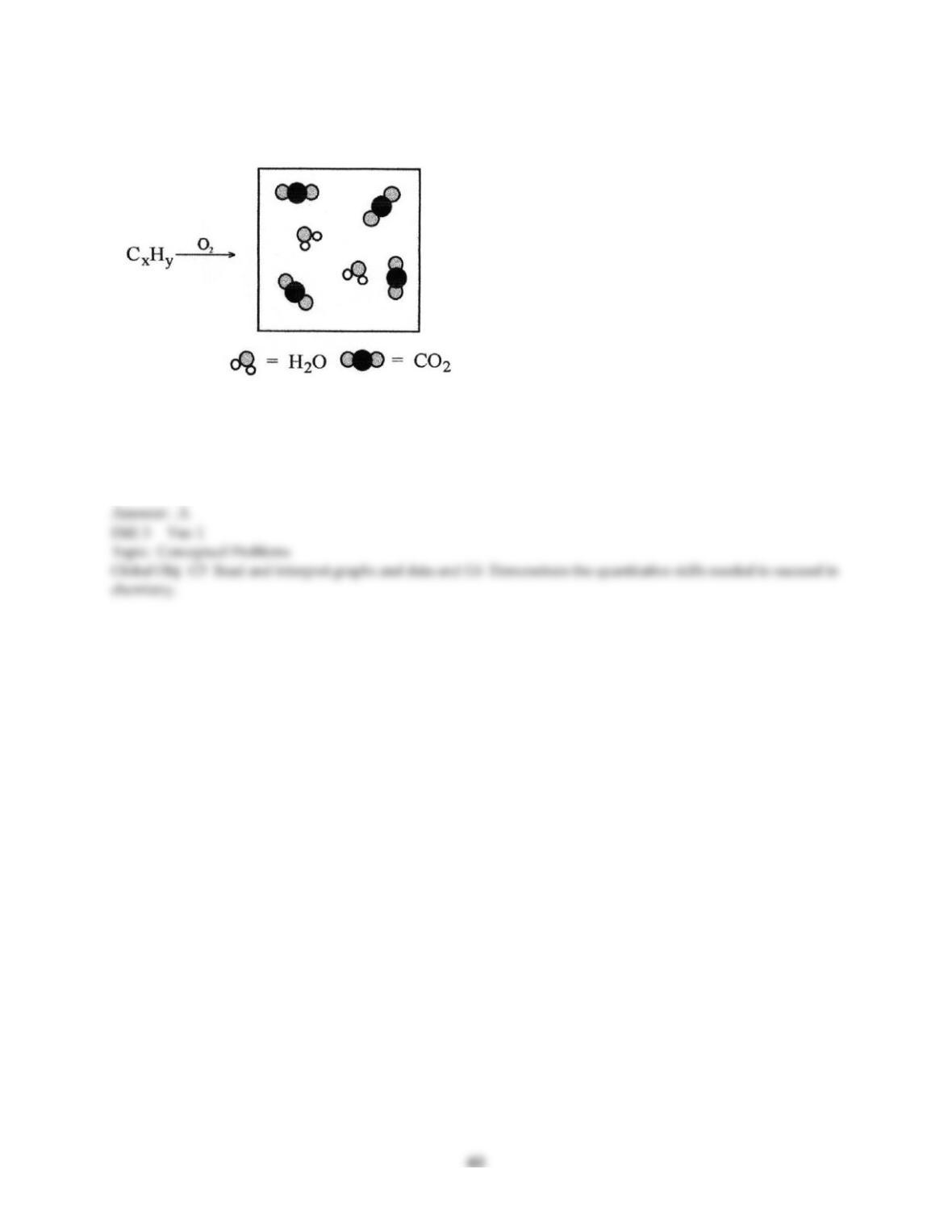
110) A hydrocarbon of unknown formula CxHy was submitted to combustion analysis with the following
results. What is the empirical formula of the hydrocarbon?
A) CH
B) C2H
C) C2H4
D) C4H4