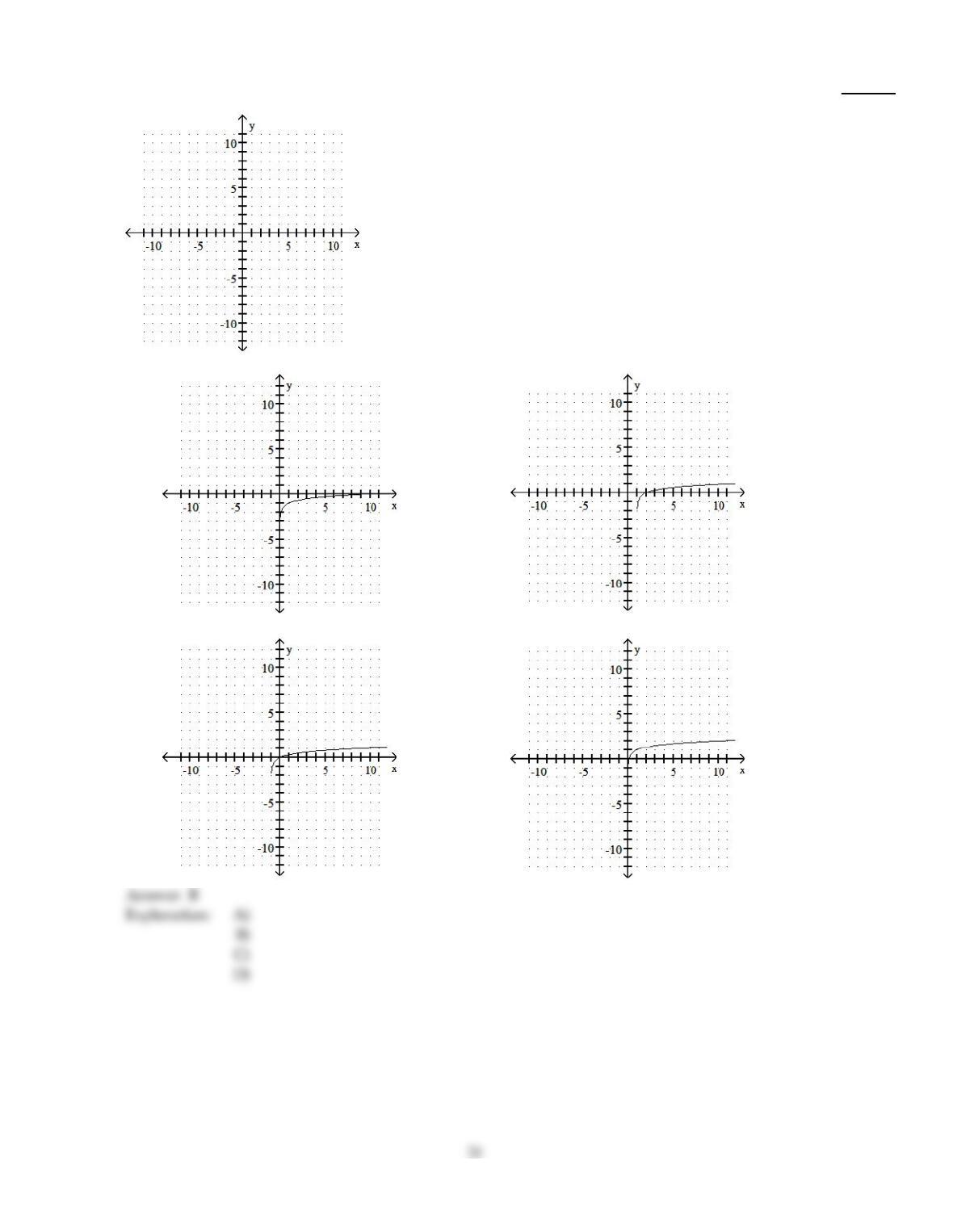
53)
Use the graph of f(x) = log x to obtain the graph of g(x) = log (x – 1).
53)
A)
B)
C)
D)
Approximate the number using a calculator. Round your answer to three decimal places.
54)
21.7
54)
A)
3.249
B)
3.400
C)
3.549
D)
2.890
Solve the logarithmic equation. Be sure to reject any value that is not in the domain of the original logarithmic
expressions. Give the exact answer.
55)
ln x +ln (x –1) =ln 56
55)
A)
{–7}
B)
{8}
C)
{8, –7}
D)
57
2
Use properties of logarithms to condense the logarithmic expression. Write the expression as a single logarithm whose
coefficient is 1. Where possible, evaluate logarithmic expressions.
56)
3log bm–log bn
56)
A)
log bm3÷log bn
B)
log b(3m
n)
C)
log b
m3
n
D)
log b(m3– n)
Evaluate or simplify the expression without using a calculator.
57)
log 1000
57)
A)
30
B)
3
C)
3
10
D)
1
3
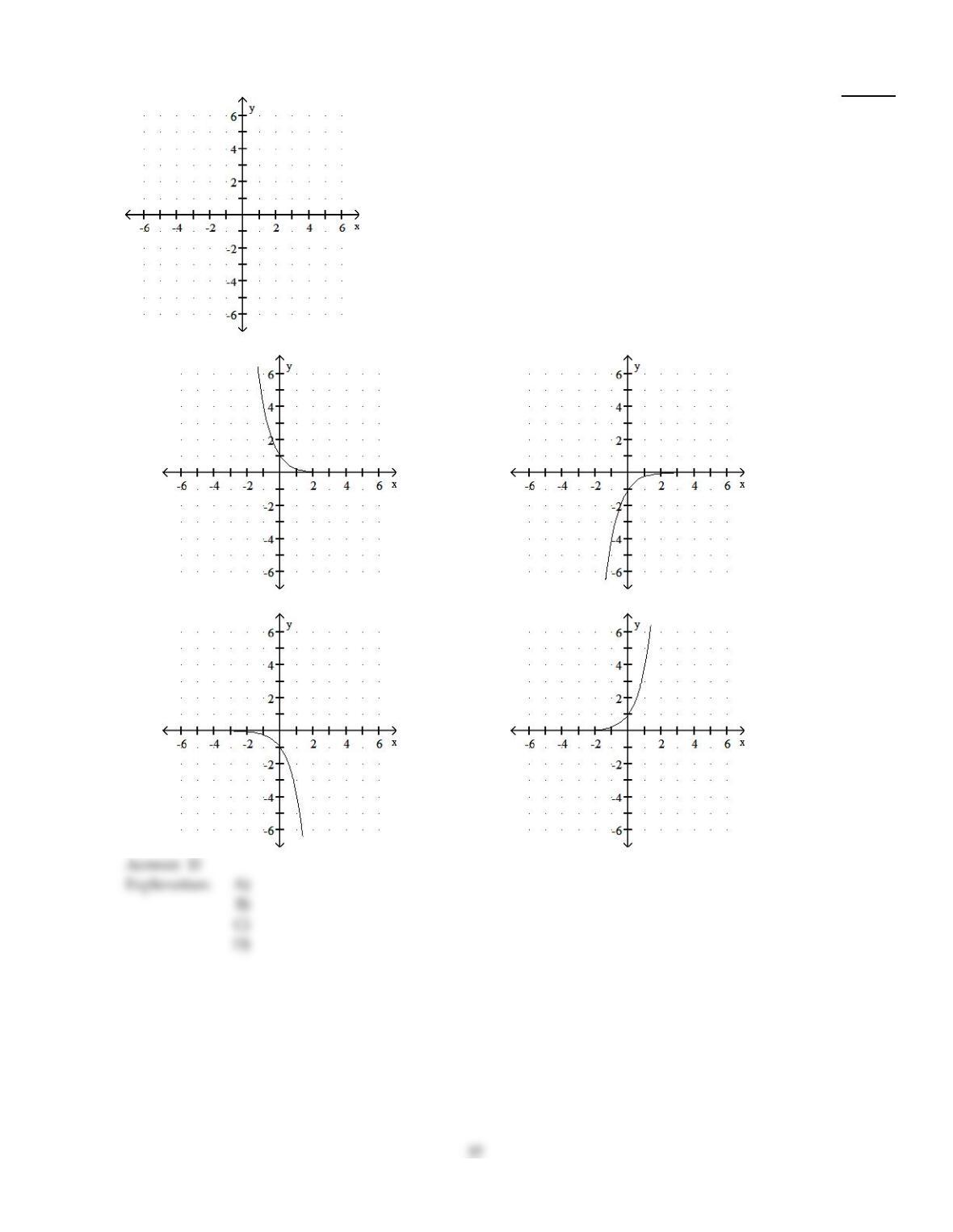
Graph the function.
22
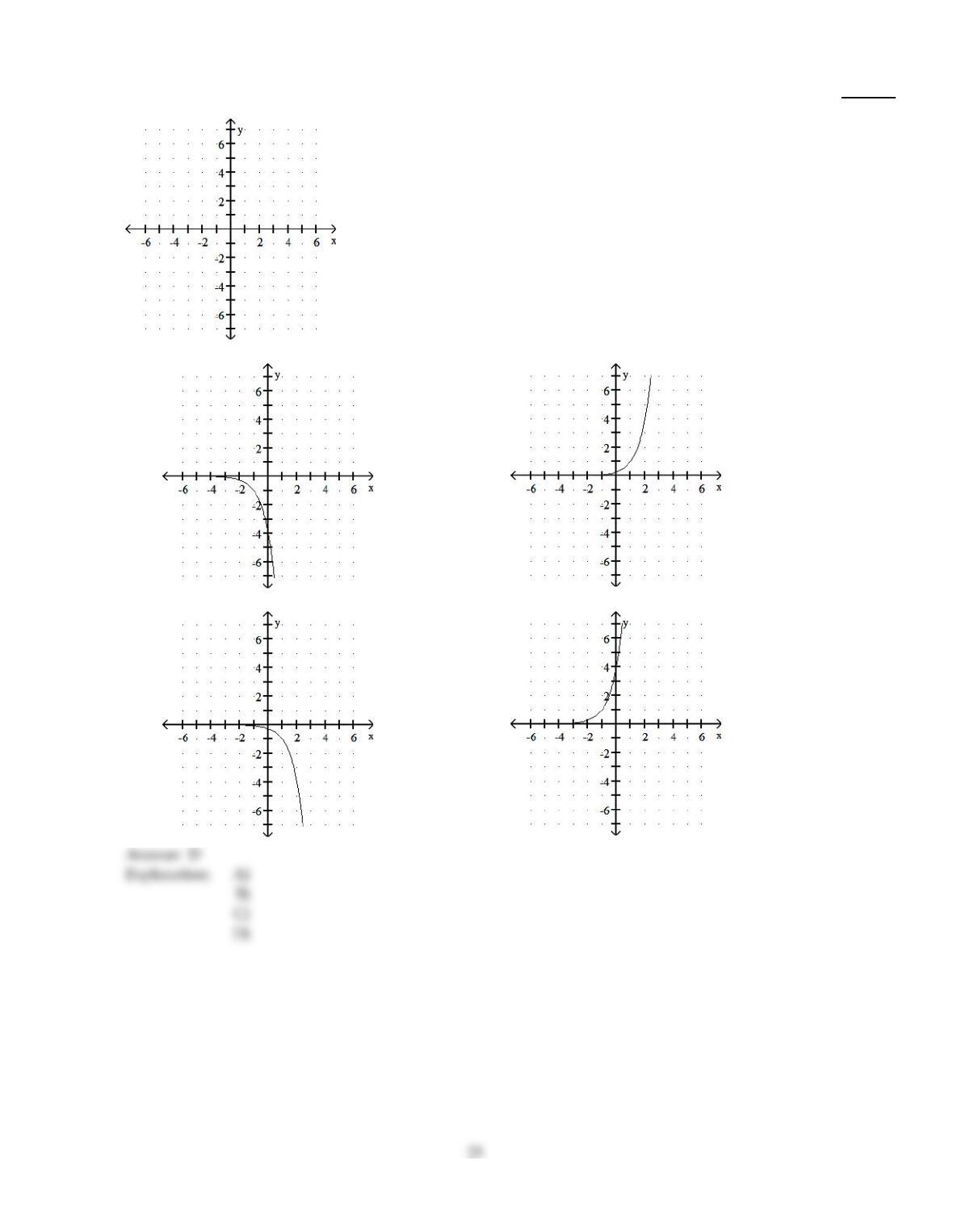
58)
Use the graph of f(x) =4x to obtain the graph of g(x) =4·4x.
58)
A)
B)
C)
D)
Solve the logarithmic equation. Be sure to reject any value that is not in the domain of the original logarithmic
expressions. Give the exact answer.
59)
log (x + 5) = log (5x – 4)
59)
A)
9
4
B)
1
4
C)
–9
4
D)
3
2
Evaluate the expression without using a calculator.
60)
log 464
60)
A)
1
3
B)
1
C)
3
D)
12
C
Use common logarithms or natural logarithms and a calculator to evaluate to four decimal places
61)
log 0.1 17
61)
A)
0.2304
B)
–0.8127
C)
–1.2304
D)
2.2304
C
Solve the problem.
62)
Cindy will require $13,000 in 2 years to return to college to get an MBA degree. How much money
should she ask her parents for now so that, if she invests it at 12% compounded continuously, she
will have enough for school? (Round your answer to the nearest dollar.)
62)
A)
$8044
B)
$10,364
C)
$16,526
D)
$10,226
D
Graph the function.
24
A
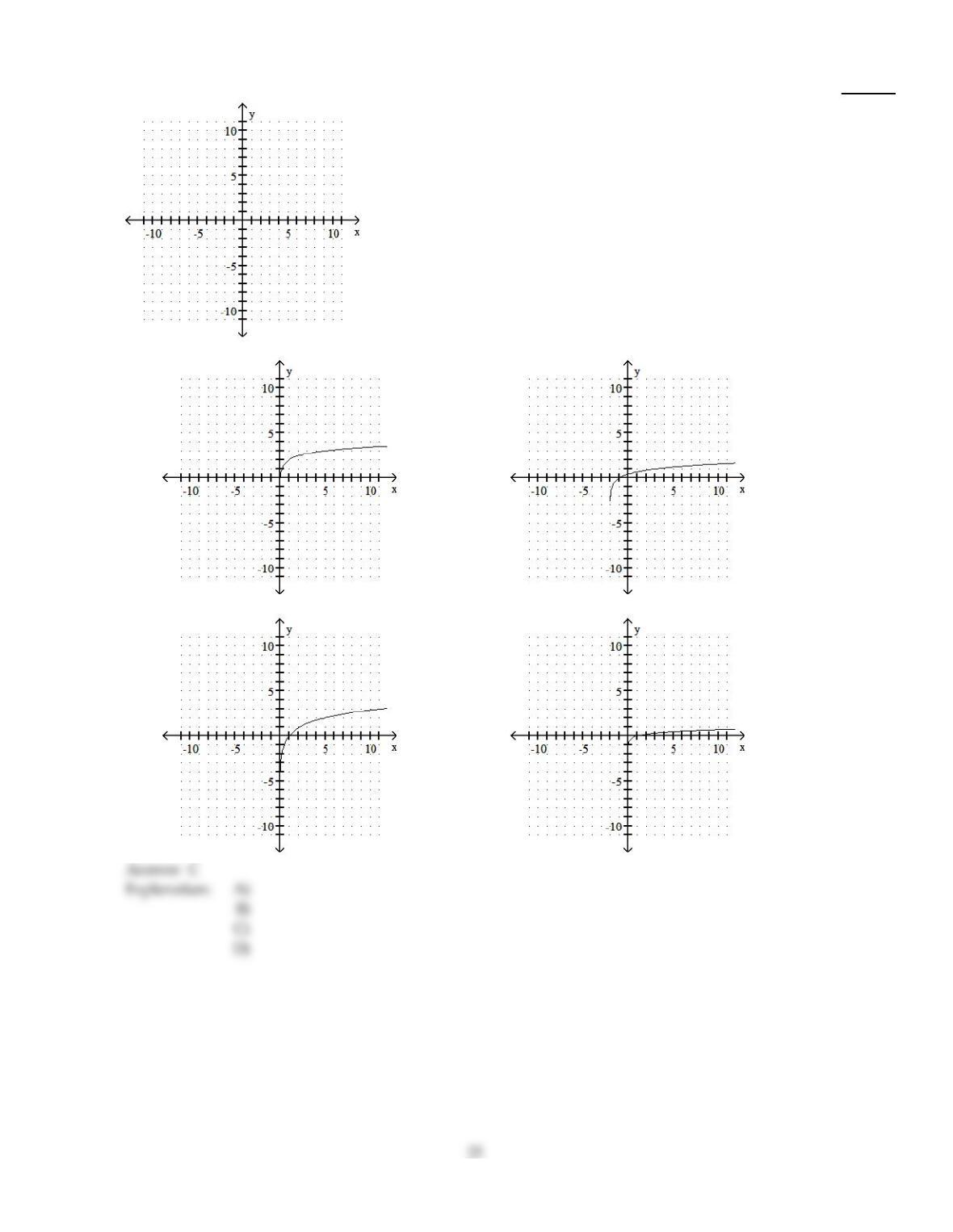
63)
Use the graph of log 5x to obtain the graph of f(x) =2log 5x.
63)
A)
B)
C)
D)
Solve the logarithmic equation. Be sure to reject any value that is not in the domain of the original logarithmic
expressions. Give the exact answer.
64)
log 2x =5
64)
A)
{2.32}
B)
{32}
C)
{10}
D)
{25}
Graph the function.
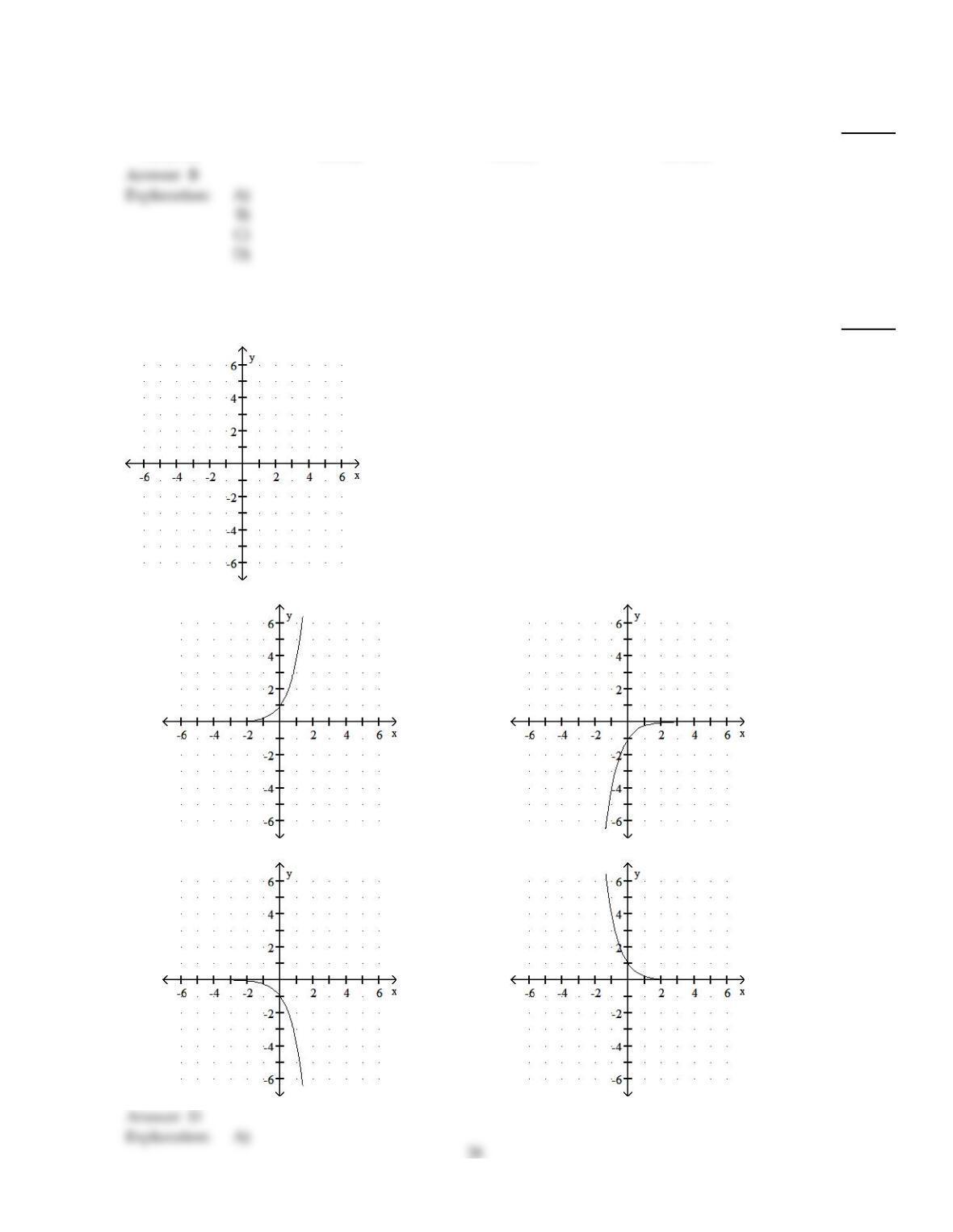
65)
Use the graph of f(x) =4x to obtain the graph of g(x) =4–x.
65)
A)
B)
C)
D)
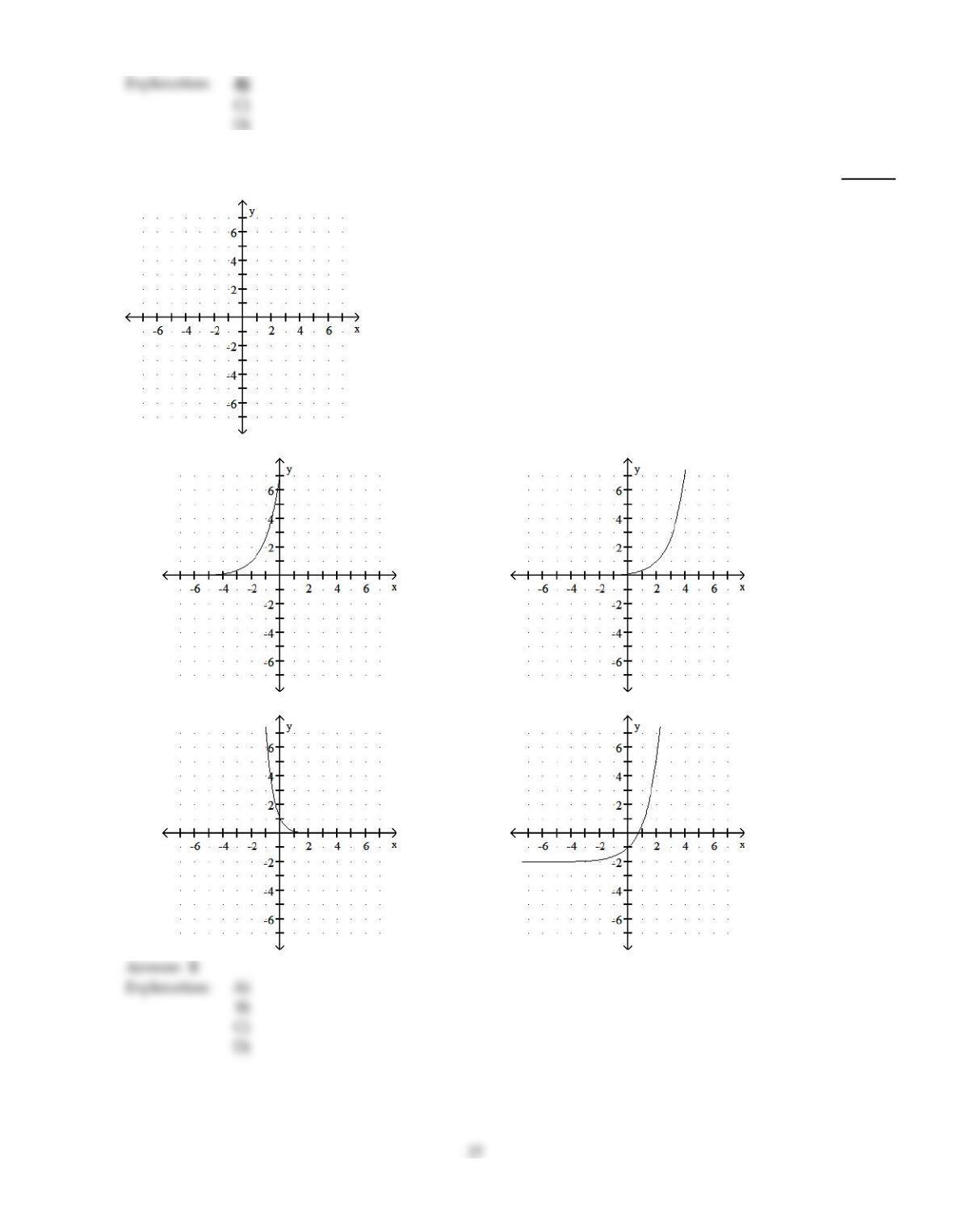
66)
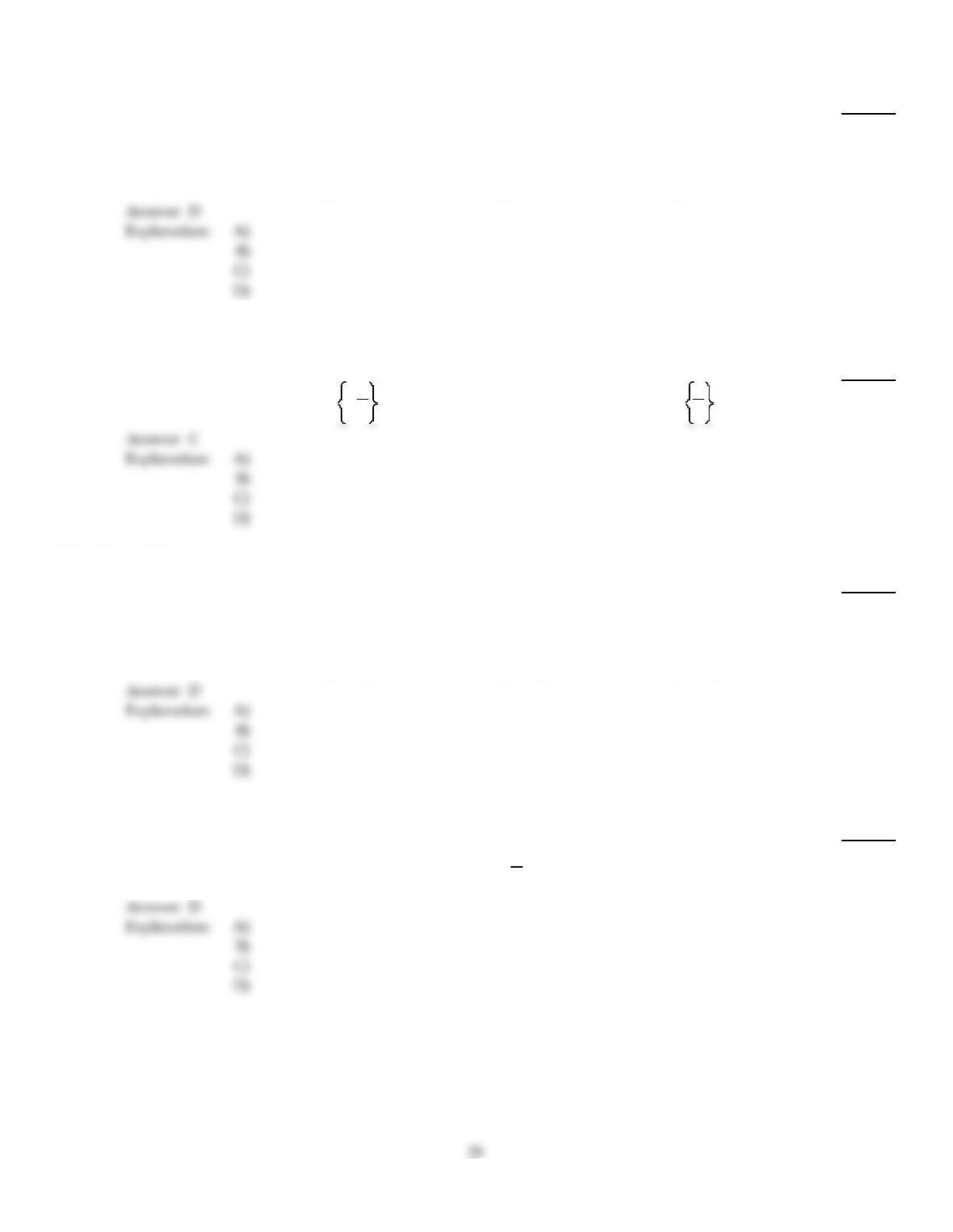
Use the graph of f(x) =ex to obtain the graph of g(x) =ex – 2.
66)
A)
B)
C)
D)
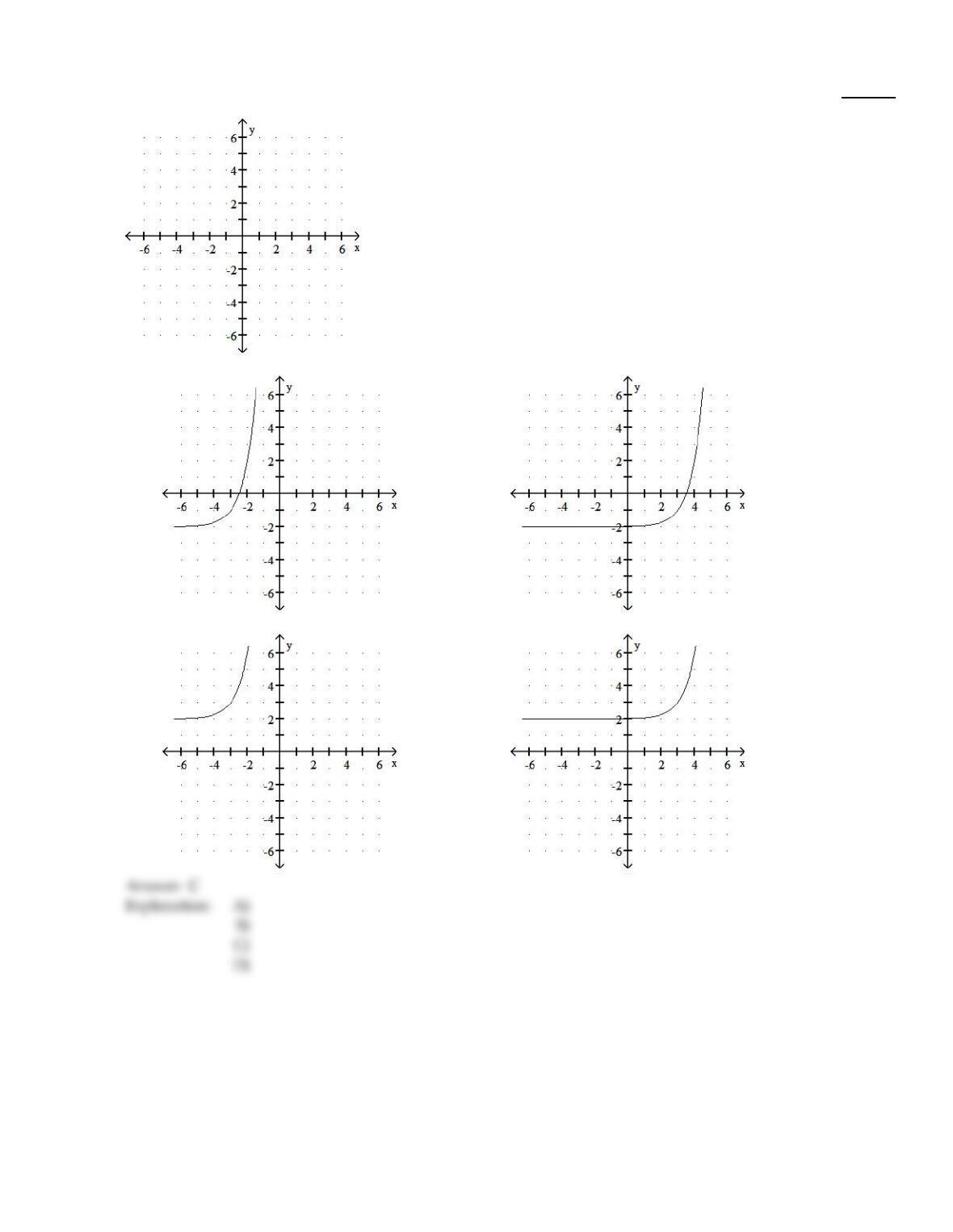
67)
Use the graph of f(x) =4x to obtain the graph of g(x) =4x + 3 + 2.
67)
A)
B)
C)
D)
28
Solve.
68)
The value of a particular investment follows a pattern of exponential growth. In the year 2000, you
invested money in a money market account. The value of your investment t years after 2000 is
given by the exponential growth model A =1500e0.045t. By what percentage is the account
increasing each year?
68)
A)
5.1%
B)
5.0%
C)
4.8%
D)
4.5%
Solve the logarithmic equation. Be sure to reject any value that is not in the domain of the original logarithmic
expressions. Give the exact answer.
69)
log 4x = log 5+ log (x – 1)
69)
A)
{–5}
B)
–5
9
C)
{5}
D)
4
3
Solve the problem.
70)
The function A =A0e–0.01155x models the amount in pounds of a particular radioactive material
stored in a concrete vault, where x is the number of years since the material was put into the vault.
If 900 pounds of the material are placed in the vault, how much time will need to pass for only 159
pounds to remain?
70)
A)
155 years
B)
160 years
C)
300 years
D)
150 years
Evaluate the expression without using a calculator.
71)
log 41
71)
A)
1
B)
4
C)
1
4
D)
0
Solve the problem.
72)
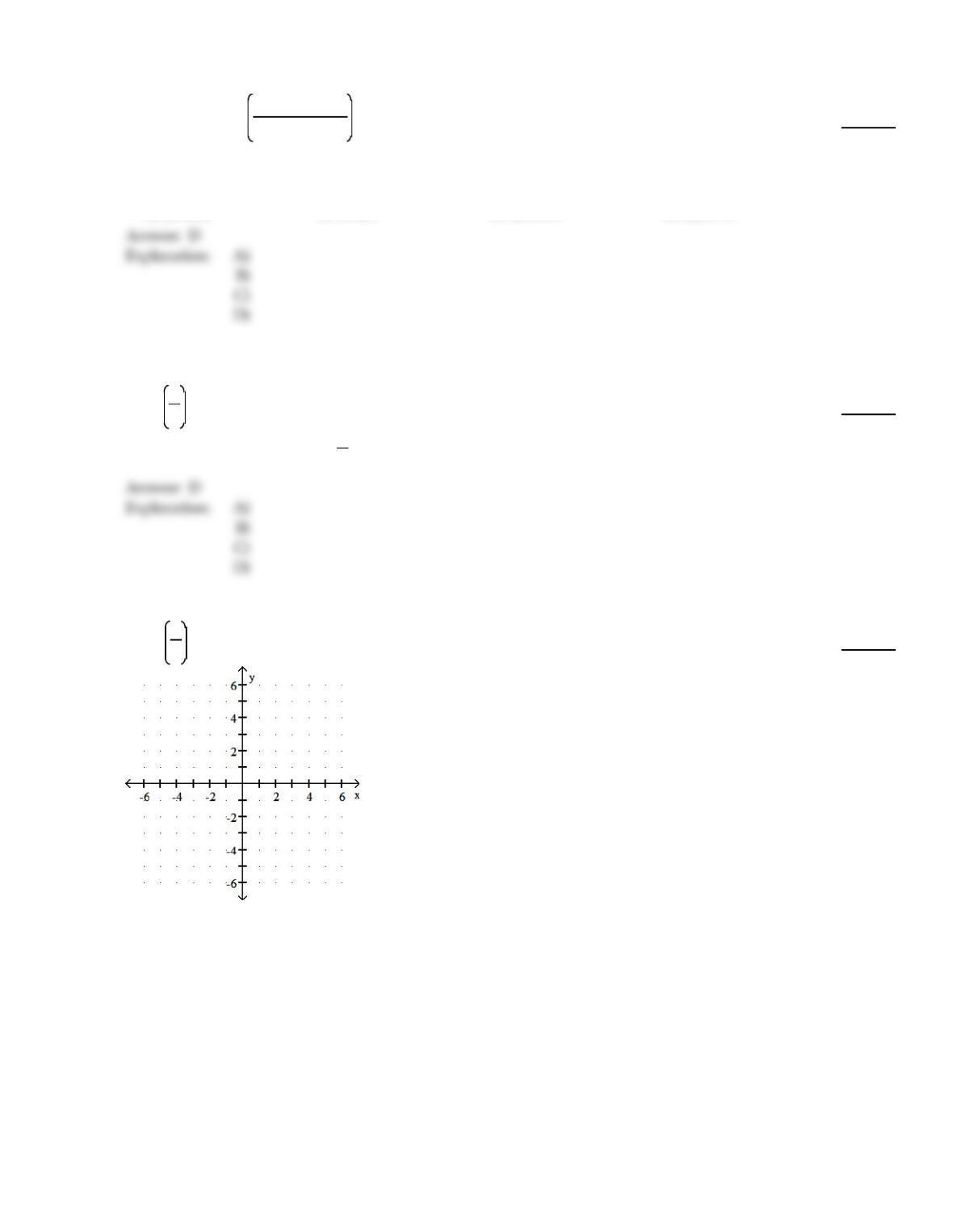
The formula S = A (1 + r)t + 1 – 1
r models the value of a retirement account, where A = the number
of dollars added to the retirement account each year, r = the annual interest rate, and S = the value
of the retirement account after t years. If the interest rate is 6%, how much will the account be
worth after 10 years if $1600 is added each year? Round to the nearest whole number.
72)
A)
$17,600
B)
$3021
C)
$31,519
D)
$23,955
Use properties of logarithms to expand the logarithmic expression as much as possible. Where possible, evaluate
logarithmic expressions without using a calculator.
73)
log 2
8
x
73)
A)
6–log 2x
B)
3
x
C)
–3log 2x
D)
3–log 2x
Graph the function by making a table of coordinates.
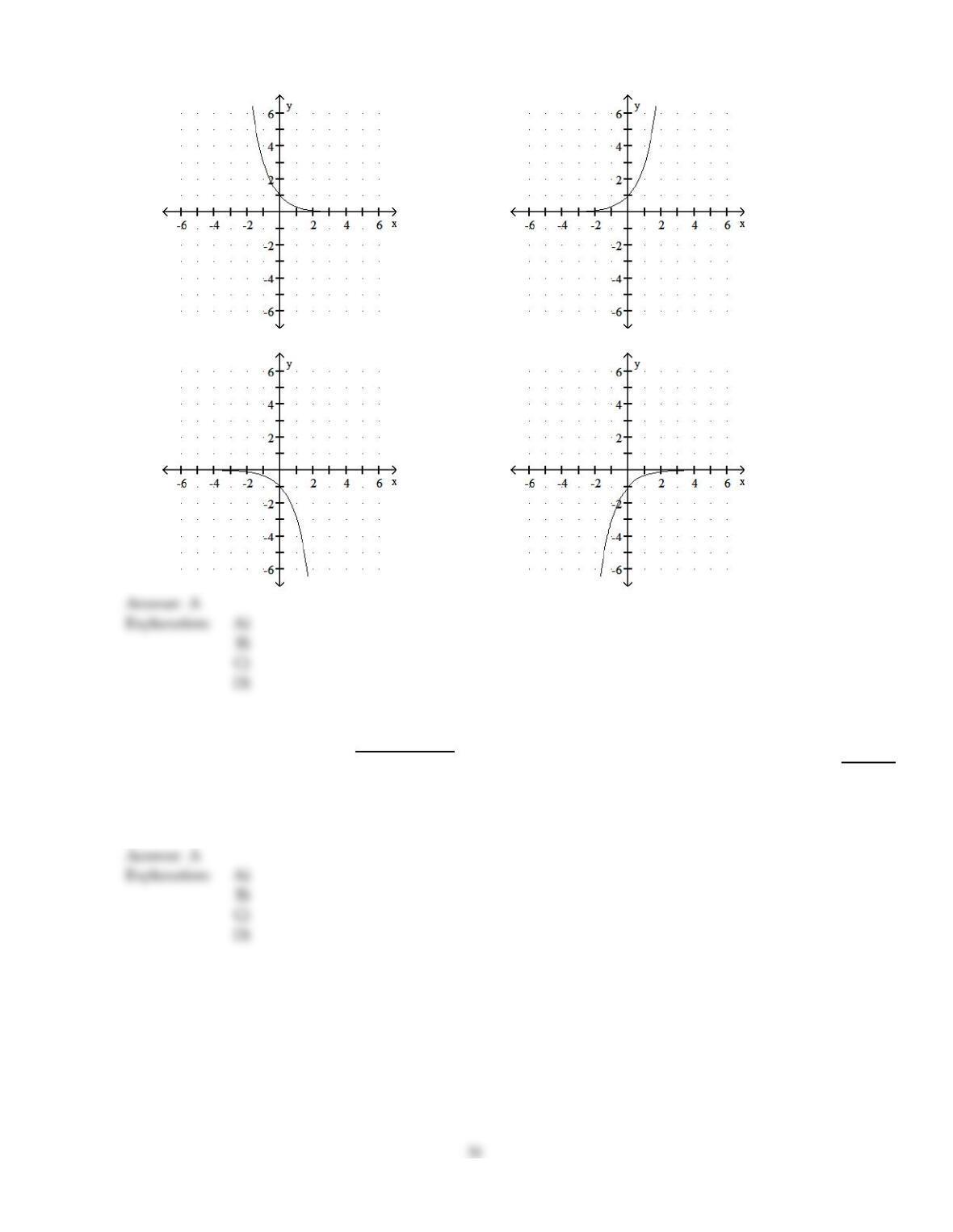
74)
f(x) =1
3
x
74)
30
A)
B)
C)
D)
Solve the problem.
75)
The logistic growth function f(t) =12,000
1 +170.4e–1.5t models the number of people who have become
ill with a particular infection t weeks after its initial outbreak in a particular community. How
many people were ill after 7 weeks?
75)
A)
11,944 people
B)
490 people
C)
12,000 people
D)
12,171 people
Solve.
76)
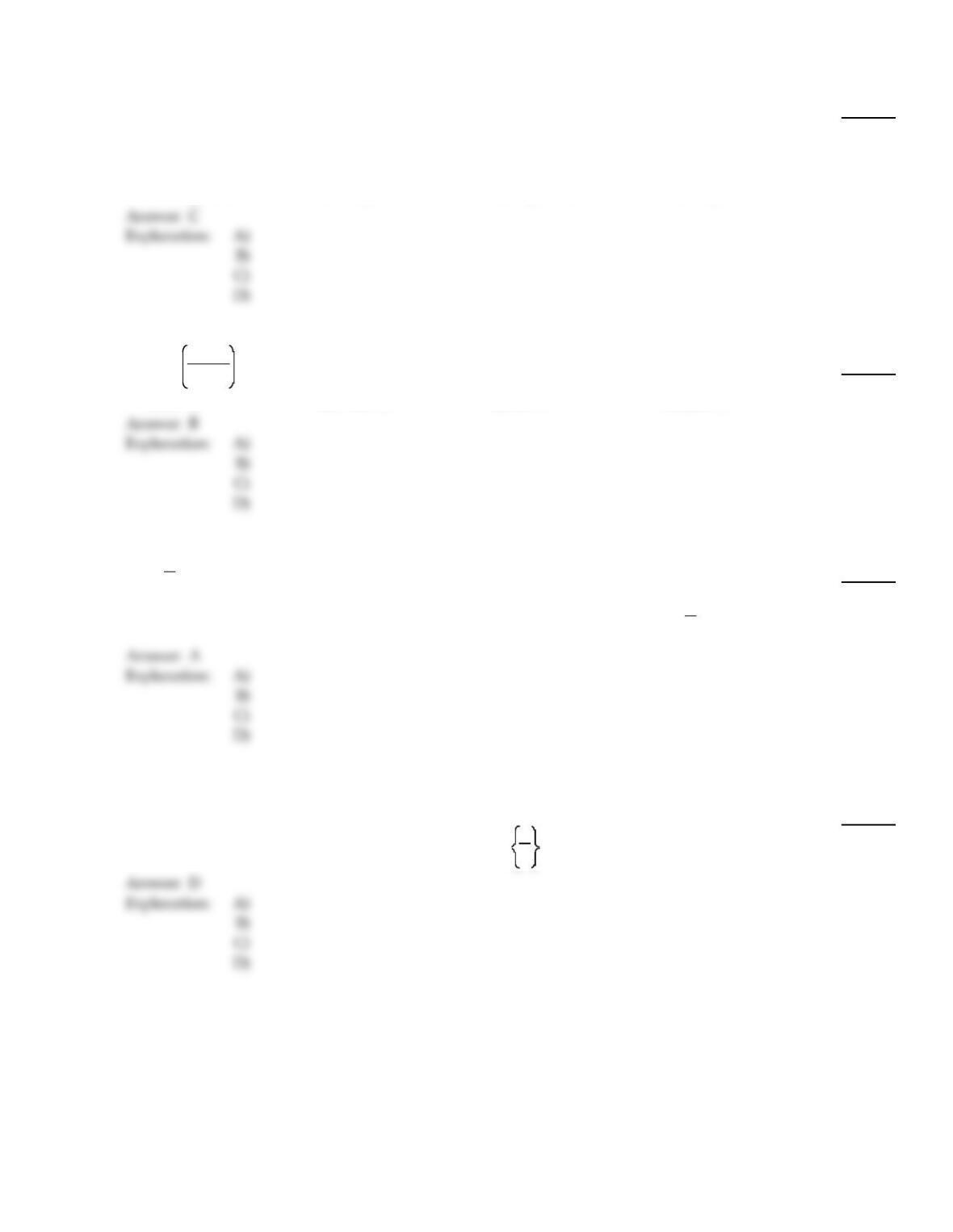
The function A =A0e–0.01155x models the amount in pounds of a particular radioactive material
stored in a concrete vault, where x is the number of years since the material was put into the vault.
If 700 pounds of the material are initially put into the vault, how many pounds will be left after 170
years?
76)
A)
992 pounds
B)
548 pounds
C)
98 pounds
D)
124 pounds
Find the domain of the logarithmic function.
77)
f(x) = ln 1
x + 10
77)
A)
(1, )
B)
(–10, )
C)
(0, )
D)
(10, )
Evaluate the expression without using a calculator.
78)
log 2
1
4
78)
A)
–2
B)
4
C)
2
D)
1
2
Solve the logarithmic equation. Be sure to reject any value that is not in the domain of the original logarithmic
expressions. Give the exact answer.
79)
log (2+ x) – log (x – 2) = log 3
79)
A)
B)
{–4}
C)
3
2
D)
{4}
32
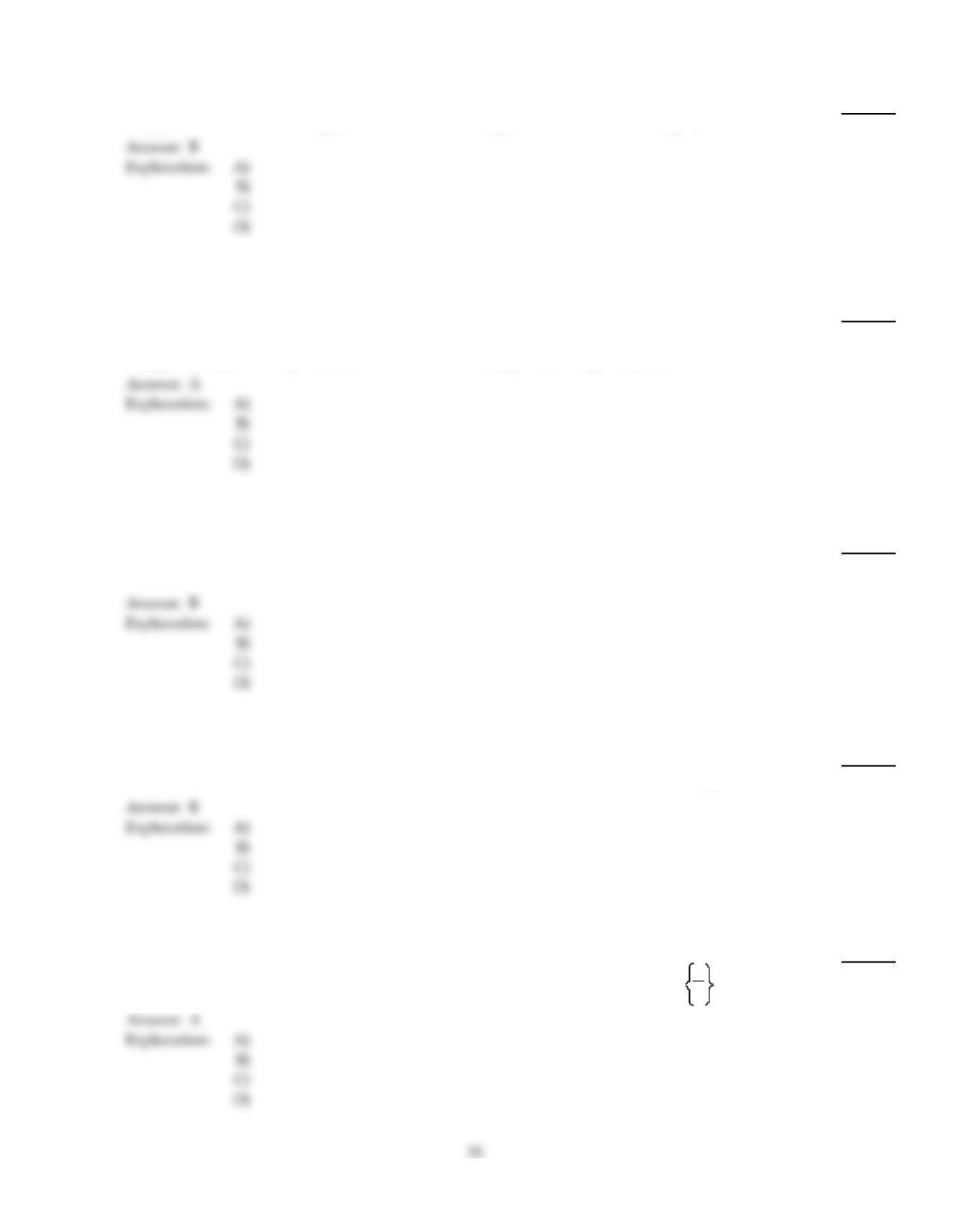
Evaluate or simplify the expression without using a calculator.
80)
ln e
80)
A)
e
B)
1
C)
0
D)
–1
Rewrite the equation in terms of base e. Express the answer in terms of a natural logarithm, and then round to three
decimal places.
81)
y =16(2.8)x
81)
A)
y =16ex ln 2.8, y =16e1.030x
B)
y =2.8ex ln 16, y =2.8e2.773x
C)
y = (ln 16)ex ln 2.8, y =2.773e1.030x
D)
y =16e2.8x, y =162.7181.030x
Use properties of logarithms to expand the logarithmic expression as much as possible. Where possible, evaluate
logarithmic expressions without using a calculator.
82)
log 7(7x)
82)
A)
x
B)
1 +log 7x
C)
7
D)
1
Evaluate the expression without using a calculator.
83)
7log 711
83)
A)
18
B)
11
C)
7
D)
log 711
Solve the equation by expressing each side as a power of the same base and then equating exponents.
84)
4(3x – 7)=16
84)
A)
{3}
B)
{–3}
C)
{4}
D)
1
4
Use properties of logarithms to condense the logarithmic expression. Write the expression as a single logarithm whose
coefficient is 1. Where possible, evaluate logarithmic expressions.
85)
(log am–log an) + 4 log ak
85)
A)
log amk4n
B)
log a
mk4
n
C)
log a
4mk
n
D)
log a
m
k4n
Solve the problem.
86)
The size of the bear population at a national park increases at the rate of 4.3% per year. If the size of
the current population is 108, find how many bears there should be in 5 years. Use y =yoe0.043t
and round to the nearest whole number.
86)
A)
134
B)
132
C)
136
D)
138
Evaluate the expression without using a calculator.
87)
log981
87)
A)
9
B)
18
C)
2
D)
81
Use properties of logarithms to condense the logarithmic expression. Write the expression as a single logarithm whose
coefficient is 1. Where possible, evaluate logarithmic expressions.
88)
log10125 +log108
88)
A)
log10133
B)
3
C)
3log1010
D)
log101000
34
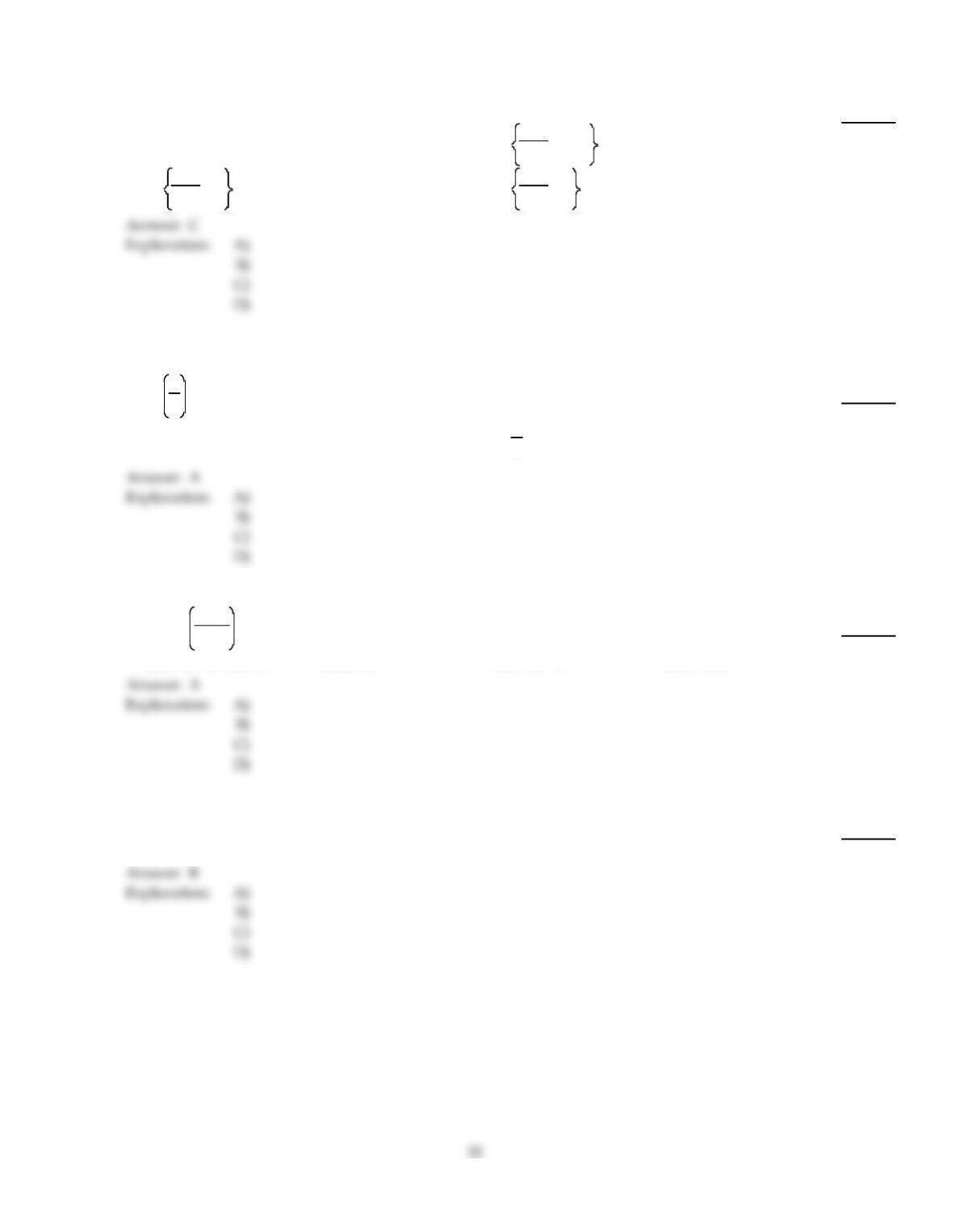
Solve the exponential equation. Express the solution set in terms of natural logarithms.
89)
4x +8=7
89)
A)
{ln 7– ln 4– ln 8}
B)
ln 4
ln 7+ ln 8
C)
ln 7
ln 4– 8
D)
ln 4
ln 7+8
Use properties of logarithms to expand the logarithmic expression as much as possible. Where possible, evaluate
logarithmic expressions without using a calculator.
90)
log 7
7
x
90)
A)
1 –log 7x
B)
–log 7x
C)
1
x
D)
7
Find the domain of the logarithmic function.
91)
f(x) = log x + 9
x – 4
91)
A)
(–, –9) (4, )
B)
(4, )
C)
(–, –9)
D)
(–9, 4)
Evaluate or simplify the expression without using a calculator.
92)
9 log 106.2
92)
A)
558
B)
55.8
C)
5.58
D)
16.4209
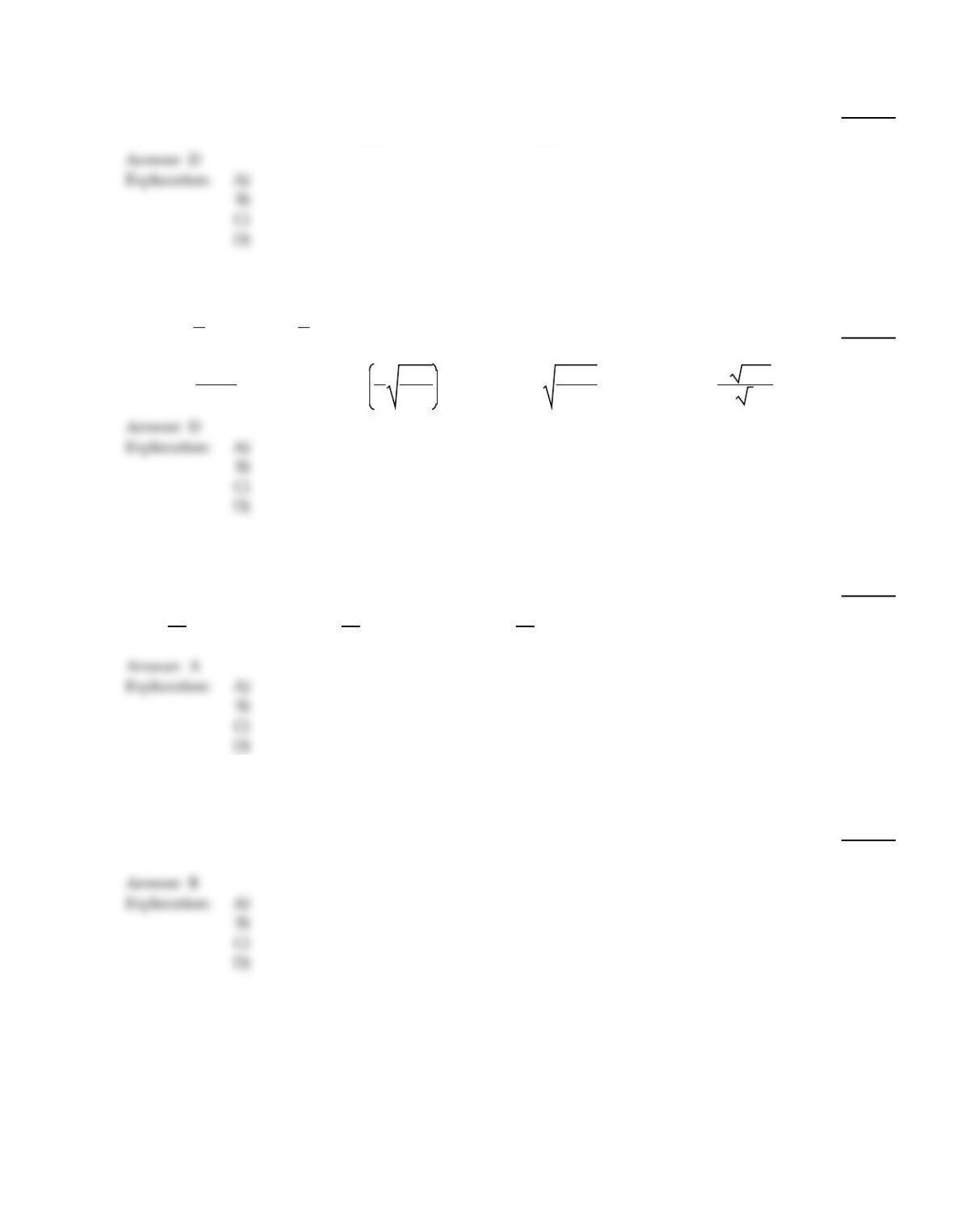
Write the equation in its equivalent logarithmic form.
93)
7x=343
93)
A)
log x343 =7
B)
log 343 7= x
C)
log 343 x =7
D)
log 7343 = x
Use properties of logarithms to condense the logarithmic expression. Write the expression as a single logarithm whose
coefficient is 1. Where possible, evaluate logarithmic expressions.
94)
3log42+1
6log4 (r –3) –1
2log4 r
94)
A)
log48r –3
12r
B)
log41
4
r –3
r
C)
log43r –9
12r
D)
log486r –3
r
Solve the logarithmic equation. Be sure to reject any value that is not in the domain of the original logarithmic
expressions. Give the exact answer.
95)
log6 (x + 2) –log6 x = 2
95)
A)
{2
35 }
B)
{1
18 }
C)
{35
2}
D)
{6}
Use properties of logarithms to expand the logarithmic expression as much as possible. Where possible, evaluate
logarithmic expressions without using a calculator.
96)
lognx5
96)
A)
–nlog5 x
B)
5logn x
C)
nlog5 x
D)
–5logn x
Graph the function by making a table of coordinates.
36
97)
f(x) =4x
97)
A)
B)
C)
D)
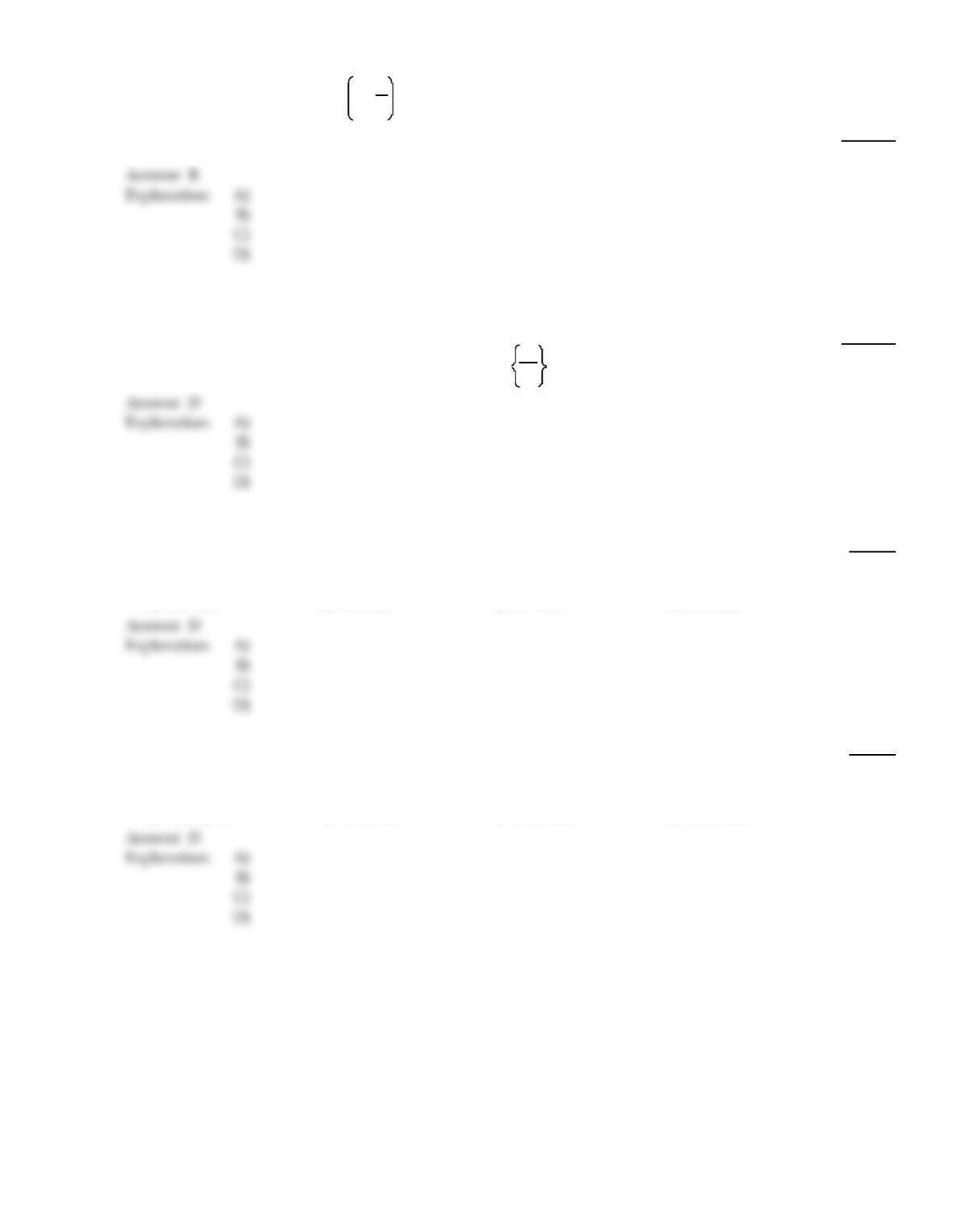
Use the compound interest formulas A = P 1 +r
n
nt and A = Pert to solve.
98)
Find the accumulated value of an investment of $3000 at 8% compounded annually for 9 years.
98)
A)
$5552.79
B)
$5997.01
C)
$4920.00
D)
$5160.00
Solve the logarithmic equation. Be sure to reject any value that is not in the domain of the original logarithmic
expressions. Give the exact answer.
99)
log x +log (x +1) =log 30
99)
A)
{6}
B)
{6, –5}
C)
31
2
D)
{5}
Solve the problem.
100)
The long jump record, in feet, at a particular school can be modeled by f(x) =20.1 +2.5 ln (x + 1)
where x is the number of years since records began to be kept at the school. What is the record for
the long jump 6 years after record started being kept? Round your answer to the nearest tenth.
100)
A)
22.6 feet
B)
24.6 feet
C)
24.1 feet
D)
25.0 feet
101)
The population in a particular country is growing at the rate of 1.2% per year. If 10,184,000 people
lived there in 1999, how many will there be in the year 2007? Use y =yoe0.012t and round to the
nearest ten–thousand.
101)
A)
13,450,000
B)
12,330,000
C)
10,990,000
D)
11,210,000
Graph the functions in the same rectangular coordinate system.
38
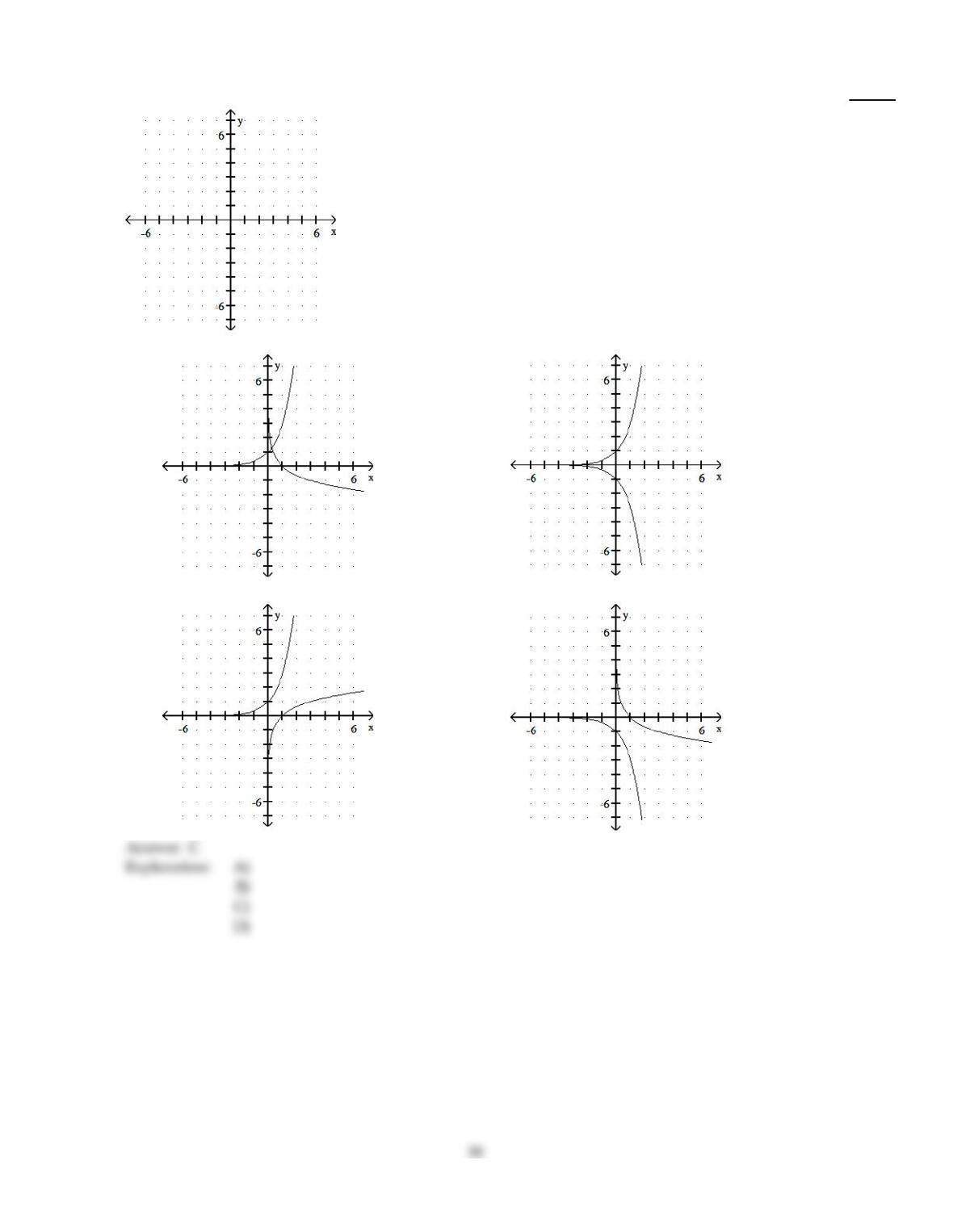
102)
f(x) =3x and g(x) =log3x
102)
A)
B)
C)
D)
Use properties of logarithms to expand the logarithmic expression as much as possible. Where possible, evaluate
logarithmic expressions without using a calculator.
103)
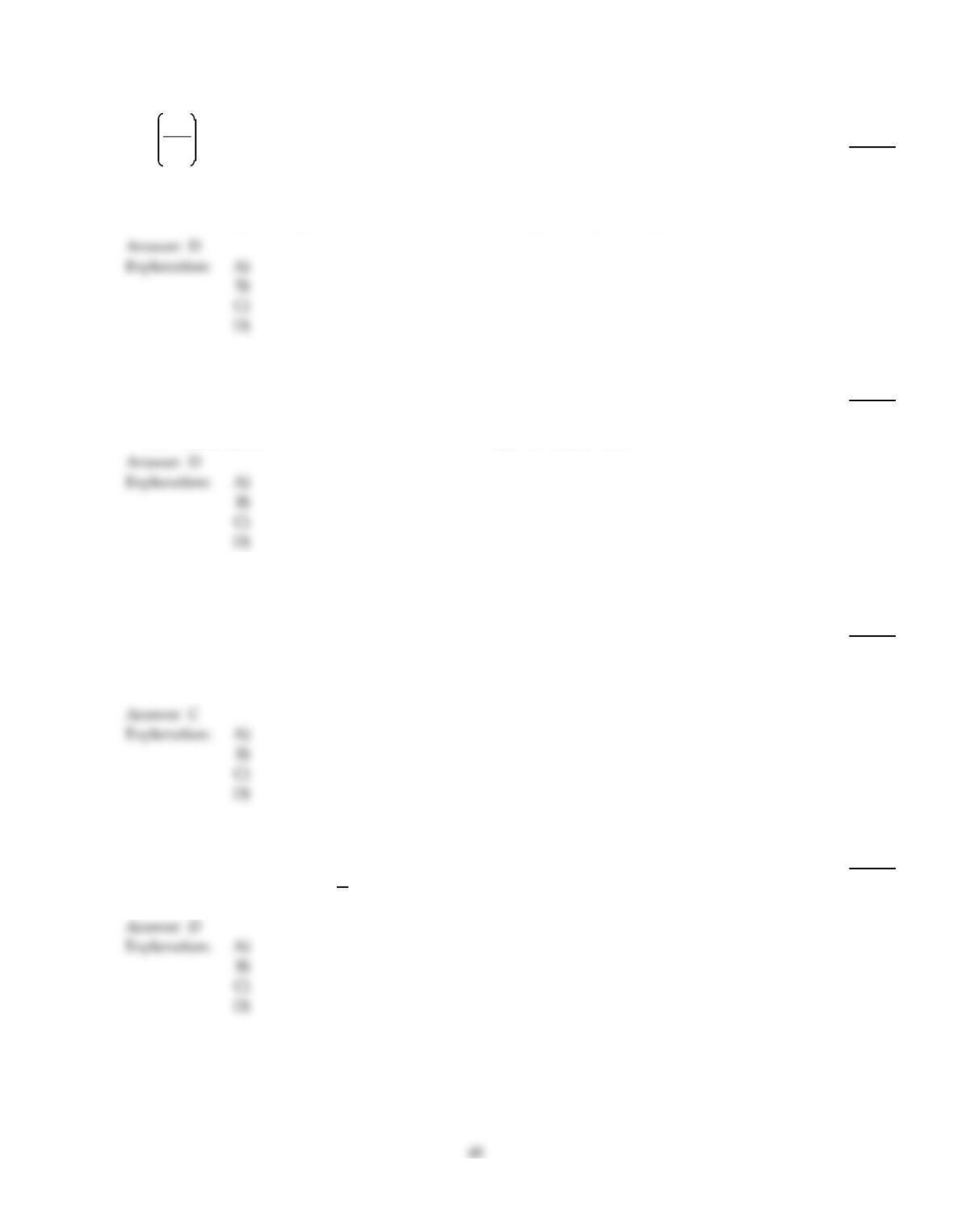
logb
xy7
z2
103)
A)
logbx +logby7+logbz2
B)
logbx +7logby +2logbz
C)
logbx +logby7–logbz2
D)
logbx +7logby –2logbz
Find the domain of the logarithmic function.
104)
f(x) =log 9(x +1)2
104)
A)
(1, )
B)
(–1, )
C)
(–, 0) or (0, )
D)
(–, –1) or (–1, )
D
Use properties of logarithms to expand the logarithmic expression as much as possible. Where possible, evaluate
logarithmic expressions without using a calculator.
105)
logb (yz4)
105)
A)
4 logb y +4logb z
B)
4logb yz
C)
logb y +4logb z
D)
logb y +logb4z
C
Evaluate or simplify the expression without using a calculator.
106)
ln e2
106)
A)
1
B)
1
2
C)
e
D)
2
D
D