6. Measures of internal consistency are used to determine which of the following?
A. The stability of a trait over time
B. The stability of a trait across different groups
C. Consistency of items on an instrument to measure a skill, trait or domain
D. Consistency of scoring by various examiners
7. What is the term used to ensure that a psychological trait, personality trait, psychological
concept attribute or theoretical characteristic is measured by an instrument?
A. Construct validity
B. Determined by the purpose of the assessment
C. Determined by the examiner according to the criterion
D. Test-retest reliability
8. Which of the following statements is true concerning the relationship between reliability
and standard error of measurement?
A. In general, the higher the reliability, the higher the standard error of
measurement.
B. In general, the higher the reliability, the lower the standard error of
measurement.
C. There is no way to determine a consistent relationship between the two, most
of the time.
D. There is a positive correlation between the standard deviation and the standard
error of measurement as well as reliability.
9. Which type of reliability study may yield a lower coefficient, before correction, due to
the reduced number of items?
A. Split-half reliability
B. Interrater reliability
C. Coefficient alpha
D. Kuder-Richardson-20
10. Which of the following is not used to measure internal consistency?
A. Kuder-Richardson-20
B. Coefficient alpha
C. Split-half reliability
D. Interrater reliability
11. A practice effect may be a problem when studying the results of which of the following?
A. Split-half reliability
B. Content validity
C. Test-retest reliability
D. Internal consistency
12. Comparing the scores of a new assessment instrument with the scores of an older test
may help to establish which of the following?
A. Content validity
B. Internal reliability
C. Alternative forms of validity
D. Coefficient alpha
13. Administering two instruments within a short period of time is necessary in order to
establish which of the following?
A. Interrater reliability
B. Alternate forms reliability
C. Predictive validity
D. Content validity
14. Correlation coefficients are expressed as which of the following?
A. Between +.5 and .5
B. Between + 1 and 0
C. Between 1 and 0
D. Between 1.00 and +1.00
15. Which of the following represents the strongest relationship?
A. .59
B. .47
C. +.28
D. +.57
16. Which of the following options would most likely represent a negative correlation?
A. The number of hours spent at a party the night before an exam and the exam
grade
B. The number of hours spent studying and test grades
C. The number of classes attended and test scores
D. The course section number and the test grade
17. The type of reliability that can look at internal consistency by using odd and even
numbered items of the same test to compare performance is called which of the
following?
A. The odd-even comparison method
B. Split-half reliability
C. Odd-even halves
D. Difficult
18. Correlation is represented by what symbol?
A. ∑
B. µ
C. r
D. α
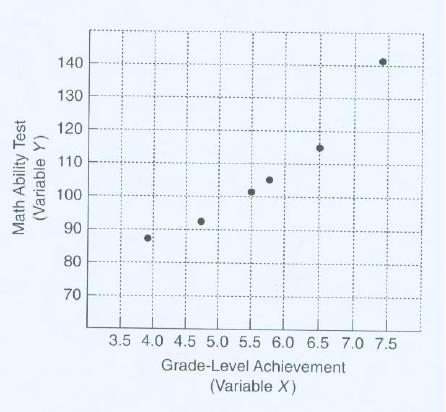
Using the graph below, answer the questions that follow.
19. What is the name given to this type of graph?
A. Dot graph
B. Scattergram
C. Unfinished line graph
D. Variable comparison graph
20. Given the general flow of the direction of the data, these variables are likely to be which
of the following?
A. Positively correlated
B. Negatively correlated
C. Possess no correlation
D. There is no way to tell correlation from visual interpretation of data.
21. Establishing interrater reliability is especially important when test data are which of the
following?
A. Scored by computer
B. Subjective
C. Scored by students
D. Objective
22. Which of the following is considered a good reliability score?
A. .50
B. .60
C. .70
D. .80
23. This type of reliability checks the consistency across items of an instrument where credit
varies across responses.
A. Split-half
B. Kuder-Richardson 20
C. Coefficient Alpha
D. Equivalent Forms
24. A test item is considered to have this if it is answered incorrectly a disproportionate
number of times by one group compared to another.
A. Item bias
B. Discriminatory features
C. Reliability
D. Validity
25. When an instrument can predict performance on some other variable, it is considered to
have which of the following?
A. Content validity
B. Construct validity
C. Predicative validity
D. Criterion-related validity
Short Answer
1. How would the use of standard error of measurement help in making educational decisions
for students?
2. Discuss the positives and negatives of the implementation of accommodations when
assessing a student with special needs.
3. Compare and contrast reliability and validity.
4. Discuss the reasons why interrater reliability is important on assessment devices that have
open-ended questions, such as essay exams.
5. Many colleges use the SAT as an entrance requirement for college. Why? What type of
validity does the SAT offer?
6. What is error in psychoeducational assessment? Does error play into assessing learners
with special needs to a greater or lesser extent than typical learners? Discuss.
7. Determine the standard error of measurement given the following information:
Standard deviation = 3
Reliability coeffiecient = .51
8. Discuss some potential challenges associated with the validity of tests and their use.
9. Describe how the data would appear in a scattergram for a positive, negative and no
correlation.
10. What is construct validity and what is used to establish it?
11. Identify and define at least two ways to determine internal consistency.
12. What are the three types of reliability? What are the optimal reliability scores?
Chapter 4 Test Bank Answer Key
True and False
Multiple Choice
Short Answer