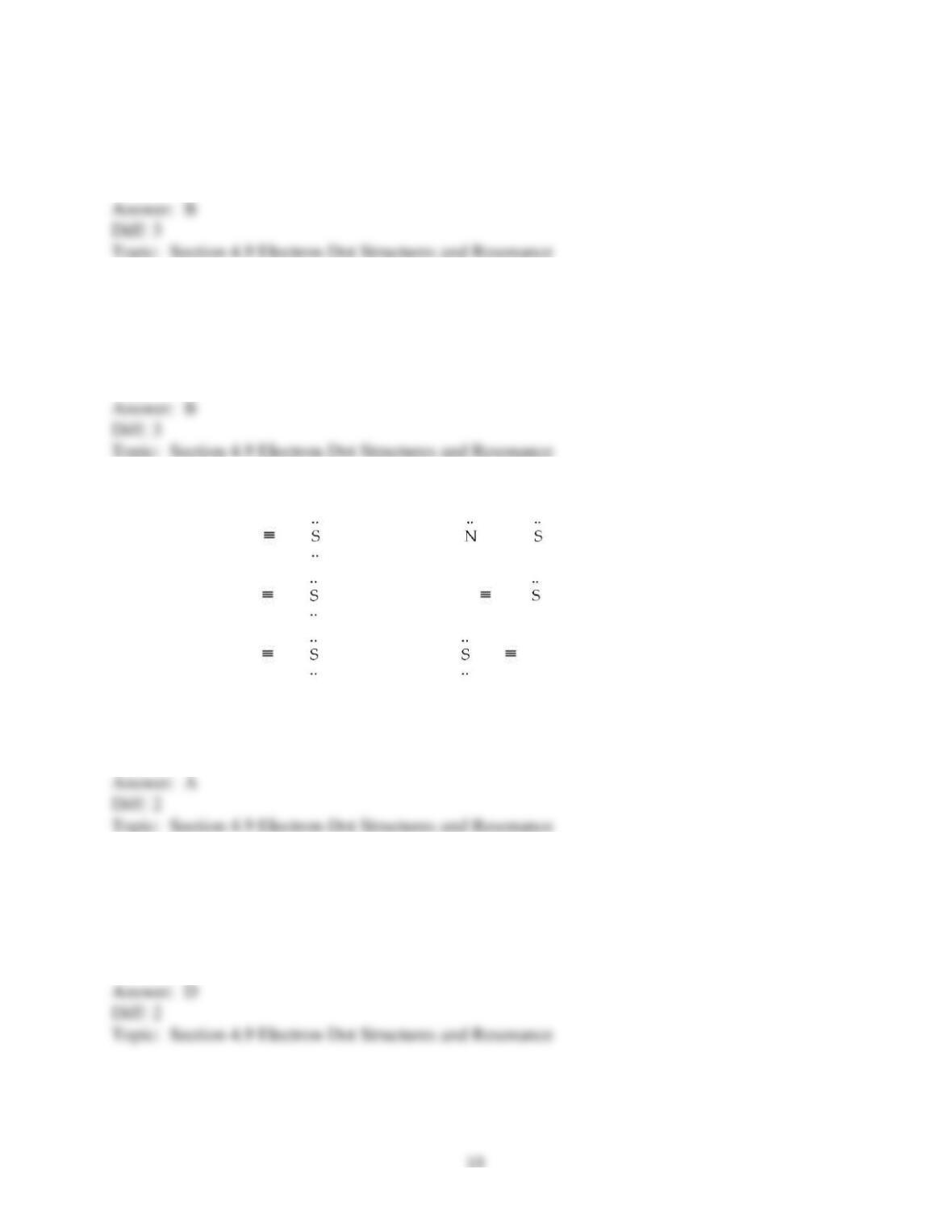
A) two
B) three
C) four
D) five
47) What is the approximate carbon-oxygen bond order in CO32-?
A) 1
B) 4/3
C) 5/3
D) 2
48) Which of the following are allowed resonance forms of NCS–?
I [: N C –:] – and [: = C = :] –
II [: N C –:] – and [: N C = :] –
III [: N C – :] – and [: – C N :] –
A) only I
B) only II
C) only III
D) I and III
49) Which one of the following is expected to exhibit resonance?
A) NH4+
B) HCN
C) CO2
D) NO2–
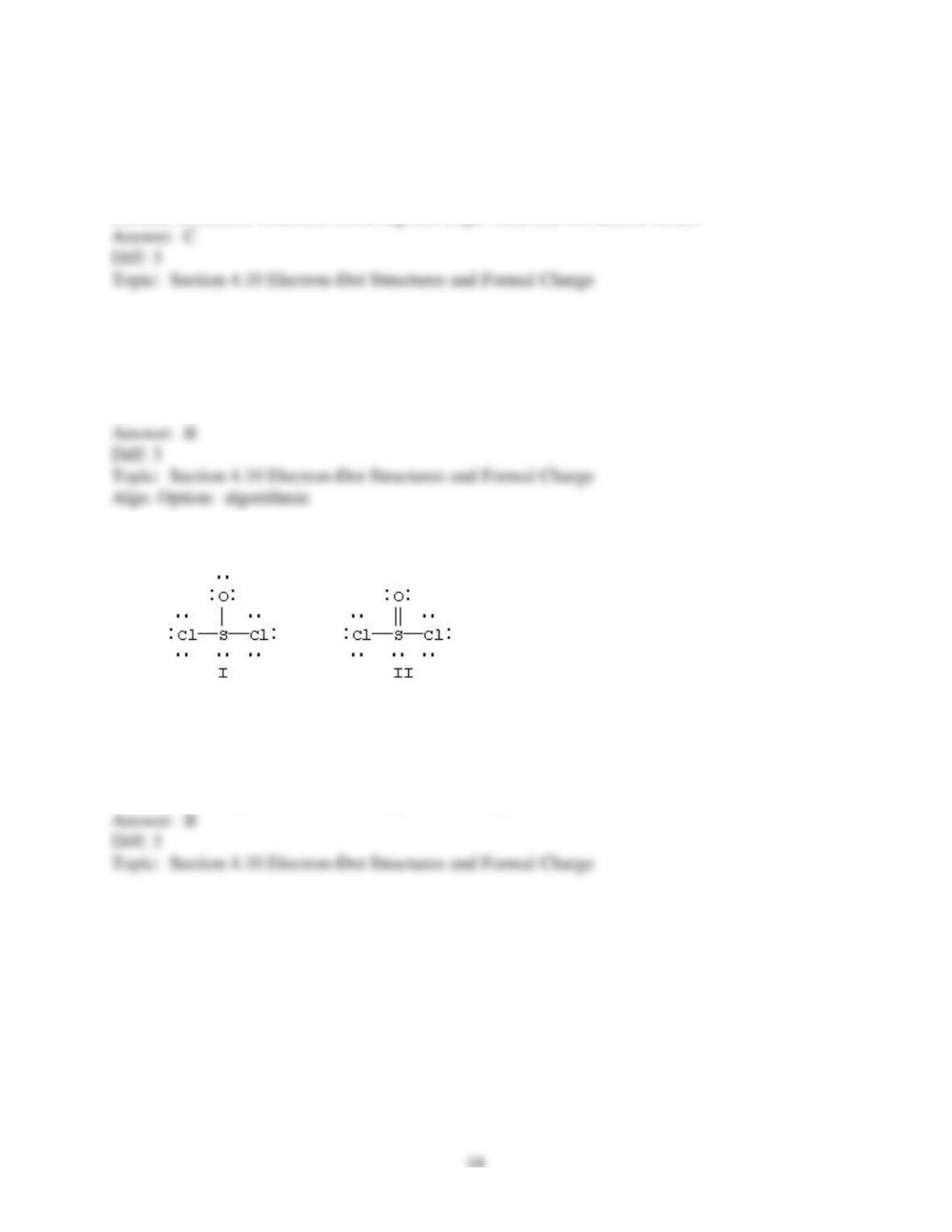
50) Based on formal charge considerations, the electron-dot structure of CO32– ion has
A) two resonance structures involving two single bonds and one double bond.
B) two resonance structures involving one single bond and two double bonds.
C) three resonance structures involving two single bonds and one double bond.
D) three resonance structures involving one single bond and two double bonds.
51) In the best Lewis structure for NO+, what is the formal charge on the N atom?
A) -1
B) 0
C) +1
D) +2
52) Two resonance forms for SOCl2 are given below.
Which is favored by the octet rule and which by formal charge considerations?
A) I is favored by the octet rule and by formal charge considerations.
B) I is favored by the octet rule and II by formal charge considerations.
C) II is favored by the octet rule and I by formal charge considerations.
D) II is favored by the octet rule and by formal charge considerations.
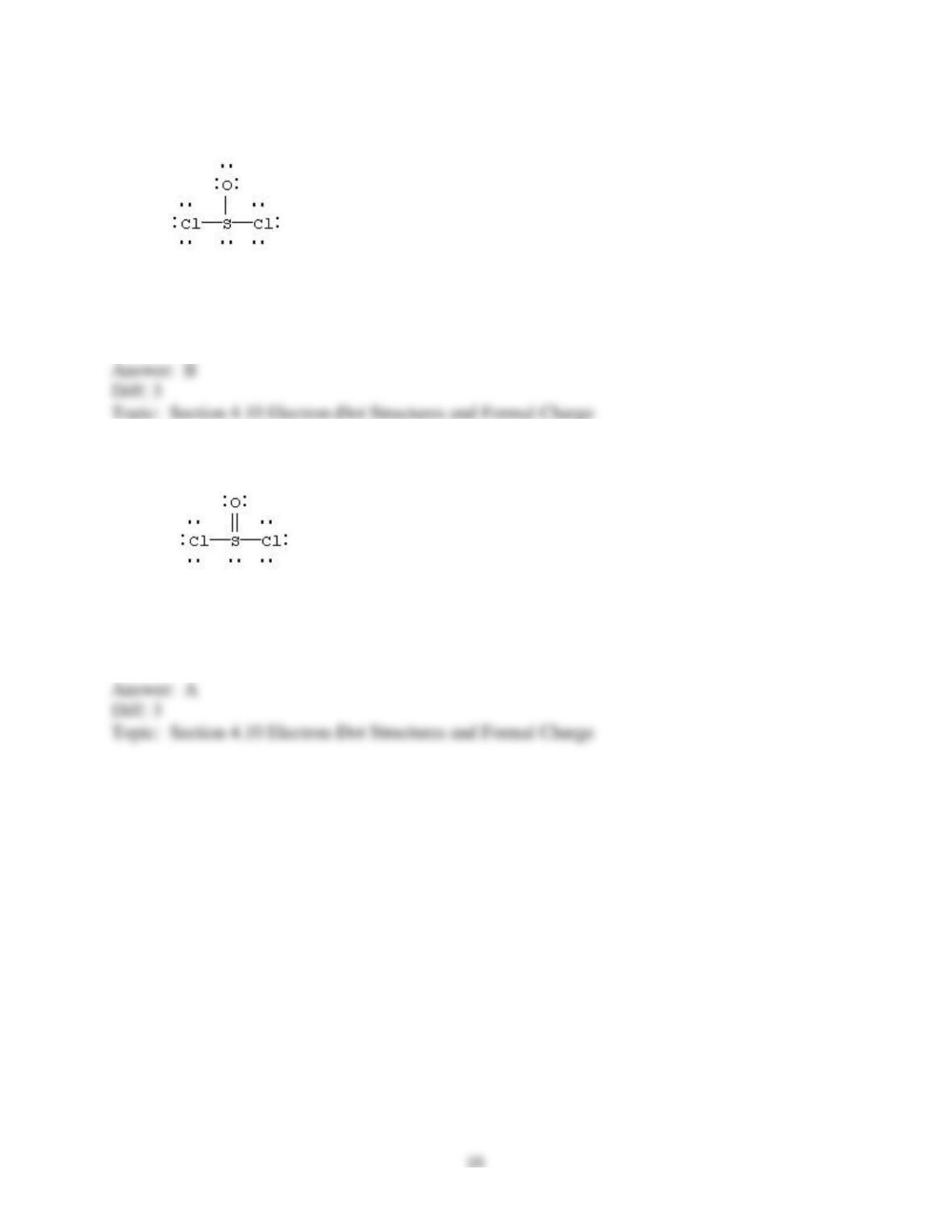
53) Assign formal charges to each atom in the resonance form for SOCl2 given below.
A) 0 for Cl, 0 for S, and 0 for O
B) 0 for Cl, +1 for S, and -1 for O
C) -1 for Cl, +4 for S, and -2 for O
D) -1 for Cl, -2 for S, and -2 for O
54) Assign formal charges to each atom in the resonance form for SOCl2 given below.
A) 0 for Cl, 0 for S, and 0 for O
B) 0 for Cl, +1 for S, and -1 for O
C) -1 for Cl, +4 for S, and -2 for O
D) -1 for Cl, -2 for S, and -2 for O
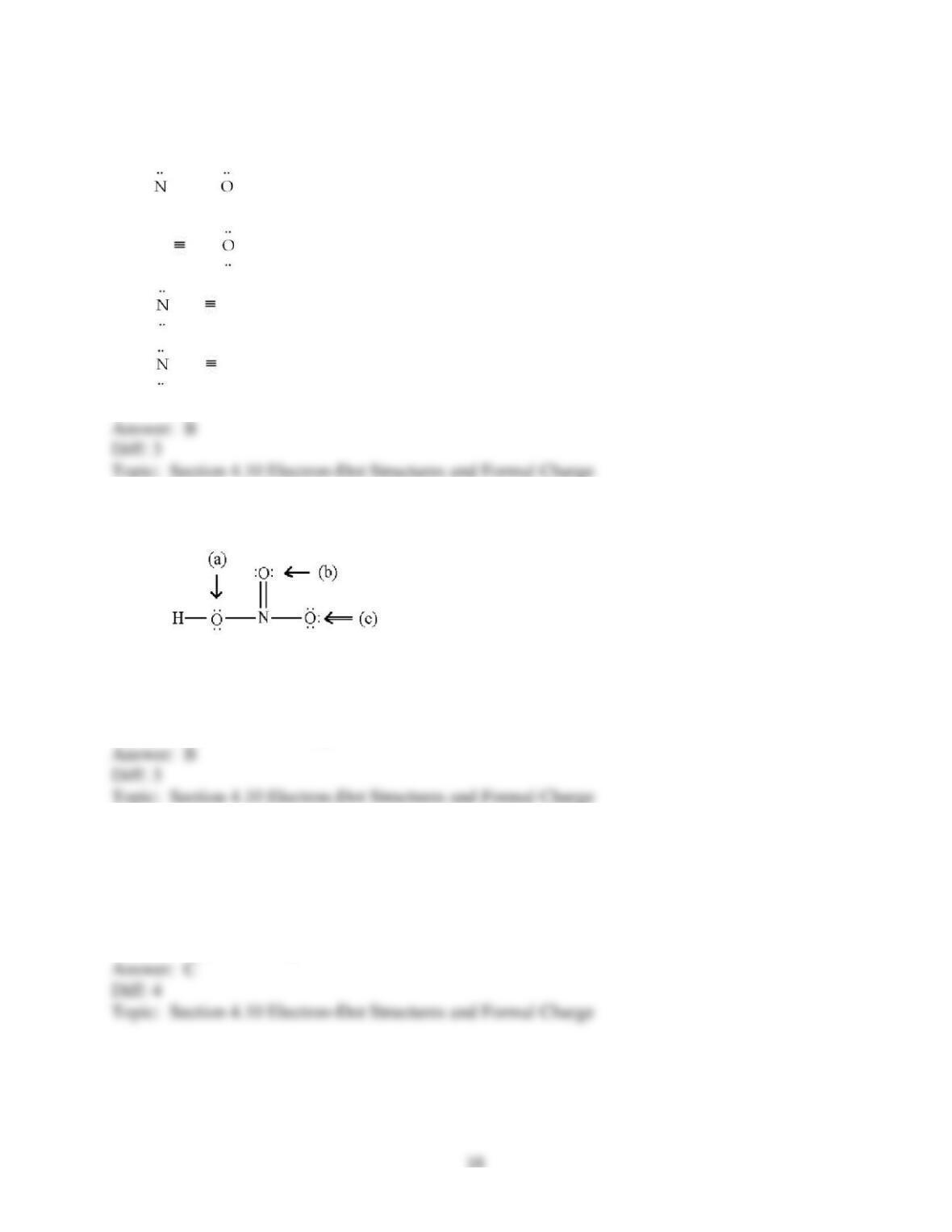
55) Which electron dot structure for OCN– has a formal charge of -1 on the most electronegative
atom?
A) [: = C = :] –
B) [: N C –:] –
C) [: – C O :] –
D) [: – O C :] –
56) Assign formal charges to all atoms in the following resonance form for HNO3.
A) 0 for all atoms
B) +1 for N, -1 for oxygen (c), 0 for all other atoms
C) +1 for N and H, -1 for oxygen (a) and oxygen (c), 0 for oxygen (b)
D) +1 for H, -2 for each oxygen, +5 for N
57) How many double and single bonds are in the resonance form for SO2 in which the formal
charges on each atom are zero?
A) two single bonds and no double bonds
B) one single bond and one double bond
C) no single bonds and two double bonds
D) Each of the above is possible.
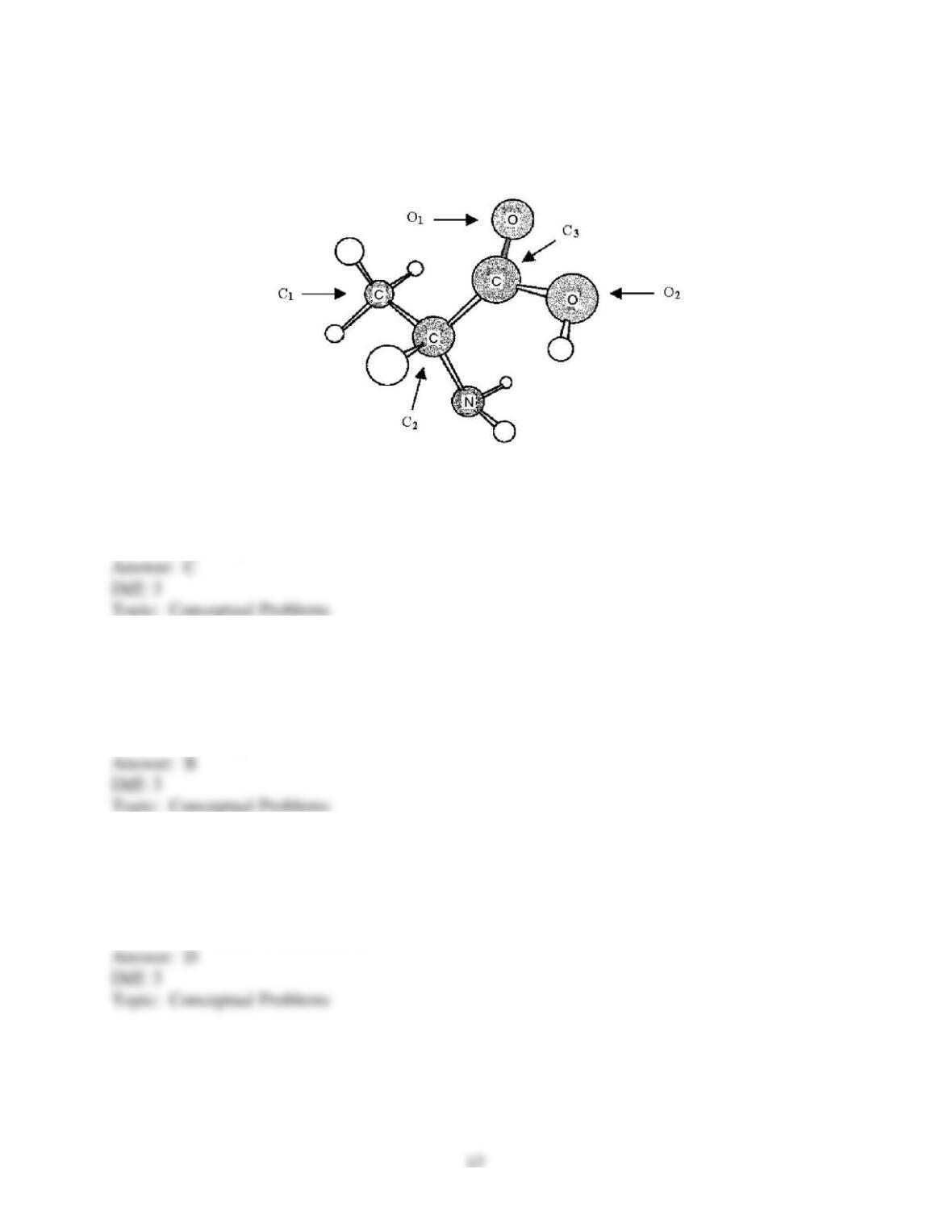
The following ball-and-stick molecular model is a representation of the amino acid alanine
(unshaded spheres = H). Only the connections between atoms are shown; multiple bonds and
nonbonded electrons are not indicated.
58) In order to complete an electron-dot structure of alanine, the nitrogen atom needs
A) 1 additional bond and 1 nonbonded pair of electrons.
B) 1 additional bond and 2 nonbonded pairs of electrons.
C) 1 nonbonded pair of electrons.
D) 2 nonbonded pairs of electrons.
59) In order to complete an electron-dot structure of alanine, the oxygen atom labeled O1 needs
A) 1 additional bond and 1 nonbonded pair of electrons.
B) 1 additional bond and 2 nonbonded pairs of electrons.
C) 1 nonbonded pair of electrons.
D) 2 nonbonded pairs of electrons.
60) In order to complete an electron-dot structure of alanine, the oxygen atom labeled O2 needs
A) 1 additional bond and 1 nonbonded pair of electrons.
B) 1 additional bond and 2 nonbonded pairs of electrons.
C) 1 nonbonded pair of electrons.
D) 2 nonbonded pairs of electrons.
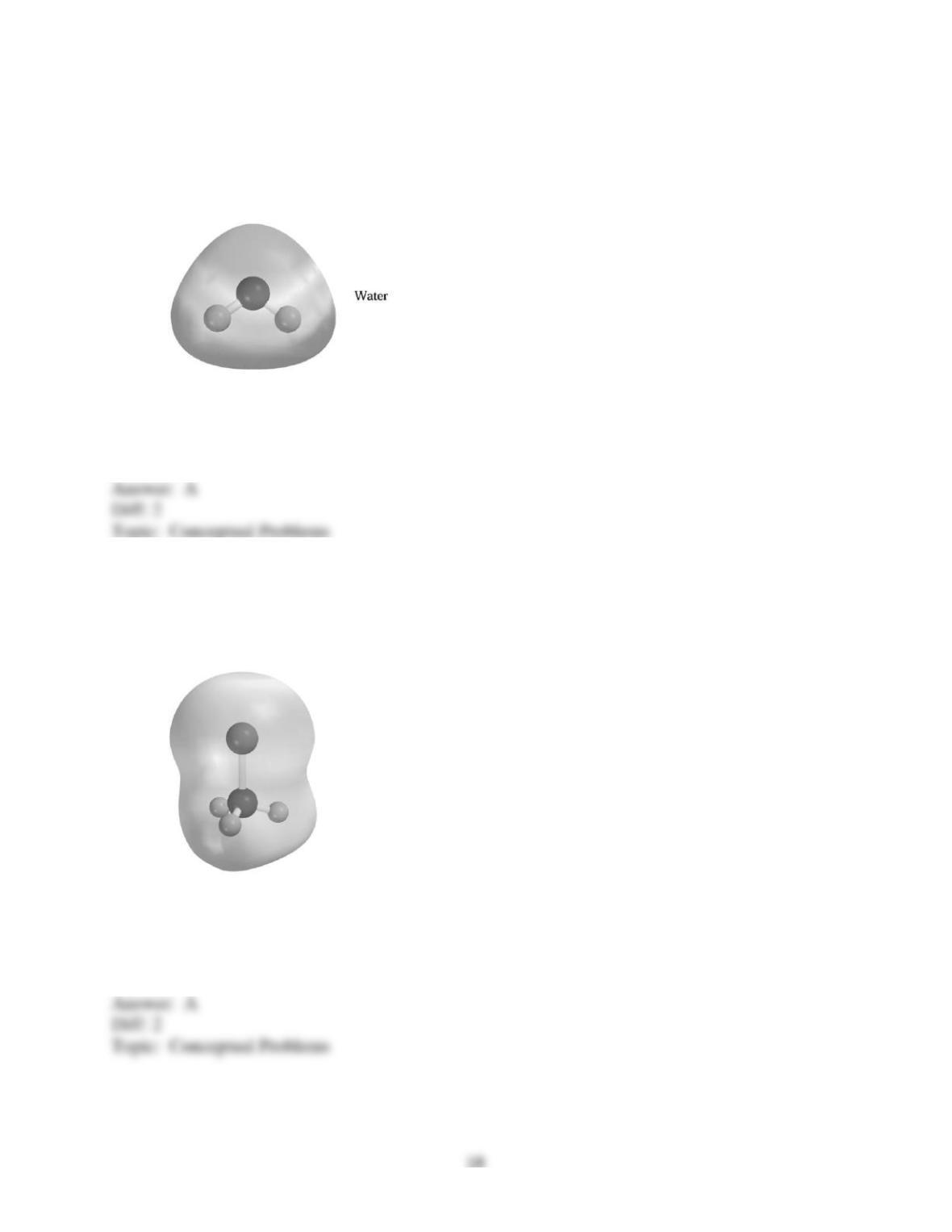
61) Electrostatic potential maps use color to portray the calculated electron distribution in a
molecule. Atoms that are electron poor and carry a δ+ charge are shown in blue. Atoms that are
electron rich and carry a δ– charge are shown in red. Atoms with little or no charge are shown in
green. The electrostatic potential map of H2O below should show
A) H blue and O red.
B) H blue and O green.
C) H green and O blue.
D) H red and O blue.
62) Electrostatic potential maps use color to portray the calculated electron distribution in a
molecule. Atoms that are electron poor and carry a δ+ charge are shown in blue. Atoms that are
electron rich and carry a δ– charge are shown in red. Atoms with little or no charge are shown in
green. The electrostatic potential map of CH3Cl below should show
A) C blue and Cl red.
B) C blue and Cl green.
C) C green and Cl blue.
D) C red and Cl blue.
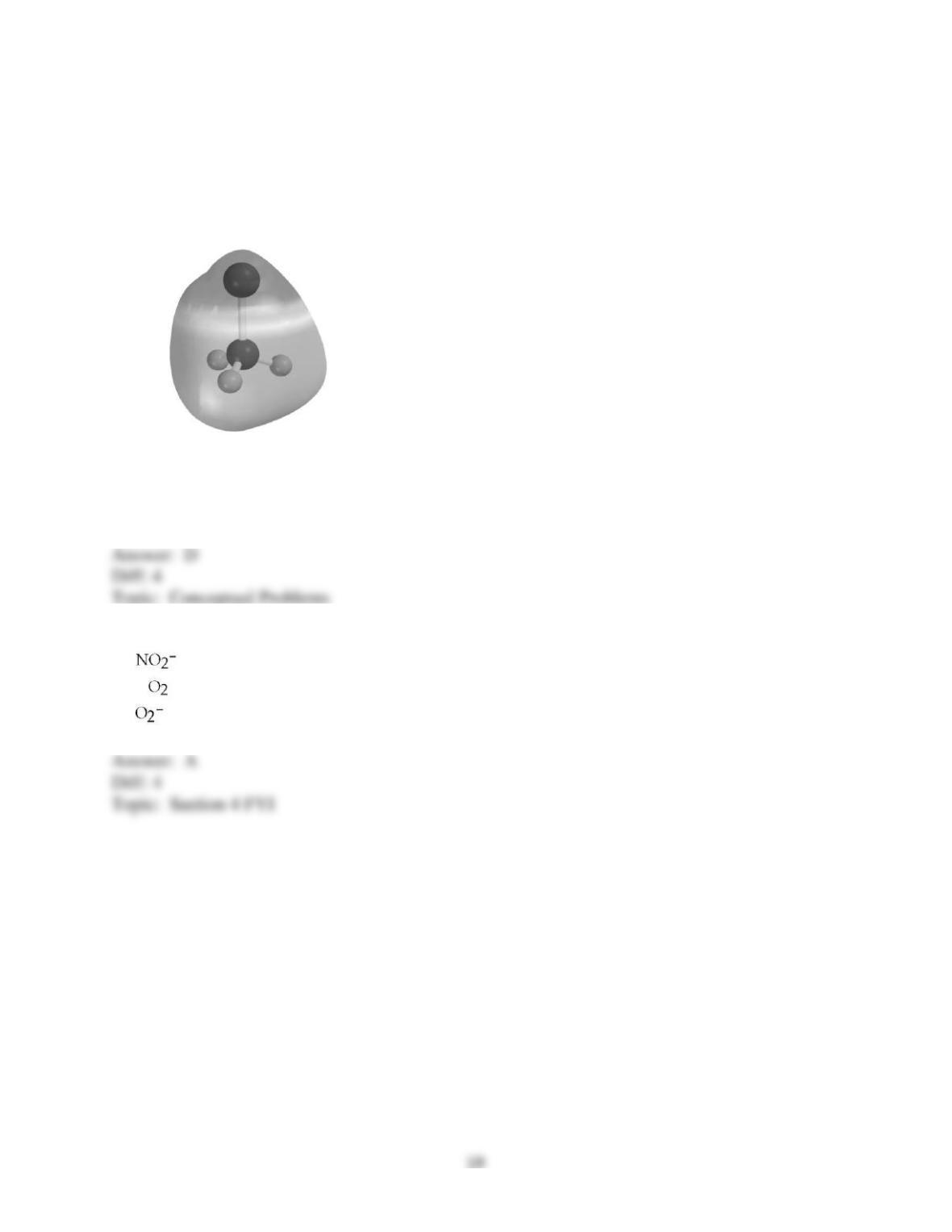
63) Electrostatic potential maps use color to portray the calculated electron distribution in a
molecule. Atoms that are electron poor and carry a δ+ charge are shown in blue. Atoms that are
electron rich and carry a δ– charge are shown in red. Atoms with little or no charge are shown in
green. The electrostatic potential map of CH3Li below should show
A) C blue and Li red.
B) C blue and Li green.
C) C green and Li blue.
D) C red and Li blue.
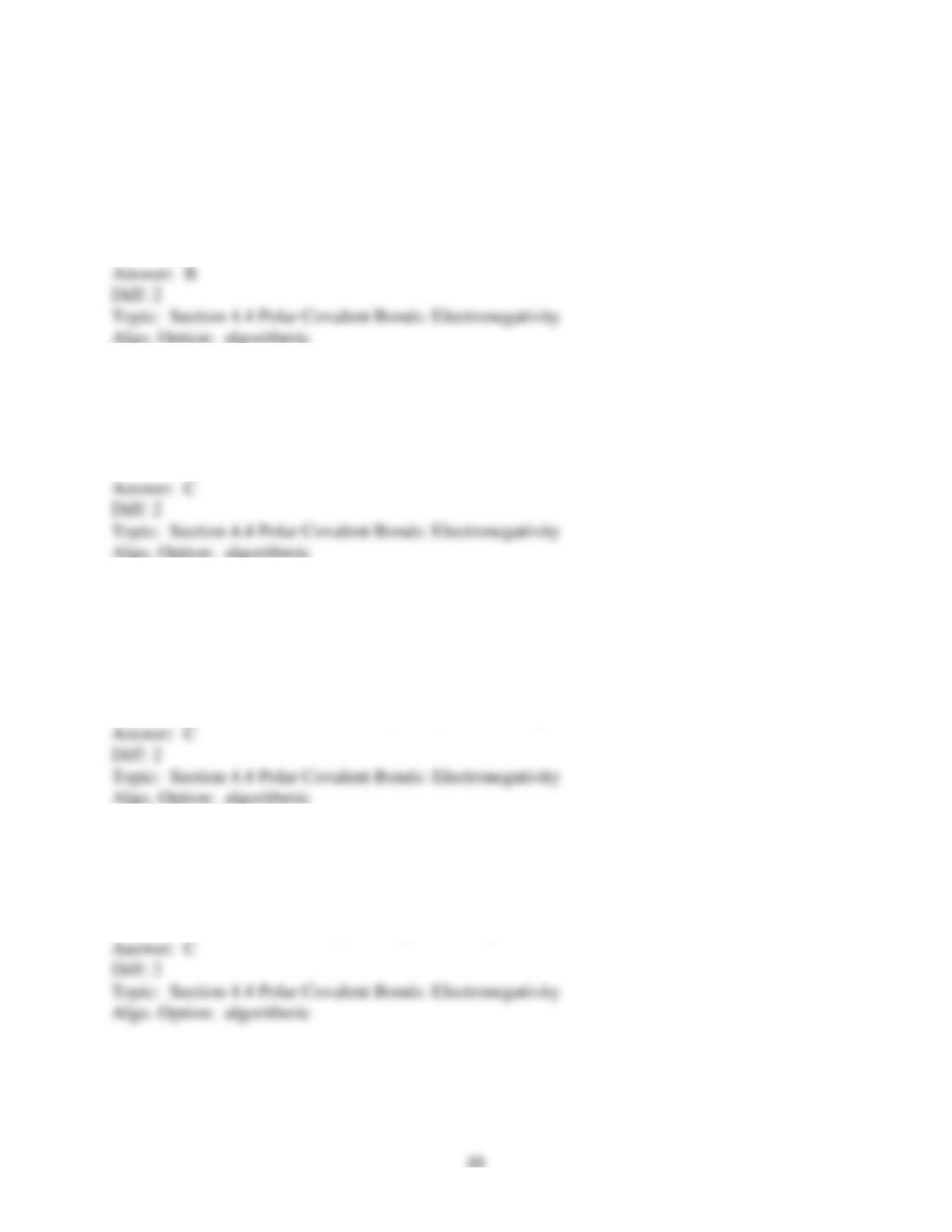
64) Which of the following is not considered to be a free radical?
A)
B) N
C)
D) NO
4.2 Algorithmic Questions
1) Of the following elements, which has the highest electronegativity?
A) S
B) Cl
C) Ti
D) Se
2) Of the following elements, which has the lowest electronegativity?
A) Sr
B) I
C) Ba
D) At
3) The electronegativity is 2.1 for H and 1.9 for Pb. Based on these electronegativities PbH4
would be expected to
A) be ionic and contain H– ions.
B) be ionic and contain H+ ions.
C) have polar covalent bonds with a partial negative charges on the H atoms.
D) have polar covalent bonds with a partial positive charges on the H atoms.
4) The compound ClF contains
A) ionic bonds.
B) nonpolar covalent bonds.
C) polar covalent bonds with partial negative charges on the F atoms.
D) polar covalent bonds with partial negative charges on the Cl atoms.
5) The phosphorus atom in PCl3 would be expected to have a
A) partial positive (δ+) charge.
B) partial negative (δ-) charge.
C) 3+ charge.
D) 3- charge.
6) The iodine atom in I2 would be expected to have a
A) charge of 1-.
B) partial charge δ-.
C) partial charge δ+.
D) charge of 0.
7) The name for the diatomic binary compound formed from fluorine and bromine is
A) bromine monofluoride
B) fluorine monobromide
C) monobromine monofluoride
D) monofluorine monobromide
8) How many lone pairs of electrons are on the As atom in AsCl3?
A) 0
B) 1
C) 2
D) 3
9) Which element can expand its valence shell to accommodate more than eight electrons?
A) N
B) O
C) Br
D) He
10) Which of the following contains an atom that does not obey the octet rule?
A) CsI
B) SnO2
C) ClF5
D) ClF
11) How many lone pairs of electrons are on the S atom in SF4 ?
A) 0
B) 1
C) 2
D) 3
12) How many lone pairs are on the Br atom in BrCl2–?
A) 0
B) 1
C) 2
D) 3
13) In the best Lewis structure for NO +, what is the formal charge on the N atom?
A) -1
B) 0
C) +1
D) +2
4.3 Short Answer Questions
1) Among the compounds H3C–CH3, H2C=CH2, and HC CH, the compound with the strongest
carbon-carbon bond is ________, and the compound with the longest carbon-carbon bond is
________.
2) Ionic compounds consist of a single three-dimensional network of ions that are attracted to
one another by strong ________ and usually exist in the solid state at room temperature, whereas
covalent compounds consist of molecules that are attracted to one another by weak ________
and can exist in gaseous, liquid, or solid state at room temperature.
3) Of the bonds C–C, C–N, C–O, and C–F, the bond that is most polar is ________.
4) The Lewis electron-dot structure of N2 has ________ nonbonding electrons pairs, ________
bonding electron pairs, and a bond order of ________.
5) The Lewis electron-dot structure of H2CO has ________ nonbonding electron pairs,
________ bonding electron pairs, and a carbon-oxygen bond order of ________.
6) The number of Lewis electron dot resonance structures required to describe NO2– is
________.
7) Based on formal charges, the best Lewis electron-dot structure of BF3 has a B–F bond order =
________.