42)
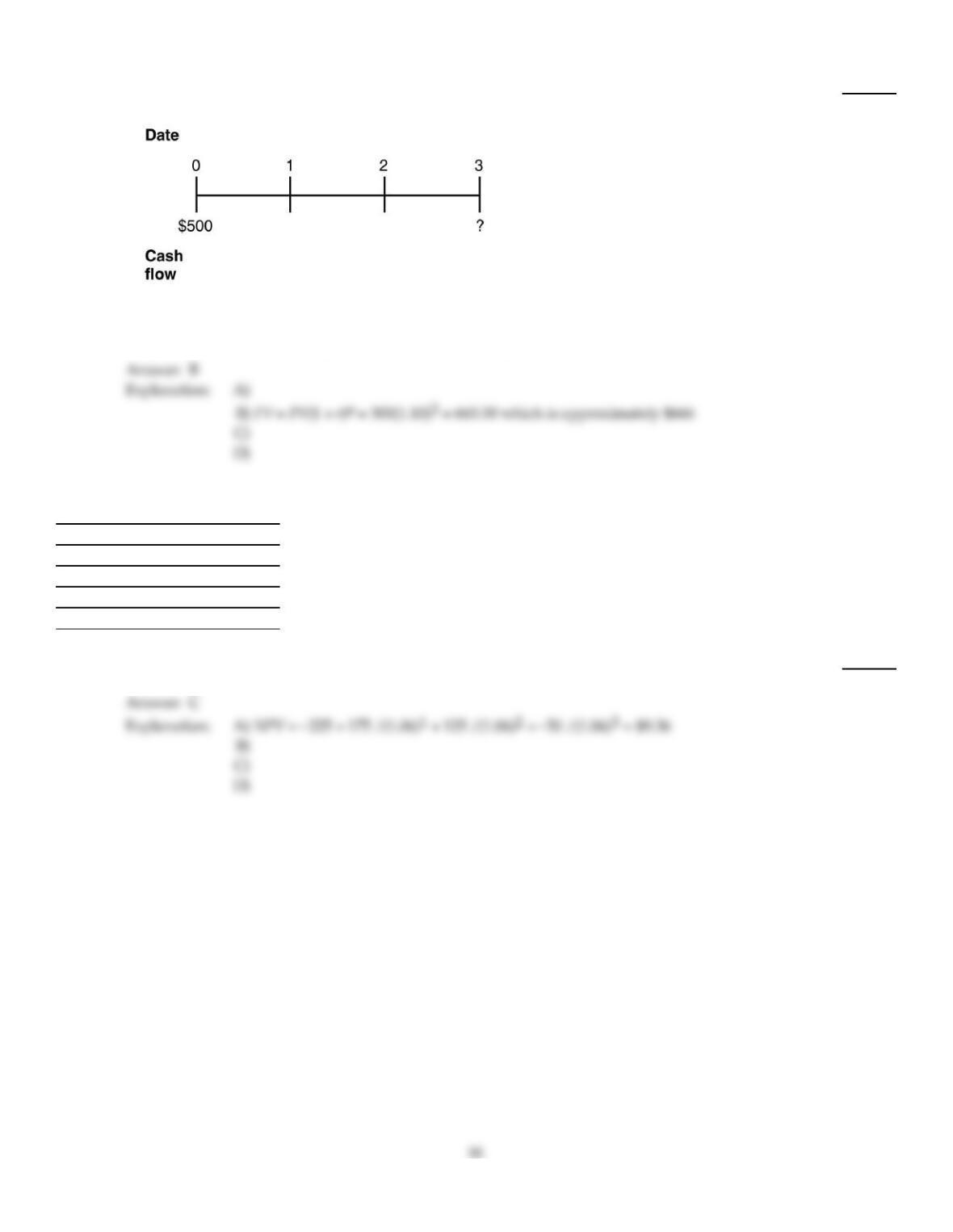
Consider the following timeline:
If the current market rate of interest is 10%, then the future value of this timeline is closest to:
42)
A)
$605
B)
$666
C)
$500
D)
$650
Use the table for the question(s) below.
Year A B
0–$150 –$225
140 175
280 125
3100 –50
43)
If the interest rate is 6%, then the NPV of investment “B” is closest to:
43)
A)
$84
B)
–$32
C)
$9
D)
$43
44)
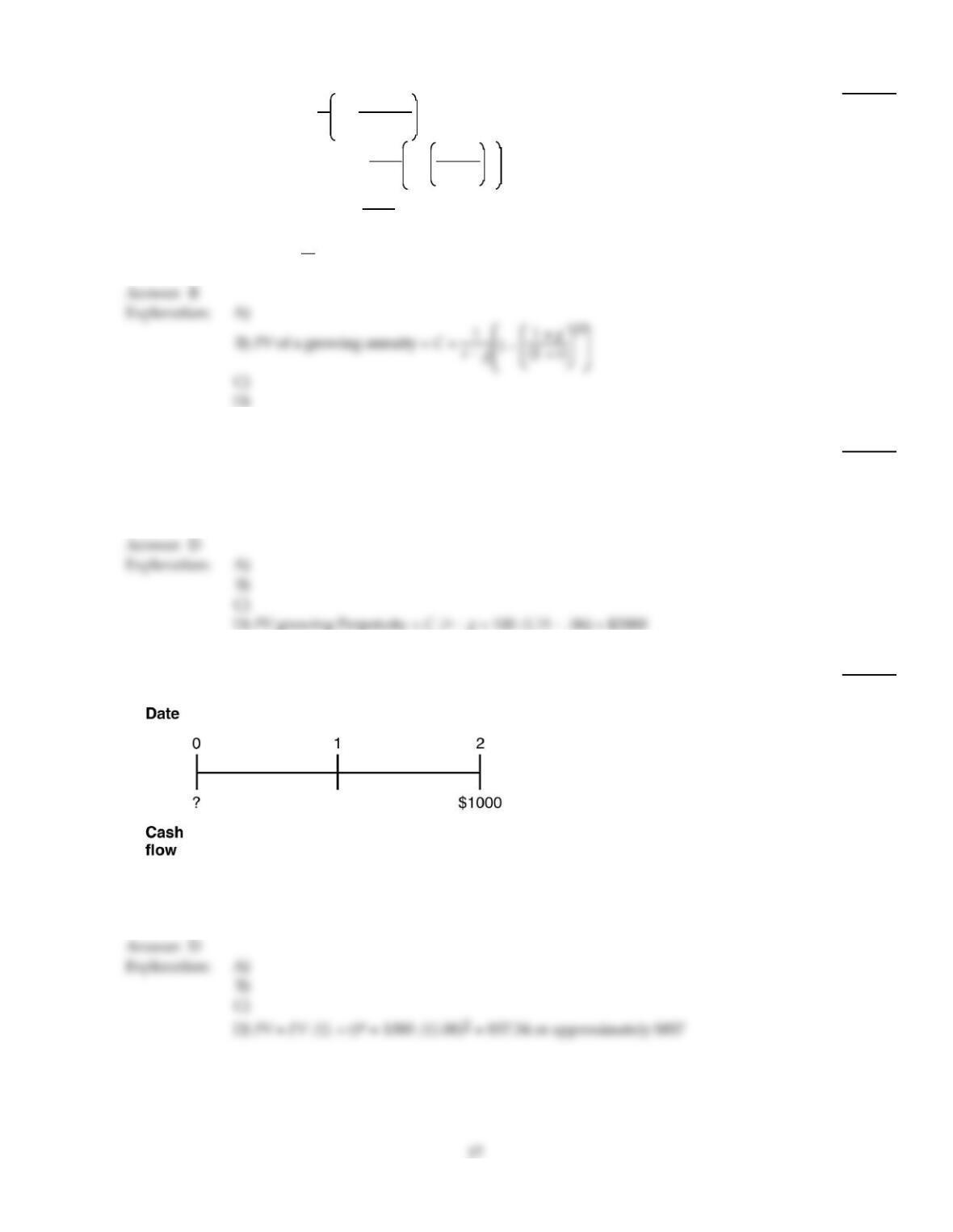
Which of the following formulas is incorrect?
44)
A)
PV of an annuity =C×1
r1 –1
(1 +r)N
B)
PV of a growing annuity =C×1
r – g 1 –
1 +r
(1 +g)
N
C)
PV of a growing perpetuity =C
r – g
D)
PV of a perpetuity =C
r
45)
Consider a growing perpetuity that will pay $100 in one year. Each year after that, you will receive
a payment on the anniversary of the last payment that is 6% larger than the last payment. This
pattern of payments will continue forever. If the interest rate is 11%, then the value of this
perpetuity is closest to:
45)
A)
$588
B)
$909
C)
$1,667
D)
$2,000
46)
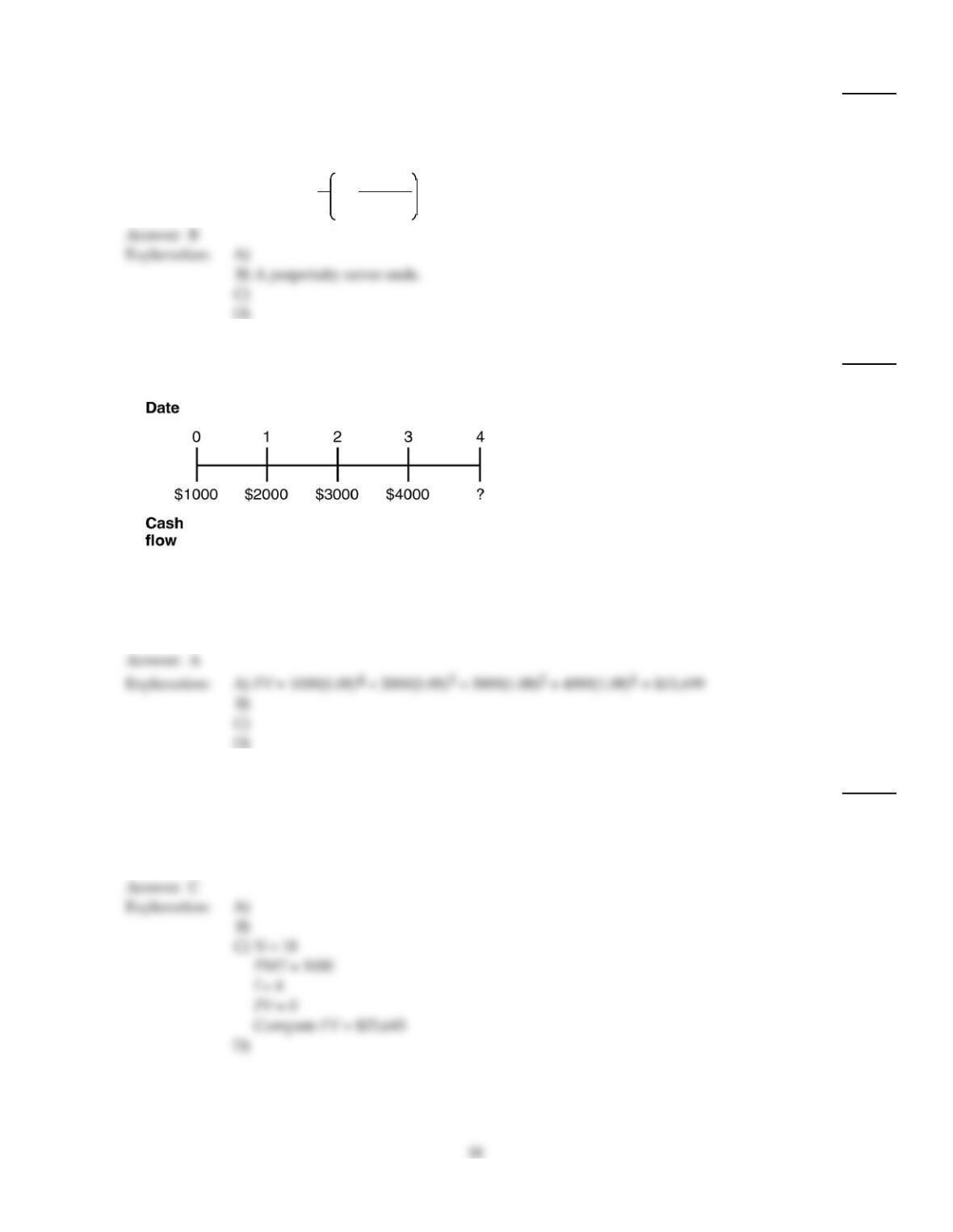
Consider the following time line:
If the current market rate of interest is 8%, then the present value of this timeline is closest to:
46)
A)
$926
B)
$1000
C)
$860
D)
$857
47)
Which of the following statements regarding annuities is false?
47)
A)
An annuity is a stream of N equal cash flows paid at regular intervals.
B)
The difference between an annuity and a perpetuity is that a perpetuity ends after some fixed
number of payments.
C)
Most car loans, mortgages, and some bonds are annuities.
D)
PV of an annuity =C×1
r1 –1
(1 +r)N
48)
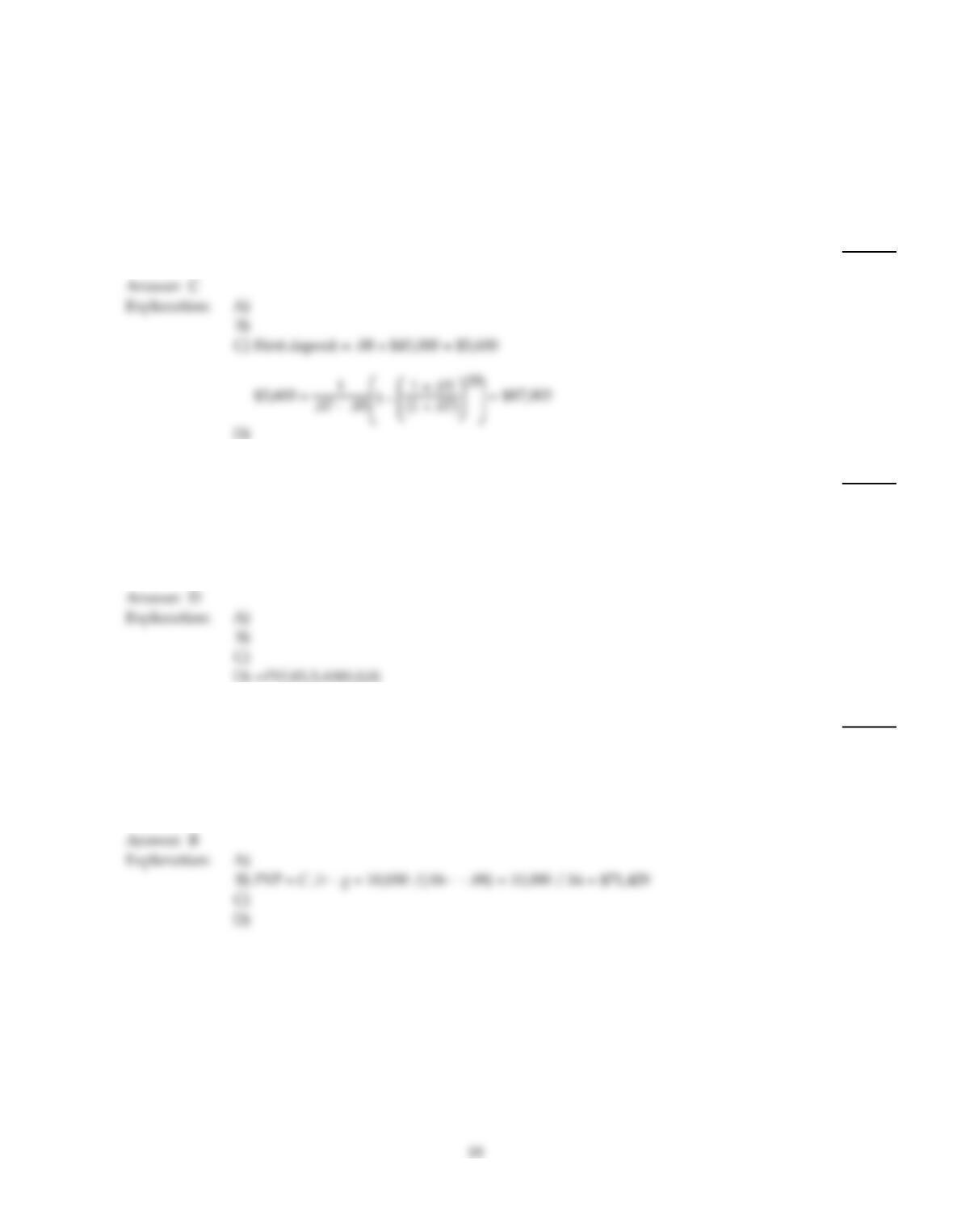
Consider the following timeline detailing a stream of cash flows:
If the current market rate of interest is 8%, then the future value of this stream of cash flows is
closest to:
48)
A)
$11,699
B)
$10,339
C)
$12,635
D)
$10,832
49)
Since your first birthday, your grandparents have been depositing $1000 into a savings account on
everyone of your birthdays. The account pays 4% interest annually. Immediately after your
grandparents make the deposit on your 18th birthday, the amount of money in your savings
account will be closest to:
49)
A)
$12,659
B)
$18,000
C)
$25,645
D)
$36,465
Use the information for the question(s) below.
Assume that you are 30 years old today, and that you are planning on retirement at age 65. Your current salary is $45,000
and you expect your salary to increase at a rate of 5% per year as long as you work. To save for your retirement, you plan on
making annual contributions to a retirement account. Your first contribution will be made on your 31st birthday and will be
8% of this year’s salary. Likewise, you expect to deposit 8% of your salary each year until you reach age 65. Assume that the
rate of interest is 7%.
50)
The present value (at age 30) of your retirement savings is closest to:
50)
A)
$46,600
B)
$108,000
C)
$87,000
D)
$75,230
51)
Suppose that you are considering an investment that will pay you $4000 per year for the next five
years. The appropriate rate of interest is 5%. You want to know the present value of the cash flows
from this investment. To solve this problem in Microsoft Excel, you would use which of the
following excel formulas?
51)
A)
=PV(5,5,4000,0)
B)
=PV(.05,5,4000,0,1)
C)
=PV(5,.05,4000,0)
D)
=PV(.05,5,4000,0,0)
=PV(.05,5,4000,0,0)
52)
You are thinking about investing in a mine that will produce $10,000 worth of ore in the first year.
As the ore closest to the surface is removed it will become more difficult to extract the ore.
Therefore, the value of the ore that you mine will decline at a rate of 8% per year forever. If the
appropriate interest rate is 6%, then the value of this mining operation is closest to:
52)
A)
$500,000
B)
$71,429
C)
$166,667
D)
This problem cannot be solved.
53)
Which of the following statements is false?
53)
A)
A dollar in the future is worth more than a dollar today.
B)
The process of moving a value or cash flow forward in time is known as compounding.
C)
The effect of earning interest on interest is known as compound interest.
D)
It is only possible to compare or combine values at the same point in time.
54)
Suppose that a young couple has just had their first baby and they wish to insure that enough
money will be available to pay for their child’s college education. They decide to make deposits
into an educational savings account on each of their daughter’s birthdays, starting with her first
birthday. Assume that the educational savings account will return a constant 7%. The parents
deposit $2000 on their daughter‘s first birthday and plan to increase the size of their deposits by 5%
each year. Assuming that the parents have already made the deposit for their daughter‘s 18th
birthday, then the amount available for the daughter’s college expenses on her 18th birthday is
closest to:
54)
A)
$97,331
B)
$67,998
C)
$103,063
D)
$42,825
A
55)
You are considering investing in a zero coupon bond that will pay you its face value of $1000 in ten
years. If the bond is currently selling for $485.20, then the IRR for investing in this bond is closest
to:
55)
A)
7.5%
B)
12%
C)
8.0%
D)
10%
A
A
56)
You are interested in purchasing a new automobile that costs $35,000. The dealership offers you a
special financing rate of 6% APR (0.5%) per month for 48 months. Assuming that you do not make
a down payment on the auto and you take the dealer’s financing deal, then your monthly car
payments would be closest to:
56)
A)
$822
B)
$647
C)
$729
D)
$842
ESSAY. Write your answer in the space provided or on a separate sheet of paper.
Use the table for the question(s) below.
Year A B
0–$150 –$225
140 175
280 125
3100 –50
57)
If the interest rate is 10%, then which investment(s), if any, would you take and why?
58)
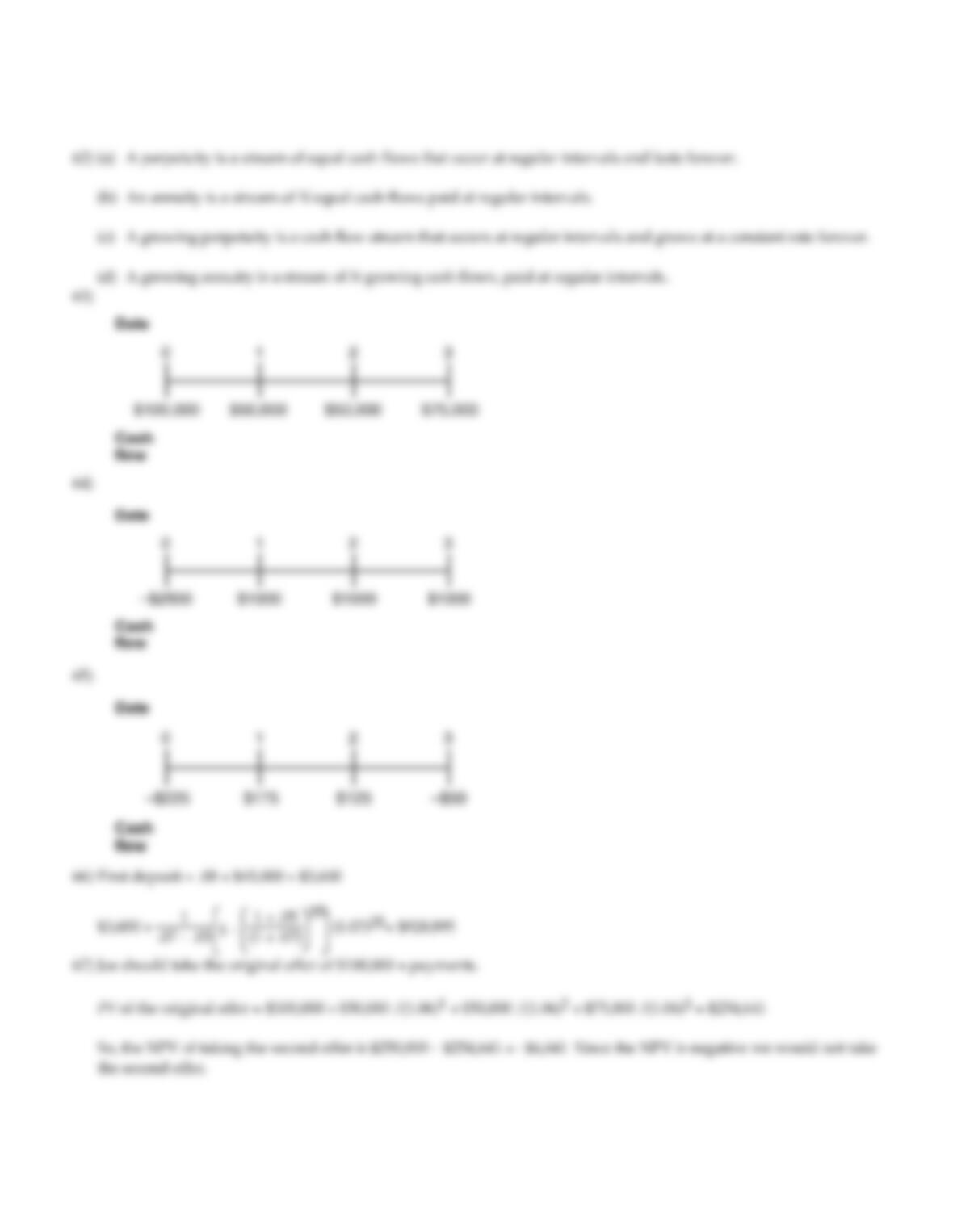
Draw a timeline detailing the cash flows from investment “A.“
Use the information for the question(s) below.
Joe just inherited the family business, and having no desire to run the family business, he has decided to sell it to an
entrepreneur. In exchange for the family business, Joe has been offered an immediate payment of $100,000. Joe will also
receive payments of $50,000 in one year, $50,000 in two years, and $75,000 in three years. The current market rate of interest
for Joe is 6%.
59)
In terms of present value, how much will Joe receive for selling the family business?
60)
Assuming that college costs continue to increase an average of 4% per year and that all her college savings are
invested in an account paying 7% interest, then the amount of money she will need to have available at age 18
to pay for all four years of her undergraduate education is closest to:
61)
Suppose that a young couple has just had their first baby and they wish to insure that enough money will be
available to pay for their child’s college education. They decide to make deposits into an educational savings
account on each of their daughter’s birthdays, starting with her first birthday. Assume that the educational
savings account will return a constant 7%. The parents deposit $2000 on their daughter’s first birthday and plan
to increase the size of their deposits by 5% each year. Draw a timeline that details the amount that would be
available for the daughter’s college expenses on her 18th birthday.
62)
Define the following terms:
(a) perpetuity
(b) annuity
(c) growing perpetuity
(d) growing annuity
Use the information for the question(s) below.
Joe just inherited the family business, and having no desire to run the family business, he has decided to sell it to an
entrepreneur. In exchange for the family business, Joe has been offered an immediate payment of $100,000. Joe will also
receive payments of $50,000 in one year, $50,000 in two years, and $75,000 in three years. The current market rate of interest
for Joe is 6%.
63)
Draw a timeline detailing Joe’s cash flows from the sale of the family business.
64)
You have been offered the following investment opportunity, if you pay $2500 today, you will receive $1000 at
the end of each of the next three years. Draw a timeline detailing this investment opportunity.
Use the table for the question(s) below.
Year A B
0–$150 –$225
140 175
280 125
3100 –50
65)
Draw a timeline detailing the cash flows from investment “B.”
Use the information for the question(s) below.
Assume that you are 30 years old today, and that you are planning on retirement at age 65. Your current salary is $45,000
and you expect your salary to increase at a rate of 5% per year as long as you work. To save for your retirement, you plan on
making annual contributions to a retirement account. Your first contribution will be made on your 31st birthday and will be
8% of this year’s salary. Likewise, you expect to deposit 8% of your salary each year until you reach age 65. Assume that the
rate of interest is 7%.
66)
The future value at retirement (age 65) of your savings is:
Use the information for the question(s) below.
Joe just inherited the family business, and having no desire to run the family business, he has decided to sell it to an
entrepreneur. In exchange for the family business, Joe has been offered an immediate payment of $100,000. Joe will also
receive payments of $50,000 in one year, $50,000 in two years, and $75,000 in three years. The current market rate of interest
for Joe is 6%.
67)
Suppose a second entrepreneur approaches Joe and offers him $250,000 today for the business. Should Joe
accept the new entrepreneur’s offer or stick with the original offer of $100,000 and the series of payments over
three years? Why?
Use the information for the question(s) below.
Suppose that a young couple has just had their first baby and they wish to ensure that enough money will be available to pay
for their child’s college education. Currently, college tuition, books, fees, and other costs, average $12,500 per year. On
average, tuition and other costs have historically increased at a rate of 4% per year.
68)
Assume that college costs continue to increase an average of 4% per year and that all her college savings are
invested in an account paying 7% interest. Draw a timeline that details the amount of money she will need to
have in the future four each of her four years of her undergraduate education.
69)
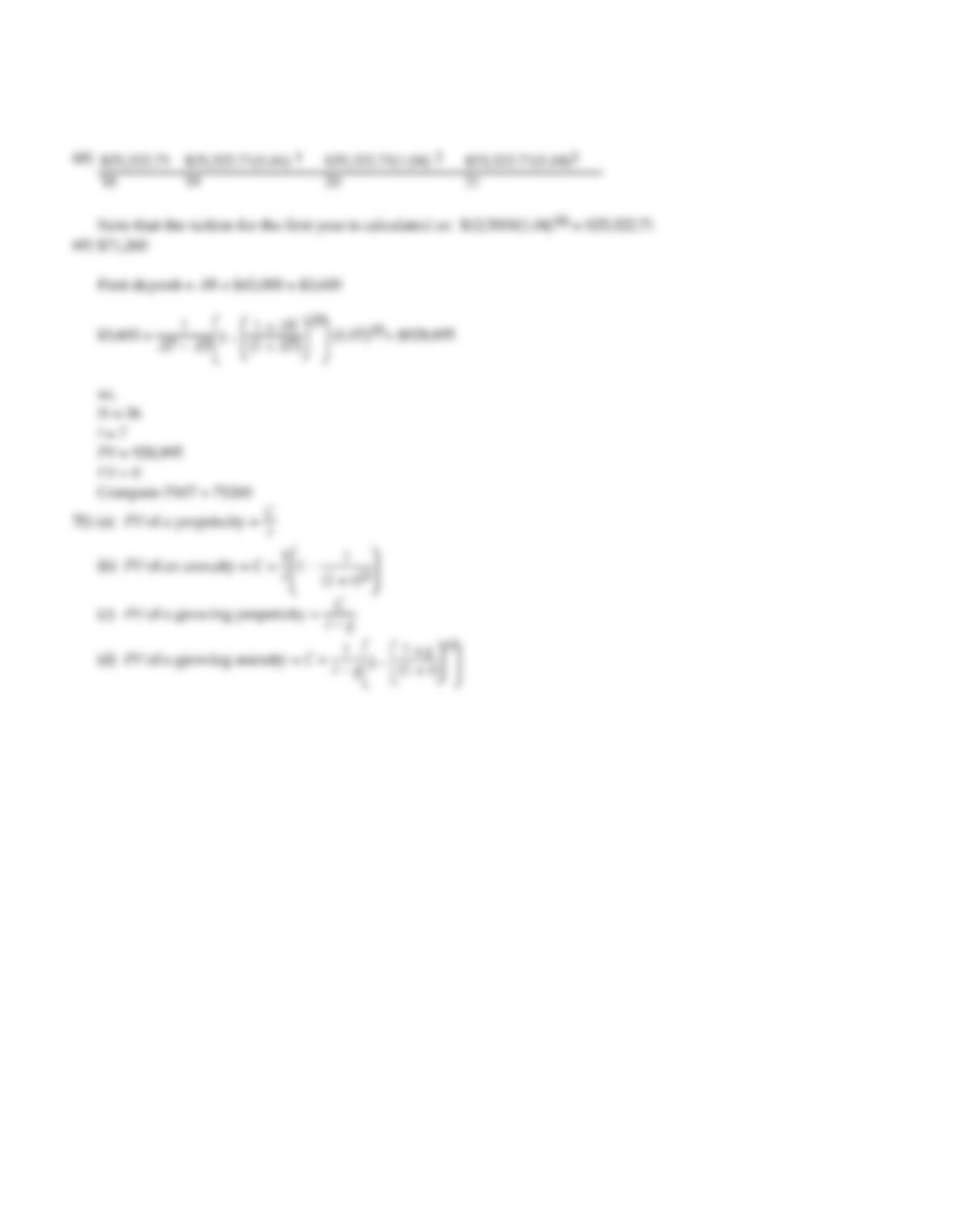
Assume that you are 30 years old today, and that you are planning on retiring at age 65. Your current salary is
$45,000 and you expect your salary to increase at a rate of 5% per year as long as you work. To save for your
retirement, you plan on making annual contributions to a retirement account. Your first contribution will be
made on your 31st birthday and will be 8% of this year’s salary. Likewise, you expect to deposit 8% of your
salary each year until you reach age 65. At retirement (age 65) you will begin withdrawing equal annual
payments to pay for your living expenses during retirement (on your 65th birthday). If you expect to die one
day before your 101st birthday (Your last withdraw will be on your 100th birthday) and if the annual rate of
return is 7%, then how much money will you have to spend in each of your golden years of retirement?
70)
How do you calculate (mathematically) the present value of a(n):
(a) perpetuity
(b) annuity
(c) growing perpetuity
(d) growing annuity
Answer Key
Testname: C4
Answer Key
Testname: C4
27
Answer Key
Testname: C4
28
Answer Key
Testname: C4
29