
ch4 Key
1. Many traditional cost accounting systems do not trace indirect costs to products.
2. In traditional cost systems, many complex products are overcosted and simple products are undercosted.
3. Traditional cost accounting systems can be effective if the level of indirect costs is low relative to the level of
direct costs and if the accuracy of the cost information is not critical to the company’s success.
4. Cost pools are groups or categories of individual cost items.
5. Activity-based costing is an approach that first assigns costs to activities and then to goods and services.
6. The first step in activity–based costing is to calculate a cost-driver rate for each activity.
7. The first step in activity–based costing is to identify and classify the activities related to the company’s
products.
8. The last step in an activity-based costing system is to calculate the cost–driver rate for each activity.
9. Unit–level resources and activities are the resources acquired and the activities performed specifically for
individual units of product or service.
10. Setting up manual and computer controlled machines is an example of a batch– level resource.

11. Facility– level activities are at the lowest end of the hierarchy of tracing resources to activities to products
and services.
12. The development of a recipe for a specific type of cereal by Kellogg Corporation is an example of a
batch-level resource.
13. Research and development would be an example of a batch-level activity.
14. Consulting with customers on distribution arrangements for a specific product is an example of a
customer-level resource.
15. The primary advantage to the top down approach of developing activities is that it is quick and inexpensive.

16. The top-down approach to identifying and classifying activities is likely to produce a more accurate result
than the interview or participative approach.
17. Materials consumed would be an example of a unit–level resource.
18. Set-up of machinery would be an example of a unit–level resource.
19. Specialized equipment used to make a certain brand of shoes would be an example of a product–level
resource.
20. Maintenance costs are typically considered product–level resources.

21. The interview approach usually generates a more accurate activity list than the top–down approach.
22. A cost-driver base should be based on the resource’s practical capacity to support activities.
23. Increases or decreases of a cost-driver base cause increases or decreases in the level of activity performed.
24. The cost-driver rate is the estimated cost of resource consumption per unit of cost driver base for each
activity.
25. Number of parts per product would be an appropriate cost driver base for facility–level activities.

26. Number of square feet of each product’s usage would be an appropriate cost–driver base for product-level
activities.
27. Batch level activities will normally use units produced as a cost driver base.
28. ABC full costing traces only the cost of unit level resources supplied and used to products and services.
29. ABC full–costing assigns as many costs to products and services as possible based on the use of resources,
regardless of the level of resources.
30. ABC full costing shows how activities may use all levels of resources.

31. A typical result of Activity-Based Costing analysis is that low-complexity customer business is often more
profitable than previously thought and high-complexity customer business is often less profitable.
32. ABC costing information can be useful for estimating the costs of new products and services only if the
processes and activities to make them are similar.
33. It is always better to use activity-based costing information than to use average cost information.
34. Customer costing identifies the costs and benefits of servicing specific customers or customer types.
35. Customer profitability analysis identifies the costs and benefits of service specific customers or customer
types to improve an organization’s overall profitability.

36. Customer costing analyzes the costs of activities devoted to service specific customers at each level.
37. ABC costing analysis is used only in the manufacturing sector.
38. Not-for-profit organizations can benefit from the use of activity based costing.
39. Implementing an Activity-Based Costing system is relatively inexpensive.
40. ABC unit–level costing assigns only the cost of unit–level resources to products. (Appendix)
41. Under activity–based costing, only unit level and batch level costs are assigned to units. (Appendix)
42. Which of the following statements regarding traditional cost accounting systems is False?
43. Which of the following is the first step in Activity-Based Costing?
44. Which of the following is not a basic step that is used to determine the cost of goods using Activity- Based
Costing?
45. Batch level resources are:
46. The purchase of chemicals to make a special batch of synthetic fiber would be an example of:
47. The review of each tax return by H & R Block would be an example of:
48. Salaries of the human resource staff responsible for hiring production personnel at Dell Computer would be
an example of:
49. Materials inventory control in a manufacturing plant would be an example of:
50. Setup labor costs required for setting up equipment for flexible production facilities for manufacturing
would be an example of:
51. Costs associated with a special machine which sands the edges of all finished products would be an example
of:
52. Maintenance of parts inventory for a specific toy in a toy production facility would be an example of:
53. Facility– level resources are:
54. Setting up a manually controlled compression molding machine is an example of:
55. Quality inspections are classified as:
56. Movement of materials for products in production is classified as:
57. The design and manufacture of a bottle cap mold for Avon Products Company is an example of:
58. The most likely cost driver base for allocating the actual cost of advertising and promotion would be:
Use the following to answer questions 59-65:
Ferguson Molding Company produces custom bottle caps and jar covers for large cosmetic companies. Each
customer owns the custom-made molds that are used for the caps and jar covers, so caps are produced only to
customer order. Each order requires the setting of molds in molding machines. Two full time mechanics, whose
combined total annual salary and benefits are $160,000 per year, are employed setting up and breaking down
the molding machines. An order consists of anywhere from 50,000 to 500,000 units. 80 orders were received
during the year 2008 for individual custom production runs. The total number of units produced was 8 million.
Hilton – Chapter 04
59. Each production run of caps or jar covers is an example of
60. The cost of setting up the molding machines is an example of
61. The machine operator‘s labor to operate the molding machine to produce a run of custom jar covers is an
example of:
62. The outsourcing design and manufacture of the custom molds is an example of:
63. The most appropriate cost driver base to allocate the salaries of the two mechanics under Activity–Based
Costing would be:
64. If the company allocates the cost of the setup mechanics based on the number of setups, the setup costs to be
allocated to an order of 300,000 Nurturing Face Cream jar covers for Aristedes Cosmetics Company would be:
65. If the company allocates the cost of the setup mechanics based on the number of units produced, the setup
cost per unit in an order of 300,000 Nurturing Face Cream jar covers for Aristedes Cosmetics Company would
be:
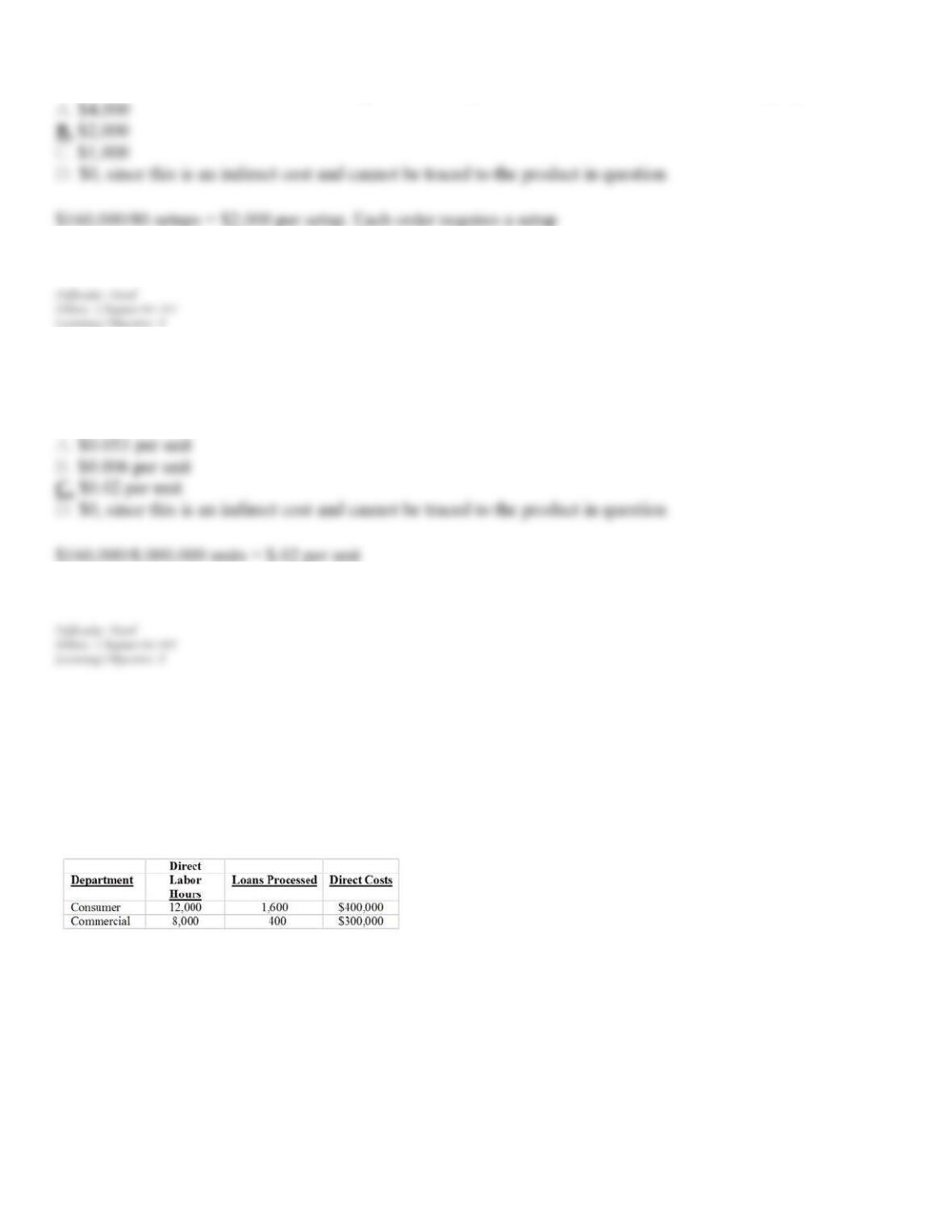
Use the following to answer questions 66-69:
The Dedham Cooperative Bank is considering either a bank wide overhead rate or departmental overhead rates
to allocate $2,000,000 of indirect costs. The bank wide rate would be based on either direct labor hours or the
number of loans processed. The departmental rates would be based on direct labor time for Consumer Loans
and a dual rate based on direct labor time and the number of loans processed for Commercial Loans. The
following information was gathered for the upcoming period:
Hilton – Chapter 04
66. If Dedham Cooperative uses a bank-wide rate based on direct labor time, what would be the indirect costs
allocated to the Consumer Department?
67. If Dedham Cooperative uses a bank wide rate based on the number of loans processed, what would be the
indirect costs assigned to the Commercial Department?
68. Management estimates that it now costs $2,000 to analyze and close a commercial loan. This amount has
been included in the $2,000,000 of indirect costs. If the remaining indirect costs are allocated based on the
number of loans processed, how much of the indirect costs should be allocated to the Consumer Department?
69. The bank estimates that the Commercial Department will result in $3,000,000 of revenues in 2008. If the
indirect costs are allocated based on direct labor hours, what profit before tax will be generated by the
Commercial Department?
70. Which of the following statements about activity based costing is not true?
71. Which of the following is not a “red flag” indicating problems with an organization’s costing system?
72. Which of the following indicates that a company may benefit from an Activity-Based Costing system?
73. Which of the following statements about choosing the best cost driver base is not true?
74. Cost drivers are:
75. Which of the following statements is true regarding Activity-Based Costing ABC. unit–level costing?
76. The Activity-Based Costing full costing approach says:
77. Which of the following is considered a batch-level resource in a bakery?
78. Which of the following is considered a unit–level resource in auto manufacturing?
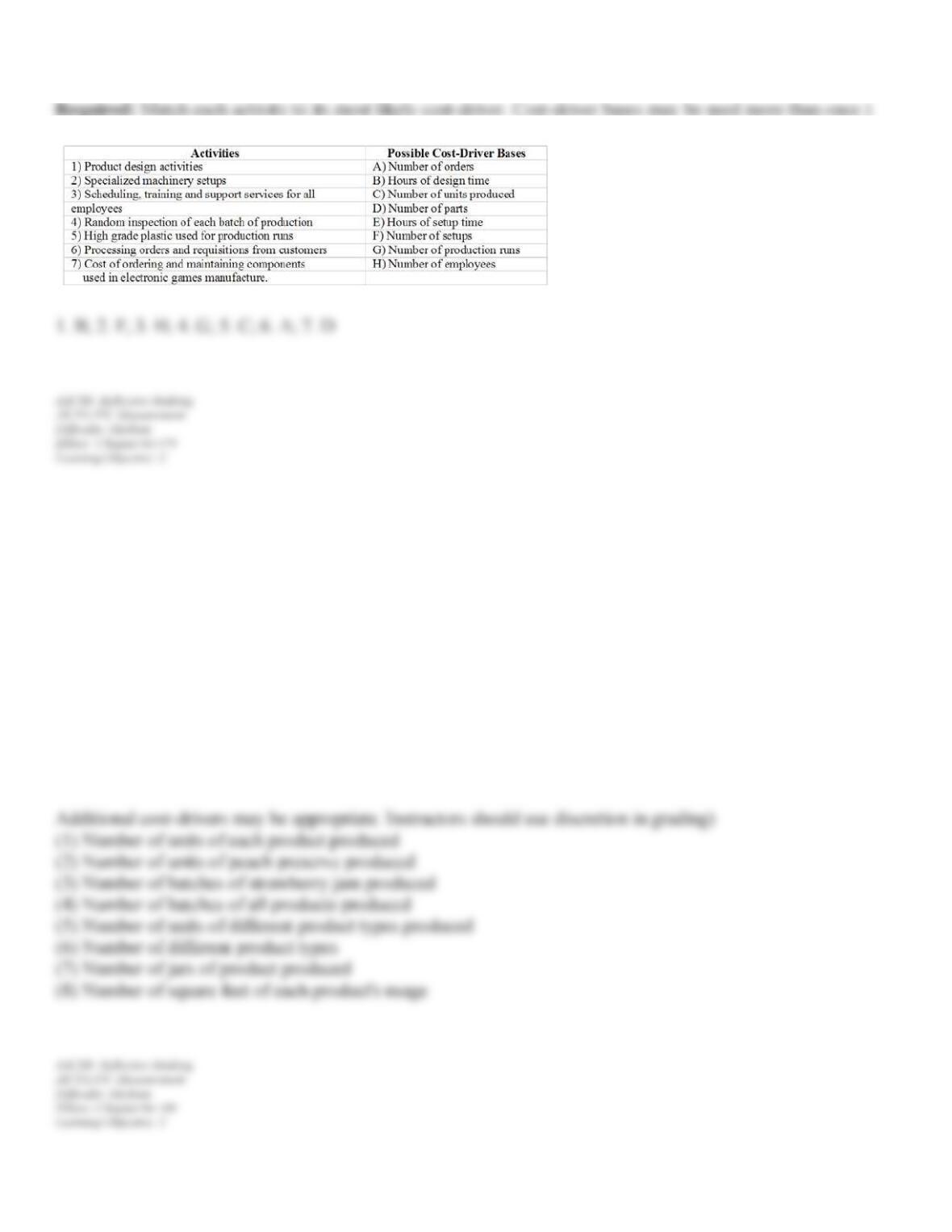
79. Listed below are activities incurred by Rhodes Manufacturing Company. The company manufactures a
variety of products for sale to large department stores
80. The Great Island Preserve Company buys fruit and processes it into a variety of jams, jellies, and preserves.
The process involves purchasing fresh fruit, cutting, cooking, adding ingredients, testing, and packaging the
finished product. Jars, labels, and other packaging are purchased from local packaging suppliers
Required: Identify a possible cost–driver base that could be used to assign costs to final product. Some
cost-driver bases can be used more than once
(1) Purchase of jars, covers, and labels for production of jam and jellies
(2) Cost of peaches for peach preserve
(3) Cooking strawberries in large kettles to prepare strawberry jam
(4) Setup of manually controlled machines
(5) Using manually controlled machines to fill jars of grape and blueberry jelly
(6) Using computer controlled machines to apply labels to each jar of preserves, jams, and jellies
(7) Quality control inspection of each finished jar of product
(8) Use of the main building for producing preserves, jams, and jellies