
Exam
Name___________________________________
MULTIPLE CHOICE. Choose the one alternative that best completes the statement or answers the question.
Simplify.
1)
e(1/2)x ·e(3/2)x
e–2x
1)
A)
e–10x
B)
e(1/2)x
C)
e–6x
D)
1
e2x
E)
none of these
2)
Which of the following is the largest number?
2)
A)
ln 6 – ln 1
B)
1
3 ln 27
C)
3
2 ln 16 – ln 8
D)
2 ln 2 + ln 3
E)
1
2 ln 16
D
E
3)
Let y =ee2x + 1. What is dy
dx ?
3)
A)
ee2
B)
e2x + 1
C)
e2
D)
2e2x + 1
E)
none of these
4)
If 1
9
3x + 4 = 81, find x.
4)
A)
x = – 3
B)
x = – 1
2
C)
x = – 3
2
D)
none of these
SHORT ANSWER. Write the word or phrase that best completes each statement or answers the question.
Differentiate.
5)
ln x
x3
Enter your answer exactly as just a ± b ln c
P(x) where P is a polynomial in x in standard form.
5)
Solve for x.
6)
e1 + x – 2 = 4
Enter your answer exactly as just a ± ln b (a, b integers).
6)
Differentiate.
7)
1 + ln (2 – x) at x = 1
Enter your answer as just a reduced fraction a
b.
7)
2
8)
(x3+ 1)e–4x
Enter your answer exactly as just ea(P(x)) where P is a polynomial in x in standard form.
8)
9)
f(x) =ex+e2x +1
e–4x
Enter your answer exactly as just P(ex) where P is a polynomial in ex in standard form.
9)
Solve for x.
10)
2 ln x + 3 ln x = 4
Enter your answer exactly as just ea/b (a, b integers).
10)
Differentiate.
11)
f(x) =ex
1 +x2
Enter your answer exactly as (P(x))ea
(Q(x))n where P and Q are polynomials.
11)
Solve for x.
12)
2ex + 1 + 2 = 6
Enter your answer exactly as just a ± ln b.
12)
Use logarithmic differentiation to differentiate.
13)
(3x + 1)5(2x – 1)–2(x + 3)4 at x = 1
Enter your answer exactly as just 3 ·4a.
13)
3
Simplify.
14)
(e1/2x)–3/4
e2x – 5
Enter your answer exactly as eP(x) where P is a polynomial with any fractions in the form
a
b in lowest terms.
14)
15)
1
9
27x ·1
3
48x ·1
81
9x
Enter your answer as 3a.
15)
16)
Solve for x: 24 – x ·28 + 2x = 64.
Enter your answer exactly as x = a (with a an integer).
16)
17)
Find the equation of the tangent line to the curve y = xex at (1, e) in slope–intercept form.
17)
Simplify.
18)
ln e1/x
Enter your answer exactly in the form ab where b is an integer.
18)
Differentiate.
19)
f(x) = (1 +x2)ex
Enter your answer exactly in the form (P(x))ea where P is a polynomial.
19)
Simplify.
20)
ln e2x – ln e–x/2
Enter just a standard polynomial in x with any fractions reduced of form a
b.
20)
4
Differentiate.
21)
f(x) =e1/x
Enter your answer exactly as just abecd.
21)
22)
(x + 3ln x)4 at x = 1
Enter just an integer.
22)
Explanation:
23)
The expression may be factored as shown. Find the missing factor.
52 + h = 25( )
Enter your answer as 5a.
23)
Explanation:
Differentiate.
24)
ln 1 +x2
2x + 5 at x = 1
Enter your answer as just a reduced fraction a
b.
24)
Explanation:
25)
ln 3x
ln x
Enter your answer as just ± ln c
Q(x)R(ln x) where P and R are polynomials in ln x and Q is a
polynomial in x, all in standard form.
25)
Explanation:
Simplify.
26)
eln 2x
Enter just a standard polynomial in x.
26)
Explanation:
27)
ex + 2 ln x
Enter your answer exactly as abec.
27)
5
Explanation:
28)
(e3x)2·e–x
Enter your answer as ea.
28)
Solve for x.
29)
ln x2+ (ln x)2= 0
Enter your answer exactly as x = a, b (a < b).
29)
30)
Find the slope of the tangent line to the curve y =ex
x at (1, e).
Enter just an integer.
30)
Simplify.
31)
2x·3x·5x·7x
Enter your answer exactly as ab where a is an integer.
31)
Solve for x.
32)
ex – 1 + 6 = 4ex – 1
Enter your answer exactly as just a ± ln b.
32)
Simplify.
33)
e2 ln x
Enter just a standard polynomial in x.
33)
34)
ln xyz – ln y2
x
Enter your answer as just ln anb
c.
34)
6
35)
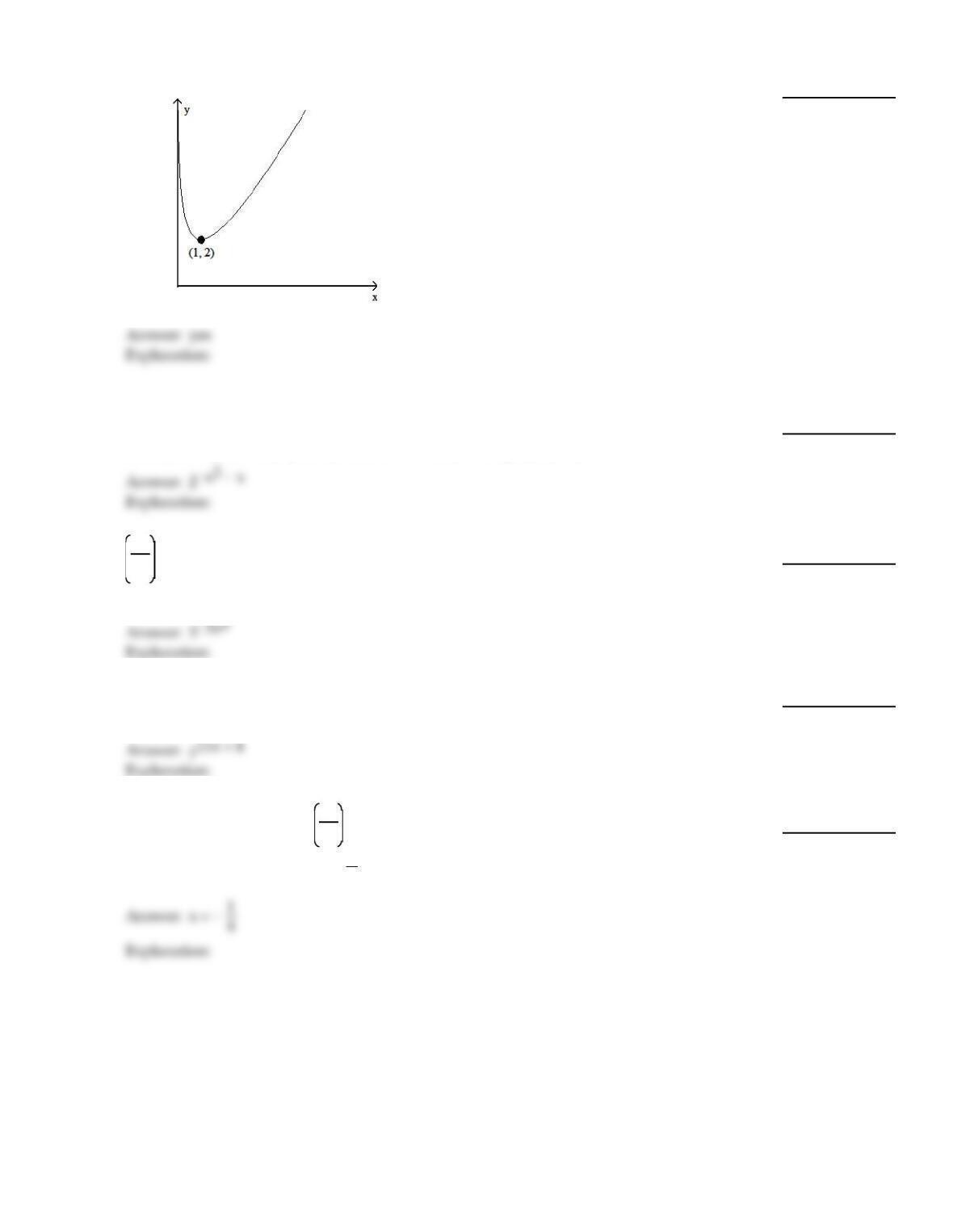
Is this the graph of y = 2x – ln x2, x > 0? Enter just the word “yes” or “no”.
35)
Simplify.
36)
(2–x2)(x + 1)/x
Enter your answer exactly in the form 2P(x) where P is a polynomial.
36)
37)
1
3x
3x
Enter your answer exactly in the form 3P(x), where P(x) is a polynomial.
37)
38)
y4x ·y6x ·yx·y4
Enter your answer as yP(x) where P is a polynomial in x in standard form.
38)
39)
Solve for x: (5x· 25)2= 125 ·1
25
x.
Enter your answer exactly as x =a
b in lowest terms.
39)
7
Differentiate.
40)
ex ln 2x
Enter your answer exactly as ea ln b ±ec
d .
40)
41)
Find the equation of the tangent line to the curve y =1
xex at (1, e) in the simplest form.
41)
42)
The expression may be factored as shown. Find the missing factor.
23x/2 +2–x/2 =2–x ( )
Enter your answer as 2a+ b.
42)
Simplify.
43)
16x1
8
x
Enter your answer exactly as 2a.
43)
44)
1
4
2x ·1
27
3x ·1
64
8x
Enter your answer exactly as 2a·3b.
44)
Differentiate.
45)
f(x) =ex+ 1
ex– 1
Enter your answer exactly as just P(ex)
Q(ex)n where P and Q are polynomials in ex in
standard form.
45)
8
Simplify.
46)
ln(x + 2) + ln(x – 2).
Enter your answer as just ln(P(x)) where P is a polynomial in x in standard form.
46)
47)
Solve for x: 5x·52x ·53x = 25.
Enter your answer exactly as x =a
b in lowest terms.
47)
48)
Solve for x: 35x ·3x2·33=3–3.
Enter your answer exactly as x = a, b ( a < b).
48)
Simplify.
49)
ln 1
ex
Enter just a standard polynomial in x.
49)
50)
Find the slope of the tangent line to the curve (x +e–x)2 at (0, 1).
Enter just an integer.
50)
Solve for x.
51)
eln(3x) – ln(e4) = 1
Enter your answer exactly as x =a
b.
51)
Simplify.
52)
(ex+e–x)2
Enter your answer exactly as ea+eb+ c (b < a).
52)
9
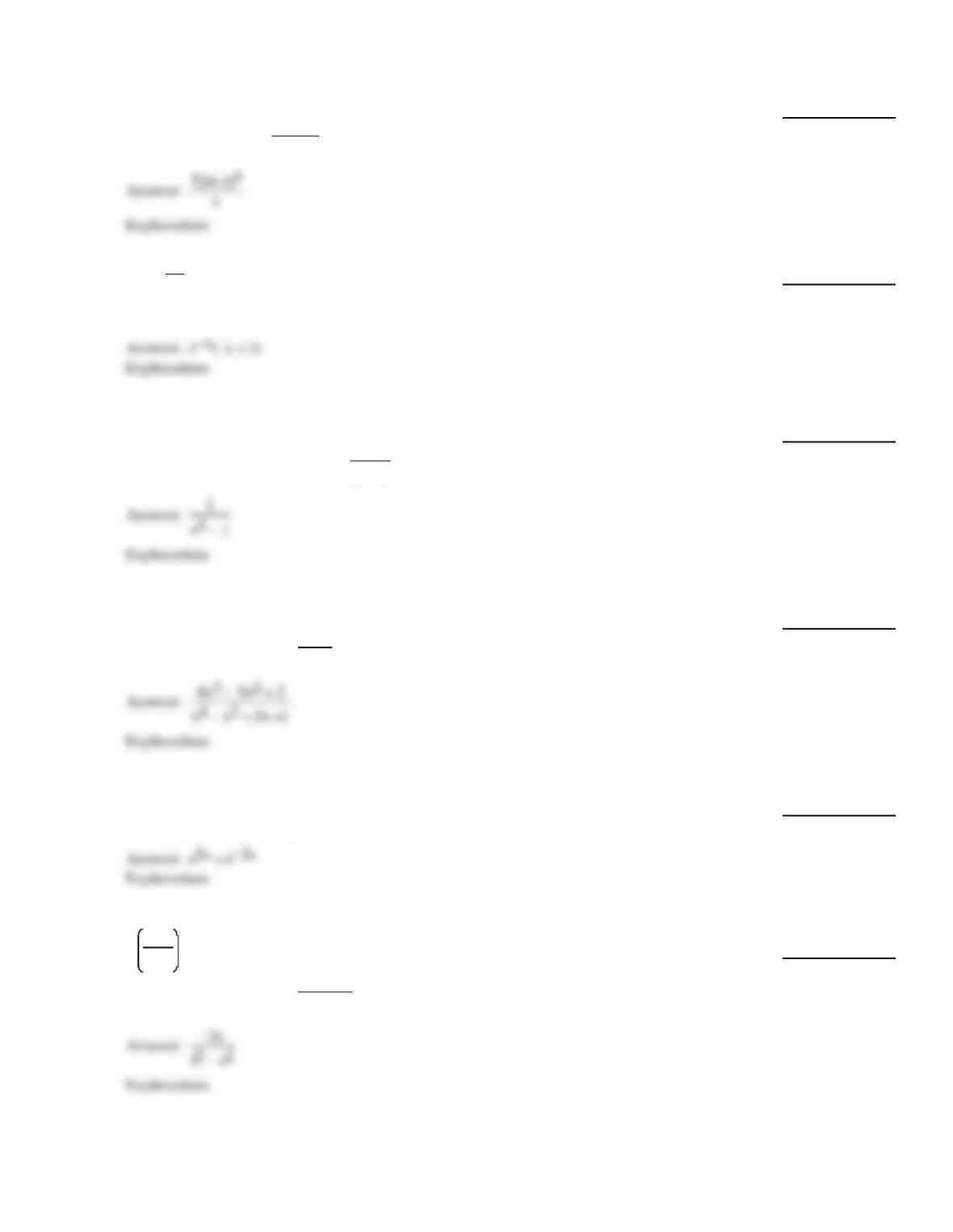
Differentiate.
53)
(ln x)5
Enter your answer as P(ln x)
Q(x) where P is a polynomial in lnx and Q is a polynomial in x.
53)
54)
f(x) =x
ex
Enter your answer exactly as just ea(P(x)) where P is a polynomial in x in standard form.
54)
Solve for x.
55)
2 ln(x + 1) – ln x2= 8
Enter your answer exactly as just a
eb– c
.
55)
Differentiate.
56)
ln(x4–x3+ 2x +1)
Enter your answer as just P(x)
Q(x) where P and Q are both polynomials in x in standard form.
56)
Simplify.
57)
(ex+e–x)(ex–e–x)
Enter your answer exactly as ea–eb.
57)
Differentiate.
58)
ln t + e
t – e
Enter your answer as just ae
tn±em.
58)
10
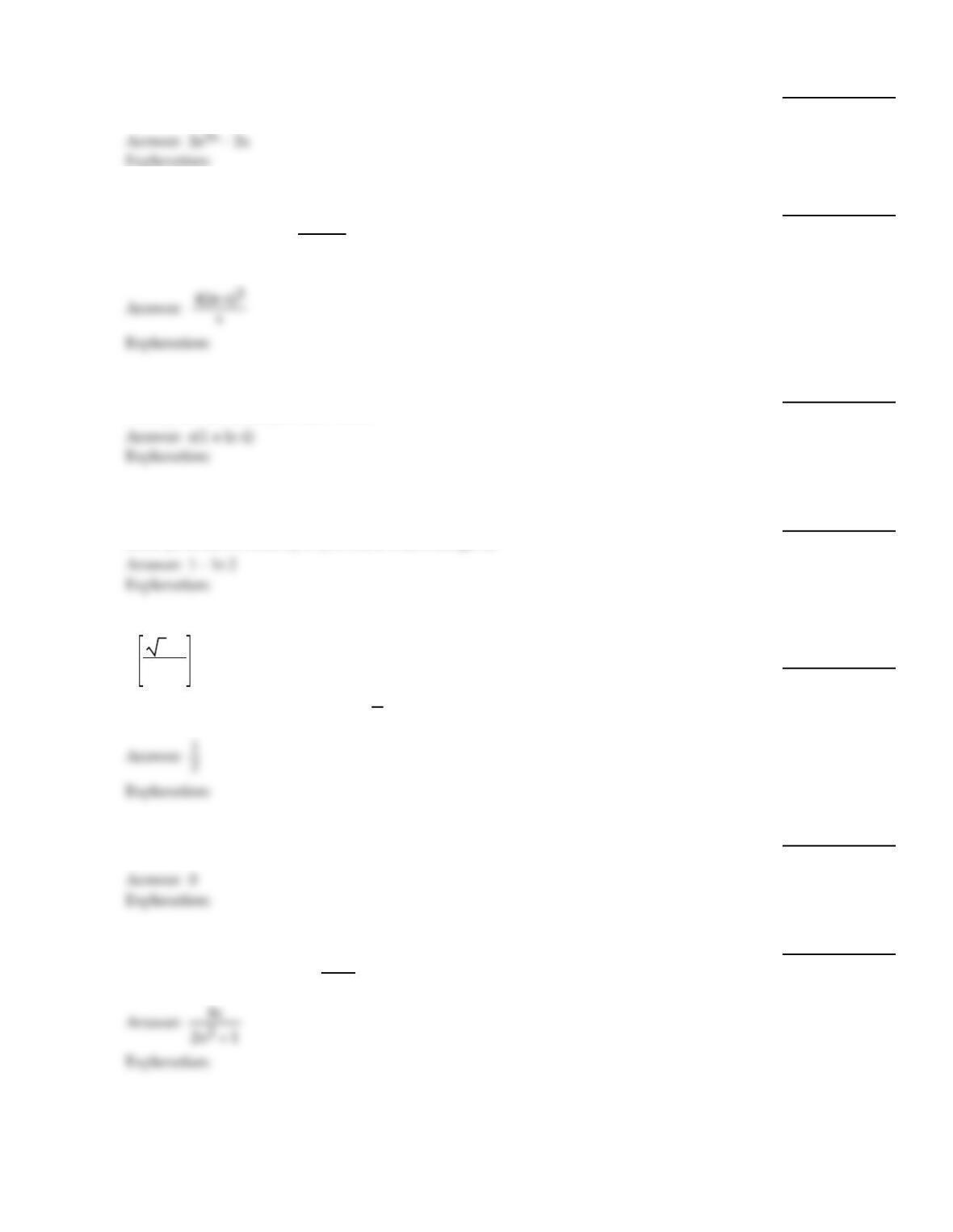
59)
e2x –x2
Enter your answer exactly as aeb– c
59)
60)
f(x) =(ln x)4
Enter your answer as just P(ln x)
Q(x) where P is a polynomial in lnx and Q is a polynomial in
x.
60)
61)
ex2ln (1 +x2) at x = 1
Enter your answer as just e(a + ln b)
61)
Solve for x.
62)
e1 + x = 2e2x.
Enter your answer exactly as just a ± ln b (a, b integers).
62)
Differentiate.
63)
ln xex
x2+ 1 at x = 1
Enter just a reduced fraction of form a
b.
63)
64)
f(x) = x ln(2x –x2) at x = 1
Enter your answer as just a real number.
64)
65)
ln(2x2+ 1)
Enter your answer exactly as P(x)
Q(x) where P and Q are polynomials in x in standard form.
65)
11
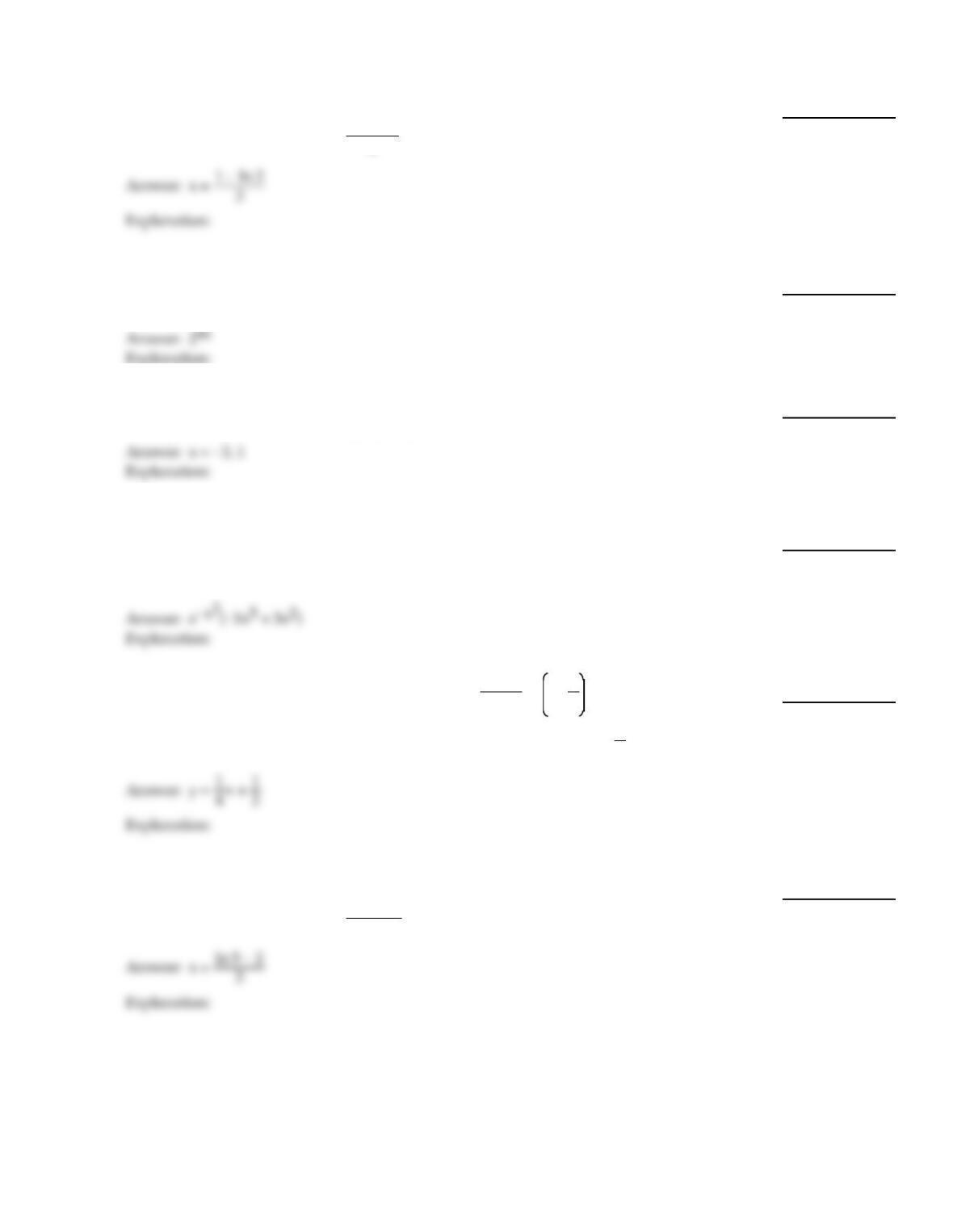
Solve for x.
66)
2e3x + 1 =e2
Enter your answer exactly as x =a – ln b
c.
66)
Simplify.
67)
2x·8x
Enter your answer exactly as 2a.
67)
68)
Solve for x: 7–5· 49 ·7x2·49x= 1.
Enter your answer exactly as x = a, b (a < b).
68)
Differentiate.
69)
f(x) =x3e–x3
Enter your answer exactly as just eP(x)(Q(x)) where P and Q are polynomials in x in
standard form.
69)
70)
Find the equation of the tangent line to the curve y =ex
1 +ex at (0, 1
2.
Enter your answer in slope–intercept form with any fractions reduced as a
b.
70)
Solve for x.
71)
4e3x + 2 = 20
Enter your answer exactly as x =ln a – b
c.
71)
12
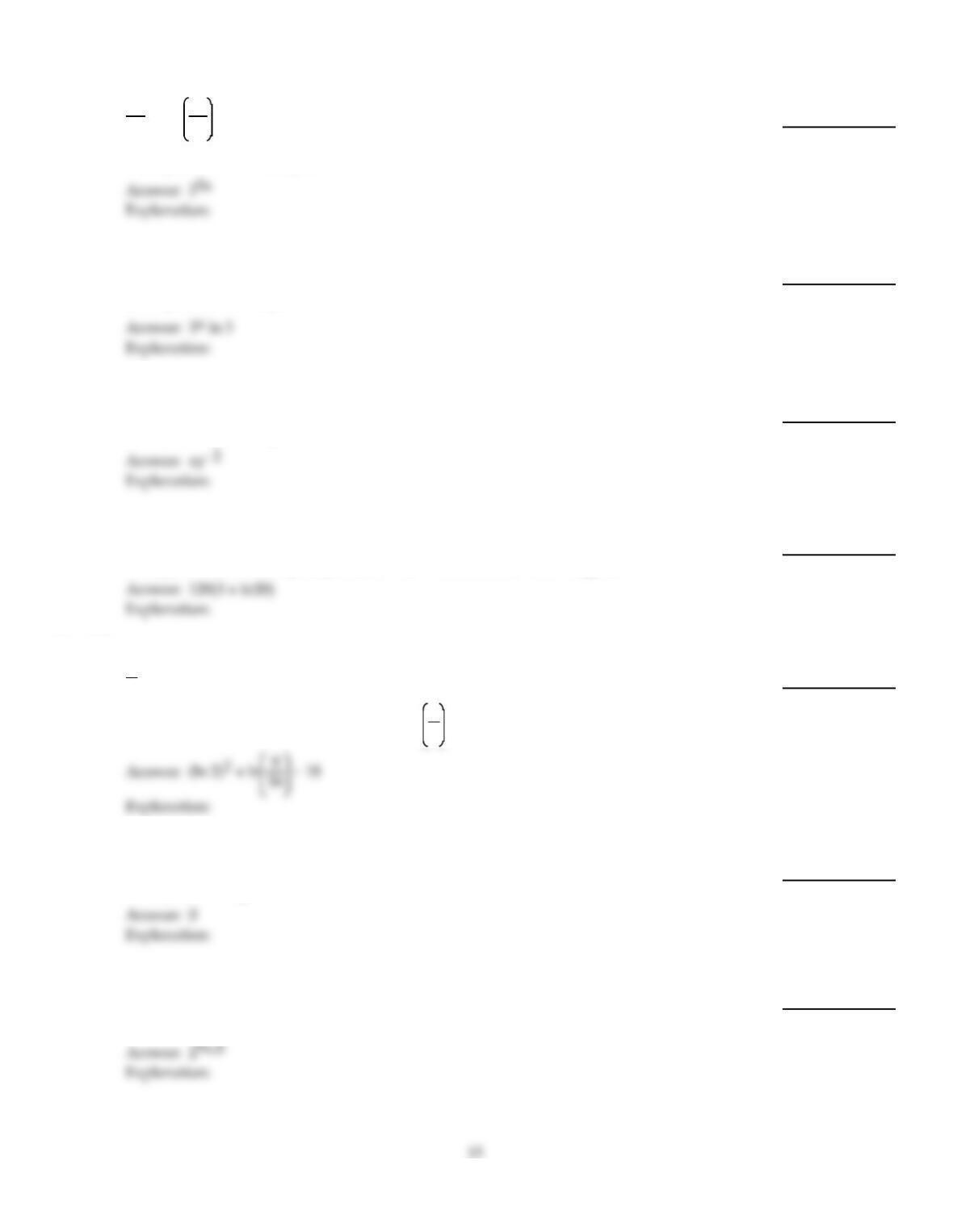
Simplify.
72)
3x
6x·8x·32
4
x
Enter your answer exactly as 2a.
72)
Use logarithmic differentiation to differentiate.
73)
3x
Enter your answer as just abln c.
73)
Simplify.
74)
eln x – 2 ln y
Enter just a standard polynomial in x.
74)
Use logarithmic differentiation to differentiate.
75)
4x·5x· 6x3 at x = 1
Enter your answer exactly as just a(b ± ln c) where a, b, and c are integers.
75)
Simplify.
76)
1
3 ln 27 – 2 ln 4 + ln 3 +(ln 2)2–eln 6 + 1/4 ln 81
Enter your answer exactly as just (ln a)n+ ln b
c– d.
76)
Differentiate.
77)
ln(ex+e–x) at x = 0
Enter just an integer.
77)
Simplify.
78)
4x·2x/2
Enter your answer exactly as 2b/c.
78)
Differentiate.
79)
f(x) = 4e3x
Enter your answer exactly as just aeb.
79)
Simplify.
80)
9x·81x·243x
Enter your answer exactly as 3a.
80)
81)
7–x·14x·498x
Enter your answer exactly as 2a·7b.
81)
Solve for x.
82)
ln(1 – 2x) = 2 ln(1 – x)
Enter just a real number.
82)
83)
ln(1 +x2) = 2.
Enter your answer exactly as just ±ea± b (a, b integers).
83)
Simplify.
84)
eln 3 + ln(2x)
Enter just a standard polynomial in x.
84)
Differentiate.
85)
x4 ln(x2+ 1)
Enter your answer exactly as P(x)
Q(x) ± R(x) ln(S(x)) where P, Q, R, and S are polynomials in
standard form.
85)
14
Simplify.
86)
310x ·311x ·312x ·3–10x
Enter your answer exactly as 3a.
86)
Differentiate.
87)
e(ln x)2
Enter your answer exactly as e(ln a)bc ln d
f.
87)
88)
f(x) =ln x
ex at x = 1
Enter your answer as just ea.
88)
89)
e3e2x
Enter your answer exactly as just aeP(ex) where P is a polynomial in ex in standard form.
89)
MULTIPLE CHOICE. Choose the one alternative that best completes the statement or answers the question.
Given ln 2 = 0.6931 and ln 5 = 1.6094, find the following.
90)
ln 250
90)
A)
3.3464
B)
5.5213
C)
3.6887
D)
1.1155
Solve for x.
91)
ln(3x – 5) – ln 25 + ln (x – 5) = 0
91)
A)
5, 5
3
B)
0, 20
3
C)
20
3
D)
15
Differentiate.
92)
(1 – 4ex)x2
92)
A)
2x – 8xex– 4x3ex – 1
B)
–8ex – 1
C)
2x – 8xex– 4x2ex
D)
–8ex· x
Simplify.
93)
ln y– 3[2ln (y–6) – ln (y+6)]
93)
A)
ln y(y –6)3
(y +6)2
B)
ln y(y +6)2
(y –6)2
C)
ln y(y +6)3
(y –6)6
D)
ln y(y +6)2
(y –6)3
C
Solve the equation.
94)
2(7 – 3x) =1
4
94)
A)
1
B)
–3
C)
1
2
D)
3
D
Simplify.
95)
16(p/2) ·1
2
p·1
2
p
95)
A)
4
p
(3/2)p + 1
B)
1
C)
4p
D)
cannot be simplified
B
C
96)
If 9t·34t ·9–2t =3, find t.
96)
A)
t =1
4
B)
t = – 2
C)
t = – 1
D)
t =1
2
Solve the equation for x.
97)
2 ln 5x =18
97)
A)
x =1
5 ln 9
B)
x =e9/5
C)
x =1
5e9
D)
x =1
10 e18
98)
If 5t·54t ·5–2t =25(–1/2)t + 1, find t.
98)
A)
t =2
7
B)
t =4
13
C)
t = – 1
2
D)
t =1
2
Differentiate.
99)
e(x –1)
e(x + 1)
99)
A)
1
B)
ex–ex(ex– 1)
(ex+ 1)
C)
0
D)
2ex
(ex+ 1)2
Find the x–value of all points where the function has relative extrema. Find the value(s) of any relative extrema.
100)
f(x) =x4
5lnx
100)
A)
Relative minimum of –4
5e–1 at e–1/4
B)
Relative minimum of 0 at 0
C)
Relative maximum of 0 at 0; relative minimum of 4
5e at e1/4
D)
Relative minimum of 4
5e at e1/4
Solve the equation.
101)
5–x=1
125
101)
A)
–3
B)
1
3
C)
1
25
D)
3
Simplify.
102)
52p ·4p·9p/2
102)
A)
180(7/2)p
B)
300p
C)
305p
D)
cannot be simplified
103)
1
27
p·3
27
p·1
3
103)
A)
1
3
6p
B)
1
3
4
27
p
C)
3(–5p – 1)
D)
none of these
104)
Find the slope of the graph of y = ln(2x + 3)1/2 at the point (3, ln 3).
104)
A)
1
2(ln 3) + 3
B)
1
9
C)
ln 3
2
D)
1
ln 3
Solve the equation for x.
105)
e–x=1
19
105)
A)
x = ln 1
19
B)
x = – ln 19
C)
x = – ln 1
19
D)
x = – ln 1
Differentiate.
106)
y = (x2– 2x +10) ex
106)
A)
x3
3+ 8x +10 ex
B)
(x2+ 8) ex
C)
(x2+ 4x + 8) ex
D)
(2x – 2) ex
Solve the equation.
107)
3x=81
107)
A)
4
B)
5
C)
3
D)
27
Simplify.
108)
e1/2 · 2e2·5e3
108)
A)
10e3
B)
11e11/2
C)
10e11/2
D)
cannot be simplified
Solve the equation for x.
109)
e0.45x=19
109)
A)
x =0.45
ln 19
B)
x =ln 19
0.45
C)
x =ln 20
0.45
D)
x =0.45 ln 19
Solve the equation.
110)
4x=1
16
110)
A)
2
B)
1
4
C)
1
2
D)
–2
Solve for x.
111)
e4x2+e(2x)2= 6
111)
A)
x =1
2 ln 1
2
B)
x = ± ln 3
2
C)
x = ± 1
2ln 6
D)
x = ± 1
4ln 6
20